

Spirometry and Lung Function Tests: What the Blowing Actually Measures
Key Takeaways
- Healthy adults exhale roughly 75–80% of their full lung capacity in the first second; an FEV1/FVC ratio below about 0.70 suggests airflow obstruction.
- Spirometry results are graded as a percent of values predicted for your age, height, and sex: 80% of predicted or above is generally considered normal.
- A valid test requires at least three maximal efforts, with the two best usually agreeing within about 150 milliliters, so poor technique is caught before it masquerades as disease.
- An FEV1 improvement of at least 12% and 200 milliliters after an inhaled bronchodilator counts as a significant reversibility response, a clue that points toward asthma.
- Smoking within 24 hours, a heavy meal, vigorous exercise, or even tight clothing can genuinely lower your numbers: the NHS lists all of these in its pre-test guidance.
- Spirometry cannot measure the air left in your lungs after exhaling or how well oxygen enters your blood; confirming restriction or gas-exchange problems requires full pulmonary function testing.
Spirometry measures how much air you can force out of your lungs and how fast, using two key numbers: forced vital capacity (FVC) and forced expiratory volume in one second (FEV1). Compared against predicted values for your age, height, and sex, these numbers help clinicians spot narrowed airways, as in asthma or COPD, or patterns suggesting restricted lung expansion. It cannot diagnose disease on its own.
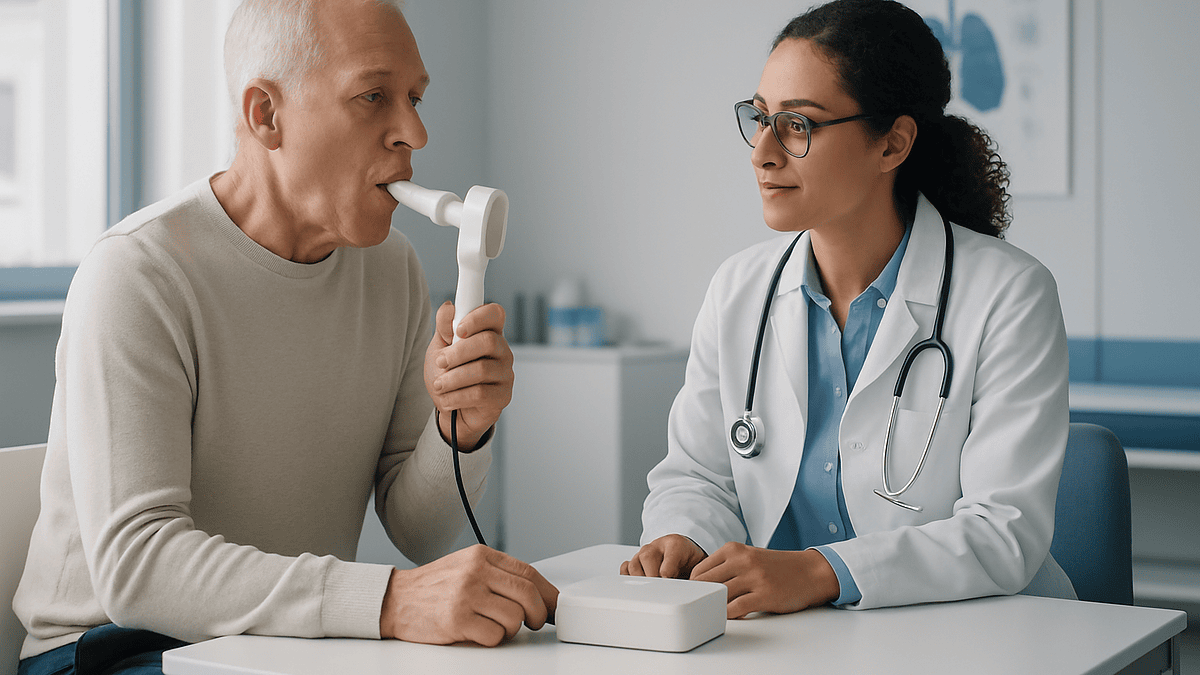
The technician leans in, almost cheering. “Blow, blow, blow, keep going, squeeze it all out!” You are sitting in a small room with a clip on your nose, exhaling into a plastic tube long past the point where it feels like anything is left. Six seconds can feel like a marathon.
That slightly theatrical moment is one of the most useful tests in respiratory medicine. A machine no bigger than a coffee maker is timing your breath to the hundredth of a second and measuring its volume down to the milliliter. From that single blast of air, a clinician can often tell whether your airways are narrowed, whether your lungs fill normally, and whether an inhaled medication is likely to help.
Yet most people walk out with a printout of curves and percentages and no real idea what any of it meant. Here is what the blowing actually measures, and what it honestly can and cannot tell you.
What does a spirometry test tell you?
Spirometry answers two deceptively simple questions: how much air can your lungs move, and how quickly can they move it? Everything else, the diagnoses, the severity grades, the treatment decisions, flows from those two measurements.
Think of your lungs as a bellows connected to a network of tubes. Some diseases shrink the bellows, so less air fits inside. Others narrow the tubes, so air comes out slowly even when plenty is stored. Spirometry can distinguish between these two problems because it tracks volume and speed at the same time, plotting them as a curve whose shape is often as informative as the numbers themselves.
According to Mayo Clinic, the test is used to help identify asthma and chronic obstructive pulmonary disease (COPD), to gauge how severe a known lung condition is, and to track whether it is stable, improving, or worsening over time. Surgeons sometimes order it before an operation to estimate how well a patient’s lungs will tolerate anesthesia.
What spirometry does not do matters just as much. It cannot see tumors, infections, blood clots, or scarring: those require imaging or other tests. It measures mechanics, not anatomy. A person can have entirely normal spirometry and still have lung disease, and an abnormal result is a pattern to investigate, not a verdict. That honest framing is worth holding onto before we get to the numbers.
FVC, FEV1, and the ratio: the three numbers that matter
Every spirometry report is built on three values, and once you understand them, the whole printout becomes readable.
- FVC (forced vital capacity) is the total volume of air you can blast out after the deepest breath you can take. For a healthy adult, this typically lands somewhere between three and five liters, roughly two large soda bottles’ worth of air.
- FEV1 (forced expiratory volume in one second) is how much of that air comes out in the first second. It is the workhorse of the test, the number most sensitive to narrowed airways.
- The FEV1/FVC ratio divides one by the other. Healthy adults usually exhale about 75 to 80 percent of their full capacity within that first second. When the ratio falls below roughly 0.70, it suggests airflow obstruction, air is trapped behind narrowed tubes.
Many reports also list peak expiratory flow (PEF), the fastest speed your breath reached, and display a flow-volume loop. Experienced readers glance at that curve first: a smooth, steep triangle suggests open airways, while a scooped-out, sagging line points to obstruction, the airflow collapsing as the small airways squeeze shut.
One caveat the glossy summaries skip: all three numbers depend on genuine maximal effort. A half-hearted blow produces numbers that look sick in a perfectly healthy chest, which is exactly why technicians coach so loudly, and why the test is always repeated.
What are the two types of spirometry?
When people search for “two types of spirometry,” they are usually bumping into two devices that share a name but do opposite jobs.
Diagnostic spirometry is the test this article describes: a calibrated machine that measures forced exhalation to assess lung function. It is performed in clinics, hospitals, and occupational health settings by trained staff, and its results feed directly into diagnosis and monitoring.
Incentive spirometry is not a test at all. It is a handheld exercise device, the clear plastic gadget with a ball or piston that rises as you inhale, given to patients after surgery or during a hospital stay. Its purpose is to encourage slow, deep breaths that keep the small air sacs open and help prevent complications such as partial lung collapse. You breathe in through an incentive spirometer; you breathe out through a diagnostic one. Cleveland Clinic notes that confusing the two is one of the most common questions patients bring to the pulmonary lab.
There is a second, more technical reading of the question. Within diagnostic testing, clinicians often distinguish baseline spirometry from post-bronchodilator spirometrythe same maneuver repeated after an inhaled airway-opening medication, to see whether the narrowing is reversible. That comparison is covered in its own section below, because it is often the most decisive part of the whole appointment.
Step by step: what actually happens in the testing room
The appointment usually takes between 15 and 45 minutes, and most of that is repetition and rest, not blowing.
First, the technician records your age, height, and sex, not small talk, but the inputs used to calculate your predicted values. Height matters enormously; taller people have larger lungs, and an error of a few centimeters shifts the goalposts.
Then comes the maneuver itself. A soft clip pinches your nose shut so no air escapes the wrong way. You seal your lips around a disposable mouthpiece, breathe in as deeply as you possibly can, and then blast the air out as hard and fast as possible, and keep pushing, ideally for six seconds or more, until your lungs feel wrung out like a dish towel. The first second delivers the drama; the long tail delivers the FVC.
Expect to repeat this at least three times, per the standards described in the NIH StatPearls review of spirometry. The two best efforts generally need to agree within about 150 milliliters of each other before the results count as reliable: a built-in safeguard against a bad blow masquerading as bad lungs. Between attempts you rest, sip water if you like, and let any lightheadedness pass.
Some people find it oddly competitive; the machine’s real-time curve becomes a video game you play against yourself. Technicians encourage that instinct. Maximal effort is the entire point.
What is a good score on a spirometry test?
There is no universal “passing” number, because a good result for a 6-foot-4 twenty-five-year-old would be alarming in a 5-foot-1 eighty-year-old. Instead, your values are expressed as a percent of predictedhow your FEV1 and FVC compare with reference values for people of your age, height, and sex drawn from large population studies.
As a broad rule of thumb, results at or above 80 percent of predicted are considered within the normal range. Below that, clinicians grade severity, most commonly using FEV1:
| FEV1, percent of predicted | Typical interpretation |
|---|---|
| 80% or above | Within normal limits |
| 70–79% | Mild reduction |
| 60–69% | Moderate reduction |
| 50–59% | Moderately severe reduction |
| 35–49% | Severe reduction |
| Below 35% | Very severe reduction |
Two honest footnotes. Cutoffs vary slightly between guidelines, and newer international standards increasingly use statistical z-scores rather than fixed percentages, because a flat 80 percent line misclassifies some healthy older adults and some younger people with early disease. Second, the FEV1/FVC ratio, not the percent predicted, is what determines whether obstruction exists in the first place. A “good score,” then, is really two things at once: a normal ratio and values close to what someone of your build should produce. Your clinician reads them together, alongside your symptoms, which is why a printout alone should never be self-diagnosed at the kitchen table.
Obstructive vs. restrictive: two very different stories in one breath
Abnormal spirometry results almost always sort into one of two patterns, and telling them apart is the test’s genuine superpower.
An obstructive pattern means air flows out too slowly. The FEV1/FVC ratio drops below about 0.70 because the first-second volume falls harder than total capacity. Asthma and COPD are the classic causes; bronchiectasis can produce it too. The everyday image: a full bathtub draining through a partially clogged pipe. Plenty of water, painfully slow exit.
A restrictive pattern means the lungs cannot fill normally. Both FEV1 and FVC shrink together, so the ratio stays normal or even runs high: a small bathtub with perfectly clear plumbing. Causes range from scarring conditions such as pulmonary fibrosis to problems outside the lungs entirely: curvature of the spine, weakened breathing muscles, or anything that limits how far the chest wall can expand.
Here is the caveat that separates careful medicine from a quick label. Spirometry can suggest restriction but cannot confirm it, because the test never measures the air left in your lungs after a full exhale. Confirming a small total lung capacity requires formal lung volume measurement in a pulmonary function lab, as Johns Hopkins Medicine explains. A low FVC on spirometry is a flag, not a finding. Some mixed patterns show features of both, which is another reason interpretation belongs to a clinician who knows your history, not to the number alone.
What happens if you fail a spirometry test?
Let’s retire the word “fail.” Spirometry is a measurement, not an exam, and there are two entirely different things people mean by failing it, worth untangling, because the consequences differ.
The first meaning is a technically unacceptable test: you coughed in the first second, stopped blowing too early, or the efforts didn’t match each other closely enough. This happens often and means almost nothing about your health. The fix is simply more attempts, better coaching, or a rescheduled visit. Children, people with sore ribs, and anyone mid-coughing-fit produce unreliable maneuvers all the time.
The second meaning is an abnormal result from a good-quality test. Even then, nothing dramatic happens in the room. What follows is a methodical sequence:
- Your clinician reviews the pattern, obstructive, possibly restrictive, or borderline, alongside your symptoms and history.
- A bronchodilator reversibility test may be added the same day to see whether the numbers improve after an inhaled airway-opening medication.
- If restriction is suspected, you may be referred for full pulmonary function testing to measure total lung capacity and gas exchange.
- Imaging, blood work, or a specialist referral may follow, depending on the picture.
One abnormal spirometry, on its own, diagnoses nothing. Guidelines for COPD, for instance, require a persistent post-bronchodilator abnormality plus a compatible history before the label applies. An unexpected result is the beginning of a conversation, usually a productive one, because lung conditions caught early are generally easier to manage than those found late.
The before-and-after blow: bronchodilator reversibility testing
Often the most informative moment of the appointment comes after the first round of blowing is done. If your baseline numbers show obstruction, the technician may hand you an inhaler containing a quick-acting airway-opening medication, a bronchodilator, then ask you to wait roughly 10 to 15 minutes and repeat the entire set of maneuvers.
The comparison answers a pointed question: is the narrowing in your airways reversible? By convention, an FEV1 that improves by at least 12 percent and at least 200 milliliters is considered a significant bronchodilator response. Two hundred milliliters is a little less than a standard cup of air, small in a kitchen, meaningful in a lung.
A strong response has traditionally pointed toward asthma, where airway muscle spasm and inflammation can relax and let air flow freely again. Obstruction that persists after the medication is more characteristic of COPD, where structural airway changes don’t loosen on command. Reality, as usual, blurs the textbook: some people with asthma show little response on a given day, and some with COPD show a partial one. The evidence supports treating reversibility as one strong clue among several, a point respiratory guidelines have increasingly emphasized, rather than a definitive dividing line.
Practical note: your care team may ask you to hold certain inhaled medications for a set window before the test so the baseline reading is honest. Follow their specific instructions rather than guessing, and never stop a prescribed medication on your own initiative.
When spirometry isn't enough: the full pulmonary function lab
Spirometry is the front door of lung testing, not the whole house. When the forced blow raises questions it cannot answer, a full pulmonary function lab has more instruments to bring out.
Lung volume measurement fills spirometry’s biggest blind spot: the air that stays in your lungs after a maximal exhale. The most precise method, body plethysmography, has you sit inside a clear booth about the size of a phone booth while pressure changes reveal your total lung capacity. This is how suspected restriction gets confirmed, or ruled out.
Diffusion capacity (DLCO) tests how well gas crosses from your air sacs into your bloodstream. You inhale a breath containing a tiny, harmless trace amount of carbon monoxide, hold it briefly, and exhale; the machine calculates how much was absorbed. A person can move air beautifully and still exchange oxygen poorly, conditions that scar or thicken the delicate membrane between air and blood show up here first.
Additional tools include exhaled nitric oxide measurement, which reflects a particular kind of airway inflammation seen in some asthma, and exercise testing when symptoms appear only under exertion.
MedlinePlus groups all of these under the umbrella of lung function tests. The practical takeaway for patients: if your clinician orders “full PFTs” after a spirometry result, it is not an escalation of alarm. It is the standard way of turning one ambiguous number into a clear physiological picture.
How to prepare, and the small things that quietly skew results
Spirometry is exquisitely sensitive to effort and circumstance, which means a handful of ordinary habits can shave real milliliters off your numbers. Preparing well is less about rules and more about giving the test a fair shot at measuring your actual lungs.
- Don’t smoke beforehand. The NHS advises avoiding smoking for 24 hours before the test; smoke temporarily narrows airways and can distort the reading.
- Skip the heavy meal. A full stomach presses on the diaphragm and limits how deeply you can inhale. A light meal a couple of hours out is fine.
- Avoid alcohol and strenuous exercise in the hours before your appointment; both can affect breathing performance.
- Wear loose clothing. A tight waistband or restrictive top genuinely reduces chest expansion, one of the few medical situations where your outfit changes your lab values.
- Follow medication instructions exactly. If your care team asks you to hold certain inhaled medications before the test, do so for the window they specify; if they don’t mention it, take everything as usual.
- Reschedule if you’re acutely sick. A chest infection in the past few weeks can lower results and muddy interpretation.
Bring a list of your current medications, and mention any recent surgery or heart problems before you blow, some conditions call for postponing the test, as covered below. Ten minutes of sensible preparation is the cheapest accuracy upgrade in respiratory medicine.
Who should get spirometry, and when it's actually worth ordering
Spirometry earns its keep in specific situations, and, this is the myth worth busting, routine screening of healthy people who feel fine is not one of them. Mainstream guidance does not recommend testing adults with no breathing symptoms and no risk factors, because an incidental borderline number in a symptom-free person creates more confusion than clarity.
The evidence supports testing when there is a real question to answer:
- Persistent symptoms: breathlessness that limits ordinary activities, wheezing, chest tightness, or a cough that lingers for weeks.
- Smoking history plus symptoms: current or former smokers with a nagging cough, daily mucus, or shortness of breath are the classic group in whom spirometry uncovers COPD: a condition that frequently goes undetected for years because people attribute early symptoms to aging or being “out of shape.”
- Suspected asthma: particularly when symptoms come and go, reversibility testing can be revealing.
- Occupational exposure: workers around dusts, fumes, or chemicals often receive baseline and periodic spirometry to catch changes early.
- Monitoring known disease: repeat testing tracks whether a condition is stable and whether treatment is working; the trend across years often matters more than any single result.
- Before some surgeries, to assess how the lungs will handle anesthesia.
If you fall into one of these groups and have never blown into the tube, it is a reasonable topic to raise at your next visit. If you fall into none of them, the absence of a spirometry result in your chart is not a gap in your care.
Is spirometry safe? Side effects, and who should postpone
For most people, spirometry is about as low-risk as medical testing gets. No needles, no radiation, no sedation, just repeated hard exhalation. That said, honest reporting means naming the real, if minor, effects.
The forceful blowing briefly raises pressure inside your chest and skull, which is why some people feel lightheaded or dizzy for a few seconds afterward. Coughing fits are common, especially in irritable airways. A short-lived feeling of chest tightness or fatigue can follow a full session of maximal efforts. Technicians build in rest between maneuvers precisely to manage this, and the sensations pass quickly.
Because of those pressure swings, certain groups are usually asked to postpone the test, typically for several weeks, per guidance summarized by Mayo Clinic and the NHS:
- A recent heart attack or stroke
- Recent eye, chest, brain, or abdominal surgery
- A collapsed lung (pneumothorax) that has not fully resolved
- Severe, uncontrolled high blood pressure
- Coughing up blood of unknown cause
None of these makes spirometry dangerous forever; they simply make this month the wrong month. Tell the technician about any of them before you start: the pre-test questionnaire exists for exactly this reason.
Infection control is the other quiet safety feature. Mouthpieces are single-use, and machines use disposable filters, so sharing germs through the equipment is not a realistic concern in a properly run lab. If you have an active respiratory infection, though, expect to be rescheduled, for your accuracy as much as anyone’s protection.
Peak flow meters at home vs. spirometry in the clinic
Plenty of people with asthma own a peak flow meter, the simple handheld tube with a sliding marker, and wonder how it relates to the elaborate clinic test. The short answer: a peak flow meter measures one number; spirometry measures the whole story.
| Peak flow meter | Clinic spirometry | |
|---|---|---|
| What it measures | Fastest exhalation speed only (PEF) | FEV1, FVC, ratio, and the full flow curve |
| Where | At home, seconds per reading | Clinic or lab, 15–45 minutes |
| Best use | Tracking day-to-day trends against your personal best | Diagnosis, severity grading, long-term monitoring |
| Precision | Rough, effort-dependent | Calibrated, quality-controlled, repeated maneuvers |
The two tools are teammates, not rivals. A peak flow meter shines at spotting a downward drift in someone’s usual pattern: a falling morning reading can flag worsening asthma before symptoms fully register, which is why many asthma action plans are built around personal-best percentages. What it cannot do is diagnose anything or distinguish an obstructive pattern from a restrictive one; a single speed reading simply doesn’t contain that information.
Portable home spirometers now exist as well, some pairing with phone apps. They can be useful for people whose specialists want frequent FEV1 tracking, but home readings supplement clinic testing rather than replace it, coaching, calibration, and quality checks are hard to replicate on a couch. If you use any home device, bring its readings to appointments so they land in context.
When to see a doctor about your breathing
A test can only help if someone thinks to order it, so it is worth being clear about which breathing symptoms deserve a professional look. The pattern that matters most is change and persistencenew symptoms that stick around, or old ones that are quietly worsening.
Make a routine appointment if you notice:
- A cough lasting longer than three weeks, with or without mucus: the NHS threshold for getting a lingering cough checked
- Breathlessness during activities that never used to wind you, such as one flight of stairs or a short walk
- Wheezing, whistling, or chest tightness, especially if it recurs at night or with exercise
- More frequent chest infections than usual
- A smoking history plus any of the above: this combination is precisely where spirometry finds disease early
Seek urgent or emergency caredo not wait for an appointment, for severe breathlessness at rest, breathing difficulty with chest pain, coughing up blood, a bluish or grayish tinge to the lips or face, or struggling to speak in full sentences.
One gentle push against a common instinct: many people normalize slow decline. Breathlessness gets blamed on age, deconditioning, or a few extra pounds, and years pass before anyone measures anything. Lung function naturally declines gradually over adulthood, but symptoms that limit your daily life are never simply “getting older.” A ten-minute blowing test is a remarkably small price for finding out what your lungs are actually doing, and for the reassurance a normal result provides.
Frequently asked questions
What does a spirometry test tell you?
Spirometry tells you how much air your lungs can move and how fast, revealing whether your airways are narrowed (an obstructive pattern, as in asthma or COPD) or whether your lungs may not be filling normally (a possible restrictive pattern). Results are compared with predicted values for your age, height, and sex. It measures lung mechanics only: it cannot detect infections, tumors, or blood clots, which require other tests.
What happens if you fail a spirometry test?
You cannot truly fail spirometry, either the test quality was poor, which just means repeating the maneuvers, or the result was abnormal, which starts a diagnostic process rather than delivering a verdict. Next steps typically include reversibility testing with an inhaled airway-opening medication, full pulmonary function testing, or imaging, depending on the pattern. A single abnormal spirometry never diagnoses a lung disease by itself.
What is a good score on a spirometry test?
A good result generally means an FEV1 and FVC at or above 80 percent of the values predicted for your age, height, and sex, together with an FEV1/FVC ratio of roughly 0.70 or higher. Because predictions are individualized, there is no single number that is good for everyone. Cutoffs also vary slightly between guidelines, and newer standards use statistical z-scores, so interpretation belongs with your clinician.
What are the two types of spirometry?
The two devices people usually mean are diagnostic spirometry, the clinic test that measures forced exhalation to assess lung function, and incentive spirometry, a handheld breathing-exercise gadget used after surgery to encourage deep inhalation and help keep air sacs open. Within diagnostic testing, clinicians also distinguish baseline spirometry from post-bronchodilator spirometry, the same maneuvers repeated after an inhaled airway-opening medication.
Can spirometry diagnose COPD or asthma on its own?
Not on its own. Spirometry is essential to both diagnoses, but guidelines require the numbers to fit with a compatible history and symptoms. COPD is generally identified by obstruction that persists after an inhaled bronchodilator in someone with relevant exposure, usually smoking. Asthma is suggested by obstruction that varies over time or improves significantly after the medication. Clinicians combine the test with your story, examination, and sometimes further testing.
Does spirometry hurt, and is it safe?
The test is painless and very low-risk for most people, though the forceful blowing can cause brief lightheadedness, coughing, or a tired-chest feeling that passes within minutes. People with a recent heart attack, stroke, collapsed lung, or recent eye, chest, or abdominal surgery are usually asked to postpone for several weeks because of the pressure changes involved. Mouthpieces are single-use, so infection risk from equipment is not a practical concern.
How long does a spirometry test take?
Plan on 15 to 45 minutes for the appointment, though each individual blow lasts only about six seconds or more. The time goes to at least three repeated maximal efforts, rest breaks between them, and quality checks to confirm the results are consistent. If reversibility testing is added, expect an extra 10 to 15 minutes of waiting after the inhaled medication before the maneuvers are repeated.
Can I eat, smoke, or exercise before spirometry?
Avoid smoking for 24 hours beforehand per NHS guidance, skip heavy meals for a couple of hours before the test, and steer clear of alcohol and vigorous exercise in the hours leading up to it, all of these can lower your measured values. Wear loose clothing so your chest can expand fully. Follow your care team’s specific instructions about whether to hold any inhaled medications before the appointment.
What is the difference between a peak flow meter and spirometry?
A peak flow meter measures only your fastest exhalation speed and is best for tracking day-to-day trends at home, especially in asthma, against your personal best reading. Spirometry, done on calibrated clinic equipment with trained coaching, measures FEV1, FVC, their ratio, and the full flow curve, enough information to distinguish obstructive from possible restrictive patterns. The home device monitors; the clinic test diagnoses and grades.
How often should spirometry be repeated?
It depends entirely on why it was ordered. People with diagnosed asthma or COPD often repeat spirometry periodically, commonly around once a year, or sooner if symptoms change, because the trend over time reveals whether the condition is stable and treatment is working. Workers in occupational monitoring programs follow set schedules. Someone with a single normal result and no symptoms typically needs no routine repeat at all.
References
This article is for general information only and is not a substitute for professional medical advice. Please consult a qualified doctor about your individual situation.

More from the Blog

Whole Genome Sequencing and Polygenic Risk Scores: What Consumer Genomics Can Predict
Whole genome sequencing reads nearly all 3 billion letters of a person's DNA and can reliably identify rare single-gene variants linked to conditions such…

Protein in Urine: What a Urinalysis Finding Means for Your Kidneys
Protein in urine, called proteinuria, means the kidneys' filters are letting protein such as albumin leak through. A single positive result on a urinalysis…
Lynch Syndrome: The Inherited Cancer Risk Worth Knowing About
Lynch syndrome is an inherited condition, caused by a change in one of the DNA mismatch repair genes, that raises lifetime risk of colorectal,…

Genetic Testing: What It Can Detect and How Long Results Take
Genetic testing can detect single-gene conditions such as cystic fibrosis, sickle cell disease and Huntington disease, chromosome differences such as Down syndrome, inherited cancer…
Pap Smear vs HPV Test: What Each Detects and the New Screening Intervals
A Pap smear examines cervical cells under a microscope for abnormal changes, while an HPV test looks for the genetic material of high-risk human…

A Short History of DNA Testing, and How Long a Test Takes Today
Modern DNA testing began in September 1984, when British geneticist Alec Jeffreys developed DNA fingerprinting at the University of Leicester; the first criminal conviction…