

Fungal Acne: Why It Is Not Acne at All and Why Acne Treatments Make It Worse

Key Takeaways
- Fungal acne is Malassezia folliculitis, an inflammation of hair follicles caused by overgrowth of a yeast that lives on almost everyone's skin, and it contains no comedones.
- The three most useful clues are itch, uniform small bumps, and a location on the forehead, chest or upper back rather than the jaw.
- In a retrospective series of 110 patients, roughly three in four had been given antibiotics for presumed acne before the yeast was identified.
- Antibiotics can worsen fungal acne by suppressing skin bacteria that normally compete with Malassezia, while benzoyl peroxide and retinoids add irritation without touching the yeast.
- A potassium hydroxide skin scraping examined under a microscope confirms the diagnosis in minutes; improvement on dandruff shampoo alone does not.
- Evidence for antifungal treatment is moderate, based on small trials and case series with response rates often above 80 percent, and recurrence after stopping is common.
Fungal acne is the everyday name for Malassezia folliculitis, an inflammation of hair follicles driven by overgrowth of a yeast that lives on nearly everyone's skin. It is not true acne, so the antibiotics and some skincare used for acne can leave it unchanged or make it worse. Clinicians diagnose it by examination, sometimes with a skin scraping, and manage it with antifungal medicines.
Scroll through skincare videos as of spring 2025 and you will meet the same scene again and again: someone lathering a dandruff shampoo over their forehead, letting it sit, and announcing that the itchy bumps they had fought for a year with acne creams vanished in a fortnight. The clips carry a label dermatologists have reluctantly adopted because patients search for it: fungal acne. The term is trending, and so are the half-truths that travel with it.
The frustrating part is that the viral stories often contain a real clinical lesson. Malassezia folliculitis, the condition behind the nickname, is routinely misread as ordinary acne, and the standard acne playbook can feed it rather than calm it. A retrospective review of 110 patients found that most had already been through courses of acne antibiotics before anyone considered yeast.
So this is a story about a misnomer, a yeast that lives on all of us, and why the right diagnosis matters more than the right shampoo.
What is fungal acne, and why is the name misleading?
The condition doctors see when a patient says fungal acne is Malassezia folliculitis, sometimes called Pityrosporum folliculitis after an older name for the same organism. Folliculitis means inflammation of hair follicles, the tiny pits in the skin from which each hair grows. Malassezia is a yeast, a single-celled fungus, that colonizes the skin of almost every adult on earth without causing harm most of the time.
Acne, by contrast, is a disease of the pilosebaceous unit: the follicle plus its attached oil gland. Its defining lesion is the comedone, a plug of dead cells and oil that shows up as a blackhead or whitehead. Bacteria called Cutibacterium acnes, hormones, inflammation and genetics all feed into it. Yeast is not the engine.
In Malassezia folliculitis, there are no comedones. The follicle fills with yeast and the body mounts an inflammatory response, producing a crop of small bumps that look alike and often itch. The two conditions can share a face, and they frequently do, which is one reason the confusion persists. Someone can have genuine acne along the jaw and a sheet of yeast-driven bumps across the forehead at the same time.
The Cleveland Clinic describes fungal acne as an infection of the hair follicles rather than a form of acne, and the distinction is more than semantic. It determines which medicines help and which make the rash worse. Calling it acne steers people toward benzoyl peroxide, retinoids and antibiotics, treatments built for a different biology. Calling it what it is, a yeast folliculitis, points toward antifungals and toward a conversation with a clinician about why the yeast overgrew in the first place.
How do you tell if acne is fungal? The key fungal acne symptoms
Picture a handful of lentils scattered across a forehead: dozens of small bumps, nearly identical in size, each about one to two millimeters across. That uniformity is the first clue. True acne is a messy mix of blackheads, whiteheads, red papules and the occasional deep, painful cyst, all at different stages. Malassezia folliculitis tends to produce a monotonous crop, a term dermatologists use for lesions that all look the same age.
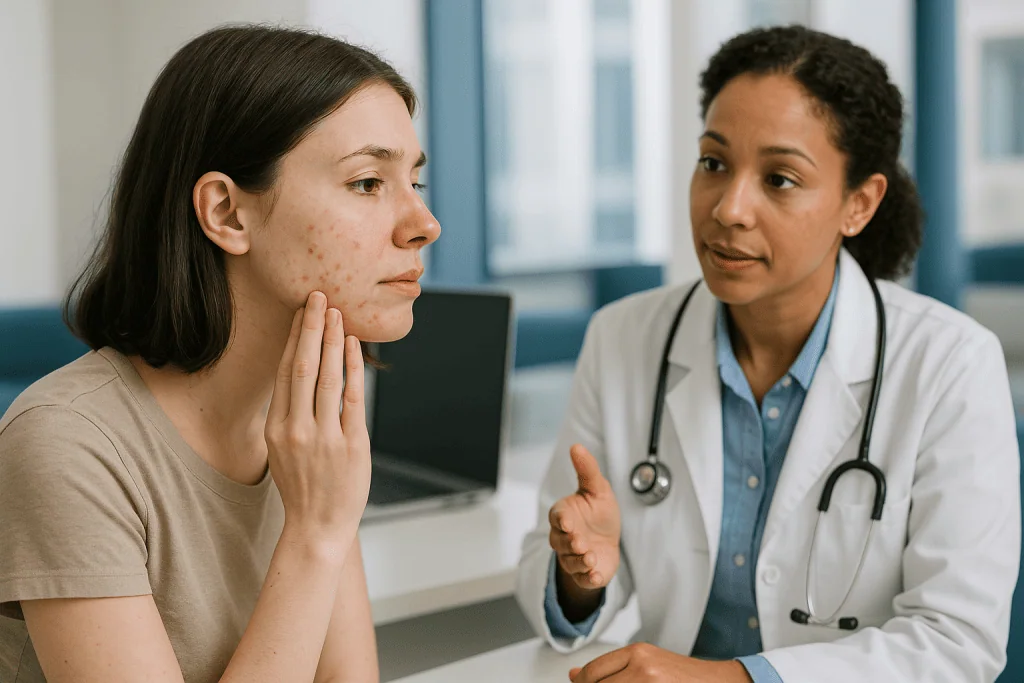
Itch is the second clue, and it is a strong one. Acne can be tender, but it rarely itches. People with fungal acne often describe a prickling or crawling sensation that flares after sweating or in a warm room. Many say they only realized something was different when the itch, not the bumps, started to bother them.
Location matters too. The yeast prefers oily, hair-bearing, sweaty skin: the forehead and hairline, the temples, the upper back, chest and shoulders. Acne loves the lower face and jaw. A rash that lives mainly on the chest and back and spares the chin is more suspicious for yeast.
History rounds out the picture. Did the bumps appear after a course of antibiotics, a tropical holiday, a new gym routine or a stretch of heavy, occlusive skincare? Have acne products made things redder and itchier rather than better? Those patterns, taken together, raise the probability of Malassezia folliculitis considerably.
None of these signs is proof. Several other conditions mimic the same look, and a clinician will often confirm the diagnosis with a simple skin test rather than rely on appearance alone. But if your forehead itches, your bumps all match, and your acne regimen has failed, it is a conversation worth having.
Fungal acne vs acne: a side-by-side comparison
Laid next to each other, the two conditions separate fairly cleanly on paper, even if they blur on a real face. The table below pulls together the features clinicians weigh, drawn from Mayo Clinic and Cleveland Clinic descriptions of folliculitis and acne.
| Feature | Fungal acne (Malassezia folliculitis) | Acne vulgaris |
|---|---|---|
| Cause | Overgrowth of Malassezia yeast inside follicles | Blocked follicles, oil, Cutibacterium acnes bacteria, hormones |
| Typical lesions | Small, uniform red bumps and tiny pustules, no blackheads | Mixed blackheads, whiteheads, papules, pustules, cysts |
| Sensation | Often itchy, worse with sweat and heat | Usually tender or painless, rarely itchy |
| Favorite sites | Forehead, hairline, chest, upper back, shoulders | Cheeks, chin, jawline, also back and chest |
| Response to antibiotics | No improvement or worsening | Often improves |
| Response to antifungals | Usually improves within weeks | No meaningful effect |
| Confirmation | Skin scraping with potassium hydroxide, sometimes biopsy | Clinical examination |
Two caveats keep this table honest. First, the conditions coexist more often than textbooks suggest, so a mixed picture does not rule out yeast. Second, response to treatment is a clue, not a diagnosis. Improvement on an antifungal supports the idea, but several unrelated rashes also settle on their own over a few weeks, which is exactly why clinicians prefer to look under a microscope when they can.
What the comparison makes plain is that the single most useful question is not what the bumps look like but what they feel like and where they sit. Itchy, uniform, forehead and trunk: think yeast. Painful, varied, jaw and cheeks: think acne.
What causes fungal acne, and why did I suddenly develop it?
Malassezia is not an invader. It is a resident, present on the skin of healthy people from a few months of age onward, and it earns its keep by living on the fatty acids in sebum, the oil our glands produce. The yeast cannot make certain lipids itself, so it settles where oil is plentiful: the scalp, face and upper trunk. Most of the time the immune system and the skin’s own ecosystem keep its numbers in check.

Fungal acne happens when that balance tips and the yeast multiplies inside follicles. The triggers are the conditions that favor yeast over everything else.
- Heat and humidity. Sweat trapped against the skin creates the warm, moist environment Malassezia thrives in, which is why the condition is more common in tropical climates and in summer.
- Occlusion. Tight synthetic workout clothing, helmets, backpacks and heavy, oily creams or sunscreens can seal moisture and oil over the follicle.
- Antibiotics. Oral antibiotics such as doxycycline and minocycline, often prescribed for acne, suppress skin bacteria. With the bacteria thinned out, yeast faces less competition and can expand.
- Immune changes. Corticosteroids, diabetes, pregnancy, HIV and other causes of weakened immunity are all associated with Malassezia overgrowth.
- Oily skin and hormones. Adolescents and young adults with high sebum production provide the richest food supply.
The word sudden in the question usually has an answer in the preceding weeks. A new antibiotic, a first humid summer in a new city, a marathon training block in polyester, or a switch to a richer night cream are the stories clinicians hear most. The yeast was always there. Something simply gave it room.
Why acne treatments make fungal acne worse
Here is the cruel loop. A person develops itchy forehead bumps, assumes acne, and starts the standard regimen. Benzoyl peroxide and topical retinoids such as adapalene or tretinoin irritate skin that is already inflamed, so the redness and itch intensify. The bumps do not clear, because those medicines target bacteria, comedones and cell turnover, none of which is the problem.
When topicals fail, the next step in conventional acne care is often an oral antibiotic. For true acne this is reasonable and backed by randomized trials. For Malassezia folliculitis it is the worst possible move. Antibiotics reduce the bacterial population on the skin, and Malassezia, being a fungus, is untouched. With its competitors suppressed, the yeast proliferates. The rash spreads, sometimes dramatically, and the patient concludes their acne is severe and resistant.
The 2018 retrospective review of 110 patients with Pityrosporum folliculitis put a number on this pattern: roughly three in four had been treated with antibiotics for presumed acne before the correct diagnosis was made, often for months. That is a lot of itchy foreheads and a lot of unnecessary antibiotic exposure.
Skincare adds a quieter version of the same problem. Many moisturizers, oils and sunscreens are built on fatty acids and esters that Malassezia can metabolize. Coconut oil, for instance, is rich in exactly the lipid chain lengths the yeast favors. Slathering those products over an active rash can be the equivalent of feeding it.
None of this means acne treatments are bad. It means they are the right tools for a different job. The lesson from the evidence is to pause and reconsider the diagnosis whenever an acne regimen makes a rash itchier and more uniform rather than better, and to raise that observation with the prescribing clinician rather than escalating on your own.
What gets mistaken for fungal acne?
The social media version of this story has a flaw running the other way. Once people learn that yeast can mimic acne, every bump becomes suspect, and genuinely different conditions get mislabeled as fungal acne and treated with shampoo. Several look-alikes deserve a mention.
Ordinary acne tops the list. Mild comedonal acne on the forehead can appear fairly uniform, especially the small closed comedones some people call texture. The difference is that comedones are plugged pores, not inflamed follicles, and they do not itch.
Bacterial folliculitis, usually caused by Staphylococcus aureus, produces pustules around hairs that can look identical. Mayo Clinic notes it often follows shaving, hot tubs or occlusion, and it responds to antibacterial treatment rather than antifungals.
Keratosis pilaris, the rough chicken-skin bumps on upper arms and sometimes cheeks, is a keratin-plugging disorder with no infection at all. It is lifelong, painless and does not respond to any antimicrobial.
Rosacea can produce clusters of small red papules and pustules across the central face, with flushing and sensitivity, and it is frequently confused with both acne and folliculitis.
Eosinophilic folliculitis, a rare itchy eruption seen mainly in people with advanced HIV, and drug-induced acneiform eruptions, especially from corticosteroids or certain cancer therapies, round out the list. Perioral dermatitis, a bumpy rash around the mouth often linked to steroid creams, is another regular impostor.
The practical point is that itchy uniform bumps narrow the field but do not close the case. A clinician can distinguish most of these by history and examination, and when doubt remains, a skin scraping or a small biopsy settles it. Self-diagnosing fungal acne from a video and treating for weeks without improvement delays the right answer just as surely as the old acne misdiagnosis did.
How do doctors diagnose fungal acne?
Most of the time the diagnosis begins with the pattern described above: uniform itchy bumps on the forehead, chest or back, a history of antibiotics or sweat and occlusion, and a poor response to acne treatment. Experienced dermatologists recognize the picture quickly, and in many clinics the diagnosis is made on that basis alone.
When confirmation is needed, the classic test is a potassium hydroxide preparation, usually shortened to KOH prep. A clinician gently scrapes the surface of a pustule onto a glass slide, adds a drop of potassium hydroxide solution to dissolve skin cells, and examines it under a microscope. Malassezia shows up as round yeast cells, sometimes with short filaments, and in Malassezia folliculitis they are present in abundance rather than the scattered few found on anyone’s skin. The test takes minutes and causes little more than a pinch.
A Wood’s lamp, an ultraviolet light, can make affected follicles fluoresce a yellow-green color in some cases, offering a quick bedside hint, although the finding is not reliable enough to rely on alone.
Skin biopsy, in which a small cylinder of skin is removed under local anesthetic and examined by a pathologist, is reserved for cases that remain puzzling or fail treatment. Under the microscope the follicle is dilated, plugged with keratin and debris, surrounded by inflammatory cells, and packed with yeast that special stains make obvious. The 2014 review in the Journal of Clinical and Aesthetic Dermatology considered biopsy the most definitive test, while noting that most patients never need it.
Culture is rarely useful, because Malassezia grows poorly on standard laboratory media and because finding the yeast on skin proves nothing on its own. The question is not whether it is there but whether it is causing the rash.
How to treat fungal acne: what clinicians actually use
Because the problem is yeast, the solution is antifungal. The medicines in use fall into two groups, topical and oral, and the choice between them depends on how widespread the rash is, how long it has lasted, and the patient’s overall health. All of these are prescription decisions or decisions made with a clinician’s guidance; this section describes what exists, not what to do.
Topical options include ketoconazole, available as a shampoo or cream, and the older dandruff actives selenium sulfide and zinc pyrithione, which have antifungal activity against Malassezia. Shampoos are often used as a wash on affected skin rather than only on the scalp, which is the kernel of truth behind the viral videos. Ciclopirox and other azole creams are alternatives. Topicals are attractive because they are gentle on the rest of the body, but they can be slow and are less effective when the yeast sits deep in the follicle or the rash covers large areas of the back.
Oral antifungals, chiefly itraconazole and fluconazole, reach the follicle from the inside and tend to work faster and more completely. They carry more responsibility: both interact with a long list of other medicines and both require consideration of liver health, so prescribers weigh risks before using them. Oral ketoconazole is no longer recommended for skin infections because of liver toxicity.
Clinicians also address the trigger. Stopping an unnecessary antibiotic, changing a steroid where possible, loosening the gym wardrobe and swapping heavy occlusive products for lighter ones are part of the plan, not optional extras.
Improvement is typically noticed within two to four weeks. Many patients then need an ongoing maintenance approach, often a periodic antifungal wash, because the yeast never leaves and the conditions that favored it often return. What that maintenance looks like is a decision for the treating clinician.
What the evidence actually says, and how strong it is
Honesty requires an admission: the evidence base for fungal acne is thinner than its online fame suggests. Here is how it grades out.
That Malassezia causes a distinct folliculitis is well established. Biopsy series over several decades show yeast packed inside inflamed follicles, and the rash clears with antifungals and recurs when they stop. This is strong observational and pathological evidence, consistent across case series from Asia, Europe and North America. It is not based on large randomized trials, because the question of whether yeast is present in the follicle does not need one.
That antifungals work is supported mainly by small trials and case series. The 2014 review summarized studies of oral itraconazole, fluconazole and topical ketoconazole showing high response rates, often above 80 percent, but most studies enrolled a few dozen patients, many lacked a placebo arm, and follow-up was short. This counts as moderate evidence: consistent, biologically plausible, but not the kind of large controlled data that supports acne antibiotics.
That oral antifungals outperform topicals is suggested by comparative series and expert opinion rather than proven by head-to-head randomized trials. Grade it as low to moderate.
That antibiotics worsen the condition rests on observational data, including the 2018 series of 110 patients in which antibiotic exposure was common before diagnosis, and on the biological logic of bacterial suppression. Plausible and widely accepted, but not proven by trial, and some of the association may reflect misdiagnosis rather than causation.
That diet, probiotics or specific skincare ingredient lists prevent fungal acne is unsupported by clinical studies. Laboratory work shows which fatty acids Malassezia can metabolize, but no trial has tested whether avoiding them on the skin changes outcomes. This is expert and community opinion, nothing more.
The takeaway: the diagnosis is solid, the mainstay treatments are reasonably well supported, and nearly everything else circulating online is extrapolation.
What changed recently
The honest answer is that the science has moved slowly while the conversation has moved fast. There has been no new medicine approved specifically for Malassezia folliculitis, no new guideline from a major dermatology body, and no large trial published. What changed is attention.
Three things anchor the recent timeline. The 2014 review by Rubenstein and Malerich in the Journal of Clinical and Aesthetic Dermatology, still the most cited overview, consolidated decades of scattered case series and argued that the condition was underdiagnosed. In 2018, a retrospective study of 110 patients published in the Journal of the American Academy of Dermatology quantified the problem, reporting that most patients had received antibiotics for presumed acne before the yeast was identified and that itch was present in the majority. Those two papers supplied the facts that creators now compress into thirty-second videos.
Patient-facing institutions have responded. The Cleveland Clinic published and has since updated a dedicated consumer page on fungal acne that states plainly it is not acne but a follicle infection, and Mayo Clinic and MedlinePlus maintain folliculitis pages that list yeast among the causes. The appearance of fungal acne as a standalone topic on hospital websites is itself a change from a decade ago, when the term barely existed outside dermatology journals.
Two shifts in prescribing practice are also worth noting, both older than the trend but relevant to it. Oral ketoconazole, once a standard antifungal for skin conditions, lost that role after regulators in the United States and Europe warned about liver injury, leaving itraconazole and fluconazole as the oral options. And dermatology guidelines for acne increasingly discourage prolonged antibiotic use to limit resistance, which, as a side effect, may reduce one of the main triggers for yeast overgrowth.
As of this writing in spring 2025, the trend is driven by viral testimony rather than new evidence. That does not make the testimony wrong. It means the facts behind it are older and more measured than the format allows.
Common myths about fungal acne, corrected
Viral health content thrives on clean rules. Fungal acne has collected several that do not survive contact with the evidence.
Myth: fungal acne means your skin is dirty or you caught a fungus. Malassezia lives on nearly everyone, is not spread like an infection in the usual sense, and overgrows because of conditions, not hygiene. Washing harder does not help and often irritates.
Myth: if dandruff shampoo on your face helped, it was definitely fungal acne. Many rashes fluctuate on their own, and anti-dandruff actives also have mild anti-inflammatory effects. Improvement is suggestive, not diagnostic, which is why clinicians prefer a scraping.
Myth: any product containing fatty acids, esters or oils will cause fungal acne. Laboratory studies identify which lipids Malassezia can digest, and online ingredient checkers turn those lists into verdicts. No clinical trial has shown that avoiding specific ingredients prevents or clears the condition. Lighter, less occlusive products are sensible during a flare; forensic ingredient audits are not evidence-based.
Myth: fungal acne is rare. Series from humid regions find it in a meaningful share of patients referred for acne that failed treatment. It is under-recognized rather than uncommon.
Myth: once treated, it is gone for good. Because the yeast remains part of normal skin flora, recurrence is common, and many people need periodic maintenance.
Myth: diet, sugar or gut health cause fungal acne. There is no clinical evidence linking dietary sugar to Malassezia folliculitis. The yeast feeds on skin oil, not on what you ate for breakfast.
Myth: it is harmless, so self-treat indefinitely. Months of antifungal washes on a rash that is actually rosacea, bacterial folliculitis or a drug eruption delays appropriate care. If a self-chosen approach has not clearly helped within a few weeks, the right next step is a clinician, not another product.
Is it okay to pop fungal acne? Daily skin care during a flare
No, and the reasons are more concrete than a general rule against picking. The bumps of Malassezia folliculitis are inflamed follicles with a small amount of pus and yeast at their center. Squeezing them pushes that material deeper and sideways into surrounding skin, breaks the follicle wall, and invites bacteria from the fingers into an already irritated site. The common results are a larger, redder bump, a small scab, and a brown or red mark that outlasts the original lesion by weeks or months, especially on darker skin tones. Popping also spreads yeast across the surface to neighboring follicles.
What does help while a rash is being treated is undramatic.
- Shower soon after sweating, and change out of damp workout clothing rather than letting it dry on the skin.
- Choose loose, breathable fabrics for the chest and back during warm weather.
- Use a gentle, non-foaming or mildly foaming cleanser; harsh scrubs and exfoliating acids increase inflammation and itch.
- Favor lightweight gel or lotion textures over heavy creams, balms and oils until the skin settles.
- Keep hair products, especially oils and pomades, off the forehead and temples.
- Resist the urge to scratch; cool compresses can take the edge off itch.
Sunscreen remains important, but texture matters during a flare. Lighter fluid formulas are generally better tolerated than thick, water-resistant sport products that sit on the skin for hours.
Anything beyond this, including whether to use an antifungal wash, how often and for how long, belongs in a conversation with a clinician. The daily measures above are supportive. They do not treat the yeast; they stop you from making its environment more comfortable while the treatment does.
Why fungal acne comes back, and how recurrence is managed
Ask anyone who has had Malassezia folliculitis and most will tell you it returned. The 2014 review noted recurrence as the rule rather than the exception once treatment stops, and the reason is straightforward. The yeast is a permanent resident. Antifungals knock its numbers down; they do not evict it. If the conditions that let it overgrow come back, so does the rash.
Recurrence usually follows a predictable trigger: the next hot, humid summer, a return to intense training in synthetic kit, another course of antibiotics for a sinus infection, a steroid prescription for asthma or eczema, or simply drifting back to richer skincare once the skin looks calm.
Clinicians manage this in two ways. The first is a maintenance plan, most often a topical antifungal wash used intermittently rather than daily, continued through high-risk seasons. Evidence for maintenance comes from clinical experience and small series rather than trials, so protocols vary, and the right rhythm is an individual decision made with the prescribing clinician. The second is trigger management: reviewing whether an antibiotic or steroid is still needed, adjusting what is applied to the skin, and timing showers around sweat.
Repeated oral antifungal courses are not a casual option. Itraconazole and fluconazole interact with many common medicines, including some statins, blood thinners and heart rhythm drugs, and both can affect the liver. Prescribers reserve them for extensive or stubborn disease and monitor accordingly.
Two patterns should prompt a fresh look rather than another round of the same treatment. If the rash recurs within days of stopping despite careful trigger control, the diagnosis may be incomplete, perhaps acne and folliculitis together. If recurrences become more frequent or severe over time, a clinician may check for an underlying reason the immune system is giving yeast more room, such as undiagnosed diabetes.
When to see a doctor about suspected fungal acne
The condition itself is not dangerous, but the path through it is littered with wrong turns, and most of them are avoidable with a single appointment. See a clinician, ideally one who can perform a skin scraping, in these situations.
- An acne regimen has made a rash itchier, redder or more widespread rather than better, or you have been on an acne antibiotic for more than a few weeks without improvement.
- Small, uniform, itchy bumps have persisted on the forehead, chest or back for more than a few weeks.
- A self-chosen antifungal wash has not produced clear improvement within about four weeks. Prolonged self-treatment of the wrong condition delays the right one.
- You take a corticosteroid, have diabetes, are pregnant, or have any condition or medicine that affects your immune system, since these change both the risk and the treatment choices.
- You are considering any oral medicine for the rash. Oral antifungals require a prescription and a review of your other medicines.
Certain features are red flags that need prompt medical attention because they point away from simple folliculitis.
- Rapid spread with fever, chills or feeling generally unwell.
- Painful, hot, swollen areas or larger boils, which suggest a bacterial infection that may need antibiotics.
- Bumps that bleed, ulcerate or form thick crusts.
- A rash appearing shortly after starting a new medicine, which could be a drug reaction.
- Yellowing of the skin or eyes, dark urine or persistent nausea while taking an oral antifungal, which can signal liver trouble.
Never stop or change a prescribed medicine, including an acne antibiotic or a steroid, on your own because of something you read, including this article. Bring the observation to the prescriber. Every decision about diagnosis, starting, continuing or stopping treatment rests with the clinician who can examine your skin and knows your history.
Frequently asked questions
How do you tell if acne is fungal?
Fungal acne usually itches, produces small bumps of nearly identical size, and favors the forehead, hairline, chest and upper back. True acne mixes blackheads, whiteheads and larger painful spots, rarely itches, and clusters on the cheeks and jaw. A history of antibiotics, heavy sweating or acne treatments that made things worse adds to the suspicion. A clinician can confirm the diagnosis with a quick skin scraping examined under a microscope.
Why did I suddenly develop fungal acne?
Something in the preceding weeks probably gave the yeast an advantage. Common culprits are a course of oral antibiotics, hot humid weather, intense exercise in tight synthetic clothing, heavy oily skincare, or a corticosteroid prescription. Diabetes, pregnancy and other immune changes also play a role. Malassezia was already living on your skin; a shift in heat, moisture, oil or competing bacteria simply let it multiply inside follicles.
What gets mistaken for fungal acne?
Ordinary comedonal acne, bacterial folliculitis caused by Staphylococcus, keratosis pilaris, rosacea, perioral dermatitis and acneiform drug eruptions from steroids or certain cancer medicines all produce clusters of small bumps. Eosinophilic folliculitis is a rare mimic in people with advanced HIV. Because several of these need entirely different treatment, persistent bumps that have not improved with a few weeks of an antifungal wash should be examined by a clinician.
Is it okay to pop fungal acne?
No. The bumps are inflamed follicles containing yeast, and squeezing forces that material deeper, breaks the follicle wall, introduces bacteria from the fingers and spreads yeast to neighboring follicles. The usual outcome is a larger bump and a dark mark that lingers for weeks, particularly on deeper skin tones. Treating the yeast and keeping the skin cool, dry and lightly moisturized clears the bumps without leaving marks.
What is the difference between fungal acne vs acne in how they are treated?
Acne is managed with medicines that target blocked pores, bacteria and inflammation, such as retinoids, benzoyl peroxide and sometimes antibiotics. Fungal acne is managed with antifungals, either topical products like ketoconazole or dandruff actives, or oral medicines like itraconazole and fluconazole for widespread disease. Using acne treatments on fungal acne tends to irritate the skin or feed the yeast, which is why the correct diagnosis comes first.
What are the most common fungal acne symptoms on the body?
On the chest, shoulders and upper back, fungal acne appears as sheets of small red bumps and pinpoint pustules that itch, especially after sweating or in warm rooms. The bumps look alike rather than varying in size and stage. Blackheads are absent. Many people notice flares after workouts, in summer, or while wearing backpacks and tight synthetic shirts, and find that acne body washes make the itch worse.
What causes fungal acne to keep coming back?
Malassezia is a permanent part of normal skin flora, so treatment lowers its numbers rather than removing it. When the conditions that favored overgrowth return, such as humid weather, heavy sweating, occlusive clothing, antibiotics or steroids, the rash often returns too. Clinicians commonly manage recurrence with an intermittent maintenance antifungal wash and by addressing triggers, and persistent or worsening recurrences prompt a check for underlying causes.
How to treat fungal acne when creams have not worked?
When topical antifungals fail or the rash is extensive, clinicians may consider oral antifungals such as itraconazole or fluconazole, which reach the follicle from within and typically act faster. These are prescription medicines with significant drug interactions and liver considerations, so the decision, the choice of medicine and the monitoring belong to the treating clinician. Failure to respond may also mean the diagnosis needs to be revisited.
Does dandruff shampoo on the face really work for fungal acne?
There is a real basis for the claim: ketoconazole, selenium sulfide and zinc pyrithione, common anti-dandruff actives, have activity against Malassezia, and clinicians do use such washes on affected skin. The evidence comes from small studies and clinical experience rather than large trials. Improvement supports the diagnosis but does not confirm it, and a rash that has not clearly improved within a few weeks should be examined by a clinician.
Can diet or sugar cause fungal acne?
No clinical evidence links dietary sugar, dairy or gut health to Malassezia folliculitis. The yeast feeds on fatty acids in skin oil, not on food in the bloodstream. Diet claims are extrapolated from unrelated yeast conditions and from laboratory studies of what Malassezia can metabolize on skin. Heat, moisture, occlusion, antibiotics, steroids and immune changes are the established triggers, and those are where management efforts are directed.
References
- Cleveland Clinic: Fungal Acne
- MedlinePlus: Folliculitis
- NIH PubMed Central: Malassezia (Pityrosporum) Folliculitis (Rubenstein and Malerich, 2014)
- NHS: Acne
This article is for general information only and is not a substitute for professional medical advice. Please consult a qualified doctor about your individual situation.

More from the Blog

SPF 30 vs 50 and Chemical vs Mineral: The Sunscreen Questions, Answered by Evidence
SPF 30 filters about 97 percent of UVB rays and SPF 50 about 98 percent, so the difference is real but small when either…
How Congenital Nevus Removal Is Planned: Size, Location, Anesthesia and Staged Surgery
Congenital nevus removal surgery is planned around four questions: how large the nevus will be at adult size, where it sits, what anesthesia the…

Why the First Days of a Shingles Rash Matter: When to See a Doctor About Antiviral Treatment
See a doctor as soon as you suspect shingles, ideally within 72 hours of the rash appearing, because antiviral medicines work by stopping the…

What a Congenital Nevus Check Involves: Dermoscopy, Photo Mapping and Tracking Change
A congenital nevus check is a skin examination of a birthmark mole. A clinician inspects the whole nevus and the surrounding skin, uses a…
How Does Phototherapy Help Atopic Dermatitis? What Sessions Involve and Who May Be Offered Them
Phototherapy for atopic dermatitis exposes affected skin to carefully measured ultraviolet light, usually narrowband UVB, in a clinic cabinet several times a week for…
A Daily Routine That Supports Atopic Dermatitis Treatment: Bathing, Moisturizing and Nail Care
A supportive atopic dermatitis daily routine rests on three anchors: a short, lukewarm bath or shower with a gentle, fragrance-free cleanser; a generous layer…