

HydraFacial: What the Treatment Does and What It Cannot Change
Key Takeaways
- A HydraFacial works on the outermost dead-cell layer of skin and the openings of pores; it does not reach the dermis where wrinkles, scars and sagging originate.
- The visible brightening typically lasts one to three weeks, roughly the time it takes the skin surface to renew itself, so results are maintenance rather than permanent.
- The best-known supporting study involved only 20 volunteers in 2008 and has not been independently replicated; no sizable randomized trial of the treatment exists.
- The cloudy fluid in the collection jar is serum mixed with dead cells, sebum and product residue, not toxins drawn from the body.
- People with active inflammatory acne, a rosacea flare, eczema on the face, a cold sore, sunburn or recent isotretinoin use should postpone treatment and ask a clinician first.
- Worsening redness after 24 hours, blistering, clustered painful bumps around the mouth, or dark patches lasting beyond two weeks are reasons to see a doctor rather than wait.
A HydraFacial is a non-invasive, device-based facial that cleanses, lightly exfoliates, vacuums debris from pores and infuses hydrating serums in one session. Published evidence is limited to small studies and expert opinion; it can leave skin temporarily smoother, brighter and better hydrated for days to weeks. It does not change deep wrinkles, sagging, scars, true pigment disorders or medical skin disease, and results are not permanent.
The jar is the star. In clip after clip, a clinician tilts a small plastic canister toward the camera and a cloudy swirl of what used to be on someone’s face sloshes around inside. Millions of people have watched that moment, and a large share of them then typed the same word into a search bar: hydrafacial. As of spring 2025 the treatment is among the most-searched aesthetic procedures in the United States, pushed along by the “gunk jar” videos, by a wave of so-called Korean HydraFacial variants, and by a growing menu of add-on serums that promise everything from lifted cheeks to erased sunspots.
None of that attention arrived because of a landmark trial. It arrived because the treatment photographs well and feels pleasant. Those are legitimate reasons to be curious. They are not evidence.
So this is the honest version: what the device actually does to your skin, what the small body of research supports, who should sit it out, and the line, drawn with care, between a nicer complexion for a fortnight and a change in the skin itself.
What does a HydraFacial do for your face?
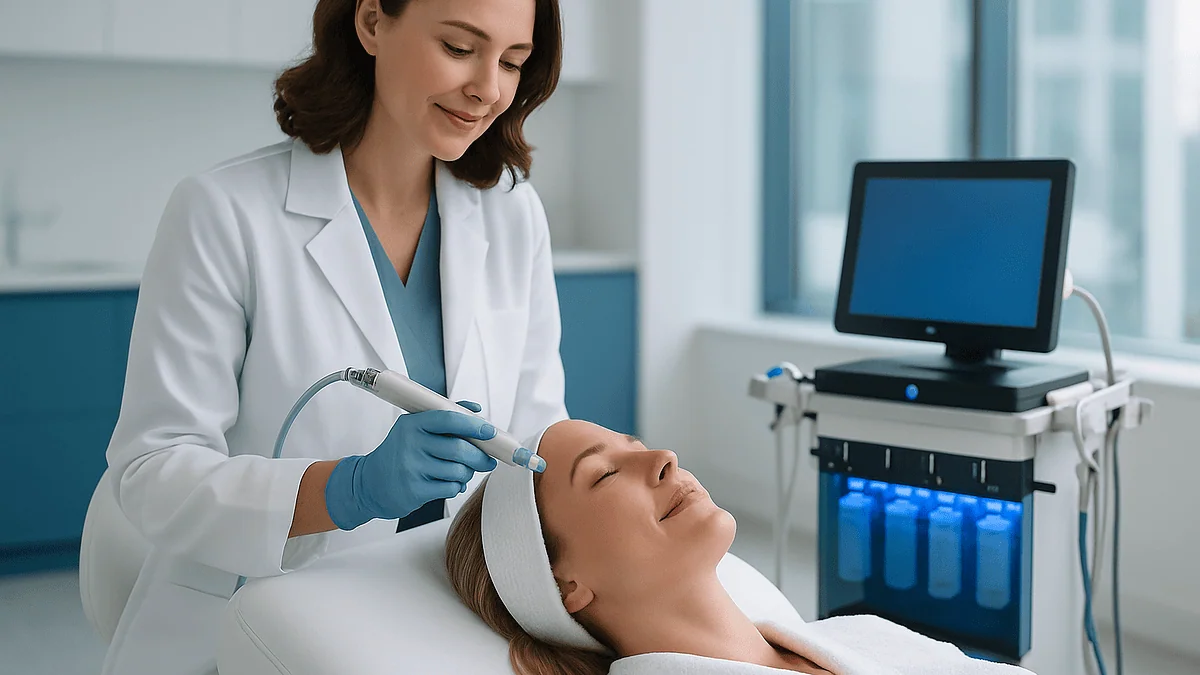
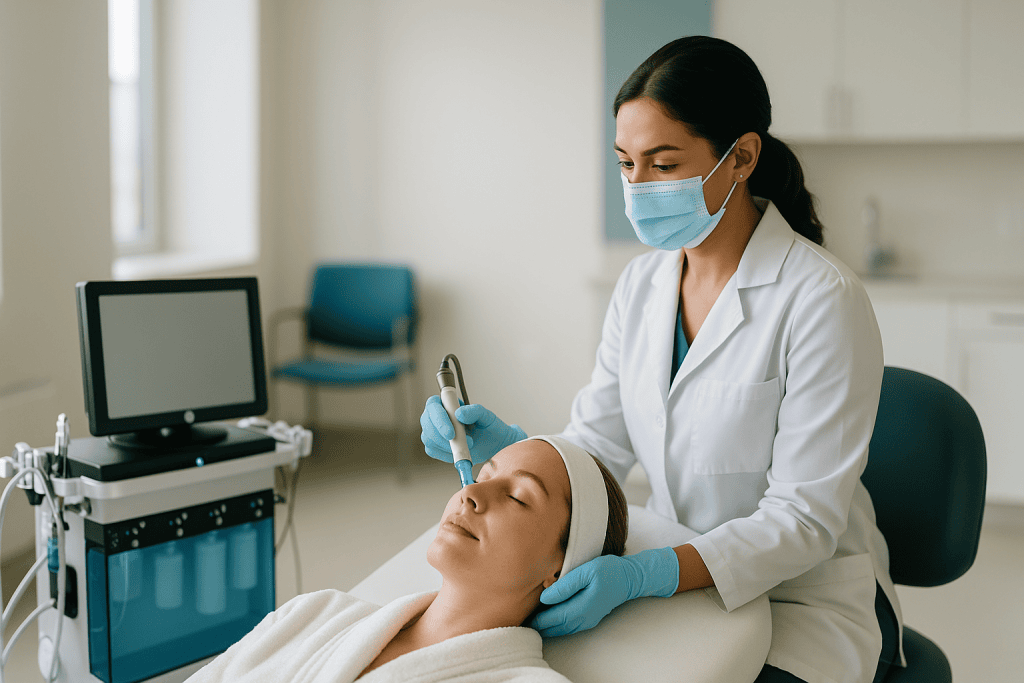
A HydraFacial is a hydradermabrasion treatment. Hydradermabrasion means mechanical exfoliation performed with a stream of liquid rather than with crystals or a sanding wheel. A handpiece with a small spiral-patterned tip glides across the skin while a built-in vacuum pulls the surface gently upward. At the same time, fluid flows through the tip, loosening dead cells and the oily plug material inside pores, and the vacuum draws that mixture into a collection jar.
The session is organized into three overlapping phases, usually finished in 30 to 45 minutes. First the skin is cleansed and lightly peeled with a mild acid solution. Next the suction is used for extraction, the removal of blackheads and surface debris. Finally the same handpiece delivers serums containing humectants and antioxidants onto the freshly exfoliated surface.
What you feel is a cool, slightly tickling pressure, not pain. What you see afterward, in most people, is skin that looks more even and reflects light better, because the uppermost layer of dead cells has been thinned and the skin is well hydrated. That immediate glow is real. It is also, by its nature, superficial: the device works on the stratum corneum, the outer layer of dead cells roughly as thick as a sheet of plastic wrap, and on the opening of the pore.
That scope matters for expectations. A hydrafacial is best understood as a thorough, mechanized version of a professional facial, with better consistency than hand extractions and less irritation than many peels. It is not a resurfacing procedure, not a laser, and not a medical treatment for any skin disease.
What changed recently to make HydraFacial trend
The clinical picture has not shifted. No new randomized trial, regulatory approval or dermatology guideline on HydraFacial has appeared in the past year. The evidence base still rests chiefly on a small split-face study of 20 volunteers published in 2008 and on clinician experience, which is why the mainstream references linked at the end of this article describe exfoliating procedures in general rather than this brand specifically.
What changed is the volume and the shape of the claims. Three forces converged:
- Short-form video. The extraction jar is a perfect ten-second payoff, and the format rewards dramatic before-and-after cuts filmed under flattering light.
- The Korean skincare wave. Clinics began marketing “Korean HydraFacial” protocols that pair the device with additional steps such as LED light, lymphatic massage or extra serum layers. These are variations in a service menu, not a different technology.
- Booster serums. The manufacturer and third parties now sell targeted add-ons marketed for pigment, firmness or pore size. The marketing language has outrun the data; there are no controlled trials showing that a booster delivered during a 30-minute session changes those features in a lasting way.
Mainstream sources updated in the last few years remain measured. Mayo Clinic’s reviewed pages on chemical peels and dermabrasion, for instance, make clear that only medium and deep resurfacing procedures reach the dermis, the living layer where wrinkles and scars actually live, and that those procedures carry real recovery time. HydraFacial is deliberately gentler, which is both its appeal and its ceiling.
So the honest headline for 2025 is this: more people want one, more clinics offer one, more things are being promised, and the science supporting it is the same modest stack it was a decade ago.
How the three steps work on your skin
Step one is cleanse and peel. The tip sweeps the face with a solution typically containing glycolic acid and salicylic acid at low, cosmetic strengths. Glycolic acid is an alpha hydroxy acid, a water-soluble acid that loosens the glue between dead surface cells. Salicylic acid is a beta hydroxy acid, an oil-soluble acid that can travel into the pore lining. Together they soften the stratum corneum so that the physical exfoliation that follows removes more with less friction. This is roughly the level of a very light at-home peel, not the medium-depth trichloroacetic acid peel a dermatologist might perform.
Step two is extraction. The vacuum pressure is adjusted by the operator and the tip is passed over congested zones such as the nose and chin. Suction pulls loosened sebum, dead cells and blackhead material up and away. Because it is mechanical and continuous, it tends to be more even than manual squeezing and leaves fewer red marks, though it cannot reach deep cystic lesions and should not be used on inflamed acne.
Step three is hydration. The handpiece delivers a serum that usually contains hyaluronic acid, a sugar molecule that holds many times its weight in water at the skin surface, along with peptides and antioxidants such as vitamins A and E. On skin that has just been exfoliated, these humectants sit in closer contact with living cells, which is why the immediate plumping effect is noticeable.
The physiology behind the glow is simple. Thinner dead layer, more water held at the surface, light scattered less unevenly. Nothing about this sequence rebuilds collagen in a measurable, durable way, and no step alters the melanocytes that make pigment. Understanding the three steps is the fastest route to understanding both the benefits and the limits.
What is actually in the serums?
Ingredient lists vary by clinic and by booster, but the core formulas share a familiar cast. Knowing what each one can and cannot do keeps the marketing in proportion.
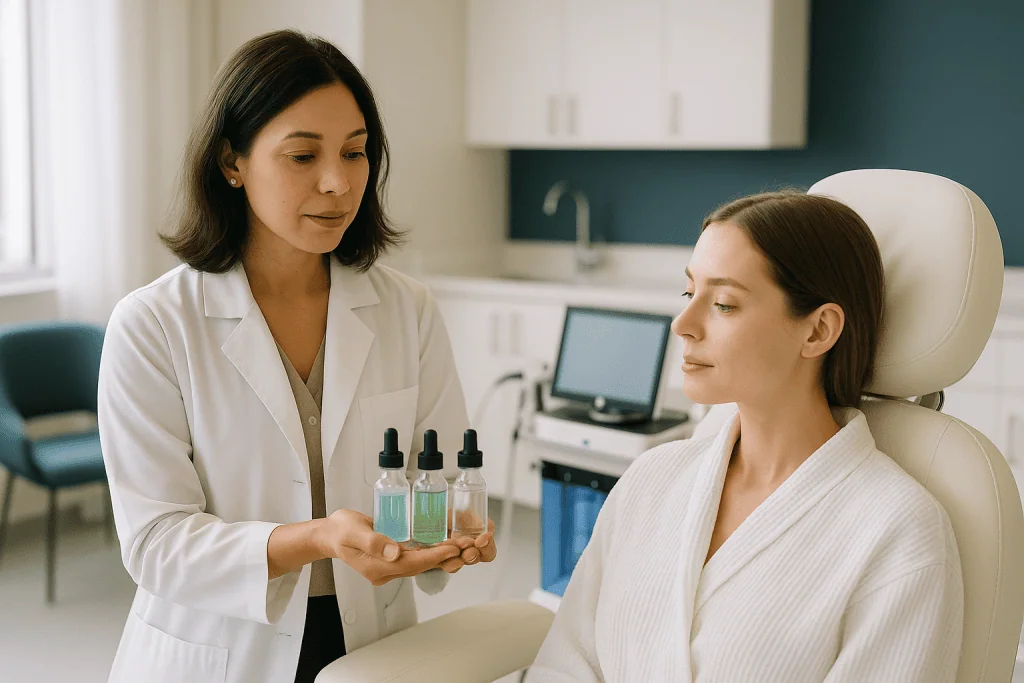
- Hyaluronic acid: a humectant. Evidence from cosmetic science shows it increases skin surface hydration while it is present. It does not fill wrinkles from the outside the way an injected filler does; the molecule is too large to pass through intact skin.
- Glycolic and salicylic acids: exfoliants. At the low concentrations used here they thin the dead layer and can modestly help blackheads. Higher-strength prescription acids are a different category with different risks.
- Antioxidants (vitamins C and E, plant polyphenols): topical antioxidants can neutralize some free radicals at the surface. Research on long-term protective benefit comes mainly from laboratory and small human studies, so grade it as promising, not proven.
- Peptides: short chains of amino acids marketed as collagen signals. The supporting data are largely manufacturer-sponsored or from cell cultures. Expert opinion is divided; no large trial shows a peptide applied once a month changes skin structure.
- Growth factors and “stem cell” extracts in premium boosters: these have the thinnest evidence of all. Treat specific firming or lifting claims with skepticism.
For comparison, the one topical ingredient with decades of randomized-trial support for fine lines and surface pigment is a prescription or over-the-counter retinoid, as Harvard Health summarizes. Retinoids are usually not part of a HydraFacial serum and are often paused around the treatment because exfoliated skin tolerates them poorly for a few days.
The practical takeaway: the serums make skin feel wonderful and look hydrated on the day. Whether a particular booster offers anything beyond that is, at present, a matter of hope rather than data.
What the evidence actually says about HydraFacial
Grading the evidence honestly means sorting it into tiers.
Randomized controlled trials: there are none of meaningful size. The treatment has never been tested against a sham procedure or against standard facials in a trial large enough to detect modest differences.
Small controlled studies: the most-cited piece of research is a 2008 split-face study in which 20 women received hydradermabrasion with antioxidant serum on one side of the face and the serum alone, or nothing, on the other, over several weeks. Biopsies suggested slightly increased epidermal thickness and higher antioxidant levels in the treated skin, and observers rated fine lines and pore appearance as improved. The study was small, short, industry-connected, and its findings have not been independently replicated. That places it in the “interesting signal” category, not the “established benefit” category.
Observational and clinical experience: dermatologists and aestheticians widely report that patients leave with smoother, brighter skin and that the treatment is well tolerated, with few adverse events. This is consistent and credible, but it is uncontrolled, which means it cannot separate the device from a good cleanse and moisturizer.
Indirect evidence: broader literature on superficial exfoliation, summarized by Cleveland Clinic and Mayo Clinic, confirms that removing the outer dead layer temporarily improves texture and radiance and that effects fade as the skin renews itself over roughly four weeks. Hydradermabrasion is a member of that family and behaves accordingly.
Put together, the strength of evidence that a HydraFacial produces a pleasant short-term improvement in surface texture and hydration is moderate and largely experiential. The strength of evidence that it produces lasting structural change is weak to absent. Anyone who tells you otherwise is quoting marketing.
HydraFacial benefits: what you can realistically expect
Set the bar where the evidence places it and the treatment comes out looking respectable. Here is what most people can reasonably expect from a single session.
Immediate smoothness. Within an hour the skin feels noticeably softer because the roughest layer of dead cells is gone. Makeup glides on more evenly, which is one reason the treatment is popular before events.
A brighter, more even tone. Exfoliation and hydration reduce the dull, slightly gray cast that builds up when dead cells pile up unevenly. This is a surface optical effect and typically lasts one to three weeks, roughly one skin-renewal cycle.
Fewer visible blackheads on the nose and chin. Suction extraction clears open comedones, the technical name for blackheads, more thoroughly than cleansing alone. Pores refill with oil over time, so the result is maintenance, not elimination.
Comfort and low downtime. Compared with a medium chemical peel, which Mayo Clinic notes can involve a week or more of peeling and redness, the HydraFacial leaves most people with mild pinkness that fades within hours. For someone with sensitive skin who finds scrubs and strong acids irritating, this gentleness is a real advantage.
A short-lived plumping of very fine lines. Hydration makes the finest crinkles around the eyes look softer for a day or two. It is temporary and depends on how dry the skin was to begin with.
Reasonable people might also count the pleasantness of the experience as a benefit. Thirty minutes of cool, rhythmic attention is relaxing, and feeling cared for has value. Just keep that benefit in its own column, separate from claims about the skin’s biology.
What a HydraFacial cannot change
This is the section most clinic websites skip, so it deserves the plainest language available.
It cannot remove wrinkles that are present at rest. Lines etched into the skin reflect loss of collagen and elastin in the dermis, as MedlinePlus describes in its overview of aging skin. A treatment that stays in the dead outer layer cannot rebuild what is missing beneath it.
It cannot lift. Sagging along the jaw or under the eyes is a matter of fat redistribution, ligament laxity and bone change. No vacuum tip, no matter how it is marketed, counteracts gravity in the lower face.
It cannot erase acne scars. Pitted or rolling scars are dermal defects. Treatments that address them, such as deeper resurfacing or dermabrasion, work by injuring the dermis in a controlled way and allowing it to remodel over months, and they carry corresponding risks. HydraFacial sits below that threshold by design.
It cannot treat melasma or stubborn pigmentation. Melasma is a hormonally influenced pigment disorder in which melanocytes overproduce color, often deep in the skin. Superficial exfoliation may brighten the surface for a few days and can even worsen melasma if it causes irritation. A brightening booster is not a treatment for a pigment disorder.
It cannot shrink pores permanently. Pore size is set by genetics and oil-gland activity. Emptying a pore makes it look smaller until it refills.
It cannot treat rosacea, eczema, active acne or any medical skin condition. For these, mainstream guidance from the NHS and Mayo Clinic points to specific prescription and lifestyle approaches, decided with a clinician.
Honesty here is not pessimism. Knowing the ceiling lets you decide whether the floor is worth it.
HydraFacial vs microdermabrasion vs chemical peel
People weighing a hydrafacial are usually comparing it with the two older exfoliation workhorses. The table below summarizes what mainstream sources describe for each. Depth refers to how far into the skin the treatment acts; the deeper it goes, the more it can change and the more recovery it demands.
| Feature | HydraFacial | Microdermabrasion | Light chemical peel | Medium chemical peel |
|---|---|---|---|---|
| Mechanism | Liquid exfoliation plus vacuum extraction plus serum infusion | Crystals or diamond tip abrade surface with suction | Low-strength acid dissolves dead cells | Trichloroacetic or stronger glycolic acid reaches upper dermis |
| Depth | Outer dead layer, pore opening | Outer dead layer | Outer dead layer | Epidermis into upper dermis |
| Typical downtime | Hours of mild pinkness | Hours to a day | One to seven days of flaking | Seven to fourteen days of peeling and redness |
| Addresses fine lines | Temporarily softens | Minimal | Minimal to modest with a series | Yes, modestly |
| Addresses scars or deep lines | No | No | No | Partially |
| Sensitive-skin tolerance | Generally good | Can irritate | Variable | Poor; requires medical supervision |
| Evidence quality | Small studies, expert opinion | Small studies, expert opinion | Moderate | Moderate to good |
The pattern is consistent. Hydradermabrasion and microdermabrasion occupy the same shallow tier, with the HydraFacial trading abrasion for suction and adding hydration, which is why many people with reactive skin tolerate it better. Chemical peels scale up in both effect and risk, and medium peels are the first rung at which Mayo Clinic describes visible improvement in wrinkles and some scarring. The right choice depends less on which is “best” and more on which layer of the skin holds the concern you want addressed.
HydraFacial side effects and downsides
The honest answer to “what are the downsides?” begins with reassurance and ends with specifics. Serious harm from a properly performed session is rare. The device is regulated as a cosmetic skin-resurfacing tool, in the same family as microdermabrasion machines, and the acids used are at cosmetic strengths.
Common, expected effects:
- Pinkness or mild redness for one to several hours, more on fair or sensitive skin.
- A feeling of tightness or mild dryness the next day as the exfoliated surface adjusts.
- Temporary increased sensitivity to sun, retinoids and fragranced products for two to three days.
Less common effects:
- Small bruise-like marks if suction was set too high, especially around the eyes or on thin skin.
- Breakouts over the following week, sometimes called purging, when loosened material inside pores surfaces. This usually settles; persistent worsening is not normal.
- Stinging or a rash in people allergic to a serum ingredient such as a plant extract or preservative.
- Flares of rosacea, eczema or perioral dermatitis when the treatment is performed during active inflammation.
- Reactivation of cold sores around the mouth in people with a history of herpes simplex, a known risk with any facial exfoliation.
Then there are the non-medical downsides. Results fade within weeks, so maintaining them requires repeat visits. The experience is operator-dependent: a skilled aesthetician adjusting suction thoughtfully delivers a different result from a rushed one. And the marketing ecosystem around boosters encourages spending on claims the evidence does not support.
Cleveland Clinic’s guidance on microdermabrasion applies almost word for word: expect temporary redness and sensitivity, protect the skin from sun afterward, and tell the provider about every skin condition and medication before the handpiece touches your face. Nothing on this list should frighten a healthy adult. Everything on it should inform one.
Who should skip or postpone a HydraFacial?
Gentle is not the same as universal. Several groups are better served by waiting or by choosing a different approach altogether, and a reputable provider will ask about each of these before beginning.
Active inflammatory acne. Suction and acid on pustules or cysts spreads bacteria and irritates already inflamed follicles. Acne that is red, painful or nodular should be managed medically first; NHS guidance describes the stepwise options a clinician may consider.
Rosacea during a flare. Rosacea is a chronic condition of facial flushing and visible blood vessels. Exfoliation and vacuum pressure can trigger prolonged redness, and Mayo Clinic lists skin irritation among common rosacea triggers. People with mild, well-controlled rosacea sometimes tolerate a low-suction session, but that judgment belongs with their dermatologist.
Current or recent isotretinoin. Isotretinoin is an oral prescription acne medicine that thins the outer skin and slows healing. Most dermatologists advise avoiding exfoliating procedures during treatment and for a period after it ends; the timing is a clinical decision, not a spa policy.
Sunburn, open wounds or cold sores. Treat broken or infected skin as an absolute stop until it heals.
Eczema, psoriasis or dermatitis on the face. Compromised skin barriers react unpredictably to acids and suction.
Pregnancy and breastfeeding. The cosmetic acids involved are low strength, and most clinicians consider the mechanical steps acceptable, but safety data on the full serum ingredient lists are limited. Many providers decline, and the cautious path is to discuss it with your obstetric clinician.
Known allergies to serum components, including shellfish-derived or plant-derived extracts in some boosters.
Recent other procedures. Skin treated with a chemical peel, laser or microneedling within the past few weeks needs time to recover. Stacking exfoliation on healing skin invites irritation and pigment change, especially in deeper skin tones.
Is HydraFacial worth it? An evidence-based answer
“Worth it” is a personal calculation, and price varies so widely by region and provider that this article deliberately quotes no figures. What can be done is to lay the question out so you can answer it for yourself.
It is more likely to be worth it if your goal is short-term and surface-level: smoother texture before an event, a brighter complexion after a dull winter, routine blackhead maintenance for oily skin, or a professional exfoliation that your sensitive skin can actually tolerate. In those scenarios the treatment reliably does what it says, with minimal downtime, and the main trade-off is that the effect fades within weeks.
It is less likely to be worth it if your goal is structural: wrinkles at rest, sagging, acne scars, melasma or persistent redness. For those concerns, the money and time spent on monthly sessions buy a pleasant afternoon and a glow that does not address the underlying issue. Evidence-supported alternatives exist, from daily retinoids with decades of trial data, as Harvard Health describes, to medically supervised resurfacing for scars and deep lines.
A useful test: ask yourself whether you would be satisfied if the result lasted two weeks and then returned to baseline. If yes, the treatment matches your expectation. If no, you are shopping for something the device does not sell.
Consider also what a good home routine already achieves. Daily sunscreen, a gentle cleanser, a moisturizer with humectants and, if tolerated, a retinoid deliver most of the long-term benefit available to skin, according to mainstream dermatology sources. A HydraFacial sits on top of that foundation as an occasional polish. It cannot substitute for it, and it is a poor use of resources when the foundation is missing.
Common myths about HydraFacial, corrected
Viral claims travel faster than corrections. Here are the ones that circulate most, with what the evidence supports.
Myth: the jar shows toxins being pulled from your body. The cloudy fluid is the serum itself, which is milky to begin with, mixed with dead skin cells, sebum and sunscreen residue. Skin does not store toxins that can be vacuumed out; the liver and kidneys handle that work. The jar is a fair record of surface debris and nothing more.
Myth: it stimulates collagen like a laser. Collagen remodeling requires a controlled injury to the dermis, which is exactly what this treatment avoids. A single small 2008 study reported a modest change in epidermal thickness; it did not demonstrate durable dermal collagen gain.
Myth: results are permanent after a series. The outer skin layer renews itself roughly every four weeks, which is also the lifespan of the result. Series pricing reflects maintenance, not accumulation.
Myth: it treats acne. It can help with blackheads and congestion, which are non-inflammatory. Inflammatory acne is driven by bacteria, hormones and immune response, and NHS guidance outlines medical treatments for it. Exfoliating active breakouts often makes them worse.
Myth: the Korean version is a different technology. Clinics using that label add steps such as LED light or massage around the same device. Those additions have their own, mostly limited, evidence and do not change what the core treatment can do.
Myth: boosters target specific problems deep in the skin. Serums applied for a few minutes act at the surface. Claims about lifting, firming or erasing dark spots are unsupported by controlled trials.
Myth: more suction means better results. Higher pressure means more bruising on thin skin, not deeper cleaning. Skilled operators lower suction around the eyes and on fragile areas for good reason.
How to prepare for a HydraFacial and care for skin afterward
Preparation is about lowering irritation risk, and aftercare is about protecting a freshly exfoliated surface. Both are straightforward, and both should be adjusted by your provider and, if you take prescription skin medicines, by the clinician who prescribes them.
In the days before:
- Pause strong exfoliants such as retinoids, high-strength acid products and physical scrubs for roughly three to five days, if your prescribing clinician agrees. Combining them with the treatment stacks exfoliation and raises the chance of stinging and redness.
- Avoid sunburn and tanning beds. Exfoliating sun-damaged skin invites uneven healing and pigment change.
- Skip waxing or hair-removal creams on the face for about a week.
- Tell the provider about every skin condition, allergy, medication and recent procedure, including cold sore history.
Right afterward:
- Expect mild pinkness for a few hours and leave the skin alone; no picking at any flaking.
- Use a gentle cleanser and a plain moisturizer for two to three days. Skin that has just lost its outer layer loses water faster.
- Apply broad-spectrum sunscreen daily and be more diligent than usual for at least a week. This is the single most important step, echoed by Cleveland Clinic and Mayo Clinic for every exfoliating procedure.
- Hold off on makeup for the rest of the day if you can, and on exfoliants, retinoids and fragranced products until any sensitivity settles.
- Avoid saunas, hot yoga and heavy sweating for a day; heat prolongs redness.
On timing, most providers suggest sessions no closer than four weeks apart, matching the skin’s renewal cycle. More frequent treatment adds irritation without adding benefit. If you are planning around an event, two to three days beforehand gives any pinkness time to fade and leaves the smoothness intact.
When to see a doctor
Most reactions to a HydraFacial are mild and resolve within a day or two. A few signs mean the situation has moved beyond aftercare and deserves prompt medical attention from a physician or dermatologist, not another visit to the aesthetician.
Seek care promptly if you notice:
- Redness, swelling or warmth that worsens after 24 hours rather than fading, which can indicate infection or a significant allergic reaction.
- Blistering, oozing, crusting or raw areas anywhere on the face.
- Clusters of painful fluid-filled bumps around the mouth or nose, which may be a cold sore outbreak triggered by exfoliation and may need antiviral treatment.
- Hives, facial swelling, itching that spreads beyond the face, or any difficulty breathing; the last of these is an emergency.
- New dark or light patches that persist for more than two weeks, particularly in medium and deeper skin tones, where post-inflammatory pigment change is more common.
- Severe or spreading acne flare rather than a few surfacing blemishes.
- Eye pain, vision change or significant bruising around the eyes after suction in that area.
See a dermatologist before booking, rather than after, if you have rosacea, eczema, psoriasis, melasma, active or scarring acne, a history of keloids, or if you take isotretinoin or other prescription skin medicines. Whether and when a cosmetic exfoliation fits around your treatment is a decision for the clinician who prescribes it; never stop or alter a prescribed medicine to make room for a facial.
Finally, a word on the bigger picture. A facial is a reasonable way to polish healthy skin. It is not a way to evaluate a changing mole, a sore that will not heal, or a new growth. Those belong in a medical exam, and no amount of glow should delay one.
Frequently asked questions
What does a HydraFacial do for your face?
It cleanses, lightly exfoliates with low-strength acids, vacuums debris and blackheads from pores, and infuses hydrating serums, all with one handpiece in about 30 to 45 minutes. The result for most people is skin that feels smoother and looks brighter and better hydrated for one to three weeks. It acts on the outer dead-cell layer and pore openings, not on the deeper structures that cause wrinkles or scars.
Is HydraFacial really worth it?
It depends entirely on your goal. For short-term smoothness, brightness and blackhead maintenance with almost no downtime, it reliably delivers and is well tolerated by sensitive skin. For wrinkles at rest, sagging, acne scars or melasma, it does not address the cause, and the evidence for lasting change is weak. A fair test is whether you would be happy with a result that fades in about two weeks.
What are the downsides and side effects of a HydraFacial?
Common effects are a few hours of pinkness, mild tightness the next day and extra sensitivity to sun and strong products for two to three days. Less common are small suction bruises, a short-lived breakout as loosened pore contents surface, allergic reactions to serum ingredients, flares of rosacea or eczema, and cold sore reactivation. Results fade within weeks, so maintaining them means repeat visits.
What does a HydraFacial cost?
Prices vary widely by region, provider and the number of booster serums added, and this article deliberately does not quote figures. A more useful question is what you are paying for: a pleasant, low-risk exfoliation with a short-lived glow. Compare that with the cost of a consistent home routine of sunscreen, moisturizer and, if tolerated, a retinoid, which mainstream dermatology sources credit with most of the long-term benefit available to skin.
How does a HydraFacial compare with microdermabrasion?
Both exfoliate only the outer dead layer and belong to the same shallow tier of treatments. Microdermabrasion abrades the skin with crystals or a diamond tip and suction; the HydraFacial uses liquid exfoliation, suction extraction and serum infusion instead. Many people with reactive skin find the HydraFacial gentler. Neither reaches the dermis, so neither treats deep lines or scars, and evidence for both rests on small studies and clinical experience.
What are the real HydraFacial benefits?
Documented, realistic benefits are smoother texture within an hour, a brighter and more even surface tone lasting one to three weeks, fewer visible blackheads on the nose and chin, temporary softening of very fine lines through hydration, and minimal downtime compared with chemical peels. These are consistent in clinical experience. Claims of collagen building, lifting or permanent pore shrinkage are not supported by controlled trials.
How long do HydraFacial results last?
Most people notice the brightest effect for a few days and a general improvement in smoothness for one to three weeks. That window matches the roughly four-week cycle in which the outer skin layer renews itself, which is why providers typically suggest spacing sessions at least a month apart. Results do not accumulate into a permanent change; each session restarts the same short-term cycle.
Can a HydraFacial help acne?
It can help non-inflammatory congestion such as blackheads and clogged pores by clearing them with suction and mild acids. It is not a treatment for inflammatory acne, which involves bacteria, hormones and immune response, and exfoliating red, painful or cystic breakouts can make them worse. Anyone with active acne, or taking a prescription acne medicine such as isotretinoin, should ask their dermatologist before booking.
Is HydraFacial safe during pregnancy?
The acids involved are low strength and the mechanical steps are generally considered acceptable, but safety data on the full ingredient lists of every serum and booster are limited. Many providers decline to treat pregnant or breastfeeding clients for that reason. The cautious path is to discuss the specific products with your obstetric clinician before scheduling, and to avoid booster add-ons whose ingredients you cannot verify.
What is a Korean HydraFacial?
It is a marketing label for a service that pairs the standard device with additional steps, commonly LED light therapy, lymphatic massage, extra serum layers or a cooling mask. The underlying technology and its limits are unchanged. The add-ons have their own, mostly limited, evidence; none of them shifts the treatment from surface exfoliation into the structural changes that lasers or medium-depth peels can produce.
References
This article is for general information only and is not a substitute for professional medical advice. Please consult a qualified doctor about your individual situation.

More from the Blog

SPF 30 vs 50 and Chemical vs Mineral: The Sunscreen Questions, Answered by Evidence
SPF 30 filters about 97 percent of UVB rays and SPF 50 about 98 percent, so the difference is real but small when either…

How Congenital Nevus Removal Is Planned: Size, Location, Anesthesia and Staged Surgery
Congenital nevus removal surgery is planned around four questions: how large the nevus will be at adult size, where it sits, what anesthesia the…

Why the First Days of a Shingles Rash Matter: When to See a Doctor About Antiviral Treatment
See a doctor as soon as you suspect shingles, ideally within 72 hours of the rash appearing, because antiviral medicines work by stopping the…

What a Congenital Nevus Check Involves: Dermoscopy, Photo Mapping and Tracking Change
A congenital nevus check is a skin examination of a birthmark mole. A clinician inspects the whole nevus and the surrounding skin, uses a…
How Does Phototherapy Help Atopic Dermatitis? What Sessions Involve and Who May Be Offered Them
Phototherapy for atopic dermatitis exposes affected skin to carefully measured ultraviolet light, usually narrowband UVB, in a clinic cabinet several times a week for…
A Daily Routine That Supports Atopic Dermatitis Treatment: Bathing, Moisturizing and Nail Care
A supportive atopic dermatitis daily routine rests on three anchors: a short, lukewarm bath or shower with a gentle, fragrance-free cleanser; a generous layer…