Quick answer
Perioral dermatitis is an inflammatory facial skin condition that causes small red bumps, irritation, and scaling around the mouth, and sometimes around the nose or eyes. Treatment focuses on identifying and removing triggers, adjusting skincare or topical medications, and using dermatology-guided therapies such as anti-inflammatory creams or oral medicines when needed.
What is perioral dermatitis?
Perioral dermatitis is a common inflammatory skin condition that causes a rash of small red or skin-colored bumps around the mouth. The name comes from “peri,” meaning around, and “oral,” meaning the mouth. Despite the name, the rash is not limited to the mouth area. In many cases it also appears around the nose, on the chin, and sometimes around the eyes. When the eye area is involved, doctors may use the broader term periorificial dermatitis, which means inflammation around the openings of the face. In medical coding systems, the condition is listed under ICD-10 code L71.0.
So, what is perioral dermatitis in everyday terms? It is best understood as a facial rash that looks a little like acne and a little like eczema, but behaves differently from both. The bumps are usually small, they may sting or burn rather than itch intensely, and they characteristically spare a narrow band of skin immediately next to the lips. This pale, unaffected border around the lip line is one of the visual clues doctors look for.
Perioral dermatitis most often affects women between roughly 20 and 45 years of age, although it can occur in men and in children of any age, including young children. It is not contagious, meaning you cannot catch it from another person or pass it on through touch, shared towels, or kissing. It is also not a sign of poor hygiene. Although the rash can be persistent and frustrating, it is generally considered a benign condition, which means it does not turn into cancer and does not usually cause lasting harm to the skin when it is managed appropriately.
Symptoms of perioral dermatitis
Perioral dermatitis symptoms can vary from person to person, but the overall pattern is fairly consistent. The rash usually develops gradually over days to weeks. Common features include:
- Small red bumps (papules): clusters of tiny raised spots, often 1 to 2 millimeters across, around the mouth, nose, or eyes. In people with darker skin tones the bumps may look skin-colored, brown, or slightly purple rather than red.
- Tiny pus-filled spots (pustules): some bumps may contain a small white or yellow head, which is why the rash is sometimes mistaken for acne.
- A clear zone next to the lips: a narrow rim of normal-looking skin directly bordering the red part of the lips is typical and helps distinguish this rash from other conditions.
- Burning or stinging: many people describe a sensation of burning, stinging, or tightness rather than strong itching, although mild itch can occur.
- Dryness, flaking, or scaling: the affected skin often feels dry and may peel slightly, and skincare products can sting when applied.
- Redness or discoloration of the surrounding skin: the background skin may look pink, red, or darker than usual, depending on skin tone.
Symptoms can change over the course of the condition. In the early stage, there may be only mild redness and a few scattered bumps that come and go. As the condition becomes more established, the bumps typically become more numerous and grouped, and the burning sensation tends to increase. If a topical corticosteroid, an anti-inflammatory cream or ointment containing steroid medicine, is being used on the face, the rash often improves temporarily while the steroid is applied and then flares strongly when it is stopped. This rebound pattern is a hallmark of steroid-related perioral dermatitis and can make the condition seem to worsen just when treatment changes begin.
There are also recognized variations. Periorificial dermatitis in children often involves the areas around the mouth, nose, and eyes at the same time and can affect boys and girls equally. A less common form called granulomatous periorificial dermatitis, seen mainly in children, produces firmer, more uniform skin-colored or yellowish-brown bumps. Regardless of the type, perioral dermatitis does not usually cause fever, swelling of the lips, or symptoms elsewhere in the body; if those occur, another diagnosis should be considered.
Causes and risk factors
The exact cause of perioral dermatitis is not fully understood, and in many cases no single trigger can be identified. Researchers believe it results from a disturbance of the skin barrier, the outermost protective layer of the skin, combined with inflammation of the tiny hair follicles and oil glands on the face. Several perioral dermatitis causes and contributing factors are widely recognized:
- Topical corticosteroids: the most consistently reported trigger. Applying steroid creams, ointments, or gels to the face, even mild ones, and even when originally prescribed for another rash, can provoke or worsen perioral dermatitis. Steroid nasal sprays and inhaled steroids used for asthma may also contribute, likely because small amounts of the medicine settle on the skin around the nose and mouth.
- Heavy or occlusive skincare products: thick moisturizers, foundations, and layered cosmetic routines may trap moisture and irritants against the skin and are frequently associated with flares.
- Fluorinated toothpaste: some reports link fluoride-containing or strongly flavored toothpastes to the condition in certain individuals, although the evidence is not conclusive.
- Hormonal factors: the condition is more common in women of reproductive age, and some people notice flares related to the menstrual cycle or to hormonal contraceptives, suggesting hormones may play a role.
- Microorganisms: imbalances in the normal microbes living on facial skin, including certain bacteria and Demodex mites (microscopic mites that naturally inhabit hair follicles), have been proposed as contributors, though their exact role is unclear.
- Environmental and physical factors: wind, heat, ultraviolet light, and occlusion from face masks or chin straps may aggravate the rash in some people.
- Underlying skin tendency: people with sensitive skin, a history of eczema (atopic dermatitis), or an impaired skin barrier appear more prone to developing the condition.
It is important to emphasize that perioral dermatitis is not caused by an allergy in the classic sense, is not an infection you can spread, and is not caused by uncleanliness. In fact, over-washing and applying too many products often make it worse rather than better.
Diagnosis
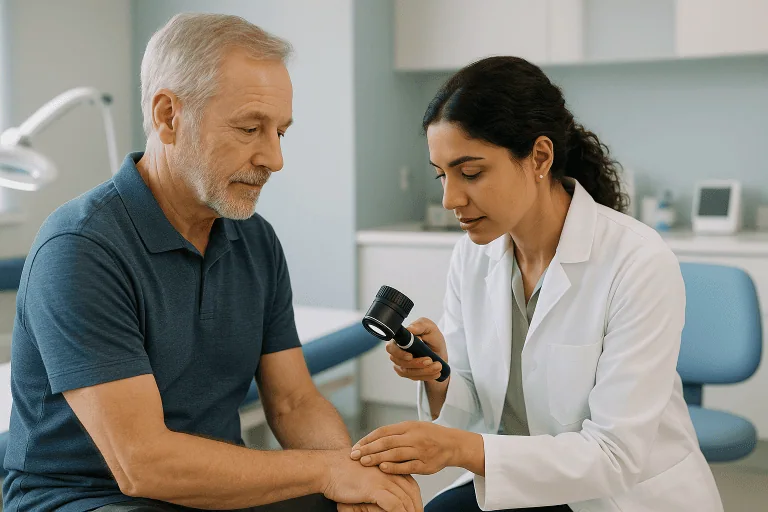
Perioral dermatitis diagnosis is usually clinical, which means a doctor can typically identify the condition by examining the skin and asking about your history. There is no single blood test, imaging study, or laboratory marker that confirms it. During the visit, the doctor will generally:
- Examine the rash closely, noting the small grouped bumps, the distribution around the mouth, nose, or eyes, and the characteristic clear zone of skin bordering the lips.
- Ask about topical steroid use, including prescription creams, over-the-counter hydrocortisone, steroid nasal sprays, and asthma inhalers, because these are common triggers.
- Review your skincare routine, including cosmetics, moisturizers, sunscreens, and toothpaste.
- Ask about the timeline, such as when the rash started, whether it flares and settles, and how it responds when products are stopped or started.
An important part of diagnosis is ruling out conditions that can look similar. These include acne (which usually involves blackheads and whiteheads, features absent in perioral dermatitis), rosacea (a chronic facial redness condition that tends to affect the cheeks and central face), seborrheic dermatitis (a flaky rash around the nose and eyebrows), allergic or irritant contact dermatitis (a reaction to something touching the skin), and, rarely, infections such as impetigo. In children, the doctor may also consider lip-licking dermatitis, which is irritation caused by repeated licking of the skin around the mouth.
Additional tests are needed only in uncertain cases. A doctor may occasionally take a skin swab to check for bacterial or fungal infection, or perform patch testing (applying small amounts of common allergens to the skin) if an allergy is suspected. A skin biopsy, removal of a tiny sample of skin for examination under a microscope, is rarely necessary but may be done when the appearance is unusual or the rash does not respond to standard treatment. Imaging tests such as X-rays or scans play no role in diagnosing this condition. At hospital level, perioral dermatitis is evaluated and managed within dermatology; at Acibadem, for example, it falls under the dermatology department.
Treatment options
Perioral dermatitis treatment aims to calm the inflammation, remove triggers, and allow the skin barrier to recover. Treatment is tailored to how severe the rash is, how long it has been present, and whether topical steroids have been involved. It is worth knowing in advance that improvement is often gradual, commonly taking several weeks, and that the rash may temporarily look worse before it looks better, especially after stopping steroid creams.
Stopping triggers and “zero therapy”
The first and most important step in nearly all cases is to stop applying topical corticosteroids to the face and to simplify the skincare routine dramatically. Doctors sometimes call this approach zero therapy or a skin “elimination diet”: washing gently with lukewarm water and, if needed, a very mild non-soap cleanser, avoiding cosmetics, heavy creams, and scrubs, and using at most a light, bland moisturizer if the skin feels uncomfortably tight. For mild, early cases, this watchful, minimalist approach alone may allow the rash to settle over weeks to a few months. If a steroid cream has been used for a long time, your doctor may recommend tapering it gradually rather than stopping abruptly, to soften the rebound flare.
Topical (applied-to-skin) medications
When the rash needs more than trigger removal, doctors often prescribe non-steroid topical medicines. Options that are commonly used include:
- Topical antibiotics such as metronidazole, erythromycin, or clindamycin, which reduce inflammation and the influence of skin bacteria.
- Azelaic acid, an anti-inflammatory cream or gel also used for rosacea and acne.
- Topical calcineurin inhibitors such as pimecrolimus or tacrolimus, which are non-steroid anti-inflammatory creams; these may be considered in selected cases, often as an alternative when steroids must be avoided.
- Topical ivermectin, which may be used in some cases, particularly when Demodex mites are thought to play a role.
Topical treatments generally take several weeks to show clear benefit, so patience and consistent use as directed are important.
Oral (taken-by-mouth) medications
For moderate to severe perioral dermatitis, or when topical treatment has not worked, doctors frequently prescribe a course of oral antibiotics from the tetracycline family, such as doxycycline. These medicines are used mainly for their anti-inflammatory effect rather than to treat an infection, and a course typically lasts several weeks. Tetracyclines are not suitable for pregnant women or young children, so alternatives such as oral erythromycin may be chosen in those groups. In rare, stubborn cases that do not respond to standard therapy, a dermatologist may discuss other options, such as low-dose oral isotretinoin, weighing the benefits and side effects carefully.
What treatment does not involve
There is no role for surgery in perioral dermatitis, and procedures such as laser therapy are not standard treatment, although a doctor may occasionally discuss light-based options for residual redness once the active rash has cleared. Steroid creams should not be restarted to control flares, as this tends to prolong the condition. Home remedies with harsh ingredients, strong exfoliants, alcohol-based toners, undiluted essential oils, usually irritate the skin further and are best avoided. If you are unsure whether a product is safe to use during treatment, ask the dermatologist guiding your care.
Living with perioral dermatitis and outlook
The outlook for perioral dermatitis is generally good. With appropriate treatment and avoidance of triggers, the rash clears completely in most people, often within a few weeks to a few months, and typically without permanent scarring. Temporary skin discoloration, pinkness in lighter skin or darker patches in deeper skin tones, can linger after the bumps have gone but usually fades over time.
That said, honesty about the course of the condition is important. Perioral dermatitis can be slow to respond, and recurrences do happen, particularly if topical steroids are used on the face again or if a heavy skincare routine is resumed too quickly. Some people experience more than one episode over the years. Practical measures that many patients find helpful for keeping skin calm include:
- Keeping the facial routine simple: a gentle cleanser, a light non-comedogenic moisturizer (one that does not block pores), and a mineral-based sunscreen your skin tolerates.
- Avoiding steroid creams on the face unless a dermatologist specifically advises them for another condition.
- Rinsing the skin around the mouth after using steroid inhalers or nasal sprays, if these are medically necessary for asthma or allergies.
- Introducing any new skincare or cosmetic product one at a time, so a trigger can be identified if the rash returns.
- Being patient during flares rather than layering on multiple products in an attempt to fix the skin quickly.
The condition can be distressing because it affects a very visible part of the face, and it is normal to feel self-conscious during a flare. Knowing that the rash is common, treatable, and not a sign of anything dangerous can help. If flares are frequent or the appearance is significantly affecting your daily life, ongoing follow-up with a dermatologist is reasonable.
Frequently asked questions
What is perioral dermatitis and is it the same as acne?
Perioral dermatitis is an inflammatory rash of small bumps around the mouth, nose, and sometimes the eyes. It can resemble acne because some bumps contain pus, but it is a different condition: it lacks blackheads and whiteheads, it often burns or stings, and it typically spares a thin border of skin next to the lips. Because the treatments differ, an accurate diagnosis by a doctor matters, some acne products can irritate perioral dermatitis and make it worse.
Can perioral dermatitis heal on its own?
In some mild cases, especially when a clear trigger such as a steroid cream or a heavy cosmetic routine is stopped, the rash may settle on its own over weeks to months. However, many cases persist or slowly worsen without treatment, and steroid-related cases in particular tend to flare when the steroid is withdrawn. Seeing a doctor is sensible if the rash lasts more than a couple of weeks, is spreading, or is uncomfortable.
How serious is perioral dermatitis?
Perioral dermatitis is not a dangerous condition. It does not spread to internal organs, it is not contagious, and it is not a form of skin cancer. Its main impact is on comfort and appearance, which can nonetheless be significant for quality of life. With treatment, most people recover fully without scarring, although temporary discoloration can remain for a while after the bumps clear.
What causes perioral dermatitis to flare up?
Common flare triggers include topical steroid creams on the face, steroid nasal sprays or inhalers, thick moisturizers and layered cosmetics, and in some people fluorinated toothpaste, hormonal changes, heat, wind, or prolonged mask wearing. Triggers vary between individuals, and often more than one factor is involved. Keeping the skincare routine minimal and avoiding facial steroids are the most widely agreed-upon preventive steps.
How is perioral dermatitis diagnosed, do I need a biopsy?
Diagnosis is usually made by a doctor examining the rash and asking about your medication and skincare history; no blood tests or scans are needed in typical cases. A biopsy, in which a tiny skin sample is examined under a microscope, is rarely required and is generally reserved for unusual presentations or rashes that fail to respond to standard treatment.
How long does perioral dermatitis treatment take to work?
Improvement is usually gradual. Topical treatments often need several weeks of consistent use before a clear benefit appears, and oral antibiotic courses commonly last around six to twelve weeks depending on the doctor’s plan. It is also common for the rash to flare temporarily after stopping steroid creams before it begins to improve. Stopping treatment early because results seem slow is a frequent reason for relapse, so following the prescribed course matters.
Will perioral dermatitis come back after it clears?
It can. Recurrence is more likely if topical steroids are used on the face again or if heavy skincare products are reintroduced quickly. Many people who keep a simple routine and avoid their known triggers remain clear long term, but no approach can guarantee that the rash will never return. If it does recur, earlier treatment episodes usually make it easier to recognize and manage promptly.
When to see a doctor
Consider making a medical appointment if you have a facial rash that has lasted more than a couple of weeks, is spreading, burns or stings, or has not improved after you stopped new skincare products. You should also seek advice before stopping any prescribed steroid cream on your own, so the withdrawal can be managed safely. Dermatology is the specialty that diagnoses and treats this condition; Acibadem’s dermatology unit is one example of a department that manages it.
Seek prompt or urgent medical attention if any of the following red flags occur, as they suggest something other than, or in addition to, perioral dermatitis:
- Rapid swelling of the lips, tongue, face, or throat, or any difficulty breathing or swallowing: these can indicate a severe allergic reaction and are an emergency.
- Fever, chills, or feeling generally unwell alongside the rash.
- Painful blisters, honey-colored crusting, or oozing, which may signal a skin infection needing treatment.
- Rash involving the eye itselfeye pain, redness of the eyeball, light sensitivity, or changes in vision.
- Rapidly worsening pain, warmth, or spreading redness beyond the original rash area.
- A rash in an infant or young child that is worsening, blistering, or accompanied by feeding problems or fever.
For a typical, slowly developing rash without these warning signs, a routine visit to a family doctor or dermatologist is appropriate. Early evaluation helps confirm the diagnosis, rules out look-alike conditions, and allows treatment to begin before the rash becomes more established.
Medically reviewed by the Acıbadem International Medical Board September 2, 2026
See our medical review board →
Update history
- PublishedJune 14, 2026
- Medical review approvedSeptember 2, 2026
- Last content updateSeptember 2, 2026