

Gallbladder Diet: What to Eat With Gallstones and After Gallbladder Removal
Key Takeaways
- About 10 to 15% of American adults have gallstones, and most never have symptoms; silent stones found by chance are usually monitored rather than removed.
- A pooled analysis of 76 randomized trials found GLP-1 receptor agonists raised the relative risk of gallbladder or biliary disease by about 37%, largely through slower gallbladder emptying and rapid weight loss.
- Very-low-fat crash diets produced new gallstones in roughly 10 to 25% of participants within weeks, so some fat at each meal is protective, not harmful.
- Cohort studies link regular nut intake, higher fiber and two or more cups of coffee a day with lower rates of symptomatic gallstones, though these are associations rather than proof.
- The green lumps produced by an olive-oil 'flush' are saponified fat, not gallstones, and the half-cup of oil involved is exactly the fatty load that can trigger an attack.
- Most people eat normally within one to three months of gallbladder removal; persistent loose stools affect a minority and often respond to soluble fiber, spread-out fat intake, or prescribed bile-acid binders.
A gallbladder diet is a pattern of eating built around high-fiber plant foods, lean protein and moderate portions of unsaturated fat, with fewer fried and ultra-processed foods and refined sugars. With gallstones it aims to reduce painful attacks; after gallbladder removal it eases digestion while the body adapts. The evidence is mostly observational, so individual tolerance and a clinician's advice should guide the details.
Scroll a food feed for ten minutes right now and you will probably meet it: a glass of olive oil, a squeeze of lemon, and a jar of green pebbles someone swears came out of their gallbladder overnight. The “gallbladder flush” is having another moment, and so is the search phrase gallbladder diet, which has climbed steadily as of March 2026.
Two things are driving it. The first is that viral flush. The second is quieter and more medical: millions of people are now losing weight quickly on GLP-1 receptor agonist medicines, and rapid weight loss is one of the best-documented triggers for new gallstones. Pooled trial data published in 2022 put a number on that risk, and clinicians have been fielding dietary questions ever since.
So here is the magazine version of what the evidence supports, what it does not, and how eating changes before and after the gallbladder is gone.
What does the gallbladder actually do, and why does food matter?
The gallbladder is a thin-walled pouch, roughly the size of a small pear, tucked under the liver. Its job is storage. The liver makes bile, a greenish digestive fluid that helps the gut break down fat, and the gallbladder holds about 30 to 50 milliliters of it between meals, concentrating it up to tenfold.
When fat from a meal reaches the small intestine, the gut releases a hormone called cholecystokinin. That hormone squeezes the gallbladder, which pushes concentrated bile down a narrow duct into the intestine. A cheeseburger prompts a stronger squeeze than a bowl of oatmeal. This is the whole reason diet enters the conversation.
Gallstones are hardened deposits that form when bile holds more cholesterol or bilirubin than it can keep dissolved. About 80% in the United States are cholesterol stones; the rest are darker pigment stones. The National Institute of Diabetes and Digestive and Kidney Diseases (NIDDK) estimates that 10 to 15% of American adults have gallstones, and most never know it. Silent stones usually stay silent.
Trouble starts when a stone blocks the duct during a contraction. The result is biliary colic: a steady, often intense pain in the upper right or center of the abdomen, sometimes spreading to the right shoulder blade, lasting from about 30 minutes to several hours. It tends to arrive after a large or fatty meal and often at night.
Two honest limits frame everything that follows. Food can change how hard the gallbladder squeezes, and over years it can nudge the chemistry of bile. Food cannot dissolve a stone that has already formed. Keep both ideas in mind and most of the online noise sorts itself out.
What changed recently
Three developments explain why the gallbladder diet is trending now.
The first is medical. A 2022 meta-analysis in JAMA Internal Medicine, indexed on PubMed, pooled 76 randomized trials with more than 100,000 participants and found that GLP-1 receptor agonists, the injectable medicines used for type 2 diabetes and weight management, raised the relative risk of gallbladder or biliary disease by about 37% compared with placebo or other treatments. The absolute increase was small, but the risk was higher with longer use and in trials focused on weight loss. GLP-1 medicines slow gallbladder emptying and drive rapid weight loss, and both effects favor stone formation. Mayo Clinic’s current gallstone guidance lists rapid weight loss among the established risk factors.
The second is cultural. Short videos promoting an overnight olive-oil-and-citrus “flush” resurfaced in late 2025 and early 2026, complete with jars of soft green lumps presented as expelled stones. No mainstream medical body endorses this practice, and NIDDK’s nutrition guidance for gallstones does not mention any flush, cleanse or detox.
The third is a slow shift in surgical advice. Older discharge leaflets told patients to follow a strict low-fat diet for months after gallbladder removal. Mayo Clinic’s current patient guidance says there is no specific diet after cholecystectomy; it recommends starting with smaller, lower-fat meals and advancing as tolerated. NHS guidance takes the same line, framing fat reduction as a short-term comfort measure rather than a lifelong rule.
Put together: more people are losing weight fast, more people are hearing about gallstones for the first time, and the advice they find ranges from sensible to pure folklore. The rest of this article sorts one from the other.
What the evidence actually says about a gallbladder diet
Nutrition evidence for gallstones comes in three grades, and it helps to label them.
Observational data (moderate strength). The largest body of evidence comes from long-running cohort studies such as the Nurses’ Health Study and the Health Professionals Follow-up Study, which tracked tens of thousands of adults for decades. In those cohorts, people who ate more fiber, nuts, vegetable protein and unsaturated fats, and who drank regular coffee, were less likely to develop symptomatic gallstones or need gallbladder surgery. Diets heavy in refined carbohydrates, added sugar, saturated fat and trans fat went the other way. Women eating nuts five or more times a week had roughly a quarter lower risk of cholecystectomy than those who rarely ate them. These are associations, not proof of cause; healthy eaters differ in many ways.
Randomized trials (strong but narrow). Trials have tested weight-loss regimens, not gallstone diets as such. They consistently show that very-low-calorie diets, especially ones with very little fat, cause new stones in a substantial share of participants within weeks, and that adding a modest amount of fat to each meal, or a prescription bile-acid medicine, reduces that risk. The GLP-1 meta-analysis described above belongs here too.
Expert opinion (weakest). Advice to avoid fried foods during an attack, eat smaller meals after surgery, or reintroduce foods gradually rests mostly on physiology and clinical experience. It is sensible, widely echoed by NIDDK, Mayo Clinic and the NHS, but not tested in trials.
The practical reading: a Mediterranean-style pattern is the best-supported long-term choice, rapid or fat-free weight loss is the best-documented hazard, and most food-by-food trigger lists are educated guesses that you personalize by paying attention to your own symptoms.
Which foods to avoid with gallstones?
Think of this as a list of foods to limit when stones are symptomatic, not a permanent ban. The common thread is large amounts of fat arriving at once, which prompts the strongest gallbladder contraction.
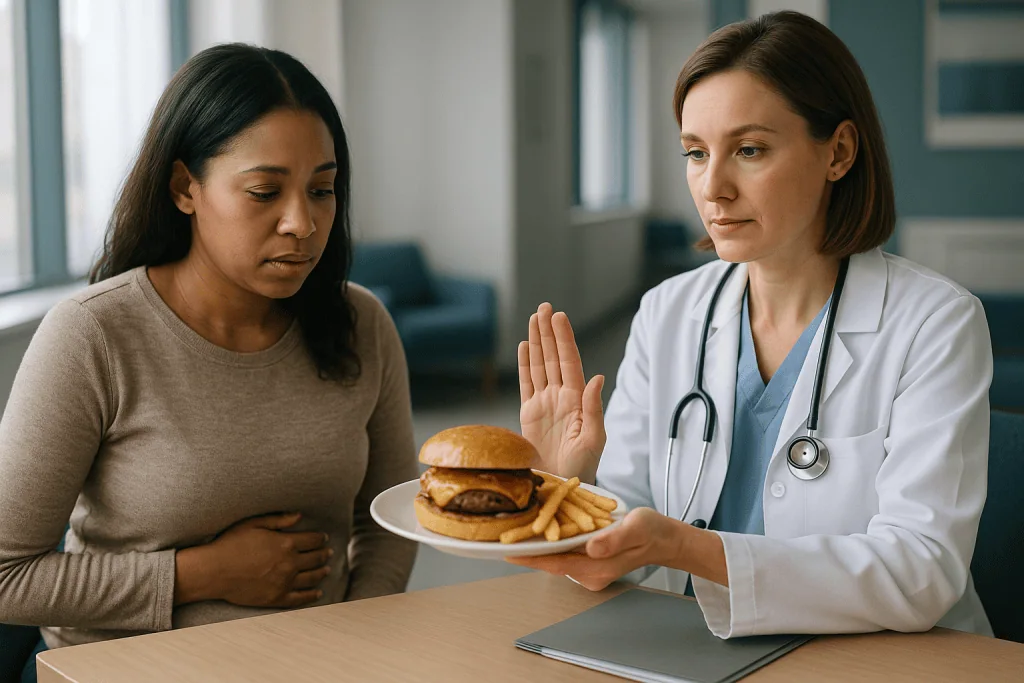
- Deep-fried foods: fries, fried chicken, doughnuts, tempura. A single fast-food meal can deliver 40 to 60 grams of fat.
- Fatty and processed meats: sausage, bacon, salami, ribs, marbled steak.
- Cream-based sauces and rich desserts: alfredo, cheesecake, ice cream in large servings.
- Pastries and refined baked goods: high in both saturated fat and refined flour, two factors linked to stone risk in cohort studies.
- Sugary drinks and sweets: high glycemic load is associated with gallstone disease, probably through insulin and cholesterol secretion into bile.
- Very large meals of any kind: volume alone increases the contraction signal.
Notice what is not on that list: fat itself. Olive oil on a salad, half an avocado, a handful of almonds or a serving of salmon deliver fat in moderate amounts alongside fiber or protein, and the cohort data point toward lower risk, not higher, for exactly these foods. The gallbladder dislikes a flood, not a stream.
Evidence grade here is a blend. The link between saturated and trans fat, refined carbohydrates and stone formation is observational and consistent. The advice to avoid fried food during active symptoms is physiology plus expert opinion. Many people with stones eat a modest portion of pizza without a flicker, while others react to a buttered roll; a two-week food-and-symptom diary tells you more about your own triggers than any generic chart.
What should a gallbladder diet include if you have gallstones?
The positive side of the list is longer and more interesting.
Fiber, in quantity. Most American adults eat around 15 grams a day; general dietary guidelines suggest 25 to 38 grams. Vegetables, fruit with skin, oats, beans, lentils and whole grains supply it. Fiber speeds intestinal transit and may reduce the amount of a secondary bile acid that makes bile more prone to form stones. In cohort studies, higher fiber intake tracked with fewer symptomatic stones.
Nuts. Several servings a week were associated with lower gallbladder surgery rates in both men and women. Nuts combine unsaturated fat, fiber and plant protein, a trio the gallbladder appears to tolerate well.
Unsaturated oils in measured amounts. Olive, canola and other vegetable oils, used by the tablespoon rather than the ladle. Some fat at each meal keeps the gallbladder emptying regularly, which prevents bile from stagnating into sludge.
Lean protein. Fish, skinless poultry, tofu, legumes, eggs in normal portions, and low-fat dairy. Plant protein specifically showed a favorable association in the Nurses’ Health Study.
Coffee. People drinking two or more cups a day had lower rates of symptomatic gallstones in several cohorts; a plausible mechanism is that caffeine stimulates regular gallbladder emptying. This does not mean coffee treats existing symptoms, and some people find it uncomfortable during an attack.
A regular meal rhythm. Skipping breakfast or fasting for long stretches lets concentrated bile sit for hours. Three moderate meals, or smaller meals plus a snack, keep the system moving.
None of this requires special products. A plate that is half vegetables, a quarter whole grains and a quarter lean protein, dressed with a spoon of oil, is a gallbladder diet without the label.
Is a low fat diet for gallbladder problems supposed to be very low in fat?
No, and this is where well-meaning advice often goes wrong. The gallbladder needs some fat to do its job. Without the cholecystokinin signal that fat provides, it sits full of concentrated bile, cholesterol crystals settle out, and the risk of new stones goes up rather than down.
The clearest demonstration comes from weight-loss trials. Very-low-calorie programs supplying under about 10 grams of fat a day produced new gallstones in roughly 10 to 25% of participants within 8 to 16 weeks. When researchers added enough fat to each meal to trigger gallbladder emptying, stone formation fell sharply. NIDDK’s guidance makes the same point: eating too little fat is itself a risk.
So what does “low fat” sensibly mean? For someone with symptomatic stones, the goal is to avoid big fatty loads, not to eliminate fat. A reasonable pattern looks like this:
- Fat spread across the day rather than concentrated in one meal.
- Roughly 25 to 35% of calories from fat, which is the general range in standard dietary guidance, with most of it unsaturated.
- Portions in the 10 to 15 gram range per meal when symptoms are active, then relaxing as they settle.
These are food-based figures from nutrition guidance, not medical doses, and a registered dietitian can tailor them.
Why the confusion persists: a low-fat meal genuinely does reduce the chance of a painful contraction in the short term, and that benefit is real and immediate. The long-term cost of going too far is invisible until a new stone forms. The balance is to lower the peaks, keep a baseline, and never treat fat-free eating as a treatment for gallstones.
Rapid weight loss, GLP-1 medicines and new gallstones
Losing weight lowers gallstone risk over the long run. Losing it quickly raises the risk in the short run. Both statements are true, and the tension between them is the single most important thing to understand right now.
During fast weight loss, the liver pulls cholesterol from shrinking fat stores and secretes more of it into bile, while reduced food intake means the gallbladder empties less often. Supersaturated bile plus a sluggish gallbladder is the recipe for stones. NIDDK and Mayo Clinic both cite losing more than about 3 pounds (1.5 kilograms) a week as a threshold where risk climbs, and after bariatric surgery a third or more of patients can develop stones within months.
GLP-1 receptor agonists add a second mechanism: they slow gallbladder contraction directly. The 2022 pooled analysis of 76 randomized trials found a 37% relative increase in gallbladder or biliary events, with cholecystitis (inflammation of the gallbladder) and stones the most common. In absolute terms the difference amounted to a few extra events per thousand people treated per year, which is why regulators and specialists describe it as a recognized but uncommon side effect rather than a reason to avoid the drugs.
What this means at the table:
- Aim for gradual loss, generally 1 to 2 pounds a week, unless a clinician has set a different target.
- Keep eating regular meals even when appetite falls; a small meal that includes some fat still triggers emptying.
- Do not skip to fat-free eating in an effort to speed results.
Some clinicians prescribe a preventive bile-acid medicine during very rapid loss; that choice, and any change to a GLP-1 prescription, belongs entirely to the prescribing clinician. New upper-right abdominal pain during weight loss deserves a prompt call, not a dietary experiment.
Diet after gallbladder removal: the first two weeks
Cholecystectomy, the surgical removal of the gallbladder, is one of the most common operations in the United States, usually done through four small keyhole incisions. Without the storage pouch, bile drips continuously from the liver into the intestine in a thinner, steadier trickle. Digestion of fat still works; it simply loses its surge capacity for a while.
Mayo Clinic’s patient guidance is clear that there is no required diet after the operation. Still, the first days are easier with a little strategy, because bloating, gas and loose stools are common while the gut recalibrates.
A sensible sequence, echoed by NHS and MedlinePlus discharge advice:
- Days 1 to 3: clear fluids, then soft, bland foods: broth, toast, rice, bananas, applesauce, plain yogurt. Anesthesia and pain relief often dull appetite anyway.
- Days 3 to 10: small meals every three to four hours. Keep each one modest in fat; a palm of lean protein, a cup of cooked vegetables, a serving of whole grain.
- Week two onward: reintroduce one richer food at a time and notice how you feel. Most people are back to familiar eating within a few weeks.
Foods people most often report as troublesome early on include fried dishes, large fatty meals, very spicy food, big servings of caffeine, and sometimes high-fat dairy. Soluble fiber from oats, bananas and cooked carrots tends to firm loose stools; a sudden jump in raw vegetables or bran can do the opposite, so add fiber gradually.
Hydration matters more than usual if stools are loose. Water, diluted juice and broth all count. Carbonated drinks sometimes add to gas discomfort in the first week and are worth pausing.
This is comfort-first advice built on physiology and clinical experience rather than trials. If something bland still causes pain, that is a reason to call the surgical team, not to tighten the diet further.
Life without a gallbladder: longer-term eating and bile acid diarrhea
The reassuring majority view is simple: most people eat normally within one to three months of surgery and never think about their gallbladder again. The liver keeps making the same bile, the intestine adapts, and fat absorption returns to near normal.
A minority have lingering symptoms, most often diarrhea. Estimates range from around 1 in 20 to 1 in 5 people, depending on how it is defined and how long after surgery researchers ask. The usual cause is bile acid diarrhea: with no gallbladder to buffer the flow, more bile reaches the colon between meals, where it draws in water and speeds transit. Stools are typically loose, urgent and watery, often soon after eating.
Dietary measures with reasonable support from clinical practice:
- Keep fat moderate and spread across meals rather than front-loaded.
- Lean on soluble fiber: oats, psyllium, barley, legumes, cooked fruit.
- Limit very large servings of caffeine, alcohol and intensely sweet foods, which can all speed the gut.
- Eat smaller, more frequent meals.
When diet alone does not settle things, clinicians can prescribe medicines that bind bile acids in the gut; several randomized and observational studies support them for this problem. The decision to start one, and which one, rests with the treating clinician.
Two long-term questions come up often. Does removal cause weight gain? Observational data are mixed and confounded by the fact that appetite often improves once pain stops. Does it require lifelong low-fat eating? No major guideline says so; the Mediterranean-style pattern that suits a gallbladder with stones suits a body without one. The gallbladder diet after surgery is really just a healthy diet with a gentler on-ramp.
Gallbladder diet at a glance: one table for both situations
Readers ask for a single page they can stick on the refrigerator. This table distills the sections above. Columns are deliberately not “allowed” and “forbidden”: the right-hand column lists foods that most people find easier to tolerate, and the middle column lists common reported triggers, with the evidence grade noted so you know how much weight to give each row.
| Food group | Commonly reported triggers | Generally better tolerated | Evidence grade |
|---|---|---|---|
| Fats and oils | Deep-fried foods, lard, butter-heavy dishes, large fatty meals | Olive or canola oil by the tablespoon, nuts, avocado in modest portions | Observational plus physiology |
| Protein | Sausage, bacon, ribs, marbled cuts, processed meats | Fish, skinless poultry, legumes, tofu, eggs in normal portions | Observational |
| Dairy | Large servings of cream, full-fat cheese, premium ice cream | Low-fat yogurt, milk, small portions of cheese | Expert opinion |
| Grains and sweets | Pastries, white bread, sugary drinks, candy | Oats, brown rice, whole-grain bread, fruit | Observational |
| Vegetables and fruit | Rarely a trigger; very large raw servings may cause gas after surgery | Nearly all, cooked or raw, aiming for half the plate | Observational |
| Drinks | Alcohol in excess, very large caffeine loads | Water, coffee in moderation, tea | Observational (coffee), expert opinion (alcohol) |
| Meal pattern | Skipping meals, one huge evening meal, crash dieting | Three moderate meals or small frequent meals, gradual weight loss | Randomized trials (weight loss), observational (pattern) |
Treat the middle column as a starting hypothesis and your own symptom diary as the final word. Most people find that two or three specific items account for nearly all their discomfort, and the rest of the list can relax.
Can you eat eggs with gallstones? Coffee, dairy and other specific questions
Some foods attract outsized worry. Here is what the evidence supports for the most-searched ones.
Eggs. Eggs appear on many online “avoid” lists, often tracing back to a tiny 1960s study on food sensitivities that has never been replicated at scale. A large egg contains about 5 grams of fat, a moderate amount that rarely triggers a strong contraction on its own. Dietary cholesterol in eggs does not translate directly into cholesterol stones; bile cholesterol is governed mainly by the liver and by overall diet quality, weight change and genetics. Most people with gallstones tolerate eggs in normal portions. A three-egg omelet loaded with cheese and sausage is a different meal, and the problem there is the total fat, not the egg.
Coffee. Cohort studies found lower rates of symptomatic gallstones among regular coffee drinkers, with men drinking two to three cups a day showing around 40% lower risk in one analysis. The likely explanation is stimulation of regular emptying. During an active attack, though, that same stimulation can feel unpleasant, so many people pause coffee until symptoms settle. Decaffeinated coffee showed no protective association.
Dairy. Low-fat milk, yogurt and small portions of cheese are generally well tolerated. Large servings of cream or full-fat cheese deliver 20 grams or more of mostly saturated fat and are a common reported trigger.
Alcohol. Moderate drinking was associated with slightly lower gallstone risk in observational studies, but no medical body recommends alcohol as prevention, and it is best avoided entirely during an acute attack or any episode of pancreatitis.
Spicy food. Not linked to stone formation. Some people find it irritating after surgery, which is a comfort issue rather than a gallbladder one.
Common myths about the gallbladder diet
Viral claims are more persuasive than guidelines because they come with a jar of evidence. The jar is the problem.
Myth: an olive-oil-and-lemon flush expels gallstones. The soft green lumps that appear the next morning are not stones. They are saponified fat: the oil reacts with digestive juices and lemon acid to form soap-like globules, which float and crumble. Real gallstones are hard, sink in water and are usually too large to pass through the bile duct without medical intervention. No mainstream source, including NIDDK, Mayo Clinic or the NHS, recognizes any flush, and a half-cup of oil in one sitting is precisely the fatty load most likely to provoke a painful attack.
Myth: apple cider vinegar dissolves stones. There is no clinical evidence. Stomach acid does not reach the gallbladder, and vinegar does not alter bile chemistry.
Myth: eating cholesterol causes cholesterol stones. Bile cholesterol is mainly determined by liver metabolism, body weight, weight change, hormones and genes. Diet quality matters, but counting egg yolks misses the point.
Myth: zero fat is the safest gallbladder diet. Trials of very-low-fat weight-loss diets show the opposite; some fat at each meal keeps bile moving and lowers the risk of new stones.
Myth: you cannot digest fat without a gallbladder. The liver still produces bile continuously. Digestion is a little less efficient with very large fatty meals, which is why spreading fat across the day helps.
Myth: every gallstone needs surgery. Silent stones found by chance on a scan are usually watched, not removed. Surgery is generally offered for stones that cause symptoms or complications, a decision made with a clinician based on the individual case.
Who is at higher risk, and can diet really prevent gallstones?
Gallstones cluster in predictable groups. Women develop them roughly twice as often as men, in part because estrogen raises cholesterol secretion into bile and progesterone slows gallbladder emptying; pregnancy and some hormonal medicines add to that effect. Risk rises with age, especially after 40. Family history carries weight, and prevalence is markedly higher among Native American and Mexican American populations, according to NIDDK. Obesity, type 2 diabetes, metabolic syndrome, certain blood disorders that raise bilirubin, and liver disease all increase risk. Rapid weight loss, as covered above, is a risk in its own right.
Many of those factors are fixed. Diet and activity are the levers that move.
The best observational evidence suggests that a Mediterranean-style pattern, built on vegetables, legumes, whole grains, nuts, fish and olive oil, is associated with fewer symptomatic gallstones over decades of follow-up. Physical activity adds an independent benefit: in cohort studies, people in the most active fifth had roughly 20 to 30% lower risk of symptomatic stones than the least active, after adjusting for weight.
Maintaining a steady weight matters as much as the number on the scale. Repeated cycles of crash dieting and regain appear to carry more gallstone risk than stable weight at a higher level, which argues for gradual, sustainable changes over dramatic ones.
No routine screening for gallstones exists, and none is recommended. Imaging is reserved for people with symptoms. If an ultrasound done for another reason happens to show silent stones, the usual advice is to leave them alone, eat well, stay active and know the warning signs described in the next section. Prevention here is not a special regimen; it is the same pattern that protects the heart and lowers the risk of type 2 diabetes.
When to see a doctor
Dietary adjustments manage mild, occasional biliary colic. They are not a substitute for assessment, and several patterns call for prompt medical attention.
Seek urgent care, or emergency care if severe, for:
- Abdominal pain so intense you cannot find a comfortable position or sit still.
- Pain lasting more than a few hours, or recurring attacks that are becoming more frequent.
- Fever or chills alongside abdominal pain, which can signal cholecystitis or infection in the bile ducts.
- Yellowing of the skin or whites of the eyes (jaundice), dark urine or pale, clay-colored stools, which suggest a stone blocking the main bile duct.
- Severe pain spreading to the back with repeated vomiting, a possible sign of pancreatitis, inflammation of the pancreas that can follow a lodged stone.
Book a routine appointment if: you suspect gallstones but have only mild symptoms; you have known stones and want a plan; you are losing weight quickly, with or without medication, and have new upper-abdominal discomfort; or you need help building an eating pattern around diabetes, pregnancy or another condition.
After gallbladder removal, contact the surgical team for: fever, spreading redness or discharge at an incision, worsening rather than easing pain, jaundice, persistent vomiting, or diarrhea that continues beyond a few weeks or comes with weight loss.
Every decision about medicines sits with the prescribing clinician. That includes whether to start or adjust a GLP-1 medicine, whether a preventive bile-acid medicine is appropriate during rapid weight loss, and whether a bile-acid binder makes sense for post-surgical diarrhea. Do not stop or change any prescribed treatment because of something read online, including this article. Bring the question to the person who knows your history.
Frequently asked questions
What are the main foods to avoid with gallstones?
The foods most often linked to attacks are those that deliver a lot of fat at once: deep-fried items, fatty and processed meats, cream sauces, rich desserts and very large meals. Refined carbohydrates and sugary drinks are associated with higher stone risk in long-term studies. Moderate portions of unsaturated fat from olive oil, nuts or fish are generally well tolerated and, in cohort data, linked to lower risk.
Can you eat eggs with gallstones?
Most people with gallstones can eat eggs in normal portions. A large egg has about 5 grams of fat, which rarely triggers a strong gallbladder contraction, and dietary cholesterol does not convert directly into cholesterol stones. Trouble usually comes from the company eggs keep, such as cheese, bacon and butter in one plate. If eggs consistently cause discomfort for you, that personal pattern is worth respecting.
What is the best diet after gallbladder removal in the first week?
Start with clear fluids and bland, soft foods such as broth, toast, rice, bananas and plain yogurt, then move to small, low-fat meals every three to four hours. Mayo Clinic notes there is no required diet after surgery, so this is a comfort-first approach while the gut adapts to a steady trickle of bile. Add richer foods one at a time and watch how you feel.
Is a low fat diet for gallbladder problems necessary for life?
No major guideline recommends lifelong strict fat restriction, either with gallstones or after removal. The goal is to avoid large fatty loads in one sitting, not to eliminate fat, because very-low-fat eating actually raises the risk of new stones. A Mediterranean-style pattern with fat spread across meals suits both situations, and after surgery most people return to familiar eating within a few months.
Can diet dissolve gallstones?
No. Food can influence how hard the gallbladder contracts and, over years, the chemistry of bile, but it cannot dissolve a stone that has already formed. Olive-oil flushes and apple cider vinegar have no supporting evidence. Some clinicians prescribe a bile-acid medicine that can slowly shrink certain small cholesterol stones; whether that is appropriate is a decision for the treating clinician based on imaging.
Does coffee help or hurt a gallbladder with stones?
Long-term cohort studies found that regular coffee drinkers, around two or more cups a day, had lower rates of symptomatic gallstones, likely because caffeine encourages regular gallbladder emptying. That is an association, not a treatment. During an active attack the same stimulation can feel uncomfortable, so many people pause coffee until symptoms settle. Decaffeinated coffee did not show the same protective pattern.
Do GLP-1 weight-loss medicines cause gallstones?
They raise the risk modestly. A 2022 meta-analysis of 76 randomized trials found a roughly 37% relative increase in gallbladder or biliary disease, with the absolute increase amounting to a few extra events per thousand people per year. Rapid weight loss and slower gallbladder emptying explain most of it. Anyone with new upper-right abdominal pain on these medicines should contact their prescribing clinician rather than adjust the medicine themselves.
Why do I have diarrhea after gallbladder removal?
Without a storage pouch, bile flows continuously into the intestine, and the extra bile acids reaching the colon draw in water and speed transit. This bile acid diarrhea affects a minority of people, with estimates from about 1 in 20 to 1 in 5. Moderating fat per meal, adding soluble fiber and eating smaller meals often help; if not, a clinician can prescribe a medicine that binds bile acids.
Can I drink alcohol if I have gallstones?
Moderate alcohol intake was associated with slightly lower gallstone risk in observational studies, but no medical body recommends drinking as prevention. Alcohol should be avoided entirely during an acute attack, after any episode of pancreatitis, and in the first weeks after surgery while the gut settles. Outside those situations, the general guidance on alcohol applies, and it is worth raising with your clinician.
How fast is it safe to lose weight if I have gallstones?
Guidance from NIDDK and Mayo Clinic points to losing more than about 3 pounds (1.5 kilograms) a week as the zone where gallstone risk rises. A pace of 1 to 2 pounds a week, with regular meals that each contain some fat, keeps the gallbladder emptying and lowers that risk. If a clinician has prescribed a faster program or a weight-loss medicine, follow their plan and report any new abdominal pain promptly.
References
This article is for general information only and is not a substitute for professional medical advice. Please consult a qualified doctor about your individual situation.

More from the Blog

How Endoscopic Ablation for Barrett’s Esophagus Is Done and What You Feel Afterwards
A Barrett's esophagus ablation procedure is done during a sedated upper endoscopy: a thin, flexible camera tube passes through the mouth, and a small…
When Ulcerative Colitis Needs Surgery: Severe Flares, Failed Medicines and Precancer Findings
Ulcerative colitis usually needs surgery in three situations: a severe flare that does not settle with intensive hospital treatment or causes complications such as…

Is It a Crohn’s Flare? When Changing Symptoms Need a Call to Your Gastroenterologist
Call your gastroenterologist when Crohn's symptoms change from your usual baseline: more frequent or bloody stools, new or worsening abdominal pain, fever, unexplained weight…

Hepatitis B and Other Medicines: Why Every New Prescription or Supplement Gets Checked
People living with hepatitis B are usually asked to check every new prescription, over-the-counter product and supplement with their care team because the liver…
The Low-FODMAP Diet: How It Works, Who It Is For and Why It Is Not Forever
The low FODMAP diet temporarily removes fermentable carbohydrates, such as lactose, fructans, excess fructose, galacto-oligosaccharides and polyols, that pull water into the bowel and…

Which Tests Find the Cause of Hepatitis? Viral Markers, Liver Panels and Ultrasound
Doctors find the cause of hepatitis with a stepwise set of tests. A liver panel (ALT, AST, ALP and bilirubin) shows how inflamed the…