

Gastric Bypass vs Gastric Sleeve: Why Reflux, Diabetes and Eating Habits Shape the Choice

Key Takeaways
- Sleeve gastrectomy is the bariatric operation recognized by the NIDDK as able to cause or worsen GERD, because it creates a narrow, high-pressure stomach tube that still produces acid.
- Gastric bypass usually improves reflux because the walnut-sized pouch makes little acid and bile enters the intestine downstream, away from the esophagus.
- Findings on pre-operative endoscopy, especially a hiatal hernia, esophagitis or Barrett's esophagus, are among the strongest reasons teams steer away from a sleeve.
- Bypass improves type 2 diabetes partly through gut-hormone changes that begin within days, which is why long-standing or insulin-treated diabetes often tilts the choice toward it.
- Dumping syndrome, with early symptoms 10 to 30 minutes after eating sugary food, is mainly a bypass phenomenon because the sleeve keeps the pyloric valve.
- Both operations require lifelong supplements and blood monitoring, with bypass carrying the heavier burden for iron, calcium, vitamin B12, folate and vitamin D.
For people with established acid reflux, gastric bypass is usually favored over a gastric sleeve, because the small pouch produces little acid and the rerouted intestine carries bile away from the esophagus, whereas a sleeve can start or worsen reflux in some patients. Type 2 diabetes also tends to favor bypass; eating patterns, previous abdominal surgery and nutritional risk may favor a sleeve. The treating team weighs all of these together.
The consultation letter sits on the kitchen table next to a half-finished bottle of antacid tablets. That bottle, more than the number on the scale, is the detail the surgeon will ask about first. A person weighing up gastric bypass vs sleeve for reflux is rarely choosing between a “big” operation and a “small” one; they are choosing which plumbing problem they are prepared to live with.
Night-time heartburn, a hoarse voice in the morning, the cough that no inhaler touches: these are not side issues in bariatric planning. They are often the deciding ones. The same is true of a blood sugar reading that has crept up for years, and of the honest answer to “what does an ordinary Tuesday evening of eating look like for you?”
This explainer walks through the mechanics of both operations, why reflux behaves so differently after each, how diabetes and eating habits enter the equation, and what the years afterwards tend to hold. The decision itself stays where it belongs, with the person and their treating team.
Gastric bypass vs sleeve for reflux: why one symptom changes the conversation
Most comparisons of the two operations start with weight. Surgeons who deal with the aftermath start somewhere else: the esophagus, the muscular tube that carries food from the throat to the stomach. Gastroesophageal reflux disease, usually shortened to GERD, is the condition in which stomach contents wash back up that tube often enough to cause symptoms or damage.
Excess body weight raises pressure inside the abdomen, which pushes against the valve at the bottom of the esophagus. Losing weight by any route tends to ease that pressure. So far, so good for both procedures. The divergence comes from what each operation does to the stomach itself.
A sleeve turns the stomach into a narrow, high-pressure tube with its acid-producing lining largely intact. A bypass leaves a tiny pouch that makes very little acid and sends bile and digestive juices into the intestine well downstream. The National Institute of Diabetes and Digestive and Kidney Diseases notes plainly that sleeve gastrectomy can cause or worsen GERD, while bypass is not flagged with that warning in the same way.
That single difference reshapes the discussion. Someone with no reflux may reasonably lean toward the simpler sleeve. Someone already relying on acid-suppressing medicine, or who has a hiatal hernia or changes in the esophageal lining on an endoscopy, will usually hear the surgeon steer toward bypass, or at least explain why the sleeve carries a particular risk for them.
Neither operation is “better” in the abstract. The opinion worth holding, and the one most bariatric teams act on, is that reflux history should be weighed as heavily as body mass index when the two procedures are compared.
What actually happens in a sleeve gastrectomy and a gastric bypass?
Both operations are performed laparoscopically in most cases, meaning through several small incisions with a camera and long instruments rather than one large cut. Both take place under general anesthesia. From there, the two part ways.
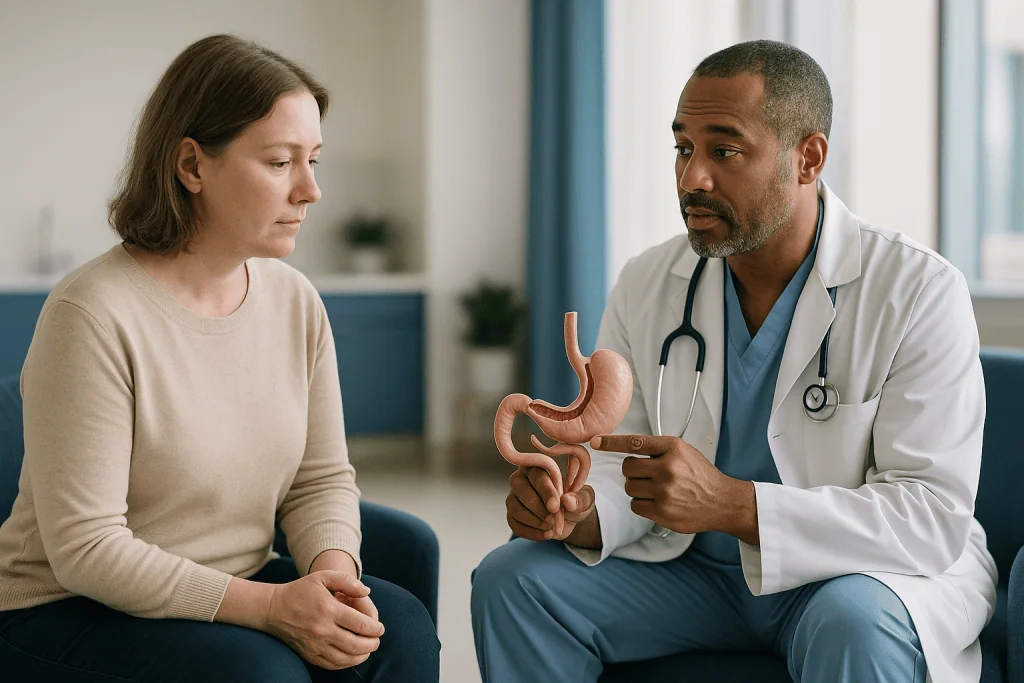
In a sleeve gastrectomy, the surgeon staples along the length of the stomach and removes roughly 80 percent of it, according to the Mayo Clinic. What remains is a slim tube shaped like a banana. Nothing is rerouted. Food still travels the normal path from esophagus to stomach to small intestine; there is simply far less room, and the part of the stomach that makes much of the appetite hormone ghrelin has gone.
In a Roux-en-Y gastric bypass, the surgeon first divides the top of the stomach to create a small pouch, about the size of a walnut and holding roughly an ounce, as the Mayo Clinic describes it. The small intestine is then cut, and the lower section is brought up and joined to the pouch. The bypassed portion, including the rest of the stomach and the first stretch of intestine, is reconnected further down so that bile and pancreatic juice still meet the food, just later. The arrangement looks like a Y, hence the name.
The practical consequences follow from the anatomy. After a sleeve, the stomach is smaller but functions much as before. After a bypass, food skips the acid-making stomach and the first part of the intestine where iron, calcium and some vitamins are normally absorbed. That is why bypass carries a stronger effect on diabetes and reflux and a heavier lifelong requirement for supplements and blood tests, points covered in later sections.
Does gastric sleeve make acid reflux worse, and why does bypass often help?
The honest answer to the first question is: for some people, yes, and it is not always predictable. The sleeve narrows the stomach into a tube with limited capacity to stretch, so pressure inside it rises after even a modest meal. The angle where the esophagus meets the stomach, which normally helps form a natural valve, is often flattened by the staple line. The acid-producing cells remain. Put those three changes together and you have a setting where contents can be pushed upward.
Some people with mild reflux find it improves after a sleeve, because weight loss lowers abdominal pressure. Others who had no symptoms before develop new heartburn. The Mayo Clinic lists gastroesophageal reflux among the recognized risks of sleeve gastrectomy, and the NIDDK makes the same point. Severity varies from occasional heartburn managed with lifestyle measures to persistent symptoms that eventually lead to conversion to a bypass.
Bypass tends to help for the mirror-image reasons. The pouch is so small that it contains few acid-producing cells. Bile, the digestive fluid made by the liver, no longer passes anywhere near the esophagus because it enters the intestine downstream of the Y junction. With less acid and no bile at the top of the system, there is little to reflux. This is why surgeons have long used bypass as the operation of choice for people with severe reflux, and as the rescue operation when reflux after a sleeve becomes unmanageable.
None of this makes bypass reflux-proof. A pouch that was constructed too large, or one that stretches over time, can produce symptoms. The difference lies in probability and mechanism, not certainty.
Which weight loss surgery is best for reflux? What the evidence actually shows
People searching for the best bariatric surgery for GERD want a one-word answer, and the closest honest one is “bypass.” The mechanistic case is strong, the pattern across guideline bodies is consistent, and the direction of conversion surgery, almost always from sleeve to bypass rather than the reverse, speaks for itself.
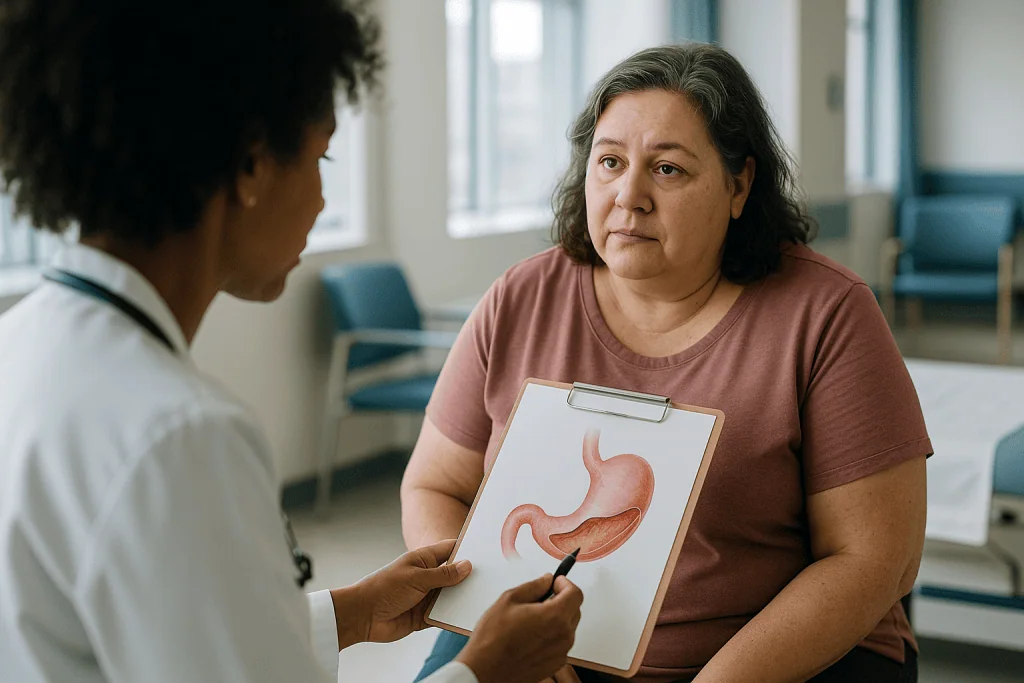
The caveats matter, though. Much of the comparative research consists of observational cohorts rather than large randomized trials, and reflux has been measured in inconsistent ways: symptom questionnaires in some studies, endoscopy or pH monitoring in others. Questionnaires can miss silent reflux, in which acid reaches the esophagus without obvious heartburn. The result is that published rates of new or worsened reflux after a sleeve vary widely between studies, and any single percentage quoted online should be treated with suspicion unless its source is clear.
What can be said with confidence, in line with the NIDDK’s summary, is that sleeve gastrectomy is the procedure associated with new or worsened GERD, and that bypass generally improves established reflux. What cannot be said is that bypass guarantees relief, or that every sleeve patient will suffer.
The decision is also rarely about reflux alone. A person with severe reflux but a history of intestinal surgery with heavy scarring may be a poor candidate for the rerouting a bypass requires. Someone whose reflux is mild and clearly driven by weight, with a normal endoscopy, may reasonably accept the sleeve’s risk in exchange for its simpler anatomy. The surgeon’s job is to put the probabilities side by side for that specific person; the person’s job is to say which trade-offs they can live with.
Hiatal hernia, Barrett's esophagus and the tests that come first
Before either operation, most teams want to look directly at the esophagus and stomach. An upper endoscopy, in which a thin flexible camera is passed down the throat under sedation, is the usual tool. It answers three questions that bear heavily on the sleeve-or-bypass choice.
First, is there a hiatal hernia? This is a condition in which the upper part of the stomach slides up through the gap in the diaphragm, the breathing muscle that separates chest from abdomen. The hernia weakens the natural anti-reflux barrier. It is common in people with higher body weight and is frequently found during bariatric work-up. Surgeons can repair it at the same time as either procedure, but repairing it alongside a sleeve does not change the sleeve’s high-pressure anatomy; the reflux risk remains. Alongside a bypass, the repair tends to reinforce an already favorable set-up.
Second, is there esophagitis, meaning visible inflammation or erosion of the esophageal lining caused by acid? Significant esophagitis is a marker of established disease and generally pushes the recommendation toward bypass.
Third, is there Barrett’s esophagus? Barrett’s is a change in the cells lining the lower esophagus, caused by long-standing reflux, that carries a small long-term risk of progressing to cancer. The Cleveland Clinic and other mainstream sources describe it as a complication of chronic GERD. Most bariatric surgeons regard Barrett’s as a strong reason to avoid a sleeve, because an operation known to aggravate reflux is a poor match for a lining that reflux has already altered.
Some centers add pH monitoring or a swallow X-ray study when the picture is unclear. The point of all this testing is simple: to find reflux before it finds the sleeve.
How type 2 diabetes tilts the decision
Type 2 diabetes, the condition in which the body stops responding properly to insulin and blood sugar rises, improves after both operations. Weight loss itself restores insulin sensitivity. The bypass, however, adds something the sleeve does not: a change in gut hormones that begins within days, before significant weight has come off.
Here is the mechanism as it is currently understood. When food arrives quickly in the lower small intestine, cells there release hormones, including one called GLP-1, that prompt the pancreas to make insulin and signal fullness to the brain. Bypass delivers food to that region far sooner than normal anatomy does. The Mayo Clinic lists type 2 diabetes among the conditions gastric bypass can improve, and the NHS notes that weight loss surgery can be considered at a lower body mass index threshold when type 2 diabetes is present.
Because of this hormonal effect, many teams lean toward bypass for people with longer-standing diabetes, those already using insulin, or those whose blood sugar has been hard to control. The sleeve still produces meaningful improvement, especially in people with recent-onset diabetes who are not yet on insulin, so it is not ruled out.
Two cautions belong here. Improvement is not the same as permanent resolution; blood sugar can rise again years later, particularly if weight returns, and any change to diabetes medicines after surgery must be managed by the prescribing clinician as glucose readings fall. And bypass can occasionally cause the opposite problem, episodes of low blood sugar one to three hours after eating, which overlaps with the late form of dumping syndrome described next.
Grazing, sweets and dumping syndrome: how eating habits shape the choice
Surgeons ask about eating patterns because the two operations punish different habits. Someone honest about their own tendencies can choose the operation whose built-in feedback they are most likely to tolerate.
Dumping syndrome is the clearest example. The Mayo Clinic describes it as a condition in which food, especially sugar, moves too quickly from the stomach into the small intestine. Early dumping, which begins 10 to 30 minutes after a meal, brings cramping, nausea, sweating, flushing and a racing heart as fluid rushes into the gut. Late dumping, one to three hours later, is a sugar surge followed by a crash. Dumping is far more common after bypass, because there is no pyloric valve, the muscular ring at the stomach outlet, to meter food into the intestine. The sleeve keeps that valve.
For a person whose eating is driven by sweets and sugary drinks, dumping is a double-edged consequence: an unpleasant deterrent that some find helpful and others find miserable. For someone who grazes on small savory portions all day, dumping is less relevant, but grazing is the habit most likely to undermine either operation, because a sleeve or a pouch only limits portion size, not frequency.
Alcohol deserves a mention. After bypass, alcohol enters the bloodstream faster and peaks higher because the stomach no longer slows it, and NIDDK guidance notes an increased sensitivity to alcohol after bariatric surgery. People with a complicated relationship with alcohol are usually asked to discuss this openly before an operation is chosen.
Carbonated drinks, large volumes of liquid with meals and eating quickly cause discomfort after both procedures. The operation does not remove the need to change habits; it changes the consequences of not doing so.
Who is usually offered which operation, and who is asked to wait
Eligibility for bariatric surgery in most guideline systems rests on body mass index plus health conditions. The NHS describes it as generally considered for adults with a BMI of 40 or more, or 35 to 40 with a condition such as type 2 diabetes or high blood pressure that could improve with weight loss, after non-surgical approaches have been tried. Some pathways consider lower thresholds in specific circumstances, such as recent-onset type 2 diabetes.
Within that eligible group, the lean toward bypass is strongest when any of the following apply: moderate or severe reflux, esophagitis or Barrett’s on endoscopy, long-standing or insulin-treated type 2 diabetes, or a hiatal hernia alongside symptoms. The lean toward a sleeve is strongest with no reflux, a history of extensive abdominal surgery or adhesions that make rerouting hazardous, conditions that already impair absorption of iron or vitamins, a need to keep the rest of the stomach accessible to endoscopy, or a strong preference for avoiding dumping and the heavier supplement burden.
People are commonly asked to wait, rather than refused, when smoking has not stopped (nicotine impairs healing and raises the risk of ulcers at the join after bypass), when an eating disorder or untreated depression needs attention first, when a dietary preparation program has not been completed, or when another medical problem such as a heart condition needs stabilizing. Pregnancy is a reason to postpone, and people are usually advised to avoid pregnancy for a period after surgery while weight is changing rapidly.
Age alone is not a barrier; fitness for anesthesia and realistic expectations matter more. Every one of these judgments is individual and sits with the multidisciplinary team.
Gastric bypass vs sleeve side by side
A table cannot make the decision, but it can show where the real differences lie. The entries below reflect mainstream descriptions from the Mayo Clinic, the NHS and the NIDDK, with mechanisms rather than outcome promises.
| Feature | Sleeve gastrectomy | Roux-en-Y gastric bypass |
|---|---|---|
| What is done | About 80 percent of stomach removed; no rerouting | Walnut-sized pouch; small intestine rerouted in a Y |
| Effect on existing reflux | May improve, stay the same, or worsen; new reflux is a recognized risk | Usually improves; used as the conversion operation for sleeve-related reflux |
| Effect on type 2 diabetes | Improvement mainly through weight loss | Improvement through weight loss plus early gut-hormone changes |
| Dumping syndrome | Uncommon; pyloric valve retained | Recognized risk, especially with sugary foods |
| Nutrient absorption | Largely preserved; vitamin B12 absorption can fall | Reduced absorption of iron, calcium, B12, folate, vitamin D |
| Lifelong supplements | Yes, generally fewer | Yes, more extensive, with regular blood monitoring |
| Reversibility | Not reversible; removed stomach cannot be restored | Technically reversible but rarely done; complex |
| Access to remaining stomach by endoscopy | Yes | Bypassed stomach cannot be reached by standard endoscopy |
| Typical hospital stay (NHS) | Usually 2 to 3 days | Usually 2 to 3 days |
| Specific later risks | Staple-line leak early; reflux and stricture later | Leak early; ulcer at the join, internal hernia, low blood sugar later |
Reading down the reflux and diabetes rows explains why those two conditions dominate the consultation. Reading down the nutrition and endoscopy rows explains why the sleeve remains the more frequently chosen operation for people without them. Each row is a trade, not a verdict.
What the first days and weeks usually look like
The early course is more alike than different. The NHS describes a hospital stay of usually two to three days for weight loss surgery, with four to six weeks commonly needed before people feel fully recovered and can return to normal activities. Walking begins on the day of surgery or the next morning, both to reduce the risk of blood clots in the legs and to help the bowel wake up.
Eating is rebuilt in stages. The first stretch is clear and then full liquids, followed by puréed foods, then soft foods, and finally regular textures in small portions. Each stage typically lasts a week or two, and the whole progression spans roughly six weeks, though dietitians adjust it to the individual and to how the staple line or join is healing. Protein is prioritized at every stage because the body is losing weight fast and needs to protect muscle.
Pain is usually managed with the medicines the team prescribes, and many people find shoulder-tip discomfort from the gas used during laparoscopy more bothersome than the incisions for the first day or two. Nausea is common early and usually settles. People who had reflux before a bypass often notice heartburn fading within the first weeks; people who develop reflux after a sleeve may notice it in the same window or much later, sometimes years on.
Follow-up visits are scheduled closely in the first months, with blood tests to check iron, vitamin B12, vitamin D and other markers. Supplements begin early and, as MedlinePlus and NIDDK both stress, continue for life. Driving, lifting and return to work are cleared by the surgical team based on the individual’s recovery, not a fixed calendar.
What happens 10 years after gastric bypass or a sleeve? The long view
The question people type into search engines, “what happens 10 years after gastric bypass,” has an unglamorous but reassuring core: for most people, life is ordinary, with a smaller plate, a daily supplement routine and an annual blood test. The sleeve vs bypass long term picture differs at the edges.
Weight regain is possible after both. The pouch or sleeve can stretch, and old eating patterns can return. Mainstream sources including the NIDDK are clear that surgery is a tool that works alongside lasting changes to diet and activity, not a substitute for them. Some people regain a portion of lost weight in the later years; a minority regain most of it. Regular follow-up catches drift early.
Nutrition is the long-term theme of bypass. Because the duodenum, the first part of the small intestine, is bypassed, iron deficiency anemia, vitamin B12 deficiency and bone thinning from poor calcium and vitamin D absorption can develop slowly over years if monitoring lapses. Sleeve patients face a lighter version of the same risk, chiefly for B12.
Bypass carries two mechanical late risks: an internal hernia, in which a loop of bowel slips through a gap created by the rerouting and can twist, and a marginal ulcer at the join between pouch and intestine, more likely in smokers and with regular use of anti-inflammatory painkillers. Both present with abdominal pain and are discussed in the red-flag section below.
The sleeve’s late risk is the one this article is about: reflux that appears or worsens over time, occasionally progressing to esophagitis or Barrett’s, which is why many teams recommend surveillance endoscopy for sleeve patients even without symptoms. Diabetes that improved can return in either group, usually alongside weight regain.
What people often get wrong
Myth one: the sleeve is the “gentle” option and the bypass is the drastic one. In operative terms both are major procedures with similar early risks of bleeding, leak and clots. The sleeve is simpler anatomically, but it is not reversible, because the removed stomach is gone. The bypass is more complex yet leaves all tissue in place.
Myth two: reflux after a sleeve can always be controlled with acid-suppressing medicines. Proton pump inhibitors, the class of medicine that reduces acid production in the stomach lining, help many people, but they do not address pressure or bile, and a minority eventually need conversion to bypass. Whether to start, continue or stop any such medicine is a decision for the prescribing clinician.
Myth three: bypass means never having reflux again. Most people improve substantially; a few develop symptoms from a stretched pouch or other anatomical issues. Better odds, not a guarantee.
Myth four: dumping syndrome is a built-in diet plan. For some it deters sugar; for others it causes fainting, distress and avoidance of eating out. It is a side effect, not a feature.
Myth five: regret is common. No major guideline publishes a regret rate for either operation, and the research consists of surveys with different questions and follow-up periods, so any single figure should be treated cautiously. What the surveys consistently show is that regret clusters around unmanaged side effects, unmet expectations and lack of follow-up, rather than around the choice of operation itself.
Myth six: surgery is the end of the work. The NIDDK frames it as the beginning of a lifelong partnership between the person, their diet and their follow-up team. People who treat it that way tend to describe the years afterward very differently from those who expected the operation to do everything alone.
Questions to ask your care team
A good consultation leaves the person understanding why a particular operation is being recommended for them, not just which one. These questions tend to draw out that reasoning.
- What did my endoscopy show, and does any finding, such as a hiatal hernia, esophagitis or Barrett’s esophagus, change which operation you recommend?
- Given my reflux history, how do you weigh the sleeve’s risk of worsening symptoms against the bypass’s additional complexity in my case?
- How long have I had type 2 diabetes, and does that history push you toward one operation over the other?
- If I have a hiatal hernia, will it be repaired at the same time, and how does that affect reflux risk with each procedure?
- What is the plan if I develop reflux after a sleeve: medicines, surveillance endoscopy, or conversion?
- Which vitamins and minerals will I need to take for life, how often will my blood be checked, and who coordinates that monitoring?
- How will my diabetes, blood pressure and other medicines be reviewed as my weight changes, and who makes those adjustments?
- What are the early warning signs of a leak, a blood clot, an internal hernia or an ulcer that I should recognize at home?
- What does your program’s follow-up schedule look like over the first year and beyond?
- Are there reasons, such as previous abdominal surgery, that make one operation technically safer for me?
It is reasonable to ask for time to think and to bring a family member or friend to the appointment. It is equally reasonable to ask the team to explain again anything that was not clear the first time. The decision belongs to the person, informed by the team’s experience with their specific findings.
When to call your doctor
Most recovery days are uneventful. A small number of symptoms, however, should not be watched and waited on, because the complications they can signal are time-sensitive. After either operation, contact the surgical team urgently, or seek emergency care, if any of the following develop.
- A fast heart rate, fever, worsening abdominal pain, or shoulder pain with a feeling of being unwell in the first days to weeks: these can indicate a leak from the staple line or the join.
- Shortness of breath, chest pain, or a swollen, painful calf: possible blood clot in the leg or lung.
- Vomiting blood or passing black, tarry stools: possible bleeding or ulcer.
- Inability to keep down liquids for more than a day: dehydration develops quickly when stomach capacity is small.
- Severe, cramping abdominal pain that comes in waves, especially months or years after a bypass: possible internal hernia, which can cut off blood supply to the bowel and needs same-day assessment.
- Episodes of shakiness, confusion, sweating or fainting an hour or more after eating: possible low blood sugar, which needs medical review.
- New or worsening heartburn, difficulty swallowing, food sticking, or regurgitation after a sleeve: reflux that needs evaluation rather than self-management.
- Persistent tiredness, pins and needles, hair loss beyond the expected early shedding, or pale skin: possible vitamin or iron deficiency.
Call sooner rather than later. Surgical teams would far rather hear about a symptom that turns out to be nothing than find a leak or hernia a day late. If the surgical team cannot be reached and symptoms are severe, emergency services are the right call, and the person should mention that they have had bariatric surgery, since this changes how some problems are investigated.
Frequently asked questions
Which weight loss surgery is best for reflux?
Gastric bypass is generally favored for people with established reflux. Its small pouch produces little acid and bile is diverted downstream, so there is little to wash back into the esophagus. A sleeve can improve mild reflux through weight loss but is also the operation that can cause or worsen GERD. The final recommendation depends on endoscopy findings and other health conditions, and rests with the treating team.
Does gastric sleeve make acid reflux worse?
It can, in some people. The sleeve creates a narrow stomach tube with higher internal pressure, a flattened natural valve angle and intact acid-producing cells, so contents may be pushed upward. Some patients improve as weight falls, others develop new heartburn, sometimes years later. Published rates vary widely between studies, which is why surgeons look for reflux carefully before recommending a sleeve.
What is the regret rate for gastric bypass patients?
No major guideline publishes a gastric bypass regret rate, and surveys use different questions and follow-up periods, so a single reliable figure does not exist. What the research does show consistently is that regret tends to cluster around unmanaged side effects, unrealistic expectations and poor follow-up rather than around the operation chosen. Discussing those factors beforehand is the practical safeguard.
What happens 10 years after gastric bypass surgery?
For most people, daily life involves smaller portions, lifelong supplements and periodic blood tests. Some weight regain is possible if the pouch stretches or eating patterns return, and diabetes that improved can recur alongside it. Late risks specific to bypass include internal hernia and ulcers at the join, both presenting with abdominal pain. Nutritional deficiencies can develop slowly if monitoring lapses.
Is gastric sleeve acid reflux treatable without another operation?
Often, yes. Weight loss itself, smaller meals, avoiding late eating and acid-suppressing medicines prescribed by the clinician help many people. If symptoms persist, or endoscopy shows inflammation or Barrett’s esophagus despite treatment, conversion to a gastric bypass is the usual surgical option. Decisions about medicines and surveillance endoscopy are made by the treating team based on findings.
Can a hiatal hernia be repaired during sleeve or bypass surgery?
Yes, surgeons commonly repair a hiatal hernia at the same time as either operation. Repair alongside a bypass reinforces an anatomy that already discourages reflux. Repair alongside a sleeve reduces one contributor but does not change the sleeve’s high-pressure tube, so reflux risk remains. A large hernia or significant symptoms often push the recommendation toward bypass.
Which is better for type 2 diabetes, sleeve or bypass?
Both improve type 2 diabetes, mainly through weight loss. Bypass adds early gut-hormone effects because food reaches the lower intestine quickly, which is why teams often favor it for long-standing or insulin-treated diabetes. The sleeve still produces meaningful improvement, especially in recent-onset diabetes. Blood sugar can rise again years later, and medicine changes are managed by the prescribing clinician.
What is dumping syndrome and does it happen after a sleeve?
Dumping syndrome occurs when food, especially sugar, passes too quickly into the small intestine, causing cramping, sweating, a racing heart and sometimes a later blood sugar crash. It is far more common after bypass, because the pyloric valve that meters food is bypassed. The sleeve keeps that valve, so dumping is uncommon, though rapid eating can still cause discomfort.
How long is recovery after sleeve vs bypass surgery?
The early course is similar for both. The NHS describes a hospital stay of usually two to three days and about four to six weeks to recover fully, with diet rebuilt from liquids through puréed and soft foods to regular textures over roughly six weeks. Return to driving, lifting and work is cleared by the surgical team based on individual healing.
Can gastric bypass be reversed if reflux or other problems develop?
Technically a bypass can be reversed because no tissue is removed, but reversal is complex, carries its own risks and is rarely performed. A sleeve cannot be reversed since the removed stomach is gone. In practice, problems after either operation are usually managed with medicines, dietary changes or revision surgery rather than reversal, and the team weighs each option individually.
References
- NIDDK (NIH): Types of weight-loss surgery
- NHS: Weight loss surgery
- MedlinePlus: Gastric bypass surgery
This article is for general information only and is not a substitute for professional medical advice. Please consult a qualified doctor about your individual situation.

More from the Blog

Long-Term Obesity Management: How Follow-Up Visits Keep Lifestyle Changes on Track
Long term obesity management works best as ongoing care rather than a single push. Regular follow-up visits let a care team track weight, waist…
Mini Gastric Bypass vs Standard Gastric Bypass: One Connection or Two, and Why It Matters
A mini gastric bypass (one anastomosis gastric bypass) joins a long, narrow stomach pouch to the small intestine with a single connection, while a…

Recovery After Robotic Bariatric Surgery: Walking, Sipping Fluids and the Staged Diet
Robotic bariatric surgery recovery time is usually similar to conventional laparoscopic (keyhole) surgery: a hospital stay of about one to two days, walking within…

Which Symptoms After Bariatric Surgery Are Expected and Which Mean Calling Your Surgeon?
After bariatric surgery, incision soreness, shoulder-tip gas pain, fatigue, mild nausea and changing bowel habits are expected and usually ease over the first weeks.…

Eating With a Gastric Balloon: From Liquids to Regular Meals Under Dietitian Guidance
Eating with a gastric balloon follows a staged plan: clear liquids for roughly the first day, full liquids through the first week, then pureed…

Can Metabolic Syndrome Be Reversed? What Realistic Progress Looks Like at Follow-Up Visits
Metabolic syndrome can often be reversed in the sense that matters clinically: when enough of its five measures return to a healthy range, a…