

Recovery After Robotic Bariatric Surgery: Walking, Sipping Fluids and the Staged Diet

Key Takeaways
- Mayo Clinic patient guidance puts the typical hospital stay after sleeve gastrectomy or gastric bypass at about one to two days, and comparative studies show robotic surgery does not reliably shorten it.
- The first walk is usually within hours of surgery because calf-muscle pumping lowers blood-clot risk and upright breathing protects the lungs.
- A staged diet moves from clear liquids to regular textures over roughly eight weeks, with each texture matched to the healing of the staple line rather than to appetite.
- Dehydration is one of the commonest reasons for readmission in the first weeks, so fluids are sipped on a schedule and separated from meals by about thirty minutes.
- The shoulder-tip ache after keyhole surgery is referred pain from carbon dioxide irritating the diaphragm and typically eases within one to three days with movement.
- Lifelong vitamin and mineral supplementation with regular blood tests is a standard part of care after both sleeve and bypass, and skipping it is the closest thing to a true 'never'.
Robotic bariatric surgery recovery time is usually similar to conventional laparoscopic (keyhole) surgery: a hospital stay of about one to two days, walking within hours of the operation, a staged diet that moves from clear liquids to soft foods over roughly six to eight weeks, and a return to most routine activity within a few weeks. Your surgical team sets your personal timeline based on the procedure and your health.
The first thing many people notice after weight-loss surgery is not the incisions. It is the medicine cup. A nurse sets down a tiny plastic measure of water and says, “Sip. Don’t gulp.” Twenty minutes later, another. For someone who has spent years being told to eat less, this new arithmetic of ounces and minutes can feel both strange and oddly reassuring.
If you are weighing up a robotic sleeve gastrectomy or gastric bypass, robotic bariatric surgery recovery time is probably the question sitting under all the others: How soon can I stand? When do I go home? When does a real meal happen again? The honest answer has fewer surprises than the internet suggests, and one genuinely important idea at its center: the robot changes how the surgeon works, not how your body heals.
This explainer walks through what the evidence actually shows about the hospital stay, the walking schedule, the sipping routine and the staged diet, and where the common myths go wrong.
What is a realistic robotic bariatric surgery recovery time?
Start with the phrase itself. “Robotic” describes the tools: the surgeon sits at a console and controls slim instruments through small incisions, with a magnified three-dimensional camera view. “Bariatric” simply means weight-loss surgery. Recovery time, then, is the period from the operating room to the point where you eat ordinary textures and move without thinking about your abdomen.
According to Mayo Clinic’s patient guidance, a hospital stay after sleeve gastrectomy or gastric bypass typically runs one to two days, and most people follow a diet that returns to regular textures at around eight weeks. Those two numbers frame the whole journey. Within them sit smaller milestones: your first walk down the corridor on the day of surgery, your first full day of clear liquids at home, the first spoon of pureed food, and the first time you forget to plan a meal around your stomach.
Where does the robot fit? Studies comparing robotic and standard laparoscopic bariatric operations have generally found similar hospital stays and similar complication rates. Cleveland Clinic’s overview of robotic surgery describes the approach as a form of minimally invasive surgery with recovery expectations comparable to other keyhole techniques. So the recovery timeline you read for laparoscopic surgery is, for practical purposes, your timeline too.
The variables that genuinely shift recovery are you, not the machine: your starting mobility, diabetes control, sleep apnea, lung health, and how faithfully you follow the walking and sipping plan. That is good news, because most of those are things you can prepare.
One more framing point. Recovery has two clocks: healing of the stomach staple line, which happens on a biological schedule, and adaptation of your eating, which happens on a behavioral one. The staged diet exists to keep the second clock from running ahead of the first.
What actually happens during robotic bariatric surgery
Picture a surgeon working through five or six incisions, each roughly the width of a fingertip. Carbon dioxide gas inflates the abdomen to create working space. Instead of holding long instruments directly, the surgeon operates them from a console a few feet away; every hand movement is translated into a wristed instrument tip inside your abdomen. Mayo Clinic notes the system offers a high-definition, magnified view and instruments that bend and rotate further than a human wrist.
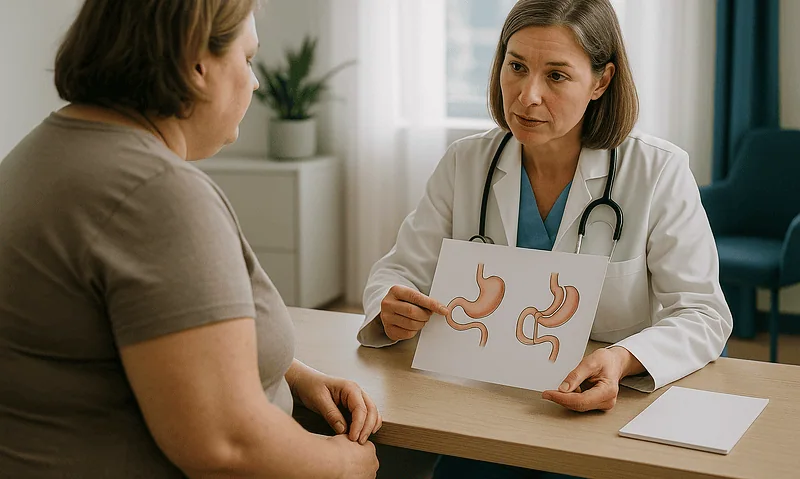
The operation itself is one of the standard bariatric procedures. In a sleeve gastrectomy, about three quarters of the stomach is removed along its outer curve, leaving a narrow tube. In a Roux-en-Y gastric bypass, a small pouch is created at the top of the stomach and connected directly to a lower loop of small intestine, so food bypasses the rest of the stomach and the first stretch of bowel. The staple lines and connections are the same whether the surgeon uses a robotic platform or conventional laparoscopic tools.
Why does this matter for recovery? Because the trauma your tissue experiences is defined by the size of the incisions and the amount of internal dissection, both of which are essentially identical between the two keyhole approaches. Your pain, your gas discomfort and your healing timeline follow from the surgery, not the console.
Anesthesia is general, so you are fully asleep. Many programs use a bundle of practices sometimes called enhanced recovery: warming, careful fluid management, nausea prevention and early mobilization. These bundles, not the robot, are often what patients are noticing when they report feeling better sooner.
Afterward you wake in recovery with sore incisions, sometimes a dry mouth from the breathing tube, and a nurse already planning your first walk. The next section explains who typically reaches that point, and who is asked to wait.
Who robotic bariatric surgery is usually for, and who is usually asked to wait
Eligibility is about the operation, not the robot. The NIH’s National Institute of Diabetes and Digestive and Kidney Diseases describes bariatric surgery as an option for adults with severe obesity, usually defined by body mass index (BMI, a ratio of weight to height) thresholds, often alongside weight-related conditions such as type 2 diabetes, sleep apnea or high blood pressure, when other approaches have not achieved sufficient results. Teams also assess whether someone can commit to lifelong follow-up and nutritional supplementation.
Robotic platforms are sometimes chosen for revision operations, for people with a very high BMI where longer instruments and wrist articulation may help, or simply because that is how a given surgeon trains and works. None of these are absolute rules, and the evidence does not show that one group of patients heals meaningfully faster with the robot.
Who is asked to wait? Typical reasons include:
- Uncontrolled medical conditions that raise anesthetic risk, such as poorly managed heart or lung disease, until they are optimized.
- Active smoking, because nicotine impairs healing of staple lines; most programs ask for a smoke-free period first.
- Untreated eating disorders or active substance misuse, which affect the ability to follow a staged diet.
- Pregnancy or plans to conceive very soon after surgery, since rapid weight loss and nutrient shifts complicate early pregnancy.
- Incomplete pre-operative preparation, including nutrition education and sleep-apnea evaluation.
Mayo Clinic emphasizes that candidacy also depends on willingness to make permanent changes in eating and activity, and to attend long-term follow-up. Being asked to wait is not a rejection; it is usually a plan to lower risk before an operation that is, after all, elective.
The final decision on procedure and timing rests with your surgical, anesthetic and dietetic team, who see the whole picture of your health.
When can I walk after bariatric surgery? Usually within hours
The most useful thing you can do for your recovery is also the simplest: get up. MedlinePlus discharge instructions for gastric bypass advise walking as much as you can starting in the hospital and continuing at home, gradually increasing distance. Most programs aim for the first walk on the day of surgery, often within a few hours of leaving the recovery area.
Why the urgency? Three mechanisms. First, blood clots. People with obesity who are lying still after abdominal surgery are at higher risk of deep vein thrombosis (a clot in a leg vein) and pulmonary embolism (a clot that travels to the lungs). Calf muscles act as a pump; walking squeezes blood back toward the heart. Compression stockings and, when the team judges it appropriate, a clot-preventing medicine are used alongside walking, but neither replaces it.
Second, lungs. General anesthesia and abdominal soreness make people breathe shallowly, which lets small airways collapse and invites pneumonia. Standing upright and walking expands the lungs; many teams also give a breathing device to use hourly.
Third, gut function. The bowel slows down after surgery. Movement encourages it to resume, which eases bloating and helps the trapped carbon dioxide from the operation disperse.
What counts as walking on day one? Short laps, not marathons: to the door, to the nurses’ station, back. A common pattern is a few minutes every hour you are awake. At home, MedlinePlus suggests increasing gradually while avoiding heavy lifting and strenuous activity for the period your surgeon specifies, often several weeks, to protect the incisions.
The shoulder or collarbone ache many people feel in the first day or two is usually referred pain from the gas irritating the diaphragm. Walking helps it settle faster than lying down does. If it worsens sharply or comes with breathlessness, that is a different matter, covered in the red-flag section.
Sipping fluids: why the first two weeks are measured in ounces
After surgery your new stomach holds a fraction of what it once did. Mayo Clinic describes the sleeve as roughly the size and shape of a banana, and a bypass pouch as smaller still. Swallowing a normal mouthful of water can stretch fresh staple lines and trigger pain, nausea or vomiting, so fluids are taken in deliberate, small sips throughout the day.
The hydration target is the same as before surgery; only the method changes. Dehydration is one of the commonest reasons people return to the hospital in the first weeks, MedlinePlus notes, because it is easy to under-drink when every sip feels like work. Signs include dark urine, dizziness on standing, headache and a dry mouth that will not clear.
Practical patterns that dietitians commonly teach:
- Keep a bottle within reach at all times and sip on a schedule, not just when thirsty; thirst signals are unreliable early on.
- Separate drinking from eating once you start pureed foods, typically stopping about thirty minutes before a meal and waiting about thirty minutes after, so liquid does not fill the pouch or flush food through too quickly.
- Choose flat, sugar-free, non-caffeinated drinks first. Carbonation stretches the stomach uncomfortably, and sugary drinks can trigger dumping syndrome after bypass, a rush of symptoms when sugar hits the small intestine.
- Room temperature is often tolerated better than ice cold in the first days.
Protein drinks usually join clear liquids within the first week, because protein supports healing and preserves muscle while calories are very low. Your dietitian will tell you the target; it varies by procedure and body size.
The sipping phase is where most people learn the rhythm of their new anatomy: the feeling of fullness arrives suddenly, and ignoring it is unpleasant. Learning to stop at that signal is not a rule imposed from outside. It is the skill the whole diet progression is built to teach.
Bariatric diet stages after surgery: from clear liquids to solid food
The staged diet is not arbitrary. Each texture matches a phase of healing: liquids while the staple line is freshest, purees as swelling settles, soft foods as the pouch adapts, and finally regular textures once the connection is robust. Mayo Clinic’s published gastric bypass diet describes the general sequence below; timings are typical ranges and your program’s schedule may differ.
| Stage | Typical timing | What it looks like | Purpose |
|---|---|---|---|
| Clear liquids | First day or two | Water, broth, sugar-free gelatin, diluted juice | Test swallowing; protect staple line |
| Full liquids | Roughly days 2 to 14 | Protein shakes, thin soups, milk or alternatives | Protein for healing while volume stays tiny |
| Pureed | Roughly weeks 2 to 4 | Blended lean meats, eggs, beans, cottage cheese | Introduce texture without chewing burden |
| Soft foods | Roughly weeks 4 to 8 | Ground meat, flaked fish, cooked vegetables, soft fruit | Rebuild chewing habits; small portions |
| Regular textures | Around week 8 onward | Most foods, small portions, protein first | Long-term eating pattern |
Two habits carry across every stage. Eat slowly, chewing thoroughly; MedlinePlus advises chewing each bite until it is nearly liquid, because a narrow outlet does not forgive large pieces. And prioritize protein at each meal, then vegetables, then anything else, since the pouch fills before you reach the plate’s end.
Foods that often cause trouble even after week eight include dry or tough meat, bread that turns doughy, rice and pasta that swell, fibrous vegetables such as celery, and popcorn or nuts early on. Tolerance is individual and improves with time for many people.
Nausea, vomiting or pain after a new food usually means the stage was advanced too quickly or the bite too large. The fix is to step back a texture for a few days and try again, in consultation with your dietitian.
How long is the hospital stay after bariatric surgery?
Shorter than most people expect. Mayo Clinic’s patient information for both sleeve gastrectomy and gastric bypass describes a hospital stay of about one to two days for uncomplicated cases. Some programs discharge selected sleeve patients the day after surgery; others keep everyone two nights. The variation reflects local protocols and individual risk more than the surgical approach.
Robotic surgery has not been shown to shorten this reliably. Comparative studies generally report similar length of stay for robotic and conventional laparoscopic bariatric operations. If a program quotes a faster discharge, ask whether that reflects the robot or an enhanced recovery protocol that would apply either way.
What has to happen before you go home? Discharge criteria are fairly consistent across programs:
- You can walk independently, including to the bathroom.
- You are tolerating clear liquids without persistent vomiting, and drinking enough to stay hydrated.
- Pain is controlled with medicines you can take at home.
- Vital signs are stable and there are no signs of bleeding or a leak from the staple line.
- You understand your diet stage, your walking plan and your warning signs.
Some patients stay longer. Sleep apnea that needs overnight monitoring, difficulty swallowing fluids, a slow bowel, or any concern on a post-operative test can add a night. NHS guidance on weight-loss surgery notes that recovery times vary and that it can take several weeks to feel fully back to normal even after a short stay.
Plan for the hospital as a launch pad, not the recovery itself. Arrange someone to drive you home, since you cannot drive under the influence of pain medicines, and expect to spend the first week at home mostly sipping, walking short laps and resting. Most people return to desk work within one to three weeks and to more physical jobs later, at the surgeon’s direction; MedlinePlus suggests discussing timing based on your specific work.
Gastric sleeve recovery timeline versus gastric bypass: week by week
The two most common operations recover along nearly parallel tracks, with a few differences worth knowing. Sleeve gastrectomy involves one long staple line and no intestinal reconnection. Gastric bypass adds two connections and re-routes the bowel, which introduces the possibility of dumping syndrome and marginal ulcers (sores where pouch meets intestine) later on.
Here is how a typical uncomplicated course tends to unfold, drawing on Mayo Clinic and MedlinePlus patient guidance:
Day of surgery. Both: first walk within hours, small sips of water, pain and gas discomfort peak in the evening.
Days 1 to 2. Both: discharge if criteria met. Clear liquids. Shoulder ache from gas begins to fade with movement.
Week 1. Both: full liquids with protein shakes; fatigue is prominent because calorie intake is very low. Incisions itch as they heal. Short walks several times daily. Bypass patients may notice bowel changes as the new route settles.
Weeks 2 to 4. Both: pureed foods begin. Energy improves. Many return to sedentary work. Hair shedding sometimes starts later in this period and is usually temporary, linked to rapid weight loss and low protein intake.
Weeks 4 to 8. Both: soft foods, then regular textures around week eight. Lifting restrictions typically lift on the surgeon’s say-so. Vitamin and mineral supplementation is well established as a lifelong routine by now.
Months 3 to 12. Both: weight loss continues steadily. Bypass patients learn which sugary or fatty foods provoke dumping. Sleeve patients sometimes notice reflux, which the team monitors.
The differences are more about what to watch than how long things take. Neither procedure heals faster because a robot was involved, and the week-by-week picture above is a typical range, not a schedule your body has agreed to. Slower progress is common and is not failure.
Pain, drains and the shoulder ache nobody warns you about
Pain after keyhole bariatric surgery is real but usually manageable, and it changes character across the first week. The incisions themselves are sore, especially the slightly larger one through which the removed stomach or stapling device passed. Deep inside, the staple line and any intestinal connection ache when the stomach contracts, which is one reason sips feel more comfortable than gulps.
Then there is the gas. The carbon dioxide used to inflate the abdomen irritates the diaphragm, and the diaphragm shares nerve pathways with the shoulder tip. The result is an ache under the collarbone or in the shoulder that has nothing to do with your shoulder and everything to do with the operation. It typically eases over one to three days and responds to walking, warmth and changing position. Lying flat tends to make it worse.
Pain control after bariatric surgery has a particular wrinkle. Non-steroidal anti-inflammatory drugs, a class of common painkillers, are generally avoided long term after gastric bypass because they raise the risk of ulcers at the new connection, and many surgeons limit them after sleeve gastrectomy too. Teams therefore lean on other classes, local anesthetic at the incisions and non-drug measures. Follow your prescribing clinician’s plan and ask before taking anything from a home medicine cabinet.
Drains are less common than they once were. Some surgeons place a thin tube near the staple line for a day or two to watch for leaks; others rely on clinical signs. If you have one, the nursing team will show you how it is emptied and when it comes out.
Constipation is a frequent, underdiscussed discomfort, driven by low fiber intake, iron supplements and pain medicines. Fluids and walking help; your team can advise further. What should not be normal is escalating pain, a fever, or a heart rate that stays high. Those belong in the red-flag section, not the wait-and-see column.
What is the downside of robotic surgery?
People searching this question deserve a straight answer rather than a brochure. Robotic platforms have genuine strengths: magnified three-dimensional vision, wristed instruments that reach around structures, and a seated, ergonomic posture for the surgeon that may reduce fatigue during long or revisional operations. Mayo Clinic and Cleveland Clinic both describe these as the principal advantages.
The downsides are equally concrete.
- Time under anesthesia. Docking the robot and setting up instruments adds minutes, and many comparative studies report longer total operating times for robotic bariatric procedures than for conventional laparoscopy. Longer anesthesia is a modest but real consideration.
- No tactile feedback. The surgeon cannot feel tissue tension through the console; they judge it visually. Experienced surgeons adapt, but it is a different skill set.
- Evidence of equivalence, not superiority. For sleeve gastrectomy and gastric bypass, the published comparisons largely show similar complication rates, similar leak rates and similar hospital stays. A recovery advantage has not been consistently demonstrated.
- Resource intensity. The systems require dedicated equipment, maintenance and trained staff, which shapes where and how they are used.
- Conversion. Any keyhole operation can be converted to open surgery if bleeding or anatomy demands it. Robotic surgery is no exception.
None of this makes robotic surgery a poor choice. The most defensible position from the evidence is that robotic and laparoscopic bariatric surgery are two ways of performing the same operation with broadly comparable outcomes, and the surgeon’s experience with their chosen approach matters more than the approach itself.
A fair question for your consultation is therefore not “Is the robot better?” but “Which approach do you and your team perform most often, and why is it the right one for me?” The answer tells you far more about your likely recovery than any marketing claim.
How long does it take to lose 100 lbs after gastric bypass?
This is one of the most searched questions about bariatric surgery, and it needs careful handling because the answer depends on where you start. Weight loss after surgery is usually described as a percentage of excess weight (the amount above a healthy-range target) or of total starting weight, not as a fixed number of pounds.
Mayo Clinic’s patient information states that after gastric bypass it may be possible to lose around seventy percent or more of excess weight within two years, and after sleeve gastrectomy around sixty percent or more of excess weight in the same period. MedlinePlus notes that many people lose weight steadily over the first year, with the pace fastest in the early months and slowing as the body adapts. These are averages drawn from large groups, not predictions for an individual.
So for someone carrying roughly 150 pounds of excess weight, a loss of 100 pounds sits within the range those averages describe over about one to two years. For someone with 100 pounds of excess weight, losing all of it would be at the upper end of typical outcomes. For someone with less, it may not be a realistic or healthy goal at all.
Several factors shape the curve: adherence to protein targets and small portions, regular movement, sleep, mental health support, and how well any weight-related conditions such as diabetes are managed. Some regain over the years is common and does not mean the operation failed; it is one reason long-term follow-up is built into every credible program.
Robotic surgery has no bearing on this number. The anatomy created is the same, so the weight-loss trajectory is the same. If you are choosing a procedure partly for its expected weight loss, that is a conversation about sleeve versus bypass, guided by your team, and not about how the surgeon held the instruments.
What people often get wrong about robotic bariatric surgery recovery time
Recovery myths cluster around the word “robotic,” and clearing them up saves disappointment.
Myth: the robot means you heal in half the time. The evidence does not support this. Robotic and laparoscopic bariatric operations use similarly sized incisions and produce similar internal healing demands. Hospital stays and return-to-work timelines are broadly comparable. What speeds recovery is early walking, hydration and following the staged diet.
Myth: the robot operates by itself. Every movement is made by the surgeon at the console. The system has no autonomy. Mayo Clinic describes it as a tool that extends the surgeon’s hands, not a replacement for them.
Myth: once you are home, the hard part is over. Many people find the second week harder than the first. Fatigue from very low calorie intake, boredom with liquids, and the emotional adjustment to a changed relationship with food often peak then. Knowing this in advance makes it easier to ride out.
Myth: if you can tolerate a food, it is fine to advance early. Tolerating a texture is not the same as the staple line being ready for it. Diet stages track healing, not appetite. Advancing early raises the risk of vomiting, which strains fresh suture lines.
Myth: pain equals a problem. Soreness at incisions and gas ache in the shoulder are expected. What matters is the trend: improving day by day is reassuring, worsening or new pain is not.
Myth: you will never feel hungry again. Hunger hormones fall after surgery, particularly after sleeve gastrectomy, and many people report much less hunger for months. It commonly returns in some form. The habits built during the staged diet are what carry you through that.
Myth: complications happen only in the hospital. Leaks, clots and dehydration can present after discharge, which is why the red-flag list matters at home as much as on the ward.
What can you never do again after bariatric surgery?
The honest answer is that the list of absolute nevers is shorter than folklore suggests, and the list of lifelong adjustments is longer. Bariatric surgery changes anatomy permanently, so a few habits become risky rather than merely unwise.
Skipping your supplements. This is the closest thing to a true never. Both sleeve and bypass reduce absorption or intake of key nutrients; MedlinePlus and Mayo Clinic describe lifelong vitamin and mineral supplementation, with regular blood tests, as a standard part of care. Deficiencies in iron, vitamin B12, vitamin D, calcium and others can develop quietly over years.
Routine use of certain anti-inflammatory painkillers is generally advised against after gastric bypass because of ulcer risk at the pouch connection. Your prescribing clinician will guide alternatives.
Drinking with meals becomes a lasting habit change. Liquids fill the pouch and can wash food through quickly, undermining fullness.
Carbonated drinks are discouraged by many programs because the gas stretches the small stomach uncomfortably; some people tolerate them later, others never do.
Alcohol deserves particular caution. After bypass it is absorbed faster and peaks higher, and some people develop new alcohol problems after surgery. Many teams recommend avoiding it in the first year and being careful thereafter.
Smoking impairs healing and raises ulcer risk; programs treat quitting as permanent.
Large, fast meals are physically no longer possible without discomfort or vomiting.
What you can usually do again, with your team’s guidance: exercise vigorously, travel, eat at restaurants, enjoy most foods in small portions, and, after an interval the team advises, become pregnant with appropriate monitoring. The operation reshapes eating; it does not end a normal life. The people who fare best tend to treat the adjustments as a new routine rather than a list of losses.
Questions to ask your care team before robotic bariatric surgery
A good consultation leaves you with fewer myths and a clearer personal timeline. These questions tend to draw out the information that matters most.
- Which procedure are you recommending for me, and why that one rather than the alternatives?
- Do you perform this operation robotically, laparoscopically, or both? How does your experience with each shape your recommendation for me?
- What is your program’s typical hospital stay, and what would make mine longer?
- What does your staged diet look like week by week, and who do I contact if I cannot tolerate a stage?
- How much walking do you expect on the day of surgery and in the first week at home?
- What is your plan for preventing blood clots, and for how long after discharge does it continue?
- Which of my current medicines will change after surgery, including how they are absorbed, and who manages that?
- Which pain medicines should I avoid long term after this operation?
- What supplements will I take for life, and how often will my blood be checked?
- What symptoms should make me call you immediately, and what number do I use out of hours?
- When can I drive, return to my specific job, lift my children or resume exercise?
- How is follow-up organized over the first year and beyond, and does it include dietetic and psychological support?
- If I am planning a pregnancy, how long do you advise waiting and what monitoring is involved?
Write the answers down or bring someone to take notes. Recovery goes more smoothly when the plan lives on paper rather than in memory, especially during the first foggy week home.
These are not challenges to the team’s expertise. Good surgical programs welcome them, because a patient who understands the plan follows it, and following the plan is the strongest predictor of a smooth robotic bariatric surgery recovery.
When to call your doctor after robotic bariatric surgery
Most recovery days are uneventful. A short list of symptoms should never be waited out, because the two most serious early complications, a leak from the staple line and a blood clot, can start subtly and progress quickly. MedlinePlus and Mayo Clinic guidance for post-operative bariatric patients highlight the following.
Call your surgical team or emergency services immediately for:
- A racing heartbeat that does not settle with rest, especially with fever, since a persistently fast pulse can be the earliest sign of a leak.
- Worsening or severe abdominal pain, or pain spreading to the left shoulder that intensifies rather than fades.
- Fever, chills or shaking.
- Shortness of breath, chest pain, or coughing up blood, which can indicate a clot in the lung.
- Pain, swelling, warmth or redness in one calf or thigh.
- Vomiting blood, or black or tarry stools.
- Inability to keep down any fluids for most of a day, or signs of dehydration such as dizziness on standing, very dark urine or passing very little urine.
Call during working hours for:
- Redness, spreading warmth, pus or a foul smell at an incision.
- Persistent nausea or vomiting after advancing a diet stage.
- New difficulty swallowing that does not improve when you slow down and take smaller bites.
- Low mood, anxiety or thoughts of self-harm; emotional shifts after surgery are common and support is part of care.
When in doubt, call. Teams would far rather reassure you about a harmless symptom than hear about a serious one late. Keep the emergency contact number your program gives you somewhere visible, and tell whoever is with you in the first week what the red flags are, because a person who is unwell may not recognize them.
Every decision about investigating or treating a symptom rests with your treating clinicians, who know your operation and your history. This list is here to help you reach them in time.
Frequently asked questions
How long is the hospital stay after robotic bariatric surgery?
Typically about one to two days for an uncomplicated sleeve gastrectomy or gastric bypass, according to Mayo Clinic patient information. The robotic approach has not been shown to shorten this compared with conventional laparoscopic surgery. Discharge depends on walking independently, tolerating clear liquids, controlled pain and stable vital signs. Sleep apnea monitoring, slow bowel recovery or any concern about the staple line can add a night. Your surgical team decides when you are ready.
When can I walk after bariatric surgery?
Usually within a few hours of leaving the recovery area, on the same day as the operation. MedlinePlus discharge guidance advises walking as much as you can in the hospital and increasing gradually at home. Early walking lowers the risk of blood clots, helps the lungs re-expand after anesthesia and encourages the bowel to resume normal movement. Short, frequent laps are the goal; heavy lifting and strenuous exercise wait until your surgeon clears them.
What are the bariatric diet stages after surgery?
Mayo Clinic describes a progression from clear liquids in the first day or two, to full liquids including protein drinks for about two weeks, then pureed foods around weeks two to four, soft foods around weeks four to eight, and regular textures from roughly week eight. Timings vary by program. Each stage matches healing of the staple line, and stepping back a stage for a few days is the usual response to nausea or vomiting.
What is the gastric sleeve recovery timeline compared with gastric bypass?
The two operations recover along very similar tracks: a one-to-two-day hospital stay, liquids for about two weeks, purees and soft foods through week eight, and a return to desk work within one to three weeks. Bypass adds intestinal connections, so patients watch for dumping syndrome after sugary foods and for ulcers at the pouch connection. Sleeve patients more often notice reflux. Neither heals faster because a robot was used.
How long does it take to lose 100 lbs after gastric bypass?
It depends on how much excess weight you start with. Mayo Clinic notes that people may lose around seventy percent or more of excess weight within two years after bypass, with the fastest loss in the early months. For someone with roughly 150 pounds of excess weight, a 100-pound loss falls within that range over about one to two years. For someone starting with less, it may not be realistic or healthy. These are group averages, not individual predictions.
What is the downside of robotic surgery for weight loss?
The main downsides are longer total operating and anesthesia time for setup, loss of tactile feedback for the surgeon, and resource intensity. Published comparisons of robotic and laparoscopic bariatric surgery mostly show similar complication rates, leak rates and hospital stays rather than a clear recovery advantage. Any keyhole operation can also be converted to open surgery if needed. Surgeon experience with their chosen approach matters more than the platform.
What can you never do again after bariatric surgery?
Very few things are absolute, but some become lifelong adjustments. Daily vitamin and mineral supplementation with regular blood tests is permanent. Certain anti-inflammatory painkillers are generally avoided after gastric bypass because of ulcer risk. Drinking with meals, carbonated drinks, large fast meals and smoking are discouraged long term, and alcohol needs particular caution because it is absorbed faster. Exercise, travel, restaurant meals in small portions and pregnancy after an advised interval usually remain possible.
Why does my shoulder hurt after robotic bariatric surgery?
The carbon dioxide gas used to inflate the abdomen irritates the diaphragm, which shares nerve pathways with the shoulder tip, so the ache is felt under the collarbone even though nothing is wrong with the shoulder. It typically eases over one to three days and improves with walking, warmth and changing position. Shoulder pain that intensifies, or comes with fever, a racing pulse or breathlessness, is a red flag and needs an urgent call to your team.
How much should I drink after bariatric surgery?
Your hydration target stays about the same as before surgery, but it must be reached in small sips spread across the whole day, because the new stomach holds only a few ounces at a time. MedlinePlus notes dehydration is a common reason for readmission early on. Dark urine, dizziness on standing and headache are warning signs. Your dietitian sets the daily fluid and protein targets for your procedure and body size, so follow their figures.
When can I go back to work after robotic bariatric surgery?
Many people return to desk-based work within one to three weeks, while physically demanding jobs wait longer, often several weeks, until the surgeon lifts lifting restrictions. MedlinePlus advises discussing timing with your team based on your specific role. Fatigue from very low calorie intake is common in the second and third weeks, so a phased return is sensible. Driving resumes only once you are off pain medicines that impair alertness and can brake comfortably.
References
This article is for general information only and is not a substitute for professional medical advice. Please consult a qualified doctor about your individual situation.

More from the Blog

Long-Term Obesity Management: How Follow-Up Visits Keep Lifestyle Changes on Track
Long term obesity management works best as ongoing care rather than a single push. Regular follow-up visits let a care team track weight, waist…

Gastric Bypass vs Gastric Sleeve: Why Reflux, Diabetes and Eating Habits Shape the Choice
For people with established acid reflux, gastric bypass is usually favored over a gastric sleeve, because the small pouch produces little acid and the…
Mini Gastric Bypass vs Standard Gastric Bypass: One Connection or Two, and Why It Matters
A mini gastric bypass (one anastomosis gastric bypass) joins a long, narrow stomach pouch to the small intestine with a single connection, while a…

Which Symptoms After Bariatric Surgery Are Expected and Which Mean Calling Your Surgeon?
After bariatric surgery, incision soreness, shoulder-tip gas pain, fatigue, mild nausea and changing bowel habits are expected and usually ease over the first weeks.…

Eating With a Gastric Balloon: From Liquids to Regular Meals Under Dietitian Guidance
Eating with a gastric balloon follows a staged plan: clear liquids for roughly the first day, full liquids through the first week, then pureed…

Can Metabolic Syndrome Be Reversed? What Realistic Progress Looks Like at Follow-Up Visits
Metabolic syndrome can often be reversed in the sense that matters clinically: when enough of its five measures return to a healthy range, a…