

Glaucoma: First Signs, Whether It Is Hereditary and Whether It Can Be Cured
Key Takeaways
- The most common form of glaucoma causes no pain or blur in its early years; the NEI estimates that about half of the 3 million Americans who have it do not know.
- A parent or sibling with glaucoma places you in the group the NEI advises to have a dilated eye exam every one to two years, yet most first-degree relatives never develop the disease.
- Glaucoma diagnosed before about age 40 is more likely to involve a single faulty gene; MedlinePlus Genetics reports that MYOC mutations account for 10 to 33 percent of juvenile open-angle cases.
- Elevated pressure inside the eye is the leading cause that treatment can change, but normal-tension glaucoma proves that nerve vulnerability, not pressure alone, decides who is harmed.
- Vision already lost to glaucoma cannot be restored; every proven treatment works by lowering eye pressure to slow or stop further loss of optic nerve fibers.
- A sudden painful red eye with headache, nausea and halos around lights signals acute angle-closure glaucoma and needs same-day emergency care.
Glaucoma often runs in families: having a parent or sibling with the condition is one of the strongest known risk factors, though inheritance is not destiny and most relatives never develop it. The most common form causes no early symptoms, so regular dilated eye exams matter most. Glaucoma cannot be cured or reversed, but when it is caught early, treatment usually slows or halts further vision loss.
A woman in her sixties sits in a dim exam room, chin on the rest, pressing a button each time a tiny light flickers somewhere in the gray field in front of her. She feels fine. Her glasses prescription has barely changed in a decade. Then the technician prints a map of her visual field, and there is a soft, crescent-shaped blank spot in the upper left that she has never once noticed.
That is how glaucoma tends to arrive: not with pain, not with blur, but with a quiet erasing at the edges that the brain politely fills in. Her mother had it. Her aunt had it. She had assumed, as many people do, that she would know when it was her turn.
The questions she asked next are the ones people type into search bars late at night. Is this inherited? Should my children be checked? And the hardest one: can it be fixed? The honest answers are more nuanced, and more hopeful, than the myths.
What are the first signs of glaucoma?
For the most common type, primary open-angle glaucoma, the truthful answer is unsettling: there usually are no first signs you can feel. The National Eye Institute (NEI), part of the NIH, estimates that about 3 million Americans have glaucoma and roughly half of them do not know it. No ache, no redness, no sudden fog.
What happens instead is slow. Nerve fibers at the back of the eye are lost gradually, and the earliest gaps appear in peripheral or side vision, often in one eye more than the other. Because the two eyes overlap and the brain is remarkably good at papering over missing information, a person can lose a meaningful slice of their visual field and still read, drive and recognize faces without a hint that anything is wrong.
Some people do eventually notice small things. Bumping a shoulder on doorframes. Missing a step at the edge of a curb. Needing more light to read than a year ago. Finding that a car in the next lane seems to appear from nowhere. Each of these is easy to blame on age, tiredness or a new prescription, which is precisely why they slip past.
The less common angle-closure form is the exception. When drainage inside the eye blocks suddenly, pressure spikes within hours and the symptoms are dramatic: severe eye pain, headache, nausea, a red eye, blurred vision and colored halos around lights. That presentation is an emergency, covered in the red-flag section below.
Open-angle vs. angle-closure glaucoma: what is the difference?
Nearly every practical question about glaucoma, from symptoms to urgency, depends on which type is involved. Both damage the optic nerve, and both usually involve pressure inside the eye, but they behave like two different diseases in daily life. Mayo Clinic and the NHS describe the main forms this way:
| Feature | Primary open-angle glaucoma | Acute angle-closure glaucoma |
|---|---|---|
| How common | The most common type in the US and UK | Rare, more frequent in people of East Asian heritage and in farsighted eyes |
| What goes wrong | Drainage channels become inefficient over years | The iris blocks the drainage angle abruptly |
| Onset | Slow, over years | Sudden, over hours |
| Early symptoms | Usually none; side vision fades unnoticed | Severe pain, red eye, headache, nausea, halos around lights |
| Urgency | Routine but essential follow-up | Same-day emergency care |
There are other, less common categories worth knowing by name. Normal-tension glaucoma damages the nerve even though pressure readings sit in the typical range, a reminder that pressure is a risk factor, not the whole story. Secondary glaucoma follows another problem such as injury, inflammation or long-term steroid use. Congenital glaucoma is present at or soon after birth, and it is the form where a single gene most often plays a direct role.
When people ask whether glaucoma is hereditary, they are almost always thinking of the slow open-angle type, and that is where family history matters most.
What is the number one cause of glaucoma?
Raised pressure inside the eye is the single most important known cause, and the only one that current treatment can change. Understanding why requires a quick tour of plumbing.
The front of the eye is constantly bathed in a clear fluid called aqueous humor, produced behind the iris and drained through a spongy meshwork at the angle where the iris meets the cornea. Production and drainage are normally balanced, like a sink with the tap running and the plug out. If the drain clogs or narrows, fluid backs up and pressure rises. The delicate fibers of the optic nerve, exiting the back of the eye, sit downstream of that pressure, and over time they thin and die.
Yet pressure alone does not explain everything. Some people carry readings above the typical range for decades without nerve damage, a state called ocular hypertension. Others develop classic glaucoma with pressure that never leaves the normal band. Researchers described by the NEI and Mayo Clinic point to how well blood supplies the nerve, how mechanically resilient the nerve head is, and how thick the cornea is as factors that decide who converts pressure into damage.
So the honest framing is this: elevated pressure is the leading modifiable cause, and lowering it is the foundation of every treatment. Genetics, age and ancestry set how vulnerable a given optic nerve is to that pressure. Which is exactly why family history deserves its own discussion.
Is glaucoma hereditary?
Yes, in the way that most common adult conditions are hereditary: it clusters in families, and family history is one of the most consistent risk factors listed by the NEI, Mayo Clinic, Cleveland Clinic and the NHS. What it is not, for the common open-angle form, is a simple inherited trait passed down like eye color.
Population studies over several decades have compared people who have a parent or sibling with glaucoma against those who do not. The consistent finding is a several-fold higher risk for first-degree relatives. The exact multiplier varies from one study to another depending on how thoroughly the relatives were examined, which is a large caveat, because many relatives in older surveys were never tested and simply did not know they were affected.
The likely reason for the pattern is a mix of many genes rather than one. Dozens of common DNA variants, each nudging risk slightly, influence how the eye drains fluid, how thick the cornea grows and how sturdy the optic nerve is. Inherit an unlucky combination and your threshold for damage sits lower. Families also share environments, ancestry and habits, all of which add to the clustering.
There is one sharp exception. Glaucoma that appears in infancy or before roughly age 40 is more often driven by a single faulty gene and can follow a clear inheritance pattern, which is why eye specialists ask not only whether relatives had glaucoma but how young they were when it started.
Will I get glaucoma if my mom has it?
Probably not, and almost certainly not without warning if you are being examined. Both halves of that sentence matter.
Having a mother, father or sibling with glaucoma raises your odds well above the general population, and it moves you into the group the NEI says should have a dilated eye exam every one to two years. That is the practical consequence: not fear, but a schedule. Most people with an affected parent still never develop the disease. Risk is a slope, not a switch.
Two details sharpen the picture. First, the age at which your relative was diagnosed. A parent diagnosed at 75 tells you less about your own genetic load than a parent diagnosed at 45, because early-onset disease points more strongly toward high-impact genes. Second, how many relatives are affected. A single grandparent with glaucoma in their eighties is close to background noise given how common the condition becomes with age. A parent and a sibling both diagnosed in midlife is a pattern worth telling your eye doctor about explicitly.
People sometimes ask whether risk comes more strongly from the mother’s side. Current evidence does not support that idea for the common form; the genes involved are spread across many chromosomes and inherited from both parents. The best gift a parent with glaucoma can give adult children is a clear account of their own diagnosis, age at onset and type, so those children can hand a precise history to their own eye care team.
Which genes are linked to glaucoma?
Genetics research has split glaucoma into two stories, and they lead to different conversations in the clinic.
The first is the rare, single-gene story. MedlinePlus Genetics, the NIH’s consumer genetics resource, explains that early-onset glaucoma affects roughly 1 in 10,000 people and is frequently caused by mutations in specific genes. The best studied is MYOC, which makes a protein called myocilin in the drainage tissue; faulty versions are thought to clog the cells that maintain outflow. MedlinePlus reports that MYOC mutations account for about 10 to 33 percent of juvenile open-angle glaucoma cases, the form that appears in the teens through early adulthood. A second gene, CYP1B1, is the most common cause of primary congenital glaucoma in babies. These conditions can follow recognizable inheritance patterns, and genetic testing is sometimes offered to relatives in affected families.
The second story is the common, adult story, and it is far messier. Large genome studies have identified many dozens of DNA regions that each shift the risk of adult open-angle glaucoma by a small amount. Some influence eye pressure, some the shape and size of the optic nerve head, some corneal thickness. No single test reads them out into a useful yes-or-no answer today; polygenic risk scores exist in research settings but are not part of routine care.
The takeaway for a worried adult child is simple. For typical late-onset glaucoma, a family history in the chair-side conversation currently tells your doctor more than any commercial DNA report.
At what age does glaucoma usually start?
Later than most people assume, but with important exceptions by ancestry. Mayo Clinic lists being over 55 as a risk factor, the NEI flags everyone over 60, and the NHS notes that glaucoma is most often diagnosed in people in their seventies and eighties. The picture is one of steadily rising risk through later life rather than a single trigger age.
Ancestry shifts the curve earlier. The NEI advises that African Americans over 40 fall into the higher-risk group for a dilated exam, reflecting both higher rates and earlier onset of open-angle glaucoma in Black populations. Hispanic and Latino adults also see rising rates with age, particularly after 60, and angle-closure glaucoma is more frequent in people of East Asian heritage.
Then there are the young. Juvenile open-angle glaucoma typically begins between roughly the teenage years and age 40, and congenital glaucoma shows up in the first months of life, often with an unusually large or cloudy cornea, watery eyes and sensitivity to light. Both are uncommon, and both are the forms most likely to be driven by a single inherited gene.
What this means in practice is that age changes what a family history implies. A 30-year-old whose father was diagnosed at 70 is not overdue for anything except a baseline exam. A 30-year-old whose father was diagnosed at 38 should be examined now and should mention that age explicitly, because it is the clue that reshapes the whole risk conversation.
Who else is at higher risk for glaucoma besides people with a family history?
Family history sits near the top of every risk list, but it shares the list with factors that are easy to overlook, and several of them stack. The Mayo Clinic and NEI risk factors, in plain terms:
- High pressure inside the eye, the one factor treatment can lower directly.
- Age over 55 to 60, and over 40 for African Americans.
- Black, Asian or Hispanic heritage.
- Corneas that are thinner than average in the center, a detail only measurable in an exam.
- Extreme nearsightedness (linked to open-angle) or extreme farsightedness (linked to angle-closure).
- Diabetes, high blood pressure, migraine and sickle cell disease.
- A past eye injury or certain kinds of eye surgery.
- Long-term use of steroid medicines, including some eye drops, which the prescribing clinician weighs against their benefits.
Notice how many of these are invisible from the outside. You cannot feel a thin cornea or elevated pressure. You may not think of your migraines or your blood pressure as eye issues. This is why the NEI’s screening advice is built around groups rather than symptoms: it is trying to catch people who feel perfectly well.
Notice also what is not on the list. Reading in poor light, screen time, wearing or not wearing glasses, and eye strain do not cause glaucoma. Those are persistent myths, and letting them go frees attention for the factors that genuinely change the odds.
How is glaucoma diagnosed?
Glaucoma is diagnosed by looking, measuring and mapping, never by a single number. The pressure check most people remember, the puff of air or the gentle blue-lit probe, is only the opening move.
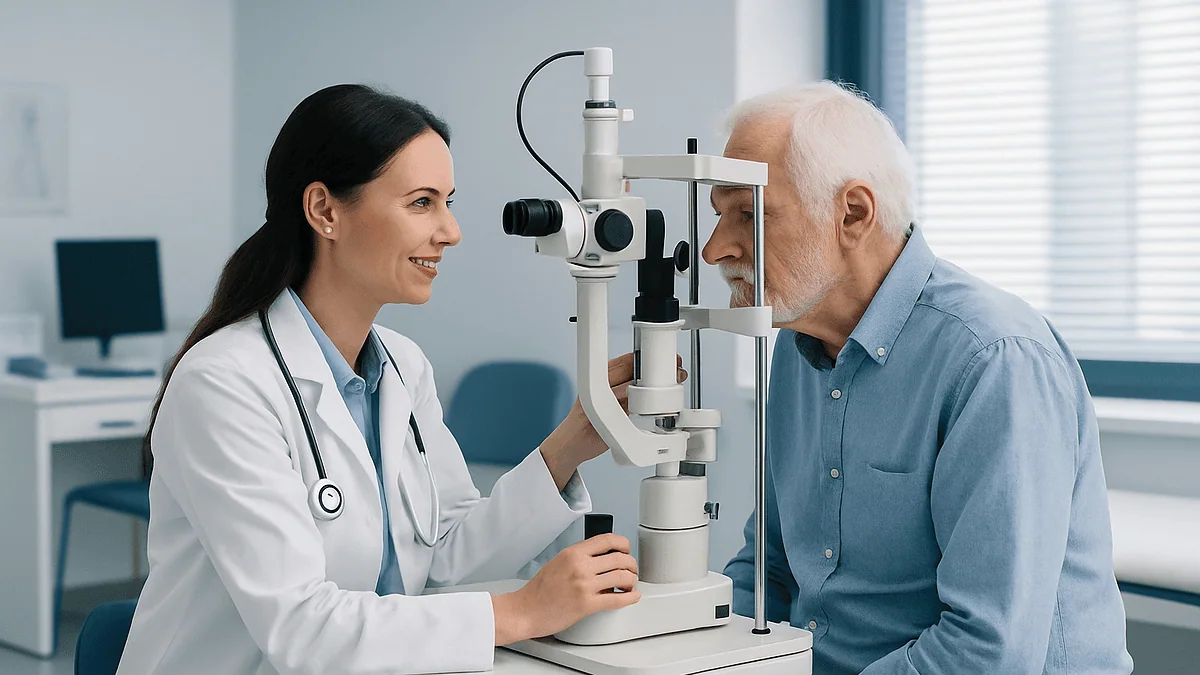
A complete evaluation, as described by the NEI and Cleveland Clinic, layers several tests. Tonometry measures pressure. A dilated exam lets the doctor examine the optic nerve head directly, looking for the characteristic cupping where nerve fibers have thinned. Optical coherence tomography, a scan that works something like ultrasound with light, measures that nerve fiber layer to the micrometer and tracks change over years. Visual field testing, the flickering-lights test from the opening of this article, maps where sensitivity has been lost. Gonioscopy uses a mirrored lens to inspect the drainage angle and tell open-angle from narrow or closed angles. Pachymetry measures corneal thickness, which both adjusts the pressure reading and stands as a risk factor in itself.
Because the disease moves slowly, a single visit often ends in a category rather than a verdict: normal, glaucoma suspect, ocular hypertension or established glaucoma. Being labeled a suspect is common and does not mean you have the disease; it means the team wants repeat measurements to see whether anything is changing. That watchful approach is the standard of care, not indecision.
Anyone with a family history should say so at the start of the appointment. It changes how aggressively borderline findings are followed.
Can glaucoma be cured?
No, and it is better to hear that plainly than to chase it. The NEI states it directly: there is no cure for glaucoma, but early treatment can often stop the damage and protect vision. Nerve fibers in the optic nerve do not regrow once lost, so vision that has already disappeared cannot be restored by drops, laser or surgery.
What treatment does do is change the future. Every established approach works by lowering pressure inside the eye, which slows or halts further loss of nerve fibers. Think of it less like repairing a bridge and more like stopping the corrosion that is weakening it. The structure you have is preserved; what is gone stays gone.
This is why the timing of diagnosis, not the sophistication of treatment, is the decisive factor in outcomes. A person caught at the glaucoma-suspect stage with a full visual field has the most to protect and, with steady follow-up, the best chance of keeping useful sight for life. A person found late, with tunnel vision, can still be helped, but the goal shifts to preserving what remains.
Research into protecting or regenerating optic nerve cells is active and genuinely interesting, and the NIH funds much of it. None of it has reached routine care. Anyone offering a cure, a reversal or a supplement that restores lost visual field is describing something the evidence does not support. The realistic promise is preservation, and for most people diagnosed in time, preservation is enough to live a full visual life.
How does glaucoma treatment work?
Every current treatment lowers eye pressure by one of two routes: making less fluid or draining more of it. The specific choice, sequence and targets are set by the treating team based on how high the pressure is, how much damage exists and how fast it is progressing.
Eye drops are the most familiar starting point. Different classes either reduce the rate at which the eye produces aqueous fluid or improve outflow through the natural drainage pathways. They are used daily, often for life, and their success depends heavily on consistency; missed doses mean hours of unprotected pressure. Side effects range from stinging and redness to changes in eyelash growth or iris color with some classes, and occasionally effects elsewhere in the body, which is why the prescriber reviews other medical conditions first.
Laser treatment is increasingly used early. In open-angle glaucoma, a brief outpatient laser applied to the drainage meshwork encourages it to work more efficiently; the UK’s NICE guideline now recommends offering this as a first option for many newly diagnosed people. In narrow or closed angles, a different laser creates a tiny opening in the iris to relieve the block.
Surgery is reserved for cases where drops and laser cannot hold pressure down. Traditional filtration surgery creates a new drainage channel under the surface of the eye; newer minimally invasive procedures insert microscopic stents or bypasses, sometimes at the same time as cataract surgery. Each carries its own risks, including infection, scarring and pressure that drops too low, and the decision always rests with the person and their surgeon after weighing alternatives.
Can you live with glaucoma without going blind?
Yes, and most people diagnosed and treated in time do exactly that. The word glaucoma still carries an old shadow, and it is worth examining where that shadow comes from.
Globally, glaucoma remains a leading cause of irreversible blindness; the World Health Organization counts about 7.7 million people living with vision impairment from it. Cleveland Clinic describes it as the second leading cause of blindness worldwide. Those numbers are real, and they are driven overwhelmingly by late or absent diagnosis in places and populations without access to regular eye care. They describe untreated glaucoma, not the disease as it unfolds under monitoring.
Under treatment, the picture changes. Because the condition progresses slowly, and because pressure lowering slows it further, many people diagnosed in their sixties keep functional vision for the rest of their lives. The visual field they finish with may have gaps, but gaps at the far periphery, in one eye, rarely limit reading, cooking or recognizing a grandchild across a room.
Living well with glaucoma has a practical texture. Appointments every few months at first, then perhaps twice a year, each with a pressure check and periodic field tests. Drops that become part of the morning routine like brushing teeth. Honest conversations about driving as fields change. Telling siblings and children to get examined. None of it is dramatic. Boring, steady follow-up is the single most protective habit in this disease, and it is entirely within reach.
When should you see a doctor about glaucoma?
Two very different timelines apply, and knowing which one you are on matters.
Seek emergency care the same day, without waiting for an appointment, if you develop a sudden, severely painful red eye, especially together with a headache, nausea or vomiting, misty or blurred vision, or rainbow-colored halos around lights. These are the red flags of acute angle-closure glaucoma, which the NHS and Cleveland Clinic classify as a medical emergency because pressure can rise high enough to damage the nerve within hours. Sudden loss of vision in one eye, with or without pain, also warrants urgent assessment regardless of the cause.
For everything else, the timeline is about routine rather than rush. The NEI recommends a dilated eye exam every one to two years for anyone over 60, for African Americans over 40, and for anyone with a family history of glaucoma at any adult age. Book one sooner if you notice side vision seems narrower, if you keep missing steps or objects at the edge of your view, if you are using steroid eye drops or tablets long term, or if you have had an eye injury.
Tell the eye care professional about affected relatives, their ages at diagnosis and the type of glaucoma if known. If you are already diagnosed and your vision seems to change between visits, call the clinic rather than waiting for the next scheduled check; a shift in symptoms is information the treating team wants promptly, not at the next routine slot.
Frequently asked questions
Is glaucoma hereditary?
Yes, glaucoma runs in families, and having a parent or sibling with it is one of the strongest known risk factors according to the NEI, Mayo Clinic and NHS. For the common adult form, inheritance works through many genes each adding a little risk, not one dominant gene. Rare early-onset and congenital forms are more often caused by a single inherited mutation and can follow clearer family patterns.
Will I get glaucoma if my mom has it?
Most likely not, though your risk is higher than average. A first-degree relative with glaucoma raises your odds several-fold, but the majority of people with an affected parent never develop the disease. The practical response is a dilated eye exam every one to two years, as the NEI advises, and telling your eye doctor your mother’s age at diagnosis and the type of glaucoma she has.
What is the number one cause of glaucoma?
Raised pressure inside the eye is the leading known cause and the only one current treatment can modify. Fluid produced in the front of the eye drains through a meshwork at the base of the iris; when drainage becomes inefficient, pressure rises and slowly damages the optic nerve. Genetics, age, ancestry and corneal thickness influence how much pressure a particular optic nerve can tolerate.
What are the first signs of glaucoma?
For open-angle glaucoma, usually nothing you can feel. Side vision fades so gradually that the brain fills in the gaps, and people may only notice bumping into things or missing curbs. Acute angle-closure glaucoma is different: sudden severe eye pain, redness, headache, nausea, blurred vision and halos around lights appear within hours and require emergency care that same day.
At what age does glaucoma usually start?
Risk climbs steadily with age. Mayo Clinic flags people over 55, the NEI everyone over 60, and the NHS notes most diagnoses happen in the seventies and eighties. African Americans face higher and earlier risk, so the NEI recommends exams from age 40. Juvenile glaucoma can appear from the teens to around 40, and congenital glaucoma is present in infancy, but both are uncommon.
Can glaucoma be cured?
No. The NEI is explicit that there is no cure, because optic nerve fibers do not regrow once lost, so vision already gone cannot be recovered. Treatment with drops, laser or surgery lowers eye pressure to slow or stop further damage, and started early it usually protects useful sight for life. Claims of reversal or restoration are not supported by current evidence.
Can you live with glaucoma without going blind?
Yes, and most people diagnosed in time do. Glaucoma remains a leading cause of blindness worldwide, with the WHO counting about 7.7 million people affected by glaucoma-related vision impairment, but those figures reflect untreated or late-diagnosed disease. With steady follow-up and pressure control, many people keep functional central vision for the rest of their lives, even with some peripheral gaps.
How often should I get my eyes checked if glaucoma runs in my family?
The NEI recommends a comprehensive dilated eye exam every one to two years for anyone with a family history of glaucoma, as well as for everyone over 60 and African Americans over 40. If a close relative was diagnosed young, before about 40, ask to be examined sooner and mention that age explicitly, since early-onset disease points toward higher-impact genes.
Can a genetic test tell me if I will get glaucoma?
Not for the common adult form. Dozens of gene variants each nudge risk slightly, and no routine test converts them into a reliable prediction; research risk scores are not part of standard care. Testing is sometimes useful in families with juvenile or congenital glaucoma, where single genes such as MYOC or CYP1B1 may be involved. For most adults, a detailed family history remains more informative.
Does screen time or reading in dim light cause glaucoma?
No. Neither screen use, reading in poor light, eye strain nor wearing or skipping glasses causes glaucoma. Established risk factors listed by Mayo Clinic and the NEI include elevated eye pressure, age, family history, Black, Asian or Hispanic heritage, thin corneas, very high refractive errors, diabetes, high blood pressure, migraine, past eye injury and long-term steroid use.
References
- National Eye Institute (NIH) – Glaucoma
- MedlinePlus Genetics – Early-onset glaucoma
- NHS – Glaucoma
- Cleveland Clinic – Glaucoma
This article is for general information only and is not a substitute for professional medical advice. Please consult a qualified doctor about your individual situation.

More from the Blog

Is Parkinson’s Genetic, and Can It Be Prevented?
Parkinson's disease is usually not directly inherited. Roughly 15 percent of people with the condition have a family history, and only a small share…

Foods That Calm Stomach Acid: What Helps Quickly and What Does Not
No food neutralizes stomach acid instantly, but some ease reflux within minutes. Sips of water, warm ginger or chamomile tea, a banana, plain oatmeal,…

Can IBS Be Cured Permanently? What Long-Term Relief Looks Like and What Helps
There is currently no known permanent cure for irritable bowel syndrome (IBS). Mainstream medical evidence describes IBS as a long-term condition in which symptoms…
Is Colon Cancer Hereditary, and Is It the Same as Bowel Cancer?
Most colon cancer is not inherited. Roughly 5 percent of cases come from a known inherited syndrome such as Lynch syndrome or familial adenomatous…

Excessive Yawning: When It’s Sleep Debt and When It’s a Signal
Excessive yawning, roughly more than a few yawns in 15 minutes without an obvious trigger, most often reflects insufficient or poor-quality sleep. Less commonly…

Goosebumps: The Evolutionary Leftover You Still Wear
Goosebumps are a reflex: tiny muscles at the base of each hair follicle contract, pulling the hairs upright and puckering the skin. Cold, fear,…