

Hair Loss Concealers and Fibres: What They Do Well, and What They Cannot
Key Takeaways
- Thinning in a given area typically becomes visible only after roughly half its hair density is lost, which is why concealers work, plenty of hair usually remains for fibers to grip.
- Keratin fibers cling to existing strands via friction and mild static, so they excel on diffuse thinning but cannot hold onto completely smooth bald skin.
- No scalp concealer regrows hair or slows loss; every credible label promises 'thicker-looking' hair, a carefully worded appearance claim, not a biological one.
- Telogen effluvium, shedding triggered by illness, childbirth, or major stress, usually resolves on its own within about six to nine months, making concealers a genuine bridge rather than a life sentence.
- Sudden patchy loss, scalp pain, scaling, or shedding well beyond the normal 50–100 hairs a day warrants a medical visit, because some causes are reversible and scarring types become permanent without early treatment.
- Per the NIH Office of Dietary Supplements, biotin supplements have no proven hair benefit in people without a deficiency and can distort thyroid and cardiac lab tests.
Hair loss concealers, keratin fibers, tinted powders, sprays, and cream sticks, genuinely improve the appearance of thinning hair by reducing the color contrast between scalp and hair. The effect is immediate, temporary, and purely cosmetic: they do not regrow hair, thicken follicles, or slow the underlying loss. They work best where some hair remains; fully bald areas are much harder to cover convincingly.
It usually happens under bathroom lighting. The overhead bulb catches the crown at just the wrong angle, and a part that looked ordinary last year suddenly seems a finger-width too wide. So you tilt your head, comb the hair the other way, and take one more photo to check.
That moment sends millions of people down the same search path, and straight into a market of shaker bottles, spray cans, and pressed powders promising “instant fullness.” Some of those promises are true. The optics behind scalp camouflage are real and surprisingly simple. Other claims quietly slide from cosmetics into biology, hinting at benefits no powder can deliver.
This guide separates the two. You’ll learn what each format actually does, how to apply it so it holds up in daylight and weather, what the evidence says about reversing hair loss, and when a widening part deserves a medical appointment rather than another product.
Do hair loss concealers work?
Yes, at the one job they’re built for. Concealers exploit a quirk of how thinning becomes visible in the first place. You’re not usually seeing missing hair; you’re seeing scalp. When pale skin shows through darker hair, the contrast reads as baldness from across a room. Dermatologists often teach that thinning in a given area tends to become noticeable only after roughly half the hair density there is gone, which means a lot of hair is still present, just no longer dense enough to block the view of skin underneath.
A concealer attacks that contrast from both directions. Fibers add physical bulk that scatters light the way real hair does, while powders, sprays, and creams tint the scalp itself so the peek-through skin matches the hair around it. Either way, the eye stops registering a bald spot because the visual signal, bright scalp against darker strands, has been dialed down.
Worth saying plainly: there is very little peer-reviewed research on scalp concealers, because there doesn’t need to be much. The mechanism is optical, not biological, and the result is visible in a mirror within about a minute. What the products cannot do is change anything happening beneath the skin. The follicle miniaturization behind pattern hair loss, the shedding of telogen effluvium, the immune activity of alopecia areata, all of it continues exactly as before, powder or no powder. A concealer is a costume, not a treatment. That’s not a criticism. Costumes, applied well, are remarkably convincing.
Fibers, powders, sprays, and sticks: what's actually in the bottle
Four formats dominate the category, and they behave differently enough that choosing the wrong one is the most common reason people decide “concealers don’t work.” A shake-on fiber applied to a smooth bald crown will sit there like sawdust; a cream stick rubbed through fine, floaty hair can clump it into greasy strings. Format matters more than brand.
| Format | How it hides thinning | Best for | Main weakness |
|---|---|---|---|
| Keratin or cotton fibers | Cling to existing strands, adding visible thickness | Diffuse thinning with plenty of remaining hair | Nothing to grip on smooth bald skin; can shed in wind without a setting spray |
| Pressed powders and cakes | Tint the scalp to match hair color; slight texture on strands | Widening parts, visible crowns, hairline edges | Needs blending skill; can transfer to fingers and fabric |
| Aerosol or pump sprays | Deposit pigment across scalp and hair quickly | Larger areas, fast morning routines | Overspray; can look flat or matte in strong light |
| Cream sticks and pomade-style concealers | Pigmented balm applied directly to skin | Small patches, scars, part lines | Heaviest feel; can weigh down fine hair |
Ingredient lists are shorter than the marketing suggests. Fibers are typically keratin (the same protein as hair), rayon, or cotton, colored with mineral pigments such as iron oxides. Powders and creams borrow directly from the makeup aisle, pigments, waxes, and binders. None of these ingredients has any known effect on hair growth, and reputable products don’t claim otherwise in the fine print, whatever the front of the box implies.
How keratin fibers cling to thinning hair
Shake a fiber bottle over your head and thousands of tiny colored filaments, most just a few millimeters long, drift down and stick to your existing strands. Manufacturers usually credit “static electricity,” and there’s some truth to that: dry fibers do carry a mild electrostatic charge that draws them toward hair. In practice, plain friction and the microscopic roughness of the hair cuticle do much of the holding. The fibers wedge among overlapping cuticle scales and against neighboring strands, and once a light mist of setting spray or flexible hairspray goes on, they’re locked in place for the day.
Two consequences follow from that mechanism, and both are worth knowing before you buy.
- Fibers need hair to hold onto. Each strand becomes a scaffold. A crown that’s thin but populated can look dramatically fuller; a patch of completely smooth scalp offers no scaffolding at all, and fibers slide off or sit in an unconvincing layer.
- Fibers work best on dry hair. Moisture collapses the static charge and mats the filaments together. Apply after styling, once hair is fully dry, and mist any wet-look products on before the fibers, not after.
Color matching is more forgiving than people fear. Because fibers scatter light rather than painting a solid block, a shade one step darker than your hair usually blends better than an exact match: it mimics the natural shadowing at the roots.
What a concealer cannot do, no matter what the ad says
The cosmetic-versus-medical line is bright, and it’s worth drawing in permanent ink. A concealer cannot regrow a single hair. It cannot slow shedding, enlarge a miniaturized follicle, extend the hair’s growth phase, or influence the hormonal signaling that drives pattern hair loss in both men and women. Nothing in a fiber bottle or scalp powder reaches living tissue in a way that changes hair biology, which is precisely why these products can be sold without clinical trials.
Watch the language on packaging and you’ll see how carefully it’s lawyered. “Thicker-looking hair.” “The appearance of fullness.” “Instantly transforms thinning areas.” Every phrase describes perception, not physiology. When marketing drifts further, vague talk of “nourishing follicles” or “supporting scalp health”, treat it as decoration, because no scalp cosmetic has demonstrated growth effects in credible published research.
There’s a subtler limitation, too: concealers can delay diagnosis. Some causes of hair loss are reversible when addressed early, thyroid disorders, iron deficiency, and certain medication effects among them, according to Mayo Clinic, and some, like scarring alopecias, cause permanent follicle loss that early treatment may help limit. A person who covers the problem for three years before seeing a clinician may lose ground that a powder can never give back. Camouflage and evaluation are not competitors. Do both: cover the thinning today, and find out why it’s happening this month.
How to cover a thinning scalp so it survives daylight
Application technique separates “undetectable” from “obviously wearing something.” The routine below takes about three minutes once practiced, and it addresses the two failure points, harsh lighting and close inspection, that make people give up.
- Start with dry, styled hair. Style first, conceal second. Brushing or blow-drying after application redistributes product unevenly.
- Tint the scalp before adding fibers. If your thinning is advanced enough that skin shows through even after fibers, dab a matched powder or cream directly onto the scalp along the part or crown. This kills the bright-skin contrast that fibers alone can’t fix.
- Apply fibers from 8–10 centimeters above the headroughly a hand-span, in short, light shakes. Distance lets fibers drift down and distribute; shaking at point-blank range creates dense clumps.
- Feather the borders. The giveaway is never the center of the covered area; it’s the hard edge where full coverage meets untouched hair. Use a fingertip, a clean makeup brush, or a purpose-made applicator to blur that line.
- Set with a light mist of flexible-hold spray held at arm’s length. This is the single step most people skip and the single biggest upgrade in durability.
- Check in the worst light you can finddirect sun through a window, or a phone flashlight held above your head, not the flattering bathroom mirror.
One habit worth adopting: apply over a sink or a towel. Fibers are pigmented, and pale bathroom tile shows every stray filament.
Will it survive rain, sweat, and a white pillowcase?
Mostly, with caveats. Quality fibers set with spray tolerate light rain, an ordinary workday, and moderate humidity without visible failure. What defeats them is anything that physically flushes or rubs the product away: a downpour without a hood, a towel dragged over wet hair, a hard gym session followed by a face-down stretch on a bench, or vigorous scratching. Powders and creams behave similarly, reasonably stable against moisture once set, vulnerable to friction.
Transfer is the honest downside nobody’s ads photograph. Expect some pigment on white pillowcases if you sleep in a full application, faint marks inside hat bands, and traces on fingers if you rub your scalp during the day. The practical fixes are unglamorous but effective: apply after showering rather than before, remove product at night (it washes out with ordinary shampoo, sometimes needing two passes), and keep darker pillowcases during heavy-use seasons.
Swimming is the one activity where no format holds up. Submersion lifts fibers and dissolves powder binders; plan to reapply afterward or embrace the uncovered look at the pool. Sweat sits in the middle: a light forehead sheen is fine, but rivulets running through a sprayed hairline can carry pigment with them, which is why athletes tend to prefer fibers plus setting spray over aerosol color alone.
None of this makes concealers impractical. It makes them cosmetics, with a cosmetic’s maintenance rhythm: applied daily, removed nightly, budgeted for like any other grooming product.
Are scalp concealers safe?
For most people, yes. The core ingredients, keratin, cotton or rayon fibers, mineral pigments, waxes, have long histories in cosmetics and sit on the skin’s surface rather than penetrating it. Concealers are regulated as cosmetics, which means they don’t undergo the pre-market efficacy trials medicines do, but their ingredients are the familiar, widely used kind rather than exotic actives.
Sensible precautions still apply, particularly because the scalp can be more reactive than people expect:
- Patch test first. Apply a small amount to the inner forearm or a discreet scalp spot and wait 24–48 hours. Fragrances, preservatives, and adhesive polymers in setting sprays are occasional triggers for contact irritation.
- Skip broken or inflamed skin. Active scalp psoriasis, seborrheic dermatitis flares, folliculitis, or any open sore should heal, and ideally be evaluated, before you layer pigment over it.
- Ventilate aerosol sprays. Use them in an open room and avoid inhaling the plume, the same courtesy you’d extend to any spray cosmetic.
- Wash it out regularly. Nightly removal keeps product from building up alongside sebum. There’s no evidence buildup harms follicles, but a clean scalp is more comfortable and easier to examine.
People undergoing chemotherapy or living with alopecia areata can generally use concealers where enough hair remains, though checking with the treating clinician first is wise if the scalp is tender, sunburned, or irritated by treatment. If itching, redness, or bumps appear after starting any product, stop and let the skin settle before troubleshooting.
Do fibers clog follicles or make hair loss worse?
This fear circulates constantly in forums, and the anatomy doesn’t support it. A hair follicle is not an open drain waiting to be plugged. Its opening is occupied by the hair shaft itself and by sebum flowing outward, and the growing part of the follicle, the bulb, sits several millimeters below the surface, well beyond the reach of any particle resting on skin. Fibers measuring millimeters in length physically cannot enter a follicular opening, and mineral pigments in powders are the same class of particles used safely in face makeup for decades.
No published clinical evidence links scalp concealers to accelerated hair loss. What people sometimes interpret as “the fibers made it worse” usually has a simpler explanation. Pattern hair loss progresses on its own timeline, so thinning continues during concealer use just as it would without it: the product gets blamed for a trend it merely witnessed. Normal shedding also becomes more noticeable when every lost hair carries visible colored fibers into the sink.
Two genuine, minor risks are worth separating from the myth. Aggressive brushing to remove set product can snap fragile, miniaturized hairs, remove with shampoo and gentle fingertips instead. And leaving heavy product on an unwashed scalp for days can aggravate seborrheic dermatitis in people prone to it, causing itch and flaking. Both are handling issues, not evidence that camouflage harms follicles. Used and removed sensibly, concealers are bystanders to your hair loss, not participants in it.
Match the camouflage to the kind of hair loss you have
Hair loss isn’t one condition, and coverage strategy should follow the pattern on your head. According to the NHS and Mayo Clinic, most cases fall into a handful of recognizable types, each with a different concealer answer.
- Pattern hair loss (androgenetic). The gradual, hormone-and-genetics-driven thinning that affects around half of men by age 50 and becomes common in women after menopause. Because hairs miniaturize rather than vanish overnight, fibers excel here: there’s usually plenty of remaining hair to grip. Men’s receding temples and women’s widening parts both respond well to a powder-plus-fiber combination.
- Telogen effluvium. Diffuse shedding triggered by illness, high fever, surgery, childbirth, significant stress, or crash dieting, typically starting two to three months after the trigger. Fibers bridge the thin months well, and there’s a genuinely hopeful footnote: this type usually resolves on its own within about six to nine months once the trigger passes.
- Alopecia areata. Autoimmune patches of smooth, complete loss. Small patches surrounded by normal hair can often be hidden by restyling plus a cream or powder on the bare skin; fibers struggle on the smooth centers. Larger or multiple patches usually push people toward toppers, wigs, or scarves, and toward a dermatologist, since treatment options exist.
- Traction and scarring alopecias. Loss from prolonged tension (tight braids, extensions) or from inflammatory conditions that destroy follicles. Cream concealers can mask edges and scars, but these patterns most urgently need medical attention, because scarred follicles do not regrow and early intervention aims to save what remains.
If you can’t confidently name your pattern, that itself is a reason to get examined before optimizing your coverage routine.
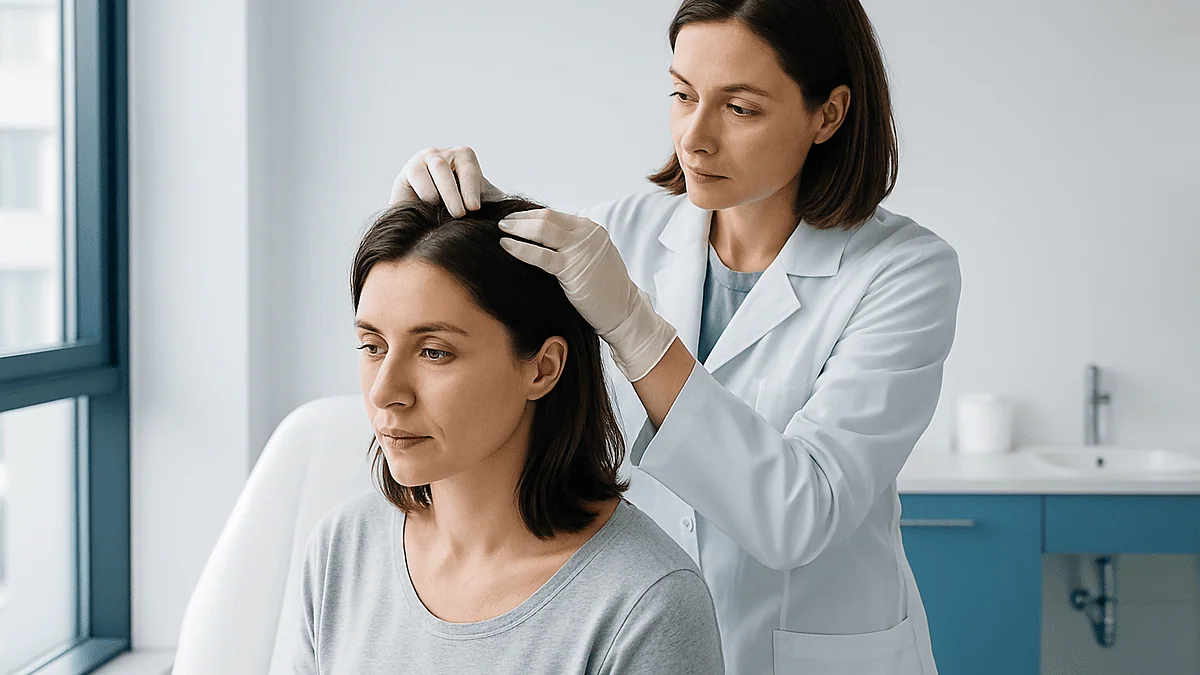
When to see a doctor about hair loss
Most hair loss is gradual, patterned, and medically benign, but some presentations deserve a prompt appointment, because they can signal a treatable underlying condition or a form of loss that becomes permanent if ignored. Based on guidance from Mayo Clinic and the NHS, make an appointment if you notice any of the following:
- Sudden or patchy losscoin-sized smooth patches, or handfuls coming out over weeks rather than years.
- Shedding well beyond the normal 50–100 hairs a day, especially clumps in the shower drain or on the pillow that represent a clear change for you.
- Scalp symptoms alongside the lossitching, burning, pain, scaling, redness, pustules, or areas that look shiny and scarred. These point toward inflammatory or infectious causes that need treatment, not camouflage.
- Hair loss with other body-wide changesfatigue, unexplained weight change, feeling unusually cold or hot, brittle nails, or menstrual changes, which can accompany thyroid disease or iron deficiency.
- Loss that began after starting a new medication, so the prescriber can review whether an alternative exists. Never stop a medicine on your own.
- Any hair loss in a child, which warrants evaluation for fungal infection and other causes.
Even ordinary pattern loss justifies a visit if it bothers you: the earlier evidence-based treatment starts, the more hair there is to preserve. A primary care clinician can run basic blood work and examine the scalp; a dermatologist can perform a closer follicle-level assessment. Expect questions about family history, diet, stress, styling habits, and recent illnesses, bring a list, and bring photos if the change has been gradual.
Can hair loss actually be reversed? What the evidence really shows
Sometimes yes, sometimes partially, sometimes no, and honesty here matters more than optimism, because the answer depends entirely on the cause.
Fully reversible cases exist. Telogen effluvium typically resolves on its own within months once the trigger, illness, childbirth, severe stress, rapid weight loss, has passed. Hair loss from iron deficiency, thyroid disorders, or a culprit medication generally improves when the underlying problem is corrected, per Mayo Clinic. Traction alopecia caught early can recover once the tension stops.
Pattern hair loss can be slowed and partially regrown, not cured. Clinician-recommended topical and oral treatments have solid trial evidence for slowing progression and producing meaningful regrowth in a substantial share of users, as Harvard Health notes for female pattern loss, but they work only while used, results vary from person to person, and no treatment restores a decades-old hairline to its original density. Low-level laser devices have some supportive evidence, though studies are smaller and results modest. Hair transplantation relocates your own follicles rather than creating new ones, which is why candidacy depends on having enough donor hair.
Scarring alopecias are the hard boundary. Once inflammation destroys a follicle and scar tissue replaces it, that follicle is gone. Treatment aims to halt the process, which is exactly why early diagnosis matters.
Anyone promising guaranteed reversal, whether a supplement, a serum, or a gadget, is selling past the evidence. The realistic framing: identify the cause, treat what’s treatable early, and use camouflage freely for the gap between where your hair is and where you’d like it to look.
What about biotin and 'hair vitamins'?
The supplement aisle sits right next to the concealer shelf, and it deserves the same evidence-first scrutiny. Biotin, a B vitamin heavily marketed for hair, has a genuinely underwhelming record. True biotin deficiency does cause hair thinning, but according to the NIH Office of Dietary Supplements, deficiency is rare in people eating a varied diet, and there is no solid evidence that biotin supplements improve hair growth in people who aren’t deficient. High doses carry a practical downside, too: biotin can interfere with certain laboratory tests, including some thyroid and cardiac assays, so tell your clinician about any supplement before blood work.
The broader pattern repeats across “hair, skin, and nails” formulas. Correcting a documented deficiency, iron, vitamin D, zinc, protein, can restore hair that the deficiency was costing you. Adding extra nutrients on top of adequate levels has not been shown to grow additional hair. Your follicles are not houseplants that respond to more fertilizer; past sufficiency, the surplus is simply excreted or, worse, accumulates.
The evidence-based nutritional advice for hair is unfashionably plain: adequate protein and overall calories, iron status checked if shedding is significant (especially for people who menstruate), and blood tests before supplements rather than after. A concealer at least is honest about being cosmetic. A hair gummy that implies regrowth is making a medical claim without the data, and often at a monthly price higher than the powder that actually delivers its promised effect within sixty seconds.
How to choose a good concealer without falling for the hype
Ignore the leaderboards and “best of” roundups for a moment; the product that wins for a reviewer’s hair may fail on yours. Selection comes down to four practical variables.
- Format follows pattern. Diffuse thinning with lots of remaining hair → fibers. Bare-skin visibility at the part or crown → powder or cream first, fibers second. Large areas covered fast → spray, accepting a flatter finish. Small patches or scars → cream stick.
- Shade beats brand. A mediocre product in the right shade outperforms a premium one in the wrong shade. Fibers can run one step darker than your hair; scalp tints should match your hair, not your skin. Graying hair often blends best with a mix of two shades, many people keep both.
- Water resistance is a spectrum, not a checkbox. “Water resistant” typically means light rain and sweat, not swimming. If your life includes daily workouts, prioritize fibers plus a dedicated setting spray over pigment sprays alone.
- Ingredient sanity check. Short lists of keratin or plant fibers plus iron oxides are the norm. Be skeptical of products padding the label with “growth-supporting” botanicals at a premium price: you’re paying for a claim the format can’t deliver.
Budget realistically: daily use of fibers typically runs through a standard bottle in one to two months, so the honest cost comparison is per month, not per bottle. Buy the smallest size first, test it in sunlight and in photos with flash, and only then commit to the economy refill.
The part nobody prints on the bottle
There’s a quiet stigma around cosmetic fixes for hair loss: a suggestion that covering thinning is vanity while treating it is legitimate. The clinical literature disagrees with that hierarchy. Hair loss is consistently associated with measurable effects on self-esteem, social confidence, and mood in both men and women; Harvard Health notes that for many women, thinning hair carries a psychological weight out of proportion to its medical seriousness. Anything safe that restores a person’s willingness to sit under office lighting or show up in photographs is doing real work.
Concealers and treatment aren’t rivals, and the people who navigate hair loss most comfortably tend to use them as a system. Camouflage handles today: the meeting, the wedding, the video call. Medical evaluation handles the trajectory, identifying the cause, catching anything reversible, and starting evidence-based treatment early enough to matter. If treatment eventually thickens the hair, the concealer gets used less. If it doesn’t, the concealer is still there, sixty seconds a morning, no prescription required.
And if the day comes when covering stops feeling worth the effort, that’s a valid endpoint too. Plenty of people cut their hair short or shave entirely and report relief at retiring the routine. The goal was never the powder. It was walking out the door without thinking about your scalp, and there is more than one honest way to get there.
Frequently asked questions
Do hair loss concealers work?
Yes, for their actual job: making thinning hair look fuller immediately. They reduce the color contrast between scalp and hair, the visual signal your eye reads as baldness, either by adding fibers that bulk up existing strands or by tinting the scalp to match the hair. The effect is cosmetic and temporary, washing out with shampoo. They do not regrow hair or slow the underlying loss.
What is the best concealer for hair loss?
The best format depends on your pattern, not on any brand. Diffuse thinning with plenty of remaining hair responds best to keratin fibers; visible scalp at the part or crown usually needs a tinted powder or cream underneath; large areas cover fastest with sprays; small patches and scars suit cream sticks. Correct shade matters more than price, test in direct sunlight before committing to a large size.
How do I cover my scalp when my hair is thinning?
Style your hair first and make sure it’s fully dry. If skin shows through, dab a matched scalp powder or cream along the part or crown to kill the bright-skin contrast. Then shake fibers from about a hand-span above the area in short, light passes, feather the edges with a fingertip or brush, and set everything with a light mist of flexible hairspray. Check the result under direct light, not just the bathroom mirror.
How can hair loss be reversed?
It depends on the cause. Shedding from illness, childbirth, stress, thyroid problems, iron deficiency, or certain medications often reverses once the trigger is corrected. Pattern hair loss can be slowed, and partially regrown in many people, with clinician-recommended treatments, but only while treatment continues, and no option fully restores lost density. Scarring alopecias destroy follicles permanently, which is why early diagnosis matters. A clinician can identify which type you have.
Do hair fibers damage hair or clog follicles?
There’s no evidence they do. Follicle openings are occupied by the hair shaft and outward-flowing sebum, and the growing bulb sits millimeters below the surface, far beyond the reach of surface particles. Fibers are too large to enter follicles at all. The realistic risks are minor: harsh brushing to remove set product can snap fragile hairs, and heavy buildup can irritate a flare-prone scalp, so wash it out nightly and remove gently with shampoo.
Can I sleep with hair fibers or scalp concealer on?
You can, but it’s not ideal. Overnight friction against the pillow rubs product loose, transfers pigment to bedding, and leaves patchy coverage by morning that’s harder to fix than a fresh application. Washing concealer out at night also keeps the scalp comfortable and lets you spot any irritation early. If you occasionally sleep in it, traveling, for example, a darker pillowcase saves laundry, and coverage will need touching up at minimum.
Do concealers work on completely bald spots?
Poorly, in most cases. Fibers need existing strands to cling to, so they slide off smooth skin or sit in an unconvincing layer. Tinted creams and powders can darken a small bare patch enough to reduce its visibility, especially when surrounding hair is restyled over it, but a large, fully bald area rarely looks natural under close inspection. For extensive smooth loss, toppers, wigs, or head coverings tend to give better results than any concealer.
Will hair fibers show in sunlight, wind, or rain?
Well-applied fibers in the right shade hold up to sunlight surprisingly well, since they scatter light much like real hair: the giveaway is usually a hard edge at the border, so feather it. Wind is manageable once a setting spray locks fibers in place. Light rain is fine; a soaking downpour or swimming is not, as submersion lifts fibers and dissolves powder binders. Sprayed-on color tends to look flattest in harsh direct light.
Are scalp concealers safe to use with alopecia areata or during chemotherapy?
Generally yes, where enough hair remains and the skin is intact. The ingredients, keratin fibers, mineral pigments, waxes, sit on the surface and are the same classes used in ordinary makeup. Patch test first, avoid broken, inflamed, or treatment-irritated skin, and check with your treating clinician if your scalp is tender. For alopecia areata specifically, see a dermatologist too, since medical treatment options exist alongside camouflage.
How much shedding is normal, and when should I worry?
Losing roughly 50 to 100 hairs a day is normal, according to Mayo Clinic and the NHS, most disappear unnoticed into brushes and drains. Worry signals are a clear change from your baseline: clumps on the pillow, handfuls in the shower, coin-sized smooth patches, a rapidly widening part, or shedding accompanied by scalp pain, scaling, or fatigue. Those patterns justify a medical appointment, because several causes are treatable and a few become permanent if ignored.
References
This article is for general information only and is not a substitute for professional medical advice. Please consult a qualified doctor about your individual situation.

More from the Blog
Traction Alopecia: How Tight Hairstyles Cause Hair Loss and Whether It Grows Back
Traction alopecia is hair loss caused by repeated pulling on the hair roots from tight braids, buns, ponytails, extensions, weaves or locs. It usually…
Keratin Treatments and Hair Botox: What the Salon Treatments Do and the Formaldehyde Question
A keratin treatment coats hair with a protein-rich solution and seals it with a flat iron to reduce frizz for roughly 2–5 months; so-called…
Receding Hairline: The Norwood Stages, Temple Thinning and the Options at Each Stage
A receding hairline is the gradual backward movement of the front hairline, usually starting at the temples, and in most men it is the…

How to Stop Hair Loss: The Treatments With Evidence, Ranked
The best-supported ways to stop or slow hair loss depend on its cause. For male and female pattern hair loss, topical minoxidil and, in…
Oral Minoxidil: Why Dermatologists Now Prescribe the Blood-Pressure Pill for Hair
Oral minoxidil is a prescription tablet approved to treat severe high blood pressure that dermatologists increasingly prescribe off-label, in amounts far below the blood-pressure…

Scalp Psoriasis vs Dandruff: How to Tell Them Apart and Treat Each
Scalp psoriasis is an immune-driven condition that produces thick, sharply bordered, silvery plaques that often extend past the hairline, while dandruff is a mild,…