

Hair Operations After 60: How Age, Scalp Laxity and Health Conditions Change the Plan
Key Takeaways
- Transplanted follicles keep the hormone resistance of the donor area, a principle called donor dominance, which is why age itself does not stop them growing.
- Scalp laxity often increases with age, but the same skin is usually thinner and more sun-damaged, so it bruises, bleeds and heals less predictably.
- A donor area that is itself diffusely thinning carries that tendency with it, so surgeons check the ratio of fine to thick hairs under magnification before proposing graft numbers.
- Antiplatelet and anticoagulant medicines increase bleeding during surgery, but only the clinician who prescribed them can decide whether any adjustment is safe.
- Transplanted hair commonly sheds about two to three weeks after surgery and regrows from around the third or fourth month, with most growth visible by six to nine months.
- No reliable regret figure exists in guideline-level sources; dissatisfaction is described as arising from hairline design, poor growth and misaligned expectations rather than age.
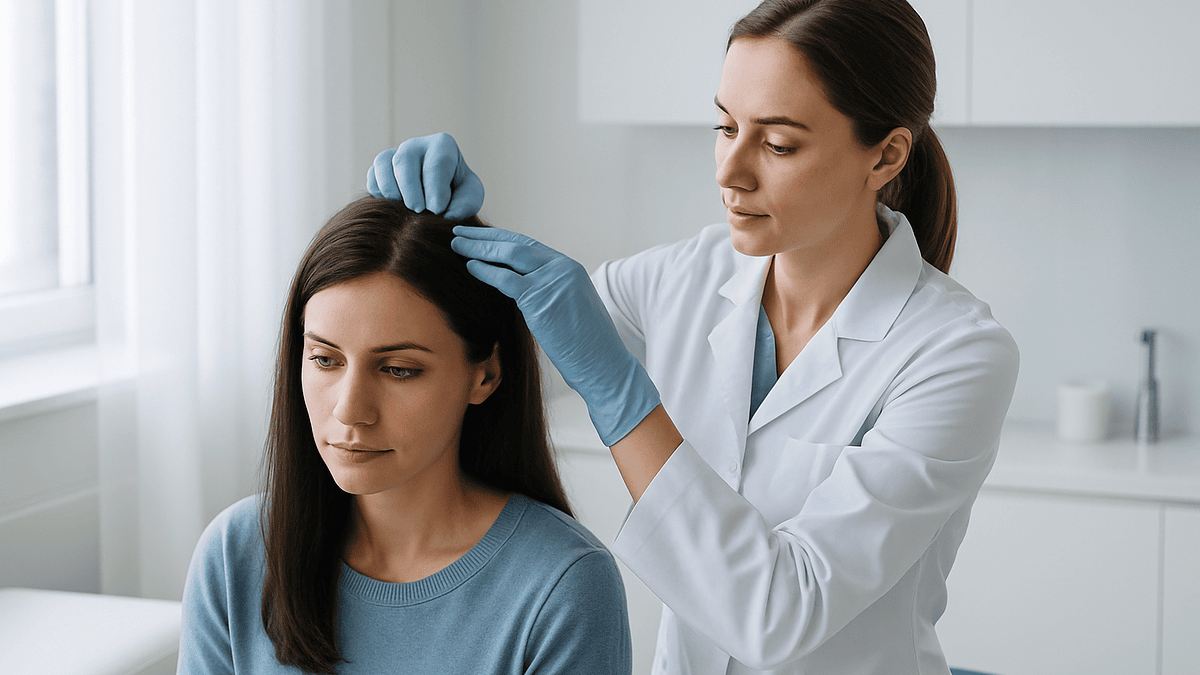
People over 60 can often have hair transplant surgery, because age alone is not the deciding factor. Surgeons weigh scalp laxity, how much stable donor hair remains, overall health, and medicines such as blood thinners before planning. Goals are usually more conservative, with realistic density targets and closer medical review. The treating team makes the decision case by case after examination and a health check.
He is 64, recently retired, and the photograph that bothers him is not an old one. It was taken last month at a grandchild’s birthday, from behind and slightly above, and it shows a crown he has never actually seen in a mirror. He is not vain, he says. He just did not expect to look like his father quite so soon.
Questions like his land on surgeons’ desks every week, and the answer is rarely a flat no. A hair operation in older adults is judged on the scalp in front of the surgeon, not the date on the driving license. What changes after 60 is the planning: how elastic the skin is, how much donor hair has quietly thinned, which medicines are on the kitchen shelf, and how much future loss still needs to be predicted.
This explainer walks through those variables honestly, including the parts that are uncertain, so the conversation with a care team starts from evidence rather than assumption.
Why a hair operation in older adults is judged on biology, not birthday
Hair transplant surgery relies on one durable biological fact: hair follicles on the back and sides of the scalp are usually resistant to the hormone signal that drives common male and female pattern loss. When those follicles are moved to the front or crown, they keep behaving as they did at the donor site. Surgeons call this donor dominance, and it does not switch off at 60 or 70.
Androgenetic alopecia, the medical name for pattern hair loss, is driven by a form of testosterone that gradually shrinks sensitive follicles over successive growth cycles. By the seventh decade, most people’s pattern has largely declared itself. That is a genuine planning advantage. A surgeon working with a 28-year-old is forecasting where the hairline will be in thirty years; a surgeon working with a 68-year-old is mostly reading a map that has already been drawn.
So what does the assessment actually look at? Four things carry most of the weight. First, the quality and density of donor hair, measured under magnification. Second, the elasticity and thickness of the scalp skin. Third, overall health, especially conditions that affect bleeding, wound healing and tolerance of a long procedure. Fourth, expectations: whether the person understands what a finite donor supply can and cannot cover.
The NIH StatPearls review of hair transplantation describes candidacy in exactly these terms, as a question of donor supply, recipient need and medical fitness rather than chronological age. Later sections unpack each factor, because after 60 the answers tend to pull the plan in a more conservative, more carefully staged direction.
How a hair transplant actually works, step by step
The procedure moves living follicular units, the natural groupings of one to four hairs that grow together, from a stable donor area to a thinning area. Two harvesting methods are in mainstream use, and both are performed under local anesthetic, which numbs the scalp while the person stays awake.
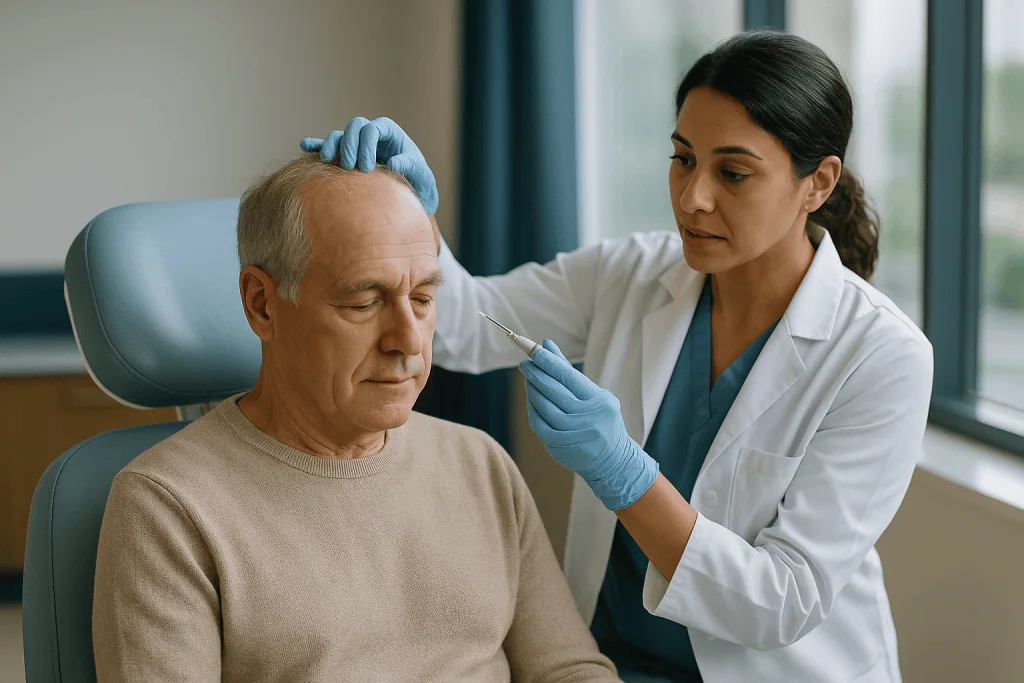
Follicular unit excision (FUE) removes individual follicular units through tiny circular punches scattered across the donor area, leaving small dot scars that are usually hidden by surrounding hair. Follicular unit transplantation (FUT), sometimes called the strip method, removes a narrow strip of scalp from the back of the head, closes the wound with stitches or staples, and dissects the strip into grafts under a microscope. It leaves a fine linear scar.
Before harvesting, the team injects a dilute anesthetic solution, a technique called tumescence, which firms the tissue and reduces bleeding. Grafts are then placed into small recipient incisions whose angle and direction mimic natural growth. Cleveland Clinic and MedlinePlus both describe the operation as a day procedure that can last several hours, with larger cases sometimes split across two sessions.
What people rarely picture is the sheer amount of sitting still. A session can run four to eight hours including breaks, according to the StatPearls review. For a 70-year-old with a stiff lower back, an enlarged prostate or blood sugar that dips when meals are missed, that duration is a planning issue in its own right, which is one reason older adults are sometimes offered smaller, staged sessions rather than a single long one.
The surgeon’s technical skill matters enormously, but so does the surgical plan, and the plan is where age-related factors do their quiet work.
Scalp laxity and hair transplant technique: why looser or thinner skin changes the plan
Scalp laxity means how much the skin of the scalp can be pinched up and moved over the skull. Surgeons test it by gathering the skin between thumb and fingers at the back of the head. A loose scalp allows a wider strip to be removed and closed under low tension in FUT; a tight scalp limits strip width and raises the risk of a stretched, visible scar.
Aging changes laxity in two directions at once, which is why this is not a simple more-is-better story. Collagen and elastin fibers in the dermis decline with age, so many older scalps feel looser and more mobile. That can make strip closure easier. But the same skin is often thinner, has less subcutaneous fat, and may carry decades of sun damage, visible as mottled pigmentation, fine wrinkling or rough actinic patches. Thin, sun-damaged skin bruises more readily, bleeds more, and heals more slowly.
For FUE, laxity matters less than skin fragility. Punching hundreds of small cores from thin skin can produce more pinpoint bleeding and, in some people, a longer period of redness and crusting. Dense placement of grafts in the recipient area also has to respect the blood supply, which is less forgiving in older, thinner scalps. Surgeons may therefore place grafts slightly less densely per session and build coverage over more than one procedure.
There is no validated laxity score that predicts outcome, and the mainstream literature summarized in StatPearls treats it as a clinical judgment. The practical point for a reader is this: if a surgeon spends a long time handling the back of the scalp and asking about sun exposure and prior scalp surgery, that is careful planning, not hesitation.
Donor supply after 60: miniaturization and the so-called safe zone
The donor area is the horseshoe of hair around the back and sides that usually survives pattern loss. Its size, density and hair caliber set the ceiling on what any operation can achieve, and all three can decline with age in ways that are easy to miss in an ordinary mirror.
Miniaturization is the gradual shrinking of a follicle so it produces a finer, shorter, paler hair before eventually stopping. Pattern loss causes it in hormone-sensitive zones, but a separate process, sometimes called senescent alopecia, produces a slow, diffuse thinning across the whole scalp in later life, including the donor area. Mayo Clinic lists aging itself among the recognized causes of hair loss for this reason.
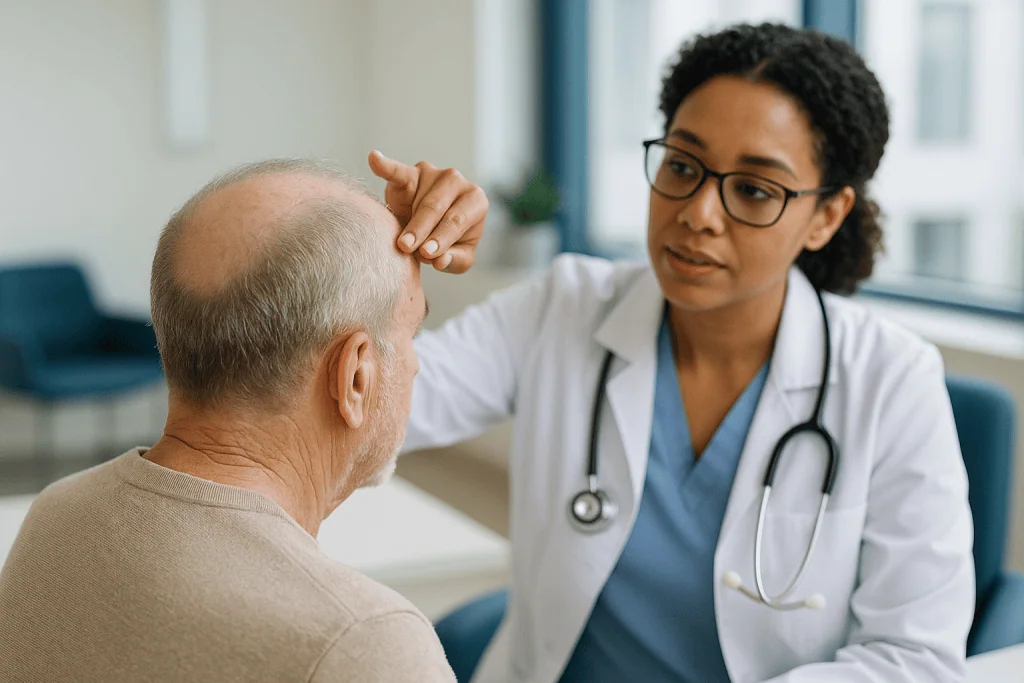
Why does this matter for surgery? Grafts taken from a donor area that is itself thinning carry that tendency with them. A surgeon assessing a 66-year-old will look under magnification at the ratio of fine to thick hairs at the back of the head. A high proportion of miniaturized hairs is a warning that transplanted coverage may soften over the following years, and it argues for conservative graft numbers and honest goal-setting.
Hair caliber also tends to fall with age, and finer hair covers less skin per follicle. Grey hair is not a problem for graft survival, and against a lighter scalp it often creates less visual contrast, which can make thinning less obvious. The practical difficulty is that grey hairs are harder to see during dissection, so some teams use dye on the donor area before harvesting.
None of this rules out surgery. It explains why older adults are often offered a smaller plan that frames the face and strengthens the front, rather than attempting to recreate the density of a thirty-year-old.
Which health conditions change the plan: heart, diabetes and medicines
Because hair transplantation is done under local anesthetic, it avoids many of the risks of general anesthesia. It is still several hours of surgery involving hundreds or thousands of small wounds, and the medical review before it is not a formality.
Antiplatelet and anticoagulant medicines are the most common complicating factor. Antiplatelets reduce the ability of platelets to clump; anticoagulants slow the clotting cascade itself. Both increase bleeding during harvesting and placement and can make grafts harder to seat. They are also, for many people, protecting a stented coronary artery or preventing stroke. No one should pause or alter these medicines on a surgeon’s suggestion alone; the cardiologist or prescriber who started them decides whether any change is safe, and the surgical team plans around that answer.
Diabetes affects healing because high blood glucose impairs the small blood vessels and white cells that wound repair depends on. Well-controlled diabetes is usually manageable; poorly controlled diabetes raises infection risk and may delay graft take, and teams typically ask for recent control data before scheduling.
Blood pressure matters because the local anesthetic usually contains epinephrine, a vessel-constricting drug that limits bleeding but can transiently raise heart rate and pressure. Uncontrolled hypertension or a recent cardiac event is a standard reason to postpone.
Mayo Clinic also notes that thyroid disease, iron deficiency and some medicines cause diffuse hair shedding. Operating on a scalp that is shedding for a treatable medical reason is poor practice, so unexplained new thinning in an older adult usually triggers blood tests before any surgical conversation continues. Immunosuppressants, long-term steroids and smoking each worsen healing and are weighed in the same review.
Who a hair operation for older adults is usually for, and who is asked to wait
Surgeons tend to describe the ideal older candidate in plain terms: a stable, well-declared pattern of loss; a donor area with good density and mostly thick hairs; healthy or well-controlled medical conditions; and expectations that match what a finite supply of grafts can deliver. People who fit this picture are often good candidates at 65 or 70, and the predictability of their loss can make planning simpler than it is for younger patients.
Others are usually asked to wait, or to pursue a different route first. Common reasons include:
- Diffuse shedding that has not yet been investigated, since iron, thyroid and medication causes need to be ruled out, as Mayo Clinic’s hair loss guidance describes.
- Scarring alopecias such as lichen planopilaris or frontal fibrosing alopecia, inflammatory conditions that destroy follicles; grafts placed into active inflammation tend to fail, and the disease must be quiet for a sustained period first.
- A recent heart attack, stroke or new coronary stent, where antiplatelet therapy cannot be adjusted and the heart needs time to stabilize.
- Poorly controlled diabetes or active infection anywhere on the scalp.
- A donor area that is itself visibly thinning, where moving hair would simply relocate the problem.
- Expectations of youthful density that no honest plan can meet.
Waiting is not a rejection. For someone with new diffuse shedding, a few months of investigation and treatment can reveal a reversible cause and a scalp that then needs far less surgery, or none. The NHS guidance on hair transplants makes the same point from the other direction: the procedure is for people whose hair loss is stable and who have enough healthy donor hair to move.
The decision always sits with the treating team, who can examine the scalp and read the medical history together.
Planning at 35 versus 65: a side-by-side look
The table below summarizes how the same operation is typically approached in a younger and an older adult. It describes common tendencies drawn from the StatPearls and Cleveland Clinic descriptions of candidacy, not rules, and individual plans vary widely.
| Planning factor | Typical approach around 35 | Typical approach around 65 |
|---|---|---|
| Predicting future loss | Major uncertainty; hairline often kept deliberately conservative | Pattern largely declared; design can follow what is already visible |
| Donor assessment | Density usually high; focus on long-term supply | Checked for age-related diffuse thinning and finer caliber |
| Scalp skin | Thicker, less sun damage | Often looser but thinner; bruises and heals more slowly |
| Session length | Single long session common | Shorter or staged sessions sometimes preferred |
| Medical review | Usually brief | Detailed; blood thinners, diabetes, blood pressure, heart history |
| Density goal | Natural density within donor limits | Framing the face and visual coverage rather than full density |
| Grey hair | Rarely relevant | Harder to see during dissection; may be dyed before harvesting |
Two patterns stand out. The younger patient’s biggest risk is a plan that looks right today and wrong in fifteen years. The older patient’s biggest risk is biological: thinner skin, a less generous donor, and medical factors that can interfere with healing. Good surgical planning in later life therefore leans on more conservative graft numbers, more thorough preoperative checks, and candid conversations about what the finished result will and will not look like.
Is a hair transplant painful? What the first two weeks usually look like
The honest answer is that the most uncomfortable part is usually the anesthetic. The injections that numb the scalp sting for a minute or two; once the area is numb, most people describe pressure and vibration rather than pain, and many read or doze during the long middle stretch.
Afterwards, the scalp typically feels tight and tender for a few days, and the back of the head can ache if a strip was removed. The NHS notes that most people can return to work within about three days and that the scalp may be sore enough to need pain relief, which the surgical team advises on. Swelling can drift down into the forehead and around the eyes in the first two to four days, and older adults with looser tissue sometimes notice this more. Sleeping with the head raised and following the team’s advice on cold compresses usually helps.
Tiny crusts form around each graft and lift off over roughly a week to ten days as gentle washing resumes. Numbness or tingling in parts of the scalp is common and generally settles over weeks to months as small nerve branches recover.
Then comes the part that alarms people who were not warned. According to MedlinePlus, the transplanted hairs commonly shed about two to three weeks after surgery. The follicles remain in place; the shafts simply fall as the follicle resets its growth cycle. Some nearby native hairs can also shed temporarily, a phenomenon called shock loss.
Strenuous activity, heavy sweating and anything that risks knocking the grafts are typically limited for several weeks on the team’s instructions. For a retired person the main challenge is often boredom rather than pain.
The 12-month growth timeline, and why patience is harder after 60
After the early shed, the scalp usually looks much as it did before surgery for two to three months. This is the dormant phase of the hair cycle, and it is the period when people quietly worry that nothing worked.
New growth generally becomes visible from around the third or fourth month, appearing first as fine, sometimes curly hairs that thicken over time. MedlinePlus states that most people see about 60 percent of new hair growth after six to nine months, and the NHS advises that it can take six months to a year to see the full result. Many surgeons prefer to assess the final outcome closer to 12 to 18 months, because later-emerging hairs continue to add caliber and density.
Why might patience be harder in later life? Two reasons, one biological and one practical. Biologically, the hair growth cycle tends to slow with age, and grey hair often grows more slowly than pigmented hair, so the fuller picture can take longer to emerge. Practically, people who have waited decades to address their hair loss often arrive with a heightened sense of urgency, and a slow-motion result tests that.
Scheduled review appointments matter here. A team that sees the scalp at a few weeks, a few months and a year can distinguish normal slow emergence from genuinely poor graft growth, and can recommend, where appropriate, a second session to build density. Mainstream sources are consistent that final judgments should not be made before the first year is out, and that the twelve-month photograph is the one that counts.
Hair transplant at 70: can a 70-year-old have one?
In principle, yes. There is no upper age limit in the NHS, Cleveland Clinic or StatPearls descriptions of the procedure. In practice, candidacy at 70 depends on the same four pillars as at 60, with the medical pillar carrying more weight.
Local anesthesia is the first reason this is realistic. Avoiding general anesthesia removes much of the cardiac and respiratory risk that makes other elective surgery harder to justify in the eighth decade. What remains is the practical burden of a long procedure. Surgeons ask about back and neck pain, prostate or bladder symptoms that make long sitting awkward, and whether blood sugar is prone to dropping. Splitting a case into shorter sessions is a common solution.
The second consideration is medicines. A 70-year-old is statistically more likely to take an antiplatelet, an anticoagulant, a blood pressure drug or a steroid. Each is managed as described earlier: the prescriber decides, the surgical team adapts. The surgeon will also want to know about any history of heart rhythm problems, since the epinephrine in the local anesthetic can transiently increase heart rate.
Third is the donor area. Age-related diffuse thinning becomes more common past 70, and a careful magnified examination is the only way to know whether enough robust follicles remain.
Goals usually shift. Many people in their seventies are not seeking the hairline of their thirties; they want a softer frame to the face or coverage of a crown that shows in photographs. Those goals often require fewer grafts and tolerate a more conservative plan. The decision rests with the treating team, ideally in conversation with the person’s usual physician, after both have reviewed the full medical history.
What happens 20 years after a hair transplant?
The transplanted follicles usually keep growing, because they carry the resistance of the donor area with them. That is the basis of donor dominance, and it is why results from decades ago are still visible on people who had surgery in their forties. But the scalp around those grafts does not stand still, and this is where long-term planning either pays off or falls short.
Native hair in the thinning zones continues to miniaturize over time. If a surgeon placed grafts only into the frontal hairline of a 40-year-old without anticipating later loss behind it, the person at 60 may have a strong front and a bare band behind, sometimes described as an island effect. Older adults have a structural advantage here: with the pattern largely declared, there is far less future loss to predict, and grafts can be placed where they will still make sense.
Transplanted hair is not entirely immune to time either. Senescent thinning affects the whole scalp, including donor-origin follicles, so coverage from any procedure tends to soften gradually over decades. The hairs that remain may be finer and greyer, which usually looks natural rather than odd, because the surrounding hair has aged in the same way.
Donor scars persist. A strip scar from FUT remains a fine line that is visible if hair is cut very short; FUE leaves scattered pale dots. Both are permanent, which is worth knowing before choosing a method.
Some people return for a second procedure years later to reinforce density, provided the donor area can spare it. The StatPearls review frames hair transplantation as managing a progressive condition, not stopping it, and that framing is the most useful thing a reader can carry into a consultation.
What people often get wrong about hair surgery later in life
“I am too old for this.” Mainstream clinical sources set no upper age limit. Fitness, donor supply and expectations decide, not the birth year.
“Grey hair cannot be transplanted.” It can. Grey follicles survive the move as well as pigmented ones. The practical issues are visibility during dissection and slower growth, not viability.
“Surgery stops hair loss.” It does not. Transplantation relocates hair; it does nothing to the hormone-driven process in the surrounding follicles. That is why some people are also prescribed medicines. Topical minoxidil, a vasodilator that appears to prolong the growth phase, and oral 5-alpha-reductase inhibitors, which lower the hormone that shrinks follicles, are the two classes Mayo Clinic describes. Whether either is appropriate, especially alongside other medicines in later life, is a decision for the prescribing clinician.
“One session is the finished product.” Many plans, particularly conservative ones in older adults, anticipate a second procedure to build density once the first has matured.
“There is a known regret rate.” People search for this number, and no reliable figure exists in the guideline-level sources this article draws on. What the literature does describe are the causes of dissatisfaction: unnatural hairline design, grafts placed without regard for future loss, poor growth, and expectations that were never aligned with the donor supply. Each of these is a planning issue, which is why the consultation matters as much as the operation.
“It is a painless procedure.” Discomfort is usually modest and short-lived, but the anesthetic injections sting, the scalp is tender for days, and numbness can linger for months. Honest framing prevents the first week from feeling like something went wrong.
Questions to ask your care team
A good consultation is a two-way examination. The surgeon studies the scalp; the person studies the plan. These questions tend to surface the information that matters most after 60.
- What did you see in my donor area under magnification, and what proportion of the hairs looked miniaturized?
- How does my scalp laxity and skin thickness affect your choice between FUE and FUT for me?
- Which of my medicines concern you, and will you contact my cardiologist or usual physician before deciding anything about them?
- Do you want recent blood tests for thyroid, iron and glucose before we go further?
- How many grafts are you proposing, and how much of my donor supply would that use?
- Are you planning one session or a staged approach, and how long would each session last?
- What will the result look like at twelve months, realistically, and what will it not look like?
- How do you design the hairline for someone my age so it still looks right in ten years?
- What happens to the native hair around the grafts, and do you expect it to keep thinning?
- What does your follow-up schedule look like, and who do I contact out of hours?
- What complications have you seen in older patients specifically, and how were they managed?
- If you think I should wait, what would need to change for you to reconsider?
Write the answers down. The most useful consultations end with a plan the person can explain to a partner or friend in their own words, including the parts that are uncertain. If a consultation leaves no room for questions, or every answer is a yes, that is itself worth noticing.
When to call your doctor
Most recovery days are uneventful: tenderness, mild swelling, some crusting, and the slow tedium of waiting for growth. A small number of problems need prompt attention, and older adults with diabetes, heart disease or weakened immunity should have a lower threshold for making the call.
Contact the surgical team or your doctor the same day if you notice:
- Bleeding from the donor or recipient area that does not stop after ten minutes of steady, gentle pressure.
- Spreading redness, warmth, increasing pain, pus or a bad smell from any wound, which can signal infection.
- Fever, chills or feeling generally unwell in the first two weeks.
- Swelling that is worsening after day four rather than settling, or swelling that closes the eyes.
- A rash, hives or itching that spreads beyond the scalp, which may indicate a reaction to a medicine or dressing.
- Clusters of small pimples around grafts that persist or multiply; folliculitis, an inflammation of the follicles, is listed by StatPearls among the recognized complications and usually responds to early treatment.
Seek emergency care without waiting if you develop chest pain, sudden breathlessness, a fast or irregular heartbeat, fainting, confusion, or weakness or numbness on one side of the body. These are not expected effects of a scalp procedure and need urgent assessment regardless of cause.
In the months that follow, mention to your team any patch where no hair is growing by the fourth or fifth month, any new thinning in the donor area, or scarring that is raised, widening or painful. None of these will necessarily mean something is wrong, but each is easier to address early. Your surgeon and your usual physician together are the right people to judge what matters; this article cannot replace that judgment.
Frequently asked questions
Can a 70 year old get a hair transplant?
Often yes, provided the person is medically fit for several hours of surgery under local anesthetic and has enough healthy donor hair. No mainstream source sets an upper age limit. The review focuses more on medicines such as blood thinners, blood pressure control, diabetes and whether the donor area has started to thin diffusely. Sessions may be shortened or staged, and goals are usually conservative. The treating team decides after examination.
Is recovery from a hair transplant painful?
Discomfort is usually modest. The anesthetic injections sting briefly, then the scalp feels tight and tender for a few days, with the donor area sometimes aching more after a strip procedure. The NHS notes most people return to work within about three days and may need pain relief the team advises on. Swelling around the forehead and temporary numbness are common and settle over days to months respectively.
What is the regret rate for hair transplants?
No reliable regret percentage exists in the guideline-level sources this article uses, so any specific figure quoted elsewhere should be treated cautiously. What the literature describes are the drivers of dissatisfaction: an unnatural hairline design, grafts placed without planning for future loss, poor growth, scarring, and expectations that exceeded the donor supply. Each is addressed in a careful consultation, which is why the planning stage matters so much.
What happens 20 years after a hair transplant?
Transplanted follicles usually keep growing because they retain the donor area’s resistance to pattern loss. The surrounding native hair, however, continues to thin, which can leave grafts looking isolated if future loss was not anticipated. Age-related diffuse thinning also gradually softens all hair, including grafts. Donor scars are permanent. Some people have a second procedure years later to rebuild density, if the donor area can spare it.
Does scalp laxity matter for a hair transplant after 60?
Yes, mainly for the strip (FUT) method, where a looser scalp allows easier closure with less scar tension. Age often increases laxity, but the skin is also thinner and may carry sun damage, which raises bleeding and slows healing in both FUE and FUT. Surgeons assess laxity by pinching the skin at the back of the head and combine that with skin thickness and donor density when choosing a technique.
Can I have a hair transplant over 60 if I take blood thinners?
Sometimes, but not without the prescriber’s involvement. Antiplatelets and anticoagulants increase bleeding during harvesting and graft placement, yet they often protect a stent or prevent stroke. The surgical team will ask the cardiologist or usual physician whether any temporary change is safe and will plan around the answer. Never pause or alter these medicines on your own; the decision belongs to the clinician who prescribed them.
Does grey hair transplant as well as pigmented hair?
Yes. Grey follicles survive harvesting and placement as reliably as pigmented ones, and lower contrast against a light scalp can make thinning less visible. The practical challenges are that grey hair is harder to see during microscopic dissection, so some teams dye the donor area beforehand, and that grey hair often grows more slowly, which can stretch the timeline before the full result is visible.
How long does it take to see hair transplant results after 60?
The timeline is similar to younger adults, though sometimes slightly slower. Transplanted hairs typically shed two to three weeks after surgery, regrowth begins around month three or four, and MedlinePlus reports most people see about 60 percent of new growth by six to nine months. The NHS advises allowing six months to a year for the full result, and many surgeons assess the final outcome at twelve to eighteen months.
Is FUE or FUT better for older scalps?
Neither is universally better. FUT suits a scalp with good laxity and leaves one fine linear scar; FUE avoids a linear scar but involves hundreds of small punches, which can bleed more in thin skin and often requires close shaving of the donor area. Older adults with loose scalps may be well suited to FUT, while those who wear hair short may prefer FUE. The surgeon weighs skin quality, donor density and preference.
Will I need to take hair loss medicine after surgery?
Surgery does not stop the underlying hair loss process, so some people are offered medicines to slow thinning of native hair. Mayo Clinic describes two main classes: topical minoxidil, which appears to prolong the growth phase, and oral 5-alpha-reductase inhibitors, which lower the hormone that shrinks follicles. Whether either is suitable, especially alongside other medicines in later life, is a decision for the prescribing clinician.
References
- Hair Transplantation – StatPearls – NCBI Bookshelf (NIH)
- Hair transplant – MedlinePlus Medical Encyclopedia
- Hair transplant – NHS
This article is for general information only and is not a substitute for professional medical advice. Please consult a qualified doctor about your individual situation.

More from the Blog
Who Is a Good Candidate for DHI Hair Transplant? Hairline Refinement and Small-Area Density
A good DHI hair transplant candidate usually has stable pattern hair loss, a healthy donor area at the back and sides of the scalp,…
Hair Transplant Cost: Turkey vs USA vs UK: the Honest Comparison Table
A hair transplant in Turkey typically costs a fraction of the same procedure in the USA or UK. Our guide range for an all-inclusive…
Which Female Hair Transplant Side Effects Are Normal? Redness, Scabbing and Swelling Explained
After a female hair transplant, a tight or achy scalp, pinkness, small scabs around each graft, mild forehead swelling and temporary shedding of the…
DHI Hair Transplant Recovery: When Scabs Lift, When Hats Are Allowed and When Sport Returns
After a DHI hair transplant, the tiny crusts around each graft usually loosen and lift over roughly one to two weeks, helped by the…
Second Hair Transplants: When a Touch-Up Makes Sense and How Many You Can Have
A second hair transplant can make sense when hair loss has progressed around a first procedure, when you want more density, or when an…
PRP for Hair Loss Myths: One Session, Instant Regrowth and Other Misconceptions Corrected
PRP for hair loss is a series of scalp injections using a concentrate of a person's own platelets, not a single-visit fix. Published protocols…