

Is a Beard Transplant Painful? Facial Numbing, Tightness and Managing Discomfort Afterward

Key Takeaways
- The procedure is done under local anesthetic, so the brief sting of the numbing injections is usually the most uncomfortable moment of the day.
- The lower face is served by the infraorbital and mental branches of the trigeminal nerve, which is why facial numbness is reported more often after beard work than after scalp-only transplants.
- Discomfort typically peaks in the first three days with throbbing, crusting and swelling, and the NHS notes most people return to work about three days after a hair transplant.
- Transplanted hairs commonly shed within weeks before new growth begins months later, a normal phase that is often mistaken for failure.
- Numbness after a transplant is listed as a usual, temporary side effect; weakness or drooping of the face is not and needs prompt assessment.
- Beard growth is shaped by androgen sensitivity, age, ethnicity, scarring and conditions such as alopecia areata, so it is not purely genetic.
A beard transplant is usually not painful during the procedure itself, because the face and donor scalp are numbed with local anesthetic; the brief sting of the numbing injections is the part most people remember. Afterward, tightness, swelling, itching and patchy facial numbness are common for days to weeks and are typically managed with simple measures and medicines your care team selects.
He has the photo saved on his phone: a cheek shot taken in good light, the jawline strong but the growth stopping short in two pale, stubborn gaps. He has tried oils, patience and a shorter trim that hides nothing. Now he is reading about grafts and donor zones, and one question keeps pulling him back to the search bar: is a beard transplant painful?
It is a fair thing to worry about. The face is not the scalp. It carries some of the densest sensory nerve supply in the body, it moves every time you talk or eat, and you cannot hide it under a cap for a week. So the honest answer has three parts: what the day itself feels like, what the following week brings, and what the odd, cotton-wool numbness along the jaw actually means.
This explainer walks through all three, using mainstream medical guidance on hair transplantation, local anesthesia and nerve recovery. Where the evidence is thin, it says so.
How a beard transplant actually works, in plain language
A beard transplant moves living hair follicles from a place where they grow reliably to a place where they do not. The follicle is the tiny pocket of skin that produces a hair; once it is relocated and takes a blood supply, it keeps growing in its new home. The hair itself does not care whether it sits on the back of the head or the chin.
Two harvesting methods dominate. Follicular unit extraction, or FUE, removes follicles one small cluster at a time with a punch tool about the width of a pencil lead, leaving dot-like marks that fade into the surrounding hair. Follicular unit transplantation, or FUT, removes a thin strip of scalp from the back of the head, closes it with stitches, and divides the strip into grafts under magnification. The NHS describes both approaches and notes that FUT leaves a linear scar while FUE leaves many tiny scars (NHS, Hair transplant).
Once harvested, the grafts are placed into small incisions made across the cheeks, jawline, mustache or goatee area. Angle matters enormously here: beard hair grows flatter and in a more varied direction than scalp hair, so the surgeon tilts each recipient site to mimic the natural sweep of the surrounding whiskers.
The whole thing is done under local anesthetic as an outpatient procedure, and the NHS notes it usually takes a day without an overnight stay (NHS). Session length rises and falls with graft count; a few hundred grafts to thicken a mustache is a shorter day than fifteen hundred to build a full cheek beard. Your surgeon will give you a realistic estimate once a plan is agreed.
Knowing this mechanism explains most of what follows: discomfort comes from two separate wounded areas, the harvested donor zone and the freshly implanted face, and each heals on its own clock.
Is a beard transplant painful during the procedure?
Most people describe the procedure itself as uncomfortable rather than painful, and the part they remember is the numbing, not the transplanting. Local anesthetic blocks the nerves that carry pain signals from a specific region while you stay awake; the NHS explains that it works by stopping nerves in that area from sending pain messages to the brain (NHS, Local anaesthesia). Lidocaine-type agents are standard for this purpose, often combined with a medicine that narrows small blood vessels to limit bleeding and prolong the numb window.
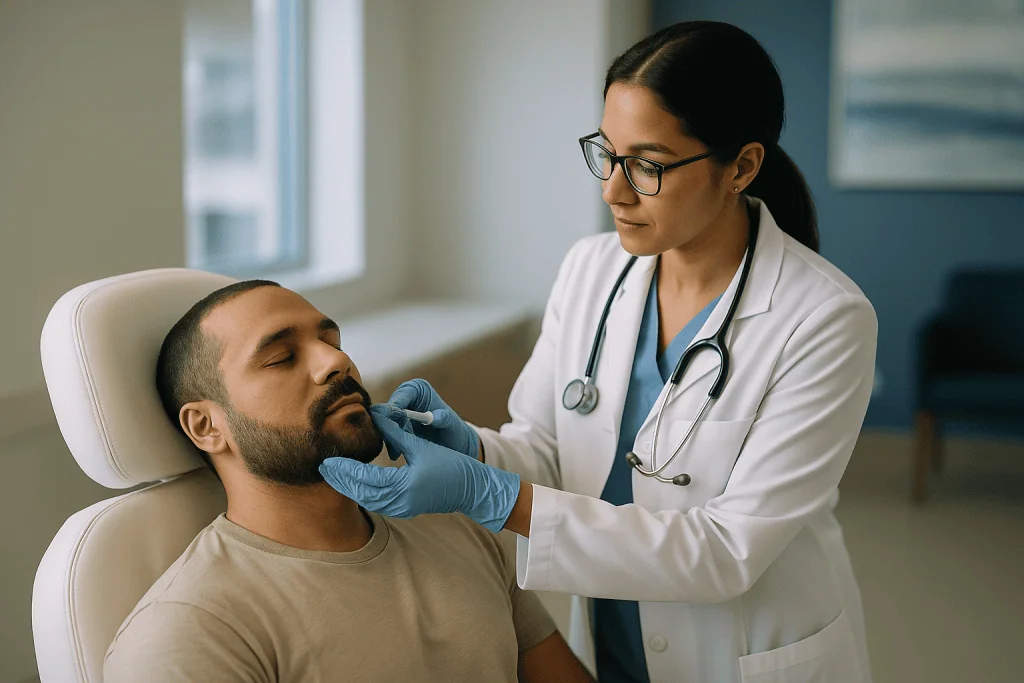
The injections themselves sting. On the face, the lower cheek and chin are especially sensitive, so surgeons typically use a very fine needle, inject slowly, and work outward from a spot that is already numb so each new injection lands on partially blocked skin. Some teams apply a numbing cream first, use vibration beside the needle, or offer a mild oral sedative so the first few minutes feel less sharp. Which of these you receive is a decision for your care team, and none of them is a general anesthetic.
Once the block is working, you should feel pressure, tugging and the occasional odd vibration from the punch tool, but not pain. If you do feel a sharp sensation partway through, say so; local anesthetic wears off unevenly over a long session and can simply be topped up.
The donor harvesting and the recipient placement are usually numbed separately, sometimes hours apart, which means two rounds of injections. Many people find the second round easier because they know what to expect. Boredom and a stiff neck from lying still tend to be the bigger complaints of the day than any sting.
Why the face reacts differently from the scalp
Anyone who has had both a scalp and a beard procedure will tell you the face feels different, and anatomy explains why. The lower face is supplied by branches of the trigeminal nerve, the large sensory nerve of the face. One branch, the infraorbital nerve, exits below the eye and serves the upper lip and cheek; another, the mental nerve, emerges from the lower jaw and serves the chin and lower lip. Both sit close to the surface, right where grafts are placed.
That density of nerve endings has two consequences. First, the numbing injections sting more here than on the crown of the head. Second, the small incisions can irritate superficial nerve twigs, which is why facial numbness after a beard transplant is reported far more often than after a scalp-only procedure.
The face also moves. Talking, chewing, yawning and smiling all stretch the implanted skin, so a tight, crusted cheek feels tighter than a tight, crusted scalp. People often notice this most on the second morning, when swelling peaks and the first firm crusts have formed.
Finally, swelling has somewhere to go on the face. Fluid from the cheeks drifts downward with gravity, so a puffy jawline on day two is common and is listed among expected short-term effects in mainstream patient guidance (Cleveland Clinic, Hair transplant). Scalp swelling, by contrast, tends to travel toward the forehead and eyes.
None of this makes the face a worse place to transplant hair. It simply means the sensations are more noticeable and the recovery is more visible, which is worth knowing before you commit to a week of sleeping on your back.
Beard transplant donor area pain: what the back of the head feels like
People who search for donor area pain are usually asking about the back and sides of the scalp, and the answer depends on how the grafts were harvested. With FUE, the donor zone is a shaved patch covered in hundreds of pinpoint wounds. During the first evening it feels raw and warm, something like sunburn or a close shave gone wrong. Sleeping is the awkward part, because the head has to rest somewhere.
With FUT, the back of the head carries a closed incision held with stitches or staples. The discomfort here is more of a pulling tightness than a sting, strongest when you tip your chin to your chest. Both MedlinePlus and the NHS describe a tender, tight scalp for several days after a hair transplant and note that pain relievers are commonly prescribed (MedlinePlus, Hair transplant; NHS).
A few practical points shape how much the donor area bothers you:
- Larger harvests mean more wounds, and the discomfort scales accordingly.
- The donor area is numbed for the harvesting itself, so the evening of surgery, when the block fades, is usually the low point.
- FUE dots typically crust within a day or two and heal within about a week; a FUT incision needs the stitches removed on a schedule your team sets (NHS).
- Patchy numbness at the donor site is common and usually improves over weeks, though a small number of people notice it for longer.
For beard work specifically, some surgeons harvest from under the chin or along the neck rather than the scalp, because that hair already has beard texture. The same rules apply: expect a sore, crusted patch rather than true pain, and expect it to settle faster than the recipient area.
Is a beard transplant painful afterward? The first three days
The honest picture of the first 72 hours is less about pain and more about a cluster of odd sensations arriving in sequence. Here is the usual order.
The evening of surgery, the local anesthetic wears off and the face begins to throb gently, in rhythm with your pulse. The donor area stings. Most people describe this as a three or four out of ten and manageable with the pain relief their team has chosen. MedlinePlus notes that the scalp may be tender enough to require medicine for several days after a hair transplant (MedlinePlus).
Day one brings crusting. Each graft seals with a tiny scab, and together they make the cheeks feel like dried glue. This is not harmful; it is the body closing the wound. It is, however, itchy, and the single most important rule of the week is not to scratch, because a dislodged graft is a lost graft.
Day two is usually swelling day. The cheeks puff, the jawline softens, and some people see fluid settle under the chin. The NHS lists a tight, achy and swollen treated area for a few days as an expected part of recovery (NHS). Sleeping with the head raised on two pillows and avoiding bending forward both help the fluid drain in the right direction.
Day three is often the turning point. Swelling starts to recede, the crusts firm up, and the throb settles into a dull awareness of your own face. The NHS notes that most people can return to work about three days after a hair transplant (NHS), though with a visibly crusted beard area many choose to wait longer for appearance rather than comfort.
Pain that climbs instead of easing over these three days is the exception, and it belongs in the section on when to call your doctor.
Facial numbing after a beard transplant: why it happens and how long it lasts
Numbness is the sensation that catches people off guard, because nobody warned them that their chin would feel like it belonged to someone else. The medical term is hypoesthesia, reduced sensation; its cousin paresthesia means tingling or pins and needles. Both are listed as recognized side effects of hair transplantation (Cleveland Clinic; MedlinePlus).
The mechanism is straightforward. Hundreds of small incisions in the cheek and chin interrupt the fine terminal branches of the sensory nerves described earlier. The main nerve trunks are not cut; the tiny end fibers are, and those regrow. MedlinePlus explains that numbness and tingling arise when nerves are damaged, compressed or irritated, and that recovery depends on the cause (MedlinePlus, Numbness and tingling).
Typical experience looks like this:
- Full numbness over the implanted area for the first few days, often blending with the lingering anesthetic.
- A patchy phase over the following weeks, with islands of normal feeling next to dead spots, and sometimes odd tingles or a crawling sensation as fibers reconnect.
- Gradual return of ordinary sensation over weeks to months. Patient guidance from mainstream sources describes transplant-related numbness as usually temporary, with a small minority reporting longer-lasting change (Cleveland Clinic).
Two practical cautions follow. First, a numb chin is easy to injure: hot drinks, shaving and even a toothbrush can scrape skin you cannot feel, so go gently. Second, numbness that is accompanied by weakness, a drooping mouth corner or trouble closing the lips is a different problem, because it involves the motor nerve of the face rather than the sensory one, and it needs prompt assessment.
Tingling as feeling returns is usually a good sign rather than a worrying one. Numbness that spreads, worsens after the first week or lasts far beyond the window your surgeon described is worth a call.
Tightness, itching and the stiff-jaw feeling
If pain is rarely the main complaint, tightness often is. Picture a hundred small scabs across the cheek, each shrinking as it dries, each pulling a fraction of a millimeter on the skin around it. Multiply that by a jaw that moves every time you speak and you have the characteristic stiff-mask sensation of the first week.
Three things drive it. Crusting contracts the skin surface. Swelling stretches the deeper tissue. And the body lays down early scar tissue around every graft, which is firmer than normal skin for a while. The combination peaks around days two to four and then loosens as the crusts lift and the swelling drains (NHS; Cleveland Clinic).
Itching arrives next, usually once the crusts begin to separate. It is a normal signal of healing skin and a known part of hair transplant recovery, but it tests patience, because the grafts are still vulnerable to being rubbed out during the first week or so. Teams commonly advise gentle rinsing with a mild cleanser from a day or two after surgery to soften the crusts, exactly as the NHS describes for scalp procedures (NHS). A cool compress held near, not on, the grafted area can ease the urge without touching the skin; ask your team whether and how they want you to use one.
The stiff-jaw feeling deserves a note of reassurance. People sometimes fear they have strained a joint. In practice the jaw joint is untouched; what they feel is tight skin resisting the opening of the mouth. Eating softer foods for a few days and keeping conversation unhurried are reasonable comfort measures. True jaw pain, clicking or inability to open the mouth is not a transplant effect and needs assessment.
Most people describe the tightness as fading week by week rather than vanishing overnight.
Beard transplant recovery time: what the following weeks usually look like
Recovery has two tracks running side by side: how the skin feels, and what the hair does. The table below gathers typical ranges from mainstream patient guidance. These are descriptions of common experience, not promises, and your own timeline is set by graft count, technique and how you heal.
| Phase | What the skin feels like | What the hair does | Source |
|---|---|---|---|
| Days 0–3 | Throbbing, swelling, firm crusts, numbness | Grafts sit in place; no visible change | NHS; MedlinePlus |
| Days 4–10 | Itching, crusts loosening, tightness easing | Transplanted hairs still present, may look sparse | NHS |
| Weeks 2–8 | Pinkness fading, patchy numbness, mild tenderness | Most transplanted hairs shed; this is expected | NHS; Cleveland Clinic |
| Months 3–4 | Skin usually feels normal; sensation returning | New growth begins from the retained follicles | Cleveland Clinic |
| Months 6–12 and beyond | Any residual numbness typically resolved | Hair thickens and matures gradually | NHS; Cleveland Clinic |
The shedding phase causes more phone calls than any other. The NHS explains that transplanted hair commonly falls out within weeks after the procedure before new growth appears months later (NHS). The follicle stays; only the original hair shaft lets go. Knowing this in advance spares a great deal of anxiety.
Discomfort, by contrast, follows a simpler curve: worst in the first three days, noticeably better within a week, and reduced to occasional sensitivity or a numb patch by the end of the first month for most people. Exercise that raises the heart rate, saunas and direct sun are commonly restricted for a period after surgery, because sweat, heat and ultraviolet light can irritate healing skin and raise bleeding risk; the exact restriction is set by your team.
Shaving over the grafted area is usually delayed until the skin has fully healed and the surgeon has confirmed the grafts are secure. Trimming comes before razor work, and sensation should be back before either, so you can feel what the blade is doing.
Managing discomfort after a beard transplant without overdoing it
Comfort after a beard transplant is mostly a matter of protecting the grafts while the body does its work. The medicine side is simple and belongs to your prescriber; the practical side is where you have real influence.
On medicines: most teams provide or recommend a pain reliever for the first few days, as the NHS and MedlinePlus both describe (NHS; MedlinePlus). Some anti-inflammatory pain relievers can thin the blood slightly, and some surgeons prefer you avoid them around the procedure for that reason, so follow the plan you were given rather than reaching for whatever is in the cabinet. A short course of antibiotic is sometimes prescribed to reduce infection risk, and a steroid is occasionally used to limit swelling; both are choices made by your clinician based on your history. Do not start, stop or substitute any of them on your own.
On practical measures, the evidence-informed basics are:
- Sleep with the head elevated for the first several nights so facial swelling drains downward rather than pooling in the cheeks.
- Keep hands off the face. Itching is normal; rubbing can displace grafts during the first week.
- Rinse as instructed, usually a gentle pour or spray with mild cleanser rather than a direct shower jet, starting when your team says (NHS).
- Avoid strenuous exercise, heavy lifting and bending that raises pressure in the head until cleared.
- Skip alcohol and smoking during healing; both impair blood flow to new grafts and slow wound repair.
- Choose soft foods and small bites for a few days if chewing pulls on the implanted skin.
A cool compress near the swollen area can be soothing, but direct ice on fresh grafts is usually discouraged because numb skin cannot warn you of cold injury. Ask before using one.
What you should not do is push through rising pain with extra pills. Pain that escalates after day three is information, not a hurdle, and the right response is a call to the team.
Beard transplant side effects beyond pain
Pain is only one item on the list of things that can happen, and an honest explainer should name the rest. Mainstream patient guidance for hair transplantation lists the following, most of them minor and self-limiting (NHS; Cleveland Clinic; MedlinePlus).
Common and usually temporary: swelling, bruising, crusting, itching, numbness or tingling, small pimples or bumps around new hairs, and shedding of the transplanted hairs before regrowth. Folliculitis, which means inflammation of hair follicles, shows up as red, tender spots in the weeks after surgery and often settles with gentle cleansing; your team may treat it if it persists.
Less common: bleeding beyond the first day, infection of the donor or recipient area, ingrown hairs, and visible scarring. The NHS notes that FUE leaves many small scars and FUT a single linear scar, and that scars may be more noticeable in people prone to raised or keloid scarring (NHS). On the face, ingrown hairs deserve a special mention because beard hair is coarse and curved; the NHS describes ingrown hairs as curling back into the skin and causing bumps, which can be mistaken for infection (NHS, Ingrown hairs, as referenced in general guidance).
Uncommon but important: shock loss, in which existing hairs near the grafts temporarily shed from the stress of surgery; longer-lasting numbness; grafts that fail to take; and an unnatural appearance if angle or density was poorly planned. Poor graft survival rates are not something any reputable source quotes as a fixed number, because they vary with technique, surgeon experience and aftercare, and this article does not invent one.
Rarely, an allergic or toxic reaction to local anesthetic can occur, which is why your team asks about prior reactions and why the procedure takes place in a setting equipped to manage it (NHS, Local anaesthesia).
None of this is an argument against the procedure. It is the information a good consultation should give you unprompted.
Who a beard transplant is usually for, and who is usually asked to wait
The typical candidate is an adult with patchy, thin or absent facial hair that has been stable for some time, a donor area with enough healthy follicles to spare, and realistic expectations about density and timing. Common reasons include genetically sparse growth, scarring from acne, burns or previous surgery, hair loss from an inflammatory skin condition that is now quiet, and gender-affirming care for transgender men seeking masculine facial hair. Some people also seek to cover a cleft-lip repair scar or a gap left by an injury.
Being asked to wait is not a rejection; it usually means something needs sorting first. Surgeons commonly defer in these situations:
- Age. Facial hair can keep filling in through the twenties, so a very young adult may simply need more time before anyone can judge the final pattern.
- Active skin disease in the treatment area, such as uncontrolled acne, folliculitis or an inflammatory alopecia; implanting into inflamed skin risks poor graft survival and more scarring.
- Alopecia areata, the autoimmune condition in which the immune system attacks hair follicles. Mayo Clinic describes it as unpredictable and sometimes recurring, and transplanted follicles can be attacked just as the originals were (Mayo Clinic, Hair loss).
- A thin donor supply. Taking too much from the back of the head trades one visible problem for another.
- Uncontrolled diabetes, bleeding disorders, blood-thinning medicines that cannot be safely paused, or a history of keloid scarring, all of which raise complication risk.
- Current smoking or heavy drinking, which many teams ask people to stop for a period around surgery because of their effect on healing.
Body dysmorphic disorder, a preoccupation with a perceived flaw that others barely notice, is another reason a thoughtful team may pause and suggest a conversation with a mental health professional first. That is good medicine, not gatekeeping.
Whether you proceed, wait or choose a non-surgical route sits with you and the treating team together, informed by an examination rather than a photograph.
What people often get wrong about beard transplant pain
Myths cluster around any procedure that is mostly discussed online, and beard transplants have collected a few that are worth correcting.
Myth: It is completely painless. The procedure is numbed, but the numbing injections sting, and the evening afterward is sore. Calling it painless sets people up to feel that something went wrong when it is simply healing normally. Uncomfortable but manageable is the fairer description, and it is what mainstream guidance implies when it says pain relief is commonly needed for a few days (NHS; MedlinePlus).
Myth: Numbness means the surgeon damaged a nerve. Patchy numbness is an expected consequence of making many small incisions through skin rich in fine sensory fibers. These fibers regrow. The main facial nerve trunks are not in the path of the needles, and numbness is listed as a routine side effect rather than a complication (Cleveland Clinic).
Myth: The new beard appears within a week. The opposite happens. Transplanted hairs usually shed within weeks and new growth takes months to begin, as the NHS describes (NHS). People who are not told this sometimes conclude the procedure failed before it has had a chance to work.
Myth: Beard growth is 100 percent genetic. Genes set much of the pattern, chiefly through how sensitive your follicles are to androgens, the hormones that drive beard growth. But age, hormone levels, ethnicity, scarring and conditions such as alopecia areata all shape what actually grows (Mayo Clinic). Genetics loads the dice; it does not throw them.
Myth: More grafts always means a better result. Over-dense placement in the face can compromise blood supply to each graft and look unnatural. Thoughtful design often means fewer grafts, well angled.
Myth: You can shave as soon as the scabs fall off. Most teams want sensation back and grafts confirmed secure before a razor touches the area. Shaving numb skin is a reliable way to cut yourself without noticing.
Questions to ask your care team before a beard transplant
A good consultation leaves you with fewer questions, not more. Bring these, and notice how fully each is answered.
- Which harvesting method do you recommend for me, and why? What will the donor area look like after it heals, and will the scars show with my usual hair length?
- Where will the grafts come from: the scalp, under the chin, or elsewhere? How many do you estimate, and how did you arrive at that number?
- How will the numbing be done, and what can be offered if I find injections hard to tolerate?
- How long will my session take, and will I need someone to drive me home?
- What pain relief will you provide, and are there medicines I take now that you want me to pause or avoid? I will not change anything without your instruction.
- What level of swelling and numbness should I expect, and over what period do you typically see sensation return in your patients?
- When can I wash my face, exercise, sleep normally, trim and eventually shave?
- What does the shedding phase look like, and when should I expect the first new growth?
- What are the specific risks in my case, given my skin, my medical history and my donor supply?
- What happens if some grafts do not take, and what is your approach to a second session?
- Are there non-surgical options I should try or rule out first?
- Who do I call after hours if something seems wrong, and what signs mean I should call rather than wait?
Two things to listen for in the replies. One is honesty about variability: a team that quotes you a precise percentage of graft survival or a fixed date for numbness resolving is overpromising, because reputable guidance does not support those figures. The other is a clear aftercare plan in writing. The decision to proceed remains yours and your team’s, and the quality of that conversation is itself useful evidence.
When to call your doctor after a beard transplant
Most recovery is dull and predictable, which is exactly what you want. A small number of signs mean the ordinary course has changed, and they are worth a same-day call to the team that treated you rather than a search engine.
Contact your care team promptly if you notice:
- Pain that is getting worse after the third day instead of easing, or pain that is not controlled by the plan you were given.
- Spreading redness, increasing warmth, pus or a foul smell from the donor or recipient area, or a fever. These are classic signs of infection, which guidance lists as a known complication (NHS; Cleveland Clinic).
- Bleeding that soaks a dressing or does not stop with gentle pressure after the first day.
- Swelling that keeps increasing after day three, or swelling that spreads toward the eyes or throat.
- Any weakness of the face: a drooping mouth corner, difficulty closing the lips or an uneven smile. Sensory numbness is expected; loss of movement is not.
- Numbness that spreads, worsens after the first week or persists well beyond the window your surgeon described.
- A large number of grafts coming away with bleeding, especially after a knock or scratch.
Seek emergency care immediately, rather than a routine call, for any sign of a severe allergic reaction after local anesthetic or prescribed medicines: swelling of the lips, tongue or throat, difficulty breathing, a widespread rash, dizziness or fainting (NHS, Local anaesthesia). The same applies to chest pain, sudden shortness of breath or calf pain and swelling after a long procedure day, which can signal a blood clot.
It is better to make an unnecessary call than to sit on a necessary one. Teams expect questions in the first week, and most answers will be reassuring. Keep the after-hours number somewhere you can find it without searching, and let the people who did the procedure make the judgment about what comes next.
Frequently asked questions
Does a beard transplant hurt?
Not during the procedure for most people, because the donor scalp and the face are numbed with local anesthetic. The injections sting for a few seconds, then you feel pressure and tugging rather than pain. The evening after surgery is typically sore and throbbing as the anesthetic fades, and tightness, swelling and itching follow for several days. Pain relief chosen by your care team is commonly needed for a short period.
Is the donor area painful after a hair transplant?
Usually tender rather than painful, and the sensation depends on the method. FUE leaves hundreds of pinpoint wounds that feel raw, like a bad sunburn, for a day or two. FUT leaves a stitched incision that pulls when you tip your head forward. Both MedlinePlus and the NHS describe a tender, tight donor scalp for several days, with discomfort easing as the area crusts and heals.
How long does beard transplant surgery take?
The NHS notes that a hair transplant usually takes a day as an outpatient procedure, without an overnight stay. Beard sessions vary with graft count: a few hundred grafts to fill a mustache gap is a shorter day than a full cheek-and-jaw build. Numbing, harvesting, graft preparation and placement happen in stages, and your surgeon will give you a realistic estimate once a plan is agreed.
How long does facial numbness last after a beard transplant?
Numbness is listed as a usual, temporary side effect of hair transplantation. Sensation often returns in patches over weeks, sometimes with tingling as fine nerve fibers reconnect, and most people report normal feeling within months. A small number notice change for longer. Numbness that spreads, worsens after the first week, or comes with facial weakness or drooping should be reported to your care team.
What is beard transplant recovery time?
Discomfort follows a short curve: worst in the first three days, much better within a week, and reduced to occasional sensitivity or a numb patch by the end of the first month for most people. Hair follows a longer one. The NHS describes transplanted hairs shedding within weeks and new growth appearing months later, with results continuing to mature over a year or more.
What are the main beard transplant side effects?
Common and usually temporary effects include swelling, bruising, crusting, itching, numbness or tingling, small bumps around new hairs, and shedding of the transplanted hairs before regrowth. Less common problems are bleeding, infection, ingrown hairs, folliculitis and visible scarring. Rarely, grafts fail to take, nearby hairs shed temporarily, or numbness lasts longer than expected. Your surgeon should discuss which apply most to you.
Is beard growth 100 percent genetic?
No. Genes set much of the pattern through how sensitive your follicles are to androgens, the hormones that drive facial hair, but they are not the whole story. Age matters, since growth can keep filling in through the twenties. Hormone levels, ethnicity, scarring and autoimmune conditions such as alopecia areata all influence what grows. A medical review can tell you whether something treatable is involved.
How much does a beard transplant cost?
This article does not quote prices, because cost depends on graft number, harvesting method, the complexity of the design and local factors that vary widely. The useful step is to ask any team you consult for a written, itemized estimate that includes consultation, the procedure, medicines, follow-up visits and the approach to any touch-up session, so you can compare like with like.
Can a beard transplant be done under general anesthesia?
It is almost always performed under local anesthetic, sometimes with a mild oral sedative to ease the injections. The NHS explains that local anesthetic stops nerves in a specific area from sending pain signals while you stay awake. General anesthesia carries more risk and is not usually justified for a procedure of this kind. If needles are a particular fear, raise it at consultation so your team can plan.
When can I shave after a beard transplant?
Most teams ask you to wait until the grafts are confirmed secure, the skin has fully healed and sensation has returned, since shaving numb skin makes cuts easy to miss. Trimming with scissors or clippers usually comes before any razor work. The exact timing depends on your healing and is set by your surgeon, so ask at your follow-up rather than guessing.
References
- MedlinePlus: Hair transplant
- NHS: Hair transplant
- NHS: Local anaesthesia
- MedlinePlus: Numbness and tingling
This article is for general information only and is not a substitute for professional medical advice. Please consult a qualified doctor about your individual situation.
Add us as a Preferred Source to see more of our trusted health content across Google Search, AI Overviews and Discover.

More from the Blog
What Makes a Scarred or Burned Brow Suitable for an Eyebrow Transplant?
A scarred or burned brow is usually considered suitable for an eyebrow transplant when the scar is mature, flat, soft and pale rather than…
Which Questions Matter Before a Hair Transplant for Women? Cause, Donor Plan and Density
Before a hair transplant, women should ask three things first: what is actually causing the hair loss and whether it has stabilized, whether the…
When Is a Hair Operation the Next Step? Stable Loss, Medical Therapy and the Timing Question
A hair operation is usually considered the next step only after hair loss has been diagnosed as pattern hair loss, has stayed stable for…
How Surgeons Plan a Soft, Rounded Hairline in a Hair Transplant for Women
Surgeons plan a soft, rounded female hairline by first confirming the diagnosis and that hair loss has stabilized, then marking a lower, curved line…
What Your Doctor Checks Before PRP for Hair Loss: Blood Thinners, Smoking and Alcohol
Before PRP for hair loss, a clinician usually reviews any blood thinners you take, how much you smoke and how much alcohol you drink,…
When Is a Female Hair Transplant Considered? Medical Treatment First, Then Stable Loss
A female hair transplant is usually considered only after two conditions are met: the cause of hair loss has been diagnosed and treated medically,…