

Hair Transplant for Women After Menopause: What Changes in Planning When Thinning Is Hormonal
Key Takeaways
- Female pattern hair loss after menopause usually thins the top and crown while keeping the frontal hairline, and surgery can only use hair from a back-and-side donor zone that is itself stable.
- The NHS lists topical minoxidil as the medical treatment with established evidence for female pattern loss, with effects typically taking three to six months to show and persisting only while it is used.
- Transplanted hairs usually shed within two to three weeks of surgery and most new growth appears over about six to nine months, according to MedlinePlus, so results are judged at a year or later.
- Donor FUE dots close over roughly one to two weeks, while strip stitches are typically removed at around ten days and the scar matures over the following year.
- No mainstream guidance sets an upper age limit for a hair transplant; a stable pattern at sixty is often more predictable than an evolving one at twenty-five.
- Iron deficiency, thyroid change, illness and new medicines can all cause shedding that mimics pattern loss at this age, so blood tests and a dermatoscope examination come before any surgical plan.
A hair transplant after menopause can be an option for some women, but planning changes because hormonal thinning is usually diffuse rather than patterned. Surgeons first confirm the cause, check that the back-of-scalp donor area is stable, often ask for medical treatment to settle shedding, and set modest density goals. Age itself is rarely the deciding factor; the pattern, donor supply and overall health are.
The ponytail is the giveaway. A woman in her late fifties told her dermatologist that she had stopped wearing one because the elastic now wrapped around three times instead of two. Her part had widened over the past four years, the hair at her temples had gone fine and wispy, and the shampoo-drain count seemed higher every week. Her mother had the same look at the same age. What she wanted to know was simple: could surgery give her back what the years since menopause had taken, and was she too late to ask?
That question sits in a different place from the one men usually bring to a hair surgeon. A hair transplant after menopause is less about moving a hairline back and more about deciding whether a scalp that is thinning everywhere has enough stable hair to borrow from. The answer depends on the pattern, the cause and the plan around the surgery, far more than on a birth year.
This guide walks through what the evidence says about hormonal thinning, how surgeons change their planning for it, what the procedure and recovery actually involve, and which questions are worth asking before anyone picks up a marker.
Why does hair thin after menopause? Hormonal hair loss explained
Every hair on the scalp cycles through a growth phase that lasts years, a short transition, and a resting phase of a few months before it sheds and a new hair starts in the same follicle. Estrogen helps keep follicles in the growth phase for longer. When ovarian estrogen falls around menopause, that protective lean on the cycle weakens. Androgens, the male-type hormones that women also make in small amounts, do not necessarily rise, but their relative influence on the follicle increases. In genetically susceptible follicles, that shift triggers miniaturization: each successive hair grows back thinner, shorter and lighter than the one before, until some follicles produce only a fine fuzz.
This is female pattern hair loss, which MedlinePlus describes as thinning mainly over the top and crown with a widening part, while the frontal hairline usually stays put. Harvard Health notes that it affects roughly one in three susceptible women and becomes more common after menopause. The word pattern matters, because it tells a surgeon that the hair at the back and sides of the head is generally spared, and that spared hair is the only material a transplant can use.
Hormonal change is not the only thing happening at this age. Iron stores can fall, thyroid function can drift, and stress or illness can push a large share of follicles into the resting phase at once, a condition called telogen effluvium. The Mayo Clinic lists all of these as causes of hair loss that can coexist with pattern thinning. A good plan starts by untangling which of them is in play, because surgery helps only the pattern component.
How a hair transplant works, in plain language
A hair transplant does not create new hair. It moves follicles from an area where they are programmed to keep growing, almost always the back and sides of the scalp, into an area where follicles have miniaturized or disappeared. The moved follicles keep the behavior of the place they came from, which is why hair transplanted from the occipital scalp, the area above the nape, tends to keep growing even when the surrounding native hair continues to thin.
Follicles are harvested as follicular units, the natural bundles of one to four hairs that grow together from a single opening. Those units are taken in one of two ways. In follicular unit excision, often called FUE, each unit is removed individually with a tiny circular punch, leaving small dot scars. In follicular unit transplantation, often called FUT or strip surgery, a thin strip of scalp is removed and divided into units under magnification, leaving one linear scar. Either way, the surgeon then makes tiny recipient incisions in the thinning area and places each unit at an angle and direction that matches the existing hair.
The procedure is done under local anesthesia and typically takes several hours, according to the Cleveland Clinic, with longer sessions for larger numbers of grafts. The grafted hairs usually fall out within two to three weeks, which alarms people who were not warned; MedlinePlus explains that this shed is expected and that new growth from the retained follicles appears over the following months. The surgery is a redistribution exercise, and that framing explains almost everything about why planning differs for a woman whose thinning is hormonal.
Hair transplant after menopause: what actually changes in the planning
Three things change, and they are all about supply rather than age. First, the surgeon needs to be confident that the donor area is genuinely stable. In classic male pattern loss, the back and sides are reliably spared. In female pattern loss after menopause, thinning can be diffuse, meaning the back and sides are also losing density, just more slowly. Harvard Health is explicit that transplantation works best for women who have an adequate, stable donor area. If the donor hair is itself miniaturizing, grafts taken from it may thin later, and the harvest can leave the back of the head visibly sparse.
Second, the goal shifts from hairline to coverage. Most women keep their frontal hairline, so the surgeon is usually filling a widened part, the crown and the area behind the hairline where the scalp shows through under light. Grafts are spread to raise overall density rather than concentrated to build an edge. That takes a larger number of grafts per visible improvement, so expectations have to be calibrated carefully.
Third, the surrounding native hair becomes part of the plan. Because thinning follicles between the grafts will keep miniaturizing, many surgeons ask that medical treatment be established and shedding settled before surgery, so that the result is not undermined within a few years. The Mayo Clinic describes a transplant as a way to make the most of remaining hair, which is a useful way to think about it: surgery adds, medicine preserves, and after menopause the preserving half of the plan carries more weight than it does for a thirty-year-old man.
Who a hair transplant after menopause is usually for, and who is asked to wait
The women most often considered good candidates share a recognizable profile. Their thinning has a clear pattern, concentrated on the top and crown, with a back and side rim that has kept its density for years. Their loss has been slow and predictable rather than sudden. Any medical treatment they use has been in place long enough to show the shedding has leveled off. Their general health allows a long procedure under local anesthesia, and their expectations are anchored to improved coverage rather than the hair of their twenties.

Several groups are usually asked to wait or to look at other options first. Women whose thinning is diffuse across the whole scalp, including the donor area, are the largest group, because moving thinning hair into thinning hair gains little. Women with active, unexplained shedding are asked to have the cause investigated, since telogen effluvium from iron deficiency, thyroid change, illness or a new medicine can mimic pattern loss and often improves once the trigger is addressed, as the NHS notes. Women with scarring forms of hair loss, in which inflammation destroys follicles and leaves smooth skin, need the condition controlled and quiet for a sustained period before any surgeon will graft into it, and some forms are not suitable for grafting at all.
Uncontrolled diabetes, bleeding problems, blood-thinning medicines that cannot be safely paused, and smoking all raise the risk of poor graft survival and wound problems, so these are discussed before a date is offered. None of these is a permanent no; most are a reason to fix something first. The decision rests with the dermatologist and surgeon who have examined the scalp, not with a checklist.
Is 60 too old? The hair transplant age limit question
There is no upper age limit in any mainstream guidance for a hair transplant, and a sixty-year-old is often a more predictable candidate than a twenty-five-year-old. Younger patients are the ones surgeons worry about, because their final pattern of loss is unknown and a hairline built today can look stranded as the surrounding hair recedes. By sixty, the pattern has usually declared itself. The surgeon can see where the loss has stopped and where it is still creeping, which makes the design more reliable.
What matters at any age is the state of the donor area and the person’s overall health. Age brings a thinner, less elastic scalp, slower wound healing and a higher chance of medical conditions that affect surgery: blood pressure, heart rhythm problems, anticoagulant use. These are managed through a proper preoperative assessment rather than by refusing on a birth date. The Cleveland Clinic frames candidacy around having enough healthy hair to transplant and the ability to grow it, not around age.
Hair characteristics also shift the math. Grey or white hair reflects more light and contrasts less with pale scalp, so a modest number of grafts can look fuller than the same number of dark grafts against a light scalp. Coarser hair covers more than fine hair. A surgeon planning for a woman after menopause takes those optics into account and may suggest that a smaller, well-placed session gives a better return than an ambitious one.
The honest answer to the search question is that sixty is not too old, but sixty with diffuse donor thinning might not be suitable, and the two situations deserve different conversations.
What tests come before any surgeon draws on the scalp
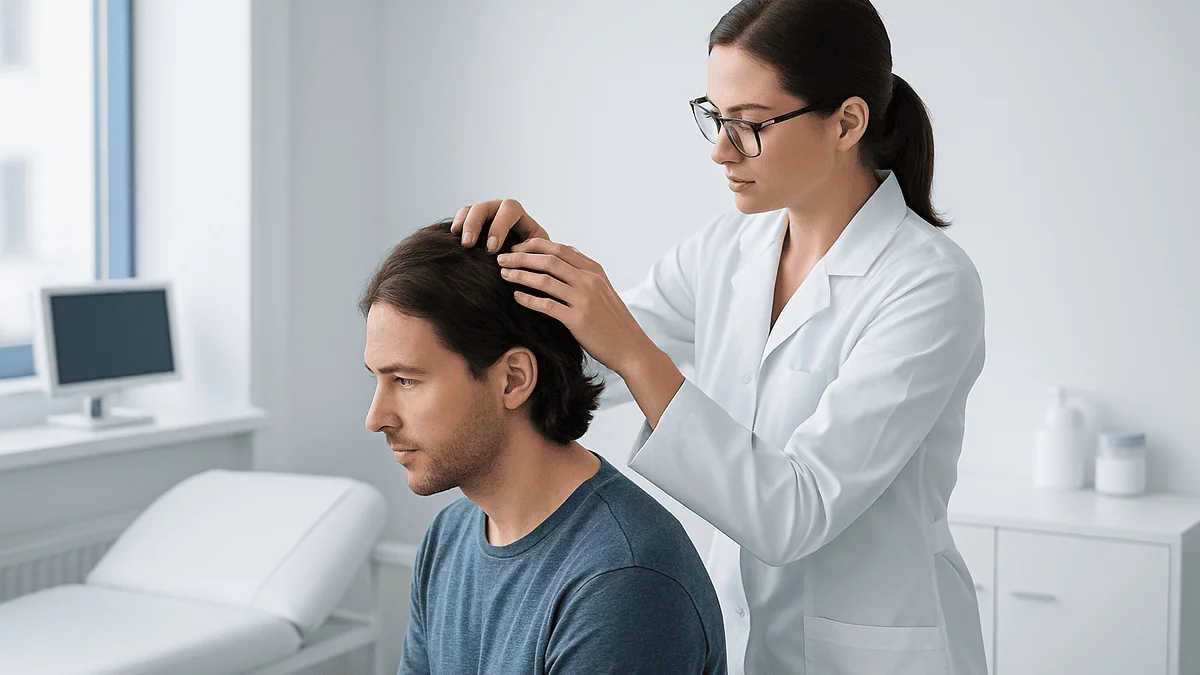
Diagnosis comes first, and for postmenopausal women it is more involved than for most men. The Mayo Clinic lists the standard workup: a history and examination, a pull test in which gently tugging a small bundle of hair shows how many are in the shedding phase, scalp examination under magnification, blood tests to look for iron deficiency, thyroid dysfunction and other treatable contributors, and sometimes a small scalp biopsy when scarring or inflammation is suspected.
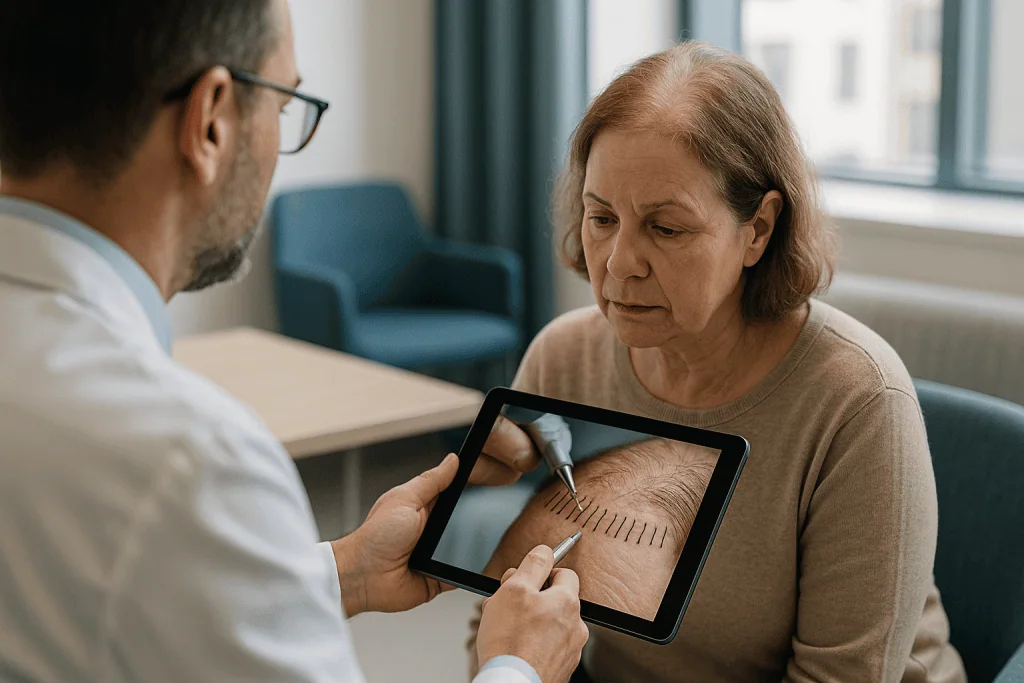
A dermatoscope, a handheld magnifier with a light, lets the clinician see whether hair shafts in the thinning zone vary in thickness, the signature of miniaturization, and whether the donor area shows the same change. That single observation often decides whether surgery is a sensible path. It also helps distinguish female pattern loss from frontal fibrosing alopecia, a scarring condition that most often affects women after menopause and causes a slowly receding band at the front hairline, often with loss of eyebrows. Grafting into an active scarring process usually fails, so this distinction is not academic.
Blood work matters for two reasons. Correcting a low iron store or an underactive thyroid can reduce shedding on its own, and the NIH Office of Dietary Supplements notes that iron deficiency is more common in women than men across adult life. Any decision to supplement belongs to the treating clinician, who will base it on the actual results rather than on a hunch.
Expect the clinician to ask about medicines, recent illness, weight change, surgery and major stress in the past six months, because a shed from any of those can take that long to show up and that long again to recover. A transplant planned on top of an unrecognized telogen effluvium is a plan built on moving sand.
FUE or strip for a female hair transplant: how the methods compare
Both harvesting techniques are used for women, and the choice depends on the donor area, hair length and what the person is willing to accept during healing. FUE requires the donor zone to be shaved, at least in a band, so the punch can reach each unit. Many women do not want that, and some surgeons can harvest from a shaved strip that longer hair above it covers. FUT does not need shaving beyond the strip itself, which the surrounding hair hides immediately, but it leaves a linear scar that shows if hair is later worn very short.
| Factor | FUE (individual punches) | FUT (strip) |
|---|---|---|
| Shaving needed | Yes, at least a band of the donor area | No, only the strip itself |
| Scar type | Many small dots, spread across the donor zone | One linear scar hidden by hair above it |
| Suitability with diffuse donor thinning | Spreads harvest, but each punch removes density from an already thin area | Concentrates harvest; fewer grafts per session if donor is sparse |
| Donor healing | Small wounds close over about 1–2 weeks | Stitches or staples typically removed at around 10 days (MedlinePlus) |
| Session length | Often longer per graft, several hours | Several hours; strip division done by a team |
Neither method is better in the abstract. A woman with long hair, a tight scalp and a modest number of grafts may be guided toward FUE under a hidden shaved band. A woman wanting a larger session and able to keep hair covering the back may be offered a strip. The healing figures above are typical ranges from MedlinePlus and the Cleveland Clinic, not promises, and the surgeon’s own assessment of scalp laxity and donor density settles the question.
Medicine alongside surgery: what it does and how long it takes
Because the native hair around the grafts keeps miniaturizing after menopause, medical treatment is usually part of the plan rather than an alternative to it. The decision to start, continue or change any of these belongs with the prescribing clinician; what follows is mechanism and timeline only.
Topical minoxidil is the only treatment the NHS and Mayo Clinic list as having established evidence for female pattern hair loss. It is thought to prolong the growth phase and widen the hair shaft, and it works only while it is used. The NHS notes it can take three to six months before any effect is visible, and the Mayo Clinic advises at least six months of use before judging whether it is helping. A transient increase in shedding in the first weeks is recognized and expected. Surgeons often ask that this treatment be settled before surgery and continued afterward, so the result is not slowly surrounded by thinning.
Anti-androgen medicines, which reduce the effect of male-type hormones on the follicle, are sometimes used off-label in postmenopausal women; the Mayo Clinic notes that evidence for them is more limited and that they are prescribed case by case. Hormone replacement therapy is prescribed for menopausal symptoms, not for hair, and the NHS does not list it as a hair-loss treatment. Platelet-rich plasma injections and low-level laser devices are offered in many places; the Mayo Clinic describes the evidence as still limited, which is the honest state of knowledge.
The timeline matters for planning. A woman who begins medical treatment and then books surgery six weeks later has not given the clinician time to see whether shedding has stabilized. Many surgeons prefer to see six to twelve months of settled loss before operating.
Is a hair transplant painful? What the day is usually like
The honest answer is that the injections of local anesthetic are the most uncomfortable part, and after that most people feel pressure and movement rather than pain. The scalp is numbed in both the donor and recipient areas with a series of small injections; this stings for a minute or two and then the area goes quiet. Some surgeons offer a mild oral sedative for anxiety, which is a decision made with the anesthetist or surgeon, not something to arrange yourself.
Once numb, the person lies or sits for several hours. FUE harvesting is done face-down or on the side; strip removal is done in a similar position and the wound is closed with stitches or staples. The recipient incisions and graft placement follow, usually face-up. Breaks for the bathroom, a drink and a meal are built into a long session. The Cleveland Clinic describes the procedure as taking roughly four to eight hours depending on the number of grafts, and some larger plans are split over two days.
Afterward, the numbness wears off over the evening and the scalp feels tight, tender and sometimes achy, especially along a strip scar. MedlinePlus notes that the surgeon may advise pain relief and that many people manage with simple measures; swelling of the forehead can appear on the second or third day and settle over a few days. A loose bandage or none at all is common. Headache and mild sleep disturbance are frequent for a night or two. Severe or escalating pain is not expected and is one of the signs that should prompt a call, covered below.
The following days and weeks: donor area recovery, the shed and the slow return
The first week is about protecting grafts. For the first few days most people are asked to sleep with the head slightly raised, avoid touching the recipient area, and wash the scalp gently in the way the surgeon demonstrates. Tiny crusts form around each graft and lift off over about a week to ten days. The Cleveland Clinic notes that many people return to desk work within a few days, while heavy exercise, swimming and anything that raises blood pressure or risks a knock to the head are usually held back for a couple of weeks.
The donor area recovers on its own schedule. FUE dots close over roughly one to two weeks and fade over a few months, though they remain visible on close inspection under very short hair. A strip wound has its stitches or staples removed at around ten days, according to MedlinePlus, and the scar matures and softens over the following year. Numbness of the donor skin is common and generally recovers over weeks to months, with a small number of people noticing a longer-lasting patch.
Then comes the part that catches people out. Between two and three weeks after surgery, most of the transplanted hairs shed. MedlinePlus explains that the follicles stay in place and that new growth usually starts within a few months, with most of the new hair present at about six to nine months. Clinicians generally wait a year or more before judging the final density, because hairs continue to thicken and lengthen through that second half.
During this stretch the native hair around the grafts can also shed from the trauma of surgery, a temporary effluvium called shock loss. It is more noticeable in women with diffuse thinning and usually recovers, but it is one more reason surgeons want shedding stable before they operate.
Risks and alternatives, in plain clinical terms
Hair transplantation is a minor surgical procedure under local anesthesia, and its risks are those of any skin surgery plus a few specific to grafting. MedlinePlus and the Cleveland Clinic list bleeding, infection, swelling, bruising around the eyes, numbness, folliculitis (inflammation around the new hairs), scarring, and grafts that do not take. Shock loss of surrounding hair, unnatural direction or density if placement is poor, and visible thinning of the donor area after over-harvesting are the complications that most concern women with diffuse loss. People on anticoagulants, people who smoke and people with poorly controlled diabetes carry higher wound-healing and graft-survival risk, and the surgeon will want these assessed first.
Alternatives deserve equal airtime. Topical minoxidil, continued indefinitely, is the evidence-based medical option listed by the NHS and Mayo Clinic for female pattern loss, and for many women it is the whole plan rather than a bridge to surgery. Treating an identified contributor such as iron deficiency or thyroid disease can reduce shedding without any procedure. Camouflage works well for diffuse thinning: colored fiber powders, scalp tinting, lighter hair color that reduces contrast with the scalp, and strategic cuts that add lift. Hairpieces and partial toppers have improved considerably and are what the NHS suggests for people who prefer not to use medicines or surgery.
Scalp micropigmentation, a form of medical tattooing that darkens the scalp between hairs, can reduce the see-through look of a widened part and is sometimes combined with a smaller graft number. None of these is right for everyone, and the ranking of them for a particular woman is a conversation for her treating team, who know her scalp, her health and her priorities.
What people often get wrong about hair transplants after menopause
Thinning after menopause is always hormonal. It is often partly hormonal, but the Mayo Clinic’s list of causes, from iron deficiency to thyroid disease to medicines and stress, applies at this age too. Several can coexist, and surgery only addresses the pattern part.
A transplant creates new hair. It relocates hair. If there is not enough stable donor hair, no technique can conjure more, and that single fact rules out more postmenopausal women than age or health ever does.
Once the grafts are in, the job is done. The grafts keep growing, but the native hair between them continues on its own path. Without ongoing medical treatment or at least honest expectation of further thinning, a result that looks full at eighteen months can look patchy later.
Hormone therapy for menopause will restore hair. The NHS does not list it as a hair-loss treatment. Some women notice less shedding on it, others none, and it is prescribed for menopausal symptoms, with its own risk discussion, not for the scalp.
Shedding after surgery means it failed. MedlinePlus describes the shed of transplanted hair at two to three weeks as expected, with regrowth over the following months.
Women cannot have FUE. They can; the issue is shaving, which can often be limited to a hidden band.
Supplements regrow hair. Correcting a measured deficiency can reduce shedding. Taking biotin or iron without a documented need has no supporting evidence for pattern loss, and the NIH Office of Dietary Supplements notes that excess iron carries its own harms. Any supplement decision belongs with the clinician who has seen the blood results.
Questions to ask your care team before deciding
A good consultation is a two-way examination. These questions tend to surface the information that matters most for a woman whose thinning began around menopause, and the answers should come from the dermatologist or surgeon who has looked at the scalp under magnification.
- What is the diagnosis, and how confident are you that this is female pattern hair loss rather than, or in addition to, a shedding condition or a scarring one?
- Have my iron, thyroid and other relevant blood tests been reviewed, and is anything being treated first?
- Under the dermatoscope, is my donor area miniaturizing, and how does that change what you would recommend?
- Do you want my shedding stable on medical treatment for a period before surgery, and for how long?
- Which harvesting method do you suggest for me, and why? How much shaving would be needed and how would it be hidden?
- Roughly how many grafts are you planning, where exactly will they go, and what coverage, not what hair, should I expect at twelve to eighteen months?
- What will the donor area look like afterward, both in the short term and if my thinning there continues?
- What happens to the hair between the grafts over the next ten years, and what is the plan for it?
- What are the specific risks in my case given my medicines and health history, and who manages a complication if one arises?
- If you would not operate, what would you do instead?
That last question is the most revealing. A clinician who can describe a thoughtful non-surgical plan for your scalp is one who is weighing your interests rather than a procedure. Write the answers down, and if anything in them conflicts with what you have read here, ask for the reasoning; the person who has examined you is the one whose judgement should carry the decision.
When to call your doctor
Most recovery is uneventful, and the team will give you written instructions and a contact number. Use it. The signs below are reasons to call the same day rather than wait for a scheduled review.
After surgery, contact the surgical team promptly if you notice spreading redness, warmth or increasing pain around the donor or recipient area, pus or a foul-smelling discharge, a fever or chills, bleeding that does not stop with gentle pressure for several minutes, or swelling that worsens after the first few days rather than settling. Severe or escalating headache, sudden vision change, chest pain, breathlessness, or a hot swollen calf after a long immobile session are rare but need urgent medical attention, not a wait-and-see approach; call emergency services if any of these develop suddenly.
Outside the surgical window, see a doctor about hair loss itself when shedding is sudden or heavy, when hair comes out in distinct patches or with a smooth or scarred scalp, when the scalp itches, burns or is sore, when eyebrows or body hair are also thinning, or when hair loss arrives with fatigue, unexplained weight change, feeling unusually cold or hot, heavy periods before menopause, or new facial hair and acne. The NHS and Mayo Clinic flag these as features that point to a treatable or inflammatory cause rather than simple pattern thinning.
Low mood that follows hair loss is also a reason to speak to a clinician. The NHS notes that hair loss can be distressing and that support is available; it is a medical concern in its own right, not vanity. In every situation above, the treating team, with the scalp and the test results in front of them, is the right place for the decision.
Frequently asked questions
How do you reverse thinning hair after menopause?
Pattern thinning after menopause cannot be fully reversed, but it can often be slowed and partly improved. The NHS and Mayo Clinic list topical minoxidil as the treatment with established evidence; it works only while used and takes three to six months to show. Treating iron deficiency or thyroid disease helps when they are present. A transplant can add coverage where native hair has gone, provided the donor area is stable. Decisions sit with your clinician.
Is 60 too old for a hair transplant?
No. There is no upper age limit in mainstream guidance, and a sixty-year-old whose pattern has stabilized is often easier to plan for than a much younger person. What matters is whether the donor area at the back and sides has kept its density, and whether general health and medicines allow a long procedure under local anesthesia. A preoperative assessment, not a birth date, decides.
Is a hair transplant painful?
The local anesthetic injections sting for a minute or two; after that most people feel pressure and movement rather than pain. The procedure lasts several hours. Afterward the scalp is tight, tender and sometimes achy for a few days, with forehead swelling possible around day two or three. MedlinePlus notes pain relief may be advised. Severe or worsening pain is not expected and should prompt a call to the team.
How long does it take for the hair transplant donor area to recover?
Small FUE wounds usually close over about one to two weeks and the dots fade over months, although they stay visible on close inspection under very short hair. For strip surgery, MedlinePlus notes stitches or staples are typically removed at around ten days, and the scar softens over the following year. Donor numbness is common and generally resolves over weeks to months. Follow your surgeon’s care instructions.
Is a hair transplant for thinning hair in women different from one for men?
Yes, mostly in planning. Women usually keep their hairline, so grafts are spread to raise density over the part and crown rather than to build an edge. Diffuse thinning is more common in women, so the donor area must be checked for miniaturization under a dermatoscope before surgery. Surgeons also more often ask for medical treatment to be settled first, because surrounding native hair keeps thinning.
Can hormone replacement therapy stop hormonal hair loss after menopause?
It is not a hair-loss treatment. The NHS does not list hormone replacement therapy as a treatment for female pattern hair loss, and it is prescribed for menopausal symptoms after a separate discussion of benefits and risks. Some women notice less shedding on it and others notice no change. Whether it is appropriate for you is a decision for your prescribing clinician, not something to start for the scalp.
What is the hair transplant age limit for women?
There is none in mainstream guidance. Candidacy rests on having a stable, adequately dense donor area, a clear diagnosis of pattern loss rather than an active shedding or scarring condition, and health that permits a several-hour procedure under local anesthesia. Surgeons are more cautious with very young patients whose pattern is still evolving than with older ones whose pattern has declared itself.
Why does transplanted hair fall out after surgery?
Because the follicles, not the hairs, are what the surgeon moved. MedlinePlus explains that the transplanted hairs usually shed within two to three weeks as the follicles reset their cycle, then produce new hair over the following months, with most growth present at about six to nine months. Native hair near the grafts can also shed temporarily, a shock loss that usually recovers.
Can a female hair transplant be done with FUE without shaving the whole head?
Often, yes. FUE needs a shaved area so the punch can reach each follicular unit, but many surgeons harvest from a narrow band at the back that longer hair above it covers. Strip surgery avoids shaving beyond the strip itself but leaves a linear scar. Which is suitable depends on donor density, scalp laxity and the number of grafts planned.
Do iron or biotin supplements regrow hair after menopause?
Correcting a measured iron deficiency can reduce shedding, which is why clinicians check blood tests before any plan. Taking iron or biotin without a documented deficiency has no supporting evidence for pattern hair loss, and the NIH Office of Dietary Supplements notes that excess iron can be harmful. Any supplement decision should follow blood results and come from the treating clinician.
References
This article is for general information only and is not a substitute for professional medical advice. Please consult a qualified doctor about your individual situation.

More from the Blog

Retrograde Alopecia: The Donor-Area Pattern That Changes Transplant Planning
Retrograde alopecia is progressive hair thinning that climbs upward from the nape of the neck and the skin above the ears, areas usually spared…
How Facial Proportions and Donor Capacity Shape an FUE Hairline Plan
An FUE hairline plan starts with the face, not the graft count. Surgeons typically place the new hairline so the forehead sits in rough…
Strip (FUT) Hair Transplants: Why the Method Persists, and Scar Repair Options
Strip (FUT) hair transplants persist because removing one thin strip of scalp lets surgeons harvest thousands of intact follicular-unit grafts in a single session,…
How Long Does a Hair Transplant Last? The Honest Answer About Permanence
Transplanted hair is generally permanent. The follicles are taken from areas of the scalp that resist the hormone-driven shrinking behind pattern baldness, and they…
Hair Transplant Costs in Istanbul: What City-Level Pricing Looks Like
In Istanbul, most hair transplants are sold as fixed, all-inclusive packages rather than per graft. Our guide range for a standard maximum-graft FUE package…
What to Ask Before an Unshaven (U-FUE) Hair Transplant: Trimming, Graft Limits and Sessions
Before an unshaven FUE hair transplant, ask exactly how your donor hair will be trimmed (fully unshaven, a partial shave or a hidden window),…