

Head Lice: What Works Now That Resistance Is Common

Key Takeaways
- Genetic surveys published in 2016 found pyrethroid-resistance mutations in lice from all 48 US states sampled, which is why permethrin and pyrethrin products fail so often today.
- A first-time infestation can go four to six weeks before itching begins, because the itch is an allergic reaction to louse saliva that the immune system has to learn.
- Nits more than a quarter inch (6 mm) from the scalp have almost always hatched or died; only live lice, or fresh eggs close to the skin, confirm an active case.
- An adult louse dies within one to two days off a human head and eggs cannot hatch at room temperature, so bedding needs a hot wash, not a fumigation.
- Ivermectin lotion, spinosad and abametapir each rest on randomized trials and are not yet undermined by documented resistance, unlike the decades-old over-the-counter options.
- Wet-combing on days one, five, nine and thirteen is timed to catch each wave of newly hatched nymphs before they are old enough to lay eggs.
Head lice in the United States are now widely resistant to over-the-counter permethrin and pyrethrin products, so a failed first treatment usually reflects resistance rather than poor technique. Approaches with the strongest current evidence are careful wet-combing every few days for two weeks and newer treatments such as ivermectin lotion, spinosad, malathion or abametapir, used exactly as labeled and chosen with a clinician when drugstore products fail.
The school nurse’s note arrives folded in a backpack, and within an hour a parent is standing in a pharmacy aisle reading the back of a box that has not changed much since the 1990s. That scene is repeating across the country this fall, and search interest in lice has spiked with it. Two currents are feeding the surge: the usual September return to classrooms, and a run of viral posts insisting that drugstore lice shampoo is useless and that a jar of mayonnaise or a few drops of tea tree oil will finish the job instead.
One of those claims has real science behind it. The other does not. As of September 2026, the CDC, the NHS and the major academic medical centers agree on a version of events that is less dramatic than the internet’s but far more useful: the oldest over-the-counter products fail often, several better-studied alternatives exist, and a fine-toothed comb remains one of the most reliable tools a family owns.
What follows is the evidence, graded by strength, with the folklore set aside.
What changed recently with head lice treatment
Resistance itself is old news to entomologists. Surveys published in 2016 tested lice collected from 48 US states and found the genetic change linked to pyrethroid resistance, known as knockdown resistance or kdr (a mutation in the louse nervous system that blunts permethrin and pyrethrins), in every state sampled, at near-total frequency in 42 of them. What has shifted since is the shelf and the rulebook.
Ivermectin lotion, first approved in 2012, became available without a prescription after a 2020 regulatory switch. Spinosad, approved in 2011, now carries a label that extends to infants six months and older. Abametapir, a lotion with an entirely different mechanism, was approved in 2020. The CDC’s treatment guidance, reorganized in 2024, lists all of these beside the older options and says plainly that resistance to over-the-counter products has been reported and that treatment failure should prompt a change of approach rather than a repeat of the same one.
School policy moved as well. The American Academy of Pediatrics reaffirmed in its 2022 clinical report that children should not be sent home mid-day for lice or kept out until every egg is gone, a position the CDC and the NHS both share. The reasoning is practical: by the time lice are noticed, a child has typically carried them for weeks, and exclusion punishes without protecting.
Nothing in the dated record supports the viral remedies. No controlled trial has shown mayonnaise, olive oil, tea tree oil or vinegar to clear an infestation reliably. The honest summary is this: the product many families reach for first is the one most likely to fail, and better-studied alternatives have been sitting nearby for years.
Why are lice resistant to over-the-counter treatments?
Permethrin and pyrethrins work by jamming open sodium channels in the louse’s nerve cells, which paralyzes and kills the insect. Pyrethrins come from chrysanthemum flowers; permethrin is the synthetic cousin. Both have been sold for lice since the 1980s, and decades of exposure did what exposure to any pesticide does: it selected for the rare lice that carried a channel shaped slightly differently. Those survivors bred, their offspring inherited the trait, and today most US lice carry it.
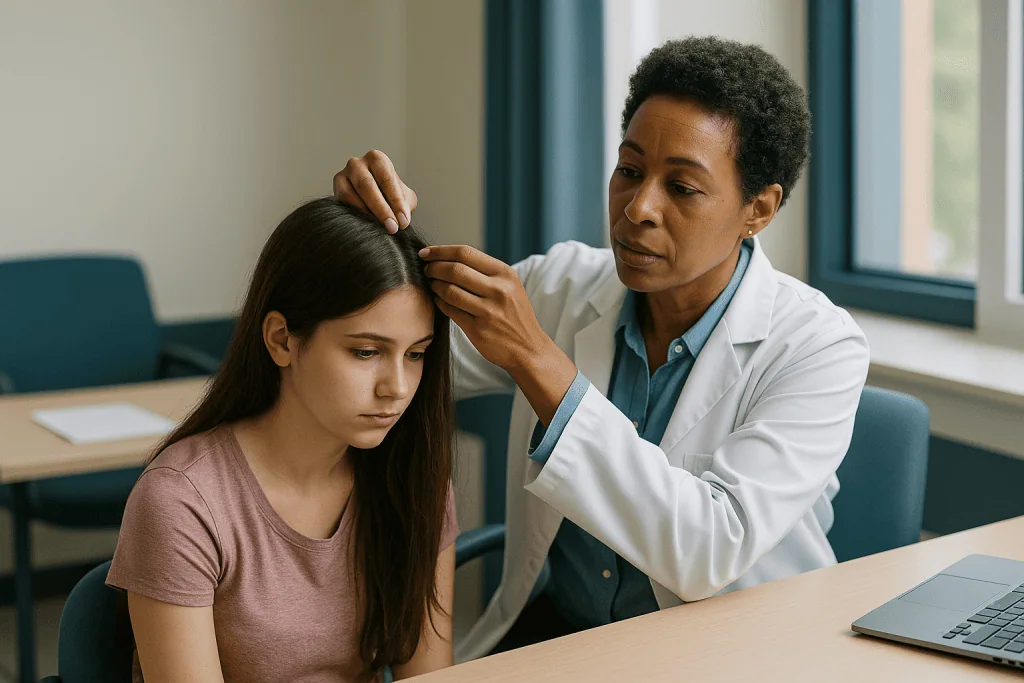
Resistance is a spectrum rather than a switch. A louse with kdr mutations may still die if drenched long enough, which is why some families report the old products still work. Many more report a wriggling louse the morning after, and that is not a sign of doing anything wrong.
Genuine resistance is only one reason a treatment fails, though, and honesty requires listing the others. Applying too little product to reach the scalp, using conditioner beforehand (it coats hair and blocks contact), skipping the second application when a label calls for one, and being reinfested by a sibling who was never checked all look identical to resistance from the bathroom mirror. So does mistaking old, empty eggshells for a live infestation.
The evidence here is graded as strong for the existence and spread of resistance: laboratory testing of louse DNA is objective and has been repeated across regions and years. The evidence on how often an individual family’s failure is resistance versus technique is weaker, drawn mostly from observational studies and clinic experience. Both matter. A second failed course of the same product, applied correctly, is the point at which most guidance says to switch.
Head lice symptoms: how can you tell if you have lice?
Itching is the headline symptom, but it is a poor early warning system. The itch is an allergic reaction to louse saliva, and on a first infestation the immune system can take four to six weeks to start reacting. A child can host lice for over a month without scratching once. Some people never itch at all.
Other clues are subtler. A tickling sensation of something moving in the hair, restless sleep (lice are most active in darkness), and small red bumps or scratch marks along the neck and behind the ears all point the same way. Those spots behind the ears and at the nape are where lice prefer to lay eggs because the scalp runs warmest there.
The only proof is a live louse. Adults are the size of a sesame seed, tan to grayish white, and move quickly away from light, which makes them hard to catch by eye alone. Nymphs (young lice that hatched within the past nine to twelve days) are smaller still. Eggs, called nits, are oval, about the size of a knot in thread, and glued to a single hair shaft close to the scalp. Nits found within about a quarter inch (6 mm) of the skin were laid recently and may be alive; nits farther out have usually hatched or died and are riding along as the hair grows.
Both the CDC and the Mayo Clinic note that combing wet, conditioned hair with a fine-toothed lice comb finds live lice more reliably than looking. Part the hair in small sections under bright light and wipe the comb on a white tissue after each pass. Finding nits alone, without a living louse, is not enough to confirm an active case.
Lice vs dandruff: telling nits from flakes
Overdiagnosis is a quieter problem than resistance, and it leads to a great deal of unnecessary treatment. Studies of samples sent to specialist labs by parents, teachers and even clinicians have found that a large share of suspected nits turn out to be something else entirely.
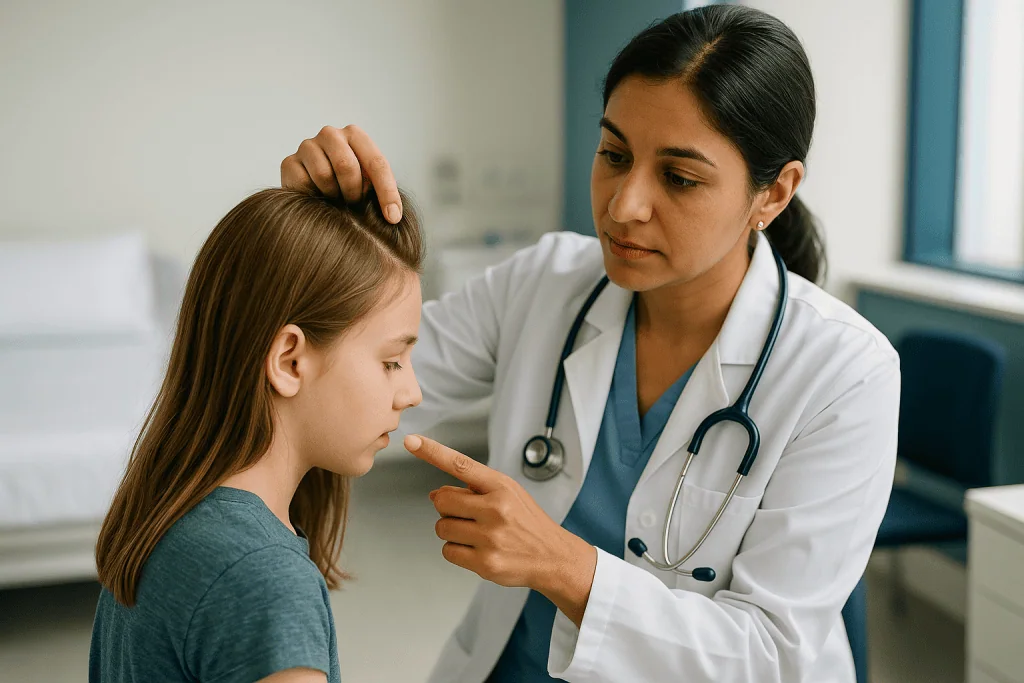
The distinguishing test is mechanical. A nit is cemented to one side of the hair shaft and will not brush, blow or flick away; you have to slide it down the hair with fingernails or a comb, and even then it resists. Dandruff sits loosely on the scalp and hair and falls at a touch. Dried hairspray, gel or dry shampoo forms irregular clumps rather than uniform ovals. Hair casts, which are thin tubes of keratin that form around a hair shaft, look confusingly like nits but slide freely up and down.
Color and position help too. Live eggs are yellowish to tan and sit near the scalp; hatched shells are white or translucent and drift outward as hair grows, roughly a centimeter a month. A cluster of pale specks halfway down a ponytail is a record of an infestation that may be long over.
A magnifying glass, a bright window and a white sheet of paper turn this from guesswork into a reasonable inspection. Under magnification a nit shows a small cap at one end and, if unhatched, a visible dark embryo inside. Dandruff shows no structure at all.
Getting this right matters because pediculicides (products designed to kill lice) are pesticides applied to a child’s skin. Using them on a case of flaky scalp offers no benefit and exposes the child for nothing. When the distinction is genuinely unclear, a clinician or school nurse with a lice comb can settle it in minutes.
What attracts lice to a person?
Nothing about cleanliness. This is the point the evidence makes most firmly and the public believes least. Lice need three things: warmth, a hair shaft to grip, and blood to drink several times a day. Freshly washed hair provides all three as readily as unwashed hair. Studies have found no relationship between hygiene and infestation, and the NHS states directly that lice have nothing to do with dirty hair.
What lice need is proximity. They cannot jump or fly; their legs end in claws built for gripping hair, not for leaping. Transmission happens almost entirely through direct head-to-head contact, which is why the CDC’s estimated six to twelve million US infestations a year cluster among children three to eleven, the age of huddled reading circles, sleepovers and selfies taken with heads pressed together. Girls are affected somewhat more often than boys, most likely because of longer hair and closer play, not any biological preference by the louse.
Sharing hats, brushes, headphones and pillows can transmit lice, but far less often than folklore suggests. A louse off a head is a louse in trouble, and one on a hat brim has minutes to find a new scalp before it weakens.
One genuine biological pattern exists. The CDC notes that head lice infestation is markedly less common among Black Americans than other US groups, which entomologists attribute to the claw shape of the North American louse being adapted to rounder hair shafts. In other parts of the world, where local lice have adapted differently, that difference disappears.
Pets play no role. Dog and cat lice are different species that cannot survive on human hair, and human lice cannot live on animals.
Can lice be on your bed?
Briefly, yes. Usefully, not for long. An adult louse that falls onto a pillow loses its warmth and food source at once and dies within one to two days. Eggs fare worse: they need scalp temperature to develop and will not hatch at room temperature, and any that do hatch produce nymphs that die within hours without a blood meal. The bed is a dead end, not a reservoir.
That biology shapes the CDC’s cleaning advice, which is more modest than most families expect. Machine-wash bedding, clothing and towels used by the infested person during the two days before treatment in hot water and dry them on high heat; 130°F (about 54°C) kills lice and eggs. Items that cannot be washed, such as stuffed animals or a favorite helmet, can be dry-cleaned or sealed in a plastic bag for two weeks, long enough for any egg to hatch and any louse to die. Soak combs and brushes in hot water for five to ten minutes. Vacuum sofas, car seats and carpets where an infested head rested, mainly to remove shed hairs with eggs attached.
Fumigant sprays and pesticide foggers are not recommended by any major health body. They deposit chemicals where children play and add nothing to the two-day-survival math.
Perspective is the real message. Families sometimes spend an exhausting weekend laundering every textile in the house while the actual infestation continues on an unchecked sibling’s head. The head is where lice live, feed and breed. Clean the recently used items, then put the effort where it counts: combing, treating and checking every person who shares a home or a bed.
What kills lice instantly? An honest answer
Nothing that is safe to put on a child’s head kills every louse and egg in seconds, and chasing that promise is where the most harmful mistakes happen. Products marketed as instant tend to be either unproven or dangerous.
The dangerous ones deserve naming. Kerosene, gasoline and other petroleum products have caused severe burns and fatal fires when used on hair. Flea and tick treatments meant for dogs and cats contain pesticides at concentrations never tested on children. Undiluted essential oils have caused chemical burns and, when swallowed, poisoning. Poison control centers and the CDC warn against all of them.
What approved treatments actually do is kill live lice over minutes to hours, and most of them do not kill eggs. That is why permethrin and pyrethrin labels call for a second application about nine days later, timed to catch nymphs that hatched after the first round. Spinosad and malathion are considered ovicidal (able to kill eggs), which is why a second course is only recommended if live lice are still found. Ivermectin lotion does not kill eggs either, but newly hatched nymphs exposed to it cannot feed and die, so a single application is usually labeled as sufficient.
The closest thing to instant is mechanical. A lice comb removes whatever it catches, right then, and shaving the head removes everything, though no guideline asks a child to go through that. Heated-air devices that dry out lice and eggs have shown promise in small studies, which counts as preliminary evidence, not established.
Speed is the wrong yardstick anyway. An approach that kills most lice in an hour but leaves viable eggs is slower, in the end, than one that reliably breaks the life cycle over two weeks.
How to get rid of lice: a plan that respects resistance
Start by confirming a live louse, not just nits. Then choose a treatment with resistance in mind. In areas where permethrin has failed repeatedly, many clinicians now steer families toward ivermectin lotion, spinosad or wet-combing from the beginning rather than after a wasted course. That is a conversation to have with a pharmacist or clinician, who can also account for a child’s age, since each product carries its own minimum age on the label.
Whatever is chosen, the label is the protocol. Apply to hair in the state the instructions specify, dry or damp, and do not use conditioner first. Work the product to the scalp, especially behind the ears and at the nape, and leave it on for exactly the stated time. Rinse over a sink rather than in the shower so it does not run over the body.
Check the hair eight to twelve hours later. Finding a few sluggish lice is normal; finding many fast-moving ones suggests the product did not work. Comb wet, conditioned hair with a lice comb every two to three days for the following two to three weeks, which both removes lice and tells you whether the treatment is holding.
Retreat only as the label directs. For permethrin and pyrethrins that is typically day nine; for ovicidal products, only if live lice reappear. Never combine products or repeat more often than instructed in hopes of a faster result.
Check everyone in the household the same day and treat only those with live lice, plus anyone who shares a bed with the infested person. Tell the school and the parents of close friends without embarrassment; lice are a fact of childhood, not a verdict on anyone’s home.
If live lice persist after two correctly applied courses of the same product, stop repeating it. That is the moment to call the clinician about a different class of treatment.
Lice treatments compared: what each one does
The table below summarizes the approaches that appear in CDC, NHS and Mayo Clinic guidance. It describes mechanism and evidence, not dosing; the label and the clinician set those. Ages listed reflect US labeling as summarized by the CDC.
| Treatment | Type | How it works | Kills eggs? | Resistance concern | Evidence strength |
|---|---|---|---|---|---|
| Permethrin lotion | Over the counter, 2 months+ | Nerve toxin (sodium channel) | No; second application needed | Widespread in US | Strong historically; effectiveness now reduced |
| Pyrethrins with piperonyl butoxide | Over the counter, 2 years+ | Nerve toxin, same target | No; second application needed | Widespread, shares kdr resistance | Same as permethrin |
| Ivermectin lotion | Over the counter since 2020, 6 months+ | Paralyzes lice; hatched nymphs cannot feed | No, but nymphs die | Not yet documented | Two randomized trials, strong |
| Spinosad suspension | Prescription, 6 months+ | Nerve overexcitation (different target) | Yes | Not yet documented | Randomized trials versus permethrin, strong |
| Malathion lotion | Prescription, 6 years+ | Enzyme inhibitor; flammable | Partially | Rare in US | Older trials, moderate |
| Abametapir lotion | Prescription, 6 months+ | Blocks enzymes lice need to develop | Yes | None documented | Two randomized trials, strong |
| Wet-combing | Home method, any age | Physical removal, repeated | Removes some; catches hatchlings | None possible | Randomized trials, moderate; technique-dependent |
| Dimethicone lotions | Nonprescription in many countries | Coats and suffocates lice physically | Variable by product | None possible | Randomized trials, mainly European, moderate to strong |
Two omissions are deliberate. Lindane is no longer recommended by the CDC for lice because of rare but serious nervous-system side effects, and oral ivermectin, though studied in trials, is not FDA-approved for head lice; whether it is appropriate for a particular patient is a decision that belongs to the treating clinician.
What the evidence actually says
Grading the evidence separates what is known from what is repeated. The strongest form is the randomized controlled trial, in which participants are assigned by chance to one treatment or another so that the comparison is fair. Below that sit observational studies, which watch what happens without assigning treatment, and expert opinion, which is informed judgment.
Ivermectin lotion rests on two randomized, vehicle-controlled trials in which roughly three-quarters of participants were louse-free two weeks after a single application, compared with under one in five given the inactive lotion. Spinosad was tested head to head against permethrin in randomized trials and cleared lice in a clearly higher share of participants. Abametapir showed similar margins against its inactive vehicle in two trials. These count as strong evidence, with the caveat that trials were industry-funded and that real-world performance is often somewhat lower.
Permethrin’s own trials from decades ago were strong, but observational data since, along with laboratory resistance testing, show its real-world effectiveness has fallen substantially in many regions. The evidence that it still works somewhere is real; the evidence that it works reliably in the average US town is not.
Wet-combing has been tested in randomized trials in the UK, where it cleared lice in roughly half of participants when done well, a figure that rises with technique and persistence. That is moderate evidence, honest about its limits. Dimethicone-based lotions have several European randomized trials behind them and outperform pyrethroids in resistant populations; the evidence is moderate to strong.
Home remedies sit at the bottom. Mayonnaise, olive oil, tea tree oil, vinegar and hair dye have no controlled trial showing reliable clearance; what exists is anecdote and small laboratory tests on lice in dishes, which do not translate to a scalp. Heated-air devices have small studies with encouraging results, which is preliminary evidence, not proof.
Lice treatment at home: does wet combing work?
The NHS puts wet-combing first, and there is logic in that choice for a country where pyrethroid resistance arrived early. The method is simple, resistance cannot develop against a comb, and it costs nothing in pesticide exposure. Its weakness is that it demands patience and technique, and trials show results vary with how carefully it is done.
The technique matters more than the tool, though the tool matters too. Use a fine-toothed detection comb with rigid teeth spaced closely enough to trap a nymph; ordinary combs are useless. Wash the hair, apply a generous amount of ordinary conditioner, and leave it in. Conditioner slows lice, which cannot grip well or flee through it, and lets the comb glide.
Detangle with a wide comb first. Then, working in small sections under a bright light, place the lice comb flat against the scalp and draw it slowly to the ends of the hair, wiping it on white tissue after every stroke and looking for lice. Cover the whole head systematically, section by section, which takes ten minutes for short hair and up to half an hour or more for long, thick hair. Rinse, and repeat the combing once more on the wet hair.
Timing is where most home attempts fail. The NHS schedule is a session on days one, five, nine and thirteen, chosen to catch each wave of nymphs after they hatch and before they can lay eggs of their own. Skipping the day-nine session lets the cycle restart. Continue until three consecutive sessions find no lice.
Combing also pairs well with any product. Even families using ivermectin lotion or spinosad benefit from combing afterward, both to remove dead and dying lice and to verify, with their own eyes, that the treatment is working.
Common myths about lice, corrected
The myth with the highest cost is that lice mean a dirty home or neglectful parenting. Every major health body rejects it; lice are indifferent to shampoo schedules and thrive in spotless households. Shame delays treatment and keeps parents from warning other families, which is exactly how an outbreak spreads through a classroom.
Lice do not jump, fly or swim between heads. They crawl. A child sitting across a table from an infested classmate is at no meaningful risk; a child sharing a pillow at a sleepover is.
Pets are not involved. Human lice cannot live on dogs or cats, and animal lice cannot live on people. Treating the family dog wastes effort and can harm the animal.
Hair dye and bleach do not reliably kill lice or eggs. Some lice may die in the process, but eggs are protected by their shell and the chemicals are not designed for the task. A dye job is not a treatment plan.
Oils and mayonnaise are said to suffocate lice overnight. Lice can close their breathing openings for hours, and no controlled trial shows these products clear an infestation. Petroleum jelly is even harder to wash out than it is to justify.
Nits do not equal an active infestation. Empty shells cling to hair for months. Without a live louse, or fresh eggs close to the scalp, treatment is not indicated.
The phrase super lice implies an unbeatable insect. Resistant lice are resistant to one class of chemical, not to combing, not to spinosad, not to ivermectin. Nor is shaving a child’s head necessary; it works, but so do gentler approaches.
Finally, no guideline recommends fumigating a house or throwing out bedding. Two days of survival off the head make that an expensive and pointless ritual.
Cleaning, school and telling other families
The awkward part of head lice is social, not medical. A found louse triggers a chain of phone calls nobody enjoys making, and the temptation is to treat quietly and say nothing. The evidence argues against that. Most infestations have been present for weeks before discovery, which means close friends and classmates have already had their exposure. The kindest and most effective step is to tell the school and the parents of children who have had recent head-to-head contact, so they can check the same evening.
School exclusion rules have loosened for good reason. The CDC and the American Academy of Pediatrics both advise against no-nit policies, which required every eggshell to be gone before a child returned. Empty shells can cling to hair for months, and a child kept home for them misses school while posing no risk to anyone. Current guidance is that a child with live lice can finish the school day, begin treatment that evening and return the next morning. Classroom-wide screenings by visual inspection have not been shown to reduce spread and are no longer recommended.
At home, check every household member the same day with a lice comb on wet, conditioned hair. Treat only those with live lice, plus anyone who shares a bed with the infested person, since transmission there is likely. Wash the items used in the previous two days as described earlier, and stop there.
Discourage head-to-head contact for the following two weeks, and put shared brushes and hair accessories away for that period. Long hair can be tied back. None of this needs to be dramatic; a calm, matter-of-fact approach, modeled by adults, is what keeps a child from feeling singled out for something that happens to millions of children a year.
When to see a doctor about lice
Most cases are managed at home, but several situations call for a clinician, and a few call for one promptly.
Make an appointment when live lice are still present after two correctly applied courses of the same over-the-counter product. Repeating it a third time rarely helps; a different class of treatment, chosen for the child’s age and history, is the next step, and that choice belongs to the prescribing clinician. Seek advice before treating any child under two years, anyone who is pregnant or breastfeeding, or anyone with a seizure disorder, asthma or an allergy to chrysanthemums or ragweed, since some products carry specific cautions for these groups. Also call if you cannot tell whether what you are seeing is a live infestation; a five-minute comb-through in the office can spare a child an unnecessary pesticide.
Red-flag signs need same-day attention. Watch for scratch marks that have become open, oozing or crusted sores, or for spreading redness, warmth and tenderness on the scalp or neck; these suggest a bacterial skin infection such as impetigo, which may need its own treatment. Fever, or swollen and tender lymph nodes at the neck, alongside scalp sores points the same way. Any burning, blistering or severe rash after a treatment or a home remedy, any product swallowed by a child, or a product that has gotten into the eyes calls for a clinician or poison control right away.
Lice on eyelashes or eyebrows are a separate situation. Standard scalp products should never go near the eyes; a clinician will advise on safe removal.
Never stop, change or double a prescribed treatment on your own, and never use a prescription product intended for someone else. If a treatment does not seem to be working, the right move is a call, not a guess.
Frequently asked questions
What kills lice instantly?
Nothing safe kills every louse and egg instantly, and products promising that are usually unproven or hazardous. Approved treatments kill live lice within minutes to hours, but most do not kill eggs, which is why labels call for a second application or follow-up combing. Kerosene, gasoline and pet flea products have caused serious injuries and should never be used on hair.
How can you tell if you get lice?
The only proof is finding a live louse, a sesame-seed-sized tan insect that moves quickly away from light. Itching may not begin for weeks, so look instead for a tickling sensation, restless sleep and small eggs glued to hair near the scalp behind the ears and at the nape. Combing wet, conditioned hair with a fine-toothed lice comb finds lice far more reliably than looking.
What attracts lice to a person?
Warmth, hair to grip and blood, all of which clean and unwashed hair provide equally. Lice are not drawn by poor hygiene, hair type or diet; they spread through direct head-to-head contact, which is why children between three and eleven, who play with heads close together, account for most cases. Shared hats and brushes transmit lice far less often than folklore suggests.
Can lice be on your bed?
Yes, briefly. A louse that falls onto bedding dies within one to two days without a scalp to feed on, and eggs cannot hatch at room temperature. Wash bedding and clothing used in the two days before treatment in hot water and dry on high heat, seal unwashable items in a bag for two weeks, and skip fumigation entirely.
Is it lice or dandruff?
Nits are glued to one side of a hair shaft and will not flick or blow away; dandruff falls off at a touch. Under magnification a nit is a uniform oval with a small cap at one end, while dandruff has no structure. Hair casts, which are tubes of keratin, look similar but slide freely along the hair. Misidentification is common and leads to needless treatment.
Do lice jump from head to head?
No. Lice cannot jump, fly or swim; their claws are built for gripping hair, not leaping. They crawl from one head to another when hair touches hair, which is why sleepovers, huddled play and shared selfies transmit them and sitting across a classroom does not. This is also why lice spread more slowly than most parents fear.
Does hair dye kill lice?
Not reliably. Hair dye and bleach may kill some adult lice, but eggs are protected by a hard shell that these chemicals are not designed to penetrate, and no controlled trial supports dye as a treatment. Anyone hoping a color appointment will double as lice control is likely to find live nymphs a week later.
Should the whole family be treated for lice?
Everyone in the household should be checked the same day with a lice comb, but only those with live lice should be treated, plus anyone who shares a bed with the infested person. Treating people who have no lice exposes them to pesticides for no benefit. Recheck everyone every few days for two weeks in case a case was missed.
Can pets spread head lice?
No. Human head lice live only on human hair and cannot survive on dogs, cats or other animals, and the lice that infest pets are different species that cannot live on people. Treating a pet during a family lice episode is unnecessary and may harm the animal. Focus checks and treatment on the people in the home.
Does heat kill lice?
Heat above about 130°F (54°C) kills lice and eggs on fabric, which is why a hot wash and high-heat dryer cycle are recommended for recently used bedding and clothing. Heated-air devices applied to the scalp have shown promising results in small studies, but the evidence is preliminary. Ordinary hair dryers and flat irons are not a recommended treatment and can burn the scalp.
References
This article is for general information only and is not a substitute for professional medical advice. Please consult a qualified doctor about your individual situation.

More from the Blog

How Parents Can Support a Child in Intensive Care After Pediatric Cardiac Surgery
Parents in the PICU after a child's heart surgery help most by being a steady, familiar presence: talking and singing in a normal voice,…

Night Terrors in Toddlers: What They Are and Are Not
No. Night terrors in toddlers are not a sign of mental illness. They are a common parasomnia, a partial arousal from deep sleep in…

Pediatric Physical Therapy vs Occupational Therapy: Which Skills Does Each One Work On?
Pediatric physical therapy mainly works on how a child moves through space: strength, balance, posture, walking and other large-muscle skills. Pediatric occupational therapy works…

Going Home After Neonatal Sepsis Treatment: Discharge Criteria and Development Reviews
Babies usually go home after neonatal sepsis once the treating team is satisfied that the infection is controlled, the antibiotic course is complete or…

Preparing Your Child for Pediatric Plastic Surgery: Evaluations, Tests and Talking It Through
Preparing a child for plastic surgery usually means a consultation with the surgical team, a separate anesthesia assessment, and only the tests the child's…

How Long Does Sensory Integration Therapy Take to Show Change? Realistic Family Timelines
Sensory integration therapy rarely shows change in the first few sessions. In the best-studied trial, children received about 30 one-hour sessions over 10 weeks…