

Is Bronchiolitis Contagious? Daycare Return, Sibling Contact and Hand Hygiene Explained

Key Takeaways
- The CDC reports that RSV, the usual cause of bronchiolitis, is typically contagious for 3 to 8 days and can spread a day or two before any symptoms appear.
- Some infants and people with weakened immune systems can shed RSV for up to 4 weeks, so hand hygiene remains useful after the child looks well.
- The NHS places the worst symptoms between day 3 and day 5, with the cough commonly lasting about 3 weeks after infectiousness has fallen for most children.
- RSV survives for many hours on hard surfaces such as crib rails and plastic toys, which makes not sharing cups, pacifiers and teething toys one of the most practical household measures.
- Nearly all children are infected with RSV by age 2, so exposure is an ordinary fact of childhood rather than a failure of parental care.
- Antibiotics have no effect on bronchiolitis because it is viral; care is supportive and centers on feeding, nasal clearance and watching for breathing difficulty.
Bronchiolitis itself is not passed from child to child; the viruses that cause it are. The most common one, RSV, is usually contagious for about 3 to 8 days, often starting a day or two before symptoms appear. Some infants can spread the virus for up to 4 weeks. The cough may linger for about 3 weeks even after the child is no longer infectious.
It is 6 a.m. and the baby monitor has been crackling for an hour. Your eight-month-old has a cough that sounds like a tiny engine turning over, her breathing is faster than yesterday, and she pushed away her bottle. Down the hall, her four-year-old brother is already asking for cereal and, in twenty minutes, will be asking to hold her. You have a work call at nine. The daycare has a policy about sick children that you have never actually read.
In that moment the medical question and the logistical question collapse into one: how long is bronchiolitis contagious, and what does that mean for the rest of the house? The honest answer has more nuance than a single number, because the illness and the virus that causes it run on different clocks.
This explainer walks through both clocks, what the evidence says about siblings, childcare and handwashing, and which signs mean the plan changes and you call for help.
How long is bronchiolitis contagious? The short version
Start with a distinction that untangles most of the confusion. Bronchiolitis is a pattern of illness, not a germ. It describes inflammation and mucus in the bronchioles, the smallest branching airways deep in the lungs. What spreads between children is the virus that sets off that inflammation, most often respiratory syncytial virus, or RSV, a common cold virus that behaves differently in very small airways.
So the contagious period belongs to the virus. The CDC reports that people infected with RSV are usually contagious for 3 to 8 days, and that they may become contagious a day or two before they show any symptoms at all. That early window matters for families, because by the time the first cough appears, siblings and playmates have often already been exposed.
The same CDC guidance adds an exception that surprises many parents: some infants, and people with weakened immune systems, can keep spreading the virus for as long as 4 weeks, even after they seem better. Nobody can tell from the outside which baby is still shedding virus, which is why hand hygiene remains useful well past the worst days.
Now layer the illness clock on top. The NHS notes that symptoms are usually at their worst between the third and fifth day, and that the cough commonly settles within about 3 weeks. A child can therefore be coughing for a fortnight while no longer being meaningfully infectious, or, less commonly, look recovered while still passing on the virus.
If you want one working rule, it is this: assume the household is in a contagious period for roughly the first week of illness, keep good hand hygiene going for the weeks that follow, and let the child’s feeding, breathing and energy, not the sound of the cough, guide decisions about daycare and contact.
What actually happens inside a baby's airways
Picture the lungs as an upside-down tree. The trunk is the windpipe, the branches are the bronchi, and the finest twigs are the bronchioles, each narrower than a strand of spaghetti. In an adult, a little swelling in those twigs barely registers. In an infant, whose bronchioles are already tiny, the same swelling can nearly close them.

When RSV or another virus infects the lining of these small airways, three things happen at once, according to the Mayo Clinic and Cleveland Clinic descriptions of the condition. The lining swells. Cells produce extra mucus, which pools because babies cannot cough as forcefully as older children. Dead cells and debris slough off and add to the clutter. Air can still squeeze in, but it struggles to get out, and that trapped air is what produces the wheeze, the fast breathing and the visible effort you may see as the skin pulls in between the ribs.
This mechanism explains why bronchiolitis is essentially an under-2 diagnosis. The NHS describes it as a common chest infection of babies and children under 2, most frequent in infants under 12 months. Older children catch the very same viruses and get a runny nose and a cough; their wider airways simply have more room to spare.
It also explains why the illness gets worse before it gets better. The inflammation peaks a few days in, then the body’s immune response clears the virus and the debris, and the airways gradually open again. The cough that lingers afterward is largely the airway lining repairing itself and clearing the last of the mucus, not ongoing infection.
Knowing this helps you interpret what you are hearing at 2 a.m. A noisy chest is expected. Breathing that looks like hard work, pauses in breathing or a baby too tired to feed are a different matter, and they are covered in the section on when to call.
What can trigger bronchiolitis? The viruses behind it
Parents often ask what triggered the illness, half expecting the answer to involve a draft, a cold room or a missed jacket. The evidence is unambiguous: bronchiolitis is caused by respiratory viruses, and the weather only matters because it changes how much time children spend close together indoors.
RSV is the leading cause. The CDC notes that nearly all children are infected with RSV by their second birthday, which makes it one of the most universal childhood infections. Most of those infections are ordinary colds; a proportion, mainly in babies, tips over into bronchiolitis. The CDC also describes RSV as the most common cause of bronchiolitis and pneumonia in children under 1 in the United States.
RSV is not the only culprit. MedlinePlus and the Mayo Clinic list several other viruses that can produce the same picture: rhinovirus, the common cold virus; human metapneumovirus; parainfluenza viruses; adenovirus; and influenza. Because so many viruses can be responsible, a child can have bronchiolitis more than once, and having had it does not provide lasting protection against the next season’s viruses.
Certain circumstances make a severe course more likely rather than causing the illness itself. Mayo Clinic and NHS guidance point to prematurity, age under 3 months, chronic heart or lung conditions, a weakened immune system, exposure to tobacco smoke, never having been breastfed, and living with older children who attend school or childcare. That last item explains why second and third children in a family often meet RSV earlier and younger than firstborns did.
The practical upshot is reassuring in one way and sobering in another. You did not cause this by opening a window. You also cannot fully prevent exposure, because these viruses circulate everywhere children gather. What you can influence is how much virus reaches the most vulnerable baby in the house, which is where hygiene and contact decisions come in.
How bronchiolitis spreads in a home with siblings
RSV travels three ways, according to the CDC: in droplets when an infected person coughs or sneezes, through direct contact such as kissing a child’s face, and through surfaces where droplets have landed. Touch a contaminated doorknob or toy, then rub your eye or nose, and the virus has found its way in.
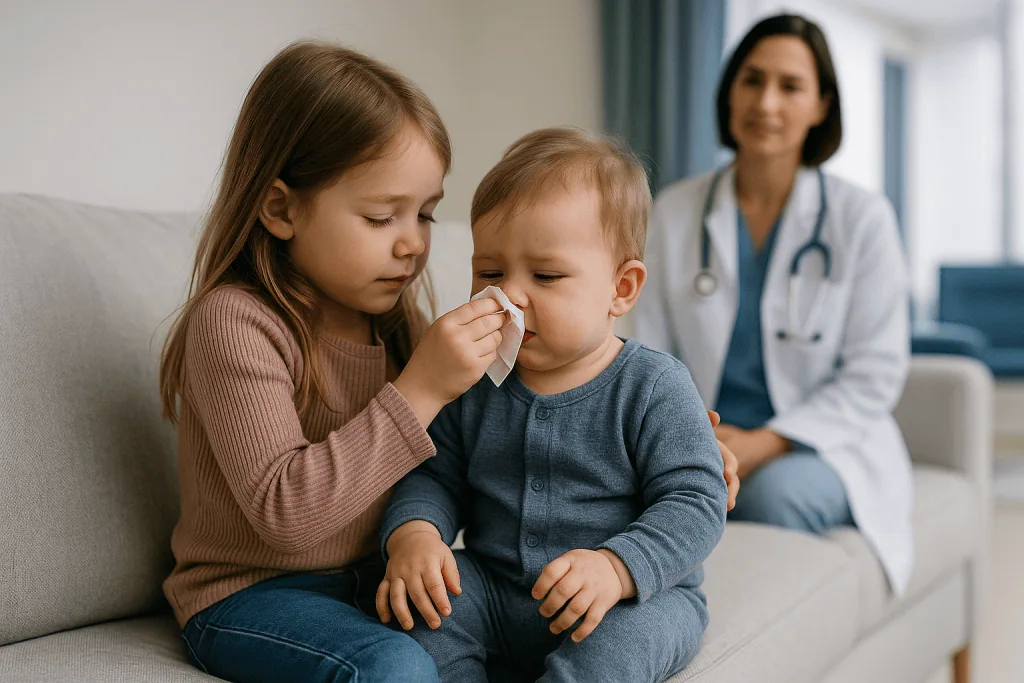
The surface route deserves particular attention in family homes. The CDC states that RSV can survive for many hours on hard surfaces such as tables and crib rails, while it survives for shorter periods on soft surfaces like tissues and on hands. A toddler who coughs onto a plastic stacking cup at breakfast and a baby who mouths that cup at lunch are, in effect, sharing the virus with a several-hour delay.
Consider what a typical weekday looks like. The preschooler brings home a runny nose from a room of fifteen other children. He wipes it with the back of his hand, then pats the baby’s cheek. He drinks from her sippy cup by mistake. He lies on the play mat she will roll across in an hour. None of this is anyone’s fault, and none of it is unusual; it is simply the way these viruses have always moved through households.
Timing compounds the challenge. Because the CDC notes that a person may be contagious a day or two before symptoms start, the older sibling was likely infectious before anyone knew he was ill. By the time the baby coughs, the exposure happened days earlier. The CDC gives the incubation period, the gap between exposure and first symptoms, as typically 4 to 6 days.
This is why complete isolation within a home is rarely realistic and why the evidence-based goal is reduction, not elimination: fewer face-to-face encounters between a sick child and an infant, fewer shared items, and more clean hands, especially in the first week.
What are the worst days of bronchiolitis? A typical timeline
Ask any parent who has been through it and they will tell you about a particular night. The illness has a shape, and knowing that shape in advance takes some of the fear out of it.
The first day or two usually looks like a cold. The NHS describes early symptoms as a runny or blocked nose, a cough and sometimes a mild fever. Feeding is often normal. Many families do not yet know anything more than a cold is coming.
Over the next few days the cough deepens, breathing may become faster or noisier, and the baby may feed less enthusiastically because breathing and sucking compete for the same effort. The NHS states that symptoms are usually worst between day 3 and day 5. This is the stretch when most hospital visits happen and when the checks described in the red-flag section matter most.
After that peak, most babies begin to turn a corner. Breathing settles first, then feeding recovers, then energy returns. The cough is the slow one. NHS guidance notes that most children recover within 2 to 3 weeks, and the residual cough can last for that whole period. A child who is bright, feeding well and sleeping reasonably but still coughing at two weeks is following a typical course, not a worrying one.
The contagious clock runs partly ahead of this. Using the CDC figure of 3 to 8 days of typical infectiousness that begins before symptoms, the highest-risk period for spread overlaps the first week, tapering as the child improves. The exception, again, is the minority of infants who shed virus for up to 4 weeks.
Two caveats. Timelines are typical ranges drawn from population data, not promises for any one child. And a second dip after improvement, or a peak that seems to keep climbing past day 5, is a reason to seek advice rather than wait it out.
Contagious window vs. symptom timeline at a glance
Because the two clocks overlap but do not match, a side-by-side view helps. The table below draws together the typical ranges published by the CDC for RSV transmission and by the NHS for the course of bronchiolitis. Every figure is a population average; your child’s treating team may advise differently based on their individual situation.
| Stage | Typical timing | What it usually looks like | Infectiousness |
|---|---|---|---|
| Exposure to first symptoms | About 4 to 6 days (CDC) | Nothing visible | May begin 1 to 2 days before symptoms (CDC) |
| Early illness | Days 1 to 2 (NHS) | Runny nose, cough, possible mild fever | High |
| Peak | Days 3 to 5 (NHS) | Harder breathing, wheeze, reduced feeding | Still within typical 3 to 8 day window (CDC) |
| Recovery | Week 2 onward (NHS) | Breathing and feeding improve; cough lingers | Falling for most; some infants shed up to 4 weeks (CDC) |
| Lingering cough | Up to about 3 weeks (NHS) | Cough without breathing difficulty | Usually low, though not zero |
Three observations follow from the table. First, the most contagious stretch coincides with the period when the child is most unwell, which is convenient in one sense: a baby who is struggling to feed is not going to daycare anyway. Second, the lingering cough is a poor guide to infectiousness in either direction, so it should not be the deciding factor for contact decisions. Third, the pre-symptomatic window means that by the time you read this table, exposure within the household has probably already occurred, which shifts the emphasis from quarantine toward protecting the most vulnerable child and watching for red flags.
Bronchiolitis daycare return: when can my child go back?
The daycare question is where the two clocks collide with real life. Parents want a date; the evidence offers criteria.
Most childcare programs, and most pediatric guidance, use readiness rather than a fixed number of days. The child should be feeding or eating normally, breathing comfortably at rest, free of fever without needing fever-reducing medicine, and well enough to take part in the day’s activities without needing one-to-one care. A child who meets those criteria has usually passed the peak that the NHS places on days 3 to 5 and is in the recovery phase where infectiousness is falling for most children.
Notice what is missing from that list: the cough. Because the NHS notes the cough may persist for around 3 weeks, keeping a child home until the cough is gone would mean weeks of absence for a child who is otherwise well and, in most cases, no longer meaningfully infectious. Programs generally accept a lingering cough for this reason, though policies vary and it is worth reading yours before the conversation at the drop-off door.
The CDC figure that some infants shed RSV for up to 4 weeks is the uncomfortable footnote. It means no return date guarantees zero transmission. The realistic goal is to return once the child is well, while the program continues the hand hygiene and toy cleaning that reduce spread from all children, including the ones who are shedding without anyone knowing.
Two situations call for a conversation with the treating clinician before return: a child who was admitted to hospital or needed oxygen, and a child with a chronic heart or lung condition or prematurity. Their team may suggest a longer recovery at home based on the individual course.
If in doubt, a phone call to the program and to your pediatric office the day before you plan to return is a small investment that avoids a wasted morning.
Sibling contact: protecting the baby without banishing the toddler
The four-year-old wants to hold his sister. The evidence does not require you to say no forever; it asks you to change the terms for about a week.
Direction matters. If the older child is the one who is ill and the infant is healthy, the stakes are highest, because the CDC identifies infants, and especially premature infants and those under 6 months, as the group most likely to become seriously ill from RSV. If the baby is the one already sick, the older sibling faces a much lower risk of severe illness, though he may still catch a cold.
Face-to-face time is the priority to limit. Droplets from a cough or sneeze travel a short distance, and kissing a baby’s face is a direct route. Practical adjustments that families find workable include having the older child play at the baby’s feet rather than her head, skipping face kisses for the week, and directing the enthusiasm toward reading to her from a chair across the room.
Shared objects are the second front. Given that the CDC reports RSV surviving for many hours on hard surfaces, pacifiers, bottles, teething toys and sippy cups deserve a strict no-sharing rule during the illness, with hard toys washed daily. Soft toys carry the virus for a shorter time but can be rotated out of the shared space for a few days.
Sleeping arrangements come up often. If siblings share a room and one is ill, temporarily moving the well child, or the sick one, is reasonable when space allows. When it does not, the other measures still reduce exposure meaningfully; perfection is not the standard.
Finally, tell the older child why. Preschoolers accept rules better when they have a job, and being the family’s chief handwasher is a job they tend to relish.
Hand hygiene that actually reduces spread, and what to clean
Handwashing sounds too simple to matter against a virus that has infected nearly every child by age 2. It matters precisely because of how RSV moves: hands are the bridge between a contaminated surface and a baby’s nose and eyes.
The CDC recommends washing hands often with soap and water for at least 20 seconds, and using an alcohol-based hand sanitizer when soap and water are not available. The twenty seconds is roughly the time it takes to sing the alphabet song at a normal pace, a useful benchmark for adults and a genuinely fun one for the toddler who has been appointed chief handwasher.
When to wash is as important as how. The moments that carry the most risk are the transitions: after wiping a child’s nose, before preparing a bottle, before picking up the baby after tending to the sick sibling, and immediately on returning home from daycare or school. Building the wash into those transitions is more effective than washing at random intervals.
Beyond hands, the CDC advises cleaning frequently touched surfaces such as doorknobs and mobile devices, covering coughs and sneezes with a tissue or upper sleeve rather than the hands, and avoiding close contact like kissing and sharing cups or utensils with people who have cold-like symptoms. An ordinary household cleaner is sufficient for surfaces; the virus is not hardy against soap and detergent.
A word on masks. Adults with a cold caring for a young infant can reasonably wear a mask during close care such as feeding, since droplets are one of the three transmission routes the CDC describes. This is a reasonable household measure rather than a formal guideline requirement, and it is one you can weigh with your own clinician.
Keep the routine going for the full 3 weeks or so that the NHS gives for recovery. Given that some infants shed virus for up to 4 weeks, the habit protects visiting relatives and the newborn next door, not only your own household.
Who is watched most closely, and who is usually asked to wait
Not every child with bronchiolitis needs the same level of caution, and not every visitor should be treated the same way. Guidance from the CDC and the NHS is consistent about who sits at the vulnerable end.
Infants under 6 months, and especially under 3 months, are watched most closely because their airways are narrowest and their reserves smallest. The CDC lists premature infants, children under 12 months, children with chronic lung disease or congenital heart disease, children with weakened immune systems and children with neuromuscular disorders as groups at higher risk of severe RSV illness. The CDC estimates that RSV leads to roughly 58,000 to 80,000 hospitalizations each year among children under 5 in the United States, most of them infants.
For these children, the treating team may set a lower threshold for review during the day 3 to 5 peak and may ask families to keep the child home from childcare for longer than a typical course would suggest. Those are individualized decisions, not general rules.
The people usually asked to wait are the visitors. Anyone with a runny nose, cough or fever, however mild, should postpone meeting a young infant. The CDC’s advice to avoid close contact with people who have cold-like symptoms applies in both directions: the sniffling grandparent should wait, and the coughing baby should not be passed around a family gathering. Older adults are themselves a higher-risk group for RSV, so a coughing infant visiting a grandparent with heart or lung disease is a two-way concern.
Vaccination and preventive antibodies exist for RSV in specific groups, including a maternal vaccine given during pregnancy and monoclonal antibody products for eligible infants, which work by supplying ready-made antibodies rather than training the immune system. Whether a particular child or pregnant person is eligible, and when, is a decision for their clinician based on current recommendations, and nothing here should be read as a suggestion to seek or skip any product.
Bronchitis vs bronchiolitis: which is worse, and when does each stop being contagious?
The two words differ by three letters and cause endless confusion, partly because search results for one keep surfacing the other. They are related but distinct.
Bronchitis is inflammation of the bronchi, the larger airways below the windpipe. Acute bronchitis is usually viral and most often affects older children and adults, producing a chesty cough that can last a few weeks. Bronchiolitis, as described above, affects the smallest airways and is largely an illness of babies under 2. Same viruses, different address, very different consequences because of airway size.
Asking which is worse therefore compares different patients. For a healthy adult, acute bronchitis is usually a miserable but self-limiting cough. For a three-month-old, bronchiolitis can affect feeding and breathing enough to need hospital observation, which is why the Mayo Clinic and NHS both frame it as a condition to monitor closely in infants. Severity depends on who is ill, not on which word appears on the chart.
Contagiousness follows the virus rather than the label. When acute bronchitis is caused by a cold or flu virus, the infectious period mirrors that virus, typically the first several days of illness, with the cough persisting long after transmission risk has fallen. Bronchiolitis caused by RSV follows the CDC’s 3 to 8 day pattern with the longer tail in some infants. In both conditions the cough is the slowest symptom to leave and the least reliable marker of whether someone is still infectious.
One more point of overlap: neither responds to antibiotics when the cause is viral, which is the usual case. Understanding that both are inflammatory responses to viruses, rather than bacterial infections to be treated with a prescription, sets more realistic expectations for the weeks of coughing that follow either diagnosis.
How bronchiolitis is treated at home, and why antibiotics do not help
Families are sometimes disappointed to learn that bronchiolitis has no specific medicine. The disappointment fades when they understand why, and what actually does help.
Antibiotics kill bacteria. Bronchiolitis is caused by viruses, so antibiotics have no target; the NHS and Mayo Clinic both state that they are not effective and are not routinely used. Prescribing them would add side effects without benefit. If a clinician does prescribe one, it is generally because a separate bacterial infection, such as an ear infection, is suspected alongside the viral illness, and that judgment belongs to the treating team.
Care is supportive, which means helping the body while it clears the virus itself. The main pillars, drawn from NHS and Mayo Clinic guidance, are keeping the child hydrated with smaller, more frequent feeds if long feeds are tiring; keeping the nose clear with saline drops and gentle suction before feeds and sleep so the baby can breathe while sucking; keeping the child upright when awake to ease breathing; and avoiding exposure to tobacco smoke, which irritates already inflamed airways.
Fever-reducing medicines may be suggested by a clinician for comfort if the child is distressed by fever. Which product, whether it is appropriate for a child of that age and how it should be given are questions for the pediatric team or pharmacist, not for a magazine article.
Bronchodilator inhalers, the kind used for asthma, and steroid medicines have been studied extensively in bronchiolitis, and mainstream guidance does not recommend them routinely because trials have not shown consistent benefit in infants. The airway narrowing in bronchiolitis comes mostly from swelling and mucus rather than the muscle spasm those medicines target, which helps explain the findings.
Hospital care, when needed, is also largely supportive: oxygen if levels are low, and fluids by tube or drip if the baby cannot feed. Most children never need it, and those who do usually go home within a few days.
What people often get wrong about bronchiolitis and contagion
Some of the most persistent beliefs about this illness are understandable, widely shared and not supported by the evidence.
The first is that a coughing child is a contagious child. As the timeline shows, the NHS gives the cough up to about 3 weeks while the CDC places typical RSV infectiousness at 3 to 8 days. Keeping a well child away from everything until the cough stops has a real cost in missed childcare and missed work, with little evidence of benefit for most children.
The second is the mirror image: that a child who seems better is no longer infectious. The CDC’s observation that some infants shed virus for up to 4 weeks argues for keeping hygiene habits going even when everyone looks well.
The third is that cold weather, damp rooms or going out without a hat cause bronchiolitis. Viruses cause it. Seasons matter only because they change how much time children spend indoors together.
The fourth is that antibiotics would clear it up if only the doctor would prescribe them. They have no effect on viruses, and their overuse carries costs for the child and the community.
The fifth is that bronchiolitis and asthma are the same thing because both involve wheezing. Bronchiolitis is an acute viral infection; asthma is a chronic condition. Some children who had bronchiolitis go on to have wheezing episodes later, and researchers continue to study whether the infection contributes to that or simply identifies children already prone to it. The evidence does not currently settle the question, and having bronchiolitis does not mean a child will have asthma.
The sixth is that having had bronchiolitis once means it cannot happen again. Because multiple viruses cause it and immunity to RSV is incomplete, repeat episodes are possible, though later ones tend to be milder as airways grow.
The final misconception is the most important to correct: that it is somehow the parents’ fault. Nearly every child meets RSV by age 2. Exposure is a fact of childhood, not a failure of care.
Questions to ask your care team
A short visit or phone call goes further when you arrive with specific questions. These are the ones that experienced pediatric nurses say families most often wish they had asked.
- Based on how my child looks today, where are we likely to be on the typical day 3 to 5 peak, and what should I expect over the next 48 hours?
- What specific signs would you want me to call about, and which ones mean I should go straight to emergency care rather than phone?
- How should I judge whether feeding is adequate, and how many wet diapers in a day would reassure you?
- Is there a reason to see my child again before this illness runs its course, or can I use the red-flag list and call as needed?
- My child has a sibling under 6 months, or was born early, or has a heart or lung condition. Does that change your advice about contact or childcare return?
- When do you consider my child ready to return to daycare, and would you be willing to write a short note if the program asks for one?
- Are there any preventive options for RSV that apply to my child, to a younger sibling or to a pregnant family member, and if so, who should I speak to about eligibility and timing?
- Is there anything I am doing at home, such as saline drops or positioning, that you would adjust?
- If my child does need hospital care, what would that typically involve and how long do children usually stay?
Write the answers down. In the middle of a difficult night, the note on the fridge in the clinician’s own words is worth more than any article, this one included. And if the answer to any question is uncertain, that is a legitimate and honest answer; bronchiolitis is a condition where the course reveals itself over days, and the team’s job is to help you watch it safely.
When to call your doctor: red-flag signs in bronchiolitis
Most children with bronchiolitis recover at home. A minority need urgent help, and the difference is usually visible if you know what to look for. The following signs are drawn from NHS and Mayo Clinic guidance and are grounds to seek care without waiting to see how the night goes.
Call emergency services or go to the nearest emergency department if your child has any pause in breathing, if breathing is very fast or your child is grunting or working hard with every breath, if the skin between or below the ribs is being sucked in sharply, if the lips, tongue or face look blue, gray or unusually pale, or if your child is exhausted, floppy, unusually drowsy or difficult to wake. These signs suggest the child is not getting enough oxygen or is tiring, and they require immediate assessment.
Contact your pediatric office or urgent care the same day if your child is taking less than half of their usual feeds, has had no wet diaper for 12 hours or has noticeably fewer wet diapers than usual, has a fever that persists or rises after the first few days, seems to be getting worse rather than better after day 5, or if you are simply worried. Parental instinct is not a red flag on any list, but clinicians take it seriously, and so should you.
Two groups warrant a lower threshold. Any baby under 3 months with a fever should be assessed promptly, whatever else is happening. And children who were born prematurely or who have a heart, lung or immune condition should be discussed with their team early in the illness, ideally before the peak, so a plan exists for the worst days.
These lists are guides, not diagnoses. Every decision about assessment, treatment and admission rests with the clinicians who can see your child, and no article can replace that judgment.
Frequently asked questions
How long is bronchiolitis contagious after symptoms start?
The virus behind bronchiolitis, usually RSV, is typically contagious for about 3 to 8 days according to the CDC, and that window often begins a day or two before the first symptoms. Most children are past the highest-risk period by the end of the first week. A minority of infants can shed virus for up to 4 weeks, which is why handwashing is worth continuing even once your child seems better.
What is the rsv contagious period for babies compared with older children?
The typical contagious period is similar, roughly 3 to 8 days, but the CDC notes that some infants, along with people with weakened immune systems, can continue spreading RSV for as long as 4 weeks. Babies are also more likely to become seriously ill from the infection. For practical purposes, treat the first week as the highest-risk period and keep hygiene measures going for a few weeks afterward.
When does bronchitis stop being contagious?
Acute bronchitis is usually caused by cold or flu viruses, so it stops being meaningfully contagious when the virus does, typically after the first several days of illness. The cough can continue for weeks after that because the airway lining is still healing, not because infection is ongoing. If a specific virus such as influenza is identified, its known infectious period is the best guide; your clinician can advise.
What is worse, bronchitis or bronchiolitis?
It depends on who is ill rather than on the name. Bronchitis affects larger airways and mainly older children and adults, usually causing a self-limiting cough. Bronchiolitis affects the smallest airways in babies under 2, whose narrow bronchioles leave little margin, so it more often affects breathing and feeding enough to need medical review. The same viruses can cause either; the age of the patient determines the risk.
What can trigger bronchiolitis?
Viruses cause bronchiolitis, most often RSV, and also rhinovirus, human metapneumovirus, parainfluenza, adenovirus and influenza. Cold weather does not cause it; it simply increases indoor crowding where viruses spread. Factors that raise the chance of a severe course include prematurity, age under 3 months, chronic heart or lung disease, a weakened immune system, tobacco smoke exposure and having older siblings in school or childcare.
What are the worst days of bronchiolitis?
The NHS places the peak between day 3 and day 5 of the illness. This is when breathing tends to be fastest and noisiest and feeding is most affected, and it is the period when most hospital visits happen. After that, breathing and feeding usually improve first while the cough lingers for up to about 3 weeks. A child who worsens after day 5 should be reviewed.
What does a typical bronchiolitis daycare return look like?
Most programs and clinicians use readiness rather than a fixed date: feeding normally, breathing comfortably at rest, fever-free without medicine and able to join activities. A lingering cough is usually accepted because the NHS notes it can last about 3 weeks. Children who were hospitalized, born early or have chronic conditions should have return timing discussed with their treating team, and it helps to read the program’s own policy in advance.
What are the main bronchiolitis symptoms in babies that parents notice first?
The illness usually begins like a cold, with a runny or blocked nose, a cough and sometimes a mild fever, according to the NHS. Over the following days breathing may become faster or wheezy and feeding may drop off as the baby works harder to breathe. This article describes the pattern for context only; a clinician who examines your child is the only person who can confirm what is going on.
Can my older child hold the baby while they have a cold?
Limiting close face-to-face contact for about the first week is the evidence-based compromise, since the CDC describes droplets and direct contact such as kissing as key routes of spread. Playing at the baby’s feet, skipping face kisses and not sharing cups, pacifiers or toys reduces exposure substantially. Complete separation within a home is rarely realistic, and reduction, especially for infants under 6 months, is the goal.
Does hand sanitizer work against the virus that causes bronchiolitis?
Yes. The CDC advises washing hands with soap and water for at least 20 seconds and using an alcohol-based hand sanitizer when soap and water are not available. The highest-value moments are after wiping a child’s nose, before preparing feeds, before handling the baby after caring for a sick sibling and on arriving home from school or childcare. Cleaning frequently touched hard surfaces adds a further layer.
References
- NHS: Bronchiolitis
- CDC: How RSV Spreads
- CDC: RSV in Infants and Young Children
- MedlinePlus: Bronchiolitis
This article is for general information only and is not a substitute for professional medical advice. Please consult a qualified doctor about your individual situation.

More from the Blog

How a Developmental Delay Assessment Works: Hearing, Vision, Milestones and Specialist Reviews
A developmental delay assessment is a staged evaluation of how a child is progressing in movement, language, thinking and social skills. It usually begins…

How Much Exercise Do Kids Need? The Guidelines and Why Play Counts
Children aged 5 to 17 need an average of at least 60 minutes a day of moderate-to-vigorous physical activity across the week, according to…

What Pediatric Plastic Surgery Treats: Congenital Differences, Injuries and Scars in Children
Pediatric plastic surgery treats differences present from birth, such as cleft lip and palate, skull and facial growth differences, and extra or fused fingers;…

Caring for a Child on Pediatric Dialysis: Access Site Care, Fluid Limits and School Days
Caring for a child on dialysis centers on three daily habits: keeping the access site clean, dry and protected; helping your child stay within…

Bronchiolitis Treatment in Hospital: Oxygen, Feeding Support and How Long Babies Usually Stay
Bronchiolitis treatment in hospital is supportive: there is no medicine that clears the virus, so the team gives oxygen when blood oxygen stays low,…

Bedwetting: When It Is Normal, When to Investigate and the Treatments
Bedwetting, medically called nocturnal enuresis, is common and usually harmless in children under 7, affecting about 1 in 5 five-year-olds and 1 in 20…