

What Pediatric Plastic Surgery Treats: Congenital Differences, Injuries and Scars in Children

Key Takeaways
- The word plastic in plastic surgery comes from a Greek root meaning to shape, and in children the specialty is almost entirely reconstructive rather than cosmetic.
- Cleft lip with or without cleft palate affects about 1 in 1,600 US babies and cleft palate alone about 1 in 1,700, according to the CDC, and care is staged across childhood by a multidisciplinary team.
- Craniosynostosis, the early fusion of a skull suture, affects about 1 in 2,500 babies per the CDC and is treated surgically; a flat spot from lying position is a different condition that does not need surgery.
- Most infantile hemangiomas grow during the first year and then fade over several years, so watchful waiting is the usual plan unless vision, breathing or skin integrity is threatened.
- Scars can take up to two years to mature according to the NHS, so judging a child's scar at the first follow-up says little about the long-term result.
- For burns, the NHS advises cooling under cool running water for 20 minutes and never using ice, butter or creams before medical assessment.
Pediatric plastic surgery treats differences present from birth, such as cleft lip and palate, skull and facial growth differences, and extra or fused fingers; injuries, including facial cuts, animal bites, fractures and burns; birthmarks and skin growths; and troublesome scars. The focus is restoring function and form in a body that is still growing, with timing decided case by case by the child's surgical team.
It is a little after seven on a weeknight, and a father is sitting in an emergency bay with a two-year-old who ran face-first into the corner of a coffee table. The cut runs through the edge of the upper lip. A nurse says, kindly, that they have asked the plastic surgeon to come down. His first reaction is confusion. Plastic surgery, in his mind, belongs to a different world of adults and elective choices, not to a toddler holding a damp cloth to her mouth.
That reaction is common, and it hides a genuinely useful question: what does pediatric plastic surgery treat? The honest answer is broader than most parents expect and narrower than the word plastic suggests. The specialty exists to repair structure in children, whether the problem arrived at birth, in an accident, or as a scar that refuses to settle.
What follows is a tour of that work: the conditions, the typical pathway from first visit to final follow-up, and the questions families tend to wish they had asked earlier.
What does pediatric plastic surgery treat, in plain terms?
Strip away the jargon and the specialty does one thing: it rebuilds or reshapes tissue in a child so that the body works and looks the way it is meant to. The word plastic comes from a Greek root meaning to mold or shape; it has nothing to do with artificial material. Pediatric adds the hard part, because every repair has to hold up through years of growth.
The work falls into four broad groups. The first is congenital differences, meaning structures that formed differently before birth: cleft lip and palate, skull sutures that closed too early, small or absent ears, extra or joined fingers. The second is injury, from a lip laceration on a coffee table to a dog bite, a broken cheekbone or a scald from a kettle. The third is growths and marks on the skin, including the red, raised birthmarks called hemangiomas and large brown moles present from birth. The fourth is scarring itself, whether from surgery, burns or acne, when a scar restricts movement or causes distress.
Across all four, the organizing principle is function first. Can the baby feed? Will the skull leave room for the brain? Will the hand grasp and pinch? Will the eyelid close? Appearance matters too, and a thoughtful surgeon treats it as a legitimate goal rather than an afterthought, because a child who is stared at carries that into every classroom. But when the two pull in different directions, function and growth win, and that is the opinion most of this article rests on.
A few realities shape everything else. Children heal fast, which is good, and scar vigorously, which complicates things. Children also cannot always say what hurts or hold still for a dressing change, so the team around the surgeon, from anesthesia to child-life specialists, is as important as the operation itself.
How is pediatric reconstructive surgery different from cosmetic surgery?
Reconstructive surgery restores a structure that is abnormal because of a birth difference, injury, infection or tumor. Cosmetic surgery changes a structure that is within the normal range because the person prefers a different look. In adults the line is sometimes blurred; in children it is drawn far more firmly, and almost all pediatric plastic surgery sits on the reconstructive side.

That distinction is not just semantic. It shapes who proposes the operation, how urgently it happens and how insurers classify it. A cleft palate repair is proposed by a team because an open palate affects feeding, speech and middle-ear health. A request to change the shape of a healthy nose is initiated by the patient, and in a growing child it will usually be declined or deferred.
There is a middle ground that families ask about often. Prominent ears, a small jaw that is within normal limits but causing teasing, or a visible birthmark on the cheek are not medically dangerous. Yet surgeons do operate on some of them, reasoning that appearance in childhood has real consequences for social development. The decision in these cases is usually slower and involves asking what the child, not only the parent, wants.
The surgical skills overlap completely. A surgeon who moves a flap of tissue to close a wound after a tumor is removed uses the same techniques a cosmetic surgeon uses to tighten skin. What differs is the reason for the operation and the person who gets to decide.
For parents, the practical takeaway is to ask the team which category they consider the proposed procedure to fall into and why. The answer tells you how the surgeon is weighing benefit against the risks of anesthesia and scarring, and it prepares you for conversations with your insurer later.
Cleft lip and palate repair: the condition most people picture
A cleft is a gap left when tissues of the lip or the roof of the mouth do not join fully during early pregnancy. According to the CDC, cleft lip with or without cleft palate affects about 1 in 1,600 babies born in the United States each year, and cleft palate alone affects about 1 in 1,700. Many clefts are now seen on routine prenatal ultrasound, which means a family’s first conversation with a plastic surgeon can happen before the baby is born.
Cleft care is a team effort, and that is not a slogan. A feeding specialist helps in the first days, because a baby with an open palate cannot create suction and may need a specially shaped bottle. An ear, nose and throat surgeon watches for fluid behind the eardrums, which is common with cleft palate. A speech therapist, an orthodontist, a geneticist and a psychologist join at different stages. The plastic surgeon operates, but the team decides.
Timing follows the baby’s growth. The NHS describes lip repair usually taking place when a baby is 3 to 6 months old and palate repair at 6 to 12 months, once the baby is larger and the tissues are easier to work with. Repairing the palate before speech develops matters, because a child learns to make sounds against a closed roof of the mouth.
The first operations are rarely the last. Later steps can include a bone graft to the gum line when the adult teeth are coming in, further surgery if speech remains nasal, nose refinement, and in some teenagers jaw surgery to align the bite. None of these is guaranteed to be needed, and the team reviews the child regularly to decide. Parents sometimes hear this list and feel overwhelmed; it helps to remember that it is spread over many years, each stage with its own purpose.
Craniofacial differences: when the skull or face grows unevenly
A baby’s skull is made of plates joined by flexible seams called sutures, which stay open so the head can expand with the growing brain. Craniosynostosis is the early closure of one or more of these sutures. The CDC estimates it affects about 1 in 2,500 babies in the United States. When a suture fuses too soon, the skull cannot grow in that direction and grows elsewhere instead, producing a long, narrow head, a flattened forehead or a tilted eye socket depending on which suture is involved.
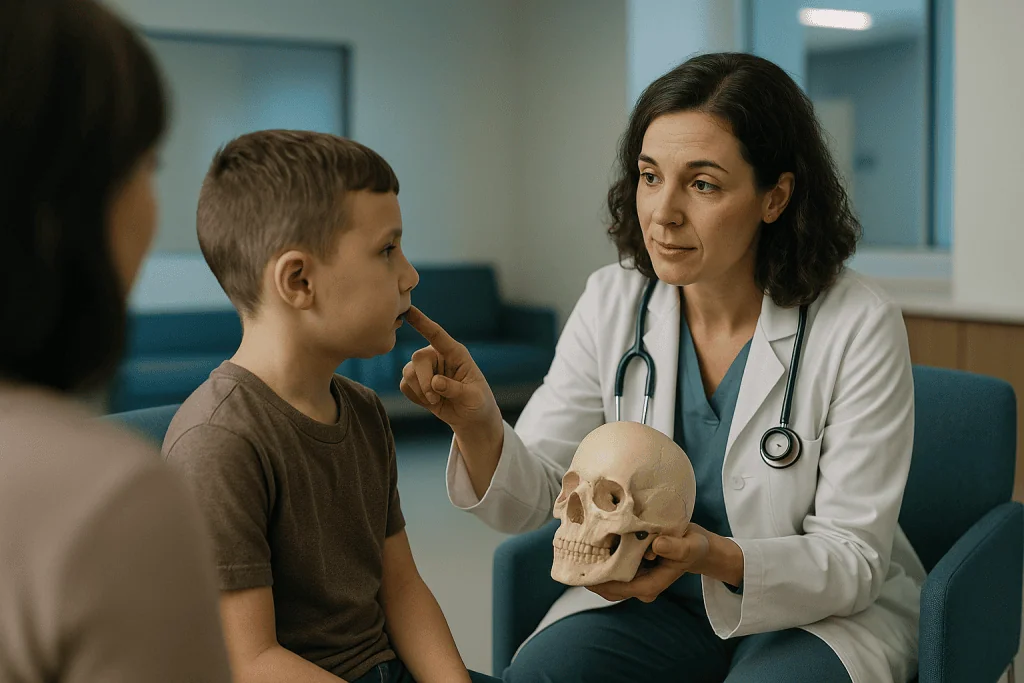
Why operate on a head shape? Because the problem is not only the shape. A skull that cannot expand can, in some children, raise pressure around the brain and affect development or vision. The operation, performed jointly by a plastic surgeon and a pediatric neurosurgeon, reopens or reshapes the fused area to give the brain room. Techniques range from endoscopic release through small incisions in young infants, often followed by a molding helmet, to open remodeling of the skull vault in older babies. The choice depends on age, the suture involved and the team’s assessment.
Parents often confuse this condition with a far more common and harmless one. Positional plagiocephaly is a flat spot caused by a baby lying in the same position, and it does not involve a fused suture. It generally improves with repositioning, supervised tummy time and sometimes a helmet; surgery is not part of its treatment. A pediatrician can usually tell the two apart by examination, with imaging if there is doubt.
The craniofacial umbrella also covers differences in the face itself: an underdeveloped jaw and cheek on one side (hemifacial microsomia), a small lower jaw that pushes the tongue back and narrows the airway in a newborn (Pierre Robin sequence), and small or absent external ears (microtia). Each has its own pathway, but the pattern is the same: protect breathing and vision first, then address shape as the face matures.
Hand and limb differences: extra, fused or missing fingers
Hands are where pediatric plastic surgery and orthopedic surgery overlap most, and in many centers the hand surgeon trained in one and practices in both. The differences treated are varied. Polydactyly means an extra finger or thumb, sometimes a fully formed digit and sometimes a small soft-tissue tag. Syndactyly means two or more fingers joined by skin, and occasionally by bone, because they did not separate in the womb. Other children are born with a thumb that is small or absent, a forearm bone that did not develop fully, or constriction bands where the skin and deeper tissues are indented as if by a thread.
The question the surgeon asks is not whether the hand looks typical but what it can do. Can the child oppose the thumb to the fingers for pinch? Will the joined fingers grow at different rates and pull each other crooked? Is a small extra digit catching on clothing? Those answers drive both whether and when to operate.
Timing is deliberately individual. Some simple extra digits are dealt with in infancy. Separating fused fingers is often planned so the operation happens before the child develops fixed habits of grip, but after the hand is large enough for the delicate skin grafts the procedure needs. A thumb reconstruction may be scheduled around the age when a child would naturally start using pinch. The team sets these windows; general rules are less useful than an examination.
Occupational therapy sits alongside surgery and sometimes replaces it. A therapist teaches a child to use what they have, fits small splints, and after an operation guides the stretching and play that keep a rebuilt web space from tightening. Parents are frequently surprised by how adaptable children are; a child born with a hand difference has never known anything else and often outperforms the adults’ expectations long before any surgery.
Birthmarks, hemangiomas and skin lesions
An infantile hemangioma is a benign growth of blood vessels, usually appearing as a bright red, raised patch in the first weeks of life. Mayo Clinic describes a typical course: rapid growth during roughly the first year, then slow fading over several years, with many shrinking substantially without any treatment. That natural history is why the most common plan for a hemangioma is careful watching rather than surgery.
Some do need treatment. A hemangioma near the eye can block vision during the window when the brain is learning to see. One on the lip or in the diaper area can break down into a painful ulcer. One inside the airway can narrow breathing. In these situations the first-line approach is usually a medicine from the beta blocker class, which slows the vessel growth; the pediatrician or dermatologist managing the child decides whether it is appropriate and oversees it. Plastic surgery enters later, to remove leftover loose skin or fatty tissue once the mark has faded, or earlier for a lesion that threatens function and is not responding.
Port-wine stains are flat, purple-red marks caused by dilated capillaries that do not fade on their own. They are treated mainly with laser, often in a series of sessions, and the surgeon’s role is to coordinate rather than cut.
Congenital melanocytic nevi are brown moles present at birth. Small ones are usually left alone or removed in a single step if they are in an awkward spot. Large ones are harder, because simply cutting them out would leave a wound that cannot be closed. Here surgeons use tissue expansion: a soft silicone balloon is placed under healthy skin nearby and gradually filled over weeks, stretching the skin so that it can later be moved to cover the area where the mole was removed. It is slow and demands patience from the whole family, but it allows large areas to be replaced with the child’s own matching skin.
Injuries: lacerations, dog bites, facial fractures and burns
Children fall, run into things, and get bitten, and a share of those injuries end up with a plastic surgeon because of where they land. Facial cuts that cross the border of the lip, the edge of the eyelid, the rim of the nostril or the cartilage of the ear need precise alignment; a lip border off by a millimeter is visible across a room for life. Emergency teams often ask plastic surgery to repair these, sometimes under local anesthetic with a child-life specialist distracting the child, and sometimes under general anesthesia if the child cannot hold still.
Dog bites are a specific category. The skin tears are often jagged and contaminated, so the wound is washed thoroughly, and the question of closing it immediately versus letting it heal from the inside is weighed against infection risk. The child’s tetanus status and the dog’s rabies status are reviewed; those are decisions for the emergency team, not for the surgeon alone.
Facial fractures in children behave differently from adult fractures because the bones are softer, heal faster and are still growing. A broken jaw or cheekbone in a child may be managed without plates, or with plates that will later be removed so they do not interfere with growth. The surgeon also checks the teeth, because a fracture through a tooth bud can affect the adult tooth years later.
Burns and scalds are the injury with the clearest first-aid message. The NHS advises cooling the burn under cool or lukewarm running water for 20 minutes as soon as possible, removing clothing or jewelry near the area unless stuck to the skin, and covering loosely with cling film or a clean non-fluffy cloth; ice, butter and creams should not be used. Deeper burns may need skin grafts, where a thin layer of skin from an unburned area is moved to the wound. Afterward the long work begins: pressure garments, moisturizing, stretching and, in growing children, sometimes later release of scars that tighten across a joint.
Scars in children: why they behave differently and what can help
Every wound that goes through the full thickness of the skin leaves a scar. In children that scar often starts out redder, firmer and more raised than parents expect, because a child’s healing response is vigorous. The NHS notes that scars can take up to two years to fully mature, gradually becoming flatter, paler and softer over that time. Judging a scar at six weeks tells you very little about how it will look at two years.
Two problem patterns are worth knowing by name. A hypertrophic scar is raised and red but stays within the boundary of the original wound and usually improves with time. A keloid grows beyond the original wound, can keep enlarging, and is more common on the chest, shoulders and ear lobes and in people with darker skin tones. Keloids are harder to treat and more likely to recur after removal, so a surgeon will often combine any excision with other measures rather than operate alone.
Conservative scar care is where most of the gain lies, and most of it is low-tech. Keeping the healed scar moisturized and gently massaged, protecting it from sun with clothing or sunscreen because new scars pigment easily, and using silicone gel or sheets as advised by the team are standard. Pressure garments are used after burns. Steroid injections into a thick scar and laser treatment to reduce redness or texture are options the team may raise.
Scar revision surgery is the last resort, not the first, and it is usually deferred until the scar has matured, because many scars that look alarming early settle on their own. Revision replaces one scar with another, ideally thinner, better oriented along natural skin lines, or broken into a less visible zigzag. It does not remove a scar; no procedure does. A surgeon who promises otherwise should prompt a second opinion.
What actually happens on the day of a child's operation
Most planned pediatric plastic surgery follows a pathway that is more predictable than families fear. Weeks before, there is a pre-assessment visit: a nurse or anesthesia clinician reviews the child’s health, asks about previous anesthetics and allergies, and explains fasting instructions, which the team gives in writing for solids, formula, breast milk and clear fluids. Follow those exactly; an unexpected snack is one of the commonest reasons an operation is postponed.
On the morning, the child is checked in, weighed and given a wristband. Many hospitals have a child-life specialist, a professional trained to prepare children for medical procedures through play and plain explanation. A toddler might practice putting a mask on a teddy bear. Numbing cream may be applied to the back of the hand so that a cannula can be placed with less distress. The surgeon marks the planned incisions with a pen while the child is awake and confirms the plan with the parents.
Anesthesia is given by a specialist experienced with children. Depending on the hospital’s policy and the child’s age, one parent may accompany the child into the anesthetic room until they are asleep, which is usually within a minute or two of breathing through the mask or receiving medicine through the cannula. The parent then waits, and someone from the team gives updates for longer procedures.
Afterward the child wakes in a recovery area with a nurse at the bedside, and parents are brought in as soon as it is safe. Children can be groggy, tearful or disoriented for a while; this is common and settles. Pain is assessed with age-appropriate tools, and the anesthesia team manages it. Many procedures are day cases, with the child going home once drinking, comfortable and passing urine. Larger operations, such as palate or skull surgery, involve an overnight stay or longer so that breathing, swelling and fluids can be watched.
Who is usually treated early, and who is usually asked to wait
The youngest age for plastic surgery is a question parents type into search engines, and the honest answer is that there is no single number. A newborn whose small jaw is blocking the airway may need surgery in the first weeks. A teenager asking to change a nose that is within normal limits will usually be asked to wait until growth is complete and the request has been stable for a long time, and the surgeon may decline altogether. Between those extremes, the deciding factor is whether the problem affects function or growth.
Things that threaten breathing, vision, feeding, brain growth or hand use are addressed early. Appearance-only concerns are deferred until the relevant structure has largely finished growing, so the result is not distorted by later development, and until the child is old enough to take part in the decision. Surgeons also factor in the practical: a palate repair is timed so speech can develop normally, and a skin graft on a hand is timed so the child can cooperate with therapy afterward.
| Condition or request | Usual approach to timing | Main reason |
|---|---|---|
| Cleft lip | Repair usually at 3–6 months (NHS) | Baby larger; feeding established |
| Cleft palate | Repair usually at 6–12 months (NHS) | Closed palate before speech develops |
| Craniosynostosis | Infancy; technique depends on age | Room for brain growth |
| Infantile hemangioma | Usually watched; treated if vision, airway or skin threatened | Most fade substantially over years (Mayo Clinic) |
| Prominent ears | Often deferred until ear growth is largely complete and child is involved | Appearance concern; stable result |
| Scar revision | Usually after the scar has matured, which can take up to 2 years (NHS) | Many scars settle without surgery |
| Cosmetic request in a teen | Generally deferred until growth is complete; may be declined | Consent, stability of request, growth |
Children are also asked to wait when they are unwell, when a skin infection is active near the planned incision, or when a parent and child disagree about what they want. That last pause is deliberate. A surgeon operating on a child’s appearance wants the child’s own voice in the room.
What the following days and weeks usually look like
Recovery from pediatric plastic surgery is a sequence rather than a single event, and knowing the shape of it lowers the temperature at home. The first few days are about swelling, which tends to peak before it falls, so a face or hand often looks worse on the second or third day than on the first. This is expected, and the discharge paperwork should say so. Bruising around the eyes after nose or skull surgery can be dramatic and is usually harmless.
Wound care instructions differ by operation. After cleft lip repair, some programs use soft arm splints for a time to stop a baby rubbing the stitches, and parents are taught how to clean the lip. After palate repair, the diet is soft or liquid while the roof of the mouth heals, and anything that could scratch it, including straws and hard toys in the mouth, is kept away. After hand surgery, the hand is often in a bulky bandage or cast that doubles as a splint, and the child may be more frustrated by the bandage than by any pain.
Stitches are either dissolvable or removed at a clinic visit, which in young children is sometimes done with a numbing cream and a distraction. Activity restrictions are mostly common sense: no contact sports, swimming or rough play until the team clears it, because a reopened wound heals with a wider scar.
Once the skin has sealed, scar care begins and continues for months. The NHS timeline of up to two years for a scar to mature is worth keeping in mind when judging the result; the redness that worries parents at the first follow-up usually fades long before that. Children with congenital differences stay under review for years, with visits spaced out as they grow, so that later steps can be planned around development rather than squeezed into a single operation.
What people often get wrong about plastic surgery for kids
The first and most persistent misunderstanding is the one the father in our opening scene had: that plastic means cosmetic or artificial. In children it almost always means reconstruction, and the surgeon called to the emergency department is there because of training in closing wounds in ways that respect how the face moves and grows.
The second is that because a baby will not remember an operation, timing does not matter. The opposite is true. Timing is driven by growth, speech development, vision development and hand use, and getting it right is a large part of the surgeon’s skill. Operating too early can leave a result that is distorted by growth; operating too late can miss a developmental window.
The third is that scars disappear. They do not. They fade, soften and flatten, and good technique and good aftercare make them far less noticeable, but a scar is permanent by definition. Families who expect invisibility are set up for disappointment at every follow-up.
The fourth is that one operation finishes the job. For lacerations, often it does. For congenital differences, care is staged across childhood, with each step timed to development. Hearing the full pathway at the start is not a sign the first operation failed.
The fifth is that waiting until adulthood is always the safer, more conservative choice. For appearance-only requests that is often right. For function, it can be the riskier path; a child who grows up unable to close an eyelid, breathe well at night or use a thumb pays a developmental price for the delay.
The sixth is that a flat spot on a baby’s head needs surgery. Positional flattening, caused by lying in one position, is managed with repositioning and sometimes a helmet. Surgery is reserved for craniosynostosis, where a suture has actually fused, and a pediatrician can usually tell the difference.
Is pediatric plastic surgery covered by insurance?
Coverage follows the reconstructive-versus-cosmetic line described earlier, and that is the most useful thing to understand before the paperwork starts. Procedures that correct a congenital difference, repair an injury or restore a function such as breathing, feeding, vision or hand use are generally classified as medically necessary, and most health plans treat them as covered services subject to the plan’s usual terms. Procedures whose purpose is purely to change a normal appearance are generally classified as cosmetic and are usually excluded.
The gray zone is where families run into trouble. Prominent ears, removal of a visible but harmless birthmark, or revision of a scar that bothers a child but does not restrict movement may be covered by some plans and not by others, and the decision often rests on how the condition is documented. Surgeons frequently write letters explaining the functional or psychosocial impact, include photographs, and request pre-authorization before scheduling. Ask whether that step has been done; an operation performed without authorization can be denied afterward.
Specific rules vary by plan type, by state and by the wording of each policy, and this article cannot tell you what yours covers. Most hospital surgical departments have a coordinator or financial counselor whose job is to check benefits, obtain authorizations and explain what the plan has said. Use that person early, keep copies of every letter, and ask for any denial in writing so that it can be appealed with additional documentation.
Two other practical points. Care for conditions such as cleft lip and palate is delivered by a team over many years, so ask how each stage, including speech therapy, orthodontics and hearing care, is handled under the plan, not only the first operation. And if a child is injured, the emergency repair and any later scar work are usually documented as related to the injury; keep the original emergency record, because it supports later claims.
Questions to ask your care team
Consultations are short and emotionally loaded, and parents regularly leave having forgotten the question that mattered most. Writing a list in advance changes the conversation; so does bringing a second adult to listen. The questions below are ones surgeons are used to answering and generally welcome, because a family that understands the plan copes better with the inevitable bumps.
- Is this procedure reconstructive or cosmetic in your view, and what is the main benefit you expect for my child?
- What happens if we do nothing, or wait a year? What would change?
- Why this timing? Is it driven by growth, function or scheduling?
- Is this one operation or the first of several? What might the full pathway look like across childhood?
- What are the specific risks for this operation in a child of this age, and how often do you see them?
- Will there be a scar, where will it sit, and how do you expect it to look after it matures?
- Who will be giving the anesthetic, and can a parent be present when my child goes to sleep?
- Will my child stay overnight? What should the first few days at home look like, and what should prompt a call?
- Which other specialists are part of my child’s care, and who coordinates them?
- What non-surgical options exist, and have we tried them?
- Has pre-authorization been requested, and who do I contact about coverage questions?
One further question is worth asking of yourself as much as of the team: what does my child want? For infants that is not answerable, and the parents decide. For a school-age child or a teenager, especially where the operation is about appearance, a good team will want to hear from the child directly, sometimes without the parents in the room. That is not a sign of distrust; it is how the decision stays where it belongs, with the patient and the people treating them.
When to call your doctor
Most recoveries are uneventful, and the team’s discharge sheet lists the usual: some swelling, mild oozing on the first day, grumpiness, a reduced appetite for a day or two. The signs below are different. They warrant a same-day call to the surgical team or, where marked, emergency services.
Call urgently, or go to an emergency department, for any difficulty breathing, noisy breathing, blue or gray lips, or a child who is struggling to stay awake after palate, jaw or airway surgery. After skull surgery, repeated vomiting, unusual drowsiness, a bulging soft spot, or a seizure are emergencies. Bleeding that soaks through a dressing or does not stop after ten minutes of firm, steady pressure needs immediate attention.
Call the team the same day for a fever as defined on your discharge instructions, for redness spreading outward from the wound, for a wound that is hot, increasingly swollen, smells or leaks cloudy fluid, for edges that have opened, or for pain that is worsening rather than easing despite the plan you were given. In a baby, fewer wet diapers than usual, refusal to drink, or a dry mouth suggests dehydration and should be reported. After hand surgery, fingers that are pale, blue, cold, numb or unusually swollen beyond the bandage need prompt assessment, as the dressing may be too tight.
For burns at home, seek medical care for any burn larger than the child’s palm, any burn to the face, hands, feet, genitals or across a joint, any burn that is white, charred or painless, and any chemical or electrical burn, after cooling with running water as the NHS advises.
Finally, trust your judgment. Parents know their child’s baseline better than any monitor. If something feels wrong and you cannot name it, that is still a reason to call. Teams would far rather reassure a worried family than hear about a complication a day late.
Frequently asked questions
What procedures do pediatric plastic surgeons do?
Pediatric plastic surgeons repair cleft lip and palate, reshape skulls affected by craniosynostosis, reconstruct small or absent ears, separate fused fingers and remove extra ones, close complex facial wounds and animal bites, treat facial fractures, graft burns, remove large birthmarks and skin growths, and revise problematic scars. They work within teams that include neurosurgeons, ear, nose and throat surgeons, speech therapists, orthodontists and occupational therapists.
What is the most common pediatric surgery?
Across all children’s surgery the most frequent operations are general ones such as hernia repair, appendix removal and ear tube placement, which are not plastic surgery. Within pediatric plastic surgery, the everyday workload is dominated by cleft lip and palate repair, hand differences, removal of skin lesions and birthmarks, and repair of facial lacerations, with craniofacial and burn reconstruction forming a smaller but more complex share.
What is the youngest age you can get plastic surgery?
There is no minimum age for reconstructive surgery; a newborn whose small jaw blocks the airway may be operated on in the first weeks of life, and the NHS describes cleft lip repair usually at 3 to 6 months. Cosmetic surgery, meaning changes to a structure within the normal range, is generally deferred until growth is complete and the young person can give informed consent, and many surgeons decline it in minors.
Is pediatric plastic surgery covered by insurance?
Procedures that correct a congenital difference, repair an injury or restore a function such as feeding, breathing, vision or hand use are generally classified as medically necessary and covered under the plan’s usual terms. Purely cosmetic changes are usually excluded. Gray-zone procedures such as prominent ear correction depend on the plan and documentation. Ask the surgical team’s coordinator to check benefits and obtain pre-authorization before scheduling.
Is plastic surgery for kids safe under general anesthesia?
General anesthesia in children is given by anesthesia specialists trained in pediatric care, with monitoring and medicine choices adjusted for age and weight. Serious complications are uncommon in healthy children, but no anesthetic is risk-free, and the pre-assessment visit exists to identify factors such as recent colds, asthma or previous reactions that change the plan. Ask the anesthesia team to explain the risks specific to your child.
How many operations does cleft lip and palate repair involve?
It varies by child and by the type of cleft. The lip and palate are usually repaired in separate operations in the first year, per NHS timing of 3 to 6 months and 6 to 12 months respectively. Later stages may include a gum-line bone graft when adult teeth erupt, speech surgery if the palate does not close sounds well, nose refinement, and in some teenagers jaw surgery. The team reviews the need for each stage over time.
Will my child's scar go away completely?
No. A scar is permanent once a wound has crossed the full thickness of the skin. What changes is how noticeable it is: the NHS notes scars can take up to two years to mature, becoming flatter, paler and softer over that period. Moisturizing, massage, sun protection and silicone products as advised by the team help, and scar revision can reposition or narrow a scar, but no treatment removes one entirely.
Does a flat spot on my baby's head need surgery?
Usually not. A flat spot from lying in one position, called positional plagiocephaly, does not involve a fused skull suture and is managed with repositioning, supervised tummy time and sometimes a helmet. Surgery is reserved for craniosynostosis, where a suture has closed early, which the CDC estimates affects about 1 in 2,500 babies. Your pediatrician can distinguish the two by examination and, if needed, imaging.
Do hemangiomas need surgery?
Most do not. Mayo Clinic describes infantile hemangiomas growing rapidly during the first year and then fading over several years, so the usual plan is observation. Treatment is considered when a hemangioma threatens vision, the airway, or breaks down into an ulcer, and the first option is often a beta blocker medicine supervised by the treating clinician. Surgery is mainly used later to remove leftover skin or tissue.
Can a teenager have cosmetic surgery?
Occasionally, but with caution. Surgeons generally wait until the relevant structure has finished growing, until the request has been stable and comes from the teenager rather than a parent, and until the young person shows realistic expectations. Many surgeons decline cosmetic procedures in minors altogether. Reconstructive procedures for teenagers, such as correcting a congenital difference or an injury, follow the usual medical pathway instead.
References
- CDC: About Cleft Lip and Cleft Palate
- NHS: Cleft lip and palate
- CDC: About Craniosynostosis
- NHS: Burns and scalds
This article is for general information only and is not a substitute for professional medical advice. Please consult a qualified doctor about your individual situation.

More from the Blog

How Much Exercise Do Kids Need? The Guidelines and Why Play Counts
Children aged 5 to 17 need an average of at least 60 minutes a day of moderate-to-vigorous physical activity across the week, according to…

Caring for a Child on Pediatric Dialysis: Access Site Care, Fluid Limits and School Days
Caring for a child on dialysis centers on three daily habits: keeping the access site clean, dry and protected; helping your child stay within…

Bronchiolitis Treatment in Hospital: Oxygen, Feeding Support and How Long Babies Usually Stay
Bronchiolitis treatment in hospital is supportive: there is no medicine that clears the virus, so the team gives oxygen when blood oxygen stays low,…

Bedwetting: When It Is Normal, When to Investigate and the Treatments
Bedwetting, medically called nocturnal enuresis, is common and usually harmless in children under 7, affecting about 1 in 5 five-year-olds and 1 in 20…

What Does Long-Term Eye Follow-Up After ROP Treatment Involve for Premature Babies?
Long-term eye follow-up after ROP treatment means scheduled checks that begin within days of laser or injection, continue every one to two weeks until…

How Long Does Whooping Cough Recovery Take? Why the Cough Outlasts Treatment Week by Week
Whooping cough typically lasts six to ten weeks, and sometimes longer. The mild cold-like first stage runs one to two weeks, the coughing-fit stage…