

Heel Pain: Plantar Fasciitis, Achilles or Something Else: How to Tell
Key Takeaways
- Sharp pain under the heel with the first steps of the morning that eases after a few minutes of walking is the signature pattern of plantar fasciitis.
- Achilles tendonitis hurts at the back of the heel or two to six centimeters up the tendon and flares with running, hills and stairs rather than after sitting.
- Roughly one in ten adults has a heel spur on X-ray and most never have pain, so the spur is almost never the target of treatment.
- A deep heel ache that worsens through the day and reproduces when you squeeze the heel bone from both sides should be checked for a stress fracture.
- The best-supported treatments are the dullest ones: calf and plantar fascia stretching, supportive footwear and gradual loading, with injections offering only short-term relief in low-quality trials.
- Most people with plantar fasciitis improve within 12 months, and the NHS advises seeing a GP if two weeks of self-care have not helped.
Heel pain is most often plantar fasciitis, which causes a sharp pain under the heel with the first steps of the morning. Pain at the back of the heel that worsens with running or stairs points toward Achilles tendonitis or bursitis. Heel spurs rarely hurt on their own. Location, timing and where it is tender usually separate the causes, and most cases improve within months with stretching, footwear changes and reduced load.
The video has eleven million views. A man in socks presses his thumb into the underside of his heel, winces, then announces that a bone spur is the problem and a single toe stretch will dissolve the pain in a week. The comments are full of people who tried it that morning. Searches for heel pain have climbed alongside clips like this one, helped by autumn marathon season and a 2023 clinical practice guideline revision that physical therapists are still digesting. As of September 2026, the question people type most is not how to treat it, but what it actually is.
That is the right question. The heel is a crowded neighborhood: a thick ligament below, a powerful tendon behind, two small fluid sacs, a fat pad, several nerves and a bone that can crack under repetitive load. Each complains differently.
Here is how to read those complaints, what the research can and cannot tell you, and which signs mean the self-care window has closed.
What changed recently in heel pain advice
Two shifts explain why clinicians talk about heel pain differently than they did a decade ago. The first is the retirement of total rest. The 2023 revision of the American Physical Therapy Association clinical practice guideline on heel pain and plantar fasciitis, published in the Journal of Orthopaedic and Sports Physical Therapy, kept its strongest recommendations for hands-on manual therapy, calf and plantar fascia stretching, taping and foot orthoses (shoe inserts that support the arch). It did not recommend simply stopping activity until pain disappears. Managed load replaced bed rest as the default.
The second shift is more honest language about injections. A 2017 Cochrane review of injected corticosteroids for plantar heel pain found a small short-term benefit, graded as low-quality evidence, and no reliable long-term advantage. Both Mayo Clinic and Johns Hopkins now describe injections as an option for persistent cases rather than a routine step, and both note that repeated injections can thin the protective fat pad or weaken the fascia.
The newer entrants, extracorporeal shockwave therapy (ESWT, focused sound pulses delivered to the heel) and platelet-rich plasma (a concentrate of the patient’s own blood platelets), have grown in marketing faster than in evidence. The 2023 guideline grades shockwave as supported by moderate evidence for people who have not improved after several months; platelet-rich plasma remains inconsistent across trials.
What has not changed is the timeline. Mayo Clinic, Johns Hopkins and the NHS all state that most people with plantar fasciitis recover within several months to a year using conservative care, and the NHS advises seeing a GP if heel pain has not eased after two weeks of self-care. The viral claims promise days. The evidence says months, and that gap is where most frustration lives.
Where exactly does your heel hurt? Start with the map
Before any test, press. Where the heel is tender tells you more than how much it hurts, and most clinicians begin exactly this way.
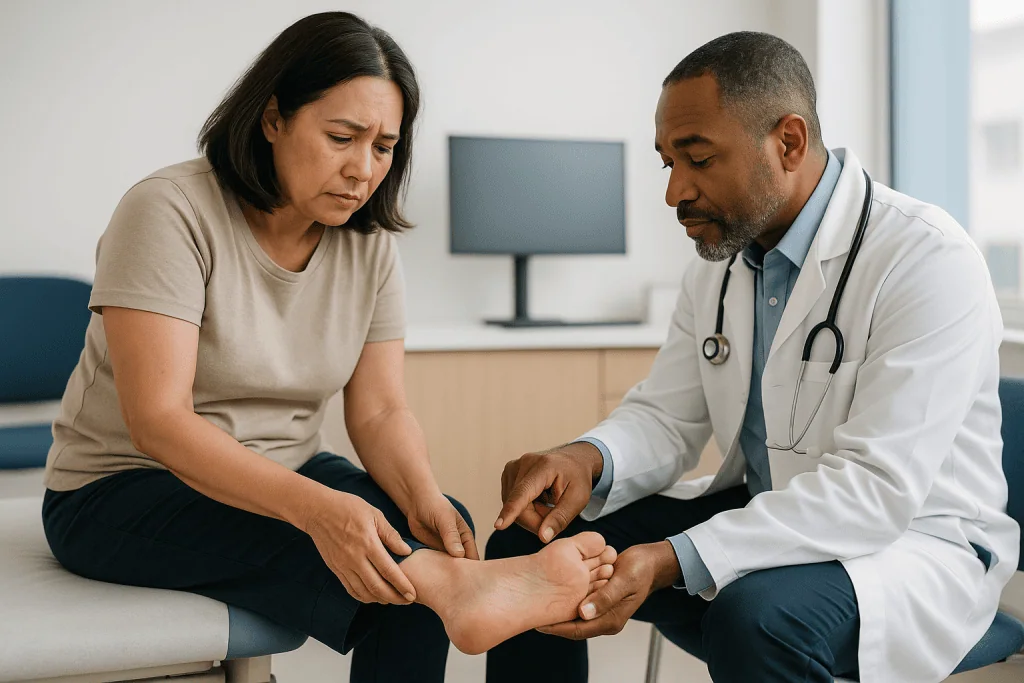
Pain concentrated on the underside of the heel, slightly toward the inner edge and a finger-width forward of the back edge, sits over the origin of the plantar fascia, the thick band of tissue that runs from heel to toes and supports the arch. This is plantar fasciitis territory.
Pain at the very back of the heel, where the Achilles tendon attaches to the heel bone, or two to six centimeters higher up the cord of the tendon itself, points to the Achilles or to the small fluid-filled sac that cushions it. Swelling or a visible bump makes the back-of-heel group more likely still.
A deep ache across the whole heel that worsens with every step, and that reproduces when you squeeze the heel bone from both sides, raises concern for a stress fracture of the calcaneus (the heel bone). Central heel pain that is worst barefoot on tile and better in cushioned shoes suggests a thinning fat pad. Burning, tingling or numbness spreading along the inner heel and sole suggests an irritated nerve rather than tissue strain.
Timing is the second axis. Plantar fasciitis announces itself with the first steps after sleep or after sitting, then eases, then returns after long standing. Achilles problems are stiff in the morning too, but they flare during and after running, hills and stairs. Stress fractures do not ease as you warm up; they get steadily worse through the day. Hold these two axes, place and time, side by side and the field narrows quickly.
Is it plantar fasciitis? The first-step sign
Plantar fasciitis is the most common cause of heel pain in adults, and Cleveland Clinic estimates it accounts for the majority of heel complaints that reach a clinic. The fascia acts like a bowstring across the arch. Every step stretches it; thousands of steps a day, on a tight calf or a changed training schedule, produce micro-tears at its attachment to the heel bone.
The signature symptom is stabbing pain under the heel with the first steps out of bed. The fascia shortens slightly overnight as the foot relaxes, then is yanked taut when weight comes down. After a few minutes of walking the pain usually eases, only to return after long periods of standing, or when you stand up after sitting through a meeting or a film. Pain is typically worse after exercise rather than during it, which is one reason runners keep running on it.
Risk factors cluster around load and anatomy. Mayo Clinic lists age between 40 and 60, running and jumping sports, occupations that keep people on hard floors for hours, higher body weight, and both flat feet and high arches, since each changes how force travels through the fascia. Tight calf muscles matter because a calf that cannot lengthen pushes extra strain into the fascia below.
One language point worth knowing: the suffix -itis means inflammation, but tissue studies of long-standing cases show more degeneration and disorganized collagen than classic inflammation. Some specialists now say plantar fasciopathy. The distinction is more than semantic. It explains why anti-inflammatory approaches alone often disappoint, and why progressive loading and stretching, which encourage the tissue to remodel, carry the stronger evidence.
What is Achilles tendonitis and what are its symptoms?
Achilles tendonitis is irritation and overload of the Achilles tendon, the thick cord connecting the calf muscles to the back of the heel bone. It is the largest and strongest tendon in the body and still fails, because it has a relatively poor blood supply and absorbs forces several times body weight with each running stride.
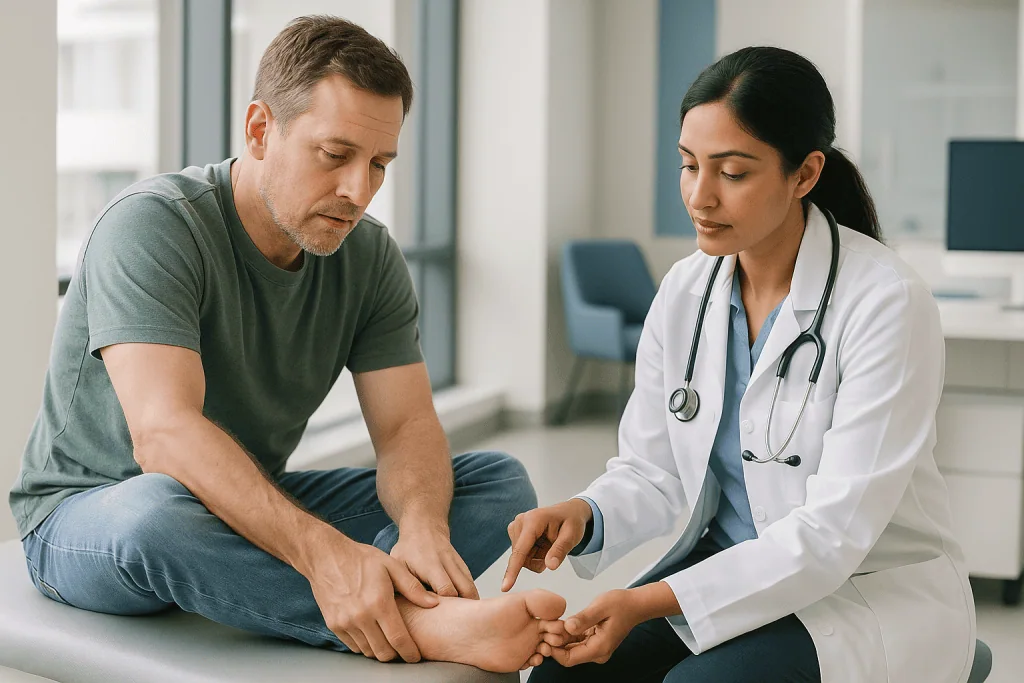
Clinicians divide it into two types by location. Non-insertional tendonitis affects the middle of the tendon, two to six centimeters above the heel, and is the classic runner’s version. Insertional tendonitis affects the lowest fibers where they attach to bone and can involve the heel bone itself; this type is common in people who are less active and tends to be more stubborn.
Symptoms described by Mayo Clinic include a mild ache at the back of the leg or above the heel after running or sport, stiffness and tenderness that is worst in the morning and eases with gentle movement, thickening of the tendon you can feel between finger and thumb, and in some people a tender nodule within the cord. Pain climbs with intensity: hills, sprinting and stairs are reliable provokers.
Risk rises with age, with sudden increases in training volume, with worn shoes and with running on hard or uneven surfaces. Men are affected more often than women. Certain medicines, including fluoroquinolone antibiotics, are associated with tendon problems; anyone taking a prescribed medicine who develops new tendon pain should raise it with the prescribing clinician rather than make changes on their own.
The red line is rupture. A sudden snap or pop at the back of the ankle, often described as being kicked, followed by weakness pushing off the toes, is an emergency rather than a flare.
What are calcaneal spurs and do they actually cause pain?
A calcaneal spur, usually called a heel spur, is a small bony projection that grows from the underside or the back of the heel bone where tendon or fascia pull on it over years. It shows up as a hook on an X-ray and photographs beautifully, which is one reason it stars in so many viral videos.
Here is the inconvenient fact: spurs are mostly bystanders. Cleveland Clinic notes that roughly one in ten adults has a plantar heel spur on imaging, and only a minority of those ever have heel pain. Conversely, many people with severe plantar fasciitis have no spur at all. The spur is evidence of long-term traction, a scar in bone, rather than a blade cutting into soft tissue. Surgeons who release the plantar fascia often leave the spur in place, and patients improve anyway.
When a spur is symptomatic, the symptoms overlap almost completely with the condition it accompanies. A plantar spur travels with plantar fasciitis: sharp underside heel pain on first steps, dull ache after standing. A posterior spur at the Achilles attachment travels with insertional Achilles tendonitis: pain and a hard bump at the back of the heel that rubs against shoe counters. Some people describe a feeling of a pebble under the heel, though that sensation more often comes from a thinning fat pad.
Why does this matter? Because believing the spur is the cause leads people toward the wrong fixes, including requests to have it removed. Treating the overloaded tissue around it, through stretching, footwear and gradual loading, is what the evidence supports, and the spur can stay exactly where it is.
What is heel bursitis and what are its symptoms?
A bursa is a small, slippery sac of fluid that sits between a tendon and a bone to reduce friction. The heel has two that matter. The retrocalcaneal bursa lies deep, between the Achilles tendon and the heel bone. The subcutaneous calcaneal bursa lies just under the skin, between the tendon and the back of the shoe. Bursitis means one of them has become irritated and swollen.
Retrocalcaneal bursitis produces pain deep at the back of the heel, felt most when you press on either side of the Achilles just above its attachment, when you point the foot upward, or when you run uphill. It often coexists with insertional Achilles tendonitis, and with a prominent ridge of bone at the upper back of the heel known as a Haglund deformity.
Superficial bursitis is the shoe problem. Rigid heel counters, formal shoes and new boots rub the back of the heel until the sac swells. The result is a visible, often reddened, warm lump that is exquisitely tender to touch and settles when the offending footwear is retired. Because it sits against the skin, this version is the one most likely to look inflamed.
Telling bursitis from Achilles tendonitis matters mainly for one reason: swelling. Tendonitis thickens the tendon itself, a firm spindle you can roll under your fingers. Bursitis puffs up beside or in front of the tendon and may feel boggy. Both hurt in the morning; bursitis hurts more with direct pressure and shoe contact.
Bursitis can also be a signal of something systemic. Enthesitis, inflammation where tendons and ligaments meet bone, is a feature of psoriatic arthritis and ankylosing spondylitis. Heel pain on both sides, in a younger adult, with back stiffness or a history of psoriasis, deserves a clinician’s assessment rather than another shoe change.
The heel pain causes you should not miss
Most heel pain is one of the four conditions above. The remainder is a short list worth knowing, because several items on it need a different plan entirely.
A calcaneal stress fracture is a hairline crack in the heel bone from repeated impact. Runners who ramp up mileage, people who switch suddenly to hard surfaces, and anyone with low bone density are at higher risk. The pain is diffuse rather than pinpoint, it worsens through the day instead of easing, and squeezing the heel from both sides reproduces it. X-rays can miss early fractures; an MRI or bone scan may be needed.
Fat pad atrophy is the thinning of the natural cushion under the heel, which loses thickness with age and after repeated steroid injections. Pain sits in the center of the heel, feels like walking on a bruise, and is worst barefoot on hard floors. Cushioning helps; stretching does little.
Nerve entrapment, including tarsal tunnel syndrome (compression of the tibial nerve on the inner ankle) and irritation of its small branch to the heel, produces burning, tingling or electric pain that may radiate into the sole and can be worse at night. Tissue-based treatments tend to fail because the tissue is not the problem.
Children between about 8 and 14 who complain of heel pain during growth spurts and sport usually have Sever’s disease, irritation of the growth plate at the back of the heel. It settles as the bone matures, but a limping child still warrants a check.
Rarely, heel pain comes from infection, a tumor, or referred pain from the lower back. Constant pain at rest, night pain, fever, unexplained weight loss or pain that spreads from the spine are the clues, and each belongs in a clinician’s office promptly.
Plantar fasciitis vs Achilles tendonitis vs bursitis: a side-by-side guide
Laid out next to one another, the common causes separate more cleanly than they feel at six in the morning. Use the table as a sorting tool, not a verdict; overlapping conditions are common, and a clinician may find two at once.
| Condition | Where it hurts | When it is worst | Tell-tale sign |
|---|---|---|---|
| Plantar fasciitis | Underside of heel, toward inner edge | First steps after sleep or sitting; after long standing | Eases after a few minutes of walking, returns later |
| Achilles tendonitis | Back of heel or 2–6 cm up the tendon | During and after running, hills, stairs | Thickened, tender tendon you can roll between fingers |
| Heel bursitis | Back of heel, beside or in front of tendon | With shoe pressure, pointing the foot up | Soft, swollen, sometimes red lump |
| Calcaneal spur | Wherever the attached tissue is overloaded | Mirrors plantar fasciitis or insertional Achilles | Seen on X-ray; often present without pain |
| Stress fracture | Whole heel, deep | Steadily worse through the day | Pain on squeezing heel from both sides |
| Fat pad atrophy | Center of heel | Barefoot on hard floors | Feels like a bruise; cushioning helps |
| Nerve entrapment | Inner heel, into sole | Often at night or at rest | Burning, tingling, numbness |
Two patterns deserve a second look even when the table seems to fit. Pain in both heels at once, especially in someone under 40, raises the question of inflammatory arthritis. And pain that fits nothing in the table, or that keeps worsening despite doing the sensible things, is the most reliable sign that the sensible things are aimed at the wrong target.
What the evidence actually says about treating heel pain
Grading the evidence is where honest heel pain writing diverges from the viral kind. Here is how the main options stack up, using the usual hierarchy: randomized trials strongest, observational studies weaker, expert opinion weakest.
Natural history: the finding that 80 to 90 percent of people with plantar fasciitis improve within 12 months comes from observational cohorts, not trials, but it is consistent across them and is echoed by Mayo Clinic and Johns Hopkins. Any treatment tested against this backdrop must beat a condition that mostly improves on its own.
Stretching of the calf and plantar fascia: supported by several small randomized trials and by the 2023 physical therapy guideline as a strong recommendation. Effect sizes are modest but consistent, and the downside is near zero.
Foot orthoses: randomized trials show prefabricated inserts perform about as well as custom-made ones for short-term pain relief. Evidence is moderate.
Night splints, which hold the foot at a right angle overnight: low-to-moderate evidence, with trials of mixed quality suggesting benefit mainly for symptoms lasting more than six months.
Corticosteroid injection: short-term relief, low-quality evidence, no long-term advantage, and documented risks of fat pad thinning and fascia rupture per the 2017 Cochrane review.
Shockwave therapy: multiple randomized trials with mixed results; the guideline grades it moderate for persistent cases.
Platelet-rich plasma: inconsistent trials, no clear superiority. Surgery: almost entirely observational data, reserved for the small minority who fail a year of conservative care.
For Achilles tendonitis, the standout is the eccentric heel-drop program, slowly lowering the heel off a step, which randomized trials support for mid-tendon disease with moderate evidence; insertional disease responds less predictably. The honest summary: the cheapest, dullest options have the best evidence, and the expensive, exciting ones have the thinnest.
What helps most at home in the first weeks
The first month is where most heel pain is won or lost, and the strategy is load management rather than rest. Keep moving, but subtract the specific activity that provokes the pain: swap running for cycling or swimming for a few weeks, shorten standing shifts where possible, and avoid hill sessions until the morning stiffness fades.
Stretch the calf twice a day, holding each position for the length of a few slow breaths and repeating several times. Add a plantar fascia stretch for underside pain: sit, cross the painful foot over the other knee, and pull the toes back toward the shin until you feel the band under the arch tighten. Doing this before the first step out of bed is the single habit people most often credit with easing the morning stab.
For Achilles tendonitis, the heel-drop exercise is the anchor. Stand on a step on the balls of both feet, rise up, shift weight to the painful side and lower that heel slowly below the step. Mild discomfort during the exercise is expected; sharp pain is not. A small heel lift inside both shoes can take tension off the tendon temporarily.
Footwear does quiet work. Cushioned, supportive shoes with a firm heel counter help plantar pain and fat pad pain; shoes with soft or open backs relieve bursitis. Going barefoot on hard floors is the most common hidden aggravator in people who are otherwise doing everything right.
Ice applied over a cloth for short periods after activity eases soreness. Over-the-counter pain relievers such as ibuprofen or acetaminophen may be used as the pharmacist or clinician directs; they manage symptoms rather than repair tissue, and anyone with kidney, stomach or heart conditions or who takes other medicines should ask first.
Give the plan two weeks. The NHS marks that point as the time to see a GP if nothing has shifted.
Treatments a clinician may discuss when heel pain lingers
If six to eight weeks of consistent self-care have not moved the needle, the next conversations happen in a clinic, and the decisions in every case belong to the treating clinician who has examined the foot.
Physical therapy usually comes first. Beyond supervised stretching and strengthening, therapists use manual techniques on the calf and foot, taping to offload the fascia, and graded return-to-running plans. For Achilles tendonitis they tailor the loading program, since the insertional type tolerates full heel drops poorly.
Orthoses and splints are the second tier. Prefabricated arch supports are a reasonable starting point; custom devices are considered when foot shape is unusual. Night splints suit people whose main symptom is the first-step pain. A walking boot that immobilizes the foot for a short period is sometimes used for severe plantar pain, for insertional Achilles problems and always for stress fractures.
Injections are discussed, not assumed. A corticosteroid injection into the plantar fascia may offer weeks of relief in a stubborn case; the clinician weighs that against fat pad thinning and the small risk of fascia rupture. Corticosteroid is generally not injected into or around the Achilles tendon itself because of rupture risk. Platelet-rich plasma is offered in some centers with the caveat that trial results are inconsistent.
Shockwave therapy is a non-invasive option for pain lasting beyond several months, cleared by regulators for plantar fasciitis in the United States since 2000, with moderate-quality evidence behind it.
Surgery is the end of the road, reached by a small minority after roughly a year of failed conservative care. Options include partial release of the plantar fascia, lengthening of a tight calf muscle, debridement of degenerated Achilles tissue, or removal of a Haglund bump. Each carries recovery measured in months.
Imaging sits alongside all of this. Ultrasound can confirm thickening of the fascia or tendon; X-ray checks the bone; MRI resolves stress fractures and nerve questions when the story does not add up.
Common heel pain myths the viral videos get wrong
The heel spur is causing the pain. It usually is not. Spurs appear on imaging in large numbers of pain-free adults, and people improve when the overloaded fascia or tendon is treated whether or not the spur remains. Spur removal is rarely part of modern surgery.
One stretch will fix it in a week. Stretching is genuinely one of the best-supported treatments, which is what makes this claim sticky. But the trials show gradual improvement over weeks to months, layered on top of footwear and load changes. A single maneuver that resolves months of tissue change in days does not exist in the literature.
Rest completely until the pain is gone. Prolonged rest weakens the calf and tendon, and both the Achilles and the fascia respond to controlled loading. The current guidance is to modify activity, not abandon it, which is a meaningful change from advice given even ten years ago.
Push through it and the tendon will toughen. Achilles tendonitis that is trained through, especially with hills and speed work, is the most common route to a thickened, degenerated tendon and, in the worst case, rupture. Pain during the eccentric exercise is acceptable; pain that is sharp, worsening or lingering the next morning is a stop sign.
Barefoot or minimalist shoes will solve everything. For some people a gradual transition to less cushioned shoes strengthens the foot. For many others, an abrupt switch is what started the plantar or Achilles pain. There is no trial evidence that minimalist footwear treats established heel pain.
Only runners get heel pain. Standing occupations, a recent weight change, new footwear and simply reaching one’s fifties are all common triggers in people who have never run a mile.
If it hurts in the heel, it is plantar fasciitis. Most of the time, yes. The exceptions, stress fracture, nerve entrapment and inflammatory arthritis, are exactly the ones that a one-size-fits-all stretching video will miss.
How to prevent heel pain from coming back
Prevention is mostly a conversation about rate of change. The plantar fascia and Achilles tendon adapt to load, but slowly, over weeks. Most episodes trace back to a jump: a new running plan, a job that moved from desk to floor, a holiday spent walking in flat sandals, a sudden return to sport after months away. Increase distance, time on feet or intensity in small weekly steps, and change only one variable at a time. The popular rule of adding no more than about ten percent per week has weak formal evidence but captures the right instinct.
Keep the calves long and strong. Tight calf muscles are the common thread running through plantar fasciitis and Achilles tendonitis alike, and the same two stretches used for treatment work as maintenance. Add calf raises, including slow lowering, two or three times a week; a tendon that is used to controlled loading tolerates uncontrolled loading better.
Treat shoes as equipment. Running shoes lose cushioning long before they look worn; rotating two pairs and replacing them on a schedule, rather than on appearance, reduces repeated stress. Shoes with a firm heel counter and some arch support protect the plantar fascia; a modest heel height reduces Achilles strain; soft or open backs prevent bursitis. Avoid long stretches barefoot on hard floors at home, which is the most under-recognized trigger in people who already had one episode.
Warm up before impact activity and cool down with the stretches afterward. Cross-train so that not every session is pounding. If body weight has risen, even a modest reduction lowers the force through the heel with every step, and a clinician can advise on realistic, respectful goals.
Finally, listen to morning stiffness. A heel that is briefly stiff on waking and then fine is normal. A heel that is stiff for several mornings in a row is the earliest, cheapest warning you will get.
When to see a doctor about heel pain
Most heel pain can be managed at home for a short period, but some signs mean that period is over or never applied. Go to an emergency department or urgent care the same day if you felt or heard a sudden pop at the back of the ankle and now cannot push off your toes or stand on tiptoe; that pattern suggests an Achilles rupture, which needs prompt assessment whether it is treated surgically or in a cast. Do the same if you cannot put weight on the foot after a fall, jump or twist, or if the heel is hot, red and swollen alongside a fever, which can signal infection.
Arrange a non-urgent appointment within days if pain has not improved after two weeks of sensible self-care, the threshold the NHS uses; if the pain is constant, present at rest or waking you at night; if there is numbness, tingling or burning spreading into the sole; if both heels hurt at once in a younger adult or you have psoriasis, inflammatory bowel disease or back stiffness; or if a child is limping or avoiding sport.
Anyone living with diabetes, peripheral neuropathy (reduced sensation in the feet) or poor circulation should see a clinician early for any new foot pain, because reduced sensation can hide damage and healing is slower.
Bring the story, not just the foot: when the pain started, what changed in the weeks before, where it is worst, when in the day it peaks, which shoes help and hurt, and a list of current medicines. Every decision that follows, from imaging to injections to a return-to-running plan, belongs to the clinician who examines you and knows your history. Never stop, start or change a prescribed medicine on the basis of heel pain without that conversation, and treat any claim of a quick fix, online or in person, with the skepticism the evidence earns.
Frequently asked questions
How can I tell plantar fasciitis from Achilles tendonitis?
Location decides it. Plantar fasciitis hurts on the underside of the heel toward the inner edge and is worst with the first steps after sleep or sitting. Achilles tendonitis hurts at the back of the heel or a few centimeters up the tendon, flares during and after running or stairs, and often leaves the tendon thickened and tender to pinch. Both are stiff in the morning, so place matters more than timing.
How do I prevent heel pain?
Change load slowly. Build running distance, standing time and intensity in small weekly steps, stretch and strengthen the calves regularly, replace worn shoes on a schedule rather than by appearance, and avoid long periods barefoot on hard floors. Warming up before impact activity and cross-training so not every session involves pounding both reduce repeated stress on the fascia and Achilles.
What are calcaneal spurs and what are their symptoms?
A calcaneal spur is a small bony outgrowth on the heel bone where tendon or fascia has pulled on it for years. By itself it usually causes no symptoms; when pain is present it mirrors the attached tissue, so a plantar spur feels like plantar fasciitis and a posterior spur feels like insertional Achilles tendonitis. Treatment targets that tissue, and the spur is generally left in place.
What is heel bursitis and what are its symptoms?
Heel bursitis is swelling of one of the small fluid sacs that cushion the Achilles tendon at the back of the heel. It causes pain on pressing either side of the tendon just above the heel bone, pain when the shoe rubs the back of the heel, and often a soft, visible, sometimes reddened lump. It frequently coexists with insertional Achilles tendonitis and a bony ridge called a Haglund deformity.
Why does my heel hurt in the morning but feel better later?
That pattern is classic for plantar fasciitis. The plantar fascia shortens slightly overnight while the foot relaxes, then is stretched abruptly when weight comes down with the first steps, causing a sharp stab that eases as the tissue warms and lengthens. Pain often returns after long standing or after sitting for a while. Stretching the calf and arch before getting out of bed commonly softens the morning peak.
Can heel pain be a stress fracture?
Yes, though it is far less common than plantar fasciitis. A calcaneal stress fracture produces a deep ache across the whole heel that worsens as the day goes on rather than easing with warm-up, and squeezing the heel bone from both sides typically reproduces it. Runners who increase mileage quickly and people with low bone density are most at risk. Early X-rays can miss it, so a clinician may order an MRI.
How long does plantar fasciitis take to get better?
Most people improve within several months, and observational studies suggest 80 to 90 percent are substantially better within a year using conservative care such as stretching, supportive footwear and activity modification. Symptoms that have lasted more than six months are considered persistent and may prompt a clinician to discuss night splints, shockwave therapy or other options. Improvement is usually gradual rather than sudden.
Do heel pain injections work?
Corticosteroid injections can provide relief for a few weeks in stubborn plantar fasciitis, but a 2017 Cochrane review graded the evidence as low quality with no clear long-term benefit, and repeated injections can thin the heel fat pad or weaken the fascia. They are generally avoided around the Achilles tendon because of rupture risk. Whether an injection suits a particular person is a decision for the examining clinician.
When should I worry about pain at the back of my heel?
Seek same-day care if you felt a sudden pop and cannot push off your toes, which suggests an Achilles rupture, or if the heel is hot, red and swollen with a fever. See a clinician within days if pain has not improved after two weeks of self-care, is present at rest or at night, comes with numbness or tingling, or affects both heels in a younger adult with back stiffness or psoriasis.
Are minimalist or barefoot shoes good for heel pain?
There is no trial evidence that minimalist footwear treats established heel pain, and an abrupt switch to flat or barefoot-style shoes is a common trigger for both plantar fasciitis and Achilles tendonitis. Some people can transition gradually once pain has settled, but during a flare most guidance favors cushioned, supportive shoes with a firm heel counter and avoiding barefoot walking on hard floors.
References
This article is for general information only and is not a substitute for professional medical advice. Please consult a qualified doctor about your individual situation.

More from the Blog

SI Joint Pain: The Often-Missed Cause of Low Back and Buttock Pain
SI joint pain comes from the sacroiliac joints, the two joints that connect the base of the spine to the pelvis. It usually causes…

Anterior Hip Replacement: How the Front Approach Differs, and for Whom
Anterior hip replacement reaches the hip joint through the front of the thigh, working between muscles rather than detaching them. Research suggests modestly less…
Posture Correctors: Do They Work, or Weaken the Muscles That Should Hold You Up?
A posture corrector can work as a short-term reminder that gently pulls the shoulders back, and small studies show people slouch less while wearing…
Is My Cast Too Tight? Numbness, Color Changes and Fracture Warning Signs to Report
A cast may be too tight if the pain keeps climbing despite elevation and prescribed pain relief, if fingers or toes turn pale, blue…

When a Broken Shoulder Is Replaced Rather Than Repaired: Shoulder Prosthesis After Fracture
A shoulder prosthesis for fracture is an artificial ball, or ball and socket, implanted when the top of the upper arm bone has shattered…

Aesthetic Foot Surgery Results: What Toe Shortening and Foot Narrowing Realistically Change
Aesthetic foot surgery results are usually modest and structural: toe shortening removes a small segment of bone so a long toe sits level with…