

Helping a Loved One Through Swallowing Rehabilitation: Mealtimes, Textures and Upright Sitting

Key Takeaways
- Sitting fully upright at about 90 degrees moves food and drink toward the esophagus and away from the airway; reclining reverses that geometry.
- Silent aspiration, where food or drink enters the airway with no cough, is common after stroke and in dementia, so a quiet meal is not proof of a safe one.
- Thin liquids such as water are usually the first consistency restricted because they move fastest and reach the airway before a delayed swallow reflex can close it.
- The chin tuck narrows the airway entrance and widens the space above the epiglottis, but research shows it helps only certain swallowing patterns and should be used only when prescribed.
- Twice-daily mouth care lowers the bacterial load in saliva, which is a major driver of aspiration pneumonia even when meals go well.
- Never crush, split or stop a tablet because it is hard to swallow; modified-release medicines change how they work when crushed, and alternatives are a prescriber's decision.
Caring for someone in swallowing rehabilitation rests on three habits: keep them fully upright at every meal and for a while afterward, serve only the food textures and liquid thickness their speech-language pathologist has recommended, and slow the pace with small mouthfuls in a calm setting. Watch for coughing, a wet-sounding voice, chest infections or weight loss, and report changes to the treating team rather than adjusting the plan yourself.
The first time Maria noticed it, her father was halfway through a bowl of soup. He stopped, cleared his throat twice, and his voice came out gurgly when he asked for more bread. Three weeks after his stroke, the physical therapist had him walking the hallway with a cane. Nobody had warned her that dinner would become the hardest part of the day.
Swallowing is the one skill most of us never think about until it fails. When it does, the family member who does the cooking, the shopping and the coaxing suddenly holds a clinical role they never applied for. The good news is that the evidence base for safer mealtimes is practical and learnable, and the most useful dysphagia caregiver tips are less about gadgets than about posture, pace and paying attention.
This guide walks through what rehabilitation actually involves, what the textures and strategies are trying to achieve, and where the line sits between what you can do at the table and what belongs to the treating team.
What actually happens when a swallow goes wrong
A normal swallow takes roughly a second, yet it coordinates the tongue, the soft palate, the muscles of the throat and the tiny flap called the epiglottis that folds over the windpipe. Dysphagia is the medical term for difficulty swallowing, and it can involve any stage of that sequence: chewing and forming a soft ball of food (the bolus), pushing it to the back of the mouth, triggering the reflex that lifts the voice box and seals the airway, or moving food down the esophagus into the stomach.
The danger everyone worries about is aspiration, which simply means food, drink or saliva slipping past the vocal cords into the lungs instead of the stomach. A healthy person coughs it straight back out. After a stroke, with Parkinson’s disease, in advanced dementia or following head and neck cancer treatment, the sensation in the throat may be blunted. That produces what clinicians call silent aspiration: material entering the airway with no cough, no sputter, no visible sign at the table. According to the NHS, repeated aspiration is the main route to aspiration pneumonia, a lung infection that is one of the most serious complications of untreated dysphagia.
Two other problems tend to arrive quietly. Food that is tiring to eat gets left on the plate, so weight and muscle drift downward. Thin liquids that feel risky get avoided, so dehydration creeps in, and dehydration itself thickens saliva and dries the mouth, which makes swallowing harder still. Understanding this loop matters for caregivers because it explains why the rehabilitation team cares as much about what stays on the plate as about what goes down the wrong way. Safety and nutrition are the same project, not competing ones.
What swallowing rehabilitation actually involves
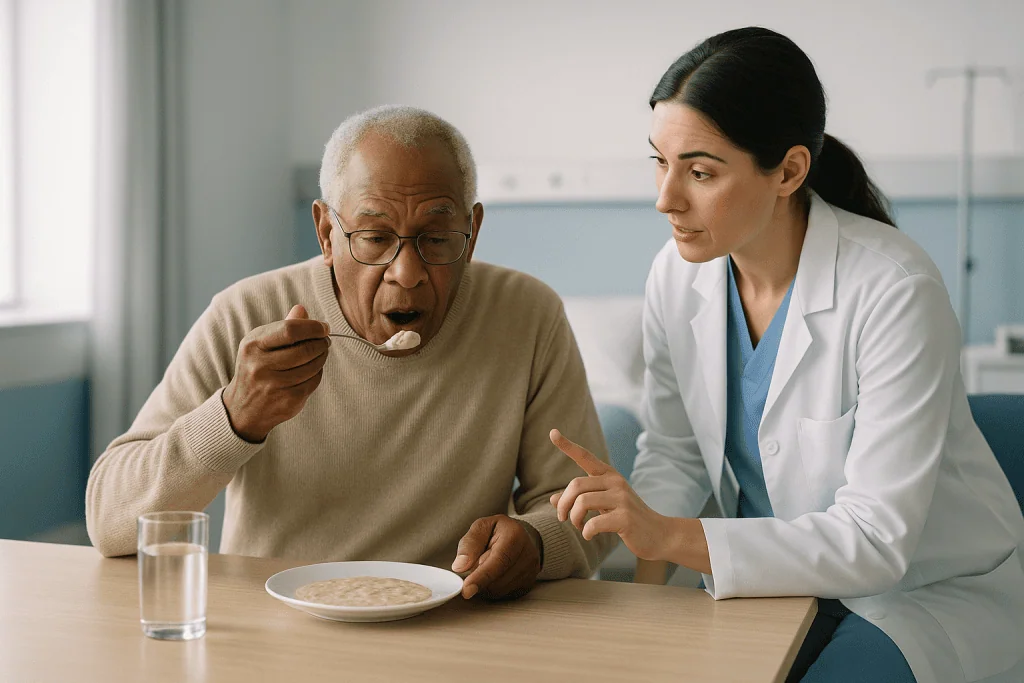
Most swallowing rehabilitation is led by a speech-language pathologist, a clinician trained in the muscles and nerves of speech and swallowing rather than a physician. The first step is usually a bedside assessment: watching the person swallow sips and small spoonfuls of different consistencies while listening to the voice, timing the swallow and checking for coughing or a change in breathing.
When more detail is needed, two instrumental tests are common. A videofluoroscopic swallow study is a moving X-ray taken while the person swallows food and drink mixed with a contrast agent, so the clinician can watch where each texture goes. A fiberoptic endoscopic evaluation of swallowing, often shortened to FEES, passes a thin camera through the nose to view the throat directly before and after each swallow. The Mayo Clinic describes both as standard ways of identifying which textures are safe and which strategies help.
Treatment then runs on two tracks. Compensatory strategies change the conditions of the swallow without changing the muscles: upright posture, smaller mouthfuls, thickened liquids, the chin tuck. Rehabilitative exercises aim to strengthen or retrain the muscles themselves, such as repeated effortful swallows, tongue-strengthening drills or head-lift exercises done lying flat. The clinician chooses exercises based on what the tests showed, and the prescription is individual; an exercise that helps one person’s weak tongue base can be pointless or unhelpful for another person whose problem is a slow-closing airway.
Your role as a caregiver sits mostly on the first track. You are the person who makes sure the compensations happen at every single meal, including the snack at ten in the evening when nobody is watching.
Who swallowing rehab is usually for, and who is usually asked to wait
Referral for swallowing rehabilitation is common after a stroke, where swallowing problems are frequent in the early days and often improve over time, according to the NHS. It is also part of routine care for people with Parkinson’s disease, motor neuron disease, multiple sclerosis, and those recovering from surgery or radiation for cancers of the mouth, throat or esophagus. Older adults with no single diagnosis but progressive frailty and muscle loss may be referred too, especially after a chest infection that turns out to have been aspiration.
Not everyone starts exercises straight away. In the first hours after a stroke, most people are kept nil by mouth, meaning nothing to eat or drink, until a trained clinician has screened their swallow. Someone who is drowsy, confused from an infection, or breathing hard with a chest infection is usually asked to wait, because active exercise needs alertness and the ability to follow instructions. A person who cannot stay awake through a meal is not in a position to practice a chin tuck.
People living with advanced dementia are a special group. Rehabilitative exercises rely on learning and memory, so the team often focuses on compensations and environment rather than strengthening drills. Decisions about how aggressively to pursue safety versus comfort in eating belong to the person, their family and the medical team together, and there is no single right answer.
Timing also matters for people with cancer. Those in the middle of radiation may be advised to keep swallowing whatever they safely can rather than resting the muscles, while surgical patients may need healing time before any exercise begins. The treating team sets that schedule, and it is reasonable to ask them why they have chosen the timing they have.
Dysphagia caregiver tips for the mealtime itself
Start before the food arrives. Check the person is awake, alert and not in the fog that follows a nap or a sedating medicine. The NHS advises that anyone with swallowing difficulty should eat only when fully alert, because a sleepy swallow is a slow and poorly protected one. Turn off the television and put the phone away; a swallow that needs concentration should not compete with the news.

Look inside the mouth. Dry lips, thick saliva or loose dentures make chewing harder and change how a bolus moves. A sip of water (if thin water is allowed) or a moist swab before eating helps.
At the table, sit at the person’s eye level rather than standing over them. Standing makes them look up, which tips the head back and opens the airway at exactly the wrong moment. A teaspoon rather than a tablespoon controls the amount, and half-filled is often plenty. Wait for the mouth to be completely empty before offering the next spoonful. If you are not sure, ask them to say a word; a clear voice usually means a cleared throat, while a wet or gurgling sound suggests residue.
Pace is your biggest lever. Meals for someone in rehabilitation routinely take twice as long as they used to, and rushing to finish before the food goes cold is where mistakes happen. Smaller, more frequent meals through the day often work better than three large ones, both for fatigue and for calories.
Finally, keep notes. A simple log of what was eaten, how long it took, and any coughing or voice change gives the speech-language pathologist far more to work with at the next review than a memory of “dinner was okay.”
Why upright sitting matters, and how to get there
Gravity is either the swallow’s assistant or its saboteur. Sitting fully upright lets food and drink travel down the throat along the back wall, where the esophagus opens, and away from the airway at the front. Recline the trunk even partway and the geometry changes: the bolus drifts toward the windpipe, the epiglottis has less help closing, and anything that pools in the throat sits closer to the airway entrance.
The target most rehabilitation teams describe is hips at roughly 90 degrees, back straight, feet flat on the floor or a footrest, and the head in a neutral position or tilted slightly forward. In a chair, that means scooting the hips fully back so the spine meets the backrest. A cushion behind the lower back helps someone who slumps. In bed, raise the head of the bed as far as it goes and use pillows behind the shoulders, not under the head alone; a pillow under the head only pushes the chin forward into a cramped posture without lifting the trunk.
Wheelchair users may need a lap tray or a table at the right height so they are not leaning forward to reach a plate. Anyone with weakness on one side, common after stroke, may lean toward the weak side; a rolled towel or firm cushion on that side keeps them centered.
Staying upright after the meal matters too, because reflux and residue can be aspirated later. Many care teams advise remaining seated for a period after eating rather than lying down, and around 30 minutes is a figure caregivers often hear; ask your team for the exact instruction they want followed. A slow walk to the sink counts as upright. A nap on the sofa does not.
Dysphagia diet textures and thickened liquids explained
Texture modification is the most visible part of a swallowing plan and the most misunderstood. The logic is simple: softer, more cohesive food needs less chewing and holds together as one bolus, while thicker liquids flow more slowly, giving a delayed swallow reflex time to catch up. Water is the fastest-moving thing most of us ever swallow, which is precisely why it can be the riskiest for someone whose airway closes late.
Many hospitals use the International Dysphagia Diet Standardisation Initiative framework, a scale of eight levels from thin liquids to regular food, so that everyone involved describes the same texture with the same words. The Cleveland Clinic and the NHS both describe texture-modified diets as a standard part of dysphagia management, always prescribed individually after assessment.
| Level | What it looks like | Everyday example |
|---|---|---|
| 0 Thin | Flows like water | Water, tea, juice |
| 1–2 Slightly to mildly thick | Pours but coats a spoon | Thick smoothie, drinking yogurt |
| 3 Moderately thick | Drips slowly off a spoon | Thick custard that still pours |
| 4 Pureed / extremely thick | Holds shape, no chewing | Smooth mashed potato, hummus |
| 5 Minced and moist | Soft lumps no larger than a pea | Finely minced meat in gravy |
| 6 Soft and bite-sized | Cuts with a fork, small pieces | Soft-cooked fish, ripe banana |
| 7 Regular / easy to chew | Normal food, soft options | Everyday meals |
Two cautions. Thickened liquids are less appealing and less thirst-quenching, so people drink less; hydration needs active planning, with drinks offered often rather than left on the table. And the level is a prescription. Loosening it because a birthday cake looks harmless, or tightening it because you are nervous, both change the plan without the information the assessment provided. Ask the team before adjusting.
Straws, cups and the chin tuck swallow strategy
Should patients with dysphagia use a straw? For many, the answer from their speech-language pathologist is no, and the reason is mechanical. A straw fires liquid to the back of the mouth quickly and in a larger volume than a sip from a cup, and it often comes with a slight head-back posture as the person leans in. Both features work against a slow or weak swallow. Some people, particularly those with weak lips or limited arm movement, are given a straw deliberately because the clinician has watched them swallow with it. The rule is not “straws are bad” but “use whatever the assessment showed to be safe.”
Cups have their own trap. Tipping a nearly empty cup to reach the last inch forces the head back. Keeping cups more than half full, or using a cup with a cut-out for the nose, lets the head stay level.
The chin tuck swallow strategy is the compensation most families have heard of. The person lowers the chin toward the chest just before and during the swallow. Mechanically, this narrows the entrance to the airway, pushes the base of the tongue backward, and widens the pocket above the epiglottis where liquid can pause safely before the swallow triggers. It tends to help people whose swallow reflex fires late or whose airway closes slowly.
Research on the chin tuck is mixed, and it does not help everyone; for some patterns of weakness it makes residue worse. It is one of several posture strategies, alongside turning the head toward a weaker side or swallowing twice on each mouthful, and the right one is chosen by watching the swallow on imaging. If nobody has prescribed a chin tuck, do not add one because it looks sensible.
How to improve swallowing in elderly loved ones without rushing them
Aging alone changes the swallow. Muscles in the tongue and throat lose bulk like muscles everywhere else, saliva production falls, and the swallow reflex triggers a fraction later than it did at forty. Clinicians call this presbyphagia, meaning age-related change in swallowing that is not yet a disorder. Add a stroke, a chest infection or a week in bed, and the margin disappears.
Strengthening is possible at any age. The exercises a speech-language pathologist prescribes, whether tongue presses, effortful swallows or head-lift drills, work on the same principle as leg exercises after a hip replacement: repeated load builds capacity. Consistency matters more than intensity, which is where a caregiver helps most, by building the exercises into a daily routine rather than leaving them for a good day.
Nutrition feeds the muscle. Protein at every meal, fortified with milk powder, nut butters, eggs or soft cheese blended into purees, supports the very muscles being trained. Johns Hopkins Medicine notes that unintended weight loss is a common consequence of dysphagia and a signal the plan needs review.
Small practical fixes add up. Dentures that no longer fit make chewing inefficient and can be adjusted by a dentist. A dry mouth from medicines such as some antidepressants, antihistamines or bladder medicines makes food stick; report this to the prescriber rather than stopping anything, because sometimes an alternative exists. Serve food warm rather than lukewarm, since temperature contrast helps trigger the swallow. Offer drinks between meals, not only with them, and count them.
The temptation is to help by feeding faster or by finishing the plate for them. Resist both. A smaller meal finished safely beats a full one that ended in coughing.
When dementia means forgetting how to swallow
Dementia changes swallowing in a different way from stroke. The muscles may be capable, but the brain’s script for eating fades: the person holds food in the mouth without chewing, tucks it into a cheek (called pocketing), forgets there is a spoon in front of them, or simply does not recognize that the thing on the plate is food. The Cleveland Clinic lists dementia among the common neurological causes of dysphagia, and in later stages it is one of the most frequent.
Prompting works better than instruction. A person who cannot follow “swallow now” may respond to the touch of an empty spoon on the lower lip, which cues the mouth to open and close. A cold or sour taste, such as a spoonful of chilled lemon-flavored puree if the team approves the texture, can trigger the swallow reflex more reliably than bland warm food. Gently stroking downward on the throat, or modeling a swallow yourself while making eye contact, sometimes helps. Hand-over-hand feeding, where you guide their hand holding the spoon, preserves the familiar motor pattern.
Environment does heavy lifting here. A plate that contrasts with the food, one item at a time, the same seat and the same time each day, and no more than one person talking. Finger foods at a soft texture the team has approved can restore independence when cutlery has become confusing.
Watch for pocketing after the meal by gently checking the cheeks, because food left there can be aspirated later. And be honest with the team about what mealtimes look like at home. In advanced dementia, there is a point where the conversation shifts from rehabilitation to comfort, and that conversation should be led by the medical team with the family, not carried alone at the kitchen table.
Mouth care and the pill problem
Here is a fact that surprises most families: the pneumonia caused by aspiration is driven as much by what lives in the mouth as by what goes down the wrong way. Saliva carrying a heavy load of bacteria, aspirated a little at a time overnight, can seed a chest infection even when meals go well. Good oral hygiene is therefore a swallowing intervention, not a cosmetic one, and it is one caregivers control completely.
Brush teeth or gums twice a day with a soft brush, including the tongue. Take dentures out at night, clean them, and check the gums beneath for sore spots that make the person avoid chewing. For someone who cannot spit safely, a small smear of toothpaste and a moistened swab to clear residue works. Dry mouth responds to frequent sips of whatever liquid is permitted and to moisturizing gels a pharmacist can suggest.
Medicines bring a separate hazard. Tablets are among the hardest things to swallow safely: small, hard, and taken with a gulp of thin water that the person may not be allowed. The instinct is to crush everything into pudding. Some medicines can be crushed; others, particularly modified-release or coated tablets, are designed to dissolve slowly and lose that design when crushed, which changes how the medicine works. Never crush, split or open a medicine without checking with the pharmacist or prescriber, and never stop a medicine because it is hard to swallow. Ask instead whether a liquid, dispersible or patch form of the same medicine exists. That decision, and any change in how a medicine is taken, belongs to the prescribing clinician.
If pills are given with a spoon of the approved thickness of puree rather than water, ask the team to confirm that is acceptable for each specific medicine.
What the following weeks usually look like
Rehabilitation is rarely a straight line. After a stroke, the NHS notes that swallowing problems often improve in the weeks and months that follow, and many people move from thickened liquids and purees toward more normal textures as reassessments show the swallow recovering. That progression is decided by repeat assessment, sometimes including another imaging study, rather than by how well dinner went on a good night.
Expect the pattern to look something like this. In the first days, the focus is safety: screening, an initial texture level, posture rules and mouth care. Over the following one to two weeks, exercises usually begin if the person is alert enough, and the speech-language pathologist watches for signs the reflex is speeding up. Reviews may then step the diet up one level at a time, keeping the previous level as a fallback on tired days. Fatigue, a chest cold or a poor night’s sleep can push the swallow backward temporarily, so a setback is not automatically a sign of failure.
For progressive conditions such as Parkinson’s disease or motor neuron disease, the direction is different. The aim there is to keep the person eating safely and enjoyably for as long as possible, adjusting textures downward when needed and revisiting strategies as symptoms change. Timelines vary so widely between individuals that any figure would be misleading; the team will tell you what they expect for your loved one and how often they plan to reassess.
Throughout, weigh the person weekly on the same scale at the same time of day, note fluid intake and record any chest symptoms. Those three data points, more than anything else, tell the team whether the plan is working between visits.
What people often get wrong
“Water is the safe option because it’s just water.” Thin liquids move fastest and are often the first thing to be restricted, precisely because they reach the airway before a slow reflex can close it. Follow the prescribed thickness for every drink, including the sip used to take medicines.
“If they’re not coughing, it went down fine.” Silent aspiration, aspiration without any cough, is common in neurological dysphagia. A clear meal is reassuring but not proof; the pattern over weeks, including chest health and weight, tells the real story.
“Coughing means they’re choking.” Choking is a blocked airway and an emergency. Coughing during a meal is usually the airway doing its job and clearing a small amount of misdirected food or drink. Let the cough finish, stay calm, do not offer water to “wash it down,” and note it for the team. Frequent coughing at meals still needs reporting.
“Thickened drinks and purees are forever.” For many stroke survivors they are a stage, not a destination, and the level is reviewed as recovery proceeds.
“Reclining is more comfortable, so it must be gentler.” Comfort and safety point in opposite directions here. Semi-reclined eating tips the bolus toward the airway.
“Bigger mouthfuls mean faster meals and better nutrition.” Larger boluses are harder to control and more likely to leave residue. Small mouthfuls, more often, deliver more food safely.
“A feeding tube removes all risk.” Tube feeding bypasses the mouth but does not stop saliva or reflux from being aspirated, and it does not replace mouth care. Whether a tube is appropriate is a medical and personal decision for the treating team and the family, not a default.
Questions to ask your care team when caring for a dysphagia patient
Caregivers often leave appointments with a texture level and little else. These questions turn a prescription into a plan you can carry out.
- Which stage of the swallow is the problem, and what did the assessment actually show? Knowing whether the issue is a weak tongue, a late reflex or residue in the throat explains why each strategy was chosen.
- Exactly which liquid thickness and food texture should we use, using the level names, and does that apply to every drink including the ones used for medicines?
- Has a chin tuck, head turn or double swallow been prescribed for this person specifically? If not, should we avoid adding one?
- Is a straw allowed? Are there specific cups or utensils you want us to use?
- How long should they stay upright after eating, and what should we do if they fall asleep in the chair?
- Which exercises should be done at home, how often, and what does a correct repetition look like? Can we watch you do one?
- Can any of the current medicines be crushed, and are there liquid or dispersible alternatives for those that cannot? Who decides that?
- What signs should make us stop a meal, and which signs mean we call the same day rather than wait for the next review?
- How often will the swallow be reassessed, and what would trigger an earlier review?
- Who do we contact if intake drops or weight falls between appointments?
- If swallowing does not improve, what are the options, and how will that conversation be handled with the person themselves?
Write the answers down during the visit. Texture levels and exercise instructions are easy to misremember, and a single shared sheet on the refrigerator means everyone who helps at mealtimes, including relief carers and visiting relatives, follows the same plan.
When to call your doctor
Some signs need urgent action rather than a note in the mealtime log. Call emergency services immediately if the person cannot breathe, cannot cough or speak, is clutching the throat, or turns blue or gray around the lips; that is choking, and it needs the standard first aid response while help is on the way. Learning back blows and abdominal thrusts from a recognized first aid course before you need them is one of the most practical things a dysphagia caregiver can do.
Contact the doctor or care team the same day for a new fever, a chest that sounds rattly or wet, breathlessness, a persistent cough that started after meals, or a change in voice quality that lasts beyond the meal. The Mayo Clinic identifies aspiration pneumonia and dehydration as the complications most worth catching early, and both can develop within days.
Report within a few days, but do not wait for the scheduled review, if you notice: meals taking noticeably longer than they did, food being pocketed in the cheeks or refused, coughing or throat clearing at most meals, drooling that is new, unexplained weight loss, dark urine or fewer wet trips to the bathroom, or the person avoiding drinks. Repeated chest infections over a few months should always prompt a fresh swallowing assessment.
Finally, call if the plan has stopped fitting the person. A texture level that worked a month ago may now be too hard or too cautious; medicines may have changed; the person may be more or less alert. None of these are failures on your part. They are the information the treating team needs, and every decision about the next step, from texture changes to exercises to the harder conversations, rests with them and with the person you are caring for.
Frequently asked questions
How can I improve swallowing in elderly parents at home?
Follow the speech-language pathologist’s exercise plan daily, since repeated practice builds throat and tongue muscle at any age. Serve protein at every meal to support those muscles, keep the person upright and alert while eating, use small mouthfuls, and offer drinks between meals as well as with them. Check dentures fit and report dry mouth to the prescriber rather than stopping any medicine.
Should patients with dysphagia use a straw?
Usually only if their speech-language pathologist has specifically approved it. A straw delivers liquid quickly to the back of the mouth in a larger volume than a cup sip, often with the head tipped back, which works against a slow or weak swallow. Some people with weak lips or limited arm movement are given a straw deliberately after assessment, so follow the individual recommendation.
What is the chin tuck swallow strategy and how does it work?
The chin tuck means lowering the chin toward the chest just before and during a swallow. It narrows the entrance to the airway, pushes the base of the tongue backward and widens the pocket above the epiglottis where liquid can pause safely. It helps people whose swallow reflex triggers late, but studies show it does not help every pattern of dysphagia and can worsen residue in some, so it should be prescribed after assessment.
What are the most useful tips for caring for a dysphagia patient at mealtimes?
Keep them fully upright and alert, remove distractions, sit at eye level, use a teaspoon with small amounts, and wait until the mouth is empty before the next bite. Serve only the prescribed textures and liquid thickness, allow extra time, and stay upright afterward for as long as the team advises. Brush teeth twice daily and keep a simple log of intake, timing and any coughing.
What are dysphagia diet textures and who decides the level?
Dysphagia diet textures are standardized categories of food consistency and liquid thickness, often described using the International Dysphagia Diet Standardisation Initiative levels from thin liquids to regular food. Softer, cohesive food needs less chewing and holds together, while thicker liquids flow slowly enough for a delayed reflex to catch up. The level is a prescription set by the speech-language pathologist after assessment and changed only after review.
How long should someone stay upright after eating with dysphagia?
Care teams commonly advise remaining seated upright for a period after meals so that residue and reflux are not aspirated when lying down, and around 30 minutes is a figure many caregivers are given. The exact instruction depends on the individual’s swallow and reflux history, so ask your team for the specific time they want followed and whether a slow walk counts.
Is coughing during a meal the same as choking?
No. Coughing is the airway clearing a small amount of misdirected food or drink and is usually protective; stay calm, let it finish, and do not offer water to wash it down. Choking is a blocked airway where the person cannot breathe, cough or speak, and it is an emergency needing first aid and emergency services. Frequent coughing at meals should still be reported to the care team.
What if my relative with dementia forgets how to swallow?
Use prompts rather than instructions: touch an empty spoon to the lower lip, try a cold or sour taste at an approved texture, model a swallow while making eye contact, or guide their hand with yours. Serve one item at a time in a quiet, consistent setting and check the cheeks afterward for pocketed food. Discuss with the team when the goal shifts from rehabilitation toward comfort.
Can I crush tablets into pudding if swallowing pills is hard?
Not without checking with the pharmacist or prescriber first. Some tablets can be crushed, but modified-release and coated medicines are designed to dissolve slowly and behave differently when crushed. Never stop a medicine because it is difficult to swallow; ask whether a liquid, dispersible or patch version exists. Any change in how a medicine is taken is the prescribing clinician’s decision.
Does swallowing recover after a stroke?
Often it improves. The NHS notes that swallowing problems after a stroke frequently get better over the following weeks and months, and many people progress from thickened liquids and purees toward more normal textures as reassessments show recovery. The pattern varies widely between individuals, setbacks with fatigue or illness are common, and each step up in texture is decided by the treating team after review.
References
- NHS: Dysphagia (swallowing problems)
- MedlinePlus: Swallowing Disorders
- Cleveland Clinic: Dysphagia (Difficulty Swallowing)
This article is for general information only and is not a substitute for professional medical advice. Please consult a qualified doctor about your individual situation.

More from the Blog

What a Pulmonary Rehabilitation Session Involves: Exercise, Breathing Training and Education
Pulmonary rehabilitation is a supervised program for people with chronic lung disease that combines exercise training, breathing techniques and education. A typical session includes…

Daily Life After Vision Rehabilitation: Practicing Contrast Strategies and Orientation Skills
Living with low vision after rehabilitation works best when contrast and orientation skills become daily habits: use dark-on-light or light-on-dark pairings for food, stairs,…

Shockwave Therapy for Plantar Fasciitis: What the Trials Show
Shockwave therapy shows moderate evidence of benefit for chronic plantar fasciitis. Randomized trials and meta-analyses find it relieves heel pain better than sham treatment…

Inside a Bobath Treatment Session: Guided Handling, Positioning and Task Practice
A Bobath therapy session is a hands-on neurological rehabilitation appointment, usually with a physiotherapist or occupational therapist, in which the therapist guides your movement,…

Who Is Vision Rehabilitation For? Making the Most of Remaining Sight After Vision Loss
Vision rehabilitation is for anyone whose sight loss cannot be fixed with glasses, contact lenses, medicine or surgery, and who finds reading, moving around,…

Physical Therapy Myths: No Pain No Gain, Machines Do the Work and Other Misconceptions
Physical therapy myths often come from a kernel of truth stretched too far. Some effort and mild, short-lived soreness can be part of rehabilitation,…