

Hip Dysplasia Surgery Risks: Clots, Nerve Irritation and the Symptoms to Report Early

Key Takeaways
- The CDC estimates that about half of venous blood clots occur during or soon after a hospital stay or surgery, which is why clot prevention after hip surgery continues at home, not just in the ward.
- Numbness on the front or outer thigh after a periacetabular osteotomy usually reflects stretching of the lateral femoral cutaneous nerve, a sensory-only nerve, and does not cause weakness.
- The NHS reports that developmental dysplasia of the hip affects around 1 to 2 in every 1,000 babies and that a Pavlik harness is typically worn continuously for about 6 to 12 weeks before surgery is considered.
- A periacetabular osteotomy protects existing cartilage by repositioning the socket, so people with advanced arthritis are usually steered toward hip replacement instead.
- Loss of blood supply to the growing femoral head is the childhood complication most closely watched for on follow-up X-rays, which often continue for years after a reduction.
- No single hip dysplasia surgery success rate exists in mainstream guidance, because outcomes depend on the operation, the patient's age and how much cartilage remained at the time of surgery.
Hip dysplasia surgery risks include blood clots in the leg or lung, irritation or numbness of skin nerves around the incision, infection, bleeding, slow bone healing and stiffness. Most are uncommon and many are temporary, but early reporting matters: new calf swelling, chest pain, breathlessness, fever, wound drainage or spreading numbness should be reported to the surgical team promptly. Your surgeon weighs these risks against the harm of leaving an unstable hip untreated.
The consent form is two pages long, and the word that stops her is not “osteotomy.” It is “embolism.” She is 27, a runner with a hip that clicks and aches after the fourth mile, and her surgeon has just explained that the socket she was born with is too shallow to hold the ball of her thigh bone where it belongs. Surgery can reposition it. The list of what can go wrong sits under her thumb.
Across the waiting room, a father holds a five-month-old whose ultrasound showed the same shallow socket. His questions sound different, but they are the same question: what are the real hip dysplasia surgery risks, how often do they happen, and how would we know if something were going wrong?
Both of them deserve a straight answer. Not a reassurance, and not a scare, but the actual shape of the evidence: which complications are common, which are rare, which pass on their own, and which need a phone call the same day.
What is hip dysplasia surgery, and what actually happens in the operating room?
Hip dysplasia means the hip socket, called the acetabulum, is too shallow or angled so that it does not fully cover the ball at the top of the thigh bone. The joint still moves, but the edge of the socket carries load it was never designed for. Over years that overloaded rim, and the ring of cartilage attached to it, wears down. Surgery aims to fix the geometry before the wear becomes arthritis, or to replace the joint once it has.
In babies and toddlers, the operation is usually a reduction: the surgeon guides the ball back into the socket, either without an incision (closed reduction) or through a small incision to clear tissue that blocks the way (open reduction). A body cast called a spica cast then holds the hip in place while the socket deepens with growth. Older children sometimes need an osteotomy, which simply means cutting and repositioning bone, on the pelvis, the femur, or both.
In adolescents and adults with a joint that is still healthy, the most common reshaping operation is the periacetabular osteotomy, or PAO. The surgeon makes a series of cuts around the socket, rotates the freed segment so it covers the ball properly, and fixes it with screws. Bone heals across the cuts over the following months. Some patients also have a hip arthroscopy, a keyhole procedure using a camera, to repair the torn cartilage rim (the labrum) at the same time or separately.
Once arthritis is advanced, reshaping no longer helps, and the treatment is a total hip replacement: the worn ball and socket are removed and replaced with implants. Each of these operations carries its own risk profile, and much of the confusion online comes from mixing them together. The rest of this article separates them where it matters.
Who is hip dysplasia surgery usually for, and who is asked to wait?
Surgery is a tool for a specific problem, not a default response to a diagnosis. In infants, most shallow hips found on screening are first managed without an operation. The NHS describes a soft brace called a Pavlik harness, worn continuously for around 6 to 12 weeks, that holds the hips in a bent, spread position while the socket matures on its own. Surgery is generally considered when the harness does not hold the joint, when the diagnosis is made after the age at which a harness works well, or when the hip cannot be reduced without help.

In teenagers and adults, the usual candidates for a reshaping operation share a few features: pain that limits daily life, imaging that confirms a shallow socket, and cartilage that is still largely intact. That last point is the hinge. A PAO redistributes load onto cartilage; if the cartilage is already gone, there is nothing to protect, and the operation is unlikely to relieve pain for long. Surgeons often ask people with advanced arthritis to consider a replacement instead, or to wait until symptoms justify one.
Others are asked to wait for different reasons. A hip that aches only after heavy sport may respond to activity changes, physical therapy and time. Someone actively smoking may be asked to stop first, because nicotine slows bone healing across osteotomy cuts. Uncontrolled diabetes, a body weight that raises anesthesia and wound risks, or a recent blood clot can all change the timing. None of these is a judgment; each is a lever that lowers the odds of a complication.
A growing child sits in a category of its own. Mayo Clinic notes that milder dysplasia in older children and young adults may cause no symptoms until adulthood, and surgeons weigh growth remaining, the hip’s stability and the family’s ability to manage casting before committing to an operation.
Hip dysplasia surgery risks: how common are complications, really?
The honest answer is that no single number covers all hip dysplasia surgery risks, because “hip dysplasia surgery” describes at least four different operations done on people whose ages span eight decades. What the evidence does support is a rough ranking.
Common and usually temporary: skin numbness near the incision, bruising, swelling, stiffness, and pain that outlasts what the patient expected. After a PAO, altered sensation on the front and outer thigh is frequent enough that many surgeons mention it as an expected side effect rather than a complication.
Uncommon but important: blood clots, wound infection, bleeding that needs a transfusion, slow or incomplete healing of an osteotomy cut, and irritation from screws that later need removal.
Rare and serious: a clot that travels to the lung, deep infection around bone or an implant, injury to a major nerve or blood vessel, and in children, disruption of the blood supply to the growing ball of the femur.
Why do search results and forums feel more alarming than that? Partly because people who had a smooth recovery rarely write about it. Partly because older studies of techniques no longer used still circulate. The MedlinePlus overview of developmental dysplasia of the hip lists the main complications of childhood treatment as loss of blood supply to the femoral head, stiffness and later arthritis, and it frames them as risks to be watched for, not expectations.
The practical takeaway is not a percentage. It is that the serious problems are the ones with early warning signs, and that patients who know those signs tend to get help in time. That is why the sections below spend more words on what to notice than on what to fear.
Blood clots after hip surgery: why the risk rises and how teams lower it
A deep vein thrombosis, or DVT, is a clot that forms in a deep vein, usually in the calf or thigh. If a piece breaks off and lodges in the lung, it becomes a pulmonary embolism, which can be life-threatening. Hip surgery raises the risk of both for three reasons that operate together: the operation disturbs the veins of the pelvis and leg, the body ramps up clotting to control bleeding, and the patient moves less for days afterward, so blood pools in the calves.
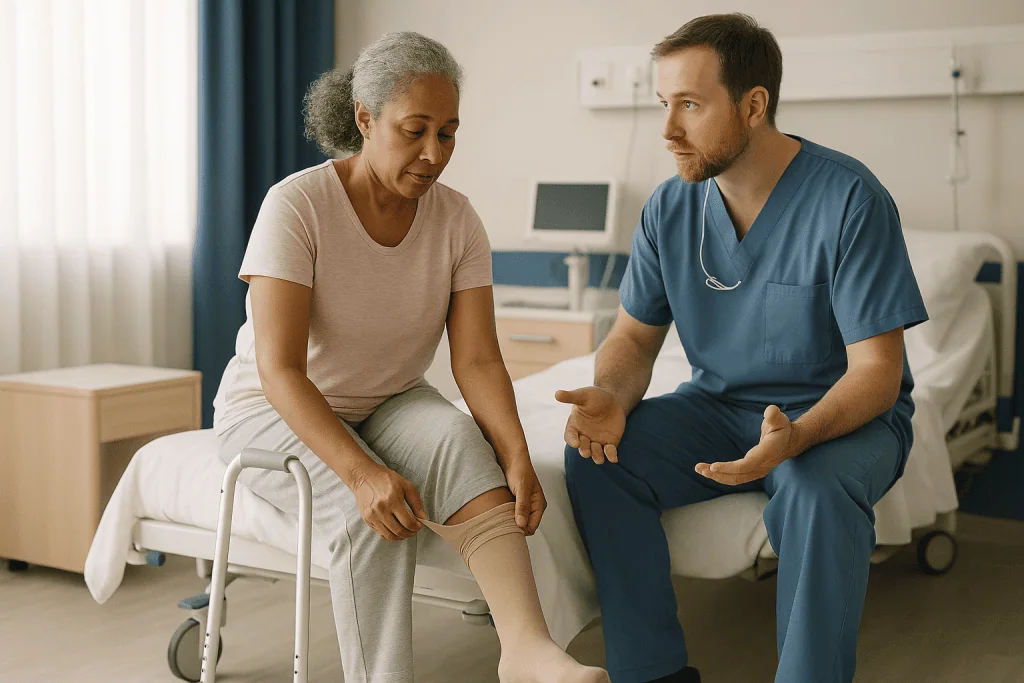
The CDC estimates that up to 900,000 people in the United States are affected by venous clots each year, and that about half of these occur during or soon after a hospital stay or surgery. Orthopedic operations on the hip sit near the top of the risk list, which is why clot prevention is built into every modern hip pathway rather than added as an afterthought.
Prevention has three layers. Movement comes first: calf exercises in bed, standing on the day of or after surgery, and walking short distances early, all of which use the leg muscles as a pump. Mechanical measures come second, including compression stockings and inflatable leg sleeves during the hospital stay. The third layer is medication: anticoagulants, a class of drugs that slow the clotting cascade so clots form less readily. They are usually prescribed for a defined period after surgery. Which agent, how long, and whether one is needed at all are decisions for the surgical team, based on the operation, the patient’s history and bleeding risk.
The NHS lists the classic signs of a DVT as throbbing or cramping pain in one leg, swelling, warm skin and redness or darkened skin around the painful area. A pulmonary embolism announces itself differently: sudden breathlessness, chest pain that worsens on breathing in, coughing up blood, or a racing heart. Any of these after hip surgery is an emergency, not a question for the next follow-up visit.
Nerve irritation after hip surgery: why the outer thigh goes numb
The nerve patients ask about most is one many have never heard of: the lateral femoral cutaneous nerve. It is a purely sensory nerve, meaning it carries feeling but does not move muscle, and it supplies the skin of the front and outer thigh. It passes just inside the bony point at the front of the pelvis, exactly where a PAO incision and the retractors that hold tissue aside do their work.
Irritation of this nerve produces numbness, tingling, burning or a patch of skin that feels like it belongs to someone else, running down the outer thigh toward the knee. Doctors call the syndrome meralgia paresthetica. Because the nerve is sensory only, it does not cause weakness or a limp. It can, however, be surprisingly bothersome: a waistband rubbing the area, or a hand on the thigh, can feel sharp or strange.
Most cases reflect stretching or bruising of the nerve rather than a cut. Stretched nerves recover, but slowly, over weeks to many months, and sensation often returns patchily. A minority of people are left with a permanent numb patch. Surgeons generally counsel that this is a known trade-off of the approach rather than a sign of a technical error.
Other nerves are at lower risk but carry higher stakes. The sciatic nerve, which runs behind the hip and controls much of the lower leg, and the femoral nerve, which powers the thigh muscles, can be stretched during a hip replacement or an osteotomy, particularly when a leg is lengthened. Weakness of the foot or difficulty lifting the knee is therefore treated differently from thigh numbness: it prompts an urgent examination rather than reassurance.
Report any new numbness or weakness at the first post-operative check, and sooner if it is spreading, involves the foot, or comes with severe pain. The team will map the area, document it and decide whether further tests are needed.
Infection, bleeding and wound problems: what patients should know
Every incision is a door, and the body spends the first two weeks after surgery closing it. Infection risk is highest in that window, then falls sharply once the skin has sealed. Surgical teams reduce the risk with antiseptic skin preparation, antibiotics given around the time of the operation, careful handling of tissue and, in the case of replacements, filtered air in the operating room. None of these makes the risk zero.
Superficial infections involve the skin and the fat beneath it. They show up as redness that spreads beyond the incision edge, increasing warmth, new or worsening pain, cloudy or foul-smelling drainage, or a wound that opens. Deep infections reach the bone, the joint or an implant. They may produce fever, chills, a wound that will not stop draining, or pain that escalates rather than settling over the first weeks. Deep infection after a hip replacement is uncommon but consequential, because bacteria can form a film on the implant surface that antibiotics alone struggle to clear.
Bleeding is a separate concern, and it is more relevant to osteotomies than to arthroscopy. Cutting pelvic bone releases blood from the marrow, and pelvic veins are large. Some patients need a transfusion. Bruising that tracks down the thigh and into the groin in the first week is common and usually harmless. A rapidly enlarging, tense, painful swelling is not: it may signal a hematoma, a collection of blood under the skin that sometimes needs draining.
Wound healing also depends on the patient. Smoking, poorly controlled blood sugar, low protein intake and some immune-suppressing medicines all slow it. Cleveland Clinic’s overview of hip dysplasia treatment emphasizes that outcomes depend heavily on following the post-operative plan, and wound care is where that starts: keep the dressing clean and dry as instructed, and resist the urge to inspect by peeling it back early.
Bone healing problems, screws and the question of avascular necrosis
An osteotomy is a controlled fracture. It heals the way any fracture heals: a blood clot forms across the cut, soft cartilage bridges the gap, and bone gradually replaces it over months. When that process stalls, surgeons use two terms. Delayed union means healing is slower than expected. Nonunion means the bone has stopped trying to heal, and the gap has become a false joint that moves and hurts.
After a PAO, the cut through the pubic bone at the front of the pelvis is the one most prone to slow healing, partly because it bears less load and gets less stimulus to knit. Many pubic nonunions cause no symptoms and are simply watched. Painful ones may need bone grafting or additional fixation. Smoking is the strongest modifiable risk factor, which is why so many surgeons make quitting a condition of the operation.
The screws that hold the repositioned socket are meant to stay, but they sit near the surface at the front of the pelvis. In slim patients they can be felt through the skin and may rub against tendons or a waistband. Removal, once the bone has healed, is a minor day procedure. Nobody plans for it, but it is a known second step for a portion of PAO patients.
Avascular necrosis is the risk that worries parents of infants most. The blood supply to the growing ball of the femur is fragile, and forceful reduction or a cast that holds the hip in an extreme position can compromise it. When the bone loses its blood supply, it can soften and deform as the child grows. MedlinePlus lists this as one of the main complications of childhood treatment. Modern practice uses gentler positioning and imaging checks to reduce the risk, and follow-up X-rays through childhood are partly aimed at catching it early.
Hip dysplasia surgery risks in children: what parents ask most
Parents tend to ask three things: will the anesthesia be safe, will the cast be unbearable, and will the hip grow normally afterward. The first two have reassuring answers; the third has an honest one.
Modern pediatric anesthesia is delivered by teams who do nothing else, with monitoring tailored to a small body. The risks are real but rare, and they are discussed at the pre-operative visit. Children with breathing infections on the day of surgery are often postponed, which is frustrating for families but lowers the chance of airway problems.
The spica cast is the part of the pathway families remember. It encases the trunk and one or both legs for weeks, is changed under anesthesia when the child grows, and turns diapering, car seats and sleep into engineering problems. Skin irritation under the edges, moisture and odor are the everyday complications. A child who suddenly becomes inconsolable, develops a fever, or has toes that turn pale, cold or swollen needs a same-day call, because a cast that has become too tight can compress skin, nerves or blood vessels.
The long-term question is about growth. A hip that is reduced and held early usually remodels well, because a young socket deepens around a centered ball. The younger the child at treatment, the more growth remains to do that work. Risks include the hip slipping out again, stiffness, a leg-length difference, and the avascular necrosis discussed above. The NHS notes that developmental dysplasia affects around 1 to 2 in every 1,000 babies and that early treatment is associated with better outcomes, which is the entire logic behind newborn hip screening.
What parents can control is attendance. Follow-up imaging continues for years, sometimes until the child stops growing, because a hip that looks perfect at two can drift at eight. Keeping those appointments is the single most useful thing a family can do.
Which hip dysplasia operation carries which risks? A side-by-side view
Risk conversations go better when everyone is talking about the same operation. The table below groups the main procedures by the concerns that come up most often. It is a map, not a forecast: individual risk depends on age, anatomy, other health conditions and the specifics of the surgery, and only the treating team can weigh those for a particular person.
| Procedure | Typical patient | Frequently discussed risks | Warning signs to report |
|---|---|---|---|
| Closed or open reduction with spica cast | Infants and toddlers when a harness has not held the hip | Hip slipping out again, stiffness, cast skin problems, loss of blood supply to the femoral head | Inconsolable crying, fever, pale or swollen toes, foul cast odor |
| Pelvic or femoral osteotomy | Older children whose socket has not deepened | Slow bone healing, leg-length difference, hardware irritation, infection | Fever, wound drainage, new limp after initial recovery |
| Periacetabular osteotomy (PAO) | Adolescents and adults with a shallow socket and healthy cartilage | Outer-thigh numbness, blood clots, bleeding, pubic nonunion, screw irritation | Calf swelling, chest pain, spreading numbness, escalating pain |
| Hip arthroscopy | Adults with a labral tear, often alongside or after a PAO | Temporary groin or foot numbness from traction, fluid swelling, stiffness | Numbness lasting beyond days, worsening groin pain |
| Total hip replacement | Adults with established arthritis from dysplasia | Blood clots, infection, dislocation, leg-length difference, nerve stretch | Sudden inability to bear weight, leg turned outward, fever |
Two patterns stand out. Blood clots and infection appear in every adult row, which is why prevention for both is standard regardless of the operation. Nerve irritation clusters in the PAO and replacement rows, tied to the incision path and any lengthening of the leg. The pediatric rows carry a risk adults never face: the joint is still growing, and the treatment must protect that growth as much as it corrects the shape.
What is the best age for hip dysplasia surgery?
There is no single best age, because there is no single hip dysplasia. The right timing depends on what the hip looks like now and how much growth or cartilage remains.
In infancy, the answer leans toward “early, and ideally without surgery.” A newborn socket is mostly cartilage and remodels rapidly around a centered ball, which is why a harness works so well in the first months. When surgery is needed, most pediatric surgeons prefer to reduce the hip before the child is walking and bearing full weight on it. The NHS guidance on developmental dysplasia is explicit that outcomes are generally better when treatment starts early.
In childhood, the calculus shifts to the socket’s remaining ability to deepen. A five-year-old with a hip that has never been fully covered may benefit from an osteotomy that gives the socket a better start while growth is still available to refine it.
For adolescents and adults, age matters less than cartilage. A PAO is designed to protect a joint that still has something to protect. A 19-year-old with early wear and a 42-year-old with pristine cartilage may both be reasonable candidates; a 30-year-old with bone-on-bone arthritis is not, however young. Mayo Clinic describes hip dysplasia as a leading cause of hip arthritis in younger adults, and the goal of adult reshaping surgery is precisely to intercept that path.
Once arthritis is established, replacement becomes the relevant operation, and here age enters again through a different door. Implants wear, and a joint replaced at 35 may need revision decades later. Surgeons therefore weigh how limiting the symptoms are now against the likelihood of a second operation in the future, a conversation that has no formula and a great deal of judgment.
Untreated hip dysplasia in adults: what tends to happen without surgery
Understanding what surgery prevents is part of understanding its risks. A shallow socket does not hurt because it is shallow. It hurts because the rim carries too much load, the labrum tears, and the cartilage at the edge thins. Untreated hip dysplasia in adults follows a fairly recognizable course, though the pace varies enormously.
Early on, people describe a deep ache in the groin or the side of the hip after long walks, running or sitting with the hips flexed. Clicking, catching or a sense that the hip might give way is common when the labrum is torn. Many adults are told for years that they have a groin strain or bursitis before an X-ray reveals the socket.
Left alone, the mechanics do not change, so the wear continues. Cleveland Clinic and Mayo Clinic both describe the main long-term consequence as osteoarthritis, often arriving decades earlier than it would in a normally shaped hip. As cartilage thins, pain becomes more constant, range of motion shrinks, and a limp may appear. The muscles around the hip weaken from disuse, and the other hip and the lower back begin to compensate.
That is the alternative against which surgical risk is weighed. It is also why “wait and see” is not risk-free. Waiting carries the near-certainty of ongoing wear in a symptomatic dysplastic hip, and it may close the window for a reshaping operation, leaving replacement as the only option. None of this means every adult with a shallow socket needs an operation; many with mild dysplasia and mild symptoms do well with strengthening, activity modification and periodic imaging. It does mean the decision is a comparison between two sets of risks, not a choice between risk and safety.
Periacetabular osteotomy recovery: what the first days and weeks usually look like
Timelines below are typical ranges drawn from the mainstream patient guidance cited in this article, not promises. Individual recovery varies with age, the exact procedure and how the bone heals.
The hospital stay for a PAO usually lasts several days. The first goals are unglamorous: pain controlled well enough to sit up, a first walk with crutches or a walker, bladder and bowel function returning, and the wound checked. Clot prevention starts immediately, with leg exercises, compression and often an anticoagulant prescribed by the team.
Weeks one to six are about protected weight-bearing. The repositioned socket is held by screws, not by healed bone, so most surgeons limit how much weight goes through the leg while the cuts knit. Crutches are constant companions. Fatigue is striking; the body is building bone, and patients are often surprised by how much they sleep. Outer-thigh numbness, if present, is usually noticed in this period. Bruising fades, swelling settles, and the first follow-up X-ray confirms the screws and the socket position.
Somewhere between six weeks and three months, depending on imaging, weight-bearing is advanced and physical therapy shifts from gentle range of motion to strengthening. Walking without aids typically follows once the surgeon is satisfied the bone has healed enough. Return to desk work, driving and low-impact exercise is negotiated case by case.
Mayo Clinic’s guidance on hip replacement, the other major adult operation, describes a broadly similar arc: early walking with support, physical therapy over weeks, and a gradual return to normal activity over a period of months. The difference is that a replacement is stable from day one, so weight-bearing restrictions are usually lighter, while dislocation precautions take their place.
Full recovery from either operation, measured as strength and confidence rather than X-rays, is commonly described in months rather than weeks.
Is hip dysplasia surgery worth it? Weighing risk against the alternative
“Worth it” is a personal calculation, and the most useful thing a writer can do is lay out the terms honestly rather than answer for the reader.
On one side sits a defined set of risks, most of them uncommon, a few of them serious, nearly all of them front-loaded into the first weeks. On the other sits the natural course of a symptomatic dysplastic hip described above: continued wear, the likelihood of early arthritis, and for younger adults, the prospect of a replacement that may itself need redoing later in life.
People also ask about the hip dysplasia surgery success rate, and here the honest answer is that no single figure exists. Published outcomes vary with the operation, the age of the patient, how much cartilage was left, the surgeon’s experience and how long patients were followed. A number quoted without those qualifiers is not information; it is marketing. What the mainstream guidance does support is that early treatment in infancy is associated with better hip development, and that reshaping surgery in adults is aimed at delaying or preventing arthritis in hips that still have healthy cartilage. Those are statements about direction, not guarantees about any individual.
Three questions tend to clarify the decision. How much is the hip limiting daily life now, not just sport? What does the imaging say about the cartilage, and therefore about which operations are realistically on the table? And what does the surgeon expect to happen over the next five years without surgery?
For the runner in the waiting room, the answer may be yes, because she has decades of joint life to protect. For someone with mild symptoms and mild dysplasia, the answer may be a structured trial of physical therapy first. Both are reasonable, and both belong to the patient and the treating team.
What people often get wrong about hip dysplasia surgery risks
Myth: numbness on the thigh means the surgeon damaged a nerve. Usually it means a sensory nerve was stretched or bruised by retraction, an expected consequence of the approach. It tends to improve over months, and it does not affect strength or walking. Weakness is the sign that warrants concern, not numbness.
Myth: blood clots only happen in the hospital. The CDC notes that about half of venous clots occur during or soon after a hospital stay or surgery, and “soon after” includes the weeks at home when walking drops and long stretches on the sofa become the norm. Prevention continues after discharge for exactly this reason.
Myth: a PAO is a hip replacement. It is the opposite. A replacement removes the joint; a PAO keeps it and moves the socket. The operations suit different stages of the same condition, and their risks, recoveries and long-term questions differ.
Myth: if the baby’s hip was fixed, the problem is over. Childhood treatment sets the hip on a better path, but growth continues for years, and follow-up imaging exists because a small proportion of hips drift or show late blood-supply changes. Skipping those appointments is where otherwise good outcomes are lost.
Myth: untreated dysplasia is harmless if it does not hurt. Mild dysplasia can indeed sit quietly for a lifetime, but a symptomatic dysplastic hip is a joint under abnormal load, and the mainstream guidance consistently identifies early arthritis as the expected consequence.
Myth: a surgeon who lists many risks is a nervous surgeon. A surgeon who lists many risks is doing informed consent properly. The list is long because the operation is significant, not because the odds are poor.
Myth: complications mean the surgery failed. Many complications, from thigh numbness to a screw that needs removing, occur in hips that go on to do exactly what the operation set out to do.
Questions to ask your care team before hip dysplasia surgery
A good consultation is a conversation, and the questions below are meant to open one rather than test anyone. Bring a written list; most people forget half of theirs once they are in the room.
- Which operation are you recommending for my hip, and what did you see on the imaging that led you there rather than to the alternatives?
- How much cartilage is left, and how does that affect what you expect the surgery to achieve over the next five to ten years?
- What is your plan for preventing blood clots, in hospital and after I go home, and what signs should send me to emergency care?
- Which nerves are near the incision, what sensation changes should I expect, and which changes would you want to hear about urgently?
- How will I know the difference between normal post-operative pain and pain that signals a problem?
- How long do you expect me to be on crutches or restricted weight-bearing, and what will you look for on X-rays before advancing me?
- Are there things I should change before surgery, such as smoking, weight, blood sugar control or certain medicines, that would lower my risk? (Never stop or change a prescribed medicine without the prescriber’s guidance.)
- Will the screws or plates stay in permanently, and how often do patients like me need them removed?
- For a child: how many cast changes are likely, how will you check the blood supply to the femoral head, and how long will follow-up imaging continue?
- Who do I call after hours if something worries me, and what number should I use?
Ask, too, what would make the surgeon decide not to operate. The answer tells you how the team thinks about the trade-offs, and it often reveals what they consider the most important risk in your particular case.
When to call your doctor after hip dysplasia surgery
Most recoveries are uneventful, and most calls to the surgical team end with reassurance. Make the call anyway. Teams would far rather hear about a symptom that turns out to be nothing than miss one that turns out to be a clot or an infection. The signs below are grouped by urgency.
Call emergency services or go to the nearest emergency department now for sudden breathlessness, chest pain that worsens when breathing in, coughing up blood, fainting, a racing or irregular heartbeat, new weakness or inability to move the foot or lift the leg, or a hip that suddenly will not bear weight and looks or feels out of place.
Call the surgical team the same day for new swelling, pain, warmth or color change in one calf or thigh; fever or chills; redness spreading beyond the incision edges; wound drainage that is cloudy, bloody in increasing amounts or foul-smelling; a wound that has opened; a rapidly enlarging, tense swelling under the skin; numbness or tingling that is spreading or now involves the foot; pain that is escalating despite the prescribed plan; or an inability to pass urine.
For a child in a spica cast, call the same day if the child is inconsolable or unusually drowsy, has a fever, has toes that look pale, blue, cold or swollen, cannot move the toes, has a foul odor or wet patch on the cast, or if the cast has cracked, softened or shifted.
Mention at the next scheduled visit any persistent thigh numbness that is stable rather than spreading, screws that can be felt through the skin, a clicking sensation, or worries about how the recovery compares with what was described.
Keep the team’s after-hours number somewhere visible, and do not let embarrassment about a false alarm delay a call. Every decision about tests and treatment sits with the clinicians who know your hip; your job is simply to give them the information early.
Frequently asked questions
Is hip dysplasia surgery worth it?
It depends on how much the hip limits your life and how much healthy cartilage remains. Surgery carries defined, mostly uncommon risks that cluster in the first weeks; leaving a symptomatic dysplastic hip alone carries the likelihood of continued wear and early arthritis. For younger adults with intact cartilage the balance often favors reshaping surgery, while mild dysplasia with mild symptoms may be managed with therapy first. The decision belongs with you and your treating team.
What is the best age for hip dysplasia surgery?
There is no single best age. In infants, early treatment is associated with better hip development, and most start with a harness rather than surgery. In children, timing depends on remaining growth. In adolescents and adults, the deciding factor is cartilage rather than birthdays: reshaping surgery suits hips with healthy cartilage, while established arthritis points toward replacement. Your surgeon weighs imaging, symptoms and growth or age together.
What are the symptoms of untreated hip dysplasia in adults?
Common features include a deep ache in the groin or side of the hip after activity or prolonged sitting, clicking or catching from a torn labrum, a feeling that the hip might give way, and gradually reducing range of motion. Over time the pattern progresses toward osteoarthritis, with more constant pain and a limp. Only imaging can confirm dysplasia, so persistent hip or groin pain should be assessed by a clinician.
What is the hip dysplasia surgery success rate?
No single success rate exists in mainstream guidance because the term covers several operations performed across all ages. Reported outcomes vary with the procedure, the patient’s age, how much cartilage remained, surgeon experience and follow-up length. Early childhood treatment is associated with better hip development, and adult reshaping surgery aims to delay or prevent arthritis in suitable hips. Ask your surgeon what they expect for your specific situation rather than relying on a general figure.
How likely are blood clots after hip surgery?
Hip operations sit near the top of the surgical clot-risk list, which is why prevention through early walking, compression and often anticoagulant medication is standard. The CDC notes that around half of venous clots occur during or soon after a hospital stay or surgery, so the weeks at home matter. Report one-sided calf swelling, pain or warmth the same day, and treat sudden breathlessness or chest pain as an emergency.
Why is my outer thigh numb after periacetabular osteotomy?
The lateral femoral cutaneous nerve, which supplies feeling to the front and outer thigh, runs directly through the area where the incision and retractors sit. Stretching or bruising it causes numbness, tingling or burning known as meralgia paresthetica. Because the nerve carries sensation only, it does not weaken the leg. Most cases improve over months, though some leave a permanent numb patch. Spreading numbness or any weakness should be reported promptly.
How long does periacetabular osteotomy recovery take?
Typical pathways involve a hospital stay of several days, protected weight-bearing on crutches for roughly the first six weeks while the bone cuts begin to knit, then advancing weight-bearing and strengthening once X-rays show adequate healing, often between six weeks and three months. Full recovery of strength and confidence is usually described in months. These are ranges from mainstream patient guidance, not promises; your surgeon sets your timeline.
What are the risks of hip dysplasia surgery for babies?
The main concerns are the hip slipping out again, stiffness, cast-related skin problems and loss of blood supply to the growing femoral head, a complication listed in mainstream pediatric guidance. Anesthesia risks are real but rare. Families should call the same day for a fever, inconsolable crying, or toes that turn pale, cold or swollen inside a spica cast. Long-term follow-up imaging is essential to catch late changes.
Can hip dysplasia be treated without surgery?
Often, yes. Most infants with a shallow socket are managed with a Pavlik harness worn for around 6 to 12 weeks, and surgery is reserved for hips that do not respond or are diagnosed later. In adults with mild dysplasia and mild symptoms, physical therapy, activity modification and periodic imaging may be appropriate. Whether a nonsurgical path is reasonable depends on the hip’s stability and cartilage, which the treating team assesses.
What signs after hip surgery should I report immediately?
Go to emergency care for sudden breathlessness, chest pain on breathing in, coughing up blood, fainting, new foot or leg weakness, or a hip that suddenly cannot bear weight. Call the surgical team the same day for one-sided calf swelling or pain, fever, spreading redness or drainage at the wound, a rapidly growing tense swelling, spreading numbness, or escalating pain. Never let fear of a false alarm delay the call.
References
- NHS: Developmental dysplasia of the hip
- MedlinePlus: Developmental dysplasia of the hip
- Cleveland Clinic: Hip dysplasia
- CDC: About venous thromboembolism (blood clots)
This article is for general information only and is not a substitute for professional medical advice. Please consult a qualified doctor about your individual situation.

More from the Blog

How a Pavlik Harness Keeps Your Baby’s Hips in Place So the Socket Can Deepen
A Pavlik harness works by holding a baby's hips bent up and gently spread apart, so the ball at the top of each thigh…

Shoulder Replacement Recovery: Timeline, Sling Life and Real Milestones
Most people wear a sling for about two to six weeks after shoulder replacement, regain everyday reach by three months, and see strength keep…
What to Ask Your Surgeon Before Hip Replacement: Approach, Implant Type and Rehab Plan
Before hip replacement, ask your surgeon which surgical approach they use and why, what implant type and bearing surface they plan (cemented or uncemented,…

First Signs of Arthritis in the Fingers, and How Arthritis Is Tested
The first signs of arthritis in the fingers are usually subtle: stiffness on waking or after gripping something, aching or tenderness in a knuckle,…

Blood Thinners and Compression Stockings After Robotic Hip Replacement: Why Both Matter
Blood thinners after hip replacement are standard because surgery on the hip, combined with days of reduced movement, sharply raises the chance of a…

Knee Replacement Surgery Cost: What Determines the Price at Home and Abroad
For international patients, our guide range for a total knee replacement is EUR 7,800-16,250, covering surgeon, implant, hospital stay and early rehabilitation. The same…