

Hormonal Acne: The Jawline Pattern, the Hormones Behind It and the Treatments With Evidence

Key Takeaways
- Hormonal acne clusters on the lower third of the face, favors deep tender nodules over blackheads and often flares 7–10 days before a period, when estrogen falls and androgens gain relative influence.
- Most women with the jawline pattern have normal blood hormone levels; the skin's local conversion of testosterone to DHT inside sebaceous glands explains why testing is reserved for those with irregular periods, hirsutism or hair thinning.
- The 2023 SAFA trial of 410 women found 82% on spironolactone reported improved acne at 24 weeks versus 63% on placebo, the first large randomized evidence for a medicine dermatologists had used off-label for decades.
- Clascoterone cream, approved in 2020 for ages 12 and up, is the only anti-androgen acne treatment available to men and adolescent boys, with two phase 3 trials roughly doubling clear-skin rates against vehicle.
- Combined oral contraceptives reduce acne lesions in a Cochrane review of more than 30 randomized trials, but benefit takes three or more cycles and progestin-only methods can worsen acne.
- Diet evidence is observational for dairy and moderate for low-glycemic eating, while spearmint tea, DIM and hormone-balancing supplements have no acne randomized trials at all.
Hormonal acne is adult acne driven by the skin's response to androgens, typically appearing as deep, tender bumps along the jawline, chin and neck that flare before a period. Blood hormone levels are usually normal. Treatments with randomized-trial evidence include topical retinoids, benzoyl peroxide, combined oral contraceptives, the topical anti-androgen clascoterone and, for many women, oral spironolactone, all prescribed and monitored by a clinician.
She is 34, has a demanding job and a skincare shelf that would impress a dermatology resident, and every month, about a week before her period, two or three hard, painful bumps surface along her jaw like clockwork. She never had acne at 16. Now she does, and the internet has a name for it, a dozen viral explanations and at least one tea.
Hormonal acne is trending for a reason. Short videos about spironolactone, “hormone balancing” protocols and dairy-free challenges rack up tens of millions of views, while doctors have quietly gained firmer ground: the first large publicly funded placebo-controlled trial of spironolactone for women’s acne was published in 2023, and clascoterone, the first topical medicine that blocks androgen receptors in the skin, has been available since its 2020 approval. As of this writing in 2025, the gap between what the algorithm says and what the trials show has rarely been wider.
This piece walks the jawline pattern back to its mechanism, grades every popular treatment by the strength of its evidence, and is honest about what nobody knows yet.
What changed recently in hormonal acne research and treatment
Three dated developments explain why clinicians talk about hormonal acne differently than they did five years ago.
In August 2020, the US Food and Drug Administration approved clascoterone cream (Winlevi) for acne in people aged 12 and older. It was the first topical medicine designed to block androgen receptors directly in the skin. Androgens are the family of hormones, including testosterone, that switch on oil production. Until then, every anti-androgen approach for acne was a pill taken by mouth and limited to women. Mayo Clinic now lists clascoterone among its acne treatment options.
In May 2023, the BMJ published the SAFA trial, a double-blind, placebo-controlled study of 410 women with persistent facial acne across England and Wales. It was the first adequately sized randomized trial of spironolactone, a blood-pressure medicine with anti-androgen effects that dermatologists had prescribed for acne for decades on the strength of small studies and clinical experience. The trial confirmed a meaningful benefit, discussed in detail below.
The third shift was cultural rather than scientific. Search interest in hormonal acne climbed as creators began sharing before-and-after spironolactone stories alongside unproven claims: that spearmint tea works the same way, that cutting dairy clears the jawline in a month, that a supplement stack can “rebalance” hormones. Some of these ideas have a thread of plausibility; most have no acne trials behind them.
Mainstream guidance has absorbed the first two developments. Mayo Clinic’s current treatment page describes spironolactone as an option for women when other treatments have not worked, and lists topical and oral retinoids, benzoyl peroxide and combined oral contraceptives as established therapies. The viral layer is what this article sets out to sort.
How do I tell if my acne is hormonal? The jawline pattern
There is no blood test that stamps acne as hormonal. Every case of acne involves hormones, because androgens are what turn on sebaceous glands in the first place. The phrase “hormonal acne” describes a recognizable pattern, and most dermatologists look for a cluster of five clues.
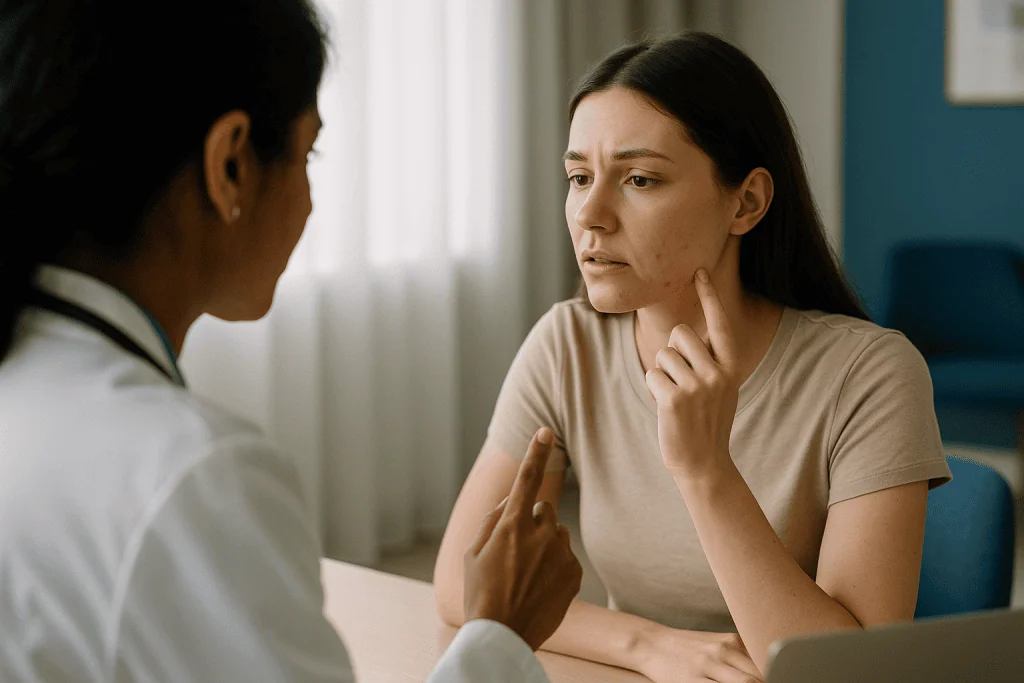
Location comes first. Hormonal acne concentrates on the lower third of the face: the jawline, the chin, around the mouth and down the sides of the neck. Teenage acne tends to crowd the T-zone, the forehead and nose, where oil glands are most numerous.
Lesion type is the second clue. Rather than a scatter of blackheads and whiteheads, the hormonal pattern favors deep, tender, inflamed nodules that sit under the skin for days or weeks and rarely come to a head. Cleveland Clinic describes these as cysts and nodules that can be painful to the touch.
Timing is the third. Many women notice a flare 7–10 days before menstruation, easing once bleeding starts. Mayo Clinic notes that hormonal changes before a period are a common acne trigger in women.
Age is the fourth. The pattern often begins or persists after 25, sometimes appearing for the first time in the 30s or 40s.
Response to treatment is the fifth. Standard topicals that handle comedonal acne, the blackhead-and-whitehead kind, may do little for deep jawline nodules.
A few points of caution. Men get androgen-driven acne too, though the cyclical pattern is specific to menstruating women. Acne around the mouth can also be perioral dermatitis, a separate rash that worsens with steroid creams, so a persistent cluster there deserves a clinical look rather than a self-diagnosis.
Which hormones actually drive hormonal acne?
Acne forms through a four-step cascade, and hormones control the first two steps.
Step one is sebum. Sebum is the oily substance made by sebaceous glands attached to each hair follicle. Androgens bind to receptors on those glands and increase both the size of the gland and the amount of oil it makes. Step two is hyperkeratinization, a plain word for dead skin cells becoming sticky and failing to shed, which plugs the follicle. Androgens accelerate that too. Step three is bacterial: Cutibacterium acnes, a normally harmless skin resident, thrives in the oxygen-poor, oil-rich plug. Step four is inflammation, the immune response that produces the red, swollen bump.
Testosterone is the best-known androgen, but inside the sebaceous gland an enzyme called 5-alpha reductase converts it into dihydrotestosterone (DHT), a more potent version. Skin can be exquisitely sensitive to DHT even when blood testosterone is entirely normal. That explains the finding, repeated across studies, that most women with the jawline pattern have unremarkable hormone panels. The problem is often local sensitivity, not a systemic surplus.
Estrogen plays defense. It suppresses sebum production and raises sex hormone-binding globulin, a protein that mops up free testosterone. Across the menstrual cycle, estrogen peaks mid-cycle and falls in the final week, while androgen levels stay comparatively steady. The result is a relative androgen dominance in the days before a period, which is why the flare arrives when it does.
Two other hormones amplify the system. Insulin and insulin-like growth factor 1 (IGF-1), a growth hormone that rises with high-glycemic eating, stimulate ovarian androgen production and act on sebaceous glands directly. Cortisol, the stress hormone, nudges oil output upward as well. None of this means hormones are “out of balance” in a way a supplement could correct; it means the skin is reading ordinary signals loudly.
Why adult acne shows up after 25, and sometimes after 40
Adult acne is common enough that calling it unusual is itself a myth. Cleveland Clinic cites surveys suggesting that roughly half of women in their 20s and about a quarter of women in their 40s experience acne. Two groups make up those numbers: people whose teenage acne never fully left, and a smaller group whose acne arrived for the first time in adulthood.

Several life transitions reliably unmask the hormonal pattern. Stopping a combined oral contraceptive removes a steady estrogen supply and lets natural androgen signaling resume, and breakouts often follow within a few months. Pregnancy and the postpartum period reshuffle hormones dramatically. Perimenopause, the years before periods stop, brings falling estrogen while androgen production declines more slowly, which can tip the ratio toward oilier, breakout-prone skin even in women who had clear skin for decades.
Medicines matter. Corticosteroids, lithium, anabolic steroids and testosterone therapy can all provoke acne, and Mayo Clinic lists several drug classes as triggers. Some progestin-only contraceptives, including certain implants and hormonal intrauterine devices, carry progestins with mild androgenic activity that can worsen acne in susceptible people. None of this is a reason to change a method on your own; it is information to bring to the prescriber.
Adult skin also behaves differently. Cell turnover slows with age, so inflammation lingers and the dark or red marks left behind, known as post-inflammatory hyperpigmentation, fade more slowly than they did at 17. Adults are also more likely to layer cosmetics, hair products and “anti-aging” actives that can irritate or occlude follicles.
Harvard Health frames adult acne as a chronic condition to be managed rather than a phase to outgrow, and that framing matters for expectations. Most effective treatments take 8–12 weeks to show their full effect, and many need to continue to hold the gains.
What are the 5 signs of hormonal imbalance a doctor looks for alongside acne?
The search phrase “5 signs of hormonal imbalance” is popular, and it deserves a careful answer. Acne on its own, even in the classic jawline distribution, is not evidence of a hormone disorder. What prompts a clinician to order blood tests is acne appearing together with other signs that androgens are elevated in the body, a state called hyperandrogenism. Five features carry the most weight.
Irregular or absent periods. Cycles consistently longer than 35 days, fewer than nine periods a year, or periods that stop altogether suggest ovulation is disrupted.
Excess coarse hair in a male pattern. Called hirsutism, this means dark, thick hair on the upper lip, chin, chest, lower abdomen or inner thighs, not the fine hair everyone has.
Thinning scalp hair at the crown or temples, sometimes called female-pattern hair loss, which can share an androgen driver with acne.
Darkened, velvety skin in body folds such as the neck or armpits, known as acanthosis nigricans. It signals insulin resistance, a state in which the body needs more insulin to move sugar into cells, and insulin resistance raises androgen production.
Sudden, severe acne in an adult with no prior history, especially with rapid weight change, a deepening voice or enlarged muscle mass. This combination is rare but can point to an androgen-producing tumor of the ovary or adrenal gland and warrants prompt evaluation.
When these signs are present, typical tests include total and free testosterone, DHEA-S (an adrenal androgen), 17-hydroxyprogesterone to check for a mild form of congenital adrenal hyperplasia, prolactin and thyroid function. When none of them are present, guidelines and mainstream references, including Cleveland Clinic, generally do not recommend routine hormone testing, because the results are usually normal and do not change treatment.
Does hormonal acne mean I have PCOS?
Not by itself. Polycystic ovary syndrome (PCOS) is the most common hormonal condition in women of reproductive age, and acne is one of its possible features, but the two are far from interchangeable.
PCOS is diagnosed when at least two of three criteria are met: infrequent or absent ovulation, usually seen as irregular periods; signs of excess androgens, either on examination (acne, hirsutism, hair thinning) or on blood tests; and ovaries with many small follicles on ultrasound. Johns Hopkins Medicine notes that other conditions with similar features, such as thyroid disease or elevated prolactin, must be ruled out first. Because acne is only one of several ways to satisfy one of three criteria, a woman with regular cycles, no excess hair and normal blood tests does not meet the definition, no matter how stubborn her jawline is.
The overlap is real, though. Many women with PCOS have persistent, treatment-resistant acne, often alongside oily skin, and insulin resistance in PCOS feeds the androgen signal through IGF-1. For that reason, a woman with cyclical jawline acne who also reports cycles longer than 35 days, difficulty conceiving or new coarse facial hair should raise PCOS with her doctor.
Diagnosis changes the conversation in useful ways. PCOS carries long-term considerations beyond skin, including higher rates of type 2 diabetes and cardiovascular risk factors, so management is coordinated by a primary care clinician, gynecologist or endocrinologist rather than treated as a skin problem alone. Lifestyle approaches that improve insulin sensitivity, combined hormonal contraception to regulate cycles and lower androgens, and anti-androgen medicines may all be discussed. Which of these is appropriate, and in what order, depends on whether pregnancy is planned, on other health conditions and on personal priorities, and those decisions belong to the woman and her clinician together.
What food triggers hormonal acne? What the diet studies show
Diet is where viral advice and evidence drift furthest apart. The honest summary: there are consistent observational signals for two dietary patterns, a handful of small trials, and nothing that justifies the sweeping elimination diets circulating online.
High-glycemic-load eating has the most support. Foods that raise blood sugar quickly, such as white bread, sugary drinks and many ultra-processed snacks, drive insulin and IGF-1, the growth factor that pushes androgen production and sebum. A few small randomized trials of low-glycemic-load diets, lasting 10–12 weeks, reported fewer inflammatory lesions compared with control diets. The trials were small, hard to blind and short, so the evidence is graded as moderate at best. Mayo Clinic lists high-carbohydrate foods as a possible trigger while noting more study is needed.
Dairy, especially skim milk, is the second signal. Large observational studies, mostly in teenagers and young adults, have linked higher milk intake to more acne, with skim milk showing a stronger association than whole milk. The proposed mechanisms involve milk’s hormonal content and its effect on IGF-1. Observational data cannot prove cause, and cheese and yogurt show weaker or no associations. Whey protein supplements, a concentrated milk derivative, appear in case series as a trigger of sudden truncal and facial acne.
Chocolate remains inconclusive; studies conflict and often cannot separate cocoa from sugar. Fatty foods, long blamed, have no good evidence against them. Omega-3 fats and zinc have small trials suggesting modest benefit, not enough to recommend over established treatment.
A practical reading: if you notice a reliable flare after a specific food, a short, deliberate trial of reducing it is reasonable. Cutting out whole food groups indefinitely on the strength of a video is not, particularly for people with a history of disordered eating. NHS guidance states plainly that there is little evidence diet causes acne.
What the evidence actually says: grading the treatments for hormonal acne
Evidence comes in grades, and the grade should shape how confident anyone sounds. Randomized controlled trials, in which participants are assigned by chance to treatment or placebo, sit at the top. Observational studies, which track what people already do, can reveal associations but not cause. Expert opinion fills the gaps.
Strong randomized-trial evidence supports the conventional backbone of acne care: topical retinoids such as adapalene and tretinoin, benzoyl peroxide and, for severe or scarring disease, oral isotretinoin. Multiple randomized trials, synthesized in Cochrane reviews, show that combined oral contraceptives reduce both inflammatory and non-inflammatory lesions compared with placebo, with benefits emerging over three or more cycles. Clascoterone rests on two large phase 3 randomized trials involving roughly 1,400 participants. Spironolactone now has one large, well-designed trial, the 2023 SAFA study, on top of decades of smaller studies and clinical experience.
Moderate evidence covers low-glycemic-load diets, discussed above, and oral antibiotics such as doxycycline for inflammatory acne, which work but are limited to short courses because of resistance concerns and are not considered a hormonal therapy at all.
Weak or absent evidence is where most viral content lives. Spearmint tea has two small studies in women with PCOS showing reduced free testosterone and self-reported hirsutism; neither measured acne. Diindolylmethane (DIM), inositol, “hormone-balancing” supplement blends, probiotics for skin and sugar detoxes have no acne randomized trials of meaningful size. The NIH Office of Dietary Supplements notes that supplements are not reviewed for effectiveness before sale.
Expert opinion governs sequencing: which treatment first, when to add a second and when to escalate. That is where a clinician earns their keep, matching the evidence to a particular person’s skin, cycle, medical history and plans for pregnancy.
Spironolactone for hormonal acne: what the SAFA trial found
Spironolactone is a diuretic developed in the 1950s to treat high blood pressure and fluid retention. It also blocks androgen receptors and reduces androgen production, which is why dermatologists began using it for women’s acne decades ago. In the United States it is not approved by the FDA for acne, so this use is off-label, meaning prescribed for a purpose outside the licensed indication. Off-label prescribing is legal and common; the question is whether evidence supports it.
Until 2023 the answer was “probably, but the trials were tiny.” The SAFA trial changed that. Researchers randomized 410 women aged 18 and older with facial acne lasting at least six months to spironolactone or an identical placebo for 24 weeks, alongside their usual topical treatment. The primary measure was a validated acne quality-of-life score at 12 weeks.
Spironolactone beat placebo at 12 weeks, and the gap widened by 24 weeks. On the participants’ own global assessment, 82% in the spironolactone group reported their acne had improved at 24 weeks compared with 63% on placebo. Headache was reported more often with the active drug, and a small number of women experienced menstrual irregularity, breast tenderness or dizziness, all known effects of the medicine. Serious adverse events were rare and similar between groups.
The results are strong but have boundaries. The trial enrolled only women, and spironolactone is generally not used for acne in men because it can cause enlarged male breast tissue (gynecomastia) and reduced libido. It must not be taken in pregnancy, because anti-androgens can affect development of a male fetus, so reliable contraception is part of the conversation. Blood potassium monitoring is advised for some patients. Doses, duration and whether it is the right choice at all are decisions for the prescribing clinician, who weighs it against alternatives such as a combined pill or clascoterone.
Clascoterone: the first topical anti-androgen, and who it suits
For decades the only way to turn down the androgen signal in acne was to change hormone levels across the whole body. Clascoterone (Winlevi) works differently. Applied as a cream, it competes with DHT for androgen receptors in the sebaceous gland, dampening oil production and inflammation where they start. Because it is broken down rapidly once it enters the bloodstream, it does not produce the body-wide hormonal effects of oral anti-androgens.
That mechanism matters for who can use it. The FDA approved clascoterone in 2020 for acne in males and females aged 12 and older. Men and adolescent boys, who cannot take spironolactone or combined oral contraceptives for acne, finally have an anti-androgen option. Women who cannot or prefer not to use hormonal pills have one as well.
The evidence is randomized-trial grade. Two identically designed phase 3 trials enrolled roughly 1,400 people with moderate to severe facial acne and compared the cream with its vehicle, meaning the same cream without the active ingredient. At 12 weeks, the proportion achieving treatment success, defined as clear or almost clear skin with a meaningful drop in lesion count, was roughly double in the clascoterone groups. The absolute numbers were modest, in the range of one in five, which is typical for a single acne medicine used alone. Lesion counts fell significantly compared with vehicle. Side effects were mostly mild local irritation, with rare reports of changes in cortisol regulation in extended-use safety studies.
Two caveats are worth stating. Head-to-head trials against retinoids, benzoyl peroxide or spironolactone have not been published, so no one can say it is better than older options; it is an addition, not a replacement. And in practice it is usually combined with a retinoid or benzoyl peroxide, a decision for the prescribing dermatologist based on skin type and acne severity.
Do birth control pills help hormonal acne?
Combined oral contraceptives, pills containing both an estrogen and a progestin, are among the best-studied hormonal treatments for acne and the only ones with FDA approval specifically for that purpose in the United States. Several formulations carry an acne indication, including those pairing ethinyl estradiol with norgestimate, norethindrone acetate or drospirenone.
They work through the estrogen described earlier. Estrogen suppresses ovarian androgen production, raises the binding protein that keeps testosterone inactive and directly reduces sebum. Progestins vary: older ones have mild androgenic activity, while drospirenone has anti-androgen properties similar to a weak spironolactone, which is part of why pills containing it are often discussed for acne.
The evidence is randomized-trial grade and consistent. A Cochrane systematic review of more than 30 trials found that combined pills reduced inflammatory and non-inflammatory lesion counts compared with placebo, and that differences between formulations were small. Mayo Clinic lists combined oral contraceptives as an acne treatment for women who also want contraception. Patience is required: benefit typically emerges after three cycles, and the first month or two can bring a temporary flare.
Combined pills are not for everyone. They raise the risk of venous blood clots, more so in smokers over 35, in people with migraine with aura, uncontrolled high blood pressure or a personal history of clotting, and they are unsuitable for anyone who may be pregnant or is breastfeeding in the early months. A clinician reviews these factors before prescribing.
Progestin-only methods, including the implant, injection and some hormonal intrauterine devices, lack estrogen’s protective effect and can worsen acne in susceptible users. If a breakout followed a method change, that is useful information for the prescriber. It is not a reason to stop or switch contraception without a conversation, since unplanned pregnancy carries its own risks, and alternatives exist.
Why the ordinary acne toolkit still matters for the jawline pattern
A hormonal label can create a strange blind spot: people conclude that only hormonal treatment will work and abandon the medicines with the deepest evidence base. The cascade described earlier, oil, plug, bacteria, inflammation, applies to jawline nodules just as it does to forehead whiteheads, and the ordinary toolkit targets every step.
Topical retinoids are the foundation. Retinoids are vitamin A derivatives that normalize how skin cells shed, unplugging follicles and preventing new comedones, and they carry anti-inflammatory effects. Adapalene is available without prescription in the US; tretinoin and tazarotene require one. Dryness and peeling in the first weeks are expected, and benefit builds over 8–12 weeks.
Benzoyl peroxide kills C. acnes without producing bacterial resistance, which is why guidelines pair it with any topical or oral antibiotic. Azelaic acid, a naturally occurring acid produced by yeast on skin, reduces bacteria, calms inflammation and fades the dark marks acne leaves behind; it is considered acceptable in pregnancy, which makes it a frequent choice when hormonal options are off the table.
Oral antibiotics such as doxycycline reduce inflammation quickly and are used for a limited course, typically a few months, to control a flare while topicals take hold. Mayo Clinic and NHS guidance both stress that antibiotics are not a long-term plan.
Oral isotretinoin, a powerful retinoid taken by mouth, is reserved for severe, scarring or treatment-resistant acne and produces long remissions in most people who complete a course. It causes severe birth defects, so in the US it is prescribed only within a pregnancy-prevention program requiring confirmed contraception and regular testing, with monitoring of liver tests and blood lipids. Those requirements, and the decision to use it, rest with the dermatologist.
Hormonal therapy, when chosen, is usually added to this foundation rather than swapped in for it.
How do hormonal acne treatments compare? A summary table
The table below gathers the main options into one view. Evidence grade reflects the type and size of studies, not how dramatic the results were; a modest effect proven in a large randomized trial earns a higher grade than a striking effect reported in a handful of patients. Every entry assumes clinician prescribing and monitoring, and none of the entries includes dosing, which is deliberately outside the scope of this article.
| Treatment | How it acts on the acne cascade | Evidence grade | Time to judge effect | Who it is generally considered for |
|---|---|---|---|---|
| Topical retinoids (adapalene, tretinoin) | Unplug follicles, reduce inflammation | Strong (many randomized trials) | 8–12 weeks | Nearly everyone with acne; foundation of care |
| Benzoyl peroxide | Kills C. acnes without resistance | Strong | 4–8 weeks | Inflammatory acne; partner to antibiotics |
| Combined oral contraceptives | Lower free androgens, reduce sebum | Strong (Cochrane review of 30+ trials) | 3 or more cycles | Women who also want contraception and have no clotting risk factors |
| Spironolactone | Blocks androgen receptors systemically | Strong since 2023 (one large RCT plus small studies) | 12–24 weeks | Adult women; not in pregnancy; not used for acne in men |
| Clascoterone cream | Blocks androgen receptors in the skin | Strong (two phase 3 RCTs) | 12 weeks | Males and females 12 and older; usually with other topicals |
| Oral isotretinoin | Shrinks sebaceous glands, acts on all four steps | Strong | Course of several months | Severe, scarring or resistant acne under strict pregnancy prevention |
| Low-glycemic-load diet | Lowers insulin and IGF-1 signaling | Moderate (small short trials) | 10–12 weeks | Adjunct; reasonable for anyone |
| Spearmint tea, DIM, supplement blends | Proposed anti-androgen effects | Weak (no acne RCTs) | Unknown | Not a substitute for treatment |
Two patterns stand out. The treatments with the best evidence are decades old and inexpensive to study, which is why the data are so deep. And every hormonal option sits on top of, not instead of, the topical foundation.
Common myths about hormonal acne, corrected
Viral health content thrives on a kernel of truth stretched past its evidence. Here are the claims that come up most in clinic conversations.
“Hormonal acne means your hormones are imbalanced.” Most women with the jawline pattern have normal hormone levels on testing. The skin’s local sensitivity to ordinary androgen signals, not a measurable surplus, usually explains the pattern. Testing is reserved for people with additional signs such as irregular periods or excess hair.
“Spearmint tea is natural spironolactone.” Two small studies in women with PCOS found that spearmint tea lowered free testosterone over a month. Neither study measured acne, and no trial has compared the tea with spironolactone or placebo for skin outcomes. It may be harmless, but it is not evidence-based acne treatment.
“Cutting dairy clears hormonal acne.” Observational studies link milk, especially skim milk, to acne in young people. Association is not cause, the effect size is modest, and no randomized trial of dairy elimination has been published. A time-limited personal trial is reasonable; a lifelong ban is not justified by the data.
“If it is hormonal, skincare is pointless.” Topical retinoids and benzoyl peroxide have the strongest evidence of any acne treatment and act on the same follicles androgens are overstimulating.
“You need to detox or clean up your diet to fix your hormones.” The liver and kidneys clear hormones continuously. Detox products have no acne trials, and the NIH Office of Dietary Supplements cautions that supplements are not evaluated for effectiveness before sale.
“Acne means you are not washing enough.” Acne begins inside the follicle, not on the surface. Over-washing and scrubbing irritate skin and can worsen inflammation. Mayo Clinic specifically advises against harsh scrubbing.
“Sun clears acne.” Short-term drying can mask lesions, but ultraviolet exposure darkens post-acne marks, ages skin and makes several acne medicines more irritating.
Can you treat hormonal acne naturally? Lifestyle steps with honest grades
“Naturally” is one of the most-searched words next to hormonal acne, and the honest answer is that lifestyle measures can support treatment, occasionally make a real difference on their own in mild cases, and rarely replace medicine for deep nodular acne. Here is what each measure has behind it.
A gentle routine has expert consensus and some trial support. Wash twice daily with a mild, non-abrasive cleanser, use products labeled non-comedogenic, meaning formulated not to block pores, and apply a light moisturizer, which paradoxically helps people tolerate retinoids. Mayo Clinic and NHS guidance both describe this baseline.
Hands off is low-tech and high-yield. Squeezing nodules pushes inflammation deeper and is a leading cause of permanent scars and dark marks, particularly in adult skin that heals more slowly.
Eating pattern has moderate evidence, covered in the diet section: a lower-glycemic-load pattern built around whole grains, legumes, vegetables and protein, with sugary drinks minimized, is supported by small trials and is good for metabolic health regardless of skin.
Stress and sleep have observational evidence. Studies of students during examinations found acne worsened with stress, plausibly through cortisol’s effect on oil glands, and short sleep is associated with more inflammatory skin conditions. Managing stress will not clear nodules alone, but it is a sensible part of the picture.
Supplements deserve caution. Zinc has a few small trials suggesting modest benefit for inflammatory lesions. High-dose vitamin B12 and some biotin-containing supplements have been linked to acne flares in case reports. Products marketed to “balance hormones” have no supportive trials, and some contain undeclared ingredients. Anyone considering a supplement should mention it to their clinician, especially alongside prescription treatment.
Hair and cosmetics are a quiet contributor: heavy pomades and oil-based foundations along the hairline and jaw can occlude follicles. Switching formulations is free to try and often overlooked.
When to see a doctor about hormonal acne
Acne is medical, not cosmetic, and the threshold for professional help is lower than many adults assume. See a primary care clinician or dermatologist if any of the following applies.
- Deep, painful nodules or cysts, or any acne that is leaving scars or persistent dark marks. Scarring is permanent and early treatment prevents it.
- No meaningful improvement after 8–12 weeks of consistent over-the-counter adapalene and benzoyl peroxide.
- Acne together with irregular or absent periods, new coarse facial or body hair, scalp hair thinning or darkened velvety skin in body folds. These point toward PCOS or another androgen-related condition that needs evaluation.
- Sudden, severe acne in an adult, especially with a deepening voice, rapid weight change or enlarged clitoris or muscle mass. This combination is rare but can signal an androgen-producing tumor and needs prompt assessment.
- Acne that began after starting a new medicine or contraceptive method. Bring the name of the product rather than stopping it yourself.
- Acne that is affecting mood, confidence or willingness to socialize. Depression and anxiety are common companions of adult acne and are treatable.
- You are pregnant, breastfeeding or planning pregnancy. Several acne medicines, including isotretinoin, spironolactone, tetracycline antibiotics and some retinoids, are unsafe in pregnancy and need a clinician’s guidance.
If you already take a prescribed acne medicine, contact the prescriber promptly for dizziness or fainting, palpitations, marked breast tenderness, missed periods or unusual bleeding on spironolactone or a combined pill; calf pain, chest pain, sudden breathlessness or severe headache on a combined pill, which can signal a clot; severe mood change, persistent abdominal pain or vision changes on isotretinoin; or any rash, swelling or breathing difficulty suggesting an allergic reaction. Never stop, skip or change a prescribed medicine on your own; the prescribing clinician can adjust the plan safely and knows your full history.
Frequently asked questions
How do I get rid of my hormonal acne?
Hormonal acne is managed, not eliminated overnight, and the most effective plan layers a topical retinoid and benzoyl peroxide with a hormonal option when needed. For women, combined oral contraceptives and spironolactone have randomized-trial evidence; clascoterone cream works for anyone over 12. Expect 8–12 weeks before judging any treatment. A clinician chooses and monitors the combination based on your history, cycle and pregnancy plans.
How do I tell if my acne is hormonal rather than regular adult acne?
Look for the pattern: deep, tender bumps along the jawline, chin and neck rather than blackheads on the forehead, a flare in the week before your period, onset or persistence after 25, and poor response to standard spot treatments. No blood test confirms it. All acne is hormone-influenced; the label simply describes this cyclical, lower-face presentation.
What are the 5 signs of hormonal imbalance that should prompt testing?
Clinicians test hormones when acne appears with irregular or absent periods, coarse hair on the face or body in a male pattern, thinning scalp hair, darkened velvety skin in body folds suggesting insulin resistance, or sudden severe acne with a deepening voice or rapid weight change. Without these, hormone panels are usually normal and rarely change treatment.
What food triggers hormonal acne?
No single food triggers acne in everyone. The most consistent observational links are with high-glycemic foods such as sugary drinks and refined carbohydrates, and with milk, particularly skim milk and whey protein supplements. Small trials of low-glycemic diets show modest improvement over 10–12 weeks. Chocolate and fatty foods lack convincing evidence. A time-limited personal trial of reducing a suspected food is reasonable; broad elimination diets are not.
Does adult acne after 25 mean something is wrong with my hormones?
Usually not. Roughly half of women in their 20s and a quarter in their 40s report acne, and most have normal hormone levels. Common triggers include stopping a combined pill, the postpartum period, perimenopause and certain medicines. Testing is worthwhile only when acne comes with irregular periods, excess hair or hair thinning, which can point to PCOS.
Is spironolactone safe for hormonal acne?
In the 2023 SAFA trial of 410 women, spironolactone was well tolerated over 24 weeks, with headache, menstrual irregularity, breast tenderness and dizziness more common than placebo and serious events rare. It must not be taken in pregnancy and is not used for acne in men. In the US it is prescribed off-label, so the decision, monitoring and any blood tests belong to the prescribing clinician.
Does spearmint tea work for hormonal acne?
There is no acne trial of spearmint tea. Two small studies in women with PCOS found it lowered free testosterone and self-reported hirsutism over about a month, but neither measured skin. It is not comparable to spironolactone, which has a large placebo-controlled trial. Drinking it is probably harmless, but it should not replace evidence-based treatment or delay seeing a clinician for nodular acne.
Will going on or off birth control affect my hormonal acne?
Often, yes. Combined pills containing estrogen typically improve acne over three or more cycles by lowering free androgens. Stopping one commonly brings a flare within a few months as natural androgen signaling resumes. Progestin-only methods, including some implants and hormonal IUDs, can worsen acne. Never stop or switch a method on your own; discuss timing and alternatives with your prescriber.
Can men get hormonal acne, and what treats it?
Yes. Androgen-driven acne affects men, and testosterone therapy or anabolic steroids can provoke it, though the premenstrual cycling is specific to women. Spironolactone and oral contraceptives are not used for acne in men. Clascoterone cream, approved for males 12 and older, is the available anti-androgen, usually alongside retinoids and benzoyl peroxide, with isotretinoin reserved for severe cases.
How long does hormonal acne treatment take to work?
Most treatments need 8–12 weeks before results can be judged, and hormonal options often take longer: combined pills show benefit after three or more cycles, and spironolactone’s effect in the SAFA trial was larger at 24 weeks than at 12. Early flares in the first month are common with retinoids and pills. Stopping too soon is the most frequent reason treatments appear to fail.
References
This article is for general information only and is not a substitute for professional medical advice. Please consult a qualified doctor about your individual situation.

More from the Blog

Microneedling at Home vs in Clinic: The Depth Difference and the Infection Risk
Microneedling at home typically uses needles 0.25–0.5 mm long that reach only the outer skin layers, while clinic devices reach 1–2.5 mm into the…

Which Folliculitis Type Is It? Why Bacterial, Fungal and Razor Causes Are Treated Differently
Folliculitis is inflammation of hair follicles, and the main types are bacterial (usually staphylococcal, or Pseudomonas after hot tubs), fungal (a yeast called Malassezia),…

Milia: The Tiny White Bumps That Are Not Pimples, and Why Squeezing Fails
Milia are tiny, firm, white or yellowish cysts, usually 1 to 2 millimeters wide, that form when the skin protein keratin gets trapped just…

Which Acne Treatment Comes First? Choosing Between Topical, Oral and Procedural Options
For most people, acne treatment starts with topical options such as a retinoid, benzoyl peroxide or azelaic acid, used for at least six to…

Acne Scars: Ice Pick, Boxcar, Rolling: Which Treatments Work for Which Type
Acne scars are treated according to their shape. Narrow, deep ice pick scars respond best to TCA CROSS or punch excision; wide, sharp-edged boxcar…
How Is Facial Seborrheic Dermatitis Treated? Beards, Eyebrows and the Cosmetics to Pause
Facial seborrheic dermatitis is usually treated with topical antifungal creams or shampoos that reduce Malassezia yeast, short courses of mild anti-inflammatory creams for flares,…