

Hot Flashes at Night and Night Sweats: Why They Peak After Midnight and What Helps

Key Takeaways
- Hot flashes occur most often during light non-REM sleep, which dominates the second half of the night, so the after-midnight cluster is a feature of sleep architecture rather than a sign of something unusual.
- The thermoneutral zone in women with frequent flashes narrows from roughly 0.4 degrees Celsius to almost nothing, so bedroom heat load and evening alcohol matter more than they would in anyone else.
- Hormone therapy reduces flash frequency by around 75 percent in randomized trials, and the November 2025 removal of the US boxed warning changed how risks are displayed, not who should avoid it.
- Fezolinetant (approved 2023) and elinzanetant (approved 2025) block the neurokinin-3 receptor in the hypothalamus and are the first nonhormonal options with large-trial evidence; fezolinetant requires liver blood tests.
- Cognitive behavioral therapy barely changes the number of flashes in trials but roughly halves how much they interfere with life and sleep, which for nighttime symptoms is usually the real problem.
- The viral insulin claim rests on observational cohort data showing an association, and no trial has shown that lowering insulin reduces night sweats.
Hot flashes at night often cluster after midnight because core body temperature, sleep stage and overnight hormone rhythms all shift during the second half of the night, when the brain's narrowed thermostat is easiest to trip. Menopause is the most common cause, but medicines, thyroid disease, infections and sleep apnea can produce similar sweats. Cooling strategies, cognitive behavioral therapy, hormone therapy and newer nonhormonal prescriptions all have trial evidence; a clinician should guide the choice.
The alarm clock has not gone off, but the body has. It is 2:40 a.m., the pillow is damp, the duvet is on the floor, and for the third time this week a woman in her late forties is standing at the bathroom sink wondering whether this is still just menopause. She is not alone in asking. As of early 2026, searches for hot flashes at night have climbed sharply, pushed by three things at once: a second drug in a new nonhormonal class reaching pharmacies, a change to the safety labeling of menopausal hormone therapy in the United States, and a viral social media claim that insulin, not estrogen, is the real culprit behind night sweats.
Some of that attention is deserved, and some of it is noise. What follows is the physiology behind the after-midnight pattern, a plain grading of what helps and how strong the evidence is, and the handful of warning signs that mean a drenched sheet needs a doctor rather than a cooler bedroom.
Why do hot flashes at night feel so much worse than daytime ones?
Daytime hot flashes have an exit. You can step outside, peel off a layer, hold a cold glass. At 2 a.m. there is nowhere to go, and the flash arrives with a wake-up call built in. A hot flash is a sudden wave of heat, usually across the face, neck and chest, that lasts one to five minutes and often ends with sweating and a chill. When the same event happens during sleep and leaves the sheets damp, it earns a second name: a night sweat. Clinicians group both under the term vasomotor symptoms, meaning symptoms produced by blood vessels widening and narrowing.
Roughly three in four women have vasomotor symptoms around menopause, and population studies that follow women through midlife find they persist for a median of about seven years, longer when they begin early in perimenopause. Perimenopause is the transitional stage before periods stop, when estrogen levels swing rather than simply fall.
What makes hot flashes at night so costly is not the heat alone but the fragmentation. Sleep laboratory studies that pair skin-conductance sensors with brain-wave recordings show that many nighttime flashes are preceded by a brief arousal, meaning the brain is already surfacing before the sweat starts. Add the minutes it takes to cool down, change a shirt and settle again, and four or five flashes can carve an hour out of the night. Over weeks that becomes daytime fog, irritability and a low mood that is easy to mistake for a separate illness.
The honest framing matters. These are a normal physiological event with an abnormal price, and most of that price is paid at night. That is why the strategies that work best for nighttime flashes target sleep and temperature regulation together, not sweat alone.
What changed recently
Three dated developments explain why this old symptom is suddenly new again.
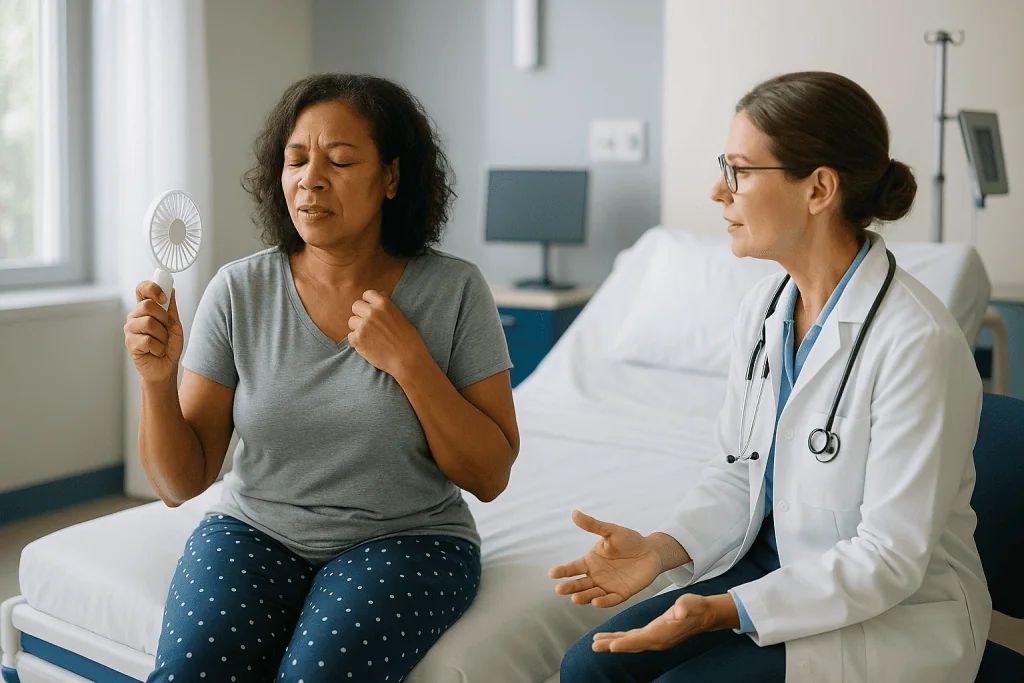
In May 2023 the US Food and Drug Administration approved fezolinetant, the first medicine in a class called neurokinin-3 receptor antagonists, for moderate to severe vasomotor symptoms of menopause. A neurokinin-3 receptor is a docking site in the brain’s temperature-control center; blocking it quiets the signal that fires a flash. Mayo Clinic’s treatment guidance now lists it alongside hormone therapy and antidepressant options. A second drug in the same family, elinzanetant, was approved in late 2025, which is why two nonhormonal names are circulating in menopause forums at once.
In November 2025 the FDA announced it was removing the boxed warning, the most prominent safety notice a US drug label can carry, from systemic menopausal hormone therapy products. The underlying risk information remains in the label text, and professional guidance on who should and should not take hormones has not been rewritten by the change. The announcement nonetheless sent many women back to their clinicians with a fair question: does this alter my decision?
The third driver is a claim that spread on short-form video in 2025: that hot flashes and night sweats are caused by high insulin and can be switched off with a low-carbohydrate diet. The claim traces back to observational analyses of a long-running US midlife cohort, which found that women with higher markers of insulin resistance reported more frequent vasomotor symptoms. Insulin resistance means the body’s cells respond sluggishly to insulin, so blood sugar and insulin both run higher. An association in a cohort is a real finding. It is not proof of cause, and no trial has shown that lowering insulin stops night sweats. The sections below treat each of these threads at the strength the evidence actually supports.
What is actually happening in the brain during a hot flash?
Picture the body’s thermostat as a dial with a comfort band on either side. Inside that band, called the thermoneutral zone, a small rise or fall in core temperature triggers nothing. Step outside it and the body acts: sweating and skin-vessel dilation to shed heat, shivering to generate it. In most adults the band is roughly 0.4 degrees Celsius wide. In women with frequent hot flashes it narrows almost to a line, so a core temperature rise too small to notice can trip a full heat-dumping response.
The dial sits in the hypothalamus, a thumb-sized region at the base of the brain. Within it lies a cluster of nerve cells nicknamed KNDy neurons, after the three chemical messengers they produce: kisspeptin, neurokinin B and dynorphin. Estrogen normally keeps these neurons restrained. When estrogen falls in perimenopause and after, the cells enlarge and fire more readily, and the neurokinin B they release nudges the thermostat toward a false alarm. This is the mechanism the newer nonhormonal drugs exploit by blocking the neurokinin-3 receptor that neurokinin B binds to.
Once the alarm fires, the sequence is quick. Blood vessels in the skin of the face and chest open wide, which is the flush. Sweat glands switch on. Heart rate climbs by a handful of beats per minute. Core temperature actually drops over the following minutes, which is why so many women describe a chill after the heat. The entire event usually runs one to five minutes.
This explains a puzzle that frustrates many women: estrogen levels on a single blood test say little about how bad the flashes are. It is the brain’s recalibration to changing hormone signals, not the absolute number, that sets the thermostat. It also explains why nighttime matters, because night is when the dial moves on its own.
Why do hot flashes at night peak after midnight?
Core body temperature follows a daily rhythm, highest in the early evening and lowest around 4 a.m. That fall is part of how sleep is initiated. The first half of the night is dominated by deep, slow-wave sleep, when the brain’s arousal threshold is high. After midnight the architecture changes: deep sleep thins out, lighter stages return, and rapid eye movement (REM) sleep, the dreaming stage, lengthens. Sleep laboratory recordings show hot flashes occur most often during light non-REM sleep and least often during REM, so the lighter second half of the night offers more windows for a flash to fire and more chances for it to wake you.

Hormone rhythms add to it. Cortisol, the body’s main stress hormone, begins to rise from about 3 a.m. toward its morning peak. Melatonin, which supports the nightly temperature drop, is falling by then. The thermostat is being nudged upward just as the mattress, the duvet and a sleeping partner have spent hours trapping heat around the skin. A narrowed thermoneutral zone does not need much.
Evening habits land in the same window. Alcohol is a vasodilator, opening skin blood vessels, and its breakdown products peak a few hours after the last glass, which for many people is between 1 and 3 a.m. A heavy or spicy late dinner raises metabolic heat output in the same period.
Two caveats keep this honest. The timing studies are small and mostly observational, so the after-midnight pattern is well described but not perfectly explained. And some women who report flashes only at night may also have daytime flashes they simply notice less because they are cooler, moving and distracted. A two-week diary noting the time, the trigger and the severity is often more revealing than any blood test.
Night sweats in women: is it always menopause?
Menopause is the most common explanation for night sweats in women over forty, but it is a diagnosis made by pattern and by excluding other causes, not by assumption. The question many people type, what illness is associated with hot flashes, deserves a direct answer.
Several conditions can produce an identical drenching sweat at 3 a.m. An overactive thyroid raises metabolic rate and heat production, usually alongside a fast heartbeat, tremor and weight loss. Obstructive sleep apnea, where the airway repeatedly closes during sleep, drives surges of stress hormones that end in sweating; it is underdiagnosed in midlife women because snoring is less often reported. Low blood sugar overnight in people treated for diabetes is a classic cause. Infections, including tuberculosis and some chronic bacterial infections, produce fevers that break with sweats. Anxiety and panic can wake a person already sweating. Acid reflux can do the same.
Medicines are an overlooked group. Antidepressants, particularly serotonergic ones, cause sweating in a meaningful minority of users. Tamoxifen and aromatase inhibitors, used after breast cancer, produce hot flashes that can be severe. Steroids, some diabetes medicines and opioid withdrawal all belong on the list. Alcohol and nicotine use are consistently associated with more frequent flashes in observational studies.
Hormonal causes outside menopause exist too: pregnancy, the weeks after childbirth, and premature ovarian insufficiency, when ovarian function declines before age forty. Men on androgen deprivation therapy for prostate cancer experience vasomotor symptoms by the same brain mechanism.
Rarely, night sweats are the first sign of a lymphoma or another cancer. This is not a prompt for self-diagnosis; it is the reason the final section of this article exists. Sweats that come with unexplained weight loss, fever or new lumps are evaluated differently from sweats that come with irregular periods and a 1 a.m. duvet fight.
What the evidence actually says about treating hot flashes at night
Grading the options by the kind of study behind them clears a lot of fog.
Strong evidence from randomized trials. Systemic estrogen therapy, with a progestogen for women who still have a uterus, reduces hot flash frequency by around 75 percent compared with placebo across dozens of trials and remains the most effective treatment. Neurokinin-3 receptor antagonists, fezolinetant and elinzanetant, cut frequency and severity meaningfully more than placebo in phase 3 trials that each enrolled several hundred women, with benefit measurable within the first weeks. Low-dose paroxetine, the only antidepressant with FDA approval for vasomotor symptoms, and gabapentin, used off-label, each show modest but consistent reductions in randomized trials. Cognitive behavioral therapy reduces how bothersome flashes are and improves sleep in trials, even when the raw count of flashes changes little.
Moderate or mixed evidence. Clinical hypnosis reduced self-reported flashes substantially in one well-run trial, but replication is thin. Weight loss produced fewer flashes in a trial of women with higher body weight. Soy isoflavones show small benefits in some meta-analyses and none in others, which usually means the effect is small and depends on the product.
Weak or negative evidence. Paced breathing, once widely recommended, did no better than a control in a randomized trial. Acupuncture performs about as well as sham acupuncture. Black cohosh, evening primrose oil and vitamin E have inconsistent or null results.
Expert opinion only. Cooling the bedroom, layered bedding, moisture-wicking sleepwear and avoiding evening alcohol are sensible, cheap and recommended by major clinical bodies, but no one has run a large trial on a fan.
One number frames everything: in hot flash trials, placebo alone typically reduces reported flashes by 20 to 30 percent. Any product promising dramatic results without a placebo comparison is making a claim the evidence cannot support.
How the main options compare for nighttime flashes
The table below summarizes what the strongest available evidence shows for each approach, with a note on what matters specifically for sleep. It is a map, not a prescription; which route suits a given woman depends on her history, which is a conversation for her clinician.
| Approach | Evidence type | Typical effect on flashes | What matters at night |
|---|---|---|---|
| Menopausal hormone therapy | Many randomized trials | Large reduction, around 75% in frequency | Most effective for sleep-disrupting sweats; suitability depends on personal and family history |
| Fezolinetant, elinzanetant | Large randomized trials | Moderate to large reduction versus placebo | Nonhormonal; elinzanetant trials also reported sleep improvement; fezolinetant requires liver blood tests |
| Low-dose paroxetine | Randomized trials | Modest reduction | Only FDA-approved antidepressant for this use; interacts with tamoxifen |
| Gabapentin (off-label) | Randomized trials | Modest reduction | Drowsiness as a side effect is sometimes useful at bedtime; clinician decides |
| Cognitive behavioral therapy | Randomized trials | Little change in count, large change in bother | Improves sleep and mood; no drug interactions |
| Weight loss (if overweight) | One randomized trial, cohort data | Modest reduction | Benefits sleep apnea risk as well |
| Soy isoflavones | Mixed meta-analyses | Small, inconsistent | Weeks to any effect; product quality varies |
| Black cohosh | Inconsistent trials | Unproven | Rare liver injury reports; not advised without medical input |
| Cool room, layered bedding, fan | Expert consensus | Unquantified | Lowers the heat load that trips a narrowed thermostat; no downside |
Two patterns stand out. First, the gap between the top rows and the supplement rows is wide, and no amount of marketing closes it. Second, the behavioral row earns its place not by stopping flashes but by changing what a flash costs, which for nighttime symptoms is often the point.
What helps hot flashes at night without a prescription
Start with the room, because the physiology says heat load matters. Sleep medicine guidance generally puts the ideal bedroom around 60 to 67 degrees Fahrenheit (16 to 19 degrees Celsius), cooler than most households run. A fan aimed across the bed does two jobs: it moves heat off the skin and it adds steady background sound that blunts the brief arousals that precede a flash.
Bedding is next. Replace a single heavy duvet with layers that can be shed one at a time, so a flash costs a sheet rather than a full strip-down. Natural fibers and moisture-wicking sleepwear dry faster than cotton jersey. Some women keep a spare top folded on the nightstand and a glass of cold water beside it; a cold sip during a flash shortens the perceived duration for many, though no trial has measured it. Cooling pillow inserts and mattress pads have small, mostly anecdotal support, and they are harmless.
Evening habits deserve a hard look. Alcohol is the most consistent trigger reported in diaries and in cohort studies, and its timing matches the after-midnight peak described earlier. Spicy food, a large late meal and a hot shower or bath within an hour of bed all push core temperature up at exactly the wrong moment. Caffeine after mid-afternoon is a plausible contributor for some; the cohort data on caffeine and flashes are mixed, so a two-week trial of cutting it is the honest test.
Smoking is associated with earlier menopause and more frequent, more severe flashes in large observational studies, and stopping has benefits far beyond sweat. Regular exercise improves sleep quality in trials, though its direct effect on flash frequency is small; the practical point is to finish vigorous sessions at least three hours before bed.
What does not hold up: paced breathing, once a standard recommendation, failed a randomized trial. It is harmless, and relaxation itself may help sleep, but it should not be sold as a flash treatment.
Does cognitive behavioral therapy help night sweats and the sleep they wreck?
Cognitive behavioral therapy, or CBT, is a structured talking therapy that changes unhelpful patterns of thought and behavior. For menopausal symptoms it has been adapted into brief programs, typically four to six sessions, delivered in groups, one to one or through guided self-help. The evidence here is better than most people expect.
Randomized trials from the United Kingdom, including programs developed for women after breast cancer treatment where hormones are not an option, found that CBT roughly halved how much hot flashes and night sweats interfered with daily life, with improvements lasting at least six months. The number of flashes recorded in diaries fell only slightly. The therapy works on the second half of the problem: the catastrophizing in the dark, the dread of the next one, the ninety minutes spent awake after a two-minute flash.
For nighttime symptoms the more relevant tool is often CBT for insomnia, known as CBT-I, which has strong trial evidence in midlife women specifically. It retrains the brain’s association between bed and wakefulness through consistent wake times, limiting time in bed to time actually asleep, and a rule to get up after about twenty minutes awake rather than lying there heating up and fuming. Trials in women with menopausal insomnia show larger and more durable improvements than sleep hygiene advice alone.
Clinical hypnosis, a guided relaxation state with imagery of coolness, reduced self-reported flash frequency by about 74 percent in one randomized trial, far more than the attention control. That is a striking result from a single well-designed study, which is exactly how it should be described: promising and awaiting replication.
None of these approaches interact with medicines, none require blood tests, and all can run alongside any prescription. The access barrier is real, since trained practitioners are not everywhere; digital CBT-I programs with trial evidence have narrowed that gap.
What medication treats hot flashes and night sweats?
Prescription options fall into two groups: hormonal, covered in the next section, and nonhormonal. Everything below is for the conversation with a prescribing clinician; doses, duration and suitability are individual decisions that belong there.
The newest nonhormonal medicines are the neurokinin-3 receptor antagonists. Fezolinetant was approved in the United States in 2023 and elinzanetant in 2025. Both act on the KNDy neurons described earlier, dampening the signal that trips the thermostat, and both reduced moderate to severe flashes significantly more than placebo in large trials, with effects seen within the first weeks. Fezolinetant’s label carries a warning about rare liver injury, and blood tests to check liver function are required before and during treatment. Elinzanetant’s trials also measured sleep disturbance and reported improvement, which is relevant for women whose main complaint is the after-midnight pattern. Common side effects for both include headache, abdominal discomfort and drowsiness.
Low-dose paroxetine is the only antidepressant with specific FDA approval for vasomotor symptoms. Several other antidepressants in the SSRI and SNRI families, notably venlafaxine, have randomized trial evidence of modest benefit and are prescribed off-label, meaning for a use the regulator has not formally approved. Paroxetine in particular interferes with the activation of tamoxifen, so women on that drug after breast cancer are usually steered elsewhere.
Gabapentin, a nerve-pain and seizure medicine, reduces flashes modestly in trials and is used off-label; its drowsiness is sometimes a feature rather than a bug when the problem is nighttime. Oxybutynin, a bladder medicine, and clonidine, a blood pressure medicine, each have smaller trial support and more side effects.
Which of these fits depends on breast cancer history, clot history, liver health, other medicines, mood and what the woman wants from treatment. Explaining the evidence is this article’s job. Choosing is the treating clinician’s.
Hormone therapy for hot flashes at night: what the label change means and does not mean
Menopausal hormone therapy, estrogen alone for women without a uterus and estrogen with a progestogen for those with one, is the most effective treatment for vasomotor symptoms by a wide margin, and for sleep-disrupting night sweats it is the option most likely to restore an unbroken night. It is also the option with the most complicated history.
The 2002 Women’s Health Initiative trial reported increased risks of breast cancer, stroke and blood clots with a combined oral regimen in a population whose average age was 63, and prescriptions fell sharply. Two decades of re-analysis have refined the picture. For healthy women who start within ten years of their final period or before age 60, the absolute risks are small and the benefits for symptoms, bone density and quality of life are substantial. Transdermal estrogen, delivered through the skin, carries lower clot risk than oral tablets in observational data. Combined therapy for more than about five years is associated with a small rise in breast cancer risk; estrogen alone has not shown that rise in the trial data.
In November 2025 the US FDA announced the removal of the boxed warning from systemic hormone therapy labels, moving the risk information into the body of the label. This changes the prominence of the warning, not the evidence behind it, and it does not change who should avoid hormones: women with a history of breast cancer, estrogen-sensitive cancers, blood clots, stroke, active liver disease or unexplained vaginal bleeding are generally still advised against systemic estrogen.
The practical message is unchanged by the headline. Hormone therapy is neither the hazard it was painted as in 2002 nor a product safe for everyone, and the decision is individualized against personal and family history, reviewed every year, and made with the prescribing clinician. Starting, stopping or adjusting it without that review is not advised.
Supplements, bioidentical hormones and other things sold for night sweats
Walk down any supplement aisle and the menopause shelf is longer than the headache shelf. The evidence is shorter.
Black cohosh, a North American herb, is the most studied. The NIH Office of Dietary Supplements summarizes the trials as inconsistent, with better-designed studies tending to show no advantage over placebo. Rare reports of liver injury have been published, which is why it should not be combined with other liver-stressing substances or taken without a clinician’s knowledge, particularly alongside fezolinetant.
Soy isoflavones, plant compounds that weakly mimic estrogen, show small reductions in flash frequency in some pooled analyses, especially in products standardized to genistein, and benefits take weeks to appear. Women on tamoxifen or with a history of estrogen-sensitive cancer should ask before using concentrated extracts. Red clover, which contains related compounds, has weaker data. Evening primrose oil, vitamin E, dong quai and wild yam creams have failed trials or never had meaningful ones.
Dietary supplements in the United States are regulated as foods, not drugs, which means potency, purity and even the identity of the ingredient are not verified before sale. Choosing products carrying an independent quality seal reduces that risk but does not create efficacy.
Compounded so-called bioidentical hormones deserve plain language. These are hormone preparations mixed to order by a pharmacy rather than manufactured as approved products. They are not FDA-approved, their dose consistency is not tested, and no evidence shows them to be safer or more effective than approved hormone therapy, which already includes plant-derived estradiol and micronized progesterone identical in structure to the body’s own. Saliva hormone testing marketed with them does not predict symptoms or guide treatment. Products sold online as research peptides for menopause are unapproved, unregulated and not for self-use.
Spending on this shelf is a personal choice; spending in place of a conversation with a clinician is the mistake.
Common myths about hot flashes at night
Flashes only at night mean it is not menopause. The after-midnight cluster is exactly what the circadian physiology predicts, and many women never have a daytime flash at all. Timing alone neither confirms nor rules out menopause.
High insulin causes hot flashes, so a low-carb diet stops them. Cohort analyses found that women with higher insulin resistance reported more frequent vasomotor symptoms. That is an association in observational data, possibly explained by shared factors such as body weight and sleep loss, which itself raises insulin resistance. No randomized trial has shown that lowering insulin reduces night sweats. Eating well is a fine idea; it is not a treatment for this.
Night sweats mean cancer. Cancer is a rare cause, and sweats that accompany it almost always come with other changes such as weight loss, fever or lumps. The vast majority of midlife night sweats are vasomotor.
The label change proves hormones are safe for everyone. The 2025 removal of the boxed warning changed how risk is displayed, not the evidence or the list of women who should avoid systemic estrogen.
Sweating at night is the body detoxing. Sweat is water, salt and trace minerals. The liver and kidneys handle toxins; the sweat glands handle temperature.
Flashes stop when periods stop. Median duration is about seven years and often extends well past the final period. Some women have symptoms into their seventies.
A cold shower right before bed prevents them. Cold water triggers vasoconstriction and a rebound warming; a lukewarm shower an hour or two before bed supports the natural temperature drop better.
Men do not get hot flashes. Men on androgen deprivation therapy for prostate cancer experience them through the same brain pathway, and the newer nonhormonal drugs are being studied in that group.
Antidepressants for flashes mean the doctor thinks it is in your head. Serotonin-acting drugs modulate the hypothalamic thermostat directly; their use reflects mechanism, not disbelief.
When to see a doctor about hot flashes at night
Most hot flashes at night are a nuisance rather than a danger, and a clinician’s main job is to confirm that and to open the treatment conversation. Some features change the conversation, and they should be raised promptly rather than filed under menopause.
- Drenching sweats that soak bedding most nights, especially with unexplained weight loss, fever, a cough lasting more than three weeks, or swollen glands in the neck, armpit or groin.
- Night sweats beginning before age 40, or sweats in anyone with no other menopausal changes such as irregular periods.
- Sweats alongside a racing or irregular heartbeat, tremor, heat intolerance or new anxiety, which can point to thyroid disease.
- Loud snoring, witnessed pauses in breathing, or waking unrefreshed despite enough hours in bed, which raise the question of sleep apnea.
- Sweats that started after a new medicine, or in someone treated for diabetes who may be running low blood sugar overnight.
- Any vaginal bleeding after menopause, or bleeding that is much heavier or more frequent than usual during perimenopause.
- Sleep loss that is affecting work, driving or mood, or any thoughts of self-harm; low mood in perimenopause is common and treatable.
- For anyone already taking a prescribed treatment: yellowing of the skin or eyes, dark urine, pale stools or persistent nausea on fezolinetant; calf pain, chest pain or sudden breathlessness on hormone therapy. These need urgent assessment.
Bring a two-week diary if you can: times, triggers, severity, and how long it took to get back to sleep. It turns a vague complaint into a pattern a clinician can act on. Expect a conversation about personal and family history, possibly a thyroid blood test, and a frank discussion of hormonal and nonhormonal options. Every decision about starting, changing or stopping a medicine belongs with the prescribing clinician, and nothing in this article replaces that visit.
Frequently asked questions
Why do I only get hot flashes at night?
Because the second half of the night combines lighter sleep, a rising cortisol rhythm, falling melatonin and hours of heat trapped under bedding, which together trip a narrowed temperature thermostat more easily than daytime conditions do. Many women also have mild daytime flashes they notice less while cooler and distracted. A two-week diary of timing and triggers usually clarifies the pattern better than a blood test.
What illness is associated with hot flashes and night sweats?
Menopause and perimenopause are by far the most common, but an overactive thyroid, obstructive sleep apnea, low overnight blood sugar in treated diabetes, infections such as tuberculosis, anxiety, acid reflux and several medicines including antidepressants and tamoxifen can produce identical sweats. Rarely, lymphoma or other cancers present this way, usually with weight loss or fever. A clinician distinguishes these by history and simple tests.
What helps hot flashes at night?
The best-supported steps are a bedroom around 60 to 67 degrees Fahrenheit, a fan, layered bedding, moisture-wicking sleepwear, no alcohol or heavy spicy food in the evening, and cognitive behavioral therapy for insomnia, which has strong trial evidence in midlife women. If flashes still fragment sleep, hormone therapy and newer nonhormonal prescriptions have randomized trial support, and the choice belongs with a prescribing clinician.
What medication can I take to treat hot flashes and night sweats?
Options with trial evidence include menopausal hormone therapy, the nonhormonal neurokinin-3 receptor antagonists fezolinetant and elinzanetant, low-dose paroxetine, and off-label use of certain other antidepressants, gabapentin or oxybutynin. Which is appropriate depends on breast cancer and clot history, liver health, other medicines and personal preference. That assessment, and every decision about dose and duration, belongs with the treating clinician.
Are night sweats in women always a sign of menopause?
No. In women over forty with irregular periods they usually are, but night sweats in women can also come from thyroid disease, sleep apnea, pregnancy, premature ovarian insufficiency before age 40, infections, anxiety and medicines. Sweats that arrive with weight loss, fever, swollen glands or a persistent cough should be assessed rather than assumed to be hormonal.
How long do nighttime hot flashes last, and for how many years?
A single flash typically lasts one to five minutes, though the time it takes to cool down and fall back asleep can stretch much longer. Across the menopause transition, cohort studies put the median duration of vasomotor symptoms at about seven years, longer when they start early in perimenopause, and a minority of women continue to have them into their seventies.
Do hot flashes really get worse after midnight?
Sleep laboratory studies show flashes occur most often in light non-REM sleep and least in REM, and light sleep increases after midnight while deep sleep fades. Core temperature reaches its low around 4 a.m. and cortisol starts rising from about 3 a.m., both nudging the thermostat. The pattern is well described in small observational studies rather than proven by large trials.
Does alcohol cause hot flashes at night?
Alcohol is the trigger most consistently reported in symptom diaries and in cohort studies. It widens skin blood vessels, disrupts the second half of sleep, and its breakdown products peak a few hours after drinking, which for an evening glass lands between 1 and 3 a.m. Cutting evening alcohol for two weeks is a cheap, honest test of whether it is contributing.
Can men get night sweats from hormone changes?
Yes. Men receiving androgen deprivation therapy for prostate cancer commonly experience hot flashes and night sweats through the same hypothalamic pathway seen in menopause. Low testosterone from other causes can contribute less predictably. Men with new drenching night sweats should be assessed for infection, thyroid disease, sleep apnea and medicine effects just as women are.
Is the insulin and hot flashes link real?
Partly. Analyses of a long-running US midlife cohort found that women with higher markers of insulin resistance reported more frequent hot flashes and night sweats. That is an observational association, possibly explained by shared factors such as body weight and sleep loss, and no randomized trial has shown that lowering insulin reduces flashes. Healthy eating is reasonable; presenting it as a treatment overstates the evidence.
References
This article is for general information only and is not a substitute for professional medical advice. Please consult a qualified doctor about your individual situation.

More from the Blog

Estrogen Dominance: Is It Real? What Doctors Say About the Popular Diagnosis
Estrogen dominance is not a recognized medical diagnosis. The term describes a theory that estrogen is too high relative to progesterone, but no accepted…

Genitourinary Syndrome of Menopause: The Under-Diagnosed Condition Behind Dryness, UTIs and Pain
Genitourinary syndrome of menopause (GSM) is the collection of vulvar, vaginal and urinary changes caused by falling estrogen after menopause, including dryness, burning, pain…

Non-Hormonal Menopause Treatments: Fezolinetant, SSRIs and What the Evidence Grades
Fezolinetant (Veozah) is a non-hormonal prescription medicine approved for moderate to severe menopausal hot flashes and night sweats. In randomized trials it cut hot-flash…

HRT Side Effects and Benefits: An Honest Balance Sheet Based on the Latest Evidence
HRT side effects range from short-lived symptoms such as breast tenderness, nausea, bloating and spotting, which usually settle within a few months, to small…

Is There a Perimenopause Test? What FSH, Estradiol and AMH Can and Cannot Tell You
There is no single perimenopause test. Perimenopause is diagnosed from your age, your changing menstrual pattern and your symptoms, not from a lab value.…

Menopause Supplements: Black Cohosh, Soy Isoflavones and Others: What Trials Show
Randomized trials have not shown that black cohosh works better than placebo for hot flashes, and soy isoflavone trials are mixed, with small benefits…