

How an Endoscopic Brow Lift Is Performed: Small Incisions, Cameras and Fixation Explained
Key Takeaways
- An endoscopic brow lift works through several scalp incisions each typically under an inch long, with a slender camera showing the surgeon the muscles and nerves beneath the forehead.
- The operation both repositions the forehead tissue and weakens the corrugator and procerus muscles that pull the brows down, which is why it differs from simple skin tightening.
- Fixation, using sutures anchored to shallow bone tunnels or small absorbable devices, holds the lifted tissue still for the weeks the body needs to form new attachments.
- Mayo Clinic describes the surgery as typically taking one to two hours, with sutures removed within about seven to ten days and most people returning to social activity in roughly ten days to two weeks.
- Forehead and scalp numbness is an expected effect of every brow lift approach rather than a complication, and it usually improves over weeks to months.
- Results are not permanent, and no mainstream guideline gives a fixed number of years a brow lift lasts; figures quoted online come from surgeon experience rather than long-term controlled studies.
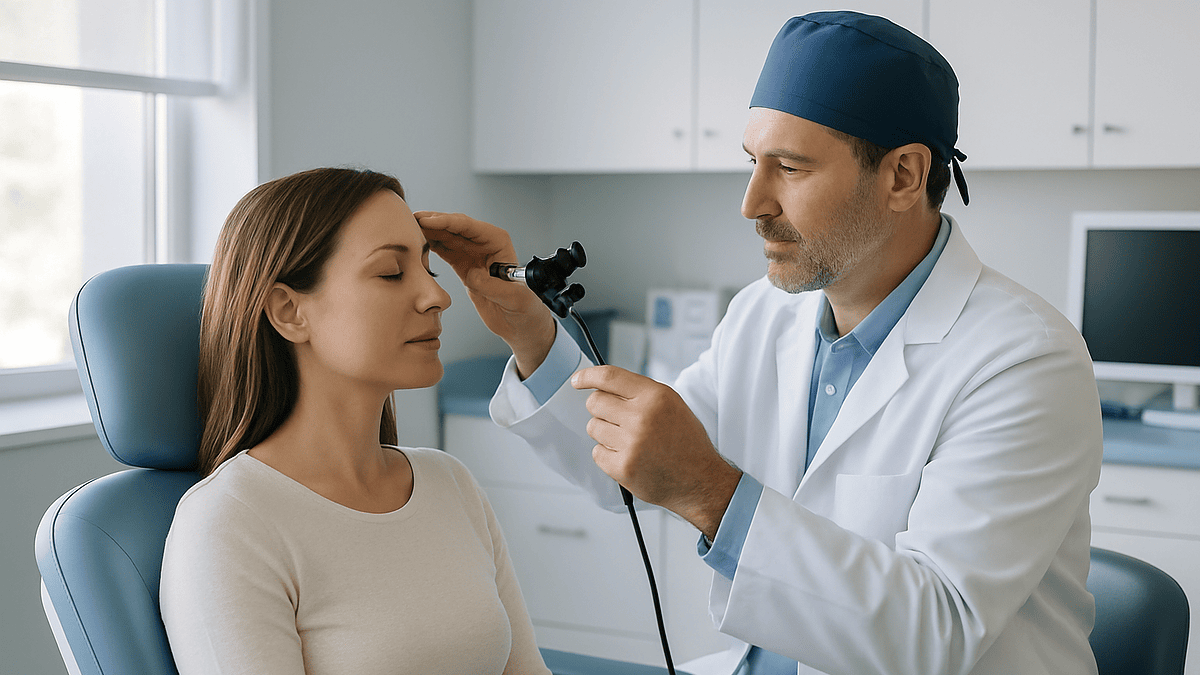
An endoscopic brow lift is done under general anesthesia or sedation through several short incisions hidden in the scalp. A pencil-thin camera lets the surgeon loosen the forehead tissues from the bone, release the muscles that pull the brows down, reposition the brow higher, and hold it there with sutures or small absorbable anchors while it heals. It usually takes one to two hours.
The photograph that finally prompted the consultation was not a bad one. It was taken at a nephew’s graduation, everyone squinting into late afternoon sun, and the woman in it looked tired in a way she did not feel. Her eyelids seemed heavier than they had at forty. When she pressed two fingertips above each eyebrow and nudged upward in the bathroom mirror, the heaviness vanished. That small experiment is, in miniature, exactly what a brow lift sets out to do.
People who ask how is a brow lift done are usually picturing a long scar and a stretched forehead. The endoscopic version, which has become one of the most commonly described approaches, looks nothing like that. It uses a few incisions shorter than a fingernail, a camera thinner than a pencil, and a way of anchoring tissue to bone that dissolves on its own.
This article walks through what the surgeon sees and does, what the first weeks feel like, and where the honest uncertainties lie.
How is a brow lift done? Start with why brows drop in the first place
Eyebrows do not sag on their own. They are pushed down by muscle and let down by tissue, and understanding that tug-of-war explains every step of the operation.
The forehead has one lifter and three depressors. The frontalis is the broad sheet of muscle that raises the brows and creases the forehead when you look surprised. Working against it are the corrugators, small muscles at the inner brow that pull the eyebrows together and downward to make the vertical frown lines, the procerus, a strip of muscle over the bridge of the nose that creates the horizontal crease there, and the outer fibers of the eye-closing muscle, the orbicularis oculi, which drag the tail of the brow down. Over decades the depressors win a little ground each year. At the same time, the skin, the fat pads and the fibrous layer under the scalp lose elasticity, so the whole brow complex drifts toward the eye.
Mayo Clinic describes the result plainly: a low brow can make the upper eyelid look heavy and the face look tired or angry even at rest. Some people compensate by holding their frontalis tense all day, which deepens horizontal forehead lines and can contribute to a feeling of forehead fatigue by evening.
A brow lift therefore has two jobs. It repositions the soft tissue higher on the skull, and it weakens the muscles that pulled it down so the new position is not immediately undermined. The endoscopic method does both from inside the scalp, using a camera to see the muscles the surgeon cannot reach by direct view. The rest of this article follows that sequence: getting in, seeing, releasing, lifting and fixing.
What actually happens during an endoscopic brow lift, step by step
Picture the operation as five movements rather than one long cut.
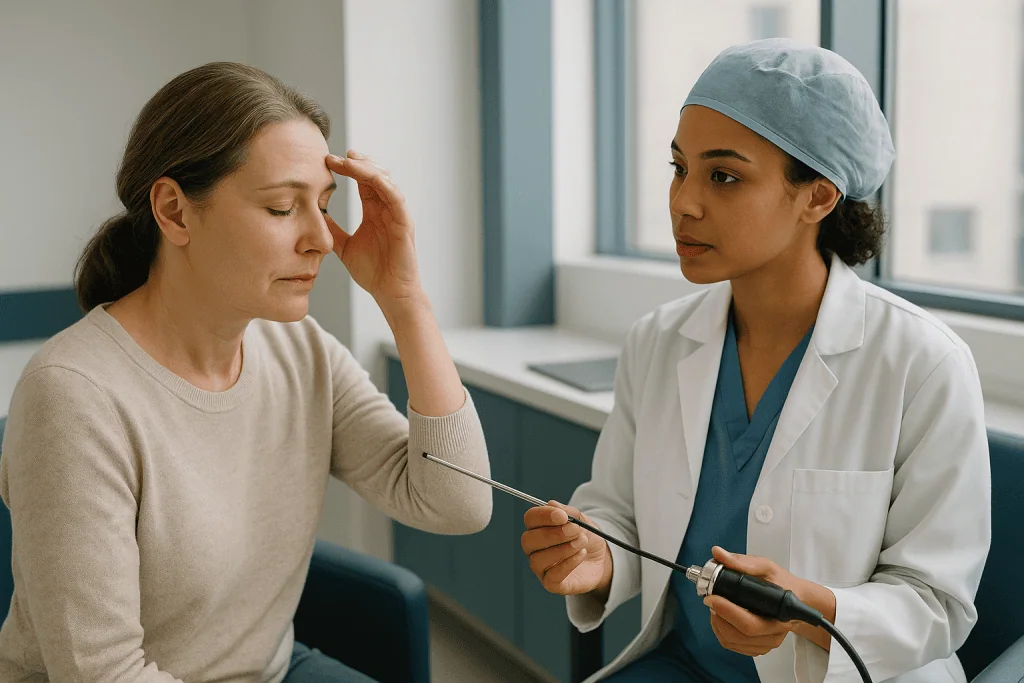
First, planning and marking. With the patient sitting upright before anesthesia, the surgeon marks the hairline, the current brow position and the intended new position. Gravity behaves differently on a lying patient, so the marks made while upright become the map.
Second, access. Once the patient is asleep or sedated, several short incisions are made within the hair-bearing scalp, each usually less than an inch long according to Mayo Clinic’s description. A small quantity of local anesthetic with a blood vessel constrictor is typically infiltrated to limit bleeding and improve the camera view.
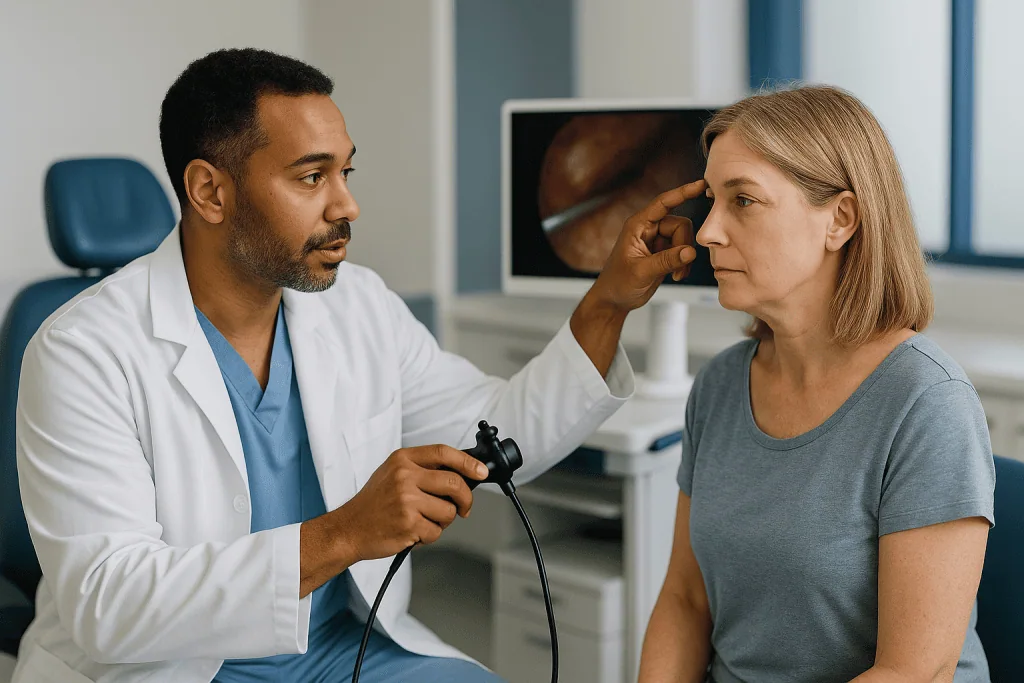
Third, elevation. Through the incisions, the surgeon uses a blunt instrument to lift the forehead tissues off the bone in a single sheet. This is done just above the periosteum, the thin membrane that covers bone, or directly beneath it. Near the eyebrows the endoscope is introduced. An endoscope is a slender rigid tube with a lens and a light at the tip, connected to a screen, so the surgeon watches a magnified image of the tissue under the forehead.
Fourth, release. Under camera view, the surgeon divides the fibrous attachments along the upper rim of the eye socket that tether the brow in its low position, and thins or partially divides the corrugator and procerus muscles while protecting the nerves running beside them.
Fifth, repositioning and fixation. The freed forehead is drawn upward and backward to the marked position and held there with sutures, small absorbable anchors or another fixation method, discussed later in detail. The scalp incisions are closed with sutures or staples. Mayo Clinic notes the whole operation typically takes one to two hours.
Where the small incisions go, and why they are hard to find later
The word people latch onto is small, but placement matters more than length.
In the endoscopic approach the incisions sit entirely behind the hairline, typically one near the midline, one on each side above the outer part of the brow, and often one at each temple for a total that surgeons commonly describe as three to five. Johns Hopkins Medicine explains that this hidden placement is the principal advantage over the older coronal approach, which runs a single continuous incision from ear to ear across the top of the head.
Three practical reasons drive the choice of location. The central incisions give a straight path to the frown muscles between the brows. The lateral incisions line up with the tail of the brow, which is the part that descends most with age and the part that lifting improves most visibly. The temporal incisions allow the surgeon to free the tissue at the outer corner, where a dense band of fibrous tissue holds the brow down and where a branch of the facial nerve that moves the forehead runs close to the surface.
Incisions are made parallel to the hair shafts, a technique sometimes called a beveled cut, so that hair follicles beneath the scar are preserved and hair can regrow through it. Even so, Mayo Clinic lists hair loss along the incision and a slightly raised hairline among recognized risks, and a person with a very high forehead may be advised toward a different incision pattern that sits along the hairline instead of behind it.
None of this makes scars invisible. It makes them unlikely to be noticed by anyone not looking for them, which is a realistic goal rather than a promise.
What the camera shows: working in the plane between skin and bone
The endoscope changes the operation from a procedure done by feel to one done by sight, and the layer in which the surgeon works is the key to why.
Beneath the forehead skin lie, in order, a layer of fat, the frontalis muscle, a loose gliding layer, the periosteum and then bone. Most endoscopic brow lifts are performed in what is called the subperiosteal plane, meaning the surgeon lifts the periosteum off the bone and works directly on the skull surface. This plane has two virtues. It is nearly bloodless, because the vessels that matter run in the layers above, and it is a natural cleavage plane, so blunt instruments separate it easily without cutting.
On the monitor the surgeon watches for specific landmarks. The supraorbital and supratrochlear nerves emerge from small notches or holes at the upper rim of the eye socket and travel upward to supply feeling to the forehead and front of the scalp. They appear as glistening cords and must be identified and protected, which is exactly the task the camera makes possible. Once they are located, the corrugator muscle fibers can be seen crossing beside them and can be divided or thinned with a grasping instrument while the nerve is kept in view.
The camera also helps at the outer edge. The temple contains a fascial layer within which a motor nerve to the frontalis travels. Surgeons stay deep to this layer, and magnification helps confirm they are in the correct plane.
Mayo Clinic lists changes in skin sensation and temporary forehead weakness among possible complications. The point of the camera is to make those outcomes less likely, not impossible, and any surgeon will say the view on the screen is a tool rather than a guarantee.
Fixation explained: how a lifted brow is held in place while it heals
Lifting tissue is easy. Persuading it to stay lifted is the part that separates a lasting result from a temporary one, and it is the part most patients have never heard of.
Once the periosteum has been separated from bone, the body needs several weeks to lay down new scar attachments in the raised position. Fixation is any method of holding the tissue still during that window. Several approaches are in mainstream use, and surgeons choose based on the patient’s bone thickness, hair density and their own training.
- Suture to bone. The surgeon drills a very shallow tunnel in the outer layer of the skull, passes a stitch through it and ties the scalp tissue to that anchor.
- Absorbable anchors. A small device made of a dissolvable polymer is seated into a shallow hole in the bone. The scalp tissue is hooked or sutured onto it, and the device breaks down over months once its job is done.
- Small screws. A short screw placed in the skull acts as a temporary post; some designs are removed at a follow-up visit and others are left permanently.
- Temporal fixation. At the outer incisions, the lifted tissue is often simply sutured to the firm deep fascia of the temple, which needs no bone anchoring.
Patients can sometimes feel a firm bump under the scalp at a fixation site for weeks or months. This is expected, and absorbable devices soften as they dissolve. What the evidence does not settle is whether one fixation method holds better than another over many years; comparisons are small and surgeon-dependent, so this is a fair thing to ask about but not a reason to expect a definitive answer.
Brow lift vs forehead lift: endoscopic, coronal, temporal and direct compared
The terms brow lift and forehead lift are used interchangeably by Mayo Clinic and most patient resources; they describe the same family of operations. What differs is the route in.
| Approach | Incision | Usual purpose | Common trade-offs |
|---|---|---|---|
| Endoscopic | Several short scalp incisions behind the hairline | Mild to moderate brow descent; frown muscle weakening | Shorter scars and less numbness reported; relies on fixation; less able to remove excess skin |
| Coronal | One continuous incision across the top of the scalp, ear to ear | Marked descent; heavy, thick forehead skin | Direct view and skin removal; longer scar, raises hairline, more scalp numbness |
| Hairline (pretrichial) | Along the front edge of the hair | People with a high forehead who should not have the hairline raised | Can lower or hold the hairline; scar sits at the edge of the hair |
| Temporal | Short incisions in the temple hair only | Drooping of the outer third of the brow | Does not address frown lines or the inner brow |
| Direct | Just above the eyebrow itself | Severe one-sided droop, often after nerve injury; thick or bald brows | Precise but leaves a visible scar above the brow |
Johns Hopkins Medicine and Cleveland Clinic both describe the endoscopic method as the less invasive of the main options, but less invasive does not mean better for everyone. A coronal lift can remove a strip of scalp skin, which the endoscopic method largely cannot, so a person with a great deal of loose forehead skin may be steered toward it. The right choice sits with the surgeon who has examined the forehead in person, and a good consultation explains why one route was recommended over the others.
Who is usually a candidate, and who is usually asked to wait
The ideal candidate for the endoscopic approach is, in a sense, defined by what the operation cannot do. It repositions and it releases; it does not remove much skin.
People who tend to be offered it have a low or flattened brow, especially at the outer third, deep frown lines that remain when the face is relaxed, and a forehead of average height with reasonably thick hair to hide the incisions. Many are in their forties to sixties, though Mayo Clinic notes that brow position, not age, is what matters, and some younger people with a naturally low brow are candidates too.
Surgeons commonly ask certain people to wait, or recommend a different plan altogether.
- Active smokers or heavy nicotine users. Nicotine narrows small blood vessels and impairs wound healing; most surgeons ask for a period of complete abstinence before and after any facial surgery, and the length of that period is set by the operating team.
- People with uncontrolled blood pressure, diabetes or a bleeding disorder, until the condition is stabilized with their own physician.
- Anyone taking medicines that thin the blood, including some over-the-counter pain relievers and supplements. The prescribing clinician, not the surgeon alone, decides whether and how these are paused.
- People whose main complaint is actually excess upper eyelid skin rather than a low brow. Lifting the brow can worsen an eyelid that is already wide open, so an eyelid procedure may be suggested instead or in combination.
- People with unrealistic expectations, or who are seeking surgery in the middle of a major life crisis. The NHS advises taking time to consider any cosmetic procedure and being clear about motivation before going ahead.
A very high forehead usually points toward a hairline incision rather than behind-the-hairline endoscopic access. A largely bald scalp may point away from the endoscopic method entirely.
Anesthesia, timing and what the day of surgery usually looks like
Most people are more anxious about being put to sleep than about the operation, so it helps to know what the options are and why one is chosen.
Mayo Clinic states that a brow lift may be performed under general anesthesia, in which the patient is fully unconscious, or under intravenous sedation combined with local anesthetic, sometimes called twilight anesthesia, in which the patient is deeply relaxed and pain-free but breathing on their own. The anesthesia team makes this decision with the surgeon based on the patient’s health, the planned length of surgery and whether other procedures such as eyelid surgery are being done at the same time.
The operation itself typically lasts one to two hours according to Mayo Clinic, longer when combined with other procedures. It is commonly performed as a day case, meaning the patient goes home the same day once awake, eating and passing urine, with a responsible adult to accompany them.
A typical day unfolds like this. The patient arrives having fasted as instructed. The surgeon marks the forehead while the patient is upright. In the operating room, monitors are attached, anesthesia is given, and the hair is parted rather than shaved along the incision lines; most surgeons do not shave the head. After surgery the patient wakes in a recovery area with a snug bandage or elastic wrap around the forehead to limit swelling. Some surgeons place a thin drain for a day; many do not.
Before discharge, the team explains how to sleep with the head elevated, how to keep the incisions clean and which medicines have been prescribed for discomfort and, in some cases, to prevent infection. Any question about those medicines, including whether to take a regular prescription that morning, belongs to the surgical and anesthesia team.
How painful is a brow lift, really?
Here is where patient forums and surgeon descriptions tend to agree, which is reassuring: the endoscopic brow lift is more uncomfortable than painful for most people, and the dominant sensations are tightness and numbness rather than sharp pain.
Three things explain this. The work is done on bone and thin membranes, which have fewer pain fibers than skin. The nerves that carry sensation from the forehead are deliberately handled during surgery, so the forehead is often partly numb for a time, which blunts pain as well as touch. And the incisions themselves are short and sit in the scalp, which heals quickly.
What people do report is a pressure headache in the first days, a feeling that the forehead is being held up by a tight band, and itching or tingling as sensation returns. Cleveland Clinic describes discomfort that is usually managed with the pain relief the surgeon prescribes, and Mayo Clinic notes that numbness and altered sensation in the scalp are common and can persist for weeks to months before settling.
The pattern over time matters more than any single number. Discomfort is generally worst in the first two to three days, coincides with peak swelling, and then eases steadily. Pain that increases after day three rather than decreasing, or pain confined to one side and accompanied by tight new swelling, is not part of the normal curve and needs a same-day call to the surgical team, because it can signal a collection of blood under the scalp.
Medicines used after surgery are chosen and adjusted by the prescribing clinician. Their purpose is comfort during the first week, and the choice of medicine, how long to continue and when to stop should follow the team’s specific instructions, not a general article.
Endoscopic brow lift recovery: what the first days and weeks usually look like
Recovery from an endoscopic brow lift is a story about swelling that travels. It begins in the forehead and, thanks to gravity, drifts downward before it disappears.
The first two to three days. The forehead is tight and swollen under a bandage. Sleeping with the head raised on two or three pillows, or in a recliner, limits how much fluid pools. Cold compresses around, but not on, the eyes help, and gentle activity such as short walks is encouraged. Bruising commonly appears around the eyes and upper cheeks, not the forehead, because that is where the fluid ends up.
Days four to ten. The bandage is usually removed within a few days. Mayo Clinic notes that sutures or staples are typically removed within seven to ten days. Numbness across the forehead and top of the scalp is expected. Some people notice a wooden, tight feeling when they try to raise their eyebrows, which reflects both swelling and deliberate muscle weakening.
Around two weeks. Mayo Clinic advises that most swelling and bruising has improved enough for many people to return to work and social activity in roughly ten days to two weeks, though residual puffiness can be present for longer. Camouflage makeup can usually be used once incisions are sealed, with the team’s approval.
Weeks three to six. Vigorous exercise, heavy lifting and bending are generally restricted for several weeks; the exact period is set by the surgeon. Sensation begins to return as tingling and itching. Firm bumps at fixation points slowly soften.
Months. The brow position seen at two weeks is not the final one; residual swelling holds the brow slightly higher than it will settle. Mayo Clinic describes final results emerging over several months as swelling fully resolves and scars fade.
How long does a brow lift last? What the evidence can and cannot say
People ask how many years a brow lift lasts as if it came with a warranty. The honest answer has two parts.
First, the surgery does not stop aging. Mayo Clinic states plainly that a brow lift’s results are not permanent and that, as the face continues to age, the brow may gradually descend again. The tissues were repositioned and the depressor muscles weakened, but skin continues to lose elasticity, fat pads continue to shrink and gravity does not take a holiday.
Second, there is no reliable, guideline-level figure for how many years the lift holds. Patient websites often quote a decade or more. That number comes from surgeons’ experience and small case series rather than from long-term controlled studies, and mainstream references such as Mayo Clinic and Cleveland Clinic deliberately avoid stating a fixed duration. This article follows their lead.
What the evidence does support is a list of factors that influence longevity. Weakening the corrugator and procerus muscles removes a force that would otherwise pull the brow down again, so a lift that includes muscle release tends to hold better in principle than pure skin tightening. Sun exposure, smoking and significant weight fluctuation accelerate loss of skin elasticity across the face, and there is no reason the forehead is exempt. Good fixation during the healing window matters because tissue that slips before scar has formed will settle lower.
Some people later choose a second, smaller procedure, or a non-surgical treatment, as aging continues. That is not a sign the first operation failed. It reflects the fact that surgery changes a snapshot, not the film.
If a surgeon quotes a specific number of years, the useful follow-up question is what data it comes from and how many of their own patients they have followed that long.
What are the downsides and risks of a brow lift?
Every operation trades one set of problems for a smaller, different set. The downsides of a brow lift fall into three groups: the near-certain, the common but temporary, and the rare but serious.
Near-certain. There will be scars, even if hidden. There will be swelling, bruising and a period of forehead numbness. Time off work and away from exercise is required. The result is not permanent.
Common and usually temporary. Mayo Clinic lists changes in skin sensation, which may include numbness or itching that lasts weeks to months and, occasionally, a small area of permanent numbness at the top of the scalp. Hair thinning along the incision lines can occur; it often regrows but may not fully. Some people notice a mild raising of the hairline. Weakness of the forehead muscles on one side, giving an uneven eyebrow lift, can occur if the motor nerve is bruised; Mayo Clinic notes this is usually temporary but can occasionally persist.
Rare but serious. Bleeding under the scalp forming a hematoma, infection at the incisions or fixation sites, a reaction to anesthesia, and a poor cosmetic result such as asymmetry or an over-lifted, surprised appearance that may need revision. Any general anesthetic carries a small risk of breathing or heart complications, which is why medical fitness is assessed beforehand.
There is a fourth downside that guides often skip: the eyes. Lifting the brow reduces how much skin sits on the upper lid. For most people that is the goal; for a person with dry eye or an eyelid that already closes incompletely, it can worsen exposure. This is a specific thing to raise if you have dry eyes or have had eyelid surgery before.
The NHS advises anyone considering cosmetic surgery to ask specifically about complications, how often the surgeon has seen them and what would be done if one occurred.
Alternatives to surgery and procedures often combined with a brow lift
A brow lift is one answer to a heavy upper face, not the only one, and an honest consultation lays out the neighbors.
Botulinum toxin injections. A botulinum toxin is a purified protein that temporarily blocks the signal from nerve to muscle. Injected into the depressor muscles at the inner and outer brow, it lets the frontalis win the tug-of-war for a few months, producing a modest lift and softening frown lines. The effect wears off, typically over three to four months according to Mayo Clinic’s description of these injections, and repeat treatment is needed to maintain it. It does not reposition tissue or remove skin, so it suits mild descent. Any decision about this treatment rests with a qualified clinician after examination.
Upper eyelid surgery. Blepharoplasty removes excess skin and sometimes fat from the upper lid. When the true problem is lid skin rather than brow position, it is the more appropriate operation. Many surgeons perform a brow lift and upper blepharoplasty together, because lifting the brow first shows how much lid skin is genuinely excess.
Thread lifts and energy-based skin tightening. Dissolvable barbed threads placed under the skin, and devices that heat the deeper skin with radiofrequency or ultrasound, are marketed for brow elevation. Evidence for meaningful, durable brow lift from these methods is limited and mostly from small, short-term studies; mainstream references do not present them as equivalent to surgery, and this article does not either.
Doing nothing. A low brow is not a medical problem in most people. When it is, for example when heavy tissue genuinely blocks the upper field of vision, that is a functional issue assessed by an eye specialist and may change how the procedure is planned. For everyone else, the decision is personal, and waiting is always a legitimate choice.
What people often get wrong about brow lifts
Some myths are harmless. These ones shape decisions, so they are worth correcting.
Myth: a brow lift makes you look permanently surprised. An over-elevated brow is a recognized poor outcome, not the intended one. Modern planning usually aims to lift the outer brow a little more than the inner, restoring the gentle arch rather than raising the whole line. The look people fear usually comes from over-correction of the inner brow, and it is something to discuss directly with the surgeon by showing what you do and do not want.
Myth: the endoscopic version is a minor procedure. The incisions are small; the surgery is not. The forehead is lifted off the skull from brow to crown, and general anesthesia or deep sedation is used. Recovery of ten days to two weeks before social activity, per Mayo Clinic, is comparable to other facial operations.
Myth: it fixes droopy eyelids. It fixes a low brow, which can make lids look heavy. If the lid itself has excess skin, a brow lift alone will disappoint.
Myth: numbness means something went wrong. Some scalp numbness is expected after any approach, because sensory nerves run exactly where the surgeon works. Mayo Clinic lists it as a common effect, and most of it improves over months.
Myth: results are permanent. They are not, as Mayo Clinic states. Aging resumes the day after surgery.
Myth: it is the same as a facelift. A facelift addresses the lower face and neck. A brow lift addresses the upper third. Some people have both, but they are separate operations with separate incisions and recoveries.
Myth: injectable treatments do the same thing. They temporarily weaken muscles. They do not reposition tissue, and their effect is measured in months, not years.
Questions to ask your care team before agreeing to a brow lift
A good consultation should leave you able to describe the plan back to the surgeon in your own words. These questions help get there.
- Which approach are you recommending for me, and why not the others? A clear answer about endoscopic versus hairline versus coronal shows the surgeon has considered your forehead height, hair and skin.
- Where exactly will the incisions be, and can you show me on my own scalp?
- What fixation method do you use, is any of it permanent, and will I be able to feel it?
- Will you be weakening the frown muscles, and what does that mean for my forehead movement afterward?
- How high do you intend to place my brows, and how do you avoid an over-lifted look?
- Do I have any upper eyelid skin excess that would be better treated with eyelid surgery, alone or combined?
- Do I have dry eyes or any eyelid closure issue that should change the plan?
- What type of anesthesia will be used and who will provide it?
- What complications have you seen with this operation, how often, and how were they managed?
- How many of these operations do you perform, and are you able to show unretouched photographs of your own patients at several months, not just weeks?
- What is your policy if I need a revision?
- Which of my regular medicines and supplements need to be stopped, who decides that, and when do I restart them?
- How will I reach the team after hours if something worries me?
The NHS recommends that anyone considering cosmetic surgery check the surgeon’s registration and specialist training, and take time between consultation and decision. None of those questions is rude. A surgeon who welcomes them is telling you something useful about how they will handle the harder conversations, should one ever be needed.
When to call your doctor after a brow lift
Most recoveries are uneventful, and most worries are about normal healing. A few signs are not, and the rule is simple: if you are unsure, call. Surgical teams would far rather answer a question than treat a delay.
Contact your surgical team the same day, or go to an emergency department if you cannot reach them, for any of the following:
- Rapidly increasing swelling on one side of the forehead or scalp, especially with tightness or pain that is getting worse rather than better after the first two to three days. This can signal bleeding under the scalp, which sometimes needs to be drained.
- Bleeding from an incision that soaks through the dressing and does not stop with gentle pressure.
- Fever, spreading redness, warmth, or thick or foul-smelling discharge from an incision, which may indicate infection.
- New or sudden vision changes, severe eye pain, or an eye that will not close, which need urgent assessment.
- Chest pain, shortness of breath, or pain and swelling in one calf, which are possible signs of a blood clot after any surgery and are a medical emergency.
- Severe headache that does not respond to the prescribed pain relief, or confusion or drowsiness beyond what the medicines would explain.
- A rash, itching all over, or swelling of the face or lips after taking a new medicine, which can indicate an allergic reaction.
Call within a day or two, rather than urgently, for an incision edge that has opened, sutures or staples that have come loose, a fixation site that feels newly prominent or tender, or an eyebrow that seems markedly higher or lower than the other once swelling has started to settle.
The surgical team owns every one of these decisions, including whether you need to be seen and what treatment, if any, is required. This article is a map of what to watch for, not a substitute for their judgment.
Frequently asked questions
How painful is a brow lift?
Most people describe tightness, pressure and numbness rather than sharp pain after an endoscopic brow lift. Discomfort is typically worst in the first two to three days, when swelling peaks, and then eases. The forehead is often partly numb early on, which blunts pain. Pain that increases after the first few days or is confined to one side needs a same-day call to the surgical team, as it can indicate bleeding under the scalp.
What is the typical cost of a brow lift?
This article does not publish prices, because they vary widely by region, surgeon, facility and anesthesia type, and because a cosmetic procedure is rarely covered by insurance unless there is a documented functional problem such as blocked upper vision. The right source for a cost estimate is a written quote from the surgical team that lists every component, including follow-up visits and the policy on revision, so that comparisons are made fairly.
What are the downsides of a brow lift?
The near-certain downsides are hidden scars, temporary swelling and bruising, forehead numbness and time off work and exercise. Common but usually temporary issues include altered sensation for weeks to months, hair thinning along incisions and occasional one-sided forehead weakness. Rare but serious risks include bleeding under the scalp, infection, anesthesia complications and an unsatisfactory or over-lifted result. Results are also not permanent, since aging continues.
How many years does a brow lift last?
There is no reliable, guideline-level figure. Mayo Clinic states that results are not permanent and the brow may gradually descend again with aging. Numbers quoted online, often a decade or more, come from surgeons’ experience and small case series rather than long-term controlled studies. Factors that influence longevity include whether the frown muscles were weakened, the quality of fixation, sun exposure, smoking and skin elasticity.
What is the difference between a brow lift vs forehead lift?
They are the same family of operations; Mayo Clinic and most patient resources use the terms interchangeably. Both reposition the eyebrows and forehead tissue higher and often weaken the muscles that pull the brows down. The meaningful differences are between approaches, such as endoscopic, coronal, hairline, temporal and direct, which vary in incision length, ability to remove skin and effect on the hairline.
How long is endoscopic brow lift recovery?
Mayo Clinic describes sutures or staples being removed within about seven to ten days and most swelling and bruising improving enough for a return to work and social activity in roughly ten days to two weeks. Strenuous exercise is usually restricted for several weeks by the surgeon. Numbness and tingling can persist for weeks to months, and the final brow position emerges over several months as residual swelling settles.
Is an endoscopic brow lift done under general anesthesia?
It can be. Mayo Clinic notes a brow lift may be performed under general anesthesia or under intravenous sedation with local anesthetic, sometimes called twilight anesthesia. The anesthesia team chooses with the surgeon based on your health, the expected length of surgery and whether other procedures, such as eyelid surgery, are combined. It is commonly a same-day procedure, with a responsible adult taking you home.
Will a brow lift make me look surprised?
An over-lifted, surprised appearance is a recognized poor outcome rather than the goal. Surgeons usually aim to lift the outer brow a little more than the inner and to restore a natural arch. The look people fear typically results from over-correcting the inner brow. Bringing photographs of what you do and do not want, and asking directly how the surgeon avoids over-elevation, is a reasonable part of the consultation.
Does a brow lift fix hooded or droopy eyelids?
Only partly. A low brow pushes skin down onto the upper lid and makes it look heavy, and lifting the brow relieves that. If the eyelid itself has excess skin, a brow lift alone will not remove it, and upper eyelid surgery may be needed instead or in combination. Surgeons often assess the lid after considering brow position, because raising the brow reveals how much lid skin is truly excess.
Can I feel the fixation devices after an endoscopic brow lift?
Often yes, for a while. A firm bump under the scalp at a fixation site is expected in the early weeks and months. Absorbable anchors soften as they dissolve over months, sutures tied to shallow bone tunnels become less noticeable as swelling resolves, and some screw designs are removed at a follow-up visit while others are left permanently. A site that becomes newly tender, red or prominent should be reported to the surgical team.
References
This article is for general information only and is not a substitute for professional medical advice. Please consult a qualified doctor about your individual situation.

More from the Blog
What Are the Risks of a Brow Lift? Numbness, Hair Loss at Incisions and Uneven Brows
The main brow lift risks are temporary or lasting numbness across the forehead and scalp, hair thinning or a bald strip along incisions hidden…

Are Lip Lift Results Long-Lasting? How the Upper Lip Ages After Surgery
A lip lift removes a narrow strip of skin beneath the nose, and because removed skin does not grow back, the shorter distance between…

Cheek Augmentation Risks: Implant Shifting, Asymmetry and Numbness Explained Honestly
Cheek augmentation risks include implant shifting or malposition, visible asymmetry, numbness or altered sensation in the cheek and upper lip, infection, bleeding, fluid collection,…
What Happens During Rhinoplasty? Anesthesia, Incisions and the Steps Inside the Operating Room
During rhinoplasty, you are given general anesthesia or intravenous sedation with local anesthetic, the surgeon makes incisions inside the nostrils (closed approach) or adds…

Why Is a Night Headband Worn After Prominent Ear Surgery? Duration, Sleep and Sports
After otoplasty, the surgery that sets prominent ears closer to the head, a soft headband is usually worn at night so that rolling over…
Which Noses Are Candidates for Revision Rhinoplasty? Breathing, Shape and What Is Assessed
A revision rhinoplasty candidate is usually someone whose nose has fully healed from a previous operation, typically around a year later, and who has…