

How Bichectomy (Cheek Reduction) Is Performed: The Incision Inside the Mouth Explained
Key Takeaways
- The buccal fat pad is a deep, encapsulated structure separate from skin-level fat, which is why it often stays full despite weight loss.
- The entire operation is done through a fingernail-length incision in the cheek lining opposite the upper molars, so there is no skin scar.
- The parotid duct and buccal branch of the facial nerve lie within millimeters of the surgical field, making experience more important than the size of the cut.
- Swelling in the first week often makes the face rounder than before surgery; the final contour typically appears over months, not weeks.
- Removed fat does not regrow, and because faces lose volume with age, many surgeons decline to operate on already slender or very young faces.
- The NHS recommends a cooling-off period of around two weeks between consultation and any cosmetic surgery, and a surgeon who encourages it is following good practice.
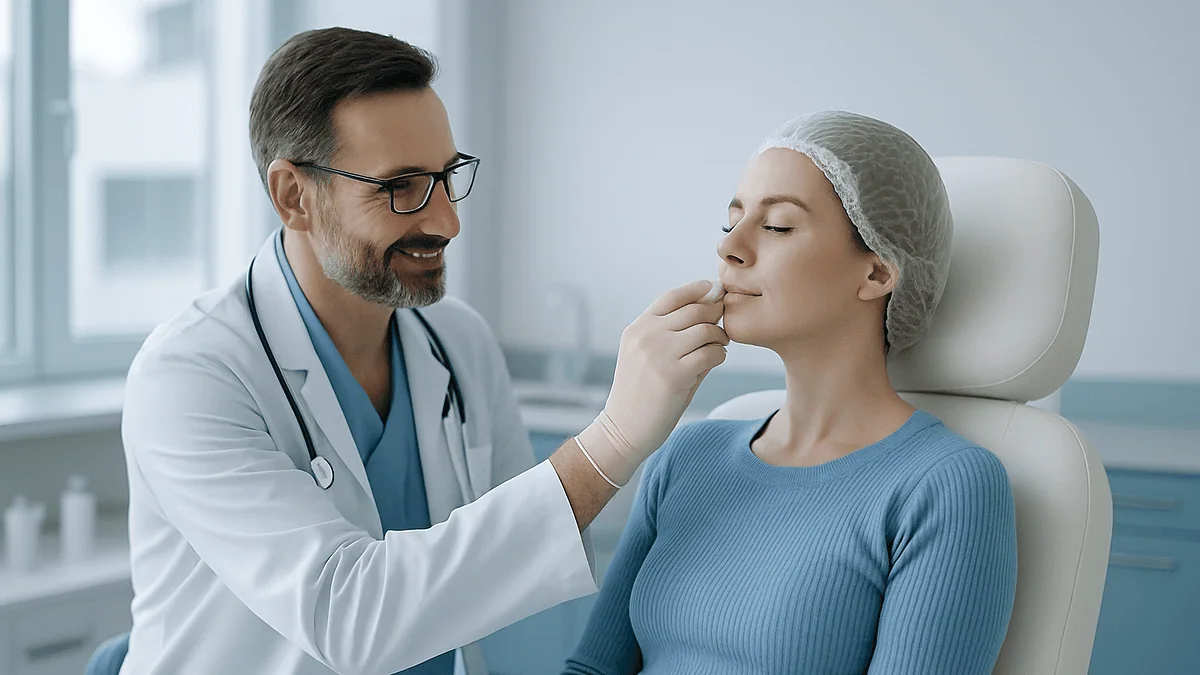
A bichectomy procedure, also called buccal fat removal, slims the lower cheeks by removing part of the buccal fat pad through a small incision inside the mouth, usually under local anesthesia with or without sedation. The surgeon opens the cheek lining near the upper back teeth, gently draws out a portion of fat, and closes with dissolvable stitches, leaving no external scar. The final contour emerges gradually as swelling settles.
The woman in the consulting room has brought a photograph of herself at nineteen. In it, her face is round in a way she has never liked, and at thirty-four it still is. Diet did not change it; neither did the jawline exercises a video promised would. What she wants to know is simple and slightly frightening: if a surgeon is going to take fat out of her cheeks, how exactly do they get in there without leaving a mark?
The honest answer is that the bichectomy procedure is one of the few operations on the face that never touches the skin. The entire approach happens through a cut about the length of a fingernail on the inside of the cheek. That single fact explains most of what patients love about it, and also why the risks are not where most people expect them to be.
This is a walk-through of what actually happens in that operating room, what the days afterward feel like, and the questions worth asking before anyone picks up a scalpel.
What the bichectomy procedure actually removes
Deep in each cheek, behind the muscle you use to chew and below the cheekbone, sits a lobulated pocket of fat called the buccal fat pad. The buccal fat pad is a distinct, encapsulated ball of fat, separate from the fat under the skin, and it is the sole target of a bichectomy procedure. The French anatomist Marie François Xavier Bichat described it in the early nineteenth century, which is why surgeons still call it Bichat’s fat pad and why the operation carries his name.
The pad has a main body and several extensions, or lobes, that thread between muscles toward the temple and the jaw. Anatomists believe it works as a gliding cushion, letting the chewing muscles slide smoothly over one another, and in infants it may help with suckling. Its size varies between people and does not shrink reliably with weight loss, which is the whole reason some slim adults still have full lower cheeks.
Only the buccal extension, the portion that bulges forward into the hollow below the cheekbone, is removed. The deeper lobes are left alone, both because they are hard to reach safely and because taking too much creates a gaunt look rather than a sculpted one. A surgeon reviewing anatomy studies indexed on PubMed will describe the goal as partial reduction, not excision of the whole structure.
Understanding this matters because it sets realistic expectations. The procedure does not touch jawline fat, the jowls that develop with age, or the fat that sits directly under the skin. It changes one specific region: the soft fullness between the cheekbone and the angle of the jaw.
Why the incision is made inside the mouth
Pick a route to the buccal fat pad and you have two choices. Come in through the facial skin, and you cut across nerve branches, cross the scar-prone cheek, and leave a visible mark forever. Come in through the mouth, and the pad is almost directly beneath the lining, separated from the surgeon by only a thin muscle. The choice is not close.

The intraoral approach, meaning access through the inside of the mouth, uses a short incision in the mucosa, the moist pink lining of the cheek. It is placed high, opposite the upper molars, roughly where a cheek bite would happen. Mucosa heals quickly, rarely forms thick scar, and is hidden the moment the mouth closes.
Two anatomical neighbors dictate exactly where that incision goes. The first is the parotid duct, the tube that carries saliva from the large parotid gland in front of the ear into the mouth; it opens through a tiny bump on the cheek lining opposite the upper second molar. The second is the buccal branch of the facial nerve, which powers the muscles that lift the corner of the mouth. Both run close to the fat pad, so the incision is positioned to stay beneath the duct opening and the dissection is kept shallow and blunt.
The surgeon then passes through the buccinator, the flat muscle that forms the wall of the cheek and keeps food from spilling into the space between teeth and lips. Gentle pressure on the outside of the cheek makes the fat present itself through the small opening, a bit like squeezing a grape from its skin. That maneuver, more than any cutting, is what defines the technique.
Step by step: how the bichectomy procedure is performed
Once anesthesia is working, the surgeon marks the outside of the cheek to show where the fullness sits, because the face looks different lying flat than sitting up. Everything that follows happens inside.
The mouth is held open, the cheek retracted, and the lining cleaned. An incision of roughly one to two centimeters is made in the mucosa opposite the upper molars, according to published surgical descriptions. Fine scissors or a blunt instrument spread the buccinator fibers rather than cutting them, protecting the small vessels and nerve twigs that run within.
Here is the moment patients ask about most. With the muscle parted, the surgeon presses on the outer cheek and the yellow, glistening fat of the buccal extension slides into view. It is grasped with forceps and drawn out slowly, without pulling hard, because tugging can recruit deeper lobes and cause bleeding or bruising. The surgeon judges how much to take by looking at the external contour as they go, comparing sides, and stops before the cheek looks hollow.
The freed portion is either clamped and cut, with any small bleeding vessel sealed, or tied off with a fine stitch. Bleeding is checked carefully, since a collection of blood inside the cheek, called a hematoma, is one of the more common complications. The mucosal opening is then closed with a few absorbable sutures that dissolve on their own.
The same steps are repeated on the other side. In experienced hands the whole operation is short, commonly under an hour for both cheeks in surgical series indexed on PubMed, though your team will give you their own estimate. There is no dressing to remove, because there is nothing on the skin to dress.
What anesthesia is used and what you feel during surgery
Because the incision is inside the mouth and the dissection is shallow, many surgeons perform a bichectomy procedure under local anesthesia, sometimes combined with light sedation. Local anesthesia numbs one small area while you stay awake; a local anesthetic works by temporarily blocking the nerves that carry pain signals from that spot. Sedation adds a medicine that makes you drowsy and relaxed without putting you fully to sleep. General anesthesia, which renders you unconscious, is less common for this operation on its own but may be chosen when it is combined with other procedures or when a patient strongly prefers it.

Awake patients usually describe pressure, tugging, and the odd sensation of someone pushing on the outside of the cheek while working inside it. Sharp pain should not be part of the experience; if it is, the surgeon adds more local anesthetic. The mouth is held open by a retractor, which some people find the least pleasant part.
The anesthesia choice shapes the day. Under local alone, most people go home shortly afterward. Under sedation or general anesthesia, you need someone to take you home and should not drive, drink alcohol, or sign important documents for at least twenty-four hours, guidance the NHS gives for all general anaesthetics. You will also be asked to fast beforehand if sedation or general anesthesia is planned.
Whichever route is used, the decision belongs to the surgeon and anesthesia team after reviewing your health history, and it is entirely reasonable to ask why they favor one option over another for you.
Who is usually a candidate, and who is usually asked to wait
The typical candidate is an adult whose lower cheeks look full despite a stable, healthy weight, and whose facial bones are strong enough to hold definition once the soft fullness is reduced. Surgeons look for a rounded lower face with good cheekbone projection, because the operation works by revealing structure that is already there. Without that structure, removing fat simply makes the face look flatter.
Several groups are commonly asked to pause or reconsider. People who are still losing or gaining weight are often asked to reach a stable point first, since the face changes with the body. Anyone with a naturally slender or angular face is usually counseled against it, because the same fullness that seems excessive in one’s twenties becomes a cushion against hollowing later. Active gum disease, dental infection, or poor oral hygiene raises the infection risk of any incision inside the mouth, so those are treated first.
Smoking impairs healing and blood supply to tissue, and surgeons routinely ask patients to stop before any elective operation; the NHS lists this among the standard steps before cosmetic surgery. Bleeding disorders, certain medicines that affect clotting, and uncontrolled diabetes call for careful review with the prescribing clinician rather than a quick yes.
Age is a softer criterion, but it shapes advice. Younger adults are often reminded that the face naturally loses volume over time, so a result that looks right now may look thin later. Older adults with early jowling may be told the fullness they dislike is not buccal fat at all but descended tissue that this procedure will not address.
Finally, the NHS recommends a cooling-off period of around two weeks between consultation and surgery for any cosmetic operation. A surgeon who encourages that pause is doing the job well.
Buccal fat pad surgery compared with other cheek-slimming options
Cheek fullness has several causes, and each one has a different answer. A table helps show where buccal fat pad surgery fits and where it does not.
| Approach | What it targets | Incision | How lasting | Typical caveat |
|---|---|---|---|---|
| Bichectomy (buccal fat removal) | Deep buccal fat below the cheekbone | Inside the mouth, no skin scar | Removed fat does not regrow | Cannot be reversed; face thins further with age |
| Facial liposuction | Fat directly under the skin of the jawline and jowl | Tiny skin punctures | Long-lasting if weight is stable | Does not reach the buccal pad |
| Chin or cheekbone augmentation (implant or filler) | Bone contour, not fat | Skin or intraoral for implants; needle for filler | Implants durable; fillers temporary | Adds structure rather than removing volume |
| Weight management | Whole-body fat, including some facial fat | None | Depends on maintenance | Buccal pad often changes little |
| Doing nothing | None | Face loses volume naturally over decades | Fullness may soften on its own with age |
Two lessons emerge. The first is that the buccal pad is a deep structure, so treatments aimed at skin-level fat leave it untouched. The second is that adding contour, through cheekbone or chin augmentation, sometimes produces a more balanced result than subtracting fat, particularly in someone with modest bone structure. Surgeons frequently discuss combining a small buccal reduction with augmentation elsewhere, and a candid consultation will explore all of these before settling on one.
Which option suits a given face is a judgment your treating team makes after examining you in person; no table can replace that.
How painful is buccal fat removal?
Most people are surprised that the cheeks themselves do not hurt much. The dominant sensations in the first days are tightness, swelling, and a bruised feeling when chewing, rather than sharp incisional pain. The inside of the mouth is well supplied with nerves, so the stitch line can feel raw for a few days, especially when eating anything salty or acidic.
Pain typically peaks in the first two or three days and then eases steadily, a pattern consistent with soft-tissue surgery described in patient guidance from MedlinePlus. Surgeons generally manage it with short courses of ordinary pain relievers chosen for the individual, and any medicine that affects bleeding is usually avoided unless the prescribing clinician says otherwise. Which medicine, how much, and for how long are decisions made by the treating team, not by a magazine.
Cold compresses applied to the outside of the cheeks in the first days reduce swelling and dull discomfort. Sleeping with the head elevated does the same. Soft, cool foods spare the incision; yogurt, smoothies, and soups are easier than anything that needs vigorous chewing.
Two sensations deserve mention because they alarm people who are not expecting them. Trismus, a temporary stiffness that limits how wide the mouth opens, is common when muscle in the cheek has been disturbed, and it eases as swelling resolves. Numbness or tingling of the inner cheek near the incision is also common and usually fades over weeks as small sensory nerve endings recover.
Pain that worsens after the third day, rather than improving, is a different matter and is covered in the section on when to call your doctor.
Buccal fat removal recovery: what the days and weeks look like
Recovery from a bichectomy procedure is front-loaded. The hardest part is the first few days, and the slowest part is waiting for the final shape.
In the first forty-eight hours, the cheeks swell, sometimes to the point where the face looks rounder than before surgery. That paradox unsettles almost everyone. Swelling is fluid, not fat, and it is the body’s normal response to a disturbed tissue plane. Bruising may appear on the outer cheek even though the skin was never cut, because blood tracks outward from the deep space.
Through the first week, most people keep to a soft diet, rinse the mouth gently after eating as directed by their team, and avoid vigorous exercise, which raises blood pressure and can provoke bleeding. The dissolvable stitches soften and fall away on their own, usually within the first couple of weeks. Many return to desk work within several days, though visible puffiness often lingers.
By two to three weeks the obvious swelling has largely gone, but the cheeks still hold some fluid and the contour is not yet settled. Surgeons in published series indexed on PubMed describe the final result appearing gradually over three to six months as the deep tissues contract and drape over the reduced pad. Photographs taken at one month are not the result; photographs taken at six months are.
Follow-up visits generally check the incision, look for fluid collections, and assess symmetry. If one side seems fuller, the team will usually wait for swelling to resolve before drawing any conclusion. These timelines are typical ranges, not guarantees, and your own surgeon’s instructions take precedence.
Is bichectomy permanent? The aging question surgeons debate
Yes, in the sense that matters most: fat removed from the buccal pad does not grow back. The remaining lobes can enlarge somewhat with significant weight gain, but the excised portion is gone. That permanence is exactly why the operation attracts both enthusiasm and caution.
The caution comes from what the face does over decades. Facial fat compartments, including the buccal pad, gradually lose volume with age, and the soft tissue of the midface descends. A cheek that looked pleasingly sculpted at twenty-eight can, in some people, look hollow and drawn at fifty as natural volume loss compounds the surgical reduction. Surgeons who write about long-term outcomes in the PubMed literature frequently flag this, and it is the main reason many decline to operate on people with already slender faces or on the very young.
The counterargument is that conservative removal, taking only the buccal extension and leaving the deeper lobes, limits that risk, and that the volume lost with aging comes from several compartments, not just this one. Both views are held by experienced clinicians, which tells you the evidence is not settled. Long-term controlled studies following patients for decades do not exist, so no one can promise you how your face will look in thirty years.
What can be done if a result looks too thin later? Fat grafting, in which fat from elsewhere in the body is injected into the cheek, or fillers can restore some volume. Neither perfectly reverses the surgery, and both carry their own considerations.
The practical upshot: treat this as a one-way decision. A surgeon who suggests removing less, or waiting, is offering something valuable.
Buccal fat removal risks: how risky is it really?
Set against many facial operations, a bichectomy procedure is small in scope, brief, and usually performed under local anesthesia. That does not make it risk-free, and the specific risks follow directly from the anatomy described earlier.
Bleeding and hematoma, a collection of blood inside the cheek, are the most frequent early problems. The space around the fat pad contains small vessels, and a hematoma can present as a rapidly enlarging, firm, painful swelling on one side. Small ones resolve; larger ones may need to be drained.
Infection is a particular concern for any incision inside the mouth, which is never a sterile place. The CDC describes the warning signs of a surgical site infection as redness, warmth, increasing pain, drainage, and fever, most commonly appearing within thirty days of surgery. Good oral hygiene and following rinsing instructions reduce the risk.
Injury to the parotid duct can cause saliva to leak into the cheek, forming a swelling called a sialocele, or a persistent drainage tract. Injury to the buccal branch of the facial nerve can weaken the muscles that lift the corner of the mouth, producing an asymmetric smile; most such weakness is temporary from stretching or swelling, but permanent injury is possible.
Asymmetry, where one cheek ends up fuller or more hollow than the other, is the most common late complaint and can reflect uneven removal or simply the fact that no face is symmetrical to begin with. Over-resection producing a gaunt appearance is the complication surgeons fear most because it is hard to correct.
Published complication rates vary by series and technique, and the NHS reminds patients that all cosmetic surgery carries risks that must be weighed against benefit. Your surgeon should walk you through their own experience honestly.
What people often get wrong about bichectomy
Misunderstandings cluster around this operation, partly because it is small and partly because social media has made it look like a filter.
The first myth is that it slims the whole face. It does not. It reduces one deep pocket below the cheekbone. It leaves the jawline, the jowls, the chin, and the fat under the skin untouched. Someone hoping for a sharper jaw may be looking at the wrong procedure entirely.
The second is that the swelling you see at one week is the result. It is not, and disappointed patients who judge early are a recurring theme. The reduced pad shows itself only after months, once fluid has cleared and tissue has settled.
The third is that because there is no skin incision, nothing important is nearby. In truth the parotid duct and facial nerve branches sit within millimeters of the working field, which is why technique and experience matter more than the size of the cut.
The fourth is that weight loss will do the same job. The buccal pad is a distinct, encapsulated structure that does not track body weight closely, which is precisely why slim people seek the surgery. The reverse is also true: gaining weight afterward may not restore what was removed.
The fifth is that it is reversible. It is not. Fat grafting and fillers can add volume back, but they are separate procedures with their own limitations.
And the last, quieter one: that a round face is a flaw to be corrected. Fuller cheeks are a normal variation and, over a lifetime, often an advantage. The decision to change them is personal and legitimate, but it deserves a clear-eyed reason, not a trend.
How to prepare for the procedure
Preparation for a bichectomy procedure is mostly about the mouth and about healing.
Dental health comes first. Because the incision passes through the cheek lining, any active gum inflammation or tooth infection raises the chance of a wound infection. A dental check and professional cleaning before surgery is common advice, and existing problems are treated first.
Smoking and nicotine in any form constrict blood vessels and slow healing; the NHS advises stopping before cosmetic surgery, and your surgeon will tell you how far in advance they want that to happen. Alcohol is generally limited in the days before, as it can increase bleeding and interact with anesthesia.
Medicines and supplements need a careful review with the prescribing clinician. Some over-the-counter pain relievers, certain herbal products, and prescription blood thinners affect clotting. No one should stop a prescribed medicine on their own; the surgeon and the doctor who prescribed it decide together what, if anything, changes, and when.
If sedation or general anesthesia is planned, you will be given fasting instructions and asked to arrange for someone to take you home and stay with you, in line with standard NHS guidance on anaesthesia. Under local anesthesia alone, many people still prefer company.
Practical preparations are simple. Stock soft foods and cold packs. Plan a few quiet days away from strenuous work. Take clear, evenly lit photographs of your face from the front and both sides, because memory of one’s own appearance is unreliable and comparison months later is genuinely useful.
Above all, use the cooling-off period the NHS recommends, around two weeks, to sit with the decision. Surgeons who respect that pause are following good practice, not being obstructive.
Questions to ask your care team
A consultation is a two-way examination. You are assessing the surgeon as carefully as they are assessing your face. The NHS advises checking that a surgeon is registered with the relevant national body and has specific training in the operation you are considering, and the same principle applies wherever you live.
Questions that tend to reveal the most:
- How much of my cheek fullness is buccal fat, and how much is skin-level fat or bone structure? Would a different approach suit me better?
- How conservatively do you remove the pad, and how do you decide when to stop during the operation?
- How do you protect the parotid duct and the facial nerve branches during dissection?
- What anesthesia do you recommend for me and why?
- What complications have you seen in your own practice, and how were they managed?
- How will my face likely change with age after this, given my bone structure and current volume?
- What happens if one side heals differently from the other?
- Who do I contact after hours if something worries me, and what would make you want to see me urgently?
- Can I see photographs of your patients at six months or later, not just at a few weeks?
Notice what is not on the list. Pressure to book quickly, a heavy emphasis on limited-time availability, or reluctance to discuss alternatives are signals the NHS specifically warns about in its guidance on choosing who performs a cosmetic procedure. A good team welcomes hard questions and is comfortable saying that surgery is not the right choice for you.
Write the answers down. Decisions made calmly, with a record to look back on, are the ones people regret least.
When to call your doctor
Most recovery is uneventful, and the daily pattern is steady improvement: a little less swelling, a little less soreness, each day slightly easier than the last. The signals to act on are the ones that break that pattern.
Call your surgical team the same day if you notice any of the following:
- A cheek that is suddenly, rapidly enlarging, especially on one side, or feels tense and firm, which can indicate a hematoma.
- Increasing pain after the third day rather than gradual improvement.
- Redness spreading across the cheek, warmth, pus or foul-tasting drainage inside the mouth, or a fever, which the CDC lists as signs of a surgical site infection.
- Difficulty opening the mouth that worsens rather than eases, or trouble swallowing.
- Weakness in the smile, a drooping corner of the mouth, or new numbness that is not improving.
- Persistent watery or salty fluid collecting in the cheek, or leaking from the incision when you eat, which may point to a parotid duct injury.
- Bleeding inside the mouth that does not stop with gentle pressure.
Seek emergency care immediately for swelling that threatens breathing, a high fever with chills and confusion, or heavy bleeding that soaks through repeatedly. These are rare, but they do not wait.
Fluid collection, infection, or nerve irritation can usually be managed well when caught early, and early is the whole point. Do not worry about bothering the team; a call about nothing is far cheaper for everyone than a complication that is left to grow.
Every decision about treatment, from whether to drain a swelling to whether a medicine is needed, rests with the surgeon who examined you. This article informs those conversations; it does not replace them.
Frequently asked questions
How risky is buccal fat removal?
It is a small operation with real but uncommon risks. The main early problems are bleeding into the cheek and infection, since the incision sits inside the mouth. Less common are injury to the saliva duct or a facial nerve branch, and the most frequent late concern is asymmetry or an overly hollow look. Published rates vary by technique, and your surgeon should share their own experience honestly.
How much does a bichectomy cost?
This magazine does not publish prices for any treatment, because figures vary widely by region, anesthesia type, and whether other procedures are combined, and a number quoted out of context can mislead. The NHS advises focusing first on the surgeon’s qualifications, registration, and complication record, then obtaining a full written quote directly from the clinic that includes follow-up and any revision policy.
Is bichectomy permanent?
Yes. Fat removed from the buccal pad does not grow back, though the remaining lobes may enlarge slightly with substantial weight gain. Because facial volume also declines naturally with age, a result that looks balanced now may look thinner decades later. That permanence is the main reason surgeons favor conservative removal and often advise slender or very young patients to wait.
How painful is buccal fat removal?
Most people describe tightness, swelling, and a bruised feeling when chewing rather than sharp pain, with discomfort peaking in the first two or three days and then easing. The stitch line inside the mouth can sting with salty or acidic foods. Cold compresses, head elevation, soft foods, and pain relief chosen by your team usually keep it manageable. Pain that worsens after day three warrants a call.
What does buccal fat removal recovery look like week by week?
The first days bring the most swelling and bruising, often making the face look rounder than before. By the end of the first week most people are eating soft foods comfortably and returning to light activity. Around two to three weeks the obvious puffiness has largely gone, and the dissolvable stitches have fallen away. The final contour emerges gradually over roughly three to six months in published series.
Does buccal fat pad surgery leave a scar?
Not a visible one. The incision is made in the moist lining inside the cheek, which heals quickly and is hidden whenever the mouth is closed. You may feel a small firm ridge along the healed line for a few weeks. Bruising can appear on the outer cheek even though the skin was not cut, because blood tracks outward from the deep tissue.
Can buccal fat removal be reversed if I regret it?
Not truly. Once the fat is removed, it is gone. Volume can be added back with fat grafting, in which fat from elsewhere in the body is injected into the cheek, or with fillers, but these are separate procedures with their own limitations and do not recreate the original anatomy. Surgeons emphasize conservative removal precisely because correction is imperfect.
Will losing weight change my cheeks the same way?
Usually not. The buccal fat pad is an encapsulated deep structure that changes less with body weight than the fat under the skin, which is why many slim people still have full lower cheeks. Weight loss can reduce jawline and jowl fullness, but it often leaves the buccal region largely unchanged. Surgeons still generally ask patients to reach a stable weight before operating.
What kind of anesthesia is used for a bichectomy procedure?
Most commonly local anesthesia, which numbs the cheek while you stay awake, sometimes with light sedation to help you relax. General anesthesia is used less often on its own but may be chosen when the procedure is combined with others or when a patient strongly prefers it. After sedation or general anesthesia, the NHS advises not driving or making important decisions for at least twenty-four hours.
How do I know if I am a good candidate?
Typical candidates are adults at a stable weight with a rounded lower face and good cheekbone structure, since the operation works by revealing what is already there. People with slender or angular faces, active dental or gum disease, ongoing weight change, or who smoke are commonly asked to wait or reconsider. Only an in-person examination by a qualified surgeon can determine what applies to you.
References
- NHS – Cosmetic procedures: overview
- NHS – Choosing who will do your cosmetic procedure
- NHS – General anaesthesia
- CDC – About Surgical Site Infections
This article is for general information only and is not a substitute for professional medical advice. Please consult a qualified doctor about your individual situation.

More from the Blog

Blood Thinners, Smoking and Rhytidectomy: What Surgeons Ask You to Stop Before a Facelift
Before a facelift, surgeons usually ask patients to stop anything that raises bleeding risk or starves healing skin of oxygen. That typically means blood-thinning…

Abdominal Etching: How Six-Pack Liposuction Works and Who It Actually Suits
Abdominal etching is a specialized liposuction technique that removes small amounts of fat in precise lines over the abdominal muscles to mimic a six-pack.…

Neck Lift Complications Explained: Hematoma, Nerve Weakness and Contour Irregularities
Neck lift complications are unwanted events caused by the surgery itself, as opposed to expected effects such as bruising and swelling. The three most…

What to Ask a Surgeon Before Prominent Ear Surgery: Technique, Symmetry and Timing
Before prominent ear surgery (otoplasty), ask the surgeon which technique they plan to use on your cartilage and why, how they measure and judge…

Questions to Ask Before a Rhytidectomy: Technique, Scars and What a Facelift Will Not Change
Before a rhytidectomy, ask which facelift technique the surgeon proposes and why, where the incisions will sit, how scars usually mature, what the operation…
How Ear Reconstruction Works: Rib Cartilage Framework, Staged Surgery and Skin Coverage
Rib cartilage ear reconstruction rebuilds a missing or underdeveloped outer ear using the patient's own rib cartilage. A surgeon removes cartilage from several ribs,…