

How Bleeding Gums Progress From Gingivitis to Periodontitis, and How Care Is Planned

Key Takeaways
- Gingivitis affects only the gum and usually settles within about ten to fourteen days of thorough plaque control, according to Cleveland Clinic, while periodontitis has already destroyed some supporting bone that does not regrow on its own.
- Dentists distinguish the two by probing: Mayo Clinic describes healthy gum pockets as one to three millimeters deep, with pockets beyond four millimeters suggesting periodontitis and those beyond five millimeters impossible to clean at home.
- The CDC estimates 47.2 percent of US adults aged 30 and over have some periodontal disease, rising to 70.1 percent after age 65, and most of it is painless until late.
- Smoking both accelerates bone loss and hides bleeding by constricting gum blood vessels, so a smoker's gums can look healthier than they are.
- Care follows a fixed sequence everywhere: control the cause, remove deposits above and below the gumline, re-measure, escalate to surgery only for unresponsive sites, then maintain for life.
- No mouthwash removes tartar or reaches deep pockets; the NHS is clear that rinses supplement, and never replace, two minutes of brushing twice daily plus daily cleaning between teeth.
Gingivitis is inflammation confined to the gum tissue that bleeds and swells but has not yet damaged the bone or fibers holding teeth; with thorough plaque removal it usually settles. Periodontitis is the next stage, where inflammation has destroyed some supporting bone, creating deeper pockets around teeth. Dentists tell them apart by measuring pocket depth and reviewing X-rays, then plan care in stages.
It starts with a faint pink swirl in the sink. You rinse, look again, and tell yourself it was the new toothbrush, or the crusty bread, or nothing at all. Weeks later the tinge is still there, and now the floss comes out red too. Somewhere between shrugging it off and searching your symptoms at midnight sits a genuinely useful question: is this gingivitis vs periodontitis, and does the difference change what happens next?
It changes almost everything. One is a reversible irritation of the soft gum; the other has already eaten into the bone that anchors your teeth. From the outside they can look strikingly similar, which is exactly why a dental team measures rather than guesses.
This explainer walks through what is happening beneath the gumline, how clinicians stage the damage, who gets treated first, what the appointments involve, and which signs mean you should stop waiting and pick up the phone.
What actually happens in the gum when plaque stays too long
Every few hours, a sticky film of bacteria called plaque settles along the line where tooth meets gum. Brushing and cleaning between the teeth sweep most of it away. Whatever remains hardens within days into tartar, a mineralized crust that a toothbrush cannot remove and that gives fresh bacteria a rough surface to cling to.
The body notices. Immune cells rush to the gum margin, blood vessels widen, and the tissue becomes puffy, tender and quick to bleed. That is gingivitis: the word simply means inflammation of the gingiva, the visible pink collar of gum around each tooth. At this point the periodontal ligament (the fine fibers tethering root to bone) and the alveolar bone beneath are intact. Remove the irritant and the gum quiets down, often in about ten to fourteen days according to Cleveland Clinic.
Left alone, the story changes. The inflamed gum peels slightly away from the tooth, creating a small pocket. Bacteria colonize the pocket, where oxygen is scarce and brushes never reach. The immune response, now chronic, begins releasing enzymes that break down ligament and bone, not just soft tissue. The pocket deepens, harboring still more bacteria, and a self-feeding cycle sets in.
That transition, from swollen gum to lost bone, is the line between gingivitis and periodontitis. Crucially, bone that is destroyed by periodontitis does not regrow on its own. Gum swelling can be undone; bone loss can only be stopped, and in some situations partly rebuilt with surgery. This is why dentists treat bleeding gums as a signal worth acting on rather than a cosmetic nuisance.
Gingivitis vs periodontitis: how you actually tell them apart
In a mirror, both conditions can show the same three things: gums that look redder than the surrounding tissue, mild puffiness at the margin, and bleeding when you brush or floss. Bad breath that returns quickly after brushing is common to both. So the honest answer to “how do you tell?” is that you usually cannot tell reliably by looking. A clinician tells the difference by measuring.

The key instrument is a periodontal probe, a slender ruler with markings in millimeters that slides gently between gum and tooth. In a healthy mouth Mayo Clinic describes the gap as typically one to three millimeters deep; pockets deeper than four millimeters may indicate periodontitis, and pockets beyond five millimeters cannot be cleaned well with ordinary home care. The dentist records six measurements around every tooth and notes where bleeding follows the probe.
Bleeding alone means inflammation. Depth plus bleeding suggests attachment has been lost. X-rays then confirm the picture, because bone height is invisible to the naked eye. In gingivitis the bone crest sits close to where the roots begin; in periodontitis it has retreated down the root.
Some clues do tilt the odds before any measurement. Gums that have visibly pulled back so teeth look longer, gaps opening between teeth that used to touch, teeth that feel slightly loose or shift when you bite, and pus at the gumline all point toward periodontitis rather than gingivitis. These are described by Mayo Clinic and the NHS as later features, not early ones, which is precisely why waiting for them is a poor strategy.
What does stage 1 periodontitis look like, and how are the stages defined?
People searching for “stage 1 periodontitis” often expect something dramatic. In reality, the earliest stage is quiet. The gums may bleed a little, feel slightly tender, and the probe finds a few pockets just beyond the healthy range. An X-ray shows the very beginning of bone loss at the crest, a change most patients would never suspect. Cleveland Clinic describes this initial stage as the point where the gums start to pull away and bone loss has only just begun, with no tooth mobility.
Dental teams now stage periodontitis using an internationally agreed system that looks at how much support has been lost and how complex the case is to manage. In plain terms:
- Stage I (initial): shallow pockets, minimal bone loss, no teeth lost to disease.
- Stage II (moderate): deeper pockets and clearer bone loss on X-ray, teeth still stable.
- Stage III (severe): bone loss reaching the middle of the root or beyond, possible looseness, some teeth may already be lost.
- Stage IV (advanced): extensive loss with drifting or missing teeth and difficulty chewing.
Alongside the stage, clinicians assign a grade that estimates how fast the disease is likely to progress, weighing factors such as smoking and diabetes. A stage I case in a heavy smoker with poorly controlled blood sugar may be watched far more closely than the same measurements in a non-smoker.
The stage describes damage already done; it does not predict the future on its own. What matters most is that stage I is the moment when stopping progression is most achievable and least invasive, which is why an early diagnosis, unsettling as it sounds, is good news in disguise.
Gingivitis vs periodontitis at a glance
Because the two conditions overlap so heavily in how they feel, a side-by-side view helps. The table below draws on descriptions from Mayo Clinic, the NHS and Cleveland Clinic. Use it to understand what your dentist is assessing, not to diagnose yourself; only measurement and imaging settle the question.
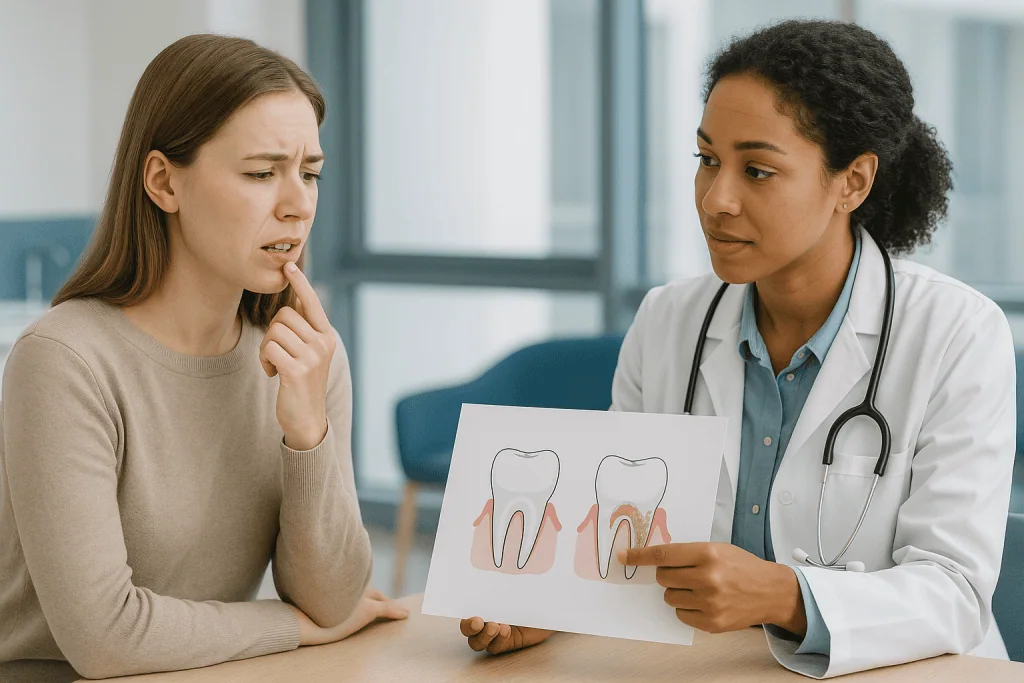
| Feature | Gingivitis | Periodontitis |
|---|---|---|
| Tissue affected | Gum only | Gum, ligament and supporting bone |
| Bleeding on brushing | Common | Common, may also bleed spontaneously |
| Pocket depth on probing | Usually within the healthy 1–3 mm range described by Mayo Clinic | Deeper pockets, typically beyond 4 mm |
| Bone loss on X-ray | None | Present, from minimal to extensive |
| Gum recession | Unusual | Frequent as disease advances |
| Loose or shifting teeth | No | Possible in later stages |
| Reversibility | Usually fully reversible with plaque control | Damage can be halted and managed; lost bone does not regrow without surgery |
| Typical care | Professional cleaning plus home care | Deep cleaning below the gumline, sometimes surgery, then lifelong maintenance |
Two lines in this table deserve emphasis. First, bleeding appears in both columns, so a bleeding gum by itself cannot tell you which condition you have. Second, the reversibility row explains why clinicians push so hard on early treatment. Gingivitis is the last exit before permanent change.
One more nuance: not every case of gingivitis progresses to periodontitis, and the CDC notes that susceptibility varies widely between people. Some individuals carry heavily inflamed gums for years without bone loss; others lose attachment quickly. Which group you fall into is not something you can feel, which brings us to the risk factors that shape a care plan.
Why some people progress to periodontitis and others never do
Plaque is necessary for gum disease but not sufficient to explain who develops the destructive form. The CDC estimates that 47.2 percent of US adults aged 30 and older have some form of periodontal disease, rising to 70.1 percent of adults aged 65 and older. Behind those numbers sit factors that tilt an individual’s immune response toward tissue destruction.
Smoking is the one clinicians raise first. The CDC identifies it as among the most significant risk factors for gum disease, and tobacco also masks bleeding by constricting blood vessels, so smokers may look healthier at the gumline than they are while losing bone underneath. Diabetes runs in both directions: high blood sugar impairs the body’s response to infection and worsens periodontitis, while active gum infection makes blood sugar harder to control, according to the CDC and Mayo Clinic.
Other contributors described by Mayo Clinic and the NHS include:
- Hormonal shifts during pregnancy, puberty and menopause, which make gums more reactive to plaque.
- Medications that reduce saliva or cause gum overgrowth, making cleaning harder.
- Genetics, since some families show a stronger inflammatory tendency.
- Conditions that lower immunity and treatments that suppress it.
- Stress and poor nutrition, which blunt healing.
- Crowded teeth, ill-fitting dental work and grinding habits that create hard-to-clean niches or overload teeth.
Age matters mainly because damage accumulates; older adults have simply had longer exposure. None of these factors means periodontitis is inevitable, and none excuses skipping the basics. They do explain why two people with identical brushing habits can have very different gums, and why a good care plan asks about your health history, not just your mouth.
How a dental team plans care: the assessment behind the plan
Planning begins with a conversation, not a scraper. Your dentist or hygienist will ask about bleeding, tenderness, bad breath, loose teeth, smoking, medical conditions, medications and previous dental work. This history shapes the grade assigned later and flags anything that might complicate treatment.
Next comes the full-mouth examination. The clinician inspects gum color and contour, checks for recession and swelling, presses gently to look for pus, and tests whether any tooth moves. Then the periodontal probe measures pocket depths at six points around each tooth, and the pattern of bleeding is charted. This chart becomes the baseline against which every future visit is compared; a pocket that measures the same a year later is a success, one that deepens is a warning.
Dental X-rays complete the picture by revealing bone height between and around the roots. Mayo Clinic describes these steps, history, probing and imaging, as the standard basis for diagnosing periodontitis and determining its severity.
From that information the team assigns a stage and grade, and the plan follows a logical sequence that is broadly the same everywhere:
- Control the cause: home-care coaching tailored to your mouth, plus support to stop smoking and manage diabetes where relevant.
- Remove the deposits: professional cleaning above the gumline for gingivitis, deep cleaning below it for periodontitis.
- Re-evaluate: measure again after healing and decide whether pockets have closed enough.
- Escalate only where needed: surgery for sites that have not responded.
- Maintain: regular supportive visits for life.
Every one of these steps is a decision made with you by your treating team, weighing your findings, health and preferences.
Who is usually treated straight away, and who is usually asked to wait
Most people with gingivitis or early periodontitis start treatment at the first appointment, because the core intervention, removing plaque and tartar, carries minimal risk and delaying it only allows more damage. Anyone with bleeding gums and pockets in the periodontitis range is generally offered deep cleaning promptly, along with home-care instruction.
Some situations change the order rather than the destination. A person who smokes may be encouraged to begin quitting before or alongside treatment, because Mayo Clinic notes that smoking reduces the response to periodontal therapy; the cleaning still happens, but the team knows healing will be slower and plans reviews accordingly. Someone with poorly controlled diabetes is often asked to work with their medical team on blood sugar in parallel, since both conditions improve together.
Surgical steps are where waiting is most common. Dentists typically ask patients to complete non-surgical deep cleaning and prove they can maintain a clean mouth before considering surgery, because operating on gums that will quickly re-accumulate plaque rarely holds. Those on medicines that affect bleeding or bone healing, people undergoing cancer treatment, and anyone with an uncontrolled medical condition will usually have surgery timed with their physicians.
Pregnancy deserves its own mention. Gums often become more inflamed during pregnancy, and routine cleaning and gingivitis treatment are considered appropriate; elective surgical procedures are commonly deferred until after delivery, a decision made jointly with the obstetric team.
Children and teenagers rarely have periodontitis, though gingivitis is common. When periodontitis does appear early in life, dentists look carefully for underlying conditions and involve specialists. In every case, the sequence and timing rest with the clinicians who have examined you.
What scaling and root planing involves, appointment by appointment
Scaling and root planing is the workhorse of periodontitis care. Scaling means removing plaque and hardened tartar from the tooth surface, including below the gumline inside the pockets. Root planing means smoothing the exposed root surface so that bacterial toxins are cleared and the gum can reattach more snugly. Mayo Clinic lists both as the first-line non-surgical treatments for periodontitis.
The appointment itself is unglamorous. After numbing the area with local anesthetic if pockets are deep or tender, the hygienist or dentist works with fine hand instruments and often an ultrasonic device, a tip that vibrates rapidly while spraying water to loosen deposits. You will hear scraping and feel pressure but should not feel sharp pain. Because thoroughness matters more than speed, the mouth is usually treated in sections across one or more visits, a schedule your team sets based on how many sites are involved and how comfortable you are.
Home care is taught at the same time, and it is not an afterthought. Deep cleaning removes what is there today; only your daily routine prevents it from returning. Expect specific coaching on brush angle along the gumline, choosing interdental brushes or floss sized to your gaps, and cleaning around any bridges or implants. The NHS recommends brushing for about two minutes twice daily and cleaning between the teeth every day.
Common risks are modest: gum tenderness for a few days, sensitivity to cold as receded gums expose root surfaces, and small changes in gum contour as swelling resolves. Alternatives to deep cleaning are limited, since removing the cause is the point; declining treatment means accepting ongoing bone loss, a trade-off your dentist will explain frankly.
When surgery or grafting enters the periodontitis plan
After deep cleaning and a healing period, the team re-measures every pocket. Sites that have shrunk back to a maintainable depth are simply monitored. Sites that remain deep, particularly beyond the five millimeter threshold Mayo Clinic describes as uncleanable at home, may be candidates for surgery. The goal is not cosmetic; it is to create shapes that a toothbrush and interdental brush can keep clean.
Mayo Clinic describes several surgical options, each chosen for a specific problem:
- Flap surgery (pocket reduction): the gum is lifted back, roots are cleaned under direct vision, and the tissue is reshaped and stitched so pockets are shallower.
- Bone grafting: where bone has been lost around a root, grafting material is placed to hold the space and support new bone formation.
- Guided tissue regeneration: a membrane is positioned between bone and gum so that bone, rather than faster-growing soft tissue, refills the defect.
- Soft tissue grafts: tissue, often from the palate, covers exposed roots to reduce sensitivity and further recession.
- Tissue-stimulating proteins: a gel applied to the root that encourages regrowth of ligament and bone.
These procedures are usually done under local anesthetic, sometimes with sedation, by a periodontist, a dentist with additional specialist training in gum and bone disease. Risks described neutrally include post-operative soreness, swelling, bleeding, infection, and longer-looking teeth as swollen gum tightens.
Regenerative approaches can rebuild some lost support, but results vary with the shape of the defect, smoking status and general health, and no clinician can promise a specific outcome. The alternative for a hopeless tooth is extraction with a plan for replacement. Which route suits a given tooth is a judgment your treating team makes with you after seeing how the site has responded so far.
What the following days and weeks usually look like
In the first day or two after a deep cleaning, gums typically feel tender and may look more inflamed than before, a normal response to instrumentation. Cold drinks can zing against newly exposed root surfaces. Light bleeding when brushing the treated area is expected and settles as the tissue heals. Your team will suggest comfort measures and may recommend a specific toothpaste for sensitivity; follow their instructions rather than a friend’s.
Over the next couple of weeks something quieter happens. Without the constant bacterial irritation, swelling drains away and the gum tightens against the tooth. Ironically, this can make gums look as if they have receded; in fact you are seeing the true position of the gum now that puffiness is gone. Teeth may feel slightly more sensitive, and small dark triangles can appear between teeth where swollen tissue once filled the gap.
Gingivitis alone generally improves noticeably in the ten to fourteen days Cleveland Clinic describes, provided brushing and interdental cleaning continue daily. Periodontitis takes longer to judge because the team is waiting for pockets to remodel, so a re-evaluation appointment is scheduled some weeks after the final cleaning session to re-probe and compare with the baseline chart.
From there, most people with a history of periodontitis move to supportive periodontal maintenance. Cleveland Clinic notes that many dentists recommend cleanings every three to four months for these patients, more frequent than the standard check-up rhythm, because pockets that once harbored disease refill with bacteria faster than healthy gums. Those visits are short and targeted: re-measure, clean below the gumline where needed, adjust home care, and catch any site drifting back before bone is lost. The intervals are set by your clinician and can lengthen when your mouth stays stable.
When is it too late to treat periodontitis, and can periodontitis be reversed?
Two fears drive this question. The first is that the damage has gone too far to bother. The second is that treatment is pointless because the disease cannot be undone. Neither holds up well against what the evidence shows.
On reversal: gingivitis is reversible, and Cleveland Clinic and Mayo Clinic both describe full recovery of the gum with good plaque control. Periodontitis is different because bone, once resorbed, does not spontaneously regrow. What treatment does is halt the destructive process, close pockets so they can be kept clean, and in selected sites rebuild some support through regenerative surgery. Clinicians therefore talk about periodontitis being controlled or managed, in the same way high blood pressure is managed, rather than reversed.
On lateness: there is no stage at which treatment stops making sense for the mouth as a whole, though there can be a point at which an individual tooth is beyond saving. A tooth that has lost most of its bone support and moves visibly may be judged hopeless and removed, both to relieve infection and to protect its neighbors. Even then, treating the remaining teeth preserves chewing function and creates a stable foundation for replacements.
Advanced disease also carries reasons to act beyond the mouth. The CDC and Mayo Clinic describe associations between periodontitis and cardiovascular disease, diabetes control and respiratory infections, though the research shows association rather than proven cause. Reducing chronic oral inflammation is reasonable on general health grounds while that science develops.
The practical answer is that the best time to treat was at the first sign of bleeding, and the second-best time is now. What your dentist can realistically achieve depends on what remains, and that assessment is theirs to make after a full examination.
What mouthwash kills gingivitis, and where medicines fit in the plan
The honest answer is that no mouthwash kills gingivitis. Rinsing cannot remove tartar or reach deep into pockets, and the NHS is explicit that mouthwash is not a substitute for brushing and cleaning between the teeth. What antiseptic rinses can do is reduce the bacterial load on surfaces you have already cleaned, which may modestly lower plaque and gum inflammation as an add-on.
Dentists sometimes suggest a short course of a prescription-strength antiseptic rinse, most commonly one based on chlorhexidine, after deep cleaning or surgery when brushing a tender area is difficult. It works by binding to oral surfaces and disrupting bacterial membranes. The NHS notes it can stain teeth and alter taste with longer use, so it is generally used for limited periods under a dentist’s direction, not as a permanent habit. Over-the-counter rinses containing essential oils or cetylpyridinium chloride are milder alternatives some people use daily; whether any rinse adds value for you is a question for your dental team.
Antibiotics have a narrower role. Mayo Clinic describes topical antibiotics placed directly into pockets after deep cleaning, and oral antibiotics in select cases of aggressive or spreading infection. They target bacteria that instruments cannot fully clear, but they are adjuncts, never a replacement for mechanical cleaning, and they are prescribed selectively because of resistance concerns. Any decision to start, continue or stop one belongs with the prescribing clinician.
Toothpastes with fluoride protect against decay on exposed roots, and some contain agents aimed at gum inflammation; again, their contribution is small compared with technique. If you want the single most powerful “product” against gingivitis, it is a correctly angled toothbrush used for two minutes twice a day, plus something that cleans between the teeth, exactly as the NHS advises.
What people often get wrong about bleeding gums and gum disease
“Bleeding means I am brushing too hard, so I should brush less.” Occasionally a stiff brush does cause trauma, but far more often bleeding signals inflammation from plaque left behind. Backing off makes it worse. Switching to a soft brush and cleaning more thoroughly, especially between teeth, is what Mayo Clinic and the NHS recommend.
“No pain, no problem.” Periodontitis is largely painless until late. Bone can disappear for years while nothing hurts, which is why the CDC’s figures on prevalence are so much higher than most people would guess.
“Gum disease only affects older people.” Damage accumulates with time, but gingivitis is common in teenagers, and periodontitis appears in adults of every age. Risk factors such as smoking and diabetes matter more than birthdays.
“A good mouthwash will fix it.” As above, rinsing supplements cleaning; it cannot replace it.
“Once you have periodontitis, you will lose your teeth.” Uncontrolled, yes, eventually. Controlled with treatment and maintenance, many teeth remain for life. The disease responds to consistent care; what it does not tolerate is neglect.
“Receding gums after a cleaning means the dentist damaged them.” The gum did not recede; swelling resolved, revealing the position the tissue had already reached. That reveal is a sign of healing, not harm.
“It runs in my family, so nothing I do matters.” Genetics shift susceptibility, not destiny. People with a family history simply have more to gain from meticulous plaque control and closer monitoring.
“Bleeding during pregnancy is normal, so it can be ignored.” Hormonal changes do make gums more reactive, but the inflammation is still plaque-driven and still responds to cleaning, which the NHS encourages during pregnancy.
Questions to ask your care team about gingivitis and periodontitis
A ten-minute conversation can turn a confusing diagnosis into a plan you understand. Bring these to your next appointment and write down the answers.
- Is this gingivitis or periodontitis, and what measurements or X-ray findings led you to that conclusion?
- If it is periodontitis, what stage and grade have you recorded, and which teeth are most affected?
- Which of my risk factors do you think matter most, and what would change my grade over time?
- What will the deep cleaning involve, how many visits do you anticipate, and will I be numbed?
- What should I expect to feel in the days afterward, and what would be unusual enough to call about?
- When will you re-measure, and what results would mean surgery is or is not needed?
- If surgery is discussed, what exactly is the goal for each site, and what are the alternatives, including watching or extraction?
- Are you recommending any rinse, gel or antibiotic, why, and for how long?
- How should I clean between my teeth given the shape of my gaps, and can you show me on my own mouth?
- How often will I need maintenance visits, and how will we decide when that interval can change?
- Are any of my medications or medical conditions affecting my gums, and should my physician know about this diagnosis?
- If I smoke, what support is available to help me stop, and how does that affect my treatment timing?
Notice that several questions ask for the reasoning, not just the recommendation. Good clinicians welcome that; a plan you understand is a plan you will follow. It also gives you a record to compare against at the next visit, so that a pocket that has shrunk from six millimeters to three is something you can celebrate together.
When to call your doctor or dentist
Most gum disease moves slowly and can wait for a scheduled appointment. A few signs should not. Contact your dentist promptly, or seek urgent medical care if a dental service is unavailable, if you notice any of the following, which Mayo Clinic and the NHS describe as features of advanced or acute infection:
- A tooth that has become noticeably loose or has shifted position over days or weeks.
- Pus, a bad taste, or a pimple-like swelling on the gum, especially if it is painful or recurring.
- Rapidly increasing swelling of the gum, face or jaw, particularly with fever or feeling unwell.
- Difficulty swallowing, difficulty opening the mouth, or any swelling that affects breathing; these are emergencies and warrant immediate care.
- Gums that bleed heavily or spontaneously without brushing, or bleeding that does not stop with gentle pressure, especially if you take blood-thinning medication or have a bleeding disorder.
- Severe, persistent gum pain, or ulcers on the gums accompanied by fever and foul breath, which can indicate a more aggressive infection.
- Bleeding gums together with unexplained bruising, tiredness or frequent infections elsewhere, which may point to a general medical cause needing your physician’s attention.
Beyond these red flags, book a routine appointment if bleeding persists after two weeks of careful brushing and interdental cleaning, if your gums appear to be receding, if teeth feel newly sensitive along the gumline, or if bad breath does not improve with cleaning. The NHS advises seeing a dentist as often as they recommend, and more promptly when symptoms change.
Pregnant patients, people with diabetes, and anyone about to start treatment that suppresses immunity or affects bone should mention bleeding gums to both their dentist and their physician, since the two teams may want to coordinate. Whatever you find in the mirror, the interpretation and the plan belong with the professionals who can measure what you cannot see.
Frequently asked questions
How do you tell if it's gingivitis or periodontitis?
You usually cannot tell by looking, because both cause red, swollen gums that bleed. A dentist measures the pocket between gum and tooth with a millimeter probe and checks X-rays for bone loss. Pockets in the healthy one to three millimeter range with no bone loss point to gingivitis; deeper pockets with bone loss on X-ray mean periodontitis.
What does stage 1 periodontitis look like?
Stage 1 periodontitis is subtle: slightly bleeding, tender gums, a few pockets just past the healthy range, and the very beginning of bone loss visible only on X-ray. Teeth are firm and nothing has been lost. Most people have no idea anything is wrong, which is why it is usually discovered at a routine examination rather than because of symptoms.
When is it too late to treat periodontitis?
It is essentially never too late to treat the mouth as a whole, though an individual tooth that has lost most of its bone and moves visibly may be judged beyond saving and removed. Treating the remaining teeth halts further loss and creates a stable base for any replacements. Your dentist decides what is realistic after a full examination.
What mouthwash kills gingivitis?
None does. Mouthwash cannot remove tartar or reach into pockets, and the NHS states it is no substitute for brushing and cleaning between teeth. Antiseptic rinses, including prescription chlorhexidine, can modestly reduce bacteria on already-cleaned surfaces and are sometimes suggested short term after treatment. Whether one suits you is a question for your dental team.
Can periodontitis be reversed?
The inflammation can be controlled and progression halted, but bone destroyed by periodontitis does not regrow on its own, so clinicians describe the disease as managed rather than reversed. Regenerative surgery can rebuild some support at selected sites, with results that vary by defect shape, smoking and health. Gingivitis, by contrast, is fully reversible with good plaque control.
What are the gingivitis vs periodontitis symptoms I would actually notice?
Both share bleeding, redness, puffiness and persistent bad breath. Features that lean toward periodontitis, per Mayo Clinic, include gums pulling back so teeth look longer, new gaps between teeth, teeth that feel loose or shift when biting, pus at the gumline and changes in how your teeth meet. These appear late, so waiting for them is unwise.
What are the periodontal disease stages?
Dentists use four stages based on how much support has been lost: stage I is initial with minimal bone loss, stage II moderate, stage III severe with deeper bone loss and possible looseness, and stage IV advanced with drifting or missing teeth. A separate grade estimates how fast the disease is likely to progress, weighing factors such as smoking and diabetes.
Does deep cleaning hurt, and how long does recovery take?
Scaling and root planing is done with local anesthetic when pockets are deep, so you feel pressure and vibration rather than sharp pain. Afterward, gums are typically tender for a few days and teeth may be sensitive to cold as swelling resolves. Your team re-measures pockets some weeks later to judge healing before deciding whether any further treatment is needed.
Why do my gums look more receded after treatment?
They are not receding further; swelling that filled the space has drained away, revealing where the gum had already retreated because of disease. This tightening is a sign of healing. Small dark triangles between teeth and cold sensitivity along the gumline are common for the same reason, and your dentist can suggest ways to manage sensitivity.
How often do I need check-ups after periodontitis treatment?
Cleveland Clinic notes that many dentists recommend supportive cleanings every three to four months for people with a history of periodontitis, because previously diseased pockets refill with bacteria faster than healthy gums. Your clinician sets the interval based on how stable your measurements remain and may lengthen it over time if your mouth stays healthy.
References
This article is for general information only and is not a substitute for professional medical advice. Please consult a qualified doctor about your individual situation.

More from the Blog

Canker Sore vs Cold Sore: How to Tell Them Apart in Ten Seconds
Location is the fastest clue. Canker sores are shallow, round ulcers with a white or yellow center that form inside the mouth, on the…
Is a Dental Spa Right for Anxious Patients? Comfort Care Without Cutting Corners
A dental spa can suit many anxious patients when the comfort features sit on top of standard clinical care rather than replacing it. Warm…
Simple vs Surgical Tooth Extraction: How the Two Procedures and Recoveries Differ
A simple extraction removes a tooth that is fully visible above the gum, using an elevator and forceps, and usually heals within days. A…

Root Canal Recovery: What the First Days Feel Like and When to Check In
Most people recover from a root canal within a few days. Mild soreness or tenderness when biting typically peaks in the first 24 to…
Simple vs Surgical Wisdom Teeth Removal: How the Approach Depends on the Tooth’s Position
A simple wisdom tooth extraction is used when the tooth has fully erupted and can be loosened and lifted out with hand instruments. A…
How Long Does Dental Numbness Last? Anesthetics, Timelines and Safe Waiting
Numbness from a routine dental injection usually lasts two to five hours in the lips and cheek, while the tooth itself often regains feeling…