

How Do Bariatric Surgeons Choose Between Sleeve and Bypass for Your Health Profile?

Key Takeaways
- Significant acid reflux is the single factor most likely to steer a surgeon away from a sleeve and toward a bypass, because sleeves can worsen GERD while bypass usually improves it.
- Long-standing or insulin-treated type 2 diabetes often favors bypass, which changes gut hormones in a way that can improve blood sugar before much weight is lost, according to the NIDDK.
- A sleeve gastrectomy removes about 80 percent of the stomach without rerouting the intestine, which preserves normal absorption and endoscopic access to the stomach lining.
- Bypass carries operation-specific long-term risks, including dumping syndrome, marginal ulcers and internal hernia, which the sleeve does not.
- The NHS states that lifelong vitamin and mineral supplements and regular blood tests are needed after either operation, with nutritional risk higher after bypass.
- A sleeve can later be converted to a bypass for severe reflux or inadequate weight loss, but the reverse is not possible, which influences how some surgeons sequence the decision.
Bariatric surgeons choose between sleeve gastrectomy and gastric bypass by weighing a person's body mass index, type 2 diabetes history, acid reflux, prior abdominal surgery, long-term medicines, nutritional risk and personal goals. Bypass is often favored when reflux or diabetes dominate; sleeve is often favored when simplicity and preserved absorption matter. The final recommendation always comes from the treating team after a full assessment.
The folder on the kitchen table has two diagrams in it. One shows a stomach trimmed into a narrow tube. The other shows a small pouch stitched to a loop of intestine. The surgeon drew both, circled a few words, and said the choice would depend “on your profile.” Now it is a quiet evening and the question that will not settle is a simple one: which one, and why?
People searching for sleeve vs bypass how to choose usually expect a winner. There is not one. What exists instead is a fairly consistent set of clinical signals that push a surgeon toward one operation or the other, and most of them have nothing to do with willpower or courage.
This explainer walks through those signals in plain language, from reflux and diabetes to medicines and recovery, so the next conversation with your care team feels less like a coin toss and more like a shared plan.
Sleeve vs bypass how to choose: what the surgeon weighs first
Before a surgeon talks about operations, they build a picture of the person. Bariatric surgery, the umbrella term for operations that change the digestive system to treat obesity, is offered on the basis of body mass index (BMI, a ratio of weight to height) and the health conditions that travel with excess weight. The National Institute of Diabetes and Digestive and Kidney Diseases (NIDDK) describes the usual thresholds as a BMI of 40 or more, or 35 or more with a serious weight-related condition, with some programs considering a BMI of 30 or more when type 2 diabetes is poorly controlled.
Once someone qualifies, the sleeve vs bypass how to choose question becomes a matter of matching. Surgeons tend to ask themselves a short list of questions in roughly this order:
- Does this person have heartburn or a diagnosed reflux problem?
- How long have they had type 2 diabetes, and how well is it controlled?
- What is their BMI, and how much weight do they need to lose for health, not appearance?
- Have they had abdominal operations, hernias or bowel disease that make rerouting the intestine harder or riskier?
- Do they rely on medicines whose absorption could change after bypass?
- Can they commit to lifelong supplements and follow-up?
Notice what is missing. Nobody chooses an operation because it is newer, because a friend had it, or because of how it sounds. The Mayo Clinic frames both procedures as tools that work only alongside permanent changes in eating and activity, and that framing shapes the whole decision. The operation that fits a reflux-prone person with long-standing diabetes may be the wrong fit for someone with Crohn’s disease who takes several daily medicines. The sections that follow unpack each signal, so the logic becomes visible rather than mysterious.
What actually happens in a sleeve gastrectomy and a gastric bypass
Both operations are nearly always done laparoscopically, meaning through several small incisions with a camera, rather than one long cut. From there the two paths diverge.
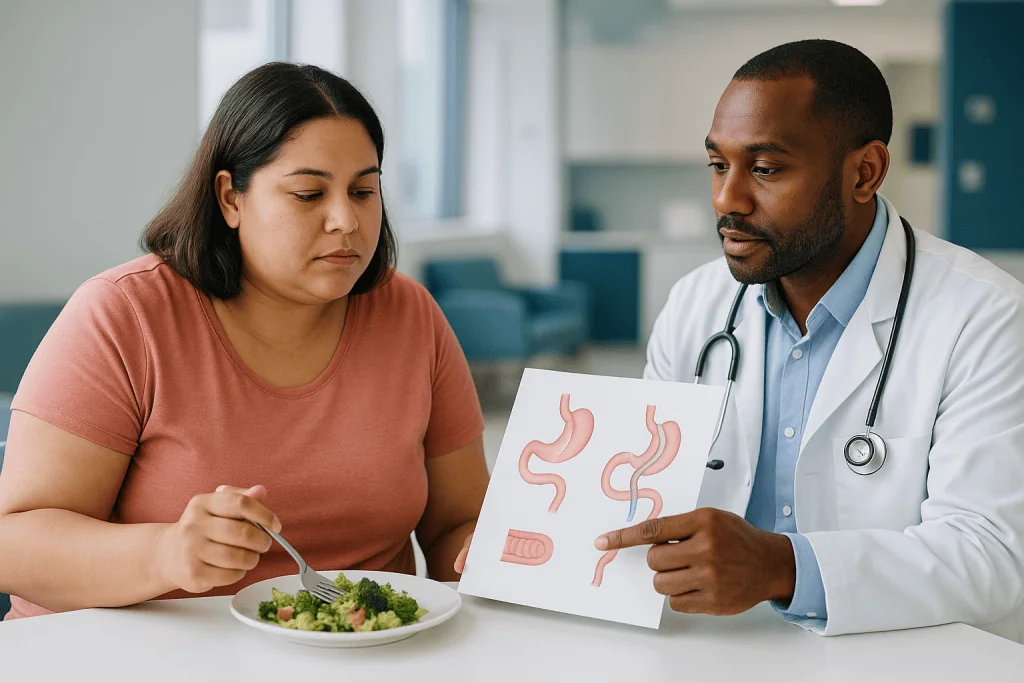
A sleeve gastrectomy removes roughly 80 percent of the stomach, according to the Mayo Clinic, leaving a slim banana-shaped tube. Nothing is rerouted. Food still travels from the esophagus through the new, smaller stomach into the small intestine in the normal order. The removed portion also produced much of the ghrelin, a hormone that signals hunger, so many people notice appetite changes that go beyond simple fullness.
A Roux-en-Y gastric bypass, usually shortened to gastric bypass, does two things. The surgeon staples off a small pouch at the top of the stomach, and the Mayo Clinic describes a pouch that holds only about an ounce of food. The surgeon then connects that pouch directly to a lower section of the small intestine. The rest of the stomach and the first stretch of intestine stay in the body but are bypassed, so food meets digestive juices further downstream. The result is a combination of restriction (less room) and altered absorption (fewer calories and nutrients taken up).
The practical differences follow from the anatomy. Because the sleeve leaves the intestine untouched, the pathway to the stomach lining and the duodenum remains open for endoscopy and for most medicines. Because bypass creates a new connection and a bypassed segment, it changes how certain nutrients and drugs are absorbed and carries a specific set of long-term risks, which a later section covers. The NIDDK notes that both procedures also change gut hormones in ways that affect blood sugar, which is why diabetes history plays such a large role in the choice.
Who is usually offered surgery, and who is usually asked to wait
Eligibility is a team judgment, not a single number. In most programs a surgeon, a dietitian, a physician and a mental health professional each see the person before any date is set. The NHS describes this assessment as a check that someone understands what the surgery involves and is ready for the long-term changes it demands.
Someone is typically a strong candidate when their BMI sits in the ranges the NIDDK lists, when they have tried structured non-surgical weight management, and when they have a weight-related condition such as type 2 diabetes, high blood pressure or sleep apnea that surgery is known to improve. A clear understanding of lifelong supplements and follow-up visits counts almost as much as the lab results.
People are often asked to wait, rather than refused outright, in a few common situations:
- Untreated or unstable mental health conditions, including active eating disorders, where the team wants treatment in place first.
- Current smoking, because smoking raises surgical and wound risks and, after bypass, the risk of ulcers at the new connection, a concern the Mayo Clinic highlights.
- Alcohol or substance misuse that has not been addressed.
- Pregnancy or plans to conceive soon; the NHS advises avoiding pregnancy for 12 to 18 months after surgery while weight is changing rapidly.
- Uncontrolled medical conditions that make anesthesia unsafe until optimized.
A few conditions tilt the choice rather than the timing. Inflammatory bowel disease, extensive prior abdominal surgery or dense scar tissue can make rerouting the intestine technically demanding, so a surgeon may lean toward a sleeve. Severe, documented reflux often does the opposite. The point is that “wait” usually means “prepare,” and the preparation period is also when the sleeve vs bypass question gets settled with the fullest information.
Gastric sleeve or bypass for diabetes: why your metabolic history matters
Type 2 diabetes is the single biggest factor that nudges many surgeons toward bypass. The reason is partly mechanical and partly hormonal. By sending food past the first part of the small intestine, bypass changes the release of gut hormones that influence insulin, and the NIDDK notes that blood sugar improvements can begin soon after the operation, before much weight has been lost.

The sleeve also improves diabetes, often substantially, mainly through weight loss and its own hormonal effects. The difference is one of degree and durability rather than kind. Across the mainstream evidence summarized by the Mayo Clinic and the NIDDK, bypass tends to produce somewhat greater average weight loss and more consistent improvement in blood sugar, especially in people whose diabetes has been present for many years or who already need insulin. Nobody can promise remission to an individual, and reputable teams do not.
So the questions a surgeon asks about diabetes are specific:
- How many years since diagnosis? Longer duration usually means the pancreas has less reserve, which favors the operation with the stronger metabolic effect.
- Is insulin already required, or are oral medicines still working?
- Are there complications such as kidney disease or nerve damage that raise the stakes?
A person with recently diagnosed, diet-controlled diabetes and no reflux may do very well with a sleeve. A person with 15 years of diabetes on insulin is more likely to hear bypass recommended. In both cases, diabetes medicines are adjusted by the prescribing clinician in the days and weeks after surgery, because blood sugar can fall quickly; this is monitored closely and never left to self-management. The decision about gastric sleeve or bypass for diabetes, then, is a conversation about metabolic history, not just a number on the scale.
Sleeve vs bypass acid reflux: the deciding factor many people overlook
Ask an experienced bariatric team what single symptom most often changes their recommendation, and heartburn comes up quickly. Gastroesophageal reflux disease (GERD), the condition in which stomach acid repeatedly rises into the esophagus, behaves very differently after the two operations.
The sleeve creates a long, narrow stomach with higher internal pressure and removes some of the natural anatomy that helps keep acid down. The Cleveland Clinic and the Mayo Clinic both list new or worsened reflux among the recognized risks of sleeve gastrectomy. For someone who already has GERD, particularly with a hiatal hernia (a condition where part of the stomach slips up through the diaphragm) or with inflammation of the esophagus seen on endoscopy, a sleeve can make daily symptoms harder to control.
Bypass tends to do the opposite. The tiny pouch produces little acid, and the rerouted intestine lets bile and digestive juices enter further downstream, so reflux often improves. This is why many surgeons treat significant GERD as a reason to favor bypass, and why some programs perform an endoscopy before surgery to look for silent esophageal damage, especially a precancerous change called Barrett’s esophagus.
That does not make the sleeve vs bypass acid reflux question automatic. Mild, occasional heartburn with a normal endoscopy may not change the plan, and a surgeon can sometimes repair a small hiatal hernia during a sleeve. Nor does bypass eliminate every reflux-type symptom; bile reflux and marginal ulcers at the new connection can mimic heartburn and need their own evaluation.
The practical takeaway is to be candid. Reflux that is controlled by an acid-suppressing medicine still counts, and so does nighttime cough or hoarseness. The team needs the full picture to match the operation to the esophagus as well as to the scale.
How BMI, age, medicines and other conditions shape the recommendation
Beyond diabetes and reflux, a cluster of smaller factors fills in the picture. None decides the case alone, but together they often make one operation the clearer fit.
BMI and the size of the task. Both operations produce meaningful weight loss, but the Mayo Clinic and NIDDK describe bypass as generally yielding somewhat more on average. For someone with a very high BMI, that margin can matter for mobility, joint load and sleep apnea. Some surgeons also use a sleeve as a first stage for people whose BMI makes a longer operation riskier, with a possible second procedure later.
Medicines that depend on absorption. Because bypass skips the first part of the small intestine, certain drugs are absorbed less predictably. Extended-release tablets and some immune-suppressing or anti-rejection medicines fall into this group, as do nonsteroidal anti-inflammatory drugs, which the Mayo Clinic links to ulcers at the bypass connection and which many teams advise avoiding permanently afterward. A person who needs regular anti-inflammatory treatment for arthritis, or who has had an organ transplant, may be steered toward a sleeve. Any adjustment to these medicines belongs to the prescribing clinician.
Bowel disease and prior surgery. Inflammatory bowel disease, extensive adhesions or previous intestinal surgery make rerouting harder and raise complication risk, again favoring the sleeve.
Age and frailty. Older adults can do well with either operation, but a shorter procedure with fewer connections is sometimes preferred when other health conditions are present.
Nutritional vulnerability. People with existing anemia, osteoporosis or a history of poor adherence to supplements may be counseled toward the operation with fewer absorption consequences, since the NHS states that lifelong vitamin and mineral supplements are needed after weight-loss surgery and the stakes are higher after bypass.
Laid side by side, these factors explain why two people with identical BMIs can leave the same clinic with different recommendations.
Sleeve vs bypass how to choose: the side-by-side summary
The table below gathers the main contrasts described by the Mayo Clinic, the NIDDK and the NHS. It is a map of tendencies, not a scoring sheet, and the right column for any individual still depends on the full assessment.
| Factor | Sleeve gastrectomy | Roux-en-Y gastric bypass |
|---|---|---|
| What changes | About 80% of stomach removed; intestine untouched | Small pouch created; intestine rerouted |
| Main mechanism | Restriction plus hunger-hormone change | Restriction plus altered absorption and gut hormones |
| Reflux | Can worsen or appear | Usually improves |
| Type 2 diabetes | Improves, mainly with weight loss | Often stronger, earlier improvement |
| Average weight loss | Substantial | Somewhat greater on average |
| Nutrient deficiency risk | Present; lower | Higher; lifelong monitoring essential |
| Dumping syndrome | Less common | More common |
| Marginal ulcer, internal hernia | Not applicable | Recognized long-term risks |
| Access to stomach by endoscopy | Preserved | Bypassed stomach not reachable by standard scope |
| Reversibility | Not reversible (tissue removed) | Technically reversible but complex; rarely done |
| Often favored when | Bowel disease, prior abdominal surgery, absorption-dependent medicines, anti-inflammatory use | Significant GERD, long-standing or insulin-treated diabetes, very high BMI |
Two rows deserve emphasis. The reflux row explains more surgical recommendations than any other single line. The endoscopy row is less obvious but matters for anyone with a family history of stomach cancer or a condition that needs regular monitoring of the stomach lining, because after bypass the remnant stomach cannot be examined with a standard scope.
Read the table as the opening of a conversation. If your profile lands squarely in one column, your surgeon’s recommendation will probably match. If it lands in both, expect a longer discussion, and that is a sign the team is doing its job.
Gastric sleeve vs bypass risks: what the evidence shows
Every operation carries risk, and comparing the two honestly means separating short-term surgical risks from long-term consequences. The NHS and the Mayo Clinic describe both sets in similar terms.
Shared short-term risks include bleeding, infection, blood clots in the legs or lungs, reactions to anesthesia and a leak from the staple line or connection, which is uncommon but serious and is the reason teams watch closely for fever, rapid heart rate and worsening abdominal pain in the first days. Bypass involves more connections than a sleeve, which is one reason some surgeons describe it as the slightly more complex operation.
Long-term risks that lean toward the sleeve center on reflux, as covered above, and on a narrowing or twist in the tubular stomach that can cause persistent vomiting and may need endoscopic treatment.
Long-term risks that lean toward bypass are more numerous because of the rerouted anatomy:
- Dumping syndrome, in which sugary or fatty food moves too quickly into the intestine and causes cramping, sweating, dizziness and diarrhea.
- Marginal ulcers at the new connection, made more likely by smoking and anti-inflammatory drugs.
- Internal hernia, where a loop of bowel slips through a gap created by the rerouting and can obstruct, sometimes years later.
- Greater risk of deficiencies in iron, vitamin B12, calcium, vitamin D and other nutrients.
Shared long-term issues include gallstones during rapid weight loss, loose skin, changes in alcohol tolerance and, for some people, mood changes that benefit from support.
The NHS emphasizes that the team weighs these risks against the health risks of untreated severe obesity, which are substantial in their own right. When people ask about gastric sleeve vs bypass risks, the most useful answer is not “which is safer” in the abstract but “which set of risks fits my body, my habits and my ability to follow up.” That is exactly the calculation your surgeon is making.
Bypass vs sleeve recovery time: what the first days and weeks look like
Recovery from the two operations looks more alike than different, which surprises many people. Both are keyhole procedures, both involve a short hospital stay in most cases, and both follow a staged return to normal eating.
In the hospital, the priorities are the same: walking within hours to lower clot risk, sipping fluids once the team is satisfied there is no leak, and managing discomfort, which is usually greatest around the incisions and the shoulder, where trapped gas from the procedure can refer pain. Length of stay depends on the individual and the program rather than on the operation alone.
At home, the Mayo Clinic describes a diet that moves from clear liquids to pureed foods, then soft foods, then regular textures in small portions over several weeks, with the exact schedule set by the dietitian. Protein comes first at each meal, fluids are sipped between meals rather than with them, and sugary drinks are off the table permanently; after bypass they can trigger dumping.
Energy returns gradually. Light activity is encouraged early, lifting is restricted while the incisions heal, and most people plan for a few weeks away from work depending on how physical the job is, with the care team setting the specific timeline. Hair thinning a few months in is common with rapid weight loss and usually settles.
Where bypass vs sleeve recovery time differs is subtle. Bypass patients are often watched a little more closely for early dumping and for how diabetes medicines are behaving as intake drops; the prescribing clinician adjusts these. Sleeve patients may notice reflux symptoms early and should report them. Both groups attend the same cadence of follow-up visits, which the NHS describes as regular and continuing for years, because that is where problems are caught while they are still small.
Supplements, blood tests and follow-up: the part that never ends
The operation lasts a couple of hours. The aftercare lasts a lifetime, and the honest answer to sleeve vs bypass how to choose includes asking which lifelong routine a person can realistically keep.
The NHS is unambiguous that people who have weight-loss surgery need vitamin and mineral supplements for the rest of their lives, along with regular blood tests to check for deficiencies. The reason differs slightly by operation. After a sleeve, the smaller stomach makes less of the acid and the intrinsic factor needed to absorb vitamin B12, and overall intake drops. After bypass, the bypassed intestine was where iron, calcium and several vitamins were mainly absorbed, so deficiencies are more frequent and can be more serious.
What that routine typically involves:
- A daily multivitamin formulated for post-bariatric needs, plus separate supplements that the team specifies based on the operation and blood results.
- Blood tests at intervals in the first year and then at least yearly, checking iron, B12, folate, vitamin D, calcium and bone markers among others.
- Adequate protein at every meal to protect muscle while fat is lost.
- Bone density monitoring in some people, because rapid weight loss and reduced calcium absorption can thin bone.
Which products and amounts are appropriate is a decision for the dietitian and prescribing clinician, and it changes over time; this article deliberately gives no specifics.
Follow-up visits are not just for labs. They are where weight regain is addressed early, where mood and relationship changes are discussed, and where the team checks that medicines for blood pressure, diabetes and cholesterol are being reduced safely as the body changes. People who stay connected to their program tend to catch problems sooner, and that holds for either operation. If the prospect of lifelong monitoring feels unmanageable, say so during assessment; it is relevant to the choice and to the timing.
Can a sleeve be converted to a bypass later, and does that change the first choice?
Yes, conversion is possible, and the possibility quietly influences many first decisions. A sleeve can later be turned into a bypass by creating the pouch and rerouting the intestine. The reverse, turning a bypass back into a sleeve, is not an option because the sleeve requires the original stomach to be present and the bypass leaves it intact but disconnected and shrunken.
Surgeons consider conversion for two main reasons. The first is reflux that becomes severe after a sleeve and does not respond to lifestyle changes and acid-suppressing medicine; converting to bypass is a recognized way to address it, consistent with the reflux tendencies the Cleveland Clinic and Mayo Clinic describe. The second is inadequate weight loss or significant regain, particularly when diabetes has returned, where the stronger metabolic effect of bypass may be sought.
This is why some surgeons describe the sleeve as a reasonable first step for people with borderline reflux or extremely high BMI: it leaves a door open. It is also why others argue the opposite, that if the profile already points clearly to bypass, doing two operations exposes the person to two sets of risks and a second recovery.
A few realities temper the idea of conversion as a safety net:
- Revision surgery is generally more complex than a first operation because of scar tissue.
- It is not offered for cosmetic reasons or for modest regain that can be addressed with dietary and behavioral support.
- Insurance or health-system criteria for revision vary and are not something a surgeon can promise in advance.
The practical use of this knowledge is simple. If your surgeon recommends a sleeve despite some reflux, ask how they would handle it if symptoms worsened. If they recommend bypass, ask whether they considered a staged approach and why they set it aside. Either answer tells you how carefully the decision was reasoned.
What people often get wrong about choosing between sleeve and bypass
Misunderstandings about these two operations travel fast, and several of them steer people toward the wrong expectations. The corrections below reflect what the Mayo Clinic, NHS and NIDDK actually say.
“The sleeve is the easy option.” It is the simpler operation to perform, with no intestinal rerouting, but it removes most of the stomach permanently and carries its own long-term issues, chiefly reflux. Easier to do is not the same as easier to live with.
“Bypass is the stronger operation, so it must be better.” Bypass tends to produce somewhat greater average weight loss and more consistent diabetes improvement, but it also brings dumping syndrome, ulcer risk, internal hernia risk and higher nutritional demands. Stronger is a trade, not a free upgrade.
“Bypass is reversible, so it is lower commitment.” Reversal is technically possible and rarely performed, because it is a major operation with real risks. Both procedures should be treated as permanent.
“The surgery does the work.” The Mayo Clinic describes both operations as tools that succeed only with lasting changes in eating and activity. Weight regain is possible after either, and the pouch or sleeve can stretch if eating patterns return to old habits.
“Choosing bypass means I will never have heartburn again.” Reflux usually improves, but ulcers and bile irritation at the connection can cause similar symptoms and need evaluation rather than assumption.
“A higher BMI always means bypass.” BMI is one input among several. Bowel disease, medicines and prior surgery can override it.
“Supplements are optional once I feel fine.” Deficiencies after bypass in particular can develop silently over years, which is why the NHS calls supplements and blood tests lifelong.
Clearing these away does not make the decision for you. It does make the conversation with your team more productive, because you will be asking about trade-offs instead of absolutes.
Questions to ask your care team before you decide
A good consultation leaves you with reasons, not just a recommendation. These questions are designed to draw those reasons out. Bring the list, and do not be shy about asking a question twice if the first answer went past you.
- Which operation are you recommending for me, and which two or three factors in my profile led you there?
- What did my pre-operative tests show about reflux, and how did that affect the choice?
- Given how long I have had diabetes and the medicines I take, what difference do you expect between the two operations for me specifically?
- Are any of my regular medicines likely to be absorbed differently after bypass, and who will manage those changes?
- Do I have any bowel disease, hernia or prior surgery that makes one procedure technically harder?
- What are the three complications you watch for most in the first month, and what should I do if I notice them?
- What is the long-term plan for supplements and blood tests, and how often will I be seen in the first year and after?
- If I have a sleeve and reflux becomes a problem, what would the options be?
- If I have a bypass, how will I recognize dumping syndrome, an ulcer or an internal hernia?
- How does this program support people whose weight loss stalls or who regain?
- What should I do about alcohol, smoking and anti-inflammatory painkillers before and after surgery?
- Who do I contact after hours if something feels wrong?
Listen for specificity. A team that can tie its recommendation to your endoscopy result, your diabetes duration and your medication list is practicing exactly the kind of individualized reasoning this article describes. A team that answers only in generalities deserves a follow-up question. In either case, the decision remains a shared one between you and the people who will care for you afterward.
When to call your doctor: red flags after sleeve or bypass
Most recovery days are uneventful, and most discomfort is expected. A small number of symptoms are not, and the NHS and Mayo Clinic agree that these need prompt contact with the surgical team or emergency services rather than a wait-and-see approach.
Seek urgent care, by calling emergency services if necessary, for:
- Abdominal pain that is severe, worsening or out of proportion to what you were told to expect, especially with a fever or a fast heartbeat; these can signal a staple-line or connection leak.
- Chest pain, shortness of breath, or a swollen, painful calf, which can indicate a blood clot in the leg or lung.
- Vomiting blood or passing black, tarry stools, which can mean bleeding or, after bypass, an ulcer.
- Persistent vomiting with inability to keep down fluids, raising the risk of dehydration and, after bypass, of a vitamin B1 deficiency that can affect the nervous system.
- Sudden, intense, crampy abdominal pain that comes in waves, sometimes with bloating and no bowel movements, which after bypass can indicate an internal hernia or obstruction.
- Fever, redness, warmth or discharge at an incision.
Contact your team within a day or two for:
- New or worsening heartburn, nighttime cough or regurgitation after a sleeve.
- Episodes of sweating, dizziness, cramping or diarrhea after eating, suggesting dumping syndrome.
- Shaky, sweaty spells or confusion that could reflect low blood sugar as diabetes medicines are adjusted.
- Unusual tiredness, numbness or tingling in the hands or feet, which can point to nutrient deficiency.
- Low mood, anxiety or changes in alcohol use that concern you or those around you.
Keep the program’s contact number where you can find it, and when in doubt, call. Surgical teams would rather hear about a false alarm than miss an early problem, and every decision about what to do next belongs with them.
Frequently asked questions
Is gastric sleeve or bypass better for diabetes?
Bypass tends to produce stronger and earlier improvement in type 2 diabetes, especially when the condition has been present for many years or requires insulin, because rerouting the intestine changes gut hormones that affect insulin. A sleeve also improves diabetes, mainly through weight loss. Surgeons weigh diabetes duration, current medicines and complications before recommending one, and no outcome can be promised for an individual.
Why does acid reflux matter so much in sleeve vs bypass?
The sleeve creates a narrow, high-pressure stomach that can cause new or worsened reflux, while bypass creates a small pouch that produces little acid and usually relieves it. For someone with documented GERD, a hiatal hernia or esophageal inflammation, most surgeons lean toward bypass. Mild occasional heartburn with a normal endoscopy may not change the plan, which is why many programs scope the esophagus before deciding.
What are the main gastric sleeve vs bypass risks I should understand?
Both carry short-term risks of bleeding, infection, blood clots and leaks. The sleeve’s main long-term issue is reflux and occasionally a narrowing of the tube. Bypass adds dumping syndrome, ulcers at the new connection, internal hernia and a higher chance of nutrient deficiencies. The NHS weighs these against the health risks of untreated severe obesity when deciding whether surgery is appropriate.
How does bypass vs sleeve recovery time compare?
Recovery is broadly similar because both are keyhole operations with a staged diet that moves from liquids to pureed to soft foods over several weeks, as the Mayo Clinic describes. Bypass patients are watched more closely for early dumping and for rapid changes in diabetes medicines; sleeve patients should report early reflux. Your team sets the specific timeline for activity and return to work.
Can I choose the operation myself?
Your preference matters and is part of the decision, but the recommendation rests on clinical findings such as reflux, diabetes history, bowel disease, prior surgery and medicines. A surgeon will explain which of these factors shaped their advice. If you prefer the other operation, ask what trade-offs that would involve for your profile. The final plan is agreed between you and the treating team.
Which bariatric surgery is right for someone with a very high BMI?
Bypass tends to produce somewhat greater average weight loss, which can matter when BMI is very high. Some surgeons instead use a sleeve first to reduce operative risk, with a possible later conversion. The choice depends on heart and lung fitness, reflux, diabetes and prior surgery rather than BMI alone, so the same number can lead to different recommendations.
Does the sleeve need fewer supplements than bypass?
Nutritional risk is lower after a sleeve because the intestine is untouched, but the NHS states that lifelong vitamin and mineral supplements and regular blood tests are needed after any weight-loss surgery. Vitamin B12, iron, vitamin D and calcium are monitored after both operations. The specific supplements and amounts are set by your dietitian and prescribing clinician based on your operation and results.
Can a sleeve be turned into a bypass later?
Yes, a sleeve can be converted to a bypass, most often for severe reflux that does not respond to treatment or for inadequate weight loss, particularly when diabetes returns. The reverse is not possible because the sleeve requires the original stomach. Revision surgery is more complex than a first operation, so it is a fallback rather than a plan.
Do I have to stop anti-inflammatory painkillers after bypass?
Many teams advise avoiding nonsteroidal anti-inflammatory drugs permanently after bypass because the Mayo Clinic links them to ulcers at the new connection. Someone who depends on these medicines for arthritis may be steered toward a sleeve instead. Decisions about any medicine, including alternatives for pain, belong to your prescribing clinician and should be discussed before surgery.
When is it safe to get pregnant after sleeve or bypass?
The NHS advises avoiding pregnancy for 12 to 18 months after weight-loss surgery, while weight is changing rapidly and nutrient levels are settling. This applies to both operations. Fertility can improve quickly after surgery, so contraception should be discussed before the procedure. Anyone planning a pregnancy later should involve the bariatric team early for nutritional monitoring.
References
- NIH NIDDK: Types of weight-loss surgery
- NIH NIDDK: Potential candidates for weight-loss surgery
- NHS: Weight loss surgery, risks
- Cleveland Clinic: Gastric sleeve surgery
This article is for general information only and is not a substitute for professional medical advice. Please consult a qualified doctor about your individual situation.

Planning This Treatment in Turkey
Our full guide for international patients: techniques, hospital stay, recovery and cost.
More from the Blog

When a Sleeve Gastrectomy Needs Revision: Re-Sleeve, Conversion to Bypass and Why
Sleeve gastrectomy revision options include re-sleeving a stretched stomach, converting the sleeve to a Roux-en-Y gastric bypass, which is usually favored when acid reflux…

Who May Be a Candidate for a Gastric Balloon? What the Bariatric Team Evaluates First
Gastric balloon candidates are usually adults whose body mass index falls roughly between 30 and 40, who have tried structured diet and activity changes…

Is Obesity a Willpower Problem? Common Myths and What Medicine Actually Says
No. Mainstream medical evidence does not treat obesity as a willpower problem. Body weight is regulated by genes, appetite hormones, sleep, medicines, health conditions…

Sleeve Gastrectomy (Gastric Sleeve) Eligibility: What the Team Weighs Beyond BMI
Sleeve gastrectomy eligibility usually starts with body mass index, commonly a BMI of 40 or higher, or 35 and above with a weight-related condition…

Metabolic Syndrome Myths: Why It Is Not Only About Weight and Not Only About Sugar
Metabolic syndrome is a cluster of at least three linked measures: a large waist, raised blood pressure, high triglycerides, low HDL cholesterol and raised…

Who May Be Considered for Gastric Banding Today? Where the Adjustable Band Still Fits
Adults may be considered for adjustable gastric banding when body mass index is 40 or higher, or 35 to 39.9 with a weight-related condition…