

How Do Home Exercises and School Routines Fit Into a Cerebral Palsy Therapy Plan?

Key Takeaways
- Cerebral palsy is the most common motor disability in childhood, affecting about 1 in 345 children according to the CDC, and the brain injury itself does not progress, so lost skills point to growth, contracture, pain or lapsed practice rather than new damage.
- Clinic sessions set goals and teach skills, but the repetitions that drive change happen in the 160-plus waking hours a week spent at home and school.
- Systematic reviews favor goal-directed, task-specific practice and strengthening over isolated passive stretching, which has not been shown to improve range or function on its own.
- In US schools, an IEP covers specialized instruction and related therapy, while a Section 504 plan covers accommodations such as extra time, accessible seating and adaptive physical education.
- After botulinum toxin injections the effect typically wears off over roughly three months, according to the NHS, so home and school practice is concentrated in that window.
- The World Health Organization applies its target of an average 60 minutes a day of moderate-to-vigorous activity to children with disabilities too, adjusted to ability, which is why community sport belongs in the plan.
Home exercises and school routines are usually the largest part of a cerebral palsy therapy plan, not an add-on to it. Therapists set goals in clinic, then families and teachers provide the daily repetitions that build strength, movement skills and independence. A good plan weaves short tasks into dressing, mealtimes, classroom transitions and physical education, with the therapy team adjusting the program as the child grows or after any procedure.
It is 7:40 on a school morning. A seven-year-old is pulling on his left sock while standing at the kitchen counter, one hand resting on the edge, because his physical therapist asked for ten standing tasks a day and this one counts. His mother is timing nothing. She is packing lunch. The sock takes a little longer than it would sitting down, and that is the point.
Families living with cerebral palsy quickly learn that the clinic appointment is the smallest slice of the week. The question that actually shapes progress is how cerebral palsy home exercises and school routines connect to what the therapist planned, and whether a busy household and a crowded classroom can realistically carry them.
This explainer walks through what therapists send home and why, how schools fit in, what the evidence supports, where medicines and procedures sit alongside daily practice, and which warning signs mean it is time to stop and call the care team.
How does a cerebral palsy therapy plan actually work?
Cerebral palsy is a group of lifelong conditions affecting movement, posture and muscle tone, caused by abnormal development of or damage to the brain before, during or shortly after birth. The CDC describes it as the most common motor disability in childhood, affecting roughly 1 in 345 children in the United States. The brain injury itself does not get worse over time, but the way the body grows around it can change, which is why therapy continues for years rather than weeks.
A therapy plan starts with an assessment. The team, usually a pediatrician or neurologist plus physical, occupational and speech therapists, maps what the child can do now and what the child and family want next. Many teams use the Gross Motor Function Classification System, or GMFCS, a five-level scale that describes how a child moves in everyday settings, from walking without limitation at level I to needing full support for sitting and mobility at level V. The level guides realistic goals; it is not a verdict on effort.
From those goals the plan branches into several strands. Clinic sessions teach a new skill or check how a movement is changing. Home programs provide the repetitions. School routines supply practice in a setting the child cannot avoid, surrounded by peers. Equipment such as braces, walkers or seating systems holds posture steady so practice can happen. Medicines or procedures to reduce muscle stiffness may be added when tightness is blocking function.
The thread tying these strands together is a shared goal written in everyday language: climb the bus steps, open a lunchbox, write a name legibly. Mayo Clinic and the NHS both describe this coordinated, multidisciplinary approach as the standard of care, with the plan reviewed and rewritten as the child grows.
Why do therapists send cerebral palsy home exercises instead of doing everything in clinic?
The honest answer is arithmetic. A child might see a therapist for an hour once or twice a week. The other 160-plus waking hours belong to the family and the school. Motor learning, the process by which the brain lays down and strengthens the pathways for a movement, depends on repetition in real contexts. No clinic schedule can supply that volume on its own.
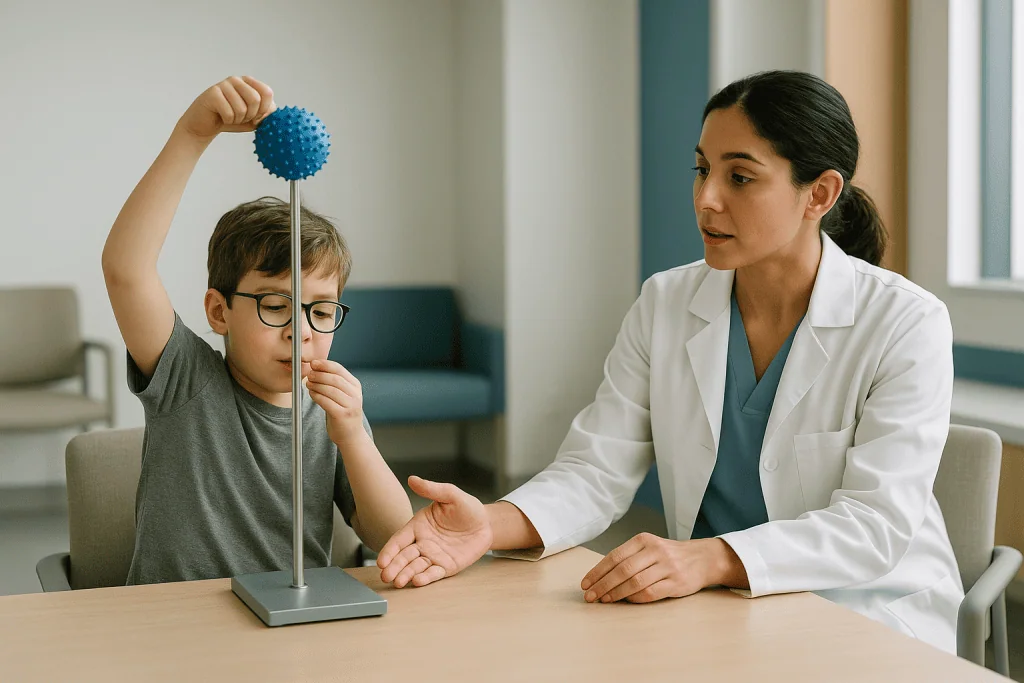
There is a second reason. A skill practiced only on a therapy mat often stays on the mat. Reaching for a cup in a quiet room with a therapist steadying your trunk is a different task from reaching for a cup at a cafeteria table while someone bumps your chair. Practicing in the environments where the skill is actually needed helps it transfer. Research summaries of cerebral palsy rehabilitation consistently favor goal-directed, task-specific training, meaning practice of the real activity, over isolated exercises that look nothing like daily life.
Home exercises also serve as a monitoring tool. When a parent notices that a stretch has become harder, that a brace is rubbing, or that a child who stood to brush teeth last month now avoids it, that observation reaches the therapist faster than the next scheduled reassessment would. Families become the early-warning system for changes in tone, pain or joint range.
Finally, the home program hands a measure of control back to the child. A nine-year-old who chooses to do her balance practice on the trampoline rather than the mat is more likely to keep doing it. Therapists increasingly build in that choice deliberately, because adherence, not the perfect exercise, is what separates programs that help from programs that fade by the third week.
What do physical therapy exercises for cerebral palsy usually include at home?
Home programs vary with age, GMFCS level and the goal of the moment, but most draw from a handful of categories.
- Task practice. Repeating a real activity, such as sit-to-stand from a dining chair, stepping over a threshold or carrying a plate across the kitchen. This is the backbone of most modern programs.
- Strengthening. Children with cerebral palsy are often weaker, not just stiffer, in the muscles that control standing and walking. Resistance work, whether body weight, stairs or small bands under therapist guidance, targets those groups.
- Stretching and positioning. Holding a muscle at length to maintain joint range, sometimes with the help of a brace or a positioning system at rest or overnight. The evidence here is more nuanced; a later section covers it.
- Balance and coordination. Standing on one foot while brushing teeth, walking along a taped line, catching a ball.
- Fine motor and self-care. Set by an occupational therapist, who focuses on daily activities: buttons, zips, utensils, pencil grip, keyboard use.
- Communication and feeding practice from a speech and language therapist, when swallowing or speech is affected.
A well-designed program is short. Therapists know that a 45-minute list will not survive a weeknight, so most ask for small bursts spread across the day rather than one long session. The instructions usually specify what to do and how it should look, not a rigid count, and they change as the child changes.
Equipment matters too. Ankle-foot orthoses, which are molded braces that hold the foot and ankle in alignment, walkers and standing frames are part of the plan, and the home program often includes checking skin and fit each day. Families are taught what a red pressure mark that fades within a short time looks like versus one that does not, because a brace that hurts is a brace that stays in the closet.
How do school routines fit into a cerebral palsy therapy plan?
School is where a child spends more structured hours than anywhere except home, and much of a cerebral palsy therapy plan can live there without anyone calling it therapy. The walk from the bus to the classroom is gait practice. Carrying a tray is a balance and bilateral hand task. Standing at a lab bench is weight-bearing. A good plan names these moments explicitly so that teachers and aides know they count.
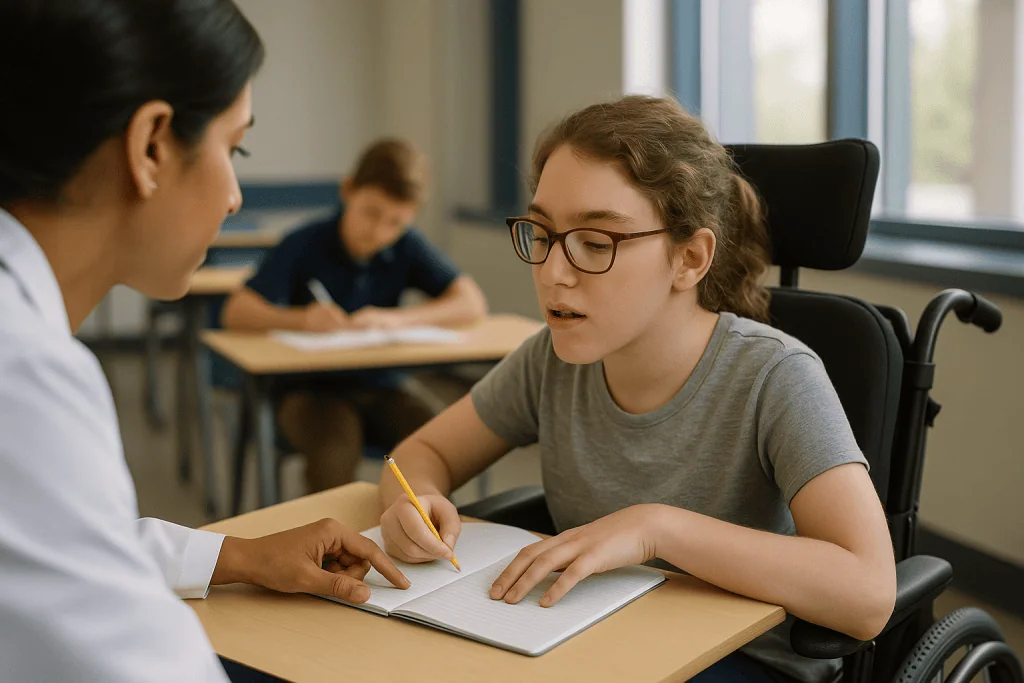
In the United States, a child with cerebral palsy who needs specialized instruction or related services usually has an Individualized Education Program, or IEP, a legal document that sets educational goals and lists the supports the school will provide. A child who does not need specialized instruction but does need adjustments may have a Section 504 plan, which covers accommodations such as extra time, accessible seating or a modified physical education program. School-based physical, occupational and speech therapists work under these plans, and their job differs from clinic therapists in one key way: their goals must connect to accessing education, not to medical outcomes in general.
Common cerebral palsy school accommodations include a second set of textbooks so a heavy backpack is not carried, a slanted writing surface or keyboard, permission to leave class early to avoid crowded corridors, a quiet place to put on braces, and scheduled movement breaks. Adaptive physical education, meaning PE adjusted so the child can take part meaningfully, is part of many plans rather than an exemption from it.
The link between clinic and school is often fragile. Information travels through the parent, and plans drift apart. Many families ask the clinic therapist to write a one-page summary of current goals that can be shared with the school team, and ask the school therapist to send observations back. When the two teams talk, even twice a year, the child stops living two separate programs.
Who is a home program usually for, and who is usually asked to wait?
Nearly every child with cerebral palsy, at every GMFCS level, is given some form of home program. For a child who walks independently it may center on strength, endurance and sports skills. For a child who uses a wheelchair full-time it may focus on positioning, assisted standing, range of motion and the fine motor or communication skills that matter most for daily life. The content changes; the principle that practice happens mostly at home and school does not.
Some situations do call for a pause or a rewrite, and families should expect the team to say so clearly.
- After orthopedic surgery on bones, tendons or muscles. The surgeon sets protected periods during which stretching, weight-bearing or specific movements are limited, and the home program is replaced by a post-operative version.
- After botulinum toxin injections into tight muscles. Therapy usually intensifies in the window when the muscle is more relaxed, but the therapist will adjust which exercises and braces are used.
- During illness, fever or uncontrolled seizures. Energy goes to recovery; tone often rises temporarily and stretching can feel worse. The program resumes when the child is well.
- When pain appears in a hip, knee or back, or when a brace causes skin breakdown. Pushing through pain in cerebral palsy is a reliable way to lose a skill rather than gain one.
- During rapid growth spurts, when muscles can lag behind bone and the whole plan may need re-measuring.
Being asked to wait is not a step backward. The NHS notes that care plans are reviewed as needs change, and a well-timed pause is part of that review. What matters is that the pause has an end point and a named person who will restart the program.
Clinic, home, school and community: where each part of the plan lives
Families often ask which setting is most important. The more useful question is which setting is best at which job. The table below summarizes how the pieces usually divide, though every child’s plan is tailored.
| Setting | Main job | Who leads | Typical content | Limits |
|---|---|---|---|---|
| Clinic or hospital therapy | Assess, teach new skills, adjust equipment, track change | Physical, occupational, speech therapists; physicians | Measuring range and strength, introducing a new movement, fitting braces, planning around procedures | Few hours per month; skills may not transfer without practice elsewhere |
| Home | Daily repetition and real-life practice | Parents, caregivers, the child | Task practice built into routines, strength work, positioning, brace wear, play | Family time and energy; needs a short, clear program |
| School | Access to learning and practice among peers | School therapists, teachers, aides under an IEP or 504 plan | Accommodations, adaptive PE, mobility between classes, handwriting or keyboard goals | Goals must link to education; communication with clinic often weak |
| Community and sport | Fitness, confidence, social belonging | Coaches, instructors, the child | Adaptive sports, swimming, cycling, dance, playground time | Availability varies; safety and supervision need planning |
Two patterns stand out. First, the clinic is where decisions are made, but the home and school are where change actually happens. A plan that is heavy on appointments and light on daily practice tends to produce careful assessments of a child who is not improving. Second, the community column is the one most often left blank, yet the World Health Organization’s activity guidance applies to children with disabilities as much as to anyone, and sport is often where a teenager finally finds a reason to keep exercising. Ask the team to fill in all four columns, not two.
Is cerebral palsy stretching at home worth it? What the evidence actually says
Stretching is the exercise most families are told to do and the one whose evidence is most often overstated. It helps to separate two ideas: spasticity, which is increased muscle tone that makes a muscle resist being stretched quickly, and contracture, which is a muscle or joint that has physically shortened and lost range. Stretching is aimed at preventing the second.
Here is what mainstream evidence shows. Brief, hands-on passive stretching, where a parent moves a limb to the end of its range and holds it, has not been shown in systematic reviews to produce lasting improvements in joint range or function on its own in children with cerebral palsy. That does not make it pointless, but it does mean a daily few minutes of calf stretching is unlikely to be the thing that changes a child’s walking.
Longer-duration, low-load positioning carries more support. Ankle-foot orthoses worn during the day, night splints, standing frames and seating systems hold muscles at length for hours rather than seconds, and these are the approaches most therapy teams rely on to maintain range. NHS guidance lists orthoses and physiotherapy together as core treatment, and Mayo Clinic describes braces and splints as tools that stretch stiff muscles and improve function.
Active movement through range, such as squatting to pick up a toy or stepping onto a stool, combines stretching with strengthening and practice, which is why therapists increasingly prefer it to passive holds.
The practical takeaway: stretching at home is reasonable as part of a program, especially when it is built into positioning and active tasks, but it should never crowd out task practice and strengthening, and it should never hurt. If a stretch has become painful or a joint has visibly lost range, that is a reassessment, not a reason to stretch harder. The decision about which stretches, braces or positions to use rests with the therapy team.
How do you build cerebral palsy home exercises into an ordinary day?
The programs that last are the ones that stop looking like programs. Therapists call this embedding: attaching a therapeutic task to something the family already does, so that the cue is the routine rather than a reminder on a phone.
Morning offers natural anchors. Standing to brush teeth with one hand on the sink practices balance and weight shift. Pulling on socks or a shirt while seated on a low stool works trunk control and hand skills. Climbing into a car seat or up the bus steps without being lifted, when the therapist agrees it is safe, is gait and strength work disguised as leaving the house.
Mealtimes suit fine motor goals. Opening containers, using a fork with the less-preferred hand, carrying a plate to the table, wiping the table afterward: each is a repetition. Evenings fit positioning and brace routines, and bath time is a low-resistance environment for moving stiff joints and practicing sitting balance.
A few principles make embedding work.
- Choose two or three anchors, not ten. A program the family does reliably on five days beats a perfect one done twice.
- Let the child pick where possible. Choice drives adherence, and adherence drives change.
- Keep the task slightly hard. If it is easy every time, the brain has nothing new to learn; if it fails every time, everyone quits.
- Rotate siblings and other adults in. Grandparents, after-school caregivers and older siblings can cue a task if they know what to look for.
- Record briefly. A tick on a calendar or a short video every few weeks gives the therapist something concrete to review.
Expect weeks when nothing gets done. Illness, exams and family life intervene. The goal is not an unbroken streak but a pattern that resumes, and a therapist who hears about the gap rather than one who discovers it.
What do the first weeks of a new therapy plan usually look like?
A new or rewritten plan tends to follow a recognizable arc, although the pace depends on the child and the goal.
In the first week or two, the work is mostly learning. Parents watch the therapist demonstrate, then practice under supervision, then try at home with photos or a short video as a guide. Children often resist a new task, not because it hurts but because it is unfamiliar and harder than the old way. Therapists expect this and usually advise persistence with low stakes rather than battles.
Through the following weeks, the task gets smoother. Improvements in how consistently a movement is performed often appear before improvements in strength or speed, because the brain refines the pattern first. This is also when fit problems with new braces or equipment surface, so skin checks and comfort reports matter most in this window.
Measurable change in strength, range or a functional skill tends to take longer and is tracked at scheduled reassessments. Clinicians avoid promising a timeline because growth, tone, motivation and school demands all pull on the result. What they do promise is a review: NHS guidance describes care plans for cerebral palsy as regularly reviewed and adjusted, and Mayo Clinic frames treatment as ongoing, with the team changing the approach as needs change.
Around a procedure, the arc looks different. After botulinum toxin injections, the NHS describes an effect that typically wears off over roughly three months, so therapists concentrate stretching, bracing and task practice in that window while the muscle is easier to work with. After orthopedic surgery, the first weeks are governed by the surgeon’s protected-movement rules, and the usual home program is replaced by a staged post-operative version that gradually returns to the ordinary plan.
If a plan has run for a stretch without any review, that is a reasonable thing to raise at the next appointment rather than something to wait on.
Where do medicines and procedures fit alongside home and school routines?
Home exercises and school routines do the daily work, but sometimes muscle tightness is high enough that practice cannot happen. That is where medicines and procedures enter, and understanding their role helps families see why the therapy plan intensifies, not pauses, around them.
Muscle relaxant medicines, taken by mouth, act on the nervous system to reduce overall muscle tone. Because they affect the whole body, they can also cause drowsiness or weakness, and the prescribing clinician weighs that trade-off. Some children with widespread, severe spasticity receive the same type of medicine through a small implanted pump delivering it directly around the spinal cord, which allows a different balance of effect and side effects. In both cases the decision, the choice of medicine and any changes belong to the prescribing team.
Botulinum toxin injections target individual overactive muscles. The toxin blocks the signal from nerve to muscle in that spot, so the muscle relaxes for a period of weeks to months. The NHS notes the effect typically lasts around three months. The injection is not the treatment; it opens a window in which stretching, bracing and task practice can achieve what they could not against a rigid muscle. A child whose home and school program lapses during that window gives up most of the benefit.
Selective dorsal rhizotomy is a surgical procedure that cuts selected sensory nerve rootlets in the lower spine to permanently reduce spasticity in the legs. It is considered for a specific group of children, usually those who walk with assistance and whose spasticity rather than weakness is the main barrier. It is followed by an intensive, months-long rehabilitation program in which home and school practice are essential.
Orthopedic surgery lengthens tendons, realigns bones or stabilizes joints when contracture or deformity has already developed. Afterward, the home program becomes a post-operative protocol led by the surgical and therapy teams. In every case, these interventions change what is possible; the daily routines decide what is actually gained.
How much daily movement is realistic for a child with cerebral palsy?
The World Health Organization recommends that children and adolescents aged 5 to 17 average at least 60 minutes a day of moderate-to-vigorous physical activity across the week, and it states explicitly that children and adolescents living with disability should aim for the same guidance where they are able, adjusting type and amount to their abilities. The guidance is a target, not a test. For many children with cerebral palsy the number will be reached partly through therapy tasks, partly through adaptive sport, and partly through ordinary play.
Why push for fitness at all when the focus has been on movement skills? Because children with cerebral palsy tend to be less active than their peers, and lower fitness compounds over years into reduced walking endurance, fatigue and, in adulthood, higher cardiovascular risk. Fitness also protects the skills the therapy plan has built; a child who is too tired to walk the corridor will take the wheelchair whether or not the gait pattern improved in clinic.
What activity looks like varies by GMFCS level. A child at level I or II may join mainstream sports with small adjustments, cycle, swim or run. At level III, a tricycle, swimming, adaptive climbing or frame-supported running may fit. At levels IV and V, assisted standing, arm-cycling, swimming with support, powered mobility sport and seated dance are among the options. Adaptive physical education in school is designed to make this possible during the school day.
Fatigue deserves respect. Children with cerebral palsy often use more energy to walk the same distance, so a school day can be exhausting before any sport begins. Therapists help families balance effort across the week, and may deliberately swap a long walk for a wheelchair on a day with PE so that energy is spent where it builds most. The question to bring to the team is not how much exercise is enough, but which activities the child enjoys enough to repeat.
What people often get wrong about home exercises and school routines
Myth: more therapy hours always mean better outcomes. Intensity matters, but what is practiced matters more. Hours of passive stretching add little; a modest number of goal-directed repetitions in real settings tends to produce more change. A plan is judged by its design, not its length.
Myth: the brain injury is getting worse when a skill is lost. Cerebral palsy itself is non-progressive, as the National Institute of Neurological Disorders and Stroke emphasizes. Skills can still fade because of growth, contracture, pain, weight change or a lapse in practice. That is a reason to reassess, not a sign of a new disease process, although any sudden change should always be checked.
Myth: a school therapist replaces the clinic therapist. School-based therapy must relate to educational access. Medical goals, equipment prescription and planning around procedures sit with the clinical team. Most children need both, and need them talking to each other.
Myth: braces weaken muscles, so children should go without. Orthoses hold alignment so that walking and standing are efficient enough to practice. Whether, when and how long a child wears them is a therapist’s decision based on the specific goal, not a matter of toughness.
Myth: if an exercise is good, pushing through pain makes it better. In cerebral palsy, pain usually signals a joint, a hip or a brace problem that needs attention. Pushing through tends to produce guarding, higher tone and avoidance.
Myth: an unproven intensive program, device or supplement will do what daily practice cannot. Families encounter many offers. The honest position is that mainstream evidence supports task-specific training, strengthening, orthoses, selected medicines and procedures, and ongoing multidisciplinary review. Anything outside that list should be discussed with the care team before time, hope or money is spent on it.
Myth: home programs are the parent’s job alone. Siblings, grandparents, aides and the child themselves can all carry pieces. A plan that depends on one exhausted adult is a plan designed to lapse.
Questions to ask your care team
Appointments are short and the questions that matter most tend to surface in the car afterward. Taking a written list helps. These are the ones families often find most useful.
- What are the two or three goals we are working toward right now, in everyday words, and how will we know when we have reached them?
- Which home tasks matter most if we only manage a few this week, and which can slide?
- Can you show me what the task should look like, and can I film it so other adults at home can cue it the same way?
- How should the braces fit, how long should they be worn, and what skin changes should make us stop and call?
- Which parts of this plan can the school carry, and will you send a summary to the school therapist or would you like me to?
- Is adaptive physical education or a movement break something we should ask to add to the IEP or 504 plan?
- What signs would tell you a stretch or exercise is doing harm rather than good?
- Is my child’s hip being monitored, and how often are the X-rays or checks due?
- If a medicine or injection is being considered, how will the home and school program change in the weeks around it?
- How often will this plan be reviewed, and who do we contact between reviews if something changes?
- What community sports or activities have worked for other children at a similar GMFCS level?
- As my child gets older, who will help plan the handover to adult services?
None of these questions has a single right answer. They are useful because they move the conversation from a list of exercises to a shared understanding of why each one is there, and because the answers give families permission to prioritize when a week falls apart. The treating team makes the clinical decisions; informed questions make those decisions fit the family.
When to call your doctor
Most of the time, a home program is adjusted at the next scheduled visit. Some changes should not wait. Contact the care team promptly, or seek urgent care where the situation is severe, if you notice any of the following.
- New or worsening pain in a hip, knee, back or shoulder, especially if the child cries when a leg is moved during dressing or diaper changes. Hip displacement is common in children with cerebral palsy who do not walk independently and can progress quietly, which is why many teams run scheduled hip surveillance.
- A sudden loss of a skill the child reliably had, such as stopping walking, standing or using a hand, or a rapid rise in stiffness that is not explained by illness.
- A seizure that is new, longer than usual or different in pattern, or any seizure in a child not previously known to have them; call emergency services for a seizure that does not stop or for breathing difficulty.
- Skin breakdown under a brace or seating: a red area that does not fade after the brace is removed, blistering or an open sore.
- Signs of a swallowing problem such as coughing or choking during meals, wet-sounding breathing after eating, repeated chest infections or unexpected weight loss.
- Fever, unusual drowsiness, vomiting or a rapid change in tone in a child with an implanted medicine pump, which can signal a problem with the device and needs same-day medical attention.
- Falls that are increasing in frequency or that result in injury.
- Changes in mood or behavior, withdrawal, or refusal of activities the child previously enjoyed, which can be the only visible sign of pain or of difficulties at school.
Trust the pattern you know. Parents and teachers see the child every day, and a change that feels wrong usually deserves a phone call even when it does not fit neatly on a list. The team would rather hear about a false alarm than find a problem at a routine review months later. Every decision about pausing, changing or restarting the plan rests with the treating clinicians, but the information that triggers the decision very often comes from home and school.
Frequently asked questions
What are realistic cerebral palsy IEP goals?
Realistic IEP goals describe a specific, observable skill that supports learning, such as moving between two classrooms within the passing period using a walker, or typing a short paragraph with a specified level of independence. They are measurable, tied to the school day and reviewed on a schedule. School therapists write them with the family; clinic goals and medical targets sit in a separate plan.
How often should cerebral palsy home exercises be done?
Most therapists ask for short bursts of practice on most days rather than one long session, because frequent repetition in real settings is what drives motor learning. The exact pattern depends on the child’s goals, age and energy, and it changes around illness, growth spurts and procedures. The therapist sets the schedule; families should report when it is not working rather than quietly abandoning it.
Can cerebral palsy stretching at home replace braces?
Usually not. Brief hands-on stretching has weak evidence for maintaining joint range on its own, while orthoses, night splints and standing frames hold muscles at length for hours and are the mainstay most teams rely on. Stretching built into active tasks still has a place, but whether a brace can be reduced or stopped is a decision for the therapy team based on measurement, not preference.
What physical therapy exercises for cerebral palsy can a parent do safely?
Parents can safely cue the tasks the therapist has demonstrated and checked, such as standing at a counter to dress, sit-to-stand from a chair, stepping over small obstacles or carrying objects. Anything involving forced stretching, heavy resistance or new positions should be introduced by the therapist first. Stop and call if a task causes pain, a sharp rise in stiffness or skin marks from a brace.
Do school therapists and clinic therapists work together?
They should, but in practice communication often runs through the parent. School therapy is limited to goals that affect education, while clinic therapy covers medical goals, equipment and planning around procedures. Asking each side for a brief written summary to share with the other, and requesting a joint conversation once or twice a year, keeps the two plans aligned.
Should a child with cerebral palsy be excused from PE?
Generally no. Adaptive physical education, meaning PE modified so the child can take part meaningfully, is usually preferable to an exemption, because fitness protects the skills therapy builds and because World Health Organization activity guidance applies to children with disabilities too. The school team can write adaptive PE into an IEP or 504 plan, with the clinic therapist advising on safe activities.
Why does my child seem stiffer on some days?
Muscle tone in cerebral palsy fluctuates with illness, fever, pain, poor sleep, cold, constipation, anxiety and growth spurts, so a stiffer day does not mean the condition is worsening. The underlying brain injury is non-progressive. A persistent rise in stiffness, new pain or a lost skill should be reported to the care team, who may check for a cause such as hip changes or brace fit.
How do home and school routines change after botulinum toxin injections?
They usually intensify. The injections relax targeted muscles for a period the NHS describes as around three months, and that window is used for stretching, bracing changes and task practice that were difficult before. The therapist will typically update the home program and may ask the school team to adjust activities. Timing and whether injections are appropriate are decisions for the treating clinicians.
What if we miss weeks of the home program?
Gaps happen in every family, and the useful response is to restart and tell the therapist rather than hide it. Skills may feel rustier after a break but typically return with practice. If a skill has clearly been lost or a joint feels tighter, the therapist can reassess before the program resumes, so that the restarted plan matches the child as they are now.
What changes as a teenager with cerebral palsy approaches adult care?
The plan shifts toward self-management: the young person learns their own program, brace routine and warning signs, and takes a larger role in setting goals. School supports move toward college or workplace accommodations. Transition to adult services should be planned over time rather than at a single handover; ask the team who coordinates this and when planning should begin.
References
- NHS: Cerebral palsy, treatment
- CDC: About cerebral palsy
- NIH NINDS: Cerebral palsy
- MedlinePlus: Cerebral palsy
This article is for general information only and is not a substitute for professional medical advice. Please consult a qualified doctor about your individual situation.

More from the Blog

Living Well With Epilepsy: Sleep, Driving Rules, Work and Keeping a Seizure Diary
Most people with epilepsy live full lives, but three areas need planning. Driving is usually paused after any seizure until a legally set seizure-free…

Living With Essential Tremor: Eating, Writing and Caffeine Habits Your Neurologist May Discuss
Living with essential tremor usually means managing a long-term, non-life-threatening shaking of the hands, head or voice rather than treating a disease that shortens…

When Does a Traumatic Brain Injury Need Surgery? How Pressure and Imaging Guide the Decision
A traumatic brain injury usually needs surgery when bleeding or swelling raises pressure inside the rigid skull enough to threaten brain tissue. Surgeons weigh…

Myasthenia Gravis Follow-Up: Which Breathing or Swallowing Changes Need Urgent Care
In myasthenia gravis, seek urgent care the same day if you notice new or worsening shortness of breath, trouble lying flat, a weak cough,…

Can Sleep, Hydration and Regular Meals Change a Migraine Treatment Plan’s Results?
Sleep, hydration and regular meals do not replace migraine treatment, but they can change how well a plan appears to work. Irregular sleep, dehydration…

Orthotics, Walkers and Standing Frames in Cerebral Palsy: How Equipment Supports Movement
Orthotics and equipment for cerebral palsy do not change the brain injury itself; they change what the body can do with the movement it…