

What Does Autonomic Testing Involve? Tilt Table, Sweat and Heart Rate Tests Explained

Key Takeaways
- Autonomic testing measures reflexes rather than structures, recording how heart rate, blood pressure and sweating respond to paced breathing, a forced exhale, tilt and mild skin stimulation.
- The tilt table raises you to roughly 60–80 degrees on a supported footboard, and a two-phase protocol typically takes about 90 minutes according to Cleveland Clinic and Mayo Clinic descriptions.
- Orthostatic hypotension is defined as a fall of at least 20 mmHg systolic or 10 mmHg diastolic within about three minutes of standing, a pattern continuous tilt monitoring captures reliably.
- In adults, postural tachycardia syndrome involves a sustained heart rate rise of at least 30 beats per minute within ten minutes of standing without a major blood pressure drop, with a 40-beat threshold for ages 12–19 (NHS).
- Reduced sweat output in the feet with normal output in the arm on QSART is a classic sign of small fibre neuropathy, and diabetes is the most common cause of autonomic neuropathy.
- Fainting on the tilt table is often the most informative outcome of the visit, not a failure, because it shows exactly how pressure and heart rate behaved in the seconds before symptoms.
Autonomic testing is a set of noninvasive measurements, usually completed in one visit of roughly one to two hours, that records how your heart rate, blood pressure and sweating respond to controlled challenges: slow paced breathing, a forced exhale, tilting upright on a padded table and mild skin stimulation. Clinicians use it to understand fainting, dizziness on standing, a racing heart or unusual sweating, not to deliver a diagnosis on its own.
The letter arrives with an appointment time and a list of instructions that read like a small puzzle: skip your morning coffee, wear loose clothing, expect to be there most of the morning. Somewhere in the middle sits a phrase that sends most people straight to a search engine: autonomic reflex screen. You have fainted twice in a year, or your heart sprints every time you stand at the kitchen counter, and now someone wants to strap you to a table and tilt it.
If you are trying to work out autonomic testing what to expect, the honest picture is reassuring in a specific way. Nothing is injected into a vein, nothing is scanned with radiation, and nobody is going to make you exercise. The lab is quiet, the lights are usually dimmed, and the whole point is to watch how your body handles ordinary jobs, standing up, breathing, keeping cool, under carefully measured conditions.
What follows is the version of that letter a seasoned patient would have wanted: what each test actually measures, how the day is likely to run, and what the numbers can and cannot tell you.
Autonomic testing: what to expect from a check-up of your body's autopilot
Most medical tests look at a structure: a bone on an X-ray, a valve on an echocardiogram. Autonomic testing is different. It measures a set of reflexes, the split-second adjustments your nervous system makes so that you do not black out when you stand or overheat when you climb stairs. The autonomic nervous system is the part of your nervous system that runs the functions you never think about: heart rate, blood pressure, digestion, sweating, pupil size and bladder control (Cleveland Clinic).
Because those functions are automatic, when they misfire the symptoms are slippery. Light-headedness on standing can come from a heart problem, dehydration, a medicine side effect or a nerve problem, and the physical examination often looks normal between episodes. Autonomic testing puts the reflexes under a controlled load and records the response as numbers, so your clinician can see whether the wiring is doing its job.
A standard visit bundles three kinds of measurement. Heart rate tests use paced breathing and a forced exhale to check the nerve that slows your heart. A tilt table test raises you toward upright while a cuff and electrodes track blood pressure and pulse. Sweat tests stimulate small patches of skin to see whether the local sweat glands answer. Each piece probes a different branch of the system, which is why they are usually done together rather than one at a time.
The results are compared with reference ranges for your age, then interpreted alongside your history. That last step matters. A tilt table result in isolation is a data point; combined with a story of fainting after long standing in heat, it becomes useful. The test does not hand you a label. It gives your treating team a physiological description they can act on, and any decision about what comes next sits with them.
Plain-language notes on the autonomic nervous system
Picture two pedals in a car. One is the sympathetic branch, the accelerator: it speeds the heart, tightens blood vessels, dilates pupils and switches on sweat glands when you are hot, frightened or standing suddenly. The other is the parasympathetic branch, the brake: it slows the heart, stimulates digestion and quietly rebuilds the body at rest. Both run constantly, and health depends on the balance shifting smoothly from moment to moment (Cleveland Clinic).

The clearest everyday demonstration is standing up. Gravity pulls roughly half a litre of blood into your legs and belly within seconds. Sensors in the neck and chest notice the pressure dip, and the sympathetic branch responds almost instantly by squeezing vessels and nudging the heart rate up a little. Blood pressure barely wobbles, and you feel nothing. When the reflex is slow or weak, pressure falls, the brain is briefly short-changed, and you feel woozy or grey out.
Sweating works through a related pathway. Sympathetic nerve fibres run to sweat glands across the skin; when the brain’s thermostat registers heat, they fire and you cool by evaporation. Damage to those thin fibres, which are among the smallest and most vulnerable nerves in the body, shows up as patchy or absent sweating, often on the feet first.
Two terms will appear in your report. Orthostatic hypotension is a sustained drop in blood pressure on standing, defined as a fall of at least 20 mmHg in the top number or 10 mmHg in the bottom number within about three minutes of standing (Mayo Clinic). Postural tachycardia describes a heart rate that climbs excessively on standing while blood pressure holds steady. The tests you are booked for are designed to catch exactly these two patterns, and to sort them from anxiety or deconditioning, which can look similar from the outside.
How does autonomic testing work? What actually happens in the lab
You arrive, change into loose clothing if you have not already, and lie on a padded table in a quiet room. A technician attaches several sticky electrodes to your chest to record heart rhythm, wraps a blood pressure cuff around your arm, and often fits a small finger cuff that reads pressure beat by beat. Nothing about the set-up is painful, and most people describe the first few minutes as oddly relaxing: you lie still and breathe while the equipment collects a baseline (Mayo Clinic).
The heart rate tests come first in many labs. You breathe slowly to a metronome or the technician’s count for a short stretch, then rest. Later you blow into a small tube, as if inflating a stiff balloon, and hold the pressure while the machine watches your pulse and blood pressure dip and rebound. These manoeuvres test the vagus nerve, the main parasympathetic cable to the heart, and the sympathetic reflexes that restore pressure afterwards.
The sweat portion may happen before or after. Small capsules are taped to the skin at a few sites on an arm and leg, and a tiny electrical current drives a sweat-stimulating chemical into the top layer of skin. You feel a warm tingling or mild itch. Sensors inside the capsule measure how much sweat the glands produce over several minutes.
Finally the table tilts. Straps across your chest and knees hold you securely, a footboard supports your weight, and the head end rises to a steep angle while measurements continue. The technician stays with you throughout and asks how you feel at intervals. If you become faint the table returns flat within seconds. Afterwards you rest until your readings settle, dress, and, in most cases, go about your day. The raw traces then go to a physician for interpretation.
Tilt table test: what to expect, minute by minute
The tilt table test is the part people worry about most, partly because of the image of being strapped upright, and partly because it is designed to provoke the very symptom that brought them in. Understanding the sequence takes most of the sting out of it.
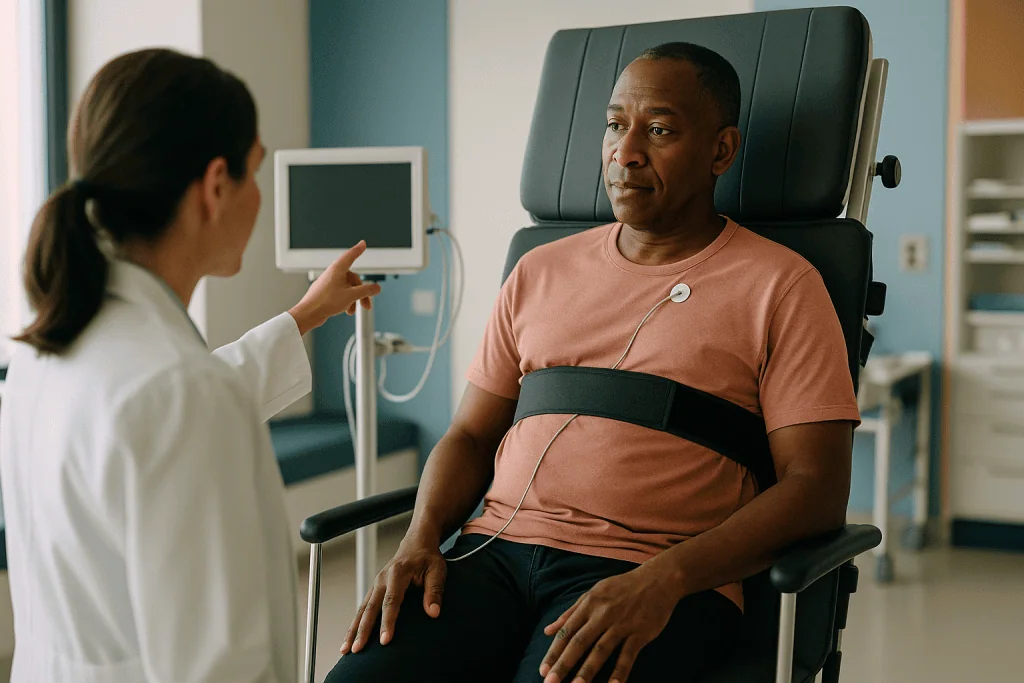
You lie flat for a rest period while the technician records stable baseline readings. Then the motorized table rises smoothly to an angle of roughly 60 to 80 degrees, so that you are nearly standing but with a footboard taking your weight (Mayo Clinic). The straps are safety belts, not restraints; you can talk, and you are asked to stay still and avoid tensing your legs, because muscle pumping would mask the very response being measured.
Once upright, the equipment records blood pressure and heart rate continuously, and the technician asks about symptoms: light-headedness, nausea, warmth, blurred vision, palpitations. Report everything, even mild things. Symptoms that arrive at the same moment as a pressure drop or heart rate surge are the most valuable finding of the whole visit.
Many protocols have a second phase for people who feel fine in the first. A medicine that mimics the body’s adrenaline response, or a tablet placed under the tongue that relaxes blood vessels, may be given to make the test more sensitive. Your clinician decides beforehand whether this applies to you, and the technician will explain it on the day (Cleveland Clinic).
If you faint or your pressure falls sharply, the table returns to flat immediately and you typically recover within moments. A tilt that provokes symptoms is not a failure; it may be exactly the information your team needs. Whether the test is called positive or negative, the interpretation depends on the pattern of numbers rather than on whether you passed or failed.
Heart rate tests: deep breathing and the Valsalva manoeuvre
Your heart rate is not a steady drumbeat. It speeds slightly as you inhale and slows as you exhale, a rhythm called respiratory sinus arrhythmia that is driven almost entirely by the vagus nerve. A healthy vagus produces a wide swing; a damaged one produces a flat line. That simple observation is the basis of the deep breathing test.
The technician asks you to breathe slowly and evenly to a visual or spoken cue, filling and emptying the lungs more fully than usual, for a short paced period. Electrodes record the beat-to-beat interval, and software calculates how much the rate rose and fell. Because the normal swing narrows with age, your result is judged against ranges for your age group rather than a single cut-off. The test is painless; the only difficulty is resisting the urge to hold your breath or breathe too fast.
The Valsalva manoeuvre, named after an eighteenth-century anatomist, is the medical version of straining. You blow steadily into a mouthpiece connected to a pressure gauge, keeping the needle at a target the technician shows you, then release and breathe normally. Straining raises pressure in the chest, briefly reducing blood returning to the heart; pressure dips, the sympathetic branch fires to compensate, and when you let go there is a characteristic overshoot as blood rushes back into a constricted system.
That sequence of dip, recovery and overshoot appears on the screen as a wave with recognizable phases. The heart rate ratio between the fastest beat during straining and the slowest beat after release reflects vagal function; the shape of the blood pressure recovery reflects sympathetic function. Together with the tilt, these two short tests let the interpreting physician say which branch is underperforming, and roughly how much, which shapes the conversation about causes (Cleveland Clinic).
Sweat test for autonomic dysfunction: QSART and the thermoregulatory test
Sweat is the autonomic system’s most visible output, and it is measured in two very different ways. The one included in most standard autonomic screens is the quantitative sudomotor axon reflex test, usually shortened to QSART: a test that stimulates a small patch of skin and measures the sweat produced by the local nerve fibres.
In practice, plastic capsules are strapped to the skin at a few standard points, typically on the forearm and along the leg to the foot. A very low electrical current, felt as warmth or a prickle, carries a sweat-stimulating chemical into the skin. The nerve endings under the capsule respond by triggering nearby sweat glands, and a stream of dry air through the capsule carries the moisture to a sensor that records volume over time. Reduced or absent output in the feet but normal output in the arm is a classic pattern of small fibre neuropathy, damage to the thinnest nerve fibres that also carry pain and temperature (Mayo Clinic).
The thermoregulatory sweat test is a separate, less common procedure done in specialized centres. You lie in a warmed chamber, coated in a powder that changes colour when wet, and the areas that do and do not sweat are photographed. It maps the whole body and can show patterns, such as a sharp line at the waist, that point toward the level of nerve or spinal cord involvement. It is not part of a routine screen and requires a longer visit; ask beforehand whether it is on your schedule.
Sweat testing is the branch most likely to be abnormal in early diabetic nerve damage and in some autoimmune conditions, which is why it is bundled with the cardiovascular tests even when your symptoms are mostly about fainting. Neither method injures the skin, though a small area of redness at the capsule site can last a day or so.
How long does an autonomic test take? A test-by-test summary table
Timing varies with the lab, the protocol your clinician ordered and how your body responds on the day, so treat the figures below as typical ranges from mainstream sources rather than a schedule. A full autonomic reflex screen, including tilt, usually occupies one appointment; a tilt table test on its own commonly takes around 90 minutes when both phases are done, and less if symptoms appear early or the second phase is not needed (Cleveland Clinic; Mayo Clinic).
| Test | What it measures | What it feels like | Typical duration |
|---|---|---|---|
| Deep breathing | Vagal (parasympathetic) control of heart rate | Slow paced breaths, painless | A few minutes including rest |
| Valsalva manoeuvre | Vagal and sympathetic blood pressure reflexes | Blowing into a tube, like inflating a stiff balloon; brief effort | Several minutes with repeats |
| QSART sweat test | Small sympathetic nerve fibres to sweat glands | Warm tingling under capsules on arm and leg | Roughly half an hour or so |
| Tilt table test | Blood pressure and heart rate response to upright posture | Being raised nearly upright, possible light-headedness | About 90 minutes for a two-phase protocol (Cleveland Clinic) |
Add time at the start for electrodes, cuffs and a rest baseline, and at the end for your readings to settle and for you to sit, dress and have something to drink. Labs also book buffer time in case the tilt provokes symptoms and you need a longer lie-down. Plan for the whole morning or afternoon, and if you are travelling any distance, arrange for someone to drive you home in case you feel washed out.
One practical note: because several parts depend on you being still and unhurried, rushing the schedule tends to produce noisier data. Arriving a little early, with instructions followed, is the single best thing you can do to make the visit efficient.
Who is autonomic testing usually for, and who is usually asked to wait
Referrals generally fall into three groups. The first is unexplained fainting or near-fainting, particularly when an electrocardiogram, heart monitor and echocardiogram have not found a cardiac rhythm or structural cause. The tilt table test is a standard part of that pathway when the story suggests a reflex or blood pressure mechanism (Mayo Clinic).
The second is dizziness or a racing heart on standing, especially in younger adults, where the question is whether the pattern meets criteria for postural tachycardia syndrome. In adults that means a sustained heart rate rise of at least 30 beats per minute within ten minutes of standing without a significant fall in blood pressure; for those aged 12 to 19 the threshold is 40 beats per minute (NHS). Continuous monitoring during tilt captures this more reliably than a manual pulse check in a clinic corridor.
The third is suspected autonomic neuropathy: nerve damage affecting automatic functions, most often in people with long-standing diabetes but also in some autoimmune, inherited and degenerative conditions. Symptoms such as unexplained sweating changes, digestive slowing, bladder trouble or blood pressure swings prompt referral, and sweat testing is particularly informative here (Mayo Clinic; MedlinePlus).
Who is asked to wait? People with a recent heart attack or unstable angina, severe narrowing of the aortic valve or the arteries to the brain, or an uncontrolled heart rhythm problem are usually not tilted until those issues are addressed, because deliberately provoking a pressure drop carries more risk for them (Cleveland Clinic). Pregnancy, a very recent stroke and an active acute illness are also common reasons to defer. Someone whose symptoms are clearly explained by a medicine or by dehydration may be asked to address that first and re-evaluate. None of this is a judgement about how serious your symptoms are; it is about getting reliable, safe data. The decision to proceed, defer or choose an alternative belongs to your treating team.
How should I prepare for autonomic testing?
Preparation has one aim: to strip out anything that could push your autonomic system up or down before the equipment ever touches you. The instructions are simple, but skipping them is the most common reason a test is inconclusive or has to be repeated.
Food and drink come first. You will usually be asked not to eat or drink for a couple of hours or more before the appointment, because a full stomach diverts blood to the gut and can blunt or exaggerate the response to tilt (Mayo Clinic). Caffeine, alcohol and nicotine are typically off the list for the preceding day, as all three shift heart rate and blood vessel tone. Ask the lab exactly what they want, and if you have diabetes, ask specifically how to manage meals safely; never fast in a way that risks low blood sugar without that conversation.
Medicines are the most important item, and the one you should never decide alone. Several common drug classes act directly on the reflexes being tested: blood pressure medicines, some antidepressants, medicines for an overactive bladder, decongestants, and certain treatments for allergies or Parkinson’s disease. Your referring clinician may ask you to hold some of them for a set period before the test, or may prefer you continue and have the results read in that context. Bring a complete list, including supplements, and follow only the instructions you were given. Stopping a prescribed medicine on your own can be unsafe and can also make the test harder to interpret.
On the day, wear loose, two-piece clothing; electrodes go on the chest and capsules on an arm and leg. Skip lotions, oils or heavy moisturizers on your limbs, because they interfere with sweat measurement. Empty your bladder just before you go in, since you may be lying still for a long stretch. Finally, arrange a lift home if you can. Most people feel fine afterwards, but a tilt that provokes symptoms can leave you tired for a few hours.
What conditions can autonomic testing diagnose, and what it cannot
A careful answer to this question is the best protection against disappointment. Autonomic testing characterizes a pattern of dysfunction. It rarely names a disease by itself, and the report you receive will usually describe findings rather than a single verdict.
Patterns it identifies well include neurally mediated (reflex) syncope, the common faint in which blood pressure and heart rate fall together under the stress of prolonged standing; orthostatic hypotension of neurogenic origin, where pressure falls on tilt but the heart rate barely responds, pointing to a sympathetic nerve problem rather than dehydration; postural tachycardia syndrome, where heart rate surges while pressure holds; and small fibre or autonomic neuropathy, where sweat output is reduced, often in the feet, alongside blunted heart rate variability (Mayo Clinic; NHS).
Those patterns then narrow the list of underlying causes. Diabetes is the most frequent cause of autonomic neuropathy; others include certain autoimmune conditions, some inherited disorders, amyloid protein deposits in nerves, and neurodegenerative diseases that affect the autonomic centres of the brain and spinal cord (MedlinePlus; Mayo Clinic). Deciding among them requires blood tests, sometimes imaging, and always a clinical history. The autonomic lab supplies one piece, and a very useful one, of that picture.
What the tests cannot do is equally important. A normal screen does not prove that nothing is wrong; symptoms that come and go can fall in the gaps between measurements, and some conditions affect fibres the tests do not sample. An abnormal result does not by itself indicate a progressive or serious disease; mild abnormalities are common with age, with some medicines and after prolonged bed rest, and they can improve when the underlying driver is addressed. Nor can autonomic testing measure anxiety, rule in or rule out a heart rhythm disorder, or predict how you will respond to any particular treatment. Any such conclusions must come from your treating team weighing all the evidence together.
What the days and weeks after autonomic testing usually look like
The physical aftermath is brief for most people. After the tilt you rest flat until your blood pressure and heart rate have returned to baseline, then sit up gradually before standing. A drink of water and a light snack help, particularly if you fasted. Mild fatigue for the rest of the day is common after a tilt that provoked symptoms, and a small pink patch or itch where the sweat capsules sat can linger for a day or so. Neither needs treatment beyond time (Mayo Clinic; Cleveland Clinic).
The analytical aftermath takes longer. The raw traces from each test are reviewed by a physician trained in autonomic interpretation, who compares your values with age-matched reference ranges, looks at the pattern across tests, and writes a report. Depending on the service, that report typically reaches your referring clinician within days to a couple of weeks; ask at the end of the visit how long the lab expects and how results will be shared, because some services release the report to a patient portal before the clinician has had a chance to explain it. Reading unfamiliar numbers alone, without context, is a reliable recipe for unnecessary worry.
The follow-up appointment is where the results become useful. If the pattern points to reflex syncope, the conversation often turns to recognizing early warning signs, fluid and salt intake as advised by your clinician, and physical counter-manoeuvres that raise blood pressure. If it points to postural tachycardia, discussion may cover graded activity and, in some cases, medicines that act on heart rate or blood volume; those decisions rest with the prescribing clinician, who will weigh your other conditions and medicines. If sweat testing suggests neuropathy, further blood tests to identify a cause are usually the next step.
Repeat testing is sometimes arranged after months or longer to track change, but a single well-conducted screen answers most initial questions.
Risks, discomforts and alternatives to a full autonomic screen
Autonomic testing sits at the low-risk end of hospital investigations. Nothing is inserted, no contrast dye is used and no radiation is involved. The realistic downsides are discomfort and, for the tilt table portion, the deliberate provocation of symptoms in a monitored setting.
During tilt you may feel light-headed, nauseated, sweaty, or notice your vision dimming; you may faint. The table is returned flat within seconds and most people recover promptly. Rarely, the blood pressure drop is accompanied by a very slow heart rate or a brief pause, which is one reason the test is done with continuous monitoring and staff trained to respond. Serious complications are uncommon, and the screening for who should wait, described earlier, exists precisely to keep them uncommon (Cleveland Clinic; Mayo Clinic). If the second phase of the tilt uses a medicine to sensitize the test, you may also notice a headache or a warm flush that settles as the drug wears off.
The sweat test produces tingling or mild burning at the capsule sites, and occasionally a small area of redness that fades within a day or two. The Valsalva manoeuvre can cause momentary dizziness or a brief headache from straining. Deep breathing is essentially without side effects, though some people feel briefly light-headed from breathing more deeply than usual.
Alternatives depend on the question being asked. For fainting, ambulatory heart monitors worn for days or weeks, or a small implantable recorder, capture rhythm during real episodes and are often used before or alongside tilt. For dizziness on standing, a simple active stand test, measuring blood pressure and pulse while you rise from lying and stand for several minutes, can be done in an ordinary clinic and is sometimes enough to confirm orthostatic hypotension or postural tachycardia (NHS). For suspected neuropathy, a skin biopsy that counts small nerve fibres is a complementary test. Which route makes sense for you is a decision for your treating team.
What people often get wrong about autonomic nervous system tests
Myth: if I faint on the tilt table, I failed. A faint under monitored conditions is often the most informative result of the day, because it lets the team see exactly how pressure and heart rate behaved in the seconds before symptoms. Conversely, not fainting does not mean the test was wasted; the recorded trends still carry information.
Myth: a normal result means my symptoms are imaginary. Autonomic function fluctuates, and a single session samples a slice of it. Normal readings narrow the possibilities and redirect the search; they do not dismiss what you experience. Clinicians who order these tests know this well.
Myth: the test will tell me whether I have a serious disease. The screen describes patterns, not diagnoses. Mild abnormalities are common with age, certain medicines and prolonged inactivity, and many improve when the driver is addressed (Mayo Clinic). A serious underlying cause is identified only through the wider work-up.
Myth: I should stop all my medicines so the test is accurate. Some medicines are held, others are deliberately continued, and the choice depends on your health and the question being asked. Stopping blood pressure or heart medicines without instruction can be dangerous. Follow only the specific guidance you were given.
Myth: it is an exercise or stress test. You lie or stand still throughout. No treadmill, no bike. The challenge comes from gravity, breathing and a mild skin stimulus, not exertion.
Myth: it involves needles or shocks. Electrodes are sticky pads, the sweat test uses a current so low it feels like warmth, and the only medicine sometimes involved in tilt is given by mouth or through a small cannula placed for safety in some labs. Ask your lab what its protocol uses.
Myth: results are available before I leave. The technician can tell you the session went smoothly but cannot interpret. Interpretation is a physician’s task and takes time.
Questions to ask your care team before and after autonomic testing
A ten-minute conversation before the appointment sharpens both the test and your understanding of it. Bring this list, and write the answers down; the details are easy to blur under stress.
- Which specific tests are included in my screen, and is the tilt table part of it? Will there be a second, medicine-assisted tilt phase?
- Which of my medicines and supplements should I hold, for how long, and which should I continue? What should I do if I forget and take one?
- Exactly how long should I avoid food, drink, caffeine, alcohol and nicotine beforehand? If I have diabetes, how do I manage meals and glucose safely around the fast?
- How long should I plan to be at the lab, and should someone drive me home?
- What symptoms should I report during the test, and what happens if I faint?
- Who interprets the results, roughly when should I expect them, and will they be released to me before I have a chance to discuss them?
After the results arrive, a second set of questions keeps the conversation anchored to what matters:
- Which pattern did the tests show, and which branch of the autonomic system is involved?
- Does this explain my symptoms fully, partly or not at all, and what does that change about the working diagnosis?
- What further tests, if any, are needed to look for a cause, and what would each one add?
- Are any of my current medicines likely to be contributing, and is a review of them planned? (Ask, rather than adjusting anything yourself.)
- What can I do day to day that is supported by evidence, and what warning signs should prompt me to call?
- Is repeat testing likely, and if so, what would prompt it?
Notice that none of these questions asks whether you passed. Framing the test as a description rather than a verdict tends to lead to more useful answers, and it keeps every decision where it belongs: with you and the team looking after you.
When to call your doctor: red-flag signs during and after autonomic testing
The test itself is supervised, so anything that happens on the table is handled on the spot. The signs below are about the hours and days around it, and about the symptoms that led to referral in the first place. Some of them are not autonomic at all, and that is the point: fainting and dizziness have several possible causes, and a few are urgent.
Call emergency services if you faint and do not recover within a minute or so, faint during exertion or while lying down, have chest pain, severe shortness of breath, a pounding or irregular heartbeat that does not settle, or if a collapse is followed by confusion, weakness on one side, difficulty speaking, a seizure or a significant head injury. Fainting with any of these features can signal a heart rhythm or blood flow problem that needs immediate assessment (Mayo Clinic; MedlinePlus).
Contact your doctor promptly if, after the test, you have prolonged dizziness that does not ease with lying down and fluids, repeated near-faints over the following day, a headache that is severe or unusual for you, or redness at the sweat test sites that spreads, becomes hot or painful, or develops blistering. Also call if you held a medicine for the test and are unsure when or whether to restart it; do not guess.
Book a routine appointment if your original symptoms are becoming more frequent, if you notice new problems such as bladder or bowel changes, unexplained changes in sweating, or falls, or if you simply do not understand the report. These deserve attention but rarely need an emergency department.
Fainting is common and usually benign, but the decision about how urgently to investigate is one your treating team should make with the whole picture in front of them. When in doubt, especially with chest symptoms or injury, err toward seeking care.
Frequently asked questions
How should I prepare for an autonomic testing appointment?
Follow your lab’s written instructions exactly: usually no food or drink for a couple of hours or more, and no caffeine, alcohol or nicotine for the preceding day (Mayo Clinic). Ask your referring clinician which medicines to hold and which to continue, and never stop a prescribed medicine on your own. Wear loose two-piece clothing, skip lotions on your arms and legs, empty your bladder beforehand and arrange a lift home in case you feel tired afterwards.
Can you give me short notes on the autonomic nervous system?
The autonomic nervous system runs functions you do not consciously control: heart rate, blood pressure, digestion, sweating, pupil size and bladder function. It has two branches that work in balance. The sympathetic branch acts like an accelerator, raising heart rate and tightening blood vessels when you stand, exercise or feel threatened. The parasympathetic branch acts like a brake, slowing the heart and promoting digestion at rest (Cleveland Clinic). Autonomic tests probe each branch separately.
What conditions can autonomic testing diagnose?
It identifies patterns rather than naming diseases outright. Common patterns include reflex syncope, neurogenic orthostatic hypotension, postural tachycardia syndrome and small fibre or autonomic neuropathy. Those patterns then point toward causes such as diabetes, autoimmune conditions or neurodegenerative disease, which are confirmed with blood tests, history and sometimes imaging (Mayo Clinic; MedlinePlus). A normal screen narrows the possibilities but does not by itself rule out a problem.
How long does an autonomic test take from start to finish?
Plan for most of a morning or afternoon. A tilt table test with both phases typically takes around 90 minutes, and it is shorter if symptoms appear early or the second phase is not needed (Cleveland Clinic; Mayo Clinic). Heart rate tests add several minutes each, sweat testing roughly half an hour, and there is set-up time at the start and recovery time at the end. Individual labs vary, so ask when you book.
Tilt table test: what to expect if I faint during it?
The table is returned to flat within seconds, staff stay at your side, and most people recover within moments, often before they fully register what happened. Continuous monitoring means the team already has the blood pressure and heart rate trace from the seconds before you fainted, which is frequently the single most useful piece of data from the visit. You rest until readings settle, then sit up gradually before standing (Mayo Clinic).
Does the sweat test for autonomic dysfunction hurt?
Not in the usual sense. QSART uses a very low electrical current to move a sweat-stimulating chemical into the skin under small capsules on your arm and leg, and most people describe warmth, tingling or a mild itch rather than pain. A small pink patch can remain for a day or so. Spreading redness, heat, blistering or pain at a site afterwards is uncommon and should prompt a call to your doctor.
Is an autonomic nervous system test the same as a stress test?
No. A cardiac stress test makes you exercise on a treadmill or bike, or uses a medicine to mimic exercise, to look at blood supply to the heart muscle. Autonomic testing asks you to lie or stand still while breathing, straining briefly and being tilted; the challenge comes from gravity and reflexes rather than exertion. The two tests answer different questions and are sometimes both ordered for unexplained fainting.
Should I stop my blood pressure medicine before autonomic testing?
Only if your referring clinician tells you to, and only for the period they specify. Some medicines are held because they blunt the reflexes being measured; others are continued deliberately so the test reflects your real-world state. Stopping blood pressure, heart or other prescribed medicines without guidance can be unsafe. Bring a full list, including supplements, to the appointment and confirm the plan for restarting anything you held.
What does a positive tilt table test mean?
It means the tilt reproduced a measurable drop in blood pressure, an excessive rise in heart rate, or both, often alongside your typical symptoms. The specific pattern matters more than the label: pressure and heart rate falling together suggests reflex syncope, pressure falling with little heart rate change suggests a sympathetic nerve problem, and heart rate surging with stable pressure suggests postural tachycardia (Mayo Clinic; NHS). Your treating team interprets this alongside your history.
When will I get my autonomic testing results?
The technician cannot interpret results on the day; a physician reviews the traces, compares them with age-matched reference ranges and writes a report, which typically reaches your referring clinician within days to a couple of weeks depending on the service. Ask at the end of the visit how long to expect and whether the report will appear in a patient portal before your follow-up, so you are not left reading unfamiliar numbers without context.
References
- Cleveland Clinic: Autonomic nervous system
- NHS: Postural tachycardia syndrome (PoTS)
- MedlinePlus: Autonomic neuropathy
This article is for general information only and is not a substitute for professional medical advice. Please consult a qualified doctor about your individual situation.

More from the Blog

Caring for Someone After a Traumatic Brain Injury: What Families Can Do in the First Weeks
In the first weeks after a traumatic brain injury, families help most by keeping the environment calm and predictable, protecting sleep, speaking slowly in…

When Is It Time to See a Neurologist for Migraine? How Frequency and Disability Guide It
Consider seeing a neurologist for migraine when attacks occur on about five or more days a month, when they regularly stop you from working…
What Does the Screening Injection Before Baclofen Pump Implantation Show?
A baclofen pump screening trial shows whether a person's spasticity loosens when a small test dose of baclofen is placed directly into the spinal…

Mealtime Support for Someone With Dysphagia: Positioning, Pacing and Swallowing Safety
Mealtime support for dysphagia means helping someone eat and drink in the way their swallowing assessment recommends: sitting fully upright with the head slightly…

What Families Can Do Between Therapy Sessions to Support a Child With Cerebral Palsy
Between therapy sessions, families support a child with cerebral palsy mainly by folding the therapist's goals into daily routines: planned positioning, regular stretching, supported…

Can Cognitive Stimulation and Nutrition Help in Alzheimer’s Disease? What Care Plans Include
Cognitive stimulation, usually delivered as structured group sessions, produces small but measurable gains in thinking and quality of life for people with mild to…