

How Do Programming Visits Fine-Tune a Deep Brain Stimulator After Parkinson DBS Surgery?
Key Takeaways
- The operation places the electrodes, but the settings that control symptoms are chosen over months of outpatient programming visits that typically begin two to four weeks after surgery.
- A temporary improvement in the weeks right after surgery, before the device is switched on, is the microlesion effect and its fading is expected rather than a sign of failure.
- Programmers test each electrode contact one at a time and look for the widest gap between symptom relief and side effects, a range called the therapeutic window.
- Tingling, facial pulling, double vision or slurred speech during programming usually mean current is reaching a neighboring structure and are typically corrected by lowering the setting or changing contact.
- Stimulation and levodopa act on the same circuits, so medicines are often reviewed and sometimes reduced during programming, but only by the prescribing clinician and never by the patient.
- Non-rechargeable generators are described by Mayo Clinic and Cleveland Clinic as lasting roughly three to five years, rechargeable ones up to about fifteen, and replacement involves the chest only, leaving the brain leads untouched.
DBS programming after surgery is the series of outpatient visits, usually beginning about two to four weeks after the electrodes are implanted, in which a neurologist or nurse uses a wireless tablet to test each electrode contact and adjust the stimulation settings. Over the first several months, settings and Parkinson's medicines are adjusted together, step by step, to control symptoms while limiting side effects such as tingling or slurred speech.
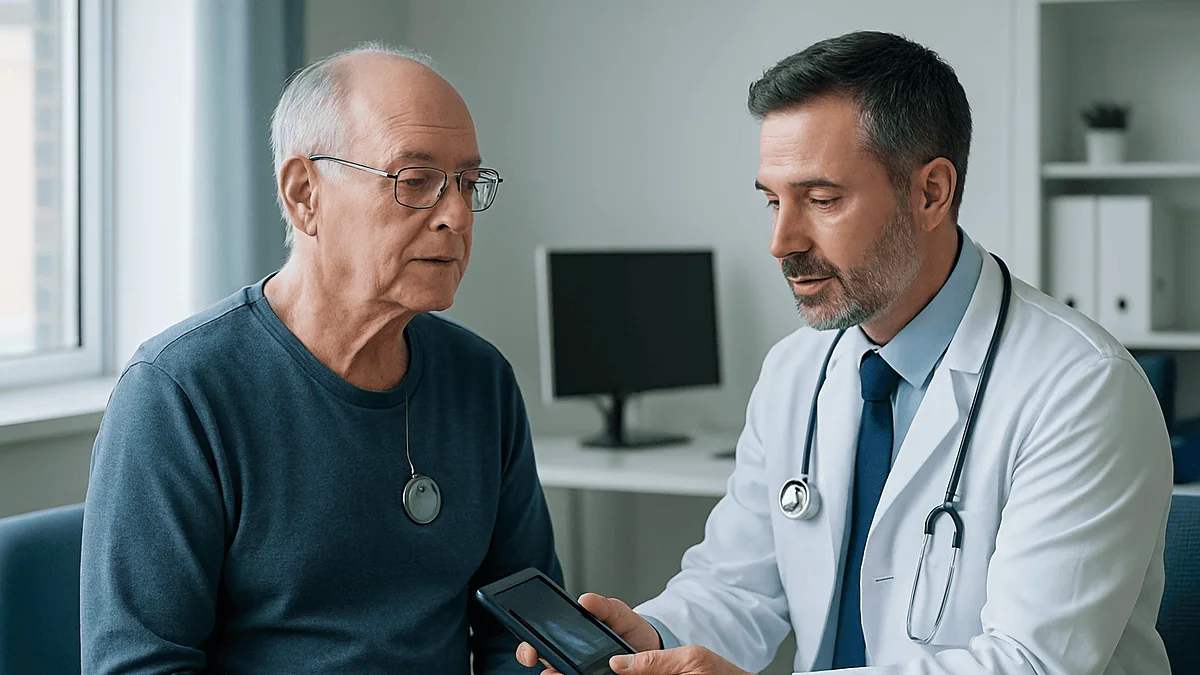
Three weeks after his brain surgery, Raymond sat in a clinic chair with a small plastic wand resting against his collarbone and a neurologist watching his right hand. “Tap your thumb and finger,” she said. He tapped. She touched the tablet. He tapped again, and something in the rhythm loosened. Then a strange pulling started at the corner of his mouth. She tapped the screen once more and it vanished. “That,” she said, “is the edge we’re looking for.”
Most people imagine deep brain stimulation as the operation. In reality, the surgery installs the hardware; the months of DBS programming after surgery decide what that hardware does. Nobody knows on the day of the operation exactly which of the eight or more electrode contacts will help most, or how strong the pulses should be.
Here is what those visits involve, why they take patience, and how to tell an ordinary adjustment from a warning sign.
What is DBS programming after surgery, and why can't the device just be set once?
Deep brain stimulation (DBS) is a treatment in which thin wires, called leads, are placed into a specific area of the brain, most often the subthalamic nucleus or the globus pallidus, and connected under the skin to a pulse generator, a battery-powered device usually placed below the collarbone. The generator sends tiny, steady electrical pulses into the target, which changes the abnormal firing patterns that drive tremor, stiffness and slowness in Parkinson’s disease.
Programming is the process of choosing how those pulses are delivered: which contacts on the lead are switched on, how much current flows, how wide each pulse is and how many pulses arrive each second. The surgeon places the lead within a target the size of a kidney bean. The programmer then decides which millimeter of that target to stimulate.
Why not set it once and walk away? Three reasons. First, the brain around a freshly placed lead is bruised and slightly swollen. That swelling itself can temporarily improve symptoms, an effect clinicians call the microlesion effect, and it fades over weeks. Settings chosen during that window would not hold. Second, stimulation and Parkinson’s medicines act on the same circuits, so changing one shifts the ideal level of the other. Third, Parkinson’s is a progressive condition. The settings that suit someone in year one may need refreshing in year four.
Guidance from sources such as Mayo Clinic and Cleveland Clinic describes DBS as a therapy that is adjusted over time rather than a single event, and that framing matters for expectations. Think of the operation as fitting a hearing aid. The device is in place, but the tuning that makes it useful happens in the clinic afterward, in stages, with the person wearing it giving constant feedback.
How does a programming visit actually work, minute by minute?
The visit begins before you arrive. Many teams ask that you come in the “off” medication state, meaning your last dose of Parkinson’s medicine was skipped or delayed according to instructions they give you. Never decide that timing yourself; the clinic sets it so they can see your symptoms without medication blurring the picture. Bring a companion if you can. Being off medicine for a few hours can be uncomfortable, and a second pair of eyes helps later when you try to remember what changed.
In the room, the clinician places a handheld communicator or wand over the generator in your chest. It talks to the device wirelessly through the skin; nothing touches the wires and nothing is inserted. On a tablet, the programmer sees every contact on each lead.
The core method is called a monopolar review. One contact is activated at a time. The current is raised in small steps while the clinician checks your wrist for rigidity, watches finger taps, looks for tremor and listens to your voice. At some point two things happen. Symptoms ease, and, if the current keeps climbing, a side effect appears: a tingling hand, a pulling eyelid, a thickened voice. The gap between benefit and side effect is called the therapeutic window. A contact with a wide window is a good candidate. This is repeated for each contact, on both sides of the brain if you have two leads.
Sessions are tiring. You are asked the same questions repeatedly, and the brain being tested is yours. Toward the end the clinician chooses a starting program, sets the limits on your patient controller and tells you when to take your medicine. You leave with settings that are deliberately conservative; the goal of visit one is a safe foundation, not a finished result.
Who is usually ready for programming, and who is asked to wait?
Readiness is less about a date on the calendar than about what the brain and the wounds are doing. Teams generally look for scalp and chest incisions that have closed cleanly, a person who is alert and able to report sensations accurately, and enough time elapsed for the immediate post-surgical swelling to settle so that the microlesion effect is no longer masking the baseline.
Several situations commonly lead a team to delay or shorten a first session:
- Post-operative confusion or drowsiness, which is not rare in older adults after brain surgery and usually clears, but makes symptom reporting unreliable.
- Any sign of wound infection, because the priority shifts entirely to protecting the hardware.
- A stronger-than-usual microlesion effect, where tremor has all but disappeared before the device is even on. Programming during this phase produces settings that stop working once the effect fades.
- Medication that is still being re-established after the hospital stay, since the team wants a stable baseline to compare against.
- Mood changes after surgery, such as low mood or unusual elation, which the team will want to understand before adding stimulation, since stimulation itself can influence mood.
There is also a difference by target. Leads in the subthalamic nucleus, the most common Parkinson’s target, often show benefit within minutes of a setting change, which makes the monopolar review efficient. Leads in the globus pallidus can take longer to reveal their full effect, so programmers sometimes work in slower, wider steps over more visits.
Being asked to wait is not a bad sign. Johns Hopkins and Cleveland Clinic patient guidance both describe the interval before activation as normal healing time. The device is doing nothing yet, and the tissue around it is using those weeks to calm down, which is exactly what makes the eventual settings trustworthy.
When does the first DBS programming after surgery visit happen, and what do the next weeks look like?
Cleveland Clinic’s patient information describes the generator being switched on and programmed for the first time a few weeks after implantation, once healing allows, and Mayo Clinic similarly places initial activation in the weeks following surgery. Two to four weeks is the range most people encounter, though your team may choose differently for the reasons above.
The weeks before that visit are quieter than most people expect. You go home from the hospital with the leads and generator in place but inactive. Sutures or staples are typically removed around one to two weeks after surgery. Symptoms may briefly seem better because of the microlesion effect, then drift back toward where they were before the operation. That drift is normal and often alarming if nobody warned you about it.
Once programming begins, the rhythm changes. A typical arc looks like this:
- First visit: monopolar review, choice of contacts, a conservative starting program.
- Following weeks: the amplitude is raised gradually, often in steps at each visit or via the patient controller within limits the clinician has set, while medicines are trimmed cautiously.
- Months two to six: fine adjustments to speech, walking, dyskinesia (involuntary writhing movements linked to medication) and mood; some contacts are swapped or combined.
- After stabilization: routine reviews, often every six to twelve months, plus visits as needed if symptoms change.
Cleveland Clinic describes this optimization phase as commonly stretching across several months rather than weeks, and Mayo Clinic notes that finding the best settings and medication balance can take time. The honest expectation is a season, not a single appointment. People who understand that from the start tend to describe the process as tedious but worthwhile. People who expected a switch to be flipped tend to describe the same visits as disappointing, even when the clinical results are identical.
How long does DBS programming take per visit, and how many visits are typical?
The first session is the longest. Testing every contact on two leads while watching for symptoms and side effects takes real time, and clinicians routinely block one to two hours for it; Cleveland Clinic patient material describes initial programming visits in that range. Later visits are shorter, often under an hour, because the programmer already knows which contacts have a wide therapeutic window and is only nudging a setting or two.
How many visits? Cleveland Clinic and Johns Hopkins both describe a series of appointments over the first several months, and in practice many people attend somewhere between four and eight sessions in the first half year. Some need fewer. Someone with tremor-dominant Parkinson’s whose lead sits precisely in the target may settle quickly. Someone with prominent dyskinesia and a complicated medication history may need more, because each change in stimulation alters how much medicine they can tolerate, and vice versa.
Several factors lengthen the process in predictable ways:
- Two leads rather than one, since each side is tested separately.
- Directional leads, which have segmented contacts that can steer current toward or away from a region. More options mean more testing but often a wider therapeutic window.
- Speech or balance side effects that appear only at the current levels needed for tremor control, forcing compromises.
- Living far from the clinic, which sometimes means fewer but longer visits, or the addition of remote programming where the team offers it.
Patience here is a clinical tool, not a personality trait. Raising stimulation quickly to chase a result tends to produce side effects that then have to be unwound, costing more visits than a steady climb would have. Ask your team roughly how many visits they anticipate for your situation. They cannot promise a number, but most can describe their usual pattern, and knowing it helps with work, travel and caregiver planning.
What are the common DBS programming side effects, and what do they mean?
Stimulation side effects are, in a sense, useful. They tell the programmer where the current is spreading beyond the target. The subthalamic nucleus sits next to fibers controlling movement, sensation, eye movement and mood, and each neighbor produces a recognizable signature when it is accidentally stimulated. Most effects appear within seconds of a setting change and disappear just as fast when the setting is lowered, which is why the monopolar review is done live.
| What you might notice | What it usually indicates | What the programmer typically does |
|---|---|---|
| Tingling or numbness in the hand, face or tongue | Current reaching sensory fibers nearby | Lower the current, switch contact or steer with a directional segment |
| Pulling of the face, eyelid or hand; cramping | Spread to motor fibers of the internal capsule | Reduce amplitude or move to a more medial contact |
| Double vision, eye deviation | Spread toward fibers controlling eye movement | Change contact, often to one higher on the lead |
| Slurred, soft or strained speech | Common at higher currents, especially with bilateral stimulation | Trade a little tremor control for clearer speech; adjust pulse width |
| New or worse dyskinesia | Often a sign stimulation is effective and medication can be reviewed | Coordinate medication timing with the prescribing neurologist |
| Sudden tearfulness, euphoria, anxiety or apathy | Spread to limbic (emotion-related) regions | Lower current or change contact; monitor mood between visits |
| Imbalance or falls | Multifactorial; may relate to stimulation, medication changes or disease | Review settings and medicines together; physical therapy referral |
Mayo Clinic lists numbness or tingling, muscle tightness in the face or arm, speech and balance problems, and mood changes among the effects that can follow stimulation and that are usually adjustable. The practical lesson is to report everything, even sensations that seem trivial or unrelated. A programmer cannot fix what is not described, and a well-described side effect often points straight to a better contact.
What happens to Parkinson's medicines while the stimulator is being tuned?
This is where programming stops being a purely electrical exercise. Levodopa, the mainstay of Parkinson’s treatment, is a precursor that the brain converts into dopamine, the chemical that the disease depletes. Stimulation of the subthalamic nucleus works on the same downstream circuits from a different direction. Add the two together at full strength and the combined effect can tip into dyskinesia, the involuntary writhing movements that people often find more troubling than the tremor they replaced.
For that reason, as stimulation is raised over the first weeks and months, the neurologist often reviews whether the medicine schedule can be reduced. The NHS notes that DBS may allow some people to take less medication, and Mayo Clinic describes stimulation as sometimes permitting a reduction in medicines, while stressing that it does not replace them. The pattern differs by target: subthalamic stimulation more frequently leads to medication reductions, whereas globus pallidus stimulation tends to leave medicine schedules closer to where they were and acts more directly on dyskinesia itself.
The sequence matters. Teams generally raise stimulation first and adjust medicine second, in small steps, waiting long enough between changes to see the true effect. Trimming medication too early or too quickly can produce a rebound of stiffness, slowness or low mood that has nothing to do with the device. Some symptoms, notably apathy or a flat mood, can appear when medication falls faster than stimulation compensates, and clinicians watch for this specifically.
Two rules protect you during this phase. Do not alter your own medicine timing or amount in response to how the stimulator feels; report the feeling and let the prescriber decide. And keep a simple diary of “on” and “off” periods, dyskinesia and sleep. That record, more than any single observation in clinic, tells the team whether the current balance between electricity and medicine is right for your daily life.
Contacts, amplitude, pulse width and frequency: what is the programmer actually changing?
Four settings do most of the work, and understanding them makes the visits less mysterious.
Contact is which metal ring on the lead is active. Standard leads have four contacts stacked a few millimeters apart; directional leads split some of those rings into segments facing different directions. Choosing a contact is choosing a location. Choosing a segment is choosing a direction, a bit like turning a garden nozzle to spray one flower bed and spare the path.
Amplitude is the strength of the current. It is the setting most often raised gradually over the first months and the one your patient controller may let you adjust within a range your clinician sets. Higher amplitude reaches more tissue, which brings more benefit until it also reaches a neighbor and produces a side effect.
Pulse width is how long each pulse lasts, measured in microseconds. Narrower pulses sometimes widen the therapeutic window, particularly for speech, because they activate large motor fibers less readily. Wider pulses can deliver more effect at lower amplitude.
Frequency is how many pulses arrive per second. Parkinson’s DBS typically uses high-frequency stimulation; the effect disappears at low rates. Some teams trial lower frequencies for specific problems such as freezing of gait, with mixed evidence, and your clinician can explain what the research does and does not support.
Newer generators add options: current steering across several contacts at once, independent control of each side, and in some devices the ability to record brain signals to guide settings. Whether any of these improves outcomes over standard programming is still being studied, and no patient should feel that lacking the newest feature means lesser care. The fundamental task, finding a contact with a wide therapeutic window and climbing slowly within it, has not changed.
What is the usual DBS surgery recovery time, and which restrictions matter most?
Recovery from the operation and tuning of the device run on parallel tracks. Cleveland Clinic describes most people returning to their usual daily activities within a few weeks of surgery, with restrictions on strenuous effort for longer, and Mayo Clinic notes that healing of the incisions and settling of swelling occur over the weeks before programming begins. Expect fatigue, a sore scalp and a tender lump where the generator sits.
Restrictions in the early weeks are about protecting the wounds and the wires, which are still settling into the scar tissue that will eventually anchor them:
- Keep incisions clean and dry until your surgical team clears you to wash normally; do not scratch or pick.
- Avoid heavy lifting, vigorous exercise and bending or straining for the period your surgeon specifies, commonly several weeks.
- Avoid extreme twisting or stretching of the neck, which puts tension on the extension wire running from head to chest.
- Do not drive until your team says you may; medication changes and post-operative fatigue affect reaction time.
Long-term precautions are about magnets and electricity. MedlinePlus and Mayo Clinic both advise telling every clinician you see that you have a DBS system, because some medical equipment is unsafe with it. Diathermy, a form of deep heat treatment sometimes used in physical therapy, must never be used. MRI scans are possible only under specific conditions with certain systems and settings, so imaging must be coordinated with the DBS team. Airport security arches and shop anti-theft gates can briefly interfere with the device or trigger an alarm; carry the identification card you were given and walk through steadily rather than lingering. Keep strong magnets, including some headphones and speaker magnets, away from the generator.
None of this means a restricted life. It means a short list of habits, most of which become automatic within months.
What is the downside of deep brain stimulation, honestly?
People searching this phrase deserve a straight answer, and the evidence supports one. DBS is a well-established treatment for motor symptoms of Parkinson’s in carefully selected people, but it carries real costs beyond money.
Surgical risk. Mayo Clinic lists bleeding in the brain, stroke, infection, seizure and problems with anesthesia among the risks of the operation. These are uncommon but serious, and they are the reason candidates are screened so carefully beforehand.
Hardware problems. Leads can move or fracture, the extension wire can erode through skin, and infection around the generator can require removal of hardware. Any of these means additional surgery.
Stimulation effects that do not fully resolve. The side effects in the table above are usually adjustable, but not always without sacrificing benefit. Speech is the classic trade-off: some people accept a softer voice for steadier hands, others choose the opposite. Cognitive changes, particularly in word finding or attention, and mood changes including apathy and depression are documented, which is why neuropsychological testing is standard before surgery.
What it does not do. DBS does not slow the underlying disease. The NHS and Mayo Clinic are clear that it manages symptoms rather than altering progression. It helps the symptoms that respond to levodopa, chiefly tremor, stiffness and slowness, and helps dyskinesia and motor fluctuations. It generally does not improve, and can worsen, balance, freezing of gait, speech, swallowing and thinking problems that levodopa does not help either.
Time. Months of visits, off-medication mornings, a controller to manage and eventual battery surgery are a genuine burden, especially for caregivers.
Alternatives your team may have discussed include optimizing oral medicines, continuous infusion therapies that deliver medication steadily through a pump, and focused ultrasound or other lesioning procedures, which treat one side and do not require hardware or programming. Which path fits depends on your symptoms, age, cognition and preferences, and that judgment sits with your treating team.
How does the patient controller work, and when is DBS battery replacement needed?
You leave the first programming visit with a small handheld controller. Depending on the system, it lets you check that the device is on, see battery status, switch between a few programs your clinician has stored, and sometimes raise or lower amplitude within a range they have locked. You cannot change contacts, pulse width or frequency, and you cannot exceed the limits set in clinic. That design is deliberate. The controller is for daily convenience and safety, not self-programming, and turning the device off is generally reserved for emergencies or specific instructions.
The generator’s battery is the part of the system that eventually wears out. Two types exist. Non-rechargeable generators are simpler to live with but need replacing when the battery runs down. Cleveland Clinic and Mayo Clinic describe these lasting roughly three to five years depending on settings, since higher amplitude and wider pulse width drain power faster. Rechargeable generators need charging at home, typically by holding or wearing a charging pad over the chest for a period every day or every few days, and are described by the same sources as lasting up to about fifteen years before the unit itself is replaced.
Replacement is a smaller operation than the original. The surgeon reopens the chest incision, disconnects the old generator from the extension wire, connects a new one and closes. The leads in the brain are not touched. Settings are transferred to the new device, though a brief check in clinic afterward is usual to confirm everything feels the same. Letting a non-rechargeable battery run flat is best avoided, because symptoms can return abruptly when stimulation stops; your team will monitor battery status at routine visits and schedule replacement ahead of time.
Which type you have was decided before surgery based on your settings, lifestyle and ability to manage charging. If you are unsure which you have or what its status is, ask at your next visit.
What people often get wrong about DBS programming
“Once it’s programmed, it’s done.” Programming is a phase that stretches over months and then continues at intervals for as long as the device is in place. Disease progression, weight change, medication changes and even scar tissue around the lead can shift the ideal settings.
“More current is always better.” Past a certain point, more current means more side effects, not more benefit. The skill lies in finding the contact with the widest gap between the two and staying inside it.
“My symptoms came back a month after surgery, so it failed.” Almost always this is the microlesion effect fading. The stimulator had not yet been turned on, or was on at a starting level. This is expected and is one reason programming begins after that window.
“DBS means no more medication.” Some people take less, particularly with a subthalamic target, but the NHS and Mayo Clinic both describe DBS as working alongside medicine, not in place of it.
“Programming is only for tremor.” Tremor responds fastest and is easiest to see in clinic, but programmers also chase stiffness, slowness, dyskinesia, motor fluctuations and, within limits, speech and walking.
“If I feel a side effect, something is wrong with the device.” Tingling or pulling at a new setting usually means the current is reaching a neighbor, not that hardware has failed. Report it; it is information, not a malfunction.
“Remote programming means I never need to go in.” Some systems allow adjustments by video visit, which helps people who live far away, but the hands-on examination of rigidity and gait cannot be fully replaced through a screen, and most teams still require periodic in-person review.
“A celebrity had it, so it works like that for everyone.” Public figures’ medical stories are edited for narrative. Your result depends on your symptoms, target, lead position and the months of tuning that follow, none of which appear in a headline.
Questions to ask your care team about programming
Write these down before the first visit and keep the answers with your device card. The people tuning your stimulator will welcome specific questions; vague worry is harder to address than a clear list.
- Which brain target were my leads placed in, and how does that affect how quickly programming changes take effect?
- Do I have directional leads or a device that records brain signals, and does that change how my visits will run?
- How should I take my medicines on the morning of a programming visit, and who do I call if I am unsure?
- Roughly how many visits do you anticipate in the first six months, and how long is each one likely to last?
- What can I adjust on my controller, what are the limits you have set, and when should I use them?
- What sensations should I expect after a setting change, and which ones should prompt a call before my next appointment?
- How will you decide when and how to adjust my Parkinson’s medication, and who makes that decision?
- What symptoms is stimulation unlikely to help in my case, so I can plan realistically for walking, speech or balance?
- Is my generator rechargeable or non-rechargeable, how long do you expect it to last at my settings, and how will you monitor it?
- Which medical procedures and scans need clearance from you first, and what should I tell other clinicians?
- Is remote programming available if I cannot travel, and what are its limitations?
- Who covers programming questions when my regular programmer is away?
One more question is worth asking out loud: “What would make you want to see me sooner than planned?” The answer will be personal to your situation and is more useful than any general list, because it comes from the people who know where your leads sit and what your last settings were.
When to call your doctor after DBS programming
Most sensations in the weeks after a setting change are mild, expected and fixable at the next visit. A short list of signs, however, should prompt a call the same day, and a few should prompt emergency services.
Call emergency services immediately for sudden severe headache, sudden weakness or numbness on one side of the body, sudden trouble speaking or understanding, a seizure, or sudden confusion. These can signal bleeding or stroke, which are rare but serious complications of brain surgery, and time matters.
Call your DBS team the same day if you notice:
- Fever, or redness, warmth, swelling, pain or drainage at any incision or along the wire path in the neck or chest. Infection around hardware is treated urgently.
- Skin thinning or the wire or generator appearing to press through the skin.
- A sudden loss of benefit, such as tremor or stiffness returning abruptly, which can indicate the device has switched off, the battery is depleted or a lead has been disturbed.
- New or worsening depression, thoughts of self-harm, unusual euphoria, agitation or marked personality change. Stimulation and rapid medication changes can both affect mood, and your team needs to know quickly.
- New double vision, marked speech change or facial pulling that does not settle within minutes of a setting adjustment you made with your controller.
- Falls, a new inability to walk safely or a swallowing problem that has appeared since the last visit.
- Any alert or error message on your controller, or a shock-like sensation from the device.
If your controller allows it and your team has instructed you to do so, returning to a previous program can be a reasonable first step while you wait for a call back. Do not alter your medication on your own in response to any of these. Keep your device identification card and the clinic’s after-hours number together, and make sure the person who lives with you knows where they are.
Frequently asked questions
What are the DBS restrictions after surgery I should follow?
In the early weeks, keep incisions clean and dry, avoid heavy lifting, straining and vigorous exercise for the period your surgeon specifies, and avoid extreme neck twisting that could tug on the wire. Long term, tell every clinician you have a DBS system, never have diathermy, arrange any MRI through your DBS team, carry your device card through security gates and keep strong magnets away from the generator. Your team’s written instructions override any general list.
Did Michael J. Fox have DBS?
According to his own public accounts, he underwent a thalamotomy, a procedure that creates a small permanent lesion in part of the thalamus to reduce tremor, rather than deep brain stimulation. Thalamotomy and DBS both target movement circuits, but a lesion is not adjustable, while DBS is tuned over time. More broadly, a public figure’s experience is not a guide to your own; outcomes depend on your symptoms, target and the months of programming that follow.
How long does it take to recover from DBS brain surgery?
Cleveland Clinic describes most people returning to usual daily activities within a few weeks, with restrictions on strenuous activity lasting longer, and Mayo Clinic places the first programming visit in the weeks after surgery once swelling has settled. Feeling the full benefit takes longer, because the stimulator is tuned gradually over several months alongside medication adjustments. Fatigue, scalp soreness and tenderness over the generator are common early on and usually fade.
What is the downside of deep brain stimulation?
The main downsides are surgical risks such as bleeding, stroke and infection, hardware problems that may need further surgery, stimulation side effects on speech, balance, mood or thinking that cannot always be fully adjusted away, and the time commitment of months of visits plus eventual battery surgery. DBS also does not slow Parkinson’s progression and generally does not help symptoms that levodopa does not help, such as freezing of gait or cognitive change.
Why did my symptoms improve right after surgery before the stimulator was turned on?
This is the microlesion effect. Placing the lead causes slight bruising and swelling in the target, which temporarily disrupts the abnormal signaling that drives symptoms. The effect can be striking and then fades over weeks as the tissue settles. Programmers deliberately wait for it to pass so that the settings they choose reflect your true baseline. Symptoms drifting back during that window is expected and is not a sign the surgery failed.
Can I adjust the DBS settings myself with the controller?
Only within limits your clinician has set. Most patient controllers let you check the device is on, view battery status, switch between a few stored programs and sometimes nudge amplitude up or down inside a locked range. You cannot change contacts, pulse width or frequency. Use it as your team instructed, note any changes you make and what you felt, and bring that record to your next visit so the programmer can interpret it.
Will DBS programming stop my Parkinson's medication?
Usually not entirely. The NHS and Mayo Clinic describe DBS as working alongside medicines and sometimes allowing a reduction, particularly with a subthalamic target, but not as a replacement. As stimulation is raised over the first months, your neurologist reviews whether the schedule can be trimmed to limit dyskinesia. Those changes are made in small steps by the prescriber; altering your own medication in response to how the stimulator feels can cause rebound symptoms.
Does DBS programming hurt?
The programming itself is painless because the communicator talks to the generator wirelessly through the skin. What people notice are the stimulation effects at the edge of each setting, such as tingling, a pulling sensation in the face or hand, or briefly slurred speech, which stop within seconds when the setting is lowered. The harder part is often the fatigue of a long session while off medication, so plan a quiet rest afterward and bring a companion.
Can DBS programming be done remotely?
Some systems allow clinicians to adjust settings during a video visit, which helps people who live far from the clinic or find travel difficult. Remote sessions have limits: a programmer cannot feel rigidity at the wrist through a screen or fully assess gait, so most teams combine remote adjustments with periodic in-person examinations. Whether it is available depends on your device and your center’s practice, and your team can tell you what they offer.
What if programming makes my speech worse?
Softer, slurred or strained speech is one of the most common trade-offs in Parkinson’s DBS, especially with leads on both sides and at higher currents. Tell your programmer specifically; options include lowering amplitude, narrowing pulse width, switching to a different or directional contact, or accepting slightly less tremor control for clearer speech. A speech-language pathologist can also help. The balance you choose is personal, and it can be revisited at any visit.
References
- Cleveland Clinic: Deep Brain Stimulation (DBS)
- MedlinePlus: Deep brain stimulation
- NHS: Parkinson's disease, Treatment
- NIH National Institute of Neurological Disorders and Stroke: Parkinson's Disease
This article is for general information only and is not a substitute for professional medical advice. Please consult a qualified doctor about your individual situation.

More from the Blog

Why Myasthenia Gravis Evaluation Includes Thymus Imaging and Breathing Tests
Myasthenia gravis evaluation includes thymus imaging because the thymus gland, which sits behind the breastbone, is abnormal in many people with the condition and…

How Long Before Preventive Migraine Treatment Shows Results? What Follow-Up Visits Assess
Preventive migraine treatment usually needs a fair trial before anyone can judge it. Most oral preventives are assessed after roughly two to three months…

Trigeminal Neuralgia Surgery Recovery: The First Days, Incision Care and Returning to Work
Recovery after microvascular decompression usually means a hospital stay of a few days, then several weeks at home while a small incision behind the…

What to Gather Before a Motor Neuron Disease Consultation: EMG Results, Scans and Medications
Before a motor neuron disease consultation, gather the actual EMG and nerve conduction reports (not just the summary letter), any MRI of the brain…

Flying Home After a Craniotomy: How Long International Patients Usually Stay and Why
Most surgical teams ask patients to avoid flying after craniotomy until a follow-up scan shows any trapped air has cleared, the wound has healed,…

Cerebrovascular Disease Follow-Up: What Is Normal and When to Call Your Neurology Team
After a stroke or TIA, lingering fatigue, mild headaches that ease with rest and slow, uneven improvement in strength or speech are usually part…