

How Do Surgeons Choose Between Robotic, Laparoscopic and Open Hernia Repair?

Key Takeaways
- Randomized trials comparing robotic and laparoscopic groin hernia repair have found no meaningful difference in complications, pain or recovery, but longer operating times with the robotic approach.
- Open groin hernia repair can be done under local or regional anesthesia, making it the usual choice for people who should avoid a general anesthetic (MedlinePlus).
- Laparoscopic and robotic repairs use three to five small cuts and inflate the abdomen with carbon dioxide gas, which causes the shoulder pain some people notice for a day or two (MedlinePlus; NHS).
- The robotic platform's wristed instruments and 3D view matter most for complex incisional hernias and repairs through old scar, not for simple first-time groin hernias.
- Recurrence and complication rates after minimally invasive hernia repair depend heavily on the surgeon's experience with that specific technique (Mayo Clinic).
- After uncomplicated groin hernia repair most people go home the same day, return to light activity within one to two weeks, and avoid heavy lifting for around four to six weeks (NHS).
Surgeons choose between robotic, laparoscopic and open hernia repair based on the hernia's location and size, whether it is a first repair or a recurrence, the patient's fitness for general anesthesia, prior abdominal surgery, and the surgeon's own training and volume. Current evidence finds robotic and laparoscopic approaches broadly similar in outcomes, while open repair remains a sound option for many groin hernias.
A man in his fifties sits in a consulting room with a folded printout of his ultrasound report and three words written on the back of an envelope: robotic, laparoscopic, open. The bulge in his groin has been there for a year. He has read that the robot is newer, that keyhole surgery hurts less, and that his neighbor had “the old-fashioned kind” and was back at work in ten days. He wants to know which one is best. The surgeon, to his mild frustration, answers with questions.
That exchange plays out every day, and it is the right way round. The robotic vs laparoscopic hernia repair debate looks like a technology contest from the outside. From the surgeon’s side of the desk it is a matching exercise: a particular hernia, in a particular body, paired with the technique most likely to fix it durably with the fewest problems.
This explainer walks through what each operation involves, what the evidence genuinely shows about differences between them, and which factors tend to tip the decision one way or another, so the conversation with your own team starts from solid ground.
What actually happens in open, laparoscopic and robotic hernia repair?
A hernia is a weak spot or gap in the muscular wall of the abdomen through which fat or a loop of intestine pushes outward. Repairing it means putting the contents back where they belong, closing or reinforcing the gap, and, in most adult repairs, laying a piece of surgical mesh over the weak area so it does not open again. Every one of the three approaches does those same jobs. What differs is the route the surgeon takes to reach the defect.
In an open repair, the surgeon makes a single incision directly over the hernia, works with hand-held instruments under direct vision, and closes the layers with stitches. For a groin hernia this can often be done under local or regional anesthesia, so the patient is awake but numb, which matters for people who are poor candidates for general anesthesia (MedlinePlus).
Laparoscopic repair reaches the same weak spot from the inside. The surgeon makes three to five small cuts, inflates the abdomen with carbon dioxide gas to create working room, and passes a thin camera and long instruments through the cuts (MedlinePlus). The image appears on a screen; the surgeon’s hands stay outside the body, moving instruments that pivot at the abdominal wall. General anesthesia is required.
Robotic repair is laparoscopic surgery with a different set of hands. The same small incisions and gas are used, but the instruments are held by mechanical arms. The surgeon sits at a console a few feet from the table, looks into a magnified three-dimensional view, and moves controls that translate finger and wrist motion to the instrument tips (Mayo Clinic). The word “robot” misleads: nothing is automated. The machine does not decide, cut or stitch on its own. It is a very precise extension of the surgeon’s hands.
Robotic vs laparoscopic hernia repair: what is really different inside the operating room?
Stand behind a laparoscopic surgeon and you will see a subtle awkwardness. Because each instrument pivots where it passes through the abdominal wall, moving a hand to the left sends the tip to the right. The instruments are straight and rigid, so sewing deep in the pelvis or around a corner means angling the whole shaft. The picture is two-dimensional, and if the surgeon’s assistant holds the camera, it drifts with fatigue.
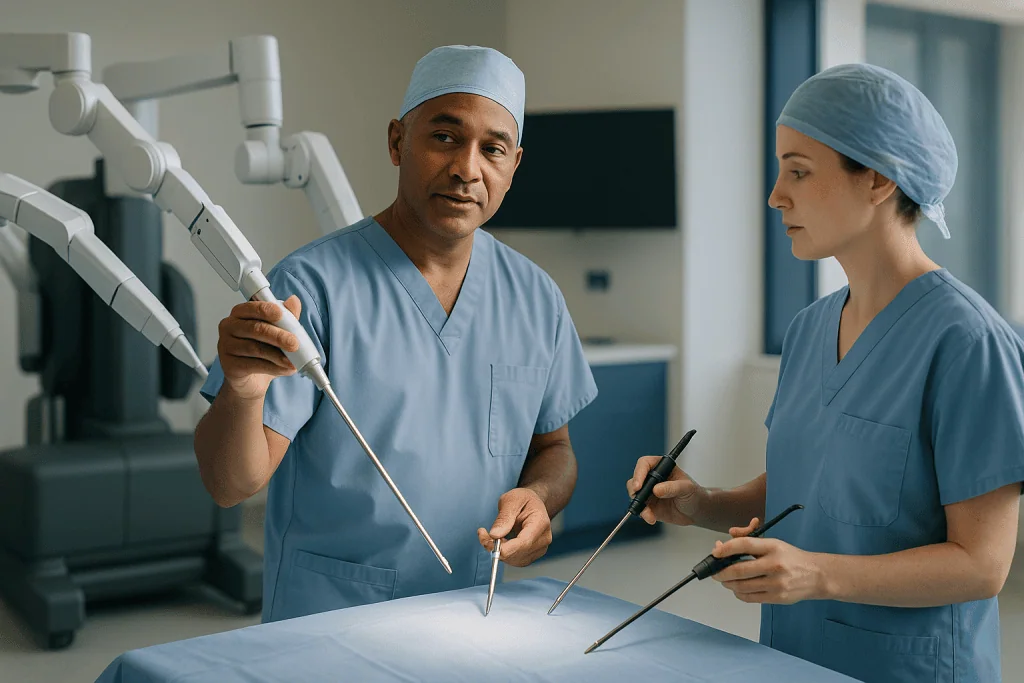
Robotic platforms were built to address exactly those irritations. The instrument tips have a wrist that bends and rotates, so the surgeon can sew along a curved line or tuck a stitch behind a fold of tissue without contorting an arm. The camera is stable, under the surgeon’s own control, and delivers depth perception through two separate optical channels (Cleveland Clinic). Hand tremor is electronically filtered. The surgeon operates seated, which some describe as less physically draining across a long list.
For the patient, though, most of these differences are invisible. The number and size of the incisions are comparable. The gas, the general anesthetic, the mesh and the internal steps of the repair are the same. Where the robotic wrist earns its keep is in the technically fiddly parts: closing a large defect with running sutures from the inside, dissecting scar tissue from a previous operation, or working in a deep, narrow pelvis.
There are trade-offs on the surgeon’s side. Setting up and connecting the arms, called docking, adds minutes to the case. The surgeon loses the sense of touch that hand-held instruments preserve, relying instead on visual cues about how much a tissue is stretching. And the machine occupies a substantial footprint, which some operating rooms and surgical schedules accommodate more easily than others.
Why do surgeons prefer robotic surgery in some cases, and not in others?
Ask a surgeon who has adopted the robotic platform why, and you rarely hear “because it is better for every patient.” The honest answers are more specific.
Ergonomics come up first. Laparoscopic hernia surgery, done for years, is associated with neck, shoulder and hand strain, and a seated console with a steady image removes much of that load. A surgeon who is comfortable at the end of a full day may operate more consistently, an indirect benefit to patients that is real but hard to measure.
Suturing comes up second. Some laparoscopic surgeons tack mesh in place with small fasteners because sewing through straight instruments is slow. The robotic wrist makes sewing inside the abdomen practical, allowing the surgeon to close the muscle gap itself and fix mesh with stitches rather than tacks. Whether that translates into less pain or fewer recurrences is still being studied; the plausible mechanism is there, the proof is incomplete.
Complex cases come up third. Large incisional hernias after previous operations, hernias that have already recurred, and repairs in patients with heavy scarring are where surgeons most often describe the platform as changing what is feasible with small incisions rather than a long open cut.
Then there are the reasons surgeons give for not using it. Longer operating time is the consistent finding across studies, largely from setup and docking. A straightforward first-time groin hernia in a slim patient gains little from the added capability. Some surgeons trained extensively in conventional laparoscopy and simply achieve excellent results that way. And availability varies; a platform is a shared institutional resource, not something every surgeon can book for every case. None of these is a reason for a patient to worry. They are the ordinary realities that shape a sensible choice.
Is robotic hernia repair better? What the evidence actually shows
The short version: for the common groin hernia, high-quality studies have not shown that robotic repair produces better outcomes than laparoscopic repair. That is worth stating plainly, because marketing around new technology can leave a different impression.

Randomized trials that assigned patients to robotic or conventional laparoscopic groin hernia repair have generally found similar rates of complications, similar pain scores in the first weeks, similar time back to normal activity, and no advantage in early recurrence, while operating times were longer and resource use higher with the robotic approach. Systematic reviews pooling multiple studies reach the same broad conclusion for inguinal hernias: no clear clinical winner between the two minimally invasive options.
Ventral and incisional hernias, the ones that form in the front of the abdomen or through old surgical scars, are a more open question. Observational studies suggest that robotic repair may shorten hospital stays compared with open repair for larger defects and may let surgeons close the muscle gap in cases where conventional laparoscopy would have left mesh bridging the hole. Observational evidence is weaker than randomized evidence, though, because surgeons and patients are not assigned at random; healthier patients or simpler hernias may drift toward one technique and flatter its results.
So the fair summary is graded. Robotic and laparoscopic groin repair: equivalent on what matters to patients, based on good-quality trials. Robotic versus open repair of complex abdominal wall hernias: promising, plausibly beneficial, not yet proven with the same rigor. Robotic repair as superior across the board: not supported.
Mainstream patient information from major medical centers reflects this caution, describing robotic surgery as a tool that offers surgeons greater precision and range of motion rather than as a guarantee of a better result (Mayo Clinic; Cleveland Clinic).
Laparoscopic vs open hernia repair: when the older approach still wins
It is easy to assume open repair is what you get when the fancier options are unavailable. That is not how experienced surgeons see it. For a first-time groin hernia on one side, open repair with mesh remains one of the most studied operations in surgery, with a long track record and low recurrence when done well (MedlinePlus).
Its advantages are practical. Open repair can be performed under local or regional anesthesia, which makes it the safer path for someone with significant heart or lung disease who would do poorly under a general anesthetic (MedlinePlus). It avoids entering the abdominal cavity altogether, so there is no gas inflation and no risk of injuring bowel or bladder from inside. In an emergency, when a hernia has trapped a loop of intestine and the blood supply is threatened, open surgery gives the surgeon the most direct access to inspect and, if needed, remove damaged bowel.
Minimally invasive repair earns its place elsewhere. Patients with hernias on both sides can have both fixed through the same small incisions in one sitting. A hernia that has come back after a previous open repair is often approached laparoscopically or robotically, so the surgeon works through fresh tissue planes rather than old scar. Studies and mainstream guidance agree that laparoscopic groin repair tends to bring less early pain and a quicker return to activity than open repair, though the gap narrows over weeks (Mayo Clinic).
There is a caveat the guidance is candid about: laparoscopic repair has a steeper learning curve, and recurrence and complication rates depend heavily on how many the surgeon has done (Mayo Clinic). An open repair by a surgeon who does them constantly is a very good operation. The technique is only half the equation.
Which hernia surgery is safest? Reading the risk numbers honestly
Safety in hernia surgery breaks into three buckets: problems during and just after the operation, longer-term problems such as chronic pain, and the hernia coming back. Each approach has a slightly different profile across those buckets, and none is risk-free.
Early complications for all three include bleeding, wound infection, fluid collecting at the repair site (a seroma), difficulty passing urine for a day or two, and reactions to anesthesia (MedlinePlus). Because laparoscopic and robotic repairs enter the abdominal cavity, they carry a small additional risk of injury to bowel, bladder or blood vessels that open groin repair does not. That risk is low in experienced hands but not zero, and it is the reason surgeons weigh general anesthesia and abdominal entry carefully in frail patients.
Chronic groin pain lasting months is one of the more troubling long-term outcomes of hernia surgery. It is generally reported somewhat less often after laparoscopic than open groin repair, which is one argument for the minimally invasive route in younger, active people. Robotic and laparoscopic approaches appear similar to each other here.
Recurrence depends less on the technique than on the quality of the repair, the use of mesh, and patient factors such as smoking, obesity, chronic cough and heavy straining. Mesh reduces recurrence compared with stitches alone, which is why it is standard in adult repairs (MedlinePlus).
What does this add up to? For groin hernias, the safest operation is the one the surgeon performs most often and most confidently, tailored to the patient’s anesthesia risk. For complex abdominal wall hernias, the calculus favors whichever approach lets the surgeon achieve a sound closure with the smallest wound, and that is where the robotic platform is most often invoked.
Robotic vs laparoscopic vs open hernia repair at a glance
Tables flatten nuance, so treat this one as a map rather than a verdict. Every row has exceptions, and your own surgeon’s experience with each technique can outweigh several of them.
| Factor | Open repair | Laparoscopic repair | Robotic repair |
|---|---|---|---|
| Incisions | One, over the hernia | Three to five small cuts (MedlinePlus) | Comparable to laparoscopic |
| Anesthesia | Local, regional or general (MedlinePlus) | General | General |
| Abdominal cavity entered | Usually not, for groin hernias | Yes, with gas inflation | Yes, with gas inflation |
| Surgeon’s view | Direct, with the naked eye | Two-dimensional screen | Magnified three-dimensional console (Mayo Clinic) |
| Instrument movement | Full hand dexterity, direct touch | Straight instruments, limited angles | Wristed tips, tremor filtering, no direct touch |
| Operating time | Typically shortest for simple groin hernias | Longer than open early in a surgeon’s experience | Longest, largely from setup and docking |
| Early pain and return to activity | Somewhat more pain early on | Generally less early pain than open (Mayo Clinic) | Similar to laparoscopic in trials |
| Hernias on both sides | Two separate incisions | Both through the same cuts | Both through the same cuts |
| Recurrence after prior repair | Works through old scar | Fresh approach from inside | Fresh approach from inside; wrist helps in scar |
| Frail or high anesthesia risk | Often preferred (MedlinePlus) | Requires general anesthesia | Requires general anesthesia |
Notice what the table does not contain: a row for “success rate” or “best overall.” Trials comparing robotic and laparoscopic groin repair have not produced a clinically meaningful difference in the outcomes patients care about, and open repair remains a first-line option in many settings. The choice lives in the rows about anesthesia, prior surgery, hernia complexity and surgeon experience.
How the type of hernia changes the choice
Hernias are not one condition. Where the gap sits changes everything about how it is best reached.
Inguinal hernias, in the groin, are by far the most common and occur far more often in men than women (Mayo Clinic). A single, first-time inguinal hernia is the classic candidate for any of the three approaches, and for this hernia the evidence is clearest that robotic and laparoscopic results are equivalent. Bilateral inguinal hernias, or a recurrence after open repair, tilt the decision toward a minimally invasive approach because one set of small incisions handles both sides or avoids old scar.
Femoral hernias sit just below the groin crease and are more common in women. They carry a higher chance of trapping bowel, so surgeons tend to recommend repair rather than waiting, and the approach depends on urgency and the surgeon’s preference.
Umbilical hernias, at the navel, are often small in adults and frequently repaired open through a curved incision hidden in the skin fold. Larger ones, or those in patients with obesity, may be approached laparoscopically or robotically so mesh can be placed widely from inside.
Incisional hernias form where a previous operation weakened the wall. They range from a small bulge to a broad defect involving much of the abdomen. These are the hernias where surgeons most often reach for the robotic platform, because closing a wide gap with sutures from the inside and positioning a large mesh behind the muscle is difficult with straight laparoscopic instruments and would otherwise require a long open incision.
Hiatal hernias, where the stomach slides up through the diaphragm, are a different world again, treated by anti-reflux surgeons rather than abdominal wall specialists, and almost always minimally invasively.
When your surgeon explains the recommendation, the first thing to listen for is which of these hernias you have.
Who is usually offered surgery, and who is asked to wait?
Not every hernia needs an operation this year, or at all. Mainstream guidance supports a period of watchful waiting for small groin hernias that cause no symptoms, particularly in men, because the chance of a dangerous complication over the short term is low and surgery brings its own risks (Mayo Clinic; NHS). Waiting means keeping an eye on the bulge, reporting any change, and revisiting the decision if discomfort grows or the hernia starts to interfere with work or exercise.
Surgery is usually recommended when a hernia causes pain, keeps enlarging, limits daily life, or shows signs it could become stuck. Femoral hernias and hernias in women are generally repaired sooner because the risk of bowel becoming trapped is higher. Incisional hernias that are growing, and any hernia that cannot be pushed back in gently, prompt a more urgent conversation.
Fitness for anesthesia shapes which operation is offered. Someone with severe lung disease or unstable heart disease may be steered toward open repair under local or regional anesthesia, precisely because it avoids a general anesthetic (MedlinePlus). Someone with a very large abdomen, previous abdominal operations, or a history of blood clots will have those factors weighed too.
Surgeons also ask patients to wait for reasons that improve the odds of a durable repair. Stopping smoking for several weeks before surgery lowers wound complications and improves healing. Getting blood sugar under control in diabetes, losing some weight where obesity is marked, and treating a chronic cough all reduce strain on the repair afterward. These requests can feel like delay. They are, in fact, part of the treatment.
The decision about timing, like the decision about technique, belongs to you and your surgical team together.
Does the surgeon's experience matter more than the machine?
If one message from this article should survive the drive home, it is this: the technique a surgeon does often and well is usually the technique that serves you best.
Patient information from major centers is unusually direct about it. Laparoscopic groin hernia repair, it notes, has recurrence and complication rates that depend heavily on the surgeon’s experience with the procedure, and the same is true of any operation with a learning curve (Mayo Clinic). Robotic surgery has its own curve. Surgeons learning the platform take longer, and early cases in any new technique carry more risk than late ones. That is not a criticism of the technology; it is how skill works.
What this means in practice is that a surgeon with hundreds of open repairs and little laparoscopic practice will likely offer you an excellent open operation, and a surgeon who has moved most of their practice onto the robotic platform will likely offer a very good robotic one. Both may be right. The mistake would be for either surgeon to attempt an approach they rarely use because a patient arrived asking for it.
Volume also reflects a wider system. Surgeons who do many hernia repairs tend to work with anesthesia teams, nurses and operating room staff who do the same, and that shared familiarity shows up in fewer small problems and smoother recoveries. Studies of surgical outcomes across many procedures consistently link higher volume with better results.
So when comparing options, the useful question is not “which technology is best?” but “which approach does this surgeon use most for hernias like mine, and how do their results look?” A good surgeon welcomes that question. The answer tells you far more than any comparison of instruments.
Does every hernia repair use mesh, and does the approach change that?
Mesh is a thin sheet of woven synthetic or, less often, biological material laid over or behind the weakened wall so that scar tissue grows into it and reinforces the area. It has become standard in adult hernia repair because it lowers the chance of the hernia returning compared with simply sewing the edges together (MedlinePlus). All three surgical approaches can use it.
Where they differ is placement. In open groin repair, mesh usually sits on top of the muscle layer, under the skin and fat. Laparoscopic and robotic groin repairs place mesh behind the muscle, between the abdominal wall and the lining of the abdomen, so intra-abdominal pressure presses the mesh against the wall rather than pushing it away. Some surgeons believe this position is mechanically favorable; it also allows one mesh to cover the groin’s several potential weak spots at once.
For incisional hernias, mesh position is a lively area of surgical discussion. Placing it in the plane behind the muscle, away from the bowel, is widely favored, and the robotic wrist has made that placement achievable through small incisions in cases that would once have required an open operation.
Patients often ask about mesh safety after reading about lawsuits and recalls. The mainstream position is that modern mesh is safe for the great majority, with known but uncommon complications: infection, chronic pain, adhesion to bowel when mesh sits inside the abdomen, and rare migration or erosion. Repairs without mesh exist and may be chosen for small umbilical hernias, for children, or for adults who decline mesh after an informed discussion, accepting a higher recurrence risk.
Whether mesh is used, which type, and where it goes are decisions to ask about directly, because they are as consequential as the choice of approach.
How painful is recovery from robotic hernia surgery?
People searching this question are usually hoping for “barely at all.” The truthful answer is “uncomfortable for a few days, manageable, and about the same as laparoscopic.”
Trials comparing robotic and laparoscopic groin repair measured pain in the first days and weeks and found no meaningful difference between them. Both approaches produce less early pain on average than open groin repair, mostly because the muscle is not cut over the hernia and the incisions are smaller (Mayo Clinic). After robotic ventral hernia repair, pain is more variable, since closing a large muscle gap with stitches, which the platform makes possible, is itself a source of soreness even though the skin wounds are small.
Three distinct discomforts show up after any minimally invasive repair. The first is soreness at the small incisions, which is usually modest. The second is a deep ache at the repair site, worse with coughing, sneezing and getting out of bed; hugging a pillow to the abdomen when coughing helps. The third surprises people: pain in the shoulder or under the ribs, caused by carbon dioxide gas irritating the diaphragm. It fades over a day or two as the gas is absorbed and is eased by walking (NHS).
Pain relief is typically a combination of simple over-the-counter analgesics with a short course of something stronger for the first days if needed. Which medicines, in what amounts, and for how long is a decision for the prescribing clinician, who will tailor it to your other health conditions. Many surgeons now use long-acting local anesthetic in the wounds at the end of the operation, which can make the first evening noticeably easier.
Pain that is escalating rather than easing after the first few days is not typical and should be reported.
Robotic hernia surgery recovery time: what the days and weeks usually look like
Because robotic and laparoscopic repairs share the same incisions, anesthetic and internal steps, their recovery timelines are effectively the same. The ranges below are typical, drawn from mainstream guidance for groin hernia repair, and your own team’s instructions take precedence.
The day of surgery. Most people having an uncomplicated groin hernia repair go home the same day, once they are awake, walking and able to pass urine (NHS; MedlinePlus). A bruise-colored swelling around the wounds or the scrotum is common and settles over a couple of weeks. Someone must drive you home.
The first few days. Expect to move slowly, sleep more, and be sore when rising from a chair. Short walks around the house several times a day help the gas pain, keep the lungs clear and lower clot risk. Showering is usually allowed once dressings permit; check your specific instructions.
One to two weeks. Most people are back to light daily activities and to desk-based work within one to two weeks (NHS). Driving is usually reasonable once you can perform an emergency stop without wincing and are no longer taking sedating medication; the same guidance applies (NHS). Sexual activity can resume when it is comfortable.
Four to six weeks. Guidance advises avoiding heavy lifting and strenuous exercise for around four to six weeks while the repair strengthens (NHS). People with manual jobs generally need longer off than those at desks.
Beyond. Numbness or tingling around the incisions often lasts for months and usually fades. Larger incisional hernia repairs, especially those with muscle gap closure, follow a slower curve, sometimes with a night or two in hospital and a longer lifting restriction.
These are typical patterns, not promises. Your surgeon will tell you what applies to your repair.
What people often get wrong about robotic vs laparoscopic hernia repair
“The robot does the surgery.” It does not. The surgeon controls every movement from the console; the machine moves only when the surgeon’s hands move (Cleveland Clinic). A better term would be computer-assisted laparoscopy.
“Robotic means smaller scars.” The incisions are about the same size and number as in conventional laparoscopy (MedlinePlus). Both are smaller than an open incision; neither is smaller than the other.
“Newer is proven better.” For groin hernias, randomized trials have found no meaningful difference in complications, pain or recovery between robotic and laparoscopic repair. The advantages of the platform are strongest in complex abdominal wall reconstruction, where the evidence is encouraging but still largely observational.
“Open repair is outdated.” Open groin repair with mesh remains a standard, durable operation and the preferred choice for patients who should avoid general anesthesia (MedlinePlus). Many highly experienced surgeons perform it by choice.
“Laparoscopic recovery is pain-free.” It is usually easier than open recovery, but the deep ache, the gas-related shoulder pain and a week or so of feeling wiped out are normal (NHS).
“Mesh always causes problems.” Mesh lowers recurrence for most adults, and serious mesh complications are uncommon, though real. Deciding for or against it is an informed conversation, not a default in either direction.
“A hernia will heal if I rest.” Hernias in adults do not close on their own. They may be safely watched if small and silent, but rest does not repair the gap (Mayo Clinic).
“I should shop for the surgeon with the fanciest equipment.” The more reliable signal is a surgeon who does many hernia repairs, explains why they recommend a particular approach for your hernia, and can describe their own outcomes candidly.
Questions to ask your care team before hernia surgery
A good consultation leaves you understanding not just what will be done but why. These questions tend to draw out the reasoning behind a recommendation. Bring them written down; adrenaline erases memory.
- What type of hernia do I have, and how large is the defect? Does that affect which approach you recommend?
- Which technique do you use most often for hernias like mine, and roughly how many do you perform each year?
- Why are you recommending this approach for me rather than the alternatives? What would change your mind?
- Will I need general anesthesia? If my health makes that riskier, is a local or regional option available?
- Will mesh be used? What kind, where will it sit, and what are the specific risks of that placement?
- How is this operation done if the hernia has come back after a previous repair, or if I have had other abdominal surgery?
- What complications are most likely with this approach, and how often do they occur in your experience?
- Should I stop smoking, lose weight, control my blood sugar or change medications before surgery, and for how long?
- Will I go home the same day, or should I plan for a night in hospital?
- What pain relief will I be given, and who do I contact if it is not enough?
- What activities should I avoid, for how long, and when can I drive and return to my particular job?
- Who do I call, at any hour, if something worries me after I am home?
Notice that none of these asks “which surgery is best?” That framing invites a sales pitch. Asking why this operation, for this hernia, in these hands invites a conversation. If a surgeon is impatient with these questions, that is useful information as well. Most welcome them; a patient who understands the plan follows instructions better and recovers with less anxiety.
When to call your doctor
Before surgery, while a hernia is being watched, some changes mean the hernia may have trapped a loop of bowel and cut off its blood supply, a surgical emergency. Seek urgent care immediately, by emergency services if necessary, if the bulge suddenly becomes very painful, hard or tender; if it cannot be pushed back in when it previously could; if the skin over it turns red, purple or dark; or if you develop nausea, vomiting, fever, or cannot pass gas or open your bowels (Mayo Clinic; NHS). Do not wait to see if it settles.
After surgery, most discomfort improves day by day. Contact your surgical team the same day if you notice any of the following:
- Fever, chills or a general sense of becoming unwell rather than better.
- Redness spreading outward from an incision, increasing warmth, or pus-like or foul-smelling drainage.
- Bleeding that soaks through a dressing, or a rapidly enlarging, tense swelling at the wound or in the scrotum.
- Pain that is worsening after the first few days, or pain not controlled by the medicines you were given.
- Inability to pass urine for several hours after arriving home.
- Persistent vomiting, a swollen abdomen, or no bowel movement combined with cramping pain.
Call emergency services rather than your clinic if you develop chest pain, sudden shortness of breath, coughing up blood, or a painful, swollen, warm calf. These can signal a blood clot in the leg or lung, an uncommon but serious complication of any operation that requires immediate treatment (NHS).
A useful rule: if you are wondering whether something is worth a call, it is. Surgical teams would much rather answer a question that turns out to be nothing than hear about a problem two days late. Your discharge paperwork should include a number to reach someone at any hour; if it does not, ask for one before you leave.
Frequently asked questions
Which is safer, laparoscopic or robotic surgery for a hernia?
For groin hernias, randomized trials have found the two approaches similarly safe, with comparable rates of complications and recurrence. Both enter the abdominal cavity and require general anesthesia, so they share the same small risk of injury to bowel, bladder or vessels that open groin repair avoids. The safer choice in practice is the technique your particular surgeon performs most often, matched to your hernia and your fitness for anesthesia.
What is the best surgery for hernia repair?
There is no single best operation; the right one depends on the hernia’s location and size, whether it is a recurrence, your health, and your surgeon’s experience. Open repair with mesh remains a standard for first-time groin hernias, laparoscopic repair suits bilateral or recurrent groin hernias, and robotic repair is most often chosen for complex abdominal wall defects. Your surgical team weighs these factors with you.
Is robotic hernia repair better than laparoscopic?
Not according to the best available evidence for groin hernias, where trials show equivalent outcomes and longer operating times with the robot. The platform offers the surgeon wristed instruments, a stable three-dimensional view and better ergonomics, which can matter in large incisional hernias or heavily scarred abdomens. For those complex repairs the evidence is promising but mostly observational rather than from randomized trials.
Why do surgeons prefer robotic surgery for some hernias?
Surgeons most often cite the ability to sew inside the abdomen with wristed instruments, allowing them to close the muscle gap and fix mesh with stitches rather than tacks, plus a steady magnified 3D view and a seated posture that reduces physical strain over long cases. They are equally clear that for a straightforward groin hernia these advantages add little, and many continue to use conventional laparoscopy or open repair.
What is the typical robotic hernia surgery recovery time?
It mirrors laparoscopic recovery. After an uncomplicated groin repair most people go home the same day, manage light activities and desk work within one to two weeks, and avoid heavy lifting and strenuous exercise for around four to six weeks (NHS). Larger incisional hernia repairs usually take longer and may involve a hospital stay. Your surgeon’s instructions for your specific repair take precedence over these general ranges.
How does laparoscopic vs open hernia repair compare for pain?
Laparoscopic repair generally causes less pain in the first days and weeks because the muscle over the hernia is not cut and the incisions are smaller, and chronic groin pain appears somewhat less common afterward (Mayo Clinic). Open repair tends to hurt more early on but the difference narrows over several weeks. Both are usually well controlled with simple pain relief prescribed by your team.
Which hernia surgery is safest for older adults or people with heart or lung disease?
Open repair under local or regional anesthesia is often preferred for people who would do poorly under a general anesthetic, because it avoids both the anesthetic and entry into the abdominal cavity (MedlinePlus). Laparoscopic and robotic repairs require general anesthesia. An anesthesiologist typically assesses overall risk before surgery, and the final recommendation comes from the surgical and anesthesia teams together.
Can I choose which type of hernia surgery I have?
You can and should express preferences, and a good surgeon will explain whether your hernia and health make your preferred approach sensible. Surgeons will generally not perform a technique they rarely use just because it was requested, since experience with a specific approach strongly influences results (Mayo Clinic). If you strongly prefer an approach your surgeon does not offer, asking for a second opinion is reasonable.
Does a hernia always need surgery?
No. Small groin hernias that cause no symptoms can often be safely watched, particularly in men, with surgery reserved for when discomfort develops or the hernia enlarges (Mayo Clinic; NHS). Femoral hernias, hernias in women, and any hernia that cannot be pushed back or becomes painful are usually repaired sooner because of the higher risk of trapped bowel. Hernias in adults do not close on their own.
What are the warning signs after hernia surgery that I should not ignore?
Call your surgical team promptly for fever, spreading redness or drainage from a wound, bleeding that soaks a dressing, a rapidly enlarging swelling, worsening rather than easing pain, inability to pass urine, or persistent vomiting with a swollen abdomen. Call emergency services for chest pain, sudden breathlessness, or a painful swollen calf, which can indicate a blood clot (NHS).
References
- MedlinePlus Medical Encyclopedia: Inguinal hernia repair
- NHS: Inguinal hernia repair
- Cleveland Clinic: Robotic surgery
- Cleveland Clinic: Hernia
This article is for general information only and is not a substitute for professional medical advice. Please consult a qualified doctor about your individual situation.

More from the Blog

What Does Progress Look Like in Fecal Incontinence Treatment? Biofeedback and Follow-Up
Biofeedback can help some adults with fecal incontinence, especially when weakened or poorly coordinated pelvic floor muscles or reduced rectal sensation are part of…

Who Actually Needs Hemorrhoid Surgery? When Office Procedures Are No Longer Enough
Hemorrhoid surgery is usually reserved for people whose symptoms persist despite fiber, fluids and office procedures such as rubber band ligation, or who have…

Minimally Invasive Surgery Recovery: Why Small Cuts Still Need a Gradual Return to Activity
Minimally invasive surgery recovery time is usually shorter than after open surgery, yet it is still measured in weeks. NHS guidance suggests many people…

Fever, Wound Redness or Bowel Trouble After Appendectomy: What to Watch and When to Call
A mild temperature in the first day or two after appendectomy is common and usually reflects the body's inflammatory response to surgery. A fever…

Fever, Wound Redness or Bowel Trouble After Appendectomy: What to Watch and When to Call
A mild temperature in the first 24 to 48 hours after appendectomy is common and usually reflects the body's response to surgery, not infection.…

What Are the Warning Signs of a Bile Leak After Gallbladder Surgery? A Rare Risk Explained
A bile leak after gallbladder surgery is an uncommon complication in which bile escapes from the sealed duct stump or a bile duct into…