

How Doctors Choose Between HDR and LDR Brachytherapy: Temporary Source or Permanent Seeds
Key Takeaways
- LDR brachytherapy leaves permanent sealed seeds whose radioactivity fades over months, while HDR withdraws a single high-activity source completely after each session lasting minutes.
- The physics of distance means radiation intensity from a small source drops to roughly a quarter when the distance doubles, which is why brachytherapy spares surrounding organs.
- HDR plans are calculated after applicators are imaged in their final position, so dwell times can be adjusted to shield the rectum or bladder; LDR seed positions are fixed once placed.
- A CT scan about a month after an LDR implant checks final seed placement, because prostate swelling from needle insertion settles and can shift the geometry.
- Urinary frequency and urgency are the most common side effects after prostate brachytherapy of either kind, tending to build over weeks with LDR and to peak sooner with HDR.
- Contact precautions around young children and pregnant women apply only after LDR seed implants and only for the early period the treating team specifies; none apply after HDR.
Doctors choose between HDR and LDR brachytherapy based on the cancer type and size, how the tumor sits next to healthy organs, the patient's anatomy and urinary or general health, and practical factors such as anesthesia and follow-up. HDR threads a temporary high-activity source through applicators for minutes per session; LDR leaves small permanent seeds that fade over months. Neither is universally better; the treating team weighs both.
Two leaflets sit on the kitchen table. One shows a grid of tiny metal seeds, each smaller than a grain of rice, resting inside a prostate. The other shows a set of thin tubes running from the body to a shielded machine the size of a mini-fridge. The radiation oncologist said both were reasonable. The patient came home with one question: which one is right for me?
That is the HDR vs LDR brachytherapy decision, and it is one of the more genuinely balanced choices in cancer care. Both approaches place radiation inside or against a tumor rather than beaming it through the body from outside. The difference is timing. One delivers its energy in minutes and leaves nothing behind. The other delivers it slowly, over weeks and months, from seeds that stay in place for life.
Understanding why a team leans one way or the other makes the conversation in the consulting room far less mysterious, and far less frightening.
What is HDR vs LDR brachytherapy in plain language?
Brachytherapy is radiation therapy delivered from a source placed inside the body, right at the tumor, instead of from a machine across the room. The prefix comes from the Greek word for short, and it describes the distance the radiation has to travel. The two letters that follow, HDR and LDR, describe how fast the energy arrives.
LDR stands for low dose rate. Small sealed seeds containing a radioactive isotope are implanted permanently, and they release their energy gradually as the isotope decays over weeks to months (Mayo Clinic). The patient goes home the same day or the next morning, carrying the treatment inside them.
HDR stands for high dose rate. A single, far more active source travels from a shielded unit through thin tubes or applicators that have been positioned in or beside the tumor. It pauses at programmed positions for seconds at a time, then retracts completely. A session usually lasts minutes, and the patient leaves with no radioactive material in the body (Mayo Clinic).
Think of it as two ways to water a plant. LDR is a slow drip line left in the soil. HDR is a watering can poured with precision, then put away. Both can deliver the same total amount of water; what changes is the pace and the practicalities.
Neither approach is a newer or better version of the other. Both have decades of clinical use, both appear in mainstream guidelines, and both remain in routine practice for prostate, cervical, breast, skin and other cancers (National Cancer Institute). The choice hinges on the tumor, the anatomy around it, the patient’s overall health and what the local team is set up to deliver safely.
How does brachytherapy actually work inside the body?
Radiation damages the DNA of cells it passes through. Cancer cells divide rapidly and repair damage poorly, so repeated injury tends to kill them, while nearby healthy cells, which divide more slowly and repair more efficiently, are better able to recover between exposures (National Cancer Institute).
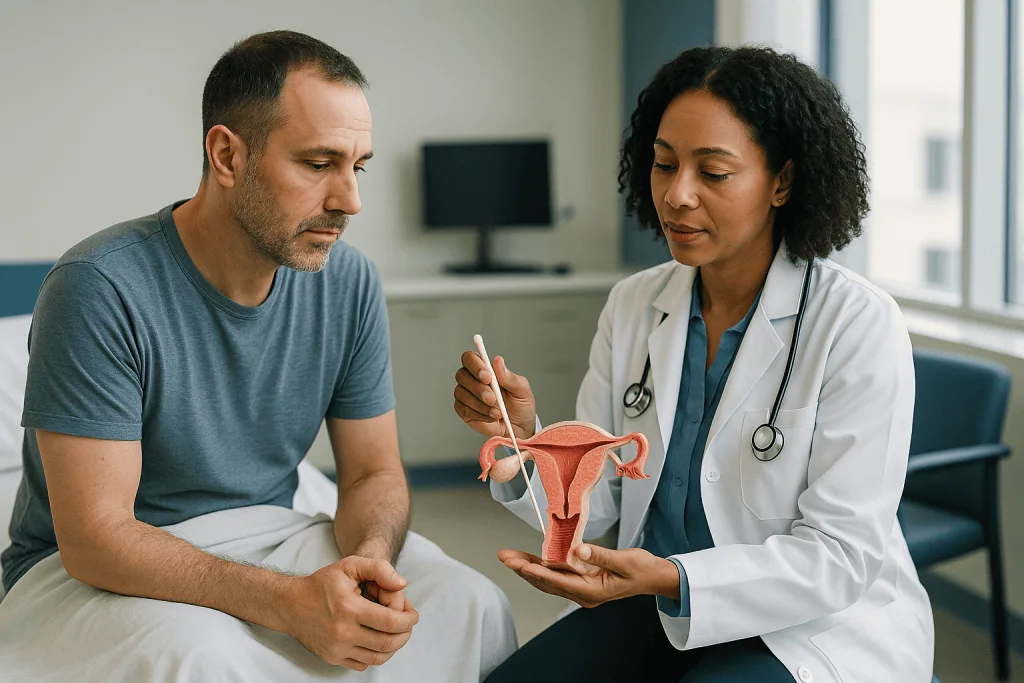
What makes brachytherapy distinctive is the physics of distance. Radiation intensity falls off steeply as you move away from a small source, roughly following an inverse-square pattern: double the distance and the intensity drops to about a quarter. A source placed inside a tumor bathes the target in a high concentration of energy while tissue a few centimeters away receives comparatively little. External beam radiotherapy, by contrast, has to pass through skin, muscle and neighboring organs on its way in (Johns Hopkins Medicine).
The isotopes used differ between the two approaches. LDR seeds typically contain iodine-125, palladium-103 or cesium-131, isotopes chosen because they emit relatively low-energy radiation that travels only a short distance in tissue. HDR most often uses iridium-192, a high-activity source housed in a machine called a remote afterloader, which pushes it into position along a cable and pulls it back automatically so that staff are never in the room while it is exposed (Mayo Clinic).
Placement is guided by imaging. For prostate treatment, an ultrasound probe in the rectum shows the gland in real time while needles are inserted through the skin between the scrotum and anus, an area called the perineum (MedlinePlus). For cervical or uterine cancers, applicators are placed through the vagina, and CT or MRI scans confirm their position before the plan is finalized. A physicist then calculates exactly where and for how long the source should sit, or how many seeds should go where, so the intended volume receives the prescribed treatment and the bladder, rectum or bowel receive as little as possible.
What happens during an LDR seed implant
An LDR implant is usually a single visit. The patient receives general or spinal anesthesia, lies on their back with legs raised in stirrups, and the team positions an ultrasound probe to map the prostate in three dimensions (MedlinePlus). Some centers do this mapping at a separate planning appointment days or weeks earlier; others plan in the operating room on the day.
A grid template rests against the perineum. Through it, the radiation oncologist inserts a series of hollow needles into precise coordinates of the gland, then deposits seeds along each track as the needle is withdrawn. Dozens of seeds are typically placed, either loose or pre-loaded into absorbable strands that hold them in a fixed pattern. Each seed is a sealed titanium capsule; the radioactive material never comes into direct contact with tissue.
The procedure itself commonly takes an hour or two. A urinary catheter is often placed temporarily to drain the bladder, and most people go home the same day or after one night (MedlinePlus). Bruising and soreness in the perineum are expected for several days.
Roughly a month later, a CT scan checks the final seed positions and confirms the delivered coverage. This post-implant assessment matters because the prostate swells after needle placement and then settles, which can shift the geometry slightly.
Seeds stay in the body permanently. Their activity fades as the isotope decays, and after the decay period they are inert metal, no more consequential than a dental filling. Because seeds are individual objects, one can occasionally migrate through a vein to the lungs or pass in the urine; this is uncommon, rarely causes symptoms, and is one reason patients are asked to strain their urine through a filter for a short time after the procedure (MedlinePlus).
What happens during an HDR session with a temporary source
HDR treatment splits into two stages: placing the applicators and delivering the radiation. For the prostate, hollow catheters are inserted through the perineum under anesthesia, much as with LDR, but no seeds are deposited. For gynecologic cancers, a specially shaped applicator is positioned in the vagina and sometimes the uterus. For breast, skin or some head and neck tumors, catheters or surface molds sit in or over the treatment area (Mayo Clinic).
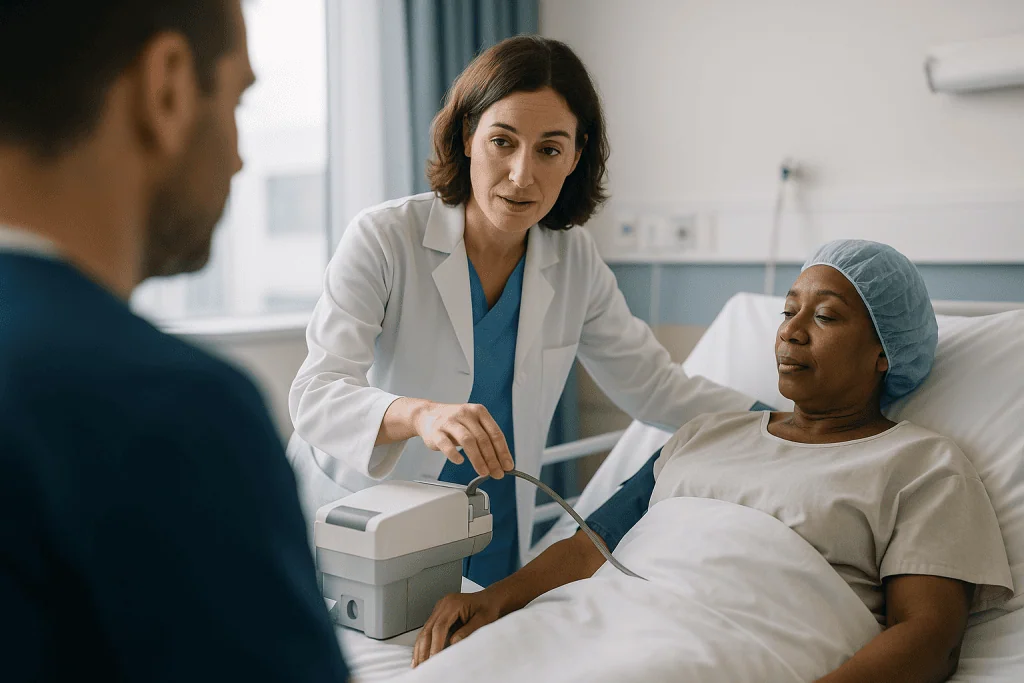
Once applicators are in place, imaging confirms their position and a physicist builds the plan: which channel the source enters, where it stops, and for how many seconds at each stop. The plan is checked by a second person before anything is delivered.
The patient is then connected to the afterloader by transfer tubes. Staff leave the shielded room, monitoring by camera and intercom, and the machine drives the source out along each channel. Delivery typically takes several minutes; the patient feels nothing during the exposure itself (Mayo Clinic). When it finishes, the source retracts into its safe and the room is cleared.
Depending on the cancer, HDR may be a single session or a short course of a few sessions. Some schedules deliver two sessions on the same day with catheters left in place overnight, which means a hospital stay lying fairly still. Others involve a fresh applicator placement at each visit, spaced days or a week apart (Mayo Clinic).
Once applicators are removed, there is no radioactive material in the body. There are no restrictions on hugging children or sitting beside a pregnant colleague, and no seeds to track on future scans. That absence of a lingering source is one of the reasons some patients, and some teams, lean toward HDR when both options are otherwise equivalent.
HDR vs LDR brachytherapy: a side-by-side comparison
The two approaches are easier to hold in mind as a table. None of the rows below declares a winner; each describes a trade-off the treating team weighs against a specific patient’s tumor, anatomy and circumstances (Mayo Clinic; Johns Hopkins Medicine).
| Feature | LDR (permanent seeds) | HDR (temporary source) |
|---|---|---|
| Radiation source | Dozens of small sealed seeds left in place | One high-activity source, fully withdrawn after each session |
| Delivery time | Gradual, over weeks to months as isotope decays | Minutes per session; one to a few sessions |
| Anesthesia events | Usually one | One per applicator placement, which may be more than one |
| Radioactive material after leaving | Yes, fading over time; short-term contact precautions | None |
| Ability to adjust the plan | Fixed once seeds are placed | Dwell times can be tuned after applicators are imaged |
| Typical solo use | Lower-risk prostate cancer | Prostate (alone or with external beam), cervix, uterus, breast, skin, others |
| Common follow-up imaging | CT about a month later to check seed placement | Imaging at each placement; no seeds to track afterward |
The row that most often decides the question is flexibility. Because HDR plans are calculated after the applicators are imaged in their final position, the team can lengthen or shorten each dwell to shape the radiation around the rectum or bladder. LDR relies on getting seed placement right during the procedure, with swelling and later settling adding a small element of uncertainty.
The row that decides the question in the other direction is convenience. A single LDR visit with no catheters left in overnight suits many people whose tumor and anatomy are well suited to seeds, and who would rather not return for repeat placements.
Brachytherapy for prostate cancer: why this decision comes up so often
Prostate cancer is where the HDR-versus-LDR question is asked most, because the prostate is one of the few organs where both techniques are routinely used on their own or alongside external beam radiotherapy (MedlinePlus; Mayo Clinic). The gland is accessible through the perineum, it can be imaged clearly with ultrasound, and it sits in a predictable relationship to the rectum behind it and the bladder above it.
For cancers considered lower risk, meaning confined to the gland with less aggressive features on biopsy, seeds alone have long been an accepted option (MedlinePlus). HDR alone is also used in this setting at centers with the equipment and expertise. For intermediate- and higher-risk disease, brachytherapy of either type is more often combined with a course of external beam radiotherapy, so the internal source acts as a concentrated boost to the gland while the external beams cover the wider area, and hormone therapy may be added. Hormone therapy in this context refers to medicines that lower testosterone or block its action, slowing prostate cancer growth; whether it is used, and for how long, is a decision for the oncology team (National Cancer Institute).
Gland size matters. A very large prostate may be hard to cover evenly with seeds, and the pubic bone can physically block needle paths to the front of the gland. HDR shares the needle-access issue but can compensate somewhat by adjusting dwell times. Some teams shrink a large gland with hormone therapy before an implant.
Urinary symptoms before treatment matter too. Brachytherapy of either type tends to worsen urinary frequency and urgency for a period afterward (MedlinePlus). Someone who already struggles to empty their bladder may be steered toward a different treatment altogether, or toward HDR, whose urinary side effects are thought by many clinicians to settle sooner because the radiation is not delivered over months. Evidence comparing the two head-to-head is mostly from observational studies and a small number of randomized trials, so this remains a judgment call rather than a settled fact.
Who is usually offered brachytherapy, and who is usually asked to wait
Brachytherapy suits tumors that are well defined, reachable with needles or applicators, and small enough for a nearby source to cover. That description fits many prostate, cervical, endometrial, breast and skin cancers, and some cancers of the head and neck, esophagus and eye (National Cancer Institute; Mayo Clinic).
People are commonly offered brachytherapy when:
- The cancer is localized and imaging shows it has not spread to distant sites.
- The organ can be reached safely and imaged during placement.
- They are fit enough for anesthesia and for lying still during the procedure.
- Bowel and urinary function are reasonable at baseline, since both may be temporarily affected.
People are often asked to wait, or offered something else, when:
- A prostate is very large or partly hidden behind the pubic bone, making even coverage difficult.
- Severe urinary obstruction is already present; treatment may be deferred until it is addressed.
- A recent procedure such as a prostate resection has left the gland scarred, which raises the risk of urinary leakage after seeds.
- Active inflammatory bowel disease affects the rectum, because the rectal wall would receive some radiation.
- The cancer has spread beyond what a local source can reach, in which case systemic treatment takes priority.
Waiting is not the same as being denied. Hormone therapy may shrink a large prostate over a few months, a urinary problem may be treated first, and a repeat scan may clarify whether disease is truly confined. Each of these steps changes the risk-benefit balance, and the multidisciplinary team, which typically includes a radiation oncologist, a urologist or surgeon, a physicist and specialist nurses, revisits the plan when the picture is clearer (NHS). Alternatives such as surgery, external beam radiotherapy alone or active surveillance for very low-risk disease sit alongside brachytherapy in that discussion, each with its own profile of side effects.
How the dose rate changes the biology, not just the schedule
The difference between a slow drip and a fast pour is not only practical. It changes how tumor and normal cells respond, and radiobiologists have argued about the consequences for decades.
When radiation arrives slowly, as with LDR seeds, healthy cells have time to repair DNA damage between hits. Cancer cells, with their weaker repair machinery, accumulate damage they cannot fix. This continuous low-intensity exposure is thought to be gentler on late-responding normal tissue, such as the rectal wall, for a given total effect on the tumor (National Cancer Institute).
When radiation arrives quickly, as with HDR, both tumor and normal cells take a heavy hit with little chance for repair during the exposure. Recovery happens in the gap between sessions instead. Some tumors, prostate cancer among them, appear particularly sensitive to large amounts of radiation delivered in few sessions, which is part of the scientific rationale for HDR in this disease. The trade-off is that healthy tissue receiving a high dose rate needs to be protected more carefully through precise geometry, which HDR’s adjustable dwell times are designed to provide.
A second biological point concerns the tumor’s own behavior over time. LDR seeds keep working for months, so cells that were in a resistant phase of their growth cycle on the day of implant are exposed later when they become more vulnerable. HDR relies on splitting treatment into sessions, or on combining it with external beam, to achieve a similar spread.
The honest summary is that the two approaches reach comparable tumor control through different routes, and that the biological arguments favor neither decisively. Clinical results, side-effect patterns, equipment, expertise and the patient’s preferences carry more weight in the room than the equations do. When a team says both are reasonable, they usually mean exactly that.
How long do brachytherapy seeds stay radioactive, and what does that mean at home?
The most common worry after an LDR implant is about the people at home. The radioactivity of permanent seeds declines steadily as the isotope decays, and the seeds are effectively inert after a period measured in months (Mayo Clinic). The radiation they emit is low energy and is largely absorbed within the prostate and surrounding tissue, so the amount reaching someone standing next to the patient is small (MedlinePlus).
Even so, teams give sensible precautions for the early weeks, when activity is highest. Typical advice, tailored by the treating center, includes avoiding prolonged close contact with young children and pregnant women, such as holding a toddler on the lap for long stretches, for a period the team specifies (MedlinePlus). Sharing a bed with a partner is generally permitted; using a condom during sex for the first few ejaculations is often advised in case a seed is passed in semen. Straining urine through a filter for a short time catches any seed that works loose. A wallet card explaining the implant is useful for travel, because sensitive detectors at airports can occasionally register the seeds.
None of this applies after HDR. The source is withdrawn completely at the end of each session, so the person leaves the department emitting no more radiation than anyone else (Mayo Clinic). For someone whose home life involves a newborn or who cares for a pregnant relative, that distinction can tip an otherwise even decision.
A further practical consequence concerns future imaging and surgery. Seeds show up clearly on X-rays and CT scans for life, which occasionally causes a moment of confusion in an emergency department. They also produce artifacts on some scans. Surgeons operating in the pelvis later will want to know they are there. The seeds pose no hazard once decayed, but they are a permanent part of the medical record.
HDR brachytherapy side effects compared with LDR: what patients report
Both approaches irritate whatever lies within range of the source, so side effects cluster around the organs next to the treated area. For prostate treatment that means the urethra, bladder and rectum; for gynecologic treatment, the vagina, bladder and bowel (Mayo Clinic; MedlinePlus).
Urinary symptoms are the most common complaint after prostate brachytherapy of either kind: needing to pass urine more often, especially at night, urgency, a weaker stream and sometimes burning. Medicines from the alpha-blocker class, which relax the muscle at the bladder outlet and make voiding easier, are often prescribed for a period; the decision to start or stop them belongs to the treating team (MedlinePlus). Blood in the urine or semen for a few weeks is expected and usually settles.
Bowel symptoms are less frequent but do occur: looser stools, urgency, and occasionally rectal bleeding months later as small blood vessels in the rectal wall become fragile. Erectile function can decline gradually over the following years, with the risk influenced by age, baseline function and whether hormone therapy or external beam radiotherapy were also used (National Cancer Institute).
Where do HDR and LDR differ? Because LDR seeds keep delivering radiation for months, urinary irritation tends to build over the first weeks and then resolve slowly. HDR’s irritation peaks sooner and, in many reports, subsides sooner, though comparative evidence comes largely from observational series rather than large randomized trials, so this should be read as a trend rather than a guarantee. HDR carries the added, small risks associated with catheters staying in place between sessions, such as discomfort and the need to lie still. LDR carries the small risk of seed migration.
For gynecologic HDR, vaginal dryness and narrowing are the main longer-term issues; teams usually discuss vaginal dilators and lubrication as part of routine aftercare (NHS).
What the following days and weeks usually look like
Recovery timelines differ between the two approaches mainly because of what is left behind and how many procedures are involved.
After an LDR implant, the first two or three days bring perineal bruising, soreness when sitting and often some blood in the urine (MedlinePlus). Most people return to desk-type work within a few days and heavier activity within a week or two, guided by comfort. Urinary frequency and urgency commonly increase through the first month and may persist for several months as the seeds continue to deliver radiation, then improve. A follow-up CT scan around a month after the implant confirms seed positions and coverage (MedlinePlus). Contact precautions around young children and pregnant women apply for the early period the team specifies.
After HDR, the day of each placement involves anesthesia recovery and, if catheters stay in overnight, a hospital stay lying fairly flat to keep them from shifting. Removal is quick and mildly uncomfortable. Perineal soreness and urinary irritation follow, generally peaking within the first couple of weeks and easing over the following weeks, though individual experience varies widely (Mayo Clinic). With no source in the body, there are no contact restrictions. If HDR is combined with external beam radiotherapy, that course adds daily outpatient visits over several weeks, with fatigue and bowel or bladder irritation building toward the end (NHS).
For both, PSA blood tests, a marker produced by prostate tissue, are checked at intervals to follow the response. PSA falls gradually after brachytherapy rather than dropping abruptly as it does after surgery, and a temporary rise, sometimes called a PSA bounce, can occur a year or more later without indicating recurrence; the team interprets these numbers in context.
Sexual function is typically discussed at follow-up, with support offered for changes in erection or ejaculation. Gynecologic patients are usually seen to check for vaginal changes and to review dilator use (NHS).
What people often get wrong about temporary sources and permanent seeds
Myths gather around any treatment that involves radiation, and brachytherapy attracts a specific set. Several deserve a plain correction.
Seeds make you dangerous to be around. The seeds emit low-energy radiation that is largely absorbed within the surrounding tissue, and their activity fades over months (MedlinePlus; Mayo Clinic). Short-term precautions around young children and pregnant women are a matter of caution, not because casual contact poses a measurable risk.
HDR is the modern method and LDR is outdated. Both are in current guidelines and current use. LDR’s single-visit convenience and long safety record keep it a mainstream choice for suitable prostate cancers. HDR’s adjustability and freedom from a retained source make it the standard for gynecologic cancers and a growing option for the prostate (National Cancer Institute).
Brachytherapy is a gentler, lesser treatment than external beam. Brachytherapy delivers a very concentrated treatment precisely because the source is inside the tumor. It is a full treatment in its own right for appropriate cancers, and it is sometimes chosen for the very reason that it can deliver more to the tumor with less to the surroundings (Johns Hopkins Medicine).
Seeds can be removed later if there is a problem. They cannot, in any practical sense. They are permanent. That is one of the reasons careful planning and a post-implant scan matter (MedlinePlus).
You can feel the radiation. No. During an HDR exposure the patient senses nothing; after an LDR implant, soreness comes from the needle tracks, not the radiation itself (Mayo Clinic).
One approach clearly has better results. Comparative studies have not shown a consistent, decisive advantage for either technique in tumor control when each is used for appropriate patients. Side-effect timing differs, logistics differ, and preferences differ. That is why the decision is individualized rather than universal.
Questions to ask your care team
A good consultation about HDR vs LDR brachytherapy should leave a patient understanding why one approach is recommended for them specifically. These questions tend to draw out that reasoning.
- Why do you lean toward seeds or a temporary source in my case, and what features of my cancer or anatomy drive that?
- Is brachytherapy being proposed on its own, or combined with external beam radiotherapy or hormone therapy, and how does that change the plan?
- How many procedures under anesthesia will I need, and will catheters stay in place between sessions?
- What urinary, bowel and sexual side effects should I expect in the first weeks, and which tend to be longer term?
- How does my current urinary function affect the choice, and is there anything to address before treatment?
- If I have seeds, what contact precautions apply at home, and for how long?
- What follow-up imaging and blood tests will I have, and how will you judge whether the treatment has worked?
- What are the alternatives you considered, including surgery, external beam alone or active surveillance, and why did you set them aside?
- Who do I call if something worries me in the first weeks, including outside office hours?
- What would make you change your recommendation between now and the procedure?
Bringing a companion to the appointment helps; people typically retain only part of what is said in a consultation, and a second listener catches the rest. Writing the answers down, or asking whether the conversation can be summarized in a letter, turns a stressful half hour into something that can be revisited calmly at the kitchen table (NHS).
None of these questions has a single correct answer. Their purpose is to make the team’s reasoning visible so that the final decision, which remains a shared one between patient and clinicians, rests on understanding rather than on which leaflet looked less alarming.
When to call your doctor
Most discomfort after brachytherapy is expected and eases over days to weeks. Some signs, though, need prompt attention because they may indicate infection, bleeding, urinary blockage or a clot, all of which are treatable when caught early (MedlinePlus; Mayo Clinic).
Contact the treating team the same day, or attend urgent care if they cannot be reached, for any of the following:
- Inability to pass urine, or passing only small dribbles with a painfully full bladder. Urinary retention can follow prostate brachytherapy and may need a temporary catheter.
- Fever, shaking chills, or feeling suddenly unwell, particularly in the first week, which can signal infection at the needle sites or in the urinary tract.
- Heavy or persistent bleeding from the urethra, rectum or vagina, or large clots in the urine, rather than the light pink tinge that is expected early on.
- Severe or worsening pelvic or perineal pain that is not controlled by the measures your team suggested.
- Pain, swelling or warmth in one calf, or sudden breathlessness or chest pain, which can indicate a blood clot after a period of anesthesia and reduced mobility.
- Redness, spreading swelling or pus at the skin where needles or catheters were placed.
- For HDR with applicators left in place: any sign that a catheter has moved or come loose, or bleeding around it.
- Persistent vomiting, or inability to keep down fluids, which raises the risk of dehydration and makes urinary symptoms worse.
Later on, new rectal bleeding, a marked change in bowel habit, or urinary symptoms that worsen again after having improved should also be reported at the next opportunity rather than waited out. Some late effects respond well to treatment, and the team will want to distinguish them from unrelated problems.
The treating team is the right first call for any of these. They know the details of the implant, the isotope or schedule used, and the medicines already prescribed, and they can decide whether a phone conversation, a clinic visit or an emergency assessment is the appropriate next step.
Frequently asked questions
Is HDR or LDR brachytherapy better for prostate cancer?
Neither has been shown to be consistently better for tumor control when each is used for suitable patients. LDR is a single-visit implant with a long track record for lower-risk disease; HDR offers adjustable planning and leaves no source in the body. The treating team weighs gland size, urinary function, cancer risk group and whether external beam or hormone therapy is also planned.
How long do LDR brachytherapy seeds stay in the body?
Permanently. The seeds are small sealed titanium capsules that are never removed. Their radioactivity declines as the isotope decays over months, after which they are inert metal that remains visible on future X-rays and CT scans. Patients are usually given a card describing the implant for airport security and for any future surgeon or emergency clinician.
Can I be around children after brachytherapy?
After HDR, yes, immediately; no radioactive material remains in the body. After an LDR seed implant, teams usually advise limiting prolonged close contact with young children and pregnant women, such as extended lap-sitting, for an early period they specify while seed activity is highest. Ordinary contact and sharing a home are generally fine. Follow the specific guidance from the treating center.
How long does an HDR brachytherapy session take?
The radiation delivery itself typically takes minutes, during which the patient feels nothing. The full visit is longer because it includes anesthesia for applicator placement, imaging to confirm position, plan calculation and checking, and recovery afterward. Some schedules leave catheters in place overnight for two sessions; others involve fresh placement at each visit, spaced days or a week apart.
What are the most common HDR brachytherapy side effects?
For prostate treatment, urinary frequency, urgency, a weaker stream and burning are most common, along with perineal soreness and short-lived blood in the urine or semen. Bowel looseness or urgency can occur, and erectile function may decline gradually over years. For gynecologic treatment, vaginal irritation, dryness and narrowing are the main concerns. Most early effects ease over weeks.
Why would a doctor recommend waiting before brachytherapy?
Common reasons include a very large prostate that is hard to cover evenly, severe existing urinary obstruction, recent prostate surgery leaving scarring, or active rectal inflammatory disease. Hormone therapy may be used first to shrink the gland, or a urinary problem may be treated before the implant. Waiting is a way of improving the balance of benefit and risk, not a refusal.
Does brachytherapy hurt?
The radiation itself cannot be felt. Discomfort comes from the needle or applicator placement, which is done under anesthesia, and from bruising and soreness in the days afterward. Catheters left in place between HDR sessions can be uncomfortable and require lying fairly still. Pain is usually manageable with measures the team recommends, and severe or worsening pain should be reported promptly.
Can a brachytherapy seed move to another part of the body?
Occasionally a loose seed can travel through a vein to the lungs or be passed in the urine or semen. This is uncommon, rarely causes symptoms, and is one reason patients are asked to strain urine through a filter and use a condom for the first few ejaculations. Stranded seeds, which are linked in absorbable material, reduce this risk further.
Is brachytherapy used alone or with other treatments?
Both. For lower-risk prostate cancer, LDR seeds or HDR alone may be offered. For intermediate- and higher-risk disease, brachytherapy of either type is often combined with external beam radiotherapy, with hormone therapy added in some cases. For cervical cancer, HDR brachytherapy is a standard component alongside external beam. The combination depends on the cancer type and stage.
How will I know if brachytherapy has worked?
For prostate cancer, PSA blood tests are checked at intervals; the level falls gradually over months to years rather than dropping abruptly, and a temporary rise can occur without meaning recurrence. Imaging and examination are used for other cancers. The treating team interprets results in context and explains what pattern they expect, so a single number should never be read in isolation.
References
This article is for general information only and is not a substitute for professional medical advice. Please consult a qualified doctor about your individual situation.

More from the Blog
Immunotherapy Cycles Explained: Why Infusions Repeat Every Few Weeks and for How Long
Immunotherapy is usually given in cycles because the drugs are cleared from the body over days to weeks and the immune response they trigger…
How to Support Someone Through Radiation Therapy: Rides, Meals and Watching for Fatigue
To support someone going through radiation, take on the repeatable jobs: a shared ride rota for daily weekday appointments, small frequent meals matched to…
Recovery After Melanoma Surgery: Stitches, Skin Grafts and Getting Back to Activity
Recovery after melanoma surgery usually takes about one to three weeks for a wound closed with stitches, and several weeks longer when a skin…
Who Sits on a Head Cancer Tumor Board and How the Group Reaches a Recommendation
A head and neck cancer tumor board is a scheduled meeting where surgeons, radiation oncologists, medical oncologists, radiologists, pathologists, and supportive specialists review one…
How CyberKnife Tracks a Moving Tumor: Robotic Arm, Real-Time Imaging and Breathing
CyberKnife tracks tumor movement by pairing a small linear accelerator on a robotic arm with two ceiling-mounted X-ray cameras that repeatedly image the patient…
Questions to Ask Before HIPEC: Second Opinions, Expected Benefits and the Recovery Plan
Before HIPEC, ask your care team how complete they expect tumor removal to be, what evidence supports HIPEC for your specific cancer type, which…