

How Fluoride Application Strengthens Enamel: Early Decay Explained and How Care Is Planned
Key Takeaways
- Fluoride does not coat teeth; it is incorporated into enamel mineral as it rebuilds after each acid attack, forming fluorapatite that dissolves less readily than ordinary enamel.
- Early decay begins as a chalky white spot with an intact surface, and at this stage remineralization can stop it, whereas a true cavity with a hole cannot close on its own.
- The CDC reports that community water fluoridation reduces cavities by roughly 25% in children and adults, and the NHS recommends professional varnish at least twice a year for children from age three.
- Root surfaces exposed by gum recession dissolve at a milder acidity than enamel, which is why adults with recession or dry mouth are frequently offered fluoride varnish.
- Spitting rather than rinsing after brushing keeps fluoride in contact with teeth for longer, a small habit the NHS specifically recommends.
- Dental fluorosis affects only teeth still forming under the gums in young children and is unrelated to varnish placed on already-erupted teeth; in regulated settings it is typically mild.
Fluoride strengthens enamel by joining the repair process that happens on every tooth after acid exposure. When minerals return to a weakened surface, fluoride is built into the crystal, creating a form that dissolves less easily in acid. It also slows the bacteria that make acid. Applied regularly through toothpaste, water, or professional varnish, it can help stop very early decay from progressing, though it cannot rebuild a cavity that has broken through.
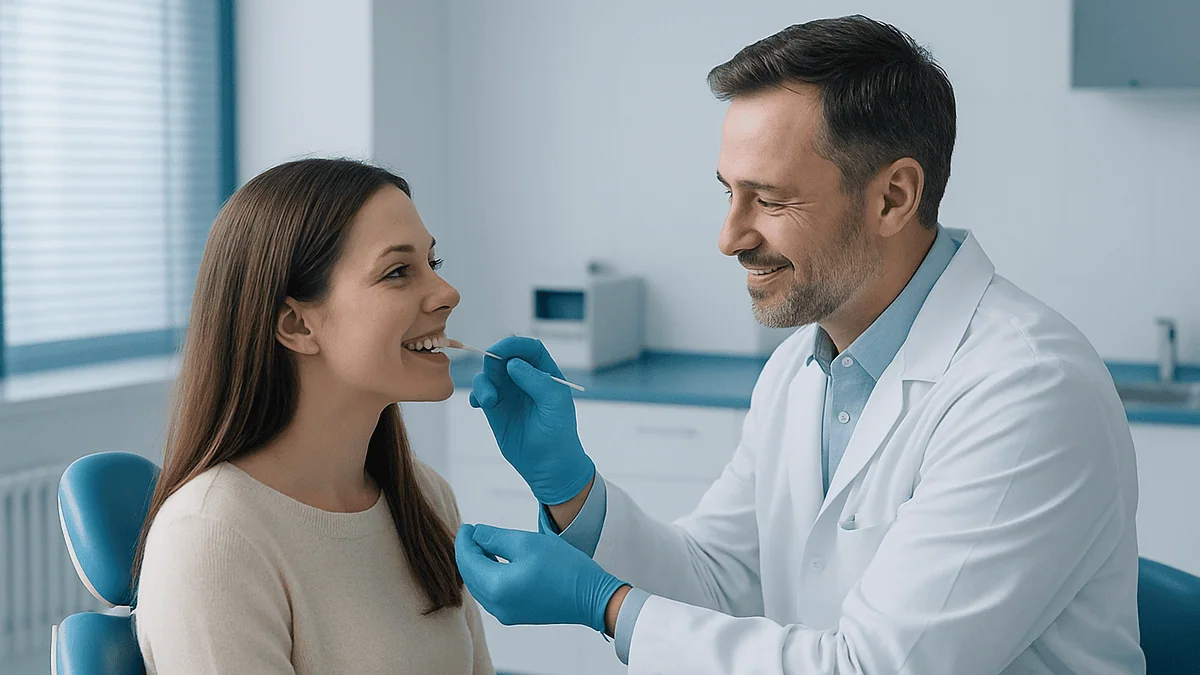
The dentist tilts the screen so the mother can see it too: a chalky patch near the gumline of her eight-year-old’s molar, pale as a fingernail against the ivory of the surrounding tooth. “Not a cavity yet,” the dentist says. “We’d like to paint some fluoride on and watch it.” The mother nods, and then the questions start on the drive home. Watch it? Paint what on? Can a tooth actually get harder?
Understanding how fluoride strengthens enamel answers most of those questions, and it turns out to be less about coating a tooth and more about changing what the tooth is made of at the surface. Enamel is constantly losing and regaining mineral, dozens of times a day, in a quiet chemical tug-of-war that nobody feels.
That tug-of-war is where early decay begins, and it is also where it can be stopped. This article walks through the mechanism, what a professional application involves, who is usually offered it, and how dental teams decide what comes next.
What is tooth enamel, and why can't it heal the way skin does?
Enamel is the thin outer shell of each tooth, and it is the hardest tissue in the human body. Unlike bone, which is remodeled by living cells throughout life, mature enamel contains no cells at all. The cells that built it finish their work before the tooth erupts and are then lost. That single fact explains why a chipped tooth stays chipped and why a cavity, once it has broken through the surface, does not close on its own.
What enamel does have is a tightly packed lattice of mineral crystals, mostly a calcium phosphate compound called hydroxyapatite, arranged in long rods running from the inner dentin to the outer surface. Between and within those rods sit tiny spaces filled with water and a small amount of protein. Those spaces matter more than their size suggests, because they are the routes by which acid gets in and mineral gets out.
Under the enamel lies dentin, a softer, yellowish, living tissue that connects to the nerve. Dentin is roughly the hardness of bone and dissolves in acid far more readily than enamel. When decay reaches it, the process speeds up, which is why dentists treat the enamel layer as the line worth defending.
The Cleveland Clinic and Mayo Clinic both describe enamel as a barrier that protects the tooth from temperature, chewing forces, and the acids produced by bacteria. The word “barrier” can be slightly misleading, though. Enamel is porous at a microscopic scale, and it is chemically active. Mineral leaves the surface whenever the fluid around it becomes acidic, and mineral returns when that fluid is neutral and rich in calcium and phosphate. A healthy mouth cycles through this loss and gain many times each day. The whole story of early decay, and of how fluoride strengthens enamel, is about which side of that cycle wins over months and years.
How fluoride strengthens enamel: the mineral swap explained
Picture a brick wall where a few bricks are quietly pulled out every time it rains and pushed back in when the sun comes out. Fluoride does not add a new coat of paint to the wall. It changes the bricks that go back in.
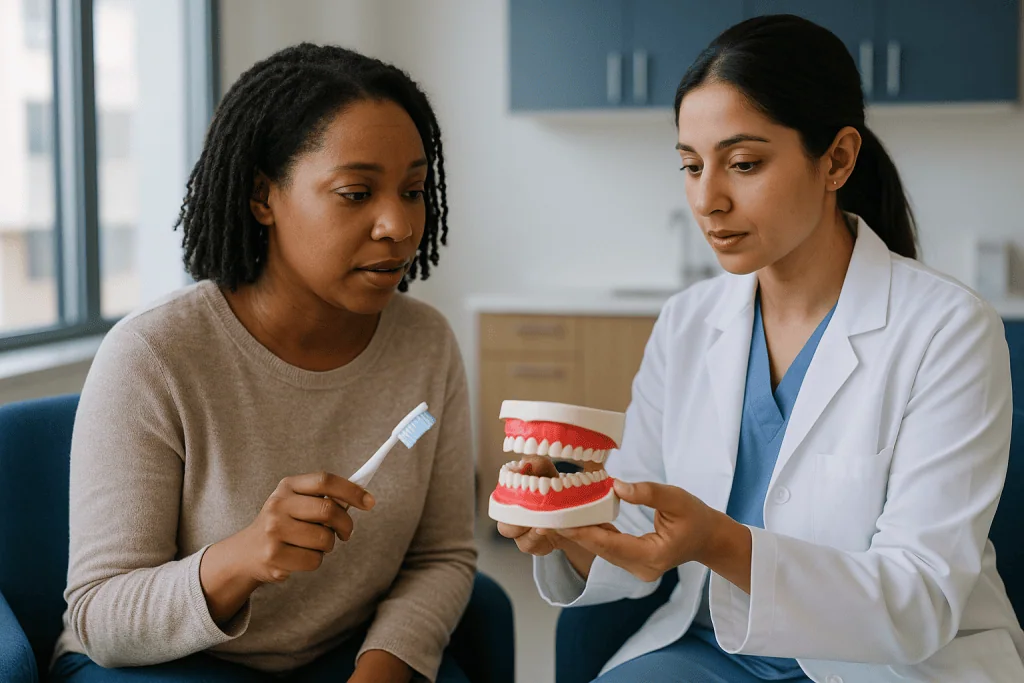
Every time you eat or drink something with sugar or starch, bacteria in dental plaque convert it into acid. When the fluid at the tooth surface drops below a certain acidity threshold, hydroxyapatite begins to dissolve, releasing calcium and phosphate. This is demineralization. Saliva then buffers the acid, and over the following minutes to an hour, calcium and phosphate drift back into the enamel and rebuild crystal. This is remineralization.
Fluoride works at three points in this cycle, and the evidence for each is described in the NIH Office of Dietary Supplements fluoride fact sheet and by the CDC:
- It is incorporated into rebuilt crystal. When fluoride ions are present during remineralization, they slot into the crystal lattice in place of some hydroxyl groups, forming fluorapatite or fluoride-enriched hydroxyapatite. This modified mineral dissolves at a more acidic pH than ordinary enamel mineral, so the same acid attack removes less of it.
- It speeds remineralization. Fluoride attracts calcium and phosphate ions toward the enamel surface, so repair happens faster after each acid challenge.
- It hampers the bacteria. Fluoride interferes with enzymes inside plaque bacteria that they use to process sugar, so less acid is produced in the first place.
The important consequence is that fluoride’s main effect is topical and ongoing. It is the fluoride present in the mouth during those thousands of small repair cycles that matters most, which is why low-level, frequent exposure through toothpaste and drinking water is the backbone of prevention, and why a single professional application is planned as part of a routine rather than as a one-time fix.
What early decay actually looks like before it becomes a cavity
Decay is not an event. It is a direction of travel. A tooth heading toward a cavity passes through a stage where mineral has been lost from just beneath the surface while the outermost layer is still largely intact. Dentists call this a white spot lesion or incipient caries, and it is the stage the mother in our opening scene was shown.
The white appearance is an optical effect. Healthy enamel is translucent because its crystals are packed tightly and light passes through them evenly. When the sub-surface loses mineral, the pores enlarge, light scatters, and the area looks chalky or frosted, especially when the tooth is dried. Along the gumline, around orthodontic brackets, and in the grooves of molars are the usual sites, because plaque collects there and is harder to brush away.
At this stage there is no hole. The surface can still be repaired by the normal remineralization cycle if the balance is tipped in its favor. The NHS describes tooth decay as a process that can be halted or slowed in its early stages when plaque is controlled and fluoride is available, and Mayo Clinic notes that early decay often produces no symptoms at all, which is why it is picked up at examinations rather than felt.
The transition from white spot to cavity happens when the weakened surface finally collapses inward, creating a physical break. Once that happens, bacteria colonize the hole itself and remineralization can no longer close it. The dentin beneath, being softer, then breaks down faster than the enamel above, which is why some cavities look small on the outside and turn out to be larger underneath.
This is why the phrase “watch it” is not a dentist stalling. Between the first frosty patch and an actual hole there is often a window measured in months, and it is inside that window that fluoride does its most useful work.
Where fluoride comes from: water, toothpaste, and professional application compared
Fluoride reaches teeth by several routes, and they are complementary rather than competing. Understanding the differences helps make sense of why a dentist might add a professional application on top of what someone already does at home.
| Source | How it reaches enamel | Typical role in prevention |
|---|---|---|
| Community water | Low, steady level in saliva and plaque fluid throughout the day | Population-wide baseline; the CDC reports roughly a 25% reduction in cavities in children and adults in fluoridated communities |
| Fluoride toothpaste | Brief high concentration at the surface during brushing, residual fluoride in plaque afterward | Daily individual protection; the NHS advises brushing twice a day with a fluoride toothpaste for all ages |
| Professional varnish or gel | Concentrated fluoride held against enamel by a sticky resin or tray for an extended contact time | Targeted boost for people at higher risk or with early lesions; the NHS recommends varnish at least twice a year for children from age three |
| Prescription-strength home products | Higher concentration than standard toothpaste, used at home under dental direction | Reserved for specific risk situations; decided by the dental team |
Notice the pattern. Water provides constant low-level exposure, toothpaste provides a daily surge, and professional treatment provides an occasional intensive contact. The NIH Office of Dietary Supplements notes that fluoride’s benefit is primarily from this topical contact with enamel over time rather than from fluoride swallowed and absorbed.
A varnish also has a practical advantage the table cannot show. Because it sets on contact with saliva into a thin film that clings to the tooth for hours, it delivers fluoride to exactly the spot the dentist is concerned about, including surfaces a brush struggles to reach. Gels and foams in trays cover more surface area but require the patient to sit still and avoid swallowing, which is one reason varnish is usually preferred for young children.
What actually happens during a professional fluoride varnish appointment
People often brace for something involving a drill. In fact, a varnish application is one of the quickest and least eventful things that happens in a dental chair, and it is commonly done at the end of a routine check-up or cleaning.
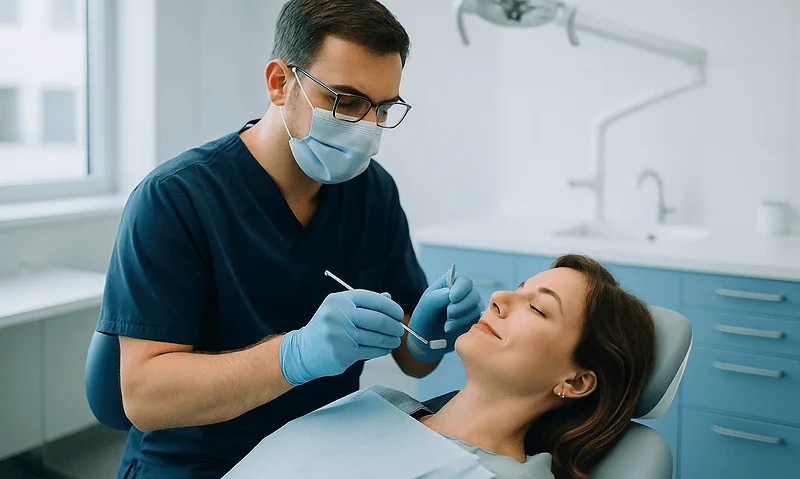
The dentist or hygienist first dries the teeth with gauze or a gentle puff of air, because the varnish bonds best to a dry surface. Using a small disposable brush, they paint a thin layer of the sticky, resin-based varnish onto the tooth surfaces, paying particular attention to any early lesions, grooves, and the areas along the gumline. The whole process typically takes a few minutes. There is no need for numbing, no scraping, and no waiting under a lamp.
Almost immediately, saliva causes the varnish to set into a soft film. Many varnishes have a faint yellowish tint or a slightly tacky feel that lasts until it wears off, and some have a mild flavor. Children sometimes describe the sensation as their teeth feeling “fuzzy” or “like wax.”
After application, the team will give instructions about eating, drinking, and brushing for the rest of that day. The purpose is to keep the varnish in contact with enamel for as long as possible so fluoride can be taken up. Exactly how long to wait and what to avoid varies with the product and the patient, so the instructions given at the appointment take precedence over anything general.
Gel or foam treatments, used more often in older children and adults, involve a soft tray filled with the product placed over the upper and lower teeth for a short timed period while the patient leans forward slightly and a suction tip removes excess. Afterward the patient spits out but does not rinse.
Either way, the appointment ends with a plan rather than a goodbye. A varnish is a scheduled intervention, and the recall interval that follows is as much a part of the treatment as the brushstroke itself.
Who is usually offered fluoride treatment, and who is usually asked to wait?
Fluoride toothpaste is for everyone with teeth. Professional application is more selective, and the selection is based on risk rather than on age alone.
Children are the group most consistently offered varnish. Newly erupted teeth are less mineralized than mature ones and are more vulnerable in their first years in the mouth, which is why the NHS recommends varnish at least twice a year from age three, and earlier for children considered at higher risk. Pediatric dental teams weigh factors such as previous cavities, frequent sugary snacks or drinks, visible plaque, and whether the family’s water supply is fluoridated.
Adults are offered professional fluoride when their risk has risen. Common reasons include a dry mouth from medications or medical conditions, gum recession that exposes softer root surfaces, orthodontic appliances that trap plaque, a history of frequent new cavities, radiation treatment to the head and neck, or difficulty brushing because of arthritis, disability, or cognitive change.
Who is usually asked to wait, or to consider something else?
- People with a known allergy to a varnish ingredient, most commonly the resin base (some varnishes contain a natural resin related to pine, and colophony sensitivity is a recognized reason to choose an alternative product).
- Those with active ulcerative gingivitis or open mouth sores, where placement is usually deferred until tissues heal.
- Anyone whose decay has already progressed past the enamel into a cavity. Fluoride will still be part of their prevention plan, but the cavity itself needs restoration.
- Patients for whom the dental team judges risk to be low and existing home care sufficient, in which case adding professional fluoride offers little extra benefit.
The decision is individual. Two people of the same age with the same number of teeth can sit at opposite ends of a risk assessment, and the treating team is the one placed to weigh the whole picture, including medical history that might not seem dental at first glance.
Does fluoride reverse cavities? What the evidence does and does not show
This is the question behind almost every online search about the topic, and the honest answer has two halves.
The first half: yes, at the earliest stage. A white spot lesion, where mineral has been lost beneath a still-intact surface, can be remineralized. Fluoride makes that remineralization faster and produces a more acid-resistant repair. Dental teams see this routinely as lesions that stop growing, become harder to the touch of a probe, and sometimes fade in appearance over successive visits. The NHS and Mayo Clinic both describe early tooth decay as a stage that can be stopped or slowed with fluoride and improved plaque control.
The second half: no, once there is a hole. When the enamel surface has broken down and a physical cavity exists, remineralization cannot close it. The space fills with bacteria and debris, and the softer dentin beneath continues to break down. At that point the treatment is a restoration, a filling or similar, to remove the infected tissue and seal the tooth. Fluoride continues to matter for the rest of the mouth, but it is not a substitute for that repair.
There is a gray zone between the two. Some lesions have a surface that is roughened but not clearly cavitated, and dentists sometimes disagree about whether such a tooth can still be managed with fluoride and monitoring or needs restoration. Modern practice leans toward monitoring where the surface is intact, because a filling commits a tooth to a lifetime of maintenance, whereas a remineralized lesion is a tooth that keeps all its own structure.
Systematic reviews of professional fluoride varnish have consistently found it reduces new cavities in children when applied regularly, and the CDC cites fluoride as one of the most effective preventive measures available. What no review claims is that fluoride can rebuild lost tooth structure. Understanding that boundary sets realistic expectations and explains why the phrase “we’ll watch it” comes with a date attached.
Fluoride varnish for adults: root surfaces, dry mouth, and braces
Varnish is often thought of as a children’s treatment, and the sight of an adult being offered it can prompt a puzzled look. Adult enamel is fully mature and, other things being equal, more resistant than a child’s. Other things, however, are frequently not equal.
The root surface is the biggest difference. As gums recede with age, gum disease, or vigorous brushing, they expose cementum and dentin, tissues that never had an enamel shell. Root dentin dissolves at a less acidic pH than enamel, meaning a mildly acidic mouth that would leave enamel untouched can still erode a root. Root caries tends to spread sideways along the gumline, can be hard to detect early, and is awkward to restore because there is little hard tissue to bond a filling to. Fluoride concentrated on those surfaces is one of the few preventive tools that directly targets this problem.
Dry mouth is the second. Saliva is the mouth’s own remineralizing fluid, carrying calcium, phosphate, and buffers that neutralize acid. MedlinePlus lists many common medications that reduce saliva flow, including some used for blood pressure, depression, allergies, and bladder control, and conditions such as Sjögren’s syndrome and diabetes can do the same. With less saliva, every acid attack lasts longer and repair is slower. The natural tug-of-war tilts toward loss, and adding fluoride is a way of tilting it back.
Orthodontic appliances are the third. Brackets and wires create sheltered ledges where plaque matures undisturbed, and white spot lesions around brackets are a well-recognized complication of adult braces. Targeted varnish during treatment is one part of how orthodontic teams try to prevent a straight smile from arriving with frosty outlines.
An adult being offered varnish is not being treated like a child. They are being treated as someone whose risk profile has changed, which is exactly how care planning is supposed to work.
How dental teams plan care: caries risk assessment and recall intervals
Behind the phrase “we’ll see you in six months” sits a structured, if sometimes unspoken, calculation. Most dental teams now use some form of caries risk assessment, a way of sorting patients into lower and higher risk categories to decide how often to review them and how intensively to intervene.
The inputs are practical. A history of new cavities in the past few years weighs heavily, because past decay is the strongest predictor of future decay. Dietary habits matter, particularly how often sugary or acidic foods and drinks are consumed rather than how much, since frequency determines how many acid attacks the enamel faces each day. Visible plaque, dry mouth, exposed roots, appliances, medical conditions, and access to fluoridated water all shift the assessment. So does the presence of existing early lesions being monitored.
The outputs are also practical. Lower-risk patients may be reviewed at longer intervals and rely on fluoride toothpaste alone. Higher-risk patients are typically seen more frequently, offered professional fluoride at those visits, and may be advised on prescription-strength home products or fissure sealants, a protective coating placed into the deep grooves of molars. Mayo Clinic describes both sealants and fluoride treatments as standard preventive options a dentist may recommend depending on individual risk.
Crucially, a risk category is not permanent. A teenager whose braces come off, an adult who changes a medication that was drying the mouth, or a family who reduces between-meal snacks may move to a lower category. Equally, new illness or a new prescription can move someone the other way.
For a monitored early lesion, planning is even more specific. The dentist records its location and appearance, often with a photograph, and sets a review date. At review, the lesion is compared with the record: unchanged or improved means the plan is working; larger or softer means the plan needs to change. The patient’s role in between is to make the home environment as favorable to remineralization as possible, which is where toothpaste, timing, and diet come in.
How fluoride strengthens enamel over the following days and weeks, and what to expect after treatment
The varnish itself is temporary. The effect is not meant to be.
In the hours after application, the film slowly wears away with eating, speaking, and eventually brushing, releasing fluoride into saliva and plaque fluid the entire time. Some of that fluoride is taken directly into the enamel surface. Some deposits on the tooth as calcium fluoride, a loosely bound reservoir that later dissolves during acid attacks and releases fluoride precisely when it is needed. This reservoir is one reason the benefit of a brief application extends well beyond the day it is applied.
Over the following weeks, each ordinary demineralization-remineralization cycle happens in a fluoride-richer environment. Repaired crystal contains more fluorapatite, the sub-surface pores of any early lesion gradually fill, and the lesion becomes harder and less porous. None of this is felt. There is no sensation of teeth getting stronger, which is one reason people sometimes doubt that anything happened.
Common after-effects are minor. A yellowish tint on the teeth for the rest of the day is normal with many varnishes and disappears when the film is brushed away. A slightly tacky or rough feeling is typical. Some people notice a mild taste. Nausea from swallowing gel is possible with tray treatments, especially in children, which is why teams use suction and ask patients not to rinse but to spit.
Timelines for improvement are not fixed. Dental teams generally re-examine monitored lesions at the next scheduled recall, and the NHS guidance of at least twice-yearly varnish for children reflects an expectation that protection needs periodic renewal rather than lasting indefinitely. What happens between appointments matters as much as the appointment itself. A varnish placed on a tooth that is then bathed in sugary drinks throughout the day is a repair crew working during a flood. The same varnish on a tooth brushed twice daily with fluoride toothpaste and given quiet hours between meals is working with the current.
Risks and side effects: fluorosis, allergy, and swallowing
Fluoride is among the most studied substances in public health, and mainstream medical bodies including the CDC, the WHO, and the NHS regard its use in toothpaste, water, and professional dental products as safe and effective when used as directed. That said, a fair explainer describes the risks, not just the reassurance.
Dental fluorosis is the most discussed. It occurs when developing teeth, still forming beneath the gums in children up to around eight years old, are exposed to more fluoride than intended over an extended period. The result is a change in enamel appearance, most commonly faint white flecks or streaks that many people never notice. The NHS notes that fluorosis in countries with regulated fluoridation is typically mild. Severe fluorosis with brown staining and pitting is rare and is associated with prolonged high intake, not with routine toothpaste use or occasional varnish. Because fluorosis affects forming teeth, it is not a concern for adults, and it is not caused by topical varnish on already-erupted teeth.
Swallowing toothpaste habitually is the most common route to excess in young children, which is why guidance from the NHS and MedlinePlus emphasizes using an appropriate small amount for age, supervising brushing, and teaching children to spit rather than swallow. Any question about how much toothpaste a particular child should use belongs with the dentist or pediatrician, not with a general article.
Allergic reactions to varnish are uncommon but recognized, usually to the resin base rather than to fluoride itself. Signs would include swelling or irritation of the lips, gums, or mouth soon after application. People with known sensitivities should mention them before treatment, since alternative formulations exist.
Nausea or stomach upset can follow accidental swallowing of a larger quantity of gel during a tray treatment. Teams minimize this with suction and positioning. Genuine acute fluoride toxicity from dental products is very rare and involves quantities far beyond what a supervised application delivers.
Weighed against decades of population data showing fewer cavities, fewer extractions, and less dental pain, mainstream evidence places the balance firmly in favor of appropriate use.
What people often get wrong about fluoride and enamel
Myths about fluoride tend to cluster around a few misunderstandings of how it actually works.
“Fluoride coats the teeth.” It does not remain as a coating. The varnish film wears off within a day, and the real effect is chemical incorporation into rebuilt enamel mineral plus a fluoride reservoir at the surface. A tooth is not sealed; it is made of slightly different, more acid-resistant material where it has repaired itself.
“If a spot is white, it’s already a cavity.” A white spot is early demineralization with an intact surface. It is precisely the stage that can be arrested. Waiting and remineralizing is a treatment, not neglect.
“Fluoride toothpaste is enough, so professional treatment is pointless.” For lower-risk people, toothpaste often is enough. For higher-risk people, the concentrated, targeted, prolonged contact of a varnish adds something toothpaste cannot replicate. The decision depends on risk, not on a universal rule in either direction.
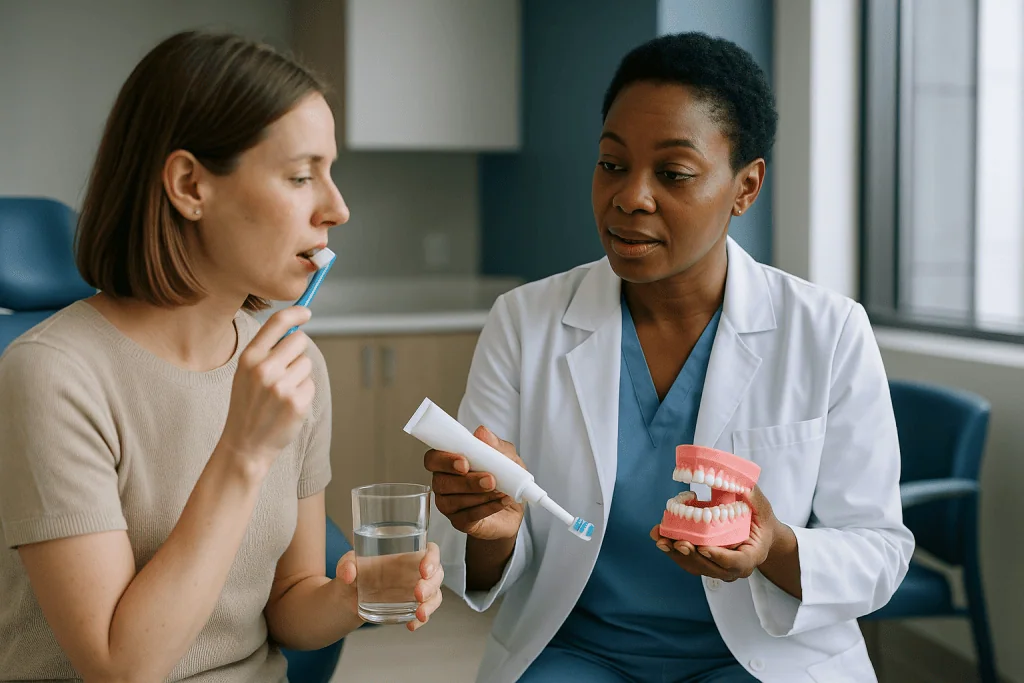
“Rinsing after brushing gets rid of the toothpaste, which is good.” The NHS specifically advises spitting out after brushing rather than rinsing with water, because rinsing washes away the fluoride that would otherwise linger and keep working.
“Adults don’t need fluoride because their enamel is finished.” Adult enamel is mature, but adults acquire exposed roots, dry mouths, and appliances, and root dentin is more vulnerable than child enamel ever was.
“Fluoride and remineralizing toothpastes without fluoride do the same thing.” Some non-fluoride ingredients are marketed for remineralization. Mainstream bodies including the NHS and CDC base their recommendations on fluoride because it has the strongest and most consistent evidence. The evidence for alternatives ranges from promising to preliminary, and no major guideline currently recommends them in place of fluoride.
“Once a lesion is arrested, it’s over.” An arrested lesion stays arrested only while conditions remain favorable. Change the diet, dry the mouth, or stop brushing, and the same spot can resume its journey.
Questions to ask your care team about fluoride and early decay
A short appointment leaves little room for questions, so it helps to arrive with a few. These are the ones that tend to produce the most useful answers.
- Is this a cavity or an early lesion? The answer determines whether the plan is monitoring or restoration, and it is fair to ask what the dentist saw or felt that led to their judgment.
- What is my, or my child’s, caries risk level, and what is driving it? Knowing whether the main factor is diet, dry mouth, plaque control, or exposed roots tells you where change would matter most.
- How often will you re-check this spot, and what would make you change the plan? A monitored lesion should have a review date and clear criteria for what “worse” looks like.
- What should we do differently at home? Ask specifically about brushing technique, whether to rinse after brushing, and timing of snacks and drinks.
- Is our tap water fluoridated? The dental team may know, or can point you to your local water utility, and the answer affects the rest of the plan.
- Are there ingredients in the varnish I should know about? Relevant if there is any history of allergy, particularly to resins or pine products.
- What exactly should we avoid, and for how long, after today’s application? Instructions differ between products, and the team’s specific advice matters more than general rules.
- Would sealants help alongside fluoride? For deep molar grooves, especially in children, the two are often considered together.
- Could any of my medications be affecting my saliva? A dentist who knows the full medication list can sometimes explain a sudden change in decay pattern.
Bring the answers home in writing if possible. Care planning works best when the patient understands not just what is being done but why, and when the same understanding is shared by everyone who brushes the teeth in question, including a child’s other caregivers.
When to call your doctor or dentist: red-flag signs
Most of what this article describes is quiet, slow, and painless. The following are not, and they warrant contacting a dental or medical professional promptly rather than waiting for the next scheduled review.
- Toothache that persists, wakes you at night, or throbs without an obvious trigger. Early decay does not hurt; pain suggests the process has reached dentin or the nerve.
- Sharp pain with sweet, hot, or cold that lingers for more than a few seconds after the trigger is removed.
- Swelling of the gum, face, or jaw, especially with fever or a feeling of being unwell. This can indicate a spreading infection and, per NHS guidance on dental abscess, needs same-day assessment.
- Difficulty swallowing or breathing, or swelling that spreads toward the eye or neck. These are emergency signs and should be treated as such.
- A visible hole, a broken piece of tooth, or a filling that has come out. The tooth is now open to bacteria and remineralization cannot help.
- Swelling, itching, or blistering of the lips, mouth, or throat within hours of a varnish or gel application, which may indicate an allergic reaction.
- Vomiting or stomach pain after a child has swallowed a large amount of toothpaste or gel, or after any suspected ingestion of fluoride products beyond normal use. Contact a poison control service or emergency care.
- A white spot that becomes brown, rough, or soft, or that seems to be growing between visits. This may mean the lesion is progressing and the plan needs revisiting sooner.
- Persistent dry mouth, particularly if new, since it changes decay risk and may relate to a medication or medical condition worth reviewing with a physician.
Fluoride and monitoring are tools for teeth that are still intact and comfortable. The moment a tooth is painful, broken, or swollen, the appropriate treatment changes, and the team that knows your history is the one to decide what that treatment should be.
Frequently asked questions
How does fluoride strengthen enamel if enamel has no living cells?
Fluoride works through chemistry rather than biology. Enamel constantly loses mineral to acid and regains it from saliva. When fluoride is present during that regain, it is built into the new crystal, producing a form called fluorapatite that resists acid better than the original. Fluoride also speeds the return of calcium and phosphate and slows acid production by plaque bacteria. No cells are needed; the tooth’s own mineral cycle does the work.
Does fluoride reverse cavities that have already formed?
No. Once the enamel surface has physically broken down into a hole, remineralization cannot fill it, and the tooth needs a restoration. Fluoride can, however, arrest and partly reverse the stage before a cavity, the white spot lesion, where mineral has been lost beneath a still-intact surface. That is why dentists sometimes monitor an early spot with fluoride and review dates rather than filling it immediately.
Is fluoride varnish for adults really worthwhile?
For adults at higher risk, yes, according to mainstream dental guidance. Exposed root surfaces, dry mouth from medication or illness, orthodontic appliances, and a history of frequent new cavities all raise risk in ways that adult enamel maturity does not offset. For lower-risk adults, fluoride toothpaste alone is often sufficient. The dental team’s risk assessment, rather than age, guides the decision.
What are the common fluoride treatment after effects?
Most are minor and brief. A yellowish tint on the teeth for the rest of the day, a tacky or slightly rough feeling, and a mild taste are typical with varnish and disappear once it is brushed away. Nausea can follow swallowing gel during tray treatments. Rarely, swelling or irritation of the lips or gums suggests an allergy to the resin base and should be reported to the dental team.
Can you remineralize tooth enamel at home?
Partly. Brushing twice daily with a fluoride toothpaste, spitting rather than rinsing, and reducing how often you consume sugary or acidic foods and drinks all tilt the mineral balance toward repair. Saliva supplies the calcium and phosphate. What home care cannot do is rebuild a cavity or provide the concentrated, targeted contact of a professional varnish for a specific lesion. Your dentist can advise which combination suits your risk.
How long after fluoride varnish should you wait to eat or brush?
Instructions vary between products and patients, so follow the specific guidance given at the appointment. In general, dental teams advise avoiding hard, hot, or sticky foods and delaying brushing for a period that same day so the varnish stays in contact with enamel as long as possible. Soft foods and water are usually fine. If you are unsure, call the practice rather than guess.
Why do dentists say they will watch an early spot instead of filling it?
Because an early lesion with an intact surface can be arrested, and a filling commits a tooth to a lifetime of maintenance. Monitoring with fluoride, improved plaque control, and a set review date gives the tooth a chance to keep all its natural structure. The dentist records the lesion, compares it at follow-up, and changes the plan if it grows, softens, or breaks through.
Can fluoride varnish cause dental fluorosis?
Not on teeth that have already erupted, which is where varnish is applied. Fluorosis develops only in teeth still forming beneath the gums when overall fluoride intake is too high for a prolonged period during childhood. The main real-world route is habitually swallowing toothpaste. Supervised brushing and age-appropriate amounts, as advised by a dentist, address that risk. In regulated settings, the NHS notes fluorosis is usually mild.
Is fluoride toothpaste enough, or do I also need professional treatment?
For many people at lower risk, fluoride toothpaste used twice daily is the mainstay and may be enough. Professional application is added when risk is higher because it delivers a concentrated dose held against the tooth for an extended time and can be targeted at specific vulnerable surfaces. The two are complementary. A caries risk assessment by your dental team determines which combination fits your situation.
What is the difference between enamel erosion and tooth decay?
Decay is caused by acid produced by plaque bacteria feeding on sugars, and it tends to be localized to where plaque collects. Erosion is caused by acid arriving directly, from acidic drinks, frequent vomiting, or stomach acid reflux, and it wears enamel more broadly without bacteria. Fluoride helps in both situations by making enamel more acid-resistant, but addressing the source of the acid is central to managing erosion.
References
- NHS – Fluoride
- NHS – Tooth decay
- CDC – About Community Water Fluoridation
- MedlinePlus – Fluoride in diet
This article is for general information only and is not a substitute for professional medical advice. Please consult a qualified doctor about your individual situation.

More from the Blog
How Gum Graft Surgery Treats Gum Recession: Where the Tissue Comes From and How It Is Placed
A gum graft procedure treats gum recession by moving a small piece of soft tissue onto the exposed root and thin gum margin so…

The First Weeks With Porcelain Veneers: Adjusting Your Bite, Speech and Sensitivity
In the first weeks with porcelain veneers, a slightly different bite, softer or hissier s sounds, and sensitivity to cold are common while the…
Is Wisdom Teeth Removal Different After 30? What Fully Formed Roots Change
Wisdom teeth removal after 30 is common and there is no age cutoff, but it is usually a slightly different operation. By the mid-twenties…

Impacted Tooth Treatment in Adults vs Teens: Why Timing Changes the Approach
An impacted tooth is one blocked from fully coming through the gum. In teens, roots are still forming and bone is more adaptable, so…

Keeping Up Orofacial Myology Exercises Between Visits: Why Daily Practice Shapes the Result
Daily myofunctional exercises matter because orofacial myology works through motor learning: the tongue, lips and jaw muscles only adopt a new resting posture and…

Bleeding Gums in Pregnancy and With Diabetes: Why Gum Care Is Planned Differently
Bleeding gums in pregnancy are usually pregnancy gingivitis: hormonal changes make gums react more strongly to plaque, so they swell and bleed with brushing.…