

Which Anesthesia for Oral and Maxillofacial Surgery? Local, Sedation or General Explained

Key Takeaways
- Sedation changes awareness and memory but does not block surgical pain, so a local anesthetic is still injected underneath almost every sedated or general-anesthetic oral procedure.
- "IV" describes the route, not the depth: intravenous medicine can produce anything from mild calm to full unconsciousness, so ask which stage of sedation is planned.
- The NHS reports that numbness from a dental local anesthetic usually fades within a few hours, and that serious allergic reactions to general anesthesia occur in roughly 1 in 10,000 cases.
- MedlinePlus advises no driving, machinery or major decisions for 24 hours after conscious sedation; the NHS extends that to 24 to 48 hours after general anesthesia.
- A heavy cold or chest infection in the week before surgery is a common reason teams postpone sedation or general anesthesia, because irritable airways raise breathing risk.
- Who administers sedation varies by country: US oral surgeons often use an operator-anesthetist model with a monitoring team, while UK guidance generally expects a separate sedationist, and general anesthesia is almost always given by an anesthesia professional.
Oral and maxillofacial surgery is usually done under one of three approaches: local anesthesia, which numbs only the surgical area while you stay awake; sedation, which relaxes you or makes you drowsy while local anesthesia still blocks pain; or general anesthesia, which keeps you fully unconscious. The choice depends on the procedure's length and complexity, your health, your anxiety level and the team's setup, and it is always made together with your treating clinicians.
The referral letter says “surgical removal, lower left wisdom tooth,” and beneath it sits a form with three small boxes: local, sedation, general. Nobody has explained what separates them. You have heard a colleague describe being “knocked out” for the same tooth and a cousin who chatted through hers with only a numb jaw. Both sound plausible. Both sound a little alarming.
That form is where most people first meet their oral surgery anesthesia options, and it rarely comes with a translator. The vocabulary overlaps in confusing ways: “twilight,” “conscious sedation,” “IV,” “asleep.” Some of those words describe how the medicine gets in, others describe how deeply it affects you, and a few are marketing rather than medicine.
The honest version is simpler than the jargon suggests. There is a spectrum, from a numb patch of gum to full unconsciousness, and your surgical team picks a point on it based on the operation, your body and your wishes. This article walks that spectrum end to end, with the evidence attached.
What are the oral surgery anesthesia options, in plain terms?
Strip away the brand names and the reassuring brochure language and the oral surgery anesthesia options sort into three families. They differ mainly in one thing: how much of your awareness they take away.
Local anesthesia numbs a specific area of the mouth. You are awake, you can hear the drill and feel pressure, but the nerves carrying pain signals from that region are temporarily switched off. Nearly every oral surgical procedure uses local anesthesia in some form, even when another technique is layered on top, because it is what actually stops pain at the source.
Sedation adds medicine that acts on the brain rather than the tooth. Depending on the depth, you may simply feel calm, or you may drift into a drowsy state where you respond to voice or touch but remember little afterward. Sedation on its own does not block surgical pain, which is why it is almost always paired with a local anesthetic.
General anesthesia produces a controlled state of unconsciousness. You do not respond to anything, you have no awareness of the operation, and a trained anesthesia provider supports your breathing and monitors your heart, blood pressure and oxygen throughout, as MedlinePlus describes.
A useful way to picture it: local anesthesia mutes one instrument in the orchestra, sedation lowers the volume in the room, and general anesthesia pauses the concert entirely. Each has a proper place. Removing a single erupted tooth rarely needs the concert paused. Reconstructing a fractured jaw usually does. Most wisdom teeth fall somewhere in between, and that middle ground is where the real conversation with your team happens.
How does local anesthesia actually work during oral surgery?
Pain travels along nerves as tiny electrical pulses. Those pulses depend on sodium ions rushing through channels in the nerve membrane. Local anesthetics such as lidocaine or articaine (both are generic drug names, not recommendations) plug those channels. With the channels blocked, the signal never leaves the tooth, so the brain never receives the message. You still feel pressure and vibration because those sensations travel on different, thicker fibers that the medicine reaches more slowly and less completely.
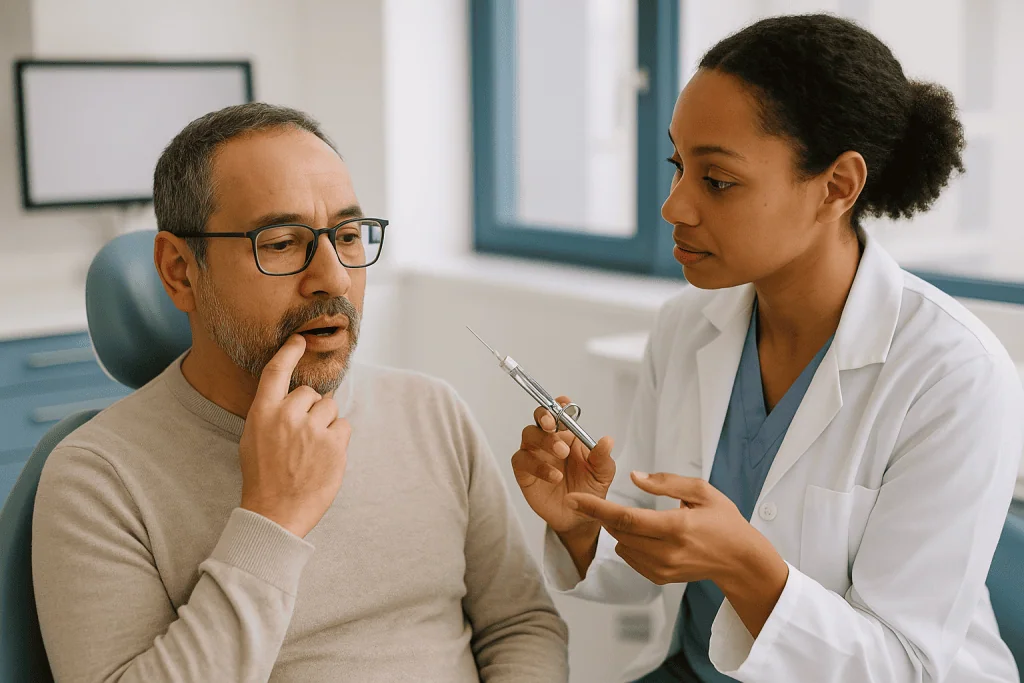
The dentist or surgeon injects the anesthetic either right beside the tooth (an infiltration) or further back, next to the main nerve trunk that serves an entire section of the jaw (a nerve block). Lower molars almost always need a block, because the dense bone of the lower jaw resists infiltration. That is why the whole side of your lip and tongue goes numb for a lower wisdom tooth but only a small patch does for an upper one.
Many dental local anesthetics contain a small amount of epinephrine, the same substance as adrenaline. It narrows nearby blood vessels, which slows the anesthetic’s departure and reduces bleeding in the surgical field. That is also why some people notice a brief racing heartbeat after the injection; the sensation usually passes within minutes.
According to the NHS, the numbness from a local anesthetic generally wears off within a few hours. Until it does, the risk is not pain but accidental damage: biting a numb lip, sipping a hot drink and not noticing the burn. For that reason surgical teams often suggest waiting to eat until feeling returns. Local anesthesia is the foundation under every other technique described in this article. Whatever else is added, this is the part that stops the operation from hurting.
What does "sedation" really mean? The spectrum from relaxed to deeply asleep
“Sedation” is one word covering several very different experiences, and much of the confusion around dental anesthesia comes from that stretch. Anesthesia guidelines describe it as a continuum with named stages.
Minimal sedation, sometimes called anxiolysis, takes the edge off. You are awake, you answer questions normally, your breathing and reflexes are untouched. Nitrous oxide breathed through a soft nasal mask usually sits here, as can a single dose of an oral sedative from the benzodiazepine class (a group of medicines that calm the brain’s activity), prescribed and timed by the clinician.
Moderate sedation, often labeled “conscious sedation,” is deeper. Medicine is typically given through a small cannula in a vein so the clinician can adjust it minute by minute. You respond purposefully to speech or a light touch, you keep breathing on your own, but time compresses and most people remember very little. MedlinePlus notes that your heart rate, blood pressure and oxygen level are watched continuously during this stage.
Deep sedation goes further still. You are hard to rouse, you may need help keeping your airway open, and the line between deep sedation and general anesthesia becomes thin. Because a patient can slide from one stage to the next without warning, anyone providing deep sedation is expected to be trained and equipped to manage general anesthesia if it happens unintentionally.
Two practical points follow. First, “IV” describes the route, not the depth: intravenous medicine can produce anything from mild calm to full unconsciousness. Second, sedation is not pain control. The local anesthetic still does that job underneath. When a friend says they were “asleep” for their extraction, they most often mean moderate or deep sedation with no memory of the event, rather than true general anesthesia.
How do they put you to sleep for oral surgery?
For a true general anesthetic, the process follows a predictable sequence whether the operation is jaw reconstruction or a difficult set of impacted teeth.
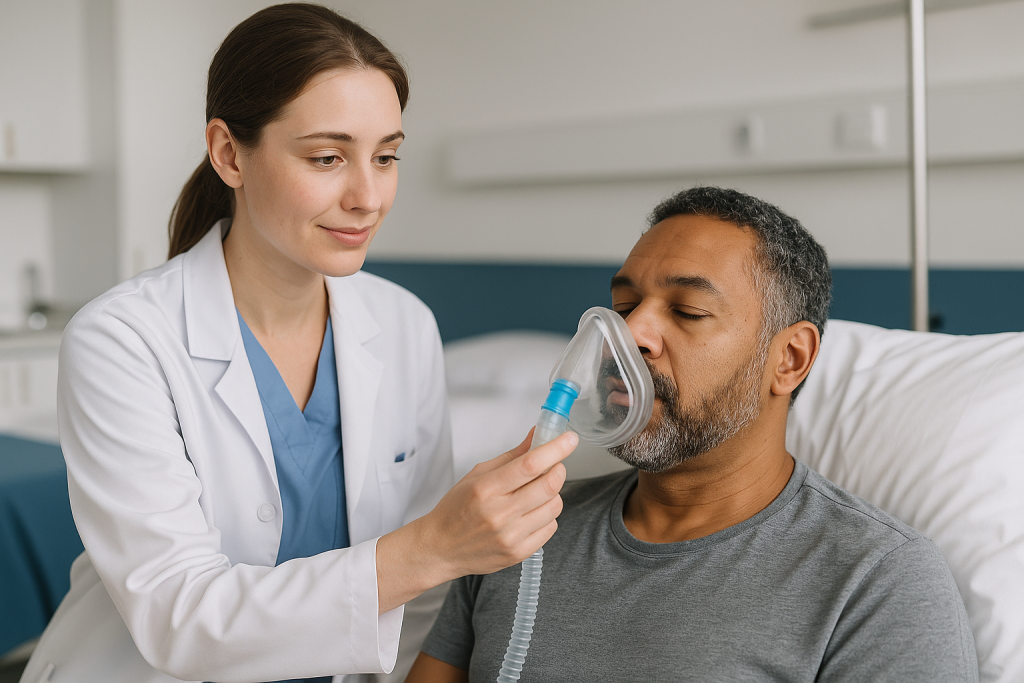
You arrive having fasted for the period your team specified. An anesthesia provider reviews your history, checks your airway (mouth opening, neck movement, dentures or loose teeth) and confirms consent. Monitoring stickers go on your chest, a clip on your finger measures oxygen, a cuff on your arm tracks blood pressure. A small cannula is placed in a vein on the hand or arm.
The anesthetic itself is usually started through that cannula. Within about a minute of the medicine going in, you lose consciousness; most people describe a warm sensation or a brief lightheadedness and then nothing. Children, and some adults who dislike needles, may instead breathe an anesthetic gas through a mask first, with the cannula placed once they are asleep.
Once you are unconscious, the team secures your airway. In maxillofacial surgery this often means a breathing tube passed through the nose rather than the mouth, so the surgeon has an unobstructed view of the teeth and jaws. A throat pack may be placed to stop blood and fluid trickling downward. Anesthetic gases or a continuous infusion keep you asleep; a local anesthetic is still injected at the surgical site to reduce bleeding and to blunt pain as you wake.
Throughout, the anesthesia provider adjusts the depth, watches every monitor and manages fluids and blood pressure. At the end, the medicines are stopped, you begin breathing fully on your own, the tube is removed and you wake in a recovery area under observation. The NHS describes the whole arc, from fasting to recovery, on its general anaesthesia page, and it is a good reference to read before your pre-operative appointment.
Sedation vs general anesthesia for dental surgery: how the team decides
People often frame this as a personal preference, and preference genuinely matters. But surgical teams weigh several factors that patients rarely see, and it helps to know what they are.
| Factor | Local only | Sedation plus local | General anesthesia |
|---|---|---|---|
| Your awareness | Fully awake | Calm to drowsy; little memory | Unconscious |
| Breathing | Entirely your own | Your own, monitored | Supported, often via a tube |
| Fasting needed | Usually none | Usually yes | Yes, typically several hours |
| Escort home | Not required | Required | Required |
| Typical setting | Dental chair | Dental chair or day surgery unit | Operating room |
| Suits | Short, straightforward procedures | Moderate procedures; anxiety; strong gag reflex | Long or complex operations; cases where cooperation is not possible |
The first driver is the operation itself. Duration matters: sitting still with a mouth propped open for two hours is very different from twenty minutes. Complexity matters too. Bone grafting, jaw repositioning and trauma repair involve bleeding, instruments in the airway and positions that are difficult to tolerate awake.
The second driver is you. Your general health, medicines, weight, sleep apnea, previous reactions to anesthesia and, crucially, your anxiety all feed in. Someone who freezes at the sound of the drill may do far better, and more safely, with moderate sedation than with a local alone.
The third driver is the setting and the team’s training and equipment, which vary between offices and hospitals. Mayo Clinic’s overview of wisdom tooth extraction lists all three approaches as legitimate depending on circumstances, and that even-handedness is the right frame: there is no universally correct box on the form, only the right one for this operation, this patient and this team.
Who is usually offered each option, and who may be asked to wait
Anesthesia providers use a simple grading of overall health, the ASA physical status classification, to help decide what is appropriate and where. Someone with no significant medical problems sits in class one; someone with mild, well-controlled conditions such as treated high blood pressure sits in class two. These patients are commonly offered any of the three approaches in an outpatient setting, subject to the procedure.
Beyond that, the calculation shifts. Serious heart or lung disease, poorly controlled diabetes, significant obesity or obstructive sleep apnea (a condition where the airway repeatedly collapses during sleep) raise the stakes for sedation and general anesthesia, because these are exactly the situations where breathing and blood pressure need close support. Such patients are more likely to be scheduled in a hospital rather than an office, or to have a local-only plan discussed first.
Some people are asked to postpone rather than switch. A chest infection or a heavy cold in the week before surgery makes airways irritable and raises the chance of breathing complications under general anesthesia; many teams will reschedule rather than proceed. Pregnancy prompts a careful conversation about timing and technique, with non-urgent surgery often deferred. A recent heart attack or stroke, or a new medicine such as a blood thinner, may also lead to a delay while the wider medical team is consulted.
Children form their own category. Young children often cannot cooperate with a long procedure under local anesthesia, so sedation or general anesthesia becomes a matter of feasibility rather than comfort. The Cleveland Clinic’s anesthesia overview describes how the approach is tailored to age, health and procedure. What every group shares is the principle that fitness for anesthesia is assessed by the team, and their answer may be “not yet” as well as “which one.”
Is IV sedation for wisdom teeth the usual choice?
Wisdom teeth are the procedure that brings most adults face to face with this decision, so they deserve their own answer. There is no single standard. Practice varies between countries, between health systems and between individual surgeons, and all three approaches are used for third molars in mainstream care.
A fully erupted upper wisdom tooth with straight roots may come out in minutes under local anesthesia alone, much like any other extraction. At the other end, four deeply impacted teeth, each requiring bone removal and sectioning, can mean well over an hour with the mouth held open, water spraying, and sustained pressure on the jaw. That is a long time to stay relaxed, and it is where IV sedation for wisdom teeth is frequently offered in office-based oral surgery.
The appeal is straightforward. Moderate intravenous sedation lets you breathe on your own, needs less equipment than general anesthesia, and typically produces little or no memory of the procedure. The surgeon still numbs each site thoroughly with local anesthetic. From your side, the experience is usually described as “I closed my eyes and it was over.”
General anesthesia for wisdom teeth is more common in hospital-based systems, for very difficult impactions, for patients with medical conditions that call for an anesthesiologist’s full attention, or for people whose anxiety or gag reflex makes even sedated cooperation unlikely. Mayo Clinic’s patient information describes all of these as acceptable paths.
Two things are worth knowing before you choose. First, sedation does not remove the need for a local anesthetic, so you will still wake with a numb jaw. Second, the surgical recovery is set by the extraction, not the anesthesia: Mayo Clinic notes that most people recover from the procedure itself over a few days regardless of how they were kept comfortable during it.
What is the safest sedation for dental work?
The question people type most often has an answer they may not expect: the safest sedation is the shallowest one that lets the procedure be done well, delivered by a team trained and equipped for the next level up.
Depth is the variable that tracks most closely with risk. At minimal sedation, breathing and protective reflexes are essentially untouched. As sedation deepens, the muscles of the throat relax, the drive to breathe softens, and the reflexes that would normally clear the airway dull. That is the mechanism behind the rare but serious events in dental sedation. It is also why nitrous oxide, which produces only minimal sedation and clears from the body within minutes of removing the mask, has such a long record of use, and why guidelines require pulse oximetry (a finger clip that reads blood oxygen) as a minimum for anything deeper.
Route matters less than depth, but it is not irrelevant. Intravenous medicine can be adjusted in small steps and reversed quickly if needed; an oral sedative, once swallowed, cannot be taken back, and its effect can be unpredictable between individuals. That unpredictability is one reason many guidelines are cautious about oral sedation in children and about giving more than one dose.
The remaining safety factors have nothing to do with the medicine. Was a proper medical history taken? Is someone other than the operating surgeon dedicated to watching you? Is there suction, oxygen, reversal medicine and a plan for an emergency? Has the team rehearsed it? MedlinePlus summarizes the standard monitoring for conscious sedation, and it is reasonable to ask your team whether that is what they provide.
So the honest answer is not a drug name. It is a match: the lightest effective depth, a monitored patient, a prepared team, and a setting appropriate to your health.
What is the strongest dental anesthesia?
This question usually hides a fear: “I have a high pain threshold, ordinary numbing does not work on me, what will?” The reassuring reality is that “strong” is the wrong axis. Anesthesia is not a ladder from weak to strong. It is a set of tools aimed at different problems.
If the worry is pain, the relevant tool is the local anesthetic, and its effectiveness depends far more on placement than on potency. A lower molar that stays sensitive after an injection is usually a problem of anatomy or infection, not of a “weak” drug. Inflamed tissue is more acidic, which reduces the amount of anesthetic able to enter the nerve; extra nerve roots or unusual nerve paths can leave a pocket of sensation. Experienced clinicians deal with this by adding a supplementary injection at a different site, choosing a different agent or technique, or in some cases treating an infection first. Long-acting local anesthetics exist and are sometimes used for extended procedures so numbness outlasts the early post-operative hours, but that is a decision for the surgeon.
If the worry is awareness or panic, no local anesthetic will solve it, however potent. That is a sedation question, and “stronger” would mean “deeper,” with all the trade-offs in breathing and monitoring described earlier.
If the worry is a complex, lengthy operation, general anesthesia is not “the strongest numbing.” It is a different category altogether, chosen for the procedure rather than for toughness.
People who report that “anesthesia never works on me” deserve to be taken seriously; true resistance is unusual, but past bad experiences are common and shape the next one. Say it plainly at your consultation. The response should be a plan, not a bigger needle.
Do most oral surgeons do their own anesthesia?
The answer depends heavily on where you live and on the depth of anesthesia involved, and that variation is worth understanding before you assume anything about your own appointment.
Local anesthesia is given by the operating dentist or surgeon everywhere. That is routine dental practice and needs no separate provider.
Sedation is where models diverge. In the United States, oral and maxillofacial surgeons complete hospital-based training that includes a substantial rotation in anesthesia, and the specialty has long used an “operator-anesthetist” approach for moderate and deep sedation in the office: the surgeon administers and directs the sedation while also operating, supported by a trained team whose members monitor the patient continuously. Regulations typically require specific permits, equipment, staff training and inspections for this model. In the United Kingdom and much of Europe, by contrast, professional guidance generally expects that moderate sedation for dental procedures be delivered by a clinician who is not simultaneously performing the surgery, or by a separately trained sedationist, and deep sedation in dental settings is uncommon outside hospitals.
General anesthesia is different again. Almost universally, it is provided by an anesthesiologist or a qualified anesthesia professional whose sole job is keeping you asleep and safe, while the surgeon concentrates on the operation. The NHS describes this division of roles on its general anaesthesia page, and it holds in most health systems.
What should you take from this? Not that one model is better; each operates within its own regulatory framework. The practical lesson is to ask, without embarrassment, who will be giving your sedation, who will be watching you while the surgeon is working, what training they hold, and what happens if something changes during the procedure. Clear, unhurried answers are a good sign.
Preparing for your oral surgery anesthesia: fasting, medicines and a ride home
Preparation is where a good outcome quietly begins, and it differs sharply by depth.
Under local anesthesia alone, there is usually nothing to fast for. Eating a normal meal beforehand is often encouraged, because you may not feel like eating for a while afterward and a numb mouth makes early eating awkward.
Sedation and general anesthesia both require an empty stomach. The reason is mechanical: when protective reflexes are dulled, stomach contents can travel up and be inhaled into the lungs. The NHS explains that patients are told to stop eating for a set period before a general anesthetic, commonly around six hours, with clear fluids allowed until closer to the procedure. Sedation instructions usually follow similar logic. Your team’s written instructions override any general figure, and “just a small breakfast” can lead to a canceled appointment.
Medicines need a conversation, not a guess. Most regular prescriptions are continued, some are paused, and a few are timed differently on the day. Blood thinners, diabetes medicines and certain heart medicines are the ones most often adjusted. Do not stop or change anything on your own; bring a list and let the prescribing clinician and the surgical team decide together.
Tell the team about smoking, vaping, alcohol and recreational drug use. This is not a moral audit. These substances change how sedatives work and how your airway behaves, and honest information keeps you safer.
Finally, logistics. Anyone receiving sedation or general anesthesia needs a responsible adult to take them home and, ideally, to stay with them that evening. MedlinePlus advises against driving, operating machinery or making major decisions for 24 hours after conscious sedation. Wear loose clothing with sleeves that roll up, remove nail polish from at least one finger for the oxygen monitor, and leave jewelry at home.
What do the hours, days and weeks after anesthesia usually look like?
It helps to separate two recoveries that happen at once: recovery from the anesthetic, which is fast, and recovery from the surgery, which takes longer.
In the first hours after a local anesthetic, the main event is the return of sensation. The NHS notes numbness generally fades over a few hours; tingling gives way to a dull ache as the surgical site makes itself known, which is why teams often suggest taking the pain relief they have prescribed or advised before the numbness fully lifts, following their specific instructions.
After moderate sedation, most people feel groggy for a few hours and unusually tired for the rest of the day. Memory of the afternoon may be patchy; it is common to ask the same question twice. MedlinePlus advises a 24-hour pause on driving, alcohol and important decisions. By the next morning, the sedative effects have typically cleared, and what remains is ordinary surgical soreness.
General anesthesia adds a slightly longer tail. The NHS lists nausea, a sore throat from the breathing tube, shivering, dizziness and temporary confusion among the common short-term effects, usually resolving within a day. Its guidance is to avoid driving, alcohol and signing legal documents for 24 to 48 hours. Some people notice poorer concentration or sleep for a few days, especially older adults, and this too generally settles.
The surgical timeline then takes over and depends entirely on what was done. For wisdom teeth, Mayo Clinic describes swelling and discomfort peaking in the first days and most people returning to normal activity within a few days, with the socket continuing to heal for weeks beneath the surface. Larger jaw operations follow a longer arc that your surgeon will map out. Whatever the operation, the anesthetic itself should be a footnote in that story within a day or two.
What are the risks of each type of dental anesthesia?
Every type of dental anesthesia carries some risk, and pretending otherwise does patients no favors. The useful thing is to know what the risks actually are, how often they happen, and how they are prevented.
Local anesthesia is remarkably safe, but not free of complications. Temporary numbness of the lip, chin or tongue from bruising of a nerve occurs occasionally after lower wisdom tooth surgery; most cases resolve over weeks to months, and a small minority persist, a risk that comes from the surgery as much as from the injection. Brief palpitations from the epinephrine component, a small bruise at the injection site, and biting a numb lip are the everyday nuisances. True allergy to modern local anesthetics is rare.
Sedation’s risks concentrate on breathing. Oxygen levels can dip if sedation goes deeper than intended, particularly in people with sleep apnea or obesity. Blood pressure can fall. Nausea and a heavy, tired feeling are common. The safeguards are continuous monitoring, careful adjustment of medicine, supplemental oxygen and a team ready to support breathing.
General anesthesia shares those risks and adds a few. The NHS records that common effects such as nausea, sore throat and shivering are usually mild and short-lived. Serious complications are uncommon: it cites a severe allergic reaction in roughly 1 in 10,000 anesthetics and death attributable to anesthesia in around 1 in 100,000, with risk higher in people who are older, have significant illness or need emergency surgery. Damage to teeth or lips from airway equipment, awareness during anesthesia and post-operative confusion are other recognized, infrequent events.
The pre-operative assessment exists precisely to shrink these numbers further for you. Disclosing every condition and medicine, following fasting rules and reporting a new cough are not formalities; they are the parts of risk reduction that only you can do.
What people often get wrong about oral surgery anesthesia options
Myths cluster around anesthesia because the experience is hard to remember and easy to embellish. Several deserve a direct correction.
“Sedation means I won’t feel anything.” Sedation changes awareness and memory, not pain transmission. The local anesthetic underneath does the pain work. A well-sedated patient with poor local anesthesia can still flinch, even if they later recall nothing.
“General anesthesia is the gold standard, so I should ask for it.” Deeper is not better. General anesthesia is the right tool for long or complex operations and for people who cannot be safely treated any other way. For a routine extraction it adds fasting, airway instrumentation, a longer recovery and a larger safety envelope without improving the surgical result.
“Laughing gas is for children.” Nitrous oxide is used across all ages for minimal sedation, wears off within minutes, and can be enough to turn a dreaded visit into a tolerable one for many anxious adults.
“I’ll wake up during the surgery.” Awareness under properly monitored general anesthesia is a rare event. With moderate sedation, being partly aware is expected and normal; you are meant to respond to the team. Those are different things, and confusing them fuels needless fear.
“Local anesthetic doesn’t work on redheads / people with high tolerance / me.” Individual variation is real, and infection or anatomy can make a block fail, but the solution is technique, not toughness, as discussed earlier.
“Anesthesia is what makes recovery slow.” Sedative effects clear within a day or two according to NHS and MedlinePlus guidance; the swelling, bruising and soreness that follow are the surgery healing.
Understanding your oral surgery anesthesia options is less about memorizing drug names than about knowing which problem each tool solves. Once that clicks, the checkbox on the form stops feeling like a gamble.
Questions to ask your care team
A consultation goes better when you arrive with specific questions rather than general worry. These cover the ground that matters most, and none of them should make a good team defensive.
- Which anesthesia approach are you recommending for my procedure, and what is the main reason it fits me rather than the alternatives?
- If I chose a lighter or a deeper option, what would change about the operation, the setting and the recovery?
- Who will be giving the sedation or anesthesia, and who will be monitoring me while you are operating? What training do they hold?
- What monitoring will be used, and what emergency equipment and plans are in place?
- Do any of my medical conditions, such as sleep apnea, heart disease, diabetes or a past reaction to anesthesia, change your recommendation or the location of the procedure?
- Which of my regular medicines should I take on the day, which should I pause, and who will confirm that with my prescribing doctor?
- Exactly when should I stop eating and drinking, and what counts as a clear fluid?
- How will pain be managed as the local anesthetic wears off, and what should I expect in the first 24 hours?
- When can I drive, return to work and make important decisions?
- What warning signs should prompt me to call you, and what number do I use out of hours?
Write the answers down, or bring someone who can. Sedation blunts memory even before it starts, because anxiety on the day does much the same. If any answer leaves you unsure, say so; asking for a second explanation is part of informed consent, not a challenge to anyone’s expertise. The decision about which box to tick belongs to you and your treating team together, and it should feel that way when you leave the room.
When to call your doctor
Most people leave oral surgery with a numb face, a wad of gauze and a set of written instructions, and the days that follow go as predicted. A few signs mean the plan has changed and you need the team, not the internet.
Call the surgical team or seek urgent care the same day if you notice bleeding that soaks through gauze and does not slow with firm pressure for 20 to 30 minutes; a fever with worsening swelling, especially swelling that spreads toward the eye or under the jaw; difficulty swallowing your own saliva; or pain that escalates sharply several days after surgery instead of easing, which can signal a problem with the healing socket. Persistent vomiting after sedation or general anesthesia, or confusion that is not clearing by the next morning, also warrants a call.
Treat the following as emergencies and call your local emergency number: any difficulty breathing or a feeling that your throat is closing; swelling of the tongue or floor of the mouth that makes it hard to speak or breathe; chest pain; a rash with facial swelling and wheeze, which can indicate a severe allergic reaction; fainting that does not resolve within a minute or two; or new weakness, drooping or slurred speech.
Numbness that outlasts the expected few hours is not an emergency, but it should be reported at your follow-up, or sooner if it is accompanied by pain or has not improved after several days, so the team can document it and advise you.
When in doubt, call. Teams would far rather answer a question that turns out to be nothing than hear about a complication late. Keep the after-hours number somewhere your escort can find it, because on the evening of surgery you may not be the one making the call.
Frequently asked questions
What is the safest sedation for dental work?
The safest sedation is the lightest depth that allows the procedure to be done properly, delivered by a trained team with continuous monitoring. Minimal sedation such as nitrous oxide leaves breathing and reflexes intact and clears within minutes. Deeper sedation carries more airway risk and calls for pulse oximetry, a dedicated monitor and emergency preparedness. Your medical history, not a drug name, determines what is safest for you, and your team should explain their reasoning.
What is the strongest dental anesthesia?
There is no single “strongest” anesthesia, because local anesthetics, sedatives and general anesthetics solve different problems. For pain, effectiveness depends mostly on correct injection placement and the absence of infection rather than potency, and long-acting local agents exist for extended procedures. For anxiety, the relevant tool is sedation depth. General anesthesia is a separate category chosen for complex operations, not a more powerful version of numbing.
How do they put you to sleep for oral surgery?
For general anesthesia, medicine is usually given through a small cannula in a vein and you lose consciousness within about a minute; children may breathe an anesthetic gas through a mask first. Once asleep, the anesthesia team secures your airway, often with a tube through the nose so the surgeon can work in the mouth, and keeps you unconscious with gas or an infusion while monitoring heart, blood pressure and oxygen throughout, as the NHS describes.
Do most oral surgeons do their own anesthesia?
It depends on the country and the depth. All surgeons give their own local anesthesia. In the United States, oral and maxillofacial surgeons are trained to administer moderate and deep sedation in the office with a monitoring team, under specific permits. In the UK and much of Europe, sedation is usually given by a separate trained clinician. General anesthesia is almost always delivered by an anesthesiologist or qualified anesthesia professional everywhere.
Is sedation vs general anesthesia for dental surgery a big difference in recovery?
Yes, though both are short compared with surgical healing. After moderate sedation most people are groggy for a few hours and clear by the next morning, with MedlinePlus advising 24 hours off driving. General anesthesia commonly adds nausea, a sore throat and shivering, and the NHS advises avoiding driving and legal decisions for 24 to 48 hours. The soreness and swelling that persist afterward come from the operation itself.
Is IV sedation for wisdom teeth safe?
Intravenous moderate sedation for wisdom teeth is widely used in mainstream oral surgery and, with proper patient selection and monitoring, serious complications are uncommon. The main risks involve breathing and blood pressure if sedation becomes deeper than intended, which is why teams use continuous pulse oximetry, keep oxygen and emergency equipment ready, and screen carefully for sleep apnea, heart or lung disease and medicines that interact with sedatives before proceeding.
Will I feel pain during oral surgery under sedation?
You should not, but the reason is the local anesthetic, not the sedation. Sedatives calm you and reduce memory; local anesthetic blocks the nerve signals that carry pain. Pressure, vibration and movement may still be perceived, particularly under lighter sedation. If anything feels sharp, tell the team; they can add local anesthetic at another site. Under general anesthesia you are unconscious and feel nothing during the procedure.
What are the main types of dental anesthesia?
Dental anesthesia falls into three families: local anesthesia, which numbs one region while you stay awake; sedation, ranging from minimal (such as nitrous oxide) through moderate “conscious” sedation to deep sedation, usually paired with local anesthetic; and general anesthesia, which produces controlled unconsciousness with airway support. MedlinePlus and the Cleveland Clinic describe these categories in detail, and most oral surgery uses one or a combination of them.
How long does dental numbness last after oral surgery?
According to the NHS, the numbness from a local anesthetic generally wears off within a few hours, though lower jaw nerve blocks often last longer than upper injections. Until sensation returns, avoid hot drinks and chewing on that side to prevent accidental burns or bites. Numbness that persists for days after lower wisdom tooth surgery should be reported to your surgeon; most such cases improve over weeks to months.
Can I eat before oral surgery with local anesthesia only?
Usually yes. When only local anesthesia is planned, most teams encourage a normal meal beforehand, because you may not want to eat for some hours afterward while your mouth is numb and sore. Fasting rules apply when sedation or general anesthesia is involved, since dulled reflexes make it possible to inhale stomach contents. Always follow the specific written instructions your surgical team gives you rather than a general rule.
References
- MedlinePlus: Anesthesia
- MedlinePlus Medical Encyclopedia: Conscious sedation for surgical procedures
- NHS: General anaesthesia
- NHS: Local anaesthesia
This article is for general information only and is not a substitute for professional medical advice. Please consult a qualified doctor about your individual situation.

More from the Blog

Impacted Tooth Treatment in Adults vs Teens: Why Timing Changes the Approach
An impacted tooth is one blocked from fully coming through the gum. In teens, roots are still forming and bone is more adaptable, so…

Keeping Up Orofacial Myology Exercises Between Visits: Why Daily Practice Shapes the Result
Daily myofunctional exercises matter because orofacial myology works through motor learning: the tongue, lips and jaw muscles only adopt a new resting posture and…

Bleeding Gums in Pregnancy and With Diabetes: Why Gum Care Is Planned Differently
Bleeding gums in pregnancy are usually pregnancy gingivitis: hormonal changes make gums react more strongly to plaque, so they swell and bleed with brushing.…

How Oral and Maxillofacial Surgeons Train, and Questions to Ask Before Your Procedure
Oral and maxillofacial surgeons first complete dental school, then a hospital-based surgical residency that typically runs four to six years and includes rotations in…

Recovery After Gummy Smile Treatment: Swelling, Sensitivity and the Reshaped Gum Line
Recovery after gummy smile treatment depends on the procedure. Gum contouring and crown lengthening usually bring mild swelling, tenderness and temporary tooth sensitivity that…
Is Sensitivity After Teeth Whitening Normal? What Helps and When to Call the Dentist
Yes. Temporary sensitivity is one of the most common side effects of peroxide-based teeth whitening. It usually appears during or shortly after treatment as…