

How Grinding and Erosion Lead to Full Mouth Reconstruction: Bite Collapse and Tooth Wear

Key Takeaways
- Enamel, once worn away by grinding or dissolved by acid, does not regrow; restorations replace it while fluoride only hardens what remains.
- Bite collapse is a shift in the resting distance between the jaws caused by generalized tooth wear, not damage to any single tooth.
- Acid erosion leaves smooth, cupped surfaces with fillings standing proud, while grinding leaves flat matching facets; most advanced wear shows both.
- Sleep bruxism is associated with sleep apnea and with stress, so a sleep assessment or medical referral often precedes major dental work.
- Dental implants replace missing teeth, most often to restore back-tooth support, and their bone-healing phase alone commonly runs for several months.
- A custom night guard protects a reconstruction from the same forces that wore the original teeth but does not stop the grinding habit itself.
Tooth wear bite collapse happens when years of grinding (bruxism) or acid erosion shorten the teeth enough that the jaws close too far, straining joints, muscles and remaining teeth. Full mouth reconstruction restores lost tooth height with a planned combination of crowns, onlays, orthodontics and, where teeth are missing, dental implants, after the cause of wear is managed. Suitability depends on individual assessment by a dental team.
A retired teacher noticed it in a photograph from her daughter’s wedding. Her smile looked shorter than she remembered, her chin a little closer to her nose, the corners of her mouth turned down. She had not lost a single tooth. She had simply been grinding them, quietly, for decades, and a lifetime of citrus and sparkling water had done the rest.
Her dentist used two phrases she had never heard: tooth wear bite collapse, and full mouth reconstruction. One sounded like a diagnosis, the other like a construction project. In a sense, both are accurate. When the biting surfaces of many teeth wear down together, the whole system that holds the jaws at the right distance quietly gives way, and rebuilding it is less like filling one cavity than re-leveling a house.
This article explains how grinding and erosion get that far, what reconstruction actually involves, where dental implants fit in, and which decisions belong with the treating team rather than a web page.
What is tooth wear bite collapse, in plain language?
Teeth are not meant to be perfectly durable. Enamel, the hard outer shell of a tooth, is the most mineralized tissue in the body, yet it does not regrow once lost, as Cleveland Clinic notes in its guidance on grinding. Under the enamel sits dentin, a softer, yellower tissue that wears several times faster once exposed. Some loss of surface over a lifetime is normal and harmless.
Bite collapse describes something more serious. When wear affects many teeth at once, especially the back teeth that act as the stops of the bite, the upper and lower jaws can close further than they were designed to. Dentists call the natural resting distance between the jaws the vertical dimension of occlusion. Lose enough tooth height and that dimension shrinks. The lower face appears shorter, the lips fold inward, the chewing muscles and jaw joints work at an unfamiliar angle, and the front teeth start taking forces they were never built to carry.
Tooth wear bite collapse is therefore not one worn tooth but a structural shift in the whole mouth. Three processes drive it, often together:
- Attrition: tooth-on-tooth wear from grinding and clenching, known as bruxism.
- Erosion: chemical loss of tooth surface from acids, whether from diet or stomach reflux.
- Abrasion: mechanical wear from outside objects, such as hard-bristled brushing.
Erosion and attrition amplify each other. Acid softens the surface, grinding strips the softened layer away, and the cycle repeats every night. That is why someone with both reflux and sleep bruxism can lose far more tooth structure than either problem would cause alone, and why the treating team looks for both before deciding how to rebuild.
Acid erosion vs grinding: how do the two actually wear teeth down?
The two main culprits leave different fingerprints, and telling them apart changes the treatment plan.

Grinding, or bruxism, is repetitive clenching or sliding of the teeth, often during sleep and often without awareness. Mayo Clinic describes sleep bruxism as a sleep-related movement disorder and notes it is more likely in people who also snore or have sleep apnea, a condition in which breathing repeatedly pauses overnight. The NHS adds that stress and anxiety are common contributors, along with certain medicines and alcohol or caffeine use. Grinding produces flat, shiny facets where upper and lower teeth match like a key in a lock, chipped edges on the front teeth, and sometimes a dull ache in the jaw muscles on waking.
Erosion is chemistry rather than mechanics. Acid dissolves mineral from enamel without any contact between teeth. Dietary sources include citrus, carbonated drinks, wine and vinegar-based foods. The other major source is the stomach. Gastroesophageal reflux disease (GERD), in which stomach acid travels back up the esophagus, can bathe the back of the teeth in acid overnight, and the NHS lists tooth problems among its recognized effects. Eroded teeth look smooth, cupped and glassy, with fillings that stand proud of the surrounding surface because the filling material resists acid while the tooth dissolves around it.
In practice, most people with advanced wear have a mix. A dentist reading the pattern can usually say which process dominates, and that matters: a night guard does nothing for reflux, and treating reflux does nothing for a clenching habit. Reconstruction built on top of an unmanaged cause tends to wear out in the same way the original teeth did.
What signs of bite collapse does a dentist look for?
People rarely arrive asking about bite collapse. They come in because a front tooth chipped on a sandwich, because cold water suddenly stings, or because a partner mentioned the nighttime grinding noise. The underlying structural change has usually been building for years and is picked up by examination rather than by the patient.
During an assessment, a dentist looks at the relationship between the parts of the mouth rather than at single teeth. They note whether the back teeth still meet in a stable way or have worn into a flat plane. They check whether the front teeth have become short and square, and whether the lower front teeth now bite high up behind the upper ones. They look for cupping on the chewing surfaces, a hallmark of erosion, and for matching flat facets, a hallmark of grinding. Sensitivity to cold often signals exposed dentin, since the tiny tubes within dentin connect to the nerve.
The face tells part of the story too. A reduced lower-face height, deepened lines from nose to mouth corners, and lips that seem to have lost support can accompany a collapsed bite, though age and weight change these features as well. Jaw joint clicking, morning headaches at the temples and tenderness in the chewing muscles are listed by Mayo Clinic and the NHS among features associated with bruxism.
None of these observations is a diagnosis on its own. Short teeth can be a normal inherited shape; sensitivity has many causes; jaw clicking is common in people who never grind. What the dentist assembles is a pattern, confirmed with the measurements and imaging described in the next section. If you have noticed changes like these, the sensible step is an examination, not self-grading against a list.
How is tooth wear assessed before anyone talks about reconstruction?
A full mouth reconstruction starts with a surprisingly slow phase: measuring. Treating worn teeth without first establishing how much height has been lost, and where the jaw should ideally rest, is like replacing floorboards without checking whether the joists have sagged.
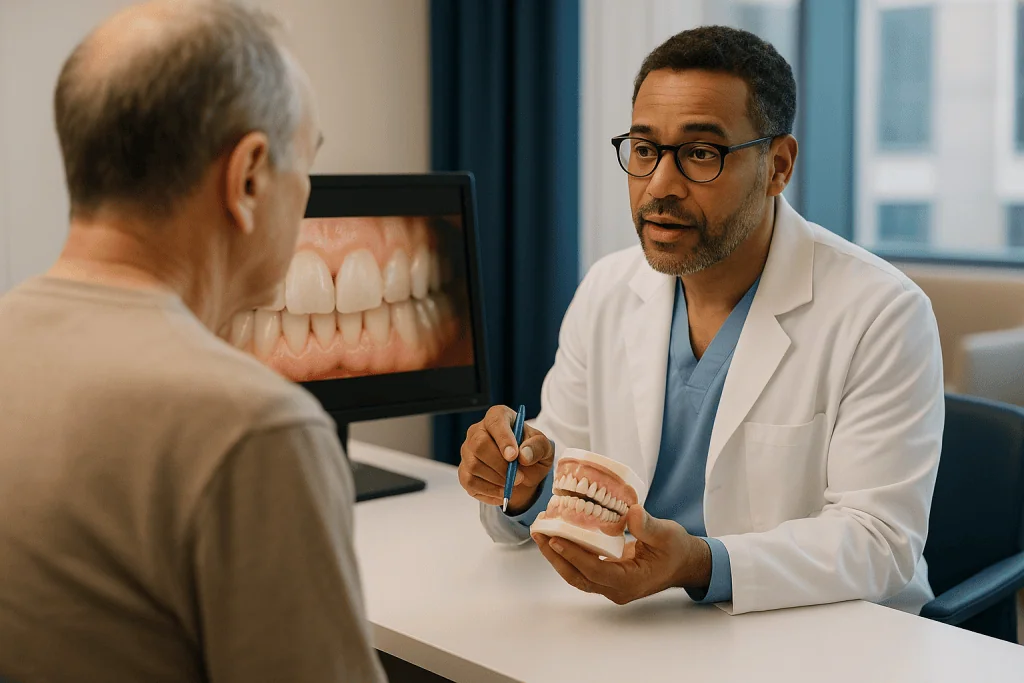
Assessment typically includes several elements. Clinical photographs document the current state and let the team track change. Dental X-rays and, where implants are being considered, three-dimensional cone-beam CT imaging show root length, bone volume and the position of nerves and sinuses. Mayo Clinic notes that implant planning routinely involves such imaging and a review of the whole medical history, since conditions such as uncontrolled diabetes, heavy smoking or certain bone medicines affect healing.
Impressions or digital scans of both arches are mounted on an articulator, a hinged device or digital model that mimics jaw movement. On this model the dentist can test an increase in vertical dimension, essentially asking: if we restore these teeth to a taller height, do the jaws, muscles and joints accept it? A wax or 3D-printed mock-up often follows, so the proposed new tooth shape can be previewed in the mouth.
Equally important is the search for cause. The team may ask about snoring, daytime sleepiness and heartburn, and may suggest a sleep assessment or a referral to a physician for reflux. Mayo Clinic specifically links sleep bruxism with sleep apnea, and reflux is a well-established source of erosion. Many clinicians also use a removable occlusal splint, a custom plastic guard worn over the teeth, as a trial of the new jaw position for weeks before anything irreversible is done. This reversible rehearsal is one of the most protective steps in the whole process, and it is reasonable to ask whether it is part of your plan.
What does full mouth reconstruction actually involve?
Full mouth reconstruction, sometimes called full mouth rehabilitation, is not a single procedure. It is a coordinated sequence that restores the shape, height and function of most or all teeth, usually across both jaws, so the bite closes at a planned and stable vertical dimension. The phrase sounds dramatic; the work is methodical.
Once the new jaw position has been tested, the restorative phase rebuilds each tooth to the planned height. Depending on how much structure is left, this uses:
- Direct composite bonding: tooth-colored resin sculpted onto the worn surface, the most conservative option and often used on front teeth or as a medium-term step.
- Onlays and veneers: thin ceramic or composite pieces that cover the chewing surface or front face of a tooth while preserving most of the remaining structure.
- Crowns: full-coverage caps for teeth that have lost too much height or have large old fillings.
- Root canal treatment: needed where wear has exposed or inflamed the nerve.
- Orthodontics: braces or aligners to move teeth that have drifted or over-erupted into the collapsed space.
Where teeth are missing or beyond saving, dental implants or bridges fill the gaps so the back of the bite has solid stops again. The sequence matters. Teeth are typically built up in segments, with the bite checked at every stage, so that the new height is distributed evenly and no single tooth carries the load.
The final element is protection. Because the forces that wore the original teeth are still present in the muscles, a night guard made to the new bite is standard practice, and the NHS describes mouth guards as a core tool for limiting grinding damage. Reconstruction changes the teeth; it does not change the person’s physiology, so the plan has to assume grinding will continue.
Where do dental implants fit into a full mouth rehabilitation for worn teeth?
Many people assume reconstruction after bite collapse means replacing everything with implants. Usually it does not. Implants replace missing teeth; they are not a treatment for worn teeth that still have healthy roots. Their role is specific and often decisive.
A dental implant is a titanium post placed surgically into the jawbone, which heals around it in a process called osseointegration, after which a crown, bridge or denture is attached. Mayo Clinic explains that the full process takes place in stages and that bone healing alone commonly runs for several months before the final tooth is attached. Where bone has shrunk after long-standing tooth loss, a bone graft may be needed first, extending the timeline further.
In a collapsed bite, implants matter most at the back of the mouth. Molars are the posts that hold the jaws apart. When they were lost years ago and never replaced, the remaining teeth drift, tilt and over-erupt into the gaps, and the front teeth grind against each other with no back support. Restoring the molar zone with implant-supported crowns gives the rebuilt bite the stable stops it needs. For someone who has lost most teeth in an arch, an implant-supported full-arch bridge or overdenture, a removable denture that clips onto implants, can reset the vertical dimension across the whole jaw.
Two cautions shape implant planning in grinders. Implants have no periodontal ligament, the natural shock absorber around a tooth root, so they transmit grinding forces directly to bone and to the attached crown. Teams therefore design implant crowns with protected bite surfaces and insist on a night guard. And Mayo Clinic notes that smoking and poorly controlled medical conditions raise the risk of implant failure, so the surgical phase may be delayed until those factors are addressed. Whether implants are included, and how many, is a decision for the restorative dentist and surgeon together.
Who is usually a candidate for reconstruction, and who is asked to wait?
Full mouth reconstruction is a large undertaking, and good teams are as careful about who should wait as about who should proceed.
People most often considered are those with generalized wear that has reduced tooth height across both arches, with symptoms or risks that are unlikely to improve on their own: recurrent chipping, sensitivity that no longer responds to simpler measures, difficulty chewing, teeth that are too short to hold ordinary fillings, or a loss of back-tooth support that is accelerating wear on the front teeth. Having a clear, manageable cause helps. Someone whose reflux is now being treated by their physician, or whose grinding is being limited with a splint, is a far better candidate than someone with an active, unaddressed driver of wear.
Several situations commonly lead to a pause or a staged approach rather than immediate reconstruction:
- Active gum disease or untreated decay, which must be stabilized first because restorations placed on inflamed or infected foundations fail early.
- Unmanaged reflux, an eating disorder involving vomiting, or heavy acidic drink consumption, since new restorations will erode just as the teeth did.
- Suspected sleep apnea, which Mayo Clinic links to sleep bruxism, because treating the sleep disorder may reduce grinding and should be evaluated by a physician.
- Smoking, uncontrolled diabetes or certain bone-affecting medicines, which Mayo Clinic flags as factors that complicate implant healing.
- Adolescence, since the jaws and teeth are still developing and most reconstruction waits for adulthood.
There is also a group for whom monitoring is the right answer. Mild to moderate wear that is not progressing and causes no symptoms is often best managed with a guard, dietary changes and periodic photographs, not crowns. Choosing not to rebuild is a legitimate clinical decision, and the treating team should be able to explain why they recommend waiting as clearly as why they recommend acting.
Treatment options for worn teeth compared
The table below summarizes the main tools used in bruxism tooth wear treatment and erosion repair, from the least invasive to the most. Few people need all of them, and the mix is chosen tooth by tooth.
| Option | What it does | Tooth structure removed | Typical place in the plan |
|---|---|---|---|
| Night guard (occlusal splint) | Separates the teeth during sleep and spreads clenching forces | None | First step and lifelong protection after any rebuild |
| Cause management (reflux care, sleep assessment, diet changes) | Reduces the acid or grinding that drives wear | None | Before and alongside every other option |
| Composite bonding | Adds height and shape with resin layered directly onto the tooth | Minimal | Front teeth, early to moderate wear, or as an interim stage |
| Onlays and veneers | Ceramic or composite covers for chewing or front surfaces | Small to moderate | Moderate wear with enough tooth remaining to bond to |
| Crowns | Full coverage caps restoring height and strength | Moderate to substantial | Severely worn teeth, large old fillings, root-treated teeth |
| Orthodontics | Repositions drifted or over-erupted teeth | None | When tooth position, not just height, has changed |
| Dental implants | Replaces missing teeth with bone-anchored posts and crowns | Not applicable (replaces absent teeth) | Restoring back-tooth support or a full arch after tooth loss |
Two points deserve emphasis. First, the least invasive options are not inferior; conservative bonding preserves tooth structure that can be built on later, and many teams deliberately favor it where the bond is strong enough. Second, the night guard appears at both ends of the table because it is the single element that outlasts everything else. Mayo Clinic and the NHS both identify guards as central to limiting grinding damage, and a reconstruction without one is a reconstruction exposed to the same forces that caused the problem.
Bruxism tooth wear treatment: why the cause comes before the crowns
The most expensive mistake in reconstructive dentistry is rebuilding a mouth while the engine of destruction is still running. Managing the cause is therefore not a preliminary; it is the treatment.
For grinding, the evidence base points to a few consistent measures. Custom occlusal splints do not stop the muscles from clenching, but they protect the tooth surfaces and distribute force, and the NHS lists mouth guards as the first-line approach. Because the NHS and Mayo Clinic both identify stress and anxiety as contributors, approaches such as cognitive behavioral therapy, relaxation techniques and improved sleep habits are reasonable parts of a plan; the evidence that they reduce grinding itself is modest, and they are offered for broader benefit rather than as a guaranteed fix. Mayo Clinic notes that where sleep apnea is present, treating the apnea can reduce bruxism, which is why a sleep evaluation is often requested before major dental work. Some medicines, including certain antidepressants, are associated with grinding; any question about this belongs with the prescribing clinician and nothing should be changed without that discussion.
For erosion, management targets acid exposure. Dietary acid can be reduced by limiting the frequency of acidic drinks and foods rather than just the amount, since each exposure softens the surface for a period afterward. Reflux is managed by a physician; the NHS describes lifestyle measures and acid-reducing medicines as the usual approach to persistent heartburn, and dental erosion is one reason a dentist may recommend a medical referral. Fluoride toothpaste and a soft brush, used gently and not immediately after an acid exposure, help the softened surface recover its mineral.
Only once wear has been slowed does the restorative phase make sense. A dentist who insists on months of guard wear and a reflux assessment before cutting a single crown is not delaying your treatment; they are protecting it.
What do the days, weeks and months after each phase usually look like?
Reconstruction unfolds over a timeline measured in months, with several distinct chapters. Experiences vary with the plan, and the ranges below are typical rather than promised.
The splint phase comes first for most people. A new guard feels bulky for the first few nights and often increases saliva; most adapt within a week or two. If the guard is being used to test a taller bite, the team will ask about jaw muscle fatigue, headaches and chewing comfort over the following weeks, since persistent discomfort suggests the proposed height needs adjusting.
The restorative phase is usually delivered in sessions grouped by region of the mouth. After a session of bonding or crown preparation, teeth may be sensitive to cold for several days, and the bite can feel strange because the brain’s map of the mouth has changed. Speech may be slightly altered for a short period when front teeth are lengthened. Temporary restorations are worn between appointments and are deliberately softer, so sticky foods are avoided.
Where implants are part of the plan, the timeline lengthens. Mayo Clinic describes the implant process as several procedures spread over months, with soreness, swelling and minor bleeding common for a few days after surgery and bone healing continuing for several months before the final crown is attached. Bone grafting, where needed, adds its own healing period before the implant is placed.
Once the final restorations are in, the bite is fine-tuned over one or more follow-up visits, and a new night guard is made to the finished teeth. Long-term, the restored mouth is reviewed at regular intervals; ceramic and composite can chip under heavy grinding, and small repairs over the years are an expected part of ownership rather than a sign of failure. The treating team sets the review schedule and remains the first call for any problem.
What are the risks and alternatives, honestly stated?
Any procedure that reshapes most of the teeth carries risks, and the evidence on long-term outcomes is drawn largely from observational studies rather than large randomized trials, so figures quoted in marketing should be treated with caution.
Restorative risks include post-operative sensitivity, which usually settles but occasionally signals an inflamed nerve that needs root canal treatment; fracture or debonding of restorations, more likely in heavy grinders; and bite discomfort if the new vertical dimension is not well tolerated, which may require adjustment or, rarely, remaking. Any tooth that is crowned loses some natural structure permanently, which is why conservative options are preferred where they will hold.
Surgical risks relate to implants. Mayo Clinic lists infection at the site, injury to neighboring teeth or blood vessels, nerve damage causing numbness or tingling, and sinus problems with upper implants among recognized complications. Implants can also fail to integrate with bone, and the risk is higher in smokers and people with poorly controlled diabetes. Peri-implantitis, inflammation and bone loss around an implant, is a long-term risk that depends heavily on home care and professional maintenance.
Alternatives exist at every level. Monitoring with a guard and photographs is appropriate for stable wear. Partial reconstruction, rebuilding only the segment causing problems, is sometimes enough. Removable dentures, with or without implant support, remain a valid option for extensive tooth loss. Orthodontics alone can occasionally correct a drifted bite without restorations.
A fair summary of the evidence is this: restoring worn teeth at an increased vertical dimension is a well-established approach that most people tolerate, implants are a reliable way to replace missing teeth when healing conditions are good, and both require ongoing protection from grinding to last. Nobody can promise how long a particular reconstruction will survive. The decision to proceed, and how far, sits with the person and their treating team after weighing these trade-offs.
What people often get wrong about tooth wear and bite collapse
Myths around worn teeth tend to push people either toward unnecessary treatment or away from timely care. Several deserve correcting.
“Worn teeth are just aging.” Some wear is normal. Wear that exposes dentin across many teeth, chips edges or shortens the bite is not an inevitable part of getting older; it is a sign of an active process, usually grinding, acid or both, that can be slowed.
“Enamel can be rebuilt with the right toothpaste.” Fluoride and some remineralizing products can harden a softened surface, which is valuable, but Cleveland Clinic is clear that lost enamel does not grow back. Restorations replace it; toothpaste protects what remains.
“If I don’t feel pain, nothing is wrong.” Wear is usually painless until late. Sensitivity and chipping often arrive after years of silent loss, which is why photographs and scans at routine visits matter.
“A night guard will stop me grinding.” It will not. The NHS describes guards as protection against damage, not as a way to end the habit. The muscles still clench; the plastic absorbs the cost.
“Reconstruction means replacing all my teeth with implants.” Implants replace missing teeth. Teeth with healthy roots are rebuilt, not extracted, and most reconstructions use implants only in the gaps.
“Once it’s rebuilt, it’s done.” New crowns and implant restorations live in the same mouth, with the same muscles and the same acid exposures. Lifelong guard wear, cause management and maintenance visits are part of the treatment, not an optional extra.
“Brushing harder after acidic drinks protects the teeth.” The opposite. Acid temporarily softens enamel, and vigorous brushing then removes it. Rinsing with water and waiting before brushing is the usual advice.
Getting these right turns a frightening-sounding diagnosis into a manageable, if lengthy, project.
Questions to ask your care team before full mouth reconstruction
A good reconstruction plan can be explained clearly, and the questions you ask shape how carefully it is built. Consider taking these to your consultation.
- What is causing my wear, and how will we confirm it? Ask specifically whether reflux, sleep apnea and medication-related grinding have been considered, and whether a referral to a physician is needed.
- How much height has been lost, and how much do you propose to restore? Ask how the new vertical dimension will be tested before anything permanent is done.
- Which teeth can be rebuilt with bonding or onlays, and which genuinely need crowns? Ask what each option removes from the natural tooth.
- Are implants part of the plan, where, and why? Ask whether bone grafting is anticipated and how the implant timeline fits with the rest of the work.
- In what order will the phases happen, and roughly how many visits over how long? Ask what will be temporary between stages and how to care for it.
- What are the specific risks for me, given my medical history, smoking status and any medicines I take?
- What happens if I cannot tolerate the new bite height? Ask how adjustments are handled.
- What is the long-term maintenance plan: guard wear, review intervals, and what repairs are expected over the years?
- What would you recommend if I chose to do less, or to wait? A team confident in its plan can describe the alternatives without pressure.
- Who do I contact if something goes wrong between appointments, and what counts as urgent?
Writing down the answers, or bringing someone to listen, helps. Treatment of this scale is rarely urgent, and taking time to understand the plan is itself part of good care. The final decisions, including the decision not to proceed, rest with you and the treating team together.
When to call your doctor or dentist
Most of the sensations that follow reconstructive dental work are mild and settle within days. A few signs should prompt a same-day call to the treating team, or urgent medical care if the dental office cannot be reached.
During the restorative phases, contact the team promptly for pain that worsens rather than eases after the first few days, a tooth that becomes tender to bite on or wakes you at night, a restoration that cracks, loosens or comes off, or a bite that feels markedly high on one side and does not settle. These usually have straightforward fixes but should not be left.
After implant surgery, Mayo Clinic advises contacting the surgeon if swelling, discomfort or any other problem gets worse in the days following the procedure. Seek care urgently for bleeding that does not stop with gentle pressure, spreading facial swelling, difficulty swallowing or breathing, fever, pus or a foul taste from the site, numbness of the lip, chin or tongue that persists beyond the anesthetic wearing off, or an implant that feels loose at any stage.
Separately from dental work, some symptoms linked to the causes of wear deserve a physician’s attention: persistent heartburn or regurgitation, which the NHS advises assessing if it is frequent or not improving; loud snoring with observed pauses in breathing or heavy daytime sleepiness, which may indicate sleep apnea; and unexplained weight loss or vomiting, which require medical evaluation in their own right.
For the general reader who has not yet had treatment, the threshold is simpler. A newly chipped tooth, new sensitivity to cold or sweet, a jaw that locks or clicks painfully, or a visible change in how the teeth meet is reason to book a dental examination rather than to wait for the next routine check. Early assessment widens the range of conservative options, and the treating team is the right place for every decision that follows.
Frequently asked questions
What are the first signs of bite collapse?
The earliest changes are usually seen by a dentist rather than felt: flat or cupped chewing surfaces, front teeth that look shorter and squarer, and lower front teeth biting high behind the upper ones. People more often notice chipping, new cold sensitivity, jaw muscle tiredness on waking, or a lower face that looks shorter in photographs. Any of these is a reason for an examination rather than self-diagnosis.
How can I tell acid erosion vs grinding damage?
Only an examination can reliably separate them, but the patterns differ. Erosion produces smooth, glassy, scooped-out surfaces, often on the inside of the upper front teeth with reflux, and fillings that sit higher than the dissolving tooth around them. Grinding produces flat facets that match between upper and lower teeth and chipped front edges. Most people with severe wear have both processes acting together.
Does full mouth reconstruction always mean dental implants?
No. Implants replace teeth that are missing or cannot be saved. Teeth with healthy roots are rebuilt with bonding, onlays or crowns rather than removed. Implants are most often added at the back of the mouth to restore the stops that hold the bite open, or to support a full-arch bridge where most teeth have been lost. The combination is decided by the restorative dentist and surgeon together.
How long does a full mouth rehabilitation for worn teeth take?
Months rather than weeks, and longer when implants are involved. A splint phase to test the new bite height often runs for several weeks, restorative work is delivered in stages, and Mayo Clinic notes that implant bone healing alone commonly takes several months before final crowns are fitted. Bone grafting adds further time. Your team can give a timeline specific to your plan.
Will a night guard stop my teeth wearing down?
A custom guard protects the tooth surfaces and spreads clenching forces, which is why the NHS and Mayo Clinic place it at the center of grinding management, but it does not stop the muscles clenching and does nothing for acid erosion. It slows mechanical wear while the causes are addressed and protects restorations afterward. Treating reflux, assessing sleep and reducing acidic drinks work alongside it.
Can worn enamel grow back with treatment?
No. Cleveland Clinic and other mainstream sources are consistent that lost enamel does not regenerate. Fluoride toothpaste and remineralizing products can re-harden a surface that acid has softened, which helps prevent further loss, but they cannot rebuild height. Where structure is gone, bonding, onlays or crowns replace it, and protecting the remaining enamel becomes the priority.
Is bruxism tooth wear treatment possible without crowns?
Often, yes, particularly when wear is caught at a mild or moderate stage. Composite bonding can restore height on front teeth with minimal removal of tooth structure, onlays can cover worn chewing surfaces, and orthodontics can correct drifted teeth. Many teams deliberately favor these conservative approaches, reserving crowns for teeth that have lost too much structure to bond to reliably.
Why does my dentist want a sleep study or reflux check before fixing my teeth?
Because rebuilding teeth while the cause of wear continues tends to produce restorations that wear or fail the same way. Mayo Clinic links sleep bruxism with sleep apnea, and stomach acid reflux is a recognized cause of erosion that the NHS advises assessing when heartburn is persistent. Identifying and managing these first protects the investment of time and tooth structure that reconstruction requires.
What are the risks of dental implants if I grind my teeth?
Implants lack the natural shock-absorbing ligament around a tooth root, so grinding forces pass straight to the crown and bone, increasing the chance of chipped porcelain, loosened components and, over time, bone loss around the implant. Mayo Clinic also lists infection, nerve injury and failure to integrate among general implant risks. A protective night guard and a carefully designed bite are standard safeguards in grinders.
Does a rebuilt bite need ongoing care?
Yes. The muscles and acid exposures that caused the original wear remain, so lifelong night guard use, continued management of reflux or sleep problems, and regular review visits are part of the treatment. Small chips and repairs over the years are expected in people who grind, and implants need the same cleaning and professional monitoring as natural teeth to prevent inflammation around them.
References
- MedlinePlus: Bruxism
- NHS: Teeth grinding (bruxism)
- Cleveland Clinic: Teeth grinding (bruxism)
- NHS: Heartburn and acid reflux
This article is for general information only and is not a substitute for professional medical advice. Please consult a qualified doctor about your individual situation.

More from the Blog

Who Is a Candidate for All On 6? Bone Volume, Bite Force and When Six Implants Are Advised
An all on 6 candidate is usually an adult missing most or all teeth in one jaw, with enough jawbone in the back of…
Why You Never Stop Blood Thinners Alone Before a Dental Bone Graft: What the Surgeon Checks
Stopping a blood thinner on your own before a dental bone graft is rarely advised. Most guidelines say routine dental surgery, including grafting, can…
Who Needs a Porcelain Crown? Cracked, Heavily Filled and Root-Treated Teeth Explained
A porcelain crown is usually considered when a tooth has lost too much sound structure for a filling to hold it together: a cracked…
Dental Crown Myths: Does a Crowned Tooth Stop Decaying and Never Need Care Again?
No. A dental crown covers the visible part of a tooth, but it cannot stop decay. The natural tooth structure beneath and around the…
What to Ask Before a Dental Bridge: How Many Teeth Are Reshaped and What the Plan Includes
Before agreeing to a dental bridge, ask which teeth will be reshaped and how much enamel each will lose, because a conventional bridge usually…

Flying After a Sinus Lift: Cabin Pressure, Timing and How International Patients Plan It
There is no published guideline setting an exact waiting period for flying after a sinus lift. Surgeons commonly ask patients to avoid air travel…