

How Is a Mini Gastric Bypass Performed? The Pouch, the Loop and the Laparoscopic Steps

Key Takeaways
- A mini gastric bypass makes one intestinal connection instead of the two used in a Roux-en-Y, which is what the word "mini" actually refers to.
- The stomach pouch is a long, narrow tube built along the inner curve of the stomach, and the excluded stomach stays inside the body rather than being removed.
- Because bile and pancreatic juice pass the single join alongside food, bile reflux into the pouch is the operation's signature trade-off and does not respond to ordinary acid-reducing medicines.
- Iron, vitamin B12, calcium and vitamin D are absorbed in the bypassed sections of gut, so supplementation and blood monitoring are lifelong according to MedlinePlus and the NIDDK.
- A fast, persistent heart rate in the first days after surgery is often the earliest sign of a staple-line leak and warrants emergency assessment.
- National guidance from the NHS and NIDDK frames the choice between mini bypass, Roux-en-Y and sleeve as a joint decision with a multidisciplinary team, not a ranking.
A mini gastric bypass, also called a one-anastomosis gastric bypass, is performed laparoscopically through a few small abdominal incisions. The surgeon staples the stomach into a long, narrow tube-shaped pouch, then lifts a loop of small intestine and joins it to the pouch with a single connection, so food skips the lower stomach and part of the intestine. Suitability and technique are decided by the treating team.
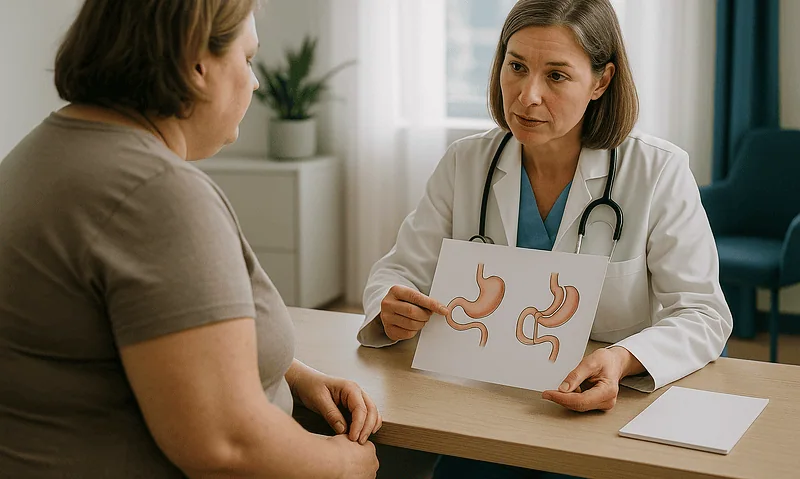
The consultation ends, and the surgeon sketches something on the back of a leaflet: a banana-shaped stomach, a single loop of bowel curling up to meet it. You nod along. On the drive home you realize you understood the drawing but not the operation. What actually happens once you are asleep on the table?
That gap between the sketch and the procedure is where most of the anxiety lives, and it is also where the mini gastric bypass is most often misunderstood. The word “mini” suggests something modest. In practice, this is a full metabolic operation that reshapes the stomach and reroutes food past a length of intestine, done with stapling instruments passed through incisions each smaller than a fingertip.
This explainer walks through how mini gastric bypass is done, stage by stage, in the order a surgical team would perform it. It also covers what the reroute changes in the body, who is usually offered it, what the trade-offs are, and which questions are worth bringing to your next appointment.
What a mini gastric bypass actually is, and why the name confuses people
The mini gastric bypass has three names in common use, and none of them is perfect. Surgeons usually say one-anastomosis gastric bypass, shortened to OAGB. An anastomosis is simply a surgical join between two hollow structures, in this case the stomach pouch and the small intestine. Some teams call it an omega-loop bypass because the lifted loop of bowel resembles the Greek letter Ω on the operating room screen. Patients tend to say “mini,” a label that describes the number of joins rather than the size of the change.
The comparison point is the standard operation described by MedlinePlus and the Mayo Clinic: the Roux-en-Y gastric bypass. That procedure creates a small stomach pouch, divides the small intestine, and makes two connections, one to bring food down and one to bring digestive juices back in. The mini version keeps the bypass principle but changes two things. The pouch is longer and shaped like a narrow tube rather than an egg. And the small intestine is not divided; it is lifted as an intact loop and stitched once to the bottom of that pouch.
Fewer joins means fewer staple lines that can leak, which is part of the appeal. It also means bile and pancreatic juices flow through the same channel as food, right past the new connection. That single design choice explains most of the operation’s advantages and most of its specific risks, and it is the thread running through everything that follows.
None of the national health bodies cited here ranks one bypass above another. Guidance from the NHS and the NIDDK treats the choice of procedure as a joint decision between a person and a specialist team, based on health, anatomy and preference.
How mini gastric bypass is done: building the pouch, step by step
Once you are under general anesthesia, the team inflates the abdomen with carbon dioxide gas to create working space, a technique called laparoscopy, meaning surgery performed through a camera and slim instruments inserted through small ports. The surgeon then turns to the stomach.

Picture the stomach as a curved sac. Its inner, shorter edge is the lesser curvature; its outer, longer edge is the greater curvature. The pouch in a mini gastric bypass is built along the lesser curvature, the side nearest the liver.
The first staple line runs horizontally, starting on the lesser curve well below the junction between the esophagus and stomach. A surgical stapler cuts and seals tissue in one motion, laying rows of tiny titanium staples on both sides of the cut. This horizontal firing creates the floor of the future pouch and leaves the lower stomach, with its acid-producing lining, behind.
Next, a calibration tube is passed down through the mouth into the stomach so the surgeon has a guide to staple against. Using it as a template, the surgeon fires the stapler vertically, upward toward the angle of His, the notch where the esophagus meets the stomach. Several firings are usually needed. The result is a long, slim gastric tube that holds a fraction of what the original stomach held.
The rest of the stomach is not removed. It stays in place, still connected to the duodenum and still producing digestive secretions, but food no longer enters it. That excluded stomach is a key difference from a sleeve gastrectomy, where the outer stomach is taken out of the body entirely, as the NIDDK describes.
Why a long pouch rather than the small one used in a Roux-en-Y? The length keeps the new intestinal join low, away from the esophagus, which surgeons regard as a way to reduce the chance of bile washing upward.
The loop: what "one anastomosis gastric bypass" means in the operating room
With the pouch complete, attention moves to the small intestine. The surgeon identifies a landmark called the ligament of Treitz, the point where the duodenum ends and the jejunum, the second part of the small intestine, begins. From there, the bowel is run through the instruments hand over hand, and the surgeon measures out a length to bypass.
That length is a deliberate choice. A longer bypassed segment means fewer calories and nutrients are absorbed, which can mean more weight loss but also a higher risk of deficiency. Different surgical teams use different lengths, sometimes adjusting for a person’s starting weight or their body’s total intestinal length. Your surgeon should be able to tell you what they plan and why.
At the chosen point, the intestine is lifted up as an intact loop. Nothing is cut. The surgeon brings the loop to the lowest part of the new stomach pouch and creates a single side-to-side connection, usually with a stapler and then reinforcing stitches. This is the one anastomosis. Food will now leave the pouch through it, and the segment of intestine leading up to it, the biliopancreatic limb, will carry bile and pancreatic enzymes down from the excluded stomach and duodenum to meet the food just past the join.
Many surgeons add a few stitches to anchor the incoming limb to the pouch, a step intended to steer digestive juices downstream rather than upward. Some also close potential gaps behind the loop to reduce the risk of bowel twisting later.
Compare this with the Roux-en-Y, where the intestine is divided and two joins are made, and the difference in complexity becomes clear. The trade-off, discussed later, is that a shared channel carries bile close to the stomach lining.
The laparoscopic steps in the order they happen
People often want the sequence written out plainly, so here it is. Exact details vary by team, and your surgeon may do things in a slightly different order.

- Positioning and anesthesia. You are put fully to sleep, and a breathing tube is placed. The anesthesia team monitors heart, lungs and blood pressure throughout.
- Access. A few small incisions are made across the upper abdomen. Hollow ports go through them, and carbon dioxide gas expands the abdominal cavity.
- Inspection. The camera surveys the liver, stomach and bowel to confirm the plan is feasible.
- Pouch creation. Horizontal then vertical staple firings shape the lesser-curve tube described above.
- Bowel measurement. The small intestine is measured from the ligament of Treitz to the chosen point.
- The anastomosis. The loop is brought up and joined to the pouch with a single connection.
- Leak check. Many teams test the join with dye or air under saline, watching for bubbles.
- Closure. Gas is released, ports are removed, and the skin incisions are closed with dissolvable stitches or glue.
The NHS notes that most weight-loss operations are performed this way, through keyhole incisions, and that open surgery with a single larger cut is uncommon but occasionally necessary, for example when scar tissue from previous operations gets in the way. Your consent form will usually mention that possibility.
A point worth appreciating: every one of these steps is watched on a high-definition screen by the whole team, and the surgeon’s hands never enter the abdomen. That is what allows a major reroute of the digestive tract to leave marks small enough to be hidden by a waistband.
How the operation changes hunger, fullness and what your body absorbs
Two mechanisms are easy to describe and were the original rationale for bypass surgery. The pouch holds far less, so a modest meal produces fullness. And because food skips part of the small intestine, fewer calories and nutrients are taken up along the way. The NIDDK describes gastric bypass as working through both restriction and malabsorption.
The more interesting story is hormonal. The stomach and intestine are not passive plumbing; they are endocrine organs. Ghrelin, a hormone made largely in the upper stomach that drives appetite, is affected when much of the stomach is excluded from the path of food. Meanwhile, food arriving quickly in the lower small intestine stimulates release of gut hormones such as GLP-1 and PYY, which signal fullness to the brain and improve how the pancreas responds to sugar. This is why blood glucose often changes within days of surgery, before meaningful weight has been lost, a pattern the Mayo Clinic and other bodies describe for bypass procedures generally.
The mini gastric bypass delivers food to the small intestine even faster than a Roux-en-Y, because there is no divided limb to slow the path and the bypassed segment is often longer. That is thought to intensify the hormonal effect. It is also why a phenomenon called dumping, when sugary or fatty food rushes into the bowel and triggers cramping, sweating and faintness, can occur after this operation.
Absorption changes are lifelong. Iron is mostly taken up in the duodenum, which is now bypassed. Vitamin B12 needs a stomach factor that the small pouch makes less of. Calcium and vitamin D uptake fall too. MedlinePlus is explicit that supplementation after bypass is permanent, not optional. What matters most, in our reading of the evidence, is that people understand this before surgery rather than discovering it at a follow-up blood test.
How long does a mini gastric bypass take, from arrival to waking up?
The honest answer separates the operation itself from the day around it. For standard gastric bypass, MedlinePlus gives a typical operating time of about 2 to 4 hours. The one-anastomosis version involves one join rather than two, so many surgeons describe it as somewhat quicker, though no fixed figure can be promised. Body shape, previous abdominal surgery and the size of the liver all affect the pace.
Your day is longer than the surgery. Expect to arrive early for checks, then a period in the anesthetic room, then the operation, then one to two hours in recovery while the anesthesia wears off and pain is brought under control. Family members waiting outside often hear nothing for five or six hours and worry unnecessarily; asking the team in advance how and when they will be updated removes that stress.
Before the day, most programs require a period of preparation. The NHS describes assessment by a multidisciplinary team, which typically includes a surgeon, an anesthetist, a dietitian and a psychologist, along with blood tests and sometimes a heart or lung check. Many teams ask for a short liquid or low-carbohydrate diet in the days beforehand to shrink the liver, which sits over the stomach and has to be lifted out of the way. That step is about surgical access and safety, not a head start on weight loss.
Hospital stay after bypass is usually short. NHS guidance describes going home within a few days, once you are drinking comfortably, walking, and your pain is managed with oral medicine. Mobilizing early, sometimes the same evening, is standard because it lowers the risk of blood clots.
Mini gastric bypass vs gastric bypass vs sleeve: the differences that matter
Most people weighing this operation are choosing between three procedures. The table compares them on the features that come up most in clinic, drawing on descriptions from the NIDDK and the NHS.
| Feature | Mini (one-anastomosis) bypass | Roux-en-Y bypass | Sleeve gastrectomy |
|---|---|---|---|
| Stomach change | Long, narrow pouch; rest of stomach stays in body | Small pouch; rest of stomach stays in body | Most of stomach removed permanently |
| Intestinal joins | One | Two | None |
| Intestine divided? | No, lifted as a loop | Yes | No |
| Malabsorption | Yes, often more than Roux-en-Y | Yes | Minimal |
| Bile exposure to pouch | Possible by design | Largely diverted | Not applicable |
| Reversible? | Technically possible | Technically possible | No |
| Lifelong supplements | Yes | Yes | Yes, usually fewer |
Two rows deserve a second look. “Bile exposure” is the mini bypass’s signature trade-off: the same simplicity that reduces staple lines allows bile to reach the pouch. And “malabsorption” cuts both ways: the feature that helps weight loss is the feature that demands disciplined supplementation.
The sleeve is the simplest anatomically but carries its own well-documented issue, acid reflux, and cannot be undone. The Roux-en-Y has the longest track record and is the operation most national health sources describe in detail. No comparison here favors one for everybody. People with severe existing reflux, for example, may be steered away from both the sleeve and the mini bypass, while someone with prior bowel surgery might be advised against a longer bypass. These are exactly the conversations your team is there to have.
Who is usually offered a mini gastric bypass, and who is usually asked to wait
Eligibility for any weight-loss operation follows broadly similar criteria across national guidance. The NHS describes surgery being considered for adults with a body mass index of 40 or more, or 35 to 40 with a condition that would improve with weight loss, such as type 2 diabetes or high blood pressure, after other approaches have been tried. The NIDDK notes that thresholds can be lower in some circumstances, including for people of Asian ancestry, in whom health risks rise at lower BMI. Body mass index, for anyone unfamiliar, is weight in kilograms divided by height in meters squared.
Within that pool, a mini bypass is more often discussed when someone has a high starting weight or type 2 diabetes, because of the operation’s strong metabolic effect, or when a surgeon judges the single join to be the safer option for a particular anatomy. It is also sometimes offered as a conversion for people whose earlier sleeve gastrectomy has not held.
Who is typically asked to wait, or offered something else? Several groups:
- People with significant gastroesophageal reflux or Barrett’s esophagus, because bile exposure to the pouch is a concern.
- Those with untreated severe mental health conditions or active substance dependence, where national guidance emphasizes stability before surgery.
- Anyone unable to commit to lifelong follow-up and supplementation, since malabsorption makes that non-negotiable.
- People planning pregnancy in the near future; most teams advise waiting until weight has stabilized.
- Individuals with certain intestinal conditions, such as Crohn’s disease, where rerouting bowel carries added risk.
“Wait” is not a rejection. It often means addressing a specific issue first, then reassessing. The NHS also stresses that you must be fit enough for a general anesthetic, which is assessed individually. The decision rests with the multidisciplinary team, and a good team will explain their reasoning rather than simply deliver a verdict.
What are the downsides of a mini gastric bypass? Side effects and risks in plain terms
Every operation has a risk profile, and the mini gastric bypass has one shaped by its anatomy. The general risks of weight-loss surgery listed by the NHS and MedlinePlus apply: bleeding, infection, blood clots in the legs or lungs, reaction to anesthesia, and leakage from a staple line or join. Leaks are the complication surgical teams watch for most closely in the first days.
Then there are risks specific to this design.
Bile reflux. Because bile and pancreatic juice arrive at the join alongside food, some can travel upward into the pouch and, rarely, the esophagus. Most people never notice it. A minority develop persistent burning or bitter regurgitation that does not respond to the acid-reducing medicines used for ordinary heartburn, because the problem is bile, not acid. Persistent cases sometimes require conversion to a Roux-en-Y.
Marginal ulcer. An ulcer at the new join, where intestinal lining meets stomach secretions. Smoking and anti-inflammatory painkillers raise this risk considerably, which is why teams ask people to stop both.
Nutritional deficiency. The longer the bypassed intestine, the greater the malabsorption. Iron deficiency anemia, low B12, low vitamin D, and in a small number of cases protein malnutrition can occur, particularly if follow-up lapses. The NIDDK describes these consequences for bypass procedures broadly.
Dumping syndrome. Cramping, nausea, sweating and lightheadedness after sugary or high-fat meals, usually manageable by changing what and how you eat.
Internal hernia and bowel obstruction. Less common than after Roux-en-Y because the intestine is not divided, but not impossible.
What we think matters most: none of these are reasons to dismiss the operation, and none should be minimized. The people who do well are the ones who knew about bile reflux and iron before surgery, not after.
How much weight do you lose with a mini gastric bypass? What the evidence actually shows
This is the question everyone asks and the one where honest answers are least satisfying, because individual results spread widely.
National health sources tend to speak about bariatric surgery as a group. The NIDDK describes people typically losing a substantial fraction of their starting body weight in the first one to two years after gastric bypass, with the greatest loss in the first year and some regain being common afterward. The NHS similarly frames surgery as a tool that produces significant weight loss when combined with lasting changes in diet and activity.
Studies of the one-anastomosis technique in the surgical literature generally report weight loss at least comparable to Roux-en-Y, and in some series slightly greater, which is consistent with its longer bypassed segment. Those studies vary in quality, follow-up length and how they define outcomes, so a single headline number would misrepresent them. Ask your surgeon what their own program’s audited results look like and how long people were followed.
Three things shape where an individual lands:
- Starting weight. Heavier starting points usually mean more kilograms lost, though not always a larger percentage.
- Bypass length. Longer segments tend to mean more weight loss and more deficiency risk.
- Behavior after surgery. The operation changes capacity and hormones; it does not change habits on its own. Grazing on soft, calorie-dense food can defeat any pouch.
Weight is also only part of the picture. For many people, the reason a team recommends bypass over a sleeve is diabetes control, blood pressure or sleep apnea, changes that Mayo Clinic describes for bypass procedures. Those improvements are genuinely valuable and are never guaranteed for any individual.
Mini gastric bypass recovery time: what the first days and weeks usually look like
Recovery has a fairly predictable shape, even though individual timelines differ.
The first day. You wake with a sore abdomen, sometimes shoulder-tip pain from the gas used during laparoscopy, and a dry mouth. Nurses encourage sips of water within hours and a walk around the ward the same day. Compression stockings and a blood-thinning injection are standard for clot prevention, as NHS guidance describes.
Going home. Most people leave within a few days, once fluids are going down comfortably and pain is controlled by tablets. You will go home with a fluid plan, a supplement plan and clear instructions about warning signs.
Weeks one and two. Liquids only, then puréed food. Fatigue is common and expected; you are consuming very few calories while your body heals. Many people are surprised to find that hunger largely disappears, an effect of the hormonal changes described earlier. Gentle walking every day is encouraged; lifting and vigorous exercise wait until the team clears you.
Weeks three to six. Soft foods, then a gradual return to textured food, one new item at a time. Learning to eat slowly, chew thoroughly and stop at the first sign of fullness takes practice. Eating too fast or too much causes discomfort or vomiting, which is the pouch’s way of teaching you its limits.
Back to normal life. Return to desk work is often possible within a couple of weeks; physically demanding jobs take longer. Driving resumes once you can brake sharply without pain and are off strong painkillers. The NHS describes recovery in these general terms, and your own team’s advice takes priority over any general guide.
Follow-up visits cluster in the first year, with blood tests to check iron, B12, vitamin D, folate and protein levels.
Eating, vitamins and follow-up for the rest of your life
The operation lasts a few hours. Living with it lasts decades, and the long-term routine is where outcomes are really decided.
How eating changes. Meals become small, protein-first and unhurried. Most teams advise separating drinking from eating by around half an hour so liquid does not flush food through the pouch or fill it before protein does. Sugary drinks and very fatty food are the commonest triggers of dumping. Alcohol is absorbed faster and hits harder after bypass; MedlinePlus and the NHS both flag this.
Supplements, permanently. A daily multivitamin and mineral supplement, along with additional iron, calcium, vitamin D and vitamin B12, is standard after any bypass. Which form and how it is taken is decided by your dietitian and doctor based on blood results. The point to absorb now is that this is not a temporary measure while you heal. It reflects a permanent change in where nutrients are absorbed.
Blood tests. Expect regular checks for the first two years and then at least annually for life. Low iron and low B12 often creep up silently; fatigue, breathlessness or tingling in the hands and feet are late signs, not early ones.
Medicines. Absorption of some medicines changes, and anti-inflammatory painkillers raise ulcer risk at the join. Tell every prescriber, dentist and pharmacist that you have had a gastric bypass. Never adjust an existing prescription yourself; ask the prescribing clinician to review it.
Pregnancy. Most teams recommend waiting until weight is stable, then close nutritional monitoring throughout, because a developing baby draws on the same nutrients that bypass makes harder to absorb.
The NIDDK frames all of this as part of the surgery rather than an afterthought, and that is the right way to see it.
What people often get wrong about the mini gastric bypass
Some misconceptions come up so often they deserve direct correction.
“Mini means minor.” It does not. The stomach is stapled, food is rerouted, and absorption changes permanently. The word refers to a single intestinal join, not to a smaller operation or a smaller effect.
“Part of my stomach is removed.” Not in this procedure. The excluded stomach stays in the body, still connected downstream. Removal is what happens in a sleeve gastrectomy, as the NIDDK describes. The distinction matters because an excluded stomach cannot be examined by a standard camera passed through the mouth, which is one reason teams take existing stomach symptoms seriously before choosing this operation.
“It is fully reversible, so there is nothing to lose.” Reversal or conversion is technically possible because nothing is removed, but it is another major operation with its own risks. Think of reversibility as a safety valve, not a plan.
“Heartburn tablets will fix any reflux.” Ordinary heartburn is acid; the reflux specific to this operation is bile, which acid-reducing medicines do not address. That is why persistent symptoms need review rather than more of the same tablet.
“Weight loss is automatic.” The pouch limits volume and the hormones dampen hunger, but liquid calories and constant grazing bypass both. The NHS is clear that lasting results depend on lasting changes in eating and activity.
“Vitamins are only for the first year.” They are for life. Deficiencies that surface five or ten years later are usually the result of supplements quietly stopping.
“Is a mini gastric bypass worth it?” This is a genuinely personal calculation, and anyone who answers it for you in a sentence is selling something. Worth depends on your health conditions, your tolerance for lifelong follow-up, and the alternatives available to you, all weighed with a team that knows your history.
Questions to ask your care team before you decide
A good consultation is a conversation, and the best conversations start with specific questions. These are ones that experienced bariatric teams expect and welcome.
- Why are you recommending a one-anastomosis bypass for me rather than a Roux-en-Y or a sleeve? What about my history points that way?
- How long a segment of intestine do you plan to bypass, and how did you choose that length for my body?
- How do you assess for reflux before surgery, and what would make you change the plan?
- What are your program’s own rates of leak, ulcer, bile reflux and reoperation, and over how many years have you tracked them?
- Who will follow me up, how often, and for how long? What happens if I move or change doctors?
- Which blood tests will I need, at what intervals, and who acts on the results?
- What is the plan if I develop bile reflux that does not settle?
- How will my current medicines be reviewed after surgery, and who is responsible for that?
- What do you need from me in the weeks before the operation, and why?
- If I am considering pregnancy in the future, how does that change the timing or the choice of procedure?
- What would make you advise me to wait or to choose a different operation entirely?
- Who do I call, day or night, in the first weeks if something feels wrong?
Write the answers down or bring someone who will. The NHS describes weight-loss surgery as a decision made with a multidisciplinary team, and the quality of that team’s answers, particularly to the questions about their own outcomes and follow-up, tells you a great deal. Hesitation to share audited results, or a follow-up plan that ends after a year, are reasonable grounds for a second opinion.
When to call your doctor: red-flag signs after a mini gastric bypass
Most recovery discomfort is expected and settles. A short list of symptoms is not, and speed matters, especially in the first two weeks when a leak or clot is most likely. The NHS and MedlinePlus describe the complications behind these signs.
Seek emergency care immediately for:
- A fast heart rate that will not settle, particularly with fever, worsening abdominal pain or a general feeling of being very unwell. A racing pulse is often the earliest sign of a leak.
- Severe or rapidly worsening abdominal pain, or pain spreading to the shoulder that is getting worse rather than better.
- Chest pain, sudden breathlessness, or coughing up blood, which can signal a clot in the lungs.
- A swollen, hot or painful calf, which can indicate a clot in the leg.
- Vomiting blood or passing black, tarry stools, possible signs of bleeding from the staple line or an ulcer at the join.
- Inability to keep any fluids down for more than a day, which can lead to dangerous dehydration quickly after bypass.
Contact your surgical team promptly, within the day, for:
- Fever, redness, warmth or discharge at an incision.
- Persistent vomiting after eating, or food repeatedly sticking, which can indicate narrowing at the join.
- Burning pain behind the breastbone or bitter fluid coming up, especially if it does not improve with the measures your team advised.
- Dizziness on standing, dark urine, or passing very little urine.
- New numbness or tingling in the hands or feet, or unusual fatigue and breathlessness months after surgery, which can point to vitamin or iron deficiency.
You will be given a direct contact number before discharge. Use it. Bariatric teams would far rather hear about a symptom that turns out to be nothing than miss one that mattered. If you cannot reach them and any of the emergency signs above are present, call emergency services and tell the responders you have recently had a gastric bypass.
Frequently asked questions
How long does a mini gastric bypass take?
The operation itself usually takes a few hours. MedlinePlus lists about 2 to 4 hours for standard gastric bypass, and the one-anastomosis version is often somewhat shorter because it involves a single join, though no fixed time can be promised. Add time for anesthesia and recovery, and family members typically wait several hours in total. Previous abdominal surgery and liver size can lengthen the procedure.
What are the downsides of a mini gastric bypass procedure?
The main specific downsides are bile reflux into the stomach pouch, ulcers at the new join, and nutritional deficiencies from bypassing a long stretch of intestine. General surgical risks such as bleeding, infection, clots and leaks also apply, as the NHS describes. Dumping syndrome after sugary meals is common early on. Most are manageable with follow-up, but persistent bile reflux sometimes requires conversion to a different bypass.
How much weight do you lose with a mini gastric bypass?
Results vary widely between individuals, so no single figure applies to everyone. The NIDDK describes gastric bypass producing substantial loss of starting body weight over the first one to two years, with some regain being common afterward. Surgical studies generally report the one-anastomosis technique performing at least comparably to Roux-en-Y. Starting weight, bypass length and eating habits after surgery all shape where a person lands.
Is a mini gastric bypass worth it?
That depends on your health, your alternatives and your willingness to commit to lifelong supplements and follow-up, so it can only be answered with your care team. Bypass procedures are associated with improvements in type 2 diabetes and other weight-related conditions, according to Mayo Clinic, but these are never guaranteed for an individual. Weigh the specific risks, especially bile reflux, against your particular circumstances.
What is the difference between a one anastomosis gastric bypass and a mini gastric bypass?
They are the same operation under different names. One-anastomosis gastric bypass, or OAGB, is the term surgeons use because it describes the single join between stomach pouch and intestine. Mini gastric bypass is the older, more informal name. Some teams also say omega-loop bypass, after the shape the lifted loop of intestine makes. All three refer to a long stomach pouch joined once to an undivided loop of small intestine.
Mini gastric bypass vs gastric bypass: which is safer?
Neither is universally safer; they carry different risk profiles. The mini bypass has fewer staple lines and joins, which may reduce leak and internal hernia risk, but exposes the pouch to bile and usually bypasses more intestine, raising deficiency risk. The Roux-en-Y has a longer track record and diverts bile away from the pouch. National sources such as the NIDDK describe both as options to be chosen with a specialist team.
Is part of the stomach removed in a mini gastric bypass?
No. The stomach is stapled to create a long, narrow pouch, but the larger excluded portion remains inside the body, still connected to the duodenum and still producing digestive juices. Food simply no longer passes through it. Removal of stomach tissue is what happens in a sleeve gastrectomy, as the NIDDK explains. Because the excluded stomach cannot be examined by a standard endoscope, teams assess stomach symptoms carefully beforehand.
What are the most common mini gastric bypass side effects in the first weeks?
Fatigue, reduced appetite, mild nausea and discomfort if you eat too fast or too much are the usual early experiences. Shoulder-tip pain from laparoscopic gas is common and fades within days. Dumping symptoms after sugary or fatty food, such as cramping, sweating and lightheadedness, can occur and usually settle with dietary adjustment. The NHS describes this early recovery period in general terms; your team’s guidance takes priority.
What is the typical mini gastric bypass recovery time before returning to work?
Many people return to desk-based work within a couple of weeks, while physically demanding jobs usually take longer, in line with general NHS guidance on weight-loss surgery recovery. Hospital stay is typically a few days. Diet progresses from liquids to purées to soft food over roughly six weeks. Individual timelines vary, and your surgical team will advise when driving, lifting and exercise can resume.
Can a mini gastric bypass be reversed?
It is technically possible because no organ is removed, and it can also be converted to a Roux-en-Y, which is sometimes done for persistent bile reflux. However, reversal or conversion is a major operation with its own risks and is not a routine step. Reversibility is best viewed as a safety option rather than a reason to proceed lightly. Any such decision sits with the treating surgical team.
References
- MedlinePlus – Gastric bypass surgery
- NHS – Weight loss surgery: Types
- NHS – Weight loss surgery: Risks
- NIH NIDDK – Types of bariatric surgery
This article is for general information only and is not a substitute for professional medical advice. Please consult a qualified doctor about your individual situation.

More from the Blog

What Does Gradual Weight Reduction With a Gastric Band Realistically Look Like Over Time?
With an adjustable gastric band, weight comes off slowly over about two years rather than in months, and long-term studies with 10 to 15…

When Lifestyle Measures Are Not Enough: How Doctors Decide a Gastric Sleeve Is the Next Step
A gastric sleeve is usually recommended when someone has a body mass index of 40 or more, or 35 or more with a weight-related…

Preparing for Robotic Bariatric Surgery: Sleep Study, Endoscopy and the Dietitian Visit
Preparing for robotic bariatric surgery usually involves three core steps: a sleep study to check for obstructive sleep apnea so anesthesia can be planned…

Long-Term Obesity Management: How Follow-Up Visits Keep Lifestyle Changes on Track
Long term obesity management works best as ongoing care rather than a single push. Regular follow-up visits let a care team track weight, waist…

Gastric Bypass vs Gastric Sleeve: Why Reflux, Diabetes and Eating Habits Shape the Choice
For people with established acid reflux, gastric bypass is usually favored over a gastric sleeve, because the small pouch produces little acid and the…
Mini Gastric Bypass vs Standard Gastric Bypass: One Connection or Two, and Why It Matters
A mini gastric bypass (one anastomosis gastric bypass) joins a long, narrow stomach pouch to the small intestine with a single connection, while a…