

How Is Shingles Pain Managed? Skin Care, Prescribed Relief and When Nerve Pain Lingers
Key Takeaways
- Antiviral treatment is most effective when started within 72 hours of the shingles rash appearing, according to the CDC, which is why an early phone call matters more than any home remedy.
- About 1 in 3 people in the United States develop shingles in their lifetime, and roughly 10 to 18 percent of them go on to have postherpetic neuralgia, with risk rising steeply after age 50.
- Shingles pain is neurological, not skin-deep: the nerve is inflamed and later sometimes damaged, which is why lingering pain responds to nerve medicines rather than ordinary painkillers.
- The rash typically heals within two to four weeks, and pain that keeps improving on that timeline is reassuring; pain persisting beyond 90 days is defined as postherpetic neuralgia.
- You cannot catch shingles from someone else, but blister fluid can give chickenpox to a person who has never had it, so cover the rash until every blister has crusted over.
- Having had shingles does not protect against a repeat episode, and the CDC recommends the recombinant zoster vaccine for adults 50 and older and for immunocompromised adults 19 and older once the acute illness has resolved.
Shingles pain management usually combines three things: an antiviral medicine started as early as possible, ideally within 72 hours of the rash, to shorten the illness; gentle skin care with cool compresses, loose clothing and a calming lotion; and pain relief matched to severity, from simple analgesics to nerve-targeted prescription options. If pain lasts beyond three months, it is treated as postherpetic neuralgia with its own plan.
It usually starts as a puzzle. A woman in her sixties feels a burning stripe along one side of her ribs and blames a pulled muscle from lifting a grandchild. Two days later a band of small blisters appears exactly where the burning was, and the muscle theory collapses. Her clothing hurts. The bedsheet hurts. She wants to know what to do, and she wants to know now.
That urgency is well placed, because shingles pain management is one of the few areas of medicine where the clock genuinely matters. The first three days after the rash appears shape how the next few weeks go, and to some extent how the next few months go.
This explainer walks through what the pain actually is, why treatment moves in stages, what skin care helps and what to skip, and what happens when the rash heals but the nerve refuses to quiet down. Every decision belongs to you and your treating team; the goal here is to make that conversation easier.
What does shingles pain management involve?
Shingles is a reactivation of the varicella-zoster virus, the same virus that causes chickenpox, which stays dormant in nerve roots after the childhood illness and can wake up decades later. According to the CDC, about 1 in 3 people in the United States will develop shingles during their lifetime. The rash gets the attention, but the pain is the problem most people actually come in about, and it is the pain that shingles pain management is built around.
Treatment runs on three tracks at once. The first is antiviral therapy, which shortens the period the virus is actively damaging the nerve. The second is skin care, which keeps the rash clean, cool and less likely to become infected. The third is pain relief, which is chosen according to how severe the pain is and how the person is coping, not according to a fixed recipe.
A fourth track opens for some people later. When pain continues after the skin has healed, typically defined as lasting 90 days or more from rash onset, clinicians call it postherpetic neuralgia, meaning nerve pain that follows shingles. It has its own set of treatments, described later in this article.
What makes shingles different from most rashes is that the pain is neurological, not dermatological. The skin hurts because an inflamed nerve is misfiring, which is why a lotion alone rarely settles it and why the medicines used for lingering pain are nerve medicines rather than painkillers in the usual sense. Understanding that single point makes almost every other decision in shingles care easier to follow.
How does shingles pain work? What is actually happening in the nerve
Think of a sensory nerve as a cable running from the skin to the spinal cord, with a junction box near the spine called a ganglion. After chickenpox, the virus retreats into these ganglia and sits quietly, often for 40 or 50 years. When immunity dips, whether from age, illness or medicines that suppress the immune system, the virus can reactivate, multiply inside the ganglion and travel down the nerve fibers to the skin they serve.

That journey is why the rash appears in a stripe. Each spinal nerve supplies a defined band of skin called a dermatome, and shingles almost always stays within one dermatome on one side of the body. The Mayo Clinic notes that pain is usually the first symptom and can appear days before any rash, which is why early shingles is so often mistaken for a heart, kidney or muscle problem depending on where the nerve runs.
The pain itself has two sources. During the acute phase, active viral replication and inflammation irritate the nerve directly, producing burning, stabbing or electric sensations. The second source is damage. An inflamed nerve can be left scarred and hypersensitive after the virus is cleared, and it may keep sending pain signals to a skin patch that looks completely normal. Cleveland Clinic describes this as the nerve misfiring, sending exaggerated messages of pain in response to light touch or to nothing at all.
This explains the two-part logic of treatment. Antivirals target the first source by shortening replication. Nerve pain medicines target the second, calming an overactive signaling system. Neither substitutes for the other, and starting the first early is the best-studied way to reduce the need for the second.
What is the best pain treatment for shingles? Why the first 72 hours matter
People searching for the single best pain treatment for shingles usually expect the answer to be a painkiller. The evidence points somewhere less obvious: the most important early step is an antiviral medicine. The CDC advises that antivirals such as acyclovir, valacyclovir and famciclovir are most effective when started as soon as possible after the rash appears, and clinical guidance generally sets 72 hours as the window in which benefit is clearest.
Antivirals do not numb anything. They work by blocking the virus from copying itself inside nerve cells, which shortens the period of active nerve injury. The Mayo Clinic notes that prompt antiviral treatment can shorten the illness and reduce its severity, and it may reduce the chance of long-lasting pain, though it cannot eliminate that risk.
Whether treatment is worthwhile after 72 hours is a clinical judgment. Many clinicians will still prescribe when new blisters are still forming, when the rash involves the face or eye, or when the person has a weakened immune system, because ongoing viral activity means there is still something to block. Anyone in those groups should not assume they have missed the window.
Pain medicine sits alongside the antiviral, not instead of it. For mild to moderate pain, clinicians commonly suggest simple over-the-counter analgesics such as acetaminophen or an NSAID, according to the CDC and Mayo Clinic. For severe acute pain, prescribers may add nerve-targeted options earlier, discussed in a later section. What matters most is the sequence: rash recognized, clinician contacted quickly, antiviral considered, then pain relief layered to fit. Delay is the most common and most avoidable error in the whole pathway.
Skin care for the shingles rash: what genuinely helps
The rash moves through predictable stages: red patches, then fluid-filled blisters, then crusting, then fading. Skin care aims to keep it clean, to reduce the maddening itch and burn, and to prevent bacterial infection getting into broken blisters. The CDC and NHS agree on a short list of measures that are safe for almost everyone.
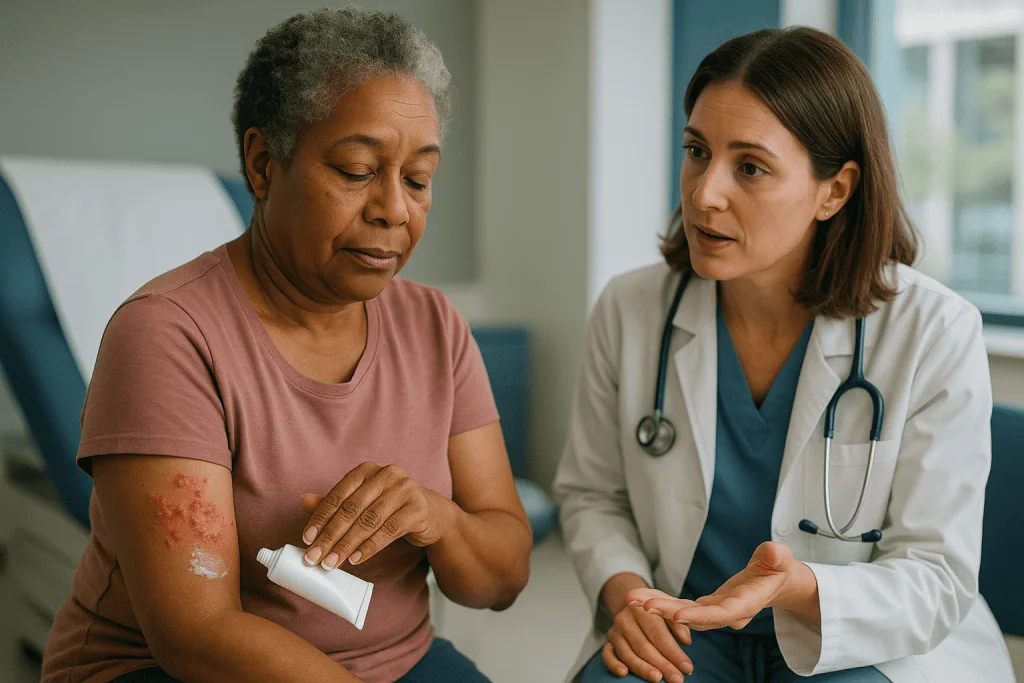
- Cool, wet compresses applied for short periods reduce burning and can soften crusts. Use a clean cloth each time and do not share towels.
- Calamine lotion or a colloidal oatmeal bath, both listed by the CDC, can ease itching once blisters are present. Avoid heavy ointments that trap heat over open blisters.
- Loose, soft, natural-fiber clothing matters more than people expect. Allodynia, meaning pain from a touch that should not hurt, is common in shingles, and friction from a waistband or bra strap can be worse than the rash itself.
- Keep the rash covered with a non-stick dressing when you are around others. The NHS notes that fluid from the blisters can pass the virus to someone who has never had chickenpox or the vaccine, giving them chickenpox rather than shingles.
- Wash hands after any contact with the rash and avoid picking at crusts, which increases scarring and infection risk.
Some measures are best avoided. Antibiotic creams are not routinely needed and can irritate. Scented lotions, alcohol-based products and adhesive tape placed directly on blistered skin tend to sting and can strip fragile skin. Heat, whether from a hot bath or a heating pad, often intensifies nerve pain even though it feels soothing at first.
None of this treats the virus. It does make the two to four weeks of rash more tolerable, and it removes infection as a complication that would otherwise extend recovery.
Prescribed relief for shingles pain: what each medicine class does
Beyond antivirals and simple analgesics, prescribers draw on several classes of medicine for shingles pain, chosen according to severity, age, other conditions and how the person is sleeping and functioning. The purpose here is to explain what each class does, not to suggest any particular one. Choice, dose and duration belong entirely to the prescribing clinician.
Gabapentinoids such as gabapentin and pregabalin were developed for epilepsy but are widely used for nerve pain. They dampen the excitability of overactive nerves. The Mayo Clinic lists them among the standard options for postherpetic neuralgia, and some clinicians use them during the acute phase when pain is severe. Drowsiness and dizziness are the most common side effects, which matters for older adults at risk of falls.
Tricyclic antidepressants, including amitriptyline and nortriptyline, work on the chemical messengers that carry pain signals, an effect separate from their mood action. They are used for nerve pain at doses different from those used for depression, and prescribers weigh side effects such as dry mouth, constipation and, in older people, effects on heart rhythm and thinking.
Topical agents include lidocaine, a local anesthetic that numbs the skin surface, and capsaicin, derived from chili peppers, which reduces a pain-signaling chemical in nerve endings over repeated use. Both are listed by the Mayo Clinic for postherpetic neuralgia and are applied only to healed skin, never to open blisters.
Opioids are sometimes used briefly for severe acute pain that has not responded to other measures. Guidance from the Mayo Clinic and NHS frames them as a short-term option with clear risks of sedation, constipation and dependence, not a foundation of care.
Corticosteroids were once added routinely. Current evidence, summarized by the Mayo Clinic, does not show they prevent lingering pain, so their use is now selective.
Who is treated more intensively, and who is usually asked to wait and watch
Not everyone with shingles gets the same intensity of care, and that variation is deliberate rather than neglectful. Clinicians sort people by risk of complications, and the sorting determines how urgently antivirals are started and how much pain support is arranged.
Groups usually treated promptly and closely include:
- Adults over 50, because the CDC notes that both shingles severity and the risk of postherpetic neuralgia rise sharply with age.
- Anyone with a weakened immune system, whether from cancer treatment, organ transplant medicines, HIV or long-term steroid use. The CDC reports a higher risk of widespread rash and complications in this group.
- People whose rash involves the forehead, eyelid or nose tip, because the eye may be affected. Herpes zoster ophthalmicus, meaning shingles of the nerve that serves the eye, can threaten sight and requires same-day assessment.
- Those with rash near the ear or with facial weakness, hearing change or dizziness, which can signal involvement of the facial nerve.
- Anyone with severe pain, a rash crossing the midline, or blisters appearing in more than one area, all of which suggest a more aggressive course.
A healthy adult under 40 with a small, single-dermatome rash and mild pain sits at the other end. Clinicians may still offer antivirals, especially inside the 72-hour window, but the conversation is more about comfort and monitoring. The CDC notes that postherpetic neuralgia is uncommon in people under 40, so the case for intensive prevention is weaker.
Being asked to wait does not mean being dismissed. It means the person should watch for change, new blisters, spreading pain, fever or any eye symptoms, and return promptly if they appear. Risk categories are a starting point; the treating team adjusts as the illness reveals itself.
How long does shingles pain last? What the next days and weeks usually look like
A rough map of the typical course helps people judge whether they are on track. The ranges below are drawn from NHS and CDC descriptions and are typical, not guaranteed; individual courses vary widely, and older adults tend to sit at the longer end.
| Phase | Typical timing | What is usually happening | Focus of care |
|---|---|---|---|
| Prodrome | 1–5 days before rash | Burning, tingling or itching in one skin band; sometimes headache or fatigue | Recognition; shingles often mistaken for other conditions |
| Eruption | Days 1–5 of rash | Red patches become fluid-filled blisters in a stripe on one side | Antiviral decision within 72 hours; skin care; analgesia |
| Crusting | Days 5–10 | Blisters dry and scab; contagious period ends once fully crusted | Infection prevention; adjusting pain relief |
| Healing | 2–4 weeks | Scabs fall away; skin may stay discolored or sensitive | Pain should be easing; reassess if it is not |
| Postherpetic neuralgia | Beyond 90 days | Pain persists in healed skin | Nerve pain plan with the treating team |
The NHS notes that the rash usually takes up to four weeks to heal fully, and the CDC describes most cases as lasting three to five weeks overall. Pain generally tracks the rash, peaking around the blister stage and easing as crusts fall away, but it can lag behind the skin by days or weeks without meaning anything has gone wrong.
The signal worth acting on is direction rather than duration. Pain that is steadily easing, even slowly, is reassuring. Pain that plateaus or worsens after the skin has healed is the cue to discuss the possibility of postherpetic neuralgia rather than waiting for the 90-day mark to pass.
How to recover from shingles quickly: what actually speeds things up
The honest answer to how to recover from shingles quickly is that only one intervention is proven to shorten the illness itself: early antiviral treatment, as described by the CDC and Mayo Clinic. Everything else supports the body while it does the work. That is still worth doing well, because a supported recovery is a more comfortable one, and complications such as skin infection or exhaustion are what typically stretch a three-week illness into six.
Rest is genuinely therapeutic here, not a platitude. Shingles reflects a dip in immune surveillance, and pushing through work and poor sleep does not help the immune system regain control. Pain that disturbs sleep deserves to be reported, because unrelieved nighttime pain is one of the strongest predictors of a miserable course, and prescribers can often adjust the plan.
Nutrition and hydration matter in the ordinary way; there is no shingles diet with evidence behind it. Claims that specific supplements, high-dose vitamins or particular foods shorten shingles are not supported by mainstream evidence, and some supplements interact with prescribed medicines. Anyone taking them should mention it to their clinician.
Gentle movement helps stiffness and mood but should be paced. Tight sportswear over the rash, swimming while blisters are open, and contact sports that could break the skin all set recovery back.
Two things slow recovery more than any other. The first is delay in seeking care, which pushes antiviral treatment past its most effective window. The second is scratching or breaking blisters, which invites bacterial infection and scarring. Avoiding both is the most practical acceleration available.
Quick, in this context, means uncomplicated. A shingles episode that runs its typical three to five weeks without infection, eye involvement or lingering pain is the good outcome to aim for.
When nerve pain lingers: postherpetic neuralgia explained
For most people the story ends when the skin heals. For a significant minority it does not. Postherpetic neuralgia, often shortened to PHN, is pain in the area of a healed shingles rash that persists beyond the acute illness. The CDC uses 90 days or more from rash onset as the defining threshold, and the Mayo Clinic describes it as pain lasting more than three months.
How common is it? The CDC reports that about 10 to 18 percent of people who get shingles will experience postherpetic neuralgia, and that the risk increases with age. Pain can also be more severe and longer-lasting in older adults. Below age 40 it is uncommon.
The pain has a distinctive character because the nerve rather than the skin is the source. Cleveland Clinic describes burning, sharp or jabbing pain, deep aching, and allodynia, where the brush of a shirt or a breeze feels painful. Some people also notice numbness or itching in the same area. The skin usually looks normal or slightly discolored, which can make the pain feel invisible to others and harder to explain.
Why does it happen? The prevailing explanation is that the virus damaged nerve fibers during the acute phase, and the damaged fibers now send signals out of proportion to any stimulus. Risk factors identified by the Mayo Clinic include older age, severe pain during the rash, a more extensive rash and, in some studies, delayed antiviral treatment.
The course varies. The NHS notes that postherpetic neuralgia often improves over time and many people find their pain settles within a year, but for some it lasts longer. That uncertainty is exactly why a structured plan, rather than waiting it out alone, is worth pursuing early.
How to manage pain after shingles: postherpetic neuralgia treatment options
Postherpetic neuralgia treatment is a different exercise from acute shingles care. The virus has finished its work, so antivirals no longer help. The aim shifts to quieting damaged nerve signaling, protecting sleep and function, and doing so with the fewest side effects for that particular person. Most people need more than one approach, and finding the right combination takes time.
First-line options described by the Mayo Clinic and Cleveland Clinic fall into two groups. Topical treatments act only where they are applied: lidocaine patches numb the skin surface, and capsaicin cream or high-concentration capsaicin patches applied under medical supervision reduce pain-signaling chemicals in nerve endings over repeated use. Oral nerve medicines act throughout the body: gabapentinoids and tricyclic antidepressants, both discussed earlier, are the most established. Prescribers usually start low and adjust gradually, judging benefit against drowsiness, dizziness or dry mouth, which is why any change should go through them.
Opioids are generally reserved for pain that has not responded to other measures and are used cautiously and briefly given their risks. For pain that remains disabling, specialist pain services may discuss nerve blocks, spinal cord stimulation or other interventional techniques. The Mayo Clinic lists these as options for selected patients rather than routine steps, and evidence for them is more limited.
Non-drug support matters more than people expect. Cognitive behavioral approaches, pacing activities, gentle exercise and treating the sleep disruption and low mood that chronic pain brings can all change how bearable the same pain feels. None of them is a stand-alone answer, but chronic pain clinics use them because the evidence for combined care is stronger than for any single drug.
How to manage pain after shingles is therefore less a single prescription than an ongoing partnership, with realistic goals: better nights, more function, less interference with daily life.
Can shingles pain be prevented in the first place?
The most effective prevention for shingles pain is preventing shingles, and the tool with the strongest evidence is vaccination. The CDC recommends the recombinant zoster vaccine, given as two doses, for adults 50 and older and for adults 19 and older who have or will have weakened immune systems. In clinical trials summarized by the CDC, the vaccine was more than 90 percent effective at preventing shingles and postherpetic neuralgia in adults 50 and older with healthy immune systems, with protection remaining strong for at least the first seven years after vaccination.
Two points about vaccination cause frequent confusion. First, having had shingles does not confer lasting immunity, and the CDC advises that people who have already had shingles can still be vaccinated once the acute illness has resolved. Second, the vaccine is not a treatment. It has no role during an active episode and does not relieve existing postherpetic neuralgia. Its value lies entirely in reducing the chance of a first or repeat episode.
Once shingles has started, the main modifiable factor for reducing lingering pain is speed. Early antiviral treatment is associated with a lower likelihood of persistent pain, according to the Mayo Clinic, though the effect is a reduction in risk rather than a guarantee. Good control of acute pain may also matter; some researchers believe that intense, prolonged acute pain sensitizes the nervous system, though the evidence here is less settled and the mechanism is still being studied.
Supplements, special diets and topical products marketed to prevent postherpetic neuralgia have no mainstream evidence behind them. Anyone concerned about their risk, particularly older adults or people on immune-suppressing medicines, is better served by a conversation with their clinician about vaccination timing than by any product.
What people often get wrong about shingles pain
Shingles collects myths, and several of them lead directly to worse outcomes.
“It is just a rash, it will go on its own.” The rash does resolve on its own. The point of early treatment is the nerve underneath it, and the 72-hour antiviral window described by the CDC closes whether or not the rash looks alarming. Waiting to see how bad it gets is the single most common mistake.
“You can catch shingles from someone with shingles.” You cannot. The NHS explains that a person who has never had chickenpox can catch chickenpox from contact with shingles blister fluid, but shingles itself only arises from the reactivation of a virus already inside the body.
“Once you have had it, you cannot get it again.” Recurrence is possible, and the CDC notes that vaccination is recommended even for people who have already had shingles.
“Ordinary painkillers should fix it.” Simple analgesics help many people with mild pain, but nerve pain often responds poorly to them. When pain is severe or lingering, the relevant medicines are nerve-targeted classes, which is why persistent pain should be reported rather than managed with escalating over-the-counter doses.
“Stress caused it.” Stress can contribute to a dip in immune function, but age and immune status are the dominant risk factors according to the CDC. Blaming oneself is neither accurate nor useful.
“Lingering pain means the virus is still active.” Postherpetic neuralgia is nerve damage, not ongoing infection. That distinction explains why antivirals stop helping and why treatment changes direction.
“Natural remedies can replace treatment.” Cool compresses and oatmeal baths ease symptoms and are endorsed by the CDC. No supplement, essential oil or herbal product has evidence for shortening shingles or preventing nerve pain, and some interact with prescribed medicines.
Questions to ask your care team about shingles pain management
A shingles appointment often happens quickly and under stress, so having questions written down helps. These are the ones that tend to change what happens next.
- Am I within the window where antiviral treatment is most useful, and if not, is it still worth considering in my case?
- Does the position of my rash, especially near my eye, ear or face, mean I need same-day specialist assessment?
- Which over-the-counter pain relief is safe for me given my other medicines and health conditions?
- If the pain becomes severe or keeps me awake, what is the plan and who do I contact?
- Are there any medicines I take, such as immune-suppressing drugs, that change how you want to manage this?
- How should I care for the rash, and when am I no longer contagious to people who have not had chickenpox?
- What signs would tell me the rash is infected or spreading?
- How long should I expect pain to continue after the skin heals, and at what point should I come back if it has not eased?
- If nerve pain does linger, which types of treatment would you consider first for someone my age, and what side effects should I watch for?
- Would a referral to a pain specialist be appropriate, and when?
- Once I have recovered, am I a candidate for the shingles vaccine, and when would you time it?
Two things make these conversations more productive. Keep a simple diary of pain intensity, sleep and any new symptoms; it turns a vague “it is bad” into information a clinician can act on. And say plainly how the pain is affecting daily life, because function, not just intensity, guides how aggressively nerve pain is treated. Every decision about medicine choice, dose and duration rests with the prescribing team, but the quality of what they decide depends on what they hear from you.
When to call your doctor about shingles pain
Most shingles episodes are managed by a primary care clinician over a few visits. Some situations need faster action, and knowing them in advance removes the temptation to wait and see.
Seek same-day or urgent care if any of the following apply, based on CDC, NHS and Mayo Clinic guidance:
- The rash is on the forehead, nose, eyelid or anywhere near the eye, or you have eye pain, redness, blurred vision or light sensitivity. Shingles affecting the eye can cause lasting vision damage without prompt treatment.
- The rash is near the ear, or you notice facial drooping, hearing loss, ringing in the ear or spinning dizziness.
- You have a weakened immune system from illness or medicines, whatever the rash looks like.
- Blisters are appearing in more than one area of the body or on both sides, which suggests widespread infection.
- You develop a high fever, confusion, severe headache, neck stiffness or drowsiness. These can signal spread to the brain or its lining and are emergencies.
- The rash becomes increasingly red, hot, swollen or oozes pus, which points to bacterial infection.
- Pain is severe, escalating or preventing sleep despite the plan you were given.
Call sooner rather than later, even outside these red flags, if you suspect shingles and have not yet been seen. The 72-hour antiviral window described by the CDC makes an early phone call more valuable than a perfect later one.
Arrange a routine review if pain continues after the rash has fully healed, if it is not gradually easing by around four weeks, or if side effects from any prescribed medicine are troubling you. Do not adjust or stop a prescribed medicine on your own; contact the prescriber, who can weigh the trade-offs.
Lingering pain is treatable, and living with it silently is not the expected course. Every step from here, from choosing a nerve medicine to considering a specialist referral, sits with your treating team.
Frequently asked questions
What is the best pain treatment for shingles?
The best early step is an antiviral medicine started as soon as possible after the rash appears, ideally within 72 hours, because it shortens the period the virus is damaging the nerve. Pain relief is layered on top, from simple over-the-counter analgesics for mild pain to nerve-targeted prescription options for severe pain. The right combination depends on age, other conditions and how the pain affects sleep and function, so it is chosen with the treating clinician.
Is shingles pain unbearable?
It ranges widely. Some people describe mild burning or itching, while others experience severe, stabbing pain that makes clothing intolerable and prevents sleep. Older adults tend to have more intense and longer-lasting pain. Severe pain is not something to endure silently; it should be reported to a clinician, because unrelieved acute pain is miserable in itself and because effective options exist beyond ordinary painkillers. Most acute shingles pain eases as the rash heals over a few weeks.
How to recover from shingles quickly?
Only early antiviral treatment has evidence for shortening the illness itself, so the fastest route to recovery is seeing a clinician promptly when the rash appears. Beyond that, rest, keeping the rash clean and covered, avoiding scratching to prevent infection, and getting adequate sleep help the body work without complications. There is no diet or supplement shown to speed recovery. A typical uncomplicated episode lasts three to five weeks according to the CDC.
How to manage pain after shingles?
Pain that continues after the rash has healed is treated as nerve pain rather than infection. Clinicians commonly use topical lidocaine or capsaicin on healed skin, and oral medicines such as gabapentinoids or tricyclic antidepressants that calm overactive nerve signaling. Non-drug approaches, including pacing activity, treating sleep problems and psychological support for chronic pain, add to the effect. Finding the right combination takes time, and any medicine adjustments should be made with the prescriber.
How long does shingles pain last?
For most people, pain rises and falls with the rash, peaking around the blister stage and easing as scabs fall off over two to four weeks. Pain can lag behind the skin by a few weeks without meaning anything is wrong. When pain persists 90 days or more after the rash began, it is called postherpetic neuralgia. The NHS notes this often improves over time, with many people finding it settles within a year, though some experience it for longer.
What is postherpetic neuralgia treatment like?
It is a stepwise process rather than a single prescription. Clinicians usually start with topical treatments or a single oral nerve medicine, adjusting gradually while watching for side effects such as drowsiness or dizziness, which matter particularly in older adults. If pain remains disabling, referral to a pain specialist may lead to discussion of nerve blocks or other interventions. Realistic goals are better sleep, less interference with daily life and reduced pain intensity rather than complete elimination.
Does nerve pain after shingles ever go away?
Often, yes, though the timeline varies. Many people find postherpetic neuralgia gradually eases over months, and the NHS notes it often improves within a year. For a smaller group, particularly older adults or those who had severe acute pain, it can persist longer. Even when pain does not fully resolve, treatment can usually reduce its intensity and impact. The uncertainty is a reason to start a structured plan early rather than wait alone.
What shingles pain relief at home actually works?
Cool, wet compresses, calamine lotion and colloidal oatmeal baths are recommended by the CDC for easing itching and burning. Loose, soft clothing reduces the pain that friction causes on sensitive skin. Over-the-counter analgesics may help mild pain if they are safe for you. Avoid heat, scented products, adhesive on blisters and picking at crusts. Home measures ease symptoms but do not treat the virus, so they complement rather than replace prompt medical assessment.
Can I be around other people while I have shingles?
You can, with precautions. Shingles itself is not passed from person to person, but fluid from the blisters can give chickenpox to someone who has never had it or been vaccinated. Keep the rash covered, wash hands after touching it, and avoid close contact with pregnant women who have not had chickenpox, newborns and people with weakened immune systems until every blister has crusted over. Once fully crusted, you are no longer contagious.
Should I get the shingles vaccine if I have already had shingles?
The CDC advises that people who have had shingles can and should still be vaccinated, because a repeat episode is possible and the vaccine reduces that risk. Vaccination is timed after the acute illness has fully resolved. The recombinant zoster vaccine is recommended for adults 50 and older and for adults 19 and older with weakened immune systems. The vaccine does not treat an active episode or relieve existing nerve pain; discuss timing with your clinician.
References
- CDC: About Shingles (Herpes Zoster)
- NHS: Shingles
- Cleveland Clinic: Postherpetic Neuralgia
- MedlinePlus: Shingles
This article is for general information only and is not a substitute for professional medical advice. Please consult a qualified doctor about your individual situation.

More from the Blog
How Does Phototherapy Help Atopic Dermatitis? What Sessions Involve and Who May Be Offered Them
Phototherapy for atopic dermatitis exposes affected skin to carefully measured ultraviolet light, usually narrowband UVB, in a clinic cabinet several times a week for…
A Daily Routine That Supports Atopic Dermatitis Treatment: Bathing, Moisturizing and Nail Care
A supportive atopic dermatitis daily routine rests on three anchors: a short, lukewarm bath or shower with a gentle, fragrance-free cleanser; a generous layer…
Is Coconut Oil Good for Your Hair? The One Oil That Penetrates
Coconut oil can genuinely help hair, and the reason is unusual: its main fatty acid, lauric acid, is small enough to penetrate the hair…
Peptides in Skincare: What Signal Peptides Do and What the Studies Show
Peptides in skincare are short chains of amino acids applied topically to signal skin cells, most often to encourage collagen production or soften expression…
How to Get Clear Skin: What Actually Works, According to Dermatology Trials
Dermatology trials show that clear skin comes mainly from treating acne consistently: a gentle cleanser, benzoyl peroxide, an adapalene retinoid, daily sunscreen, and patience…

Why Is Cellulitis Not Improving? Spreading Redness, Fever and When to Contact Your Care Team
Cellulitis usually begins to improve within about 48 hours of starting antibiotics, although redness can spread slightly at first. When it keeps worsening after…