

How Long Does Acne Treatment Take to Work? Why Early Weeks Can Look Worse Before Skin Settles
Key Takeaways
- Mayo Clinic states that most prescription acne medicines take four to eight weeks to show results, so a verdict at week three is premature.
- A visible spot began as an invisible plug weeks earlier, which is why treatments reduce new lesions first and clear existing ones later.
- NHS guidance notes acne can flare in the first 7 to 10 days of isotretinoin, and early dryness and redness with retinoids is expected rather than a sign of failure.
- Oral antibiotic courses typically run four to six months per NHS guidance and are paired with a topical that continues afterward to limit resistance.
- Hormonal treatments act on oil production rather than bacteria and commonly take several months to change the premenstrual flare pattern.
- About 95% of people aged 11 to 30 experience some acne, and roughly 3% of adults over 35 still have it, according to NHS figures.
Most acne treatments need 4 to 8 weeks before improvement is visible, and clinicians usually judge a treatment at around 6 to 12 weeks rather than sooner. Early dryness, redness or a brief flare is common, especially with retinoids and isotretinoin, because these change how the pore sheds. Full control often takes several months, and any change to a plan belongs with the prescribing clinician.
Three weeks into a new prescription cream, the bathroom mirror is not cooperating. The forehead is peeling, two new red bumps have arrived along the jaw, and the question forming in your head is a reasonable one: is this working, or is it making things worse? Most people who start treatment reach exactly this moment, and many quietly stop right there.
The frustrating truth about acne treatment, how long to work and why the first weeks can look rough, comes down to biology that runs on a slow clock. A pimple you see today began forming under the skin weeks ago. Medicines interrupt that pipeline, but they cannot erase what is already in it.
This explainer walks through what is actually happening in the pore, which timelines the major guidelines quote, how to tell an expected adjustment from a genuine problem, and when the right move is a phone call rather than patience.
Acne treatment: how long to work, in plain terms
The short version is slower than most people hope. Mayo Clinic notes that with most prescription acne medicines you may not see results for four to eight weeks, and that it can take many months, sometimes years, for acne to clear completely. NHS guidance says much the same: several months of treatment are often needed before symptoms improve, and a topical treatment is usually given at least six weeks before anyone decides whether it is helping.
Why so long? A spot does not appear overnight, even if it feels that way. The blockage that becomes a visible lesion starts as a microcomedone, a tiny plug of oil and dead cells too small to see, and it can take weeks to grow into a blackhead, whitehead or inflamed bump. Treatments mainly stop new plugs from forming. The lesions already in the pipeline still have to surface and heal on their own timetable.
That is the single most useful idea in this article. If you judge a treatment by what is on your face in week two, you are mostly judging the acne that was already on its way before you started. The fairer test is what happens to the rate of new spots over months two and three.
There is a second reason timelines stretch. Acne is usually treated in layers: a topical to unclog, something to calm inflammation or reduce bacteria, and sometimes a tablet that changes oil production. Each layer has its own lag. A clinician often reviews at six to eight weeks, adjusts, and then reviews again, so the full plan can take a season or two to settle.
What is actually happening inside a pore when acne forms
Every hair on the face sits in a follicle, a narrow tube with an oil gland attached. The gland makes sebum, the skin’s natural oil, and the lining of the tube constantly sheds dead cells. In clear skin, oil and cells flow out together. In acne-prone skin, four things go wrong, in roughly this order.
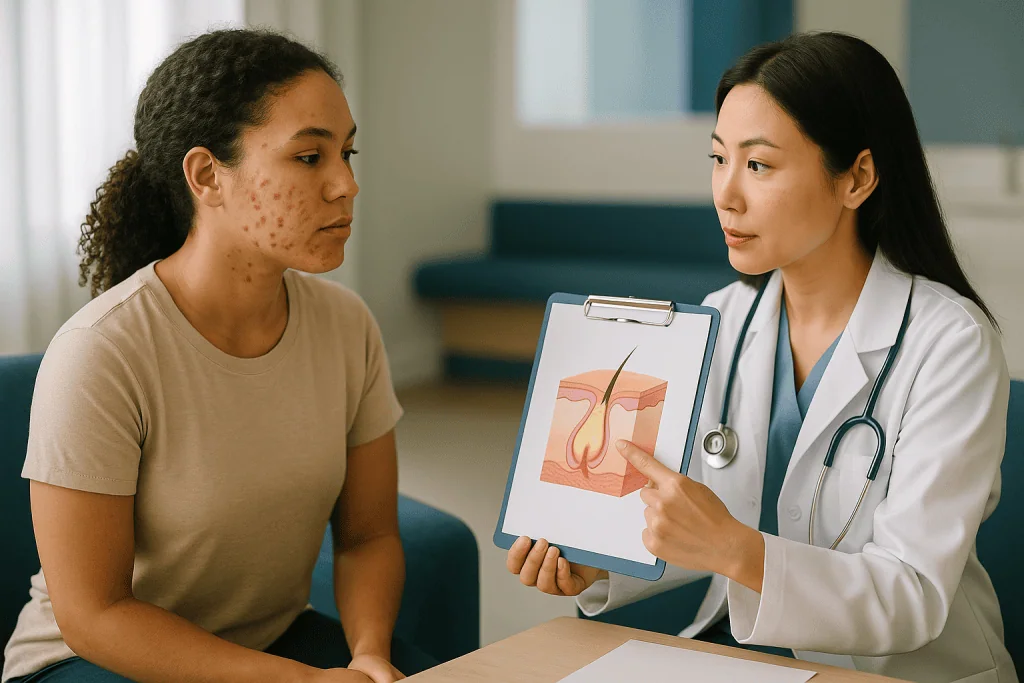
First, the lining sheds abnormally and the cells clump, narrowing the exit. Second, androgens, the hormones that rise in puberty and fluctuate through adult life, push the gland to make more oil. Oil plus sticky cells equals a plug. If the plug stays below the surface it is a closed comedone (a whitehead); if it opens and the trapped material darkens on contact with air, it is an open comedone (a blackhead). The dark color is oxidized oil, not dirt, a point MedlinePlus and NIH both make.
Third, a bacterium that lives harmlessly on everyone’s skin, Cutibacterium acnes, multiplies in the oily, airless plug. Fourth, the immune system reacts, and the wall of the follicle becomes inflamed or breaks. That produces the red papules, the pus-topped pustules and, in deeper cases, the firm nodules and cysts that hurt and scar.
Treatments target these steps. Topical retinoids normalize shedding so plugs form less often. Benzoyl peroxide reduces the bacteria and loosens plugs. Antibiotics reduce bacteria and inflammation. Hormonal options lower the androgen signal to the gland. Isotretinoin, a vitamin A derivative taken by mouth, shrinks the glands themselves. Each step unwinds over weeks, which is why the next question, why things can look worse first, has a concrete answer rather than a shrug.
Why does acne get worse before it gets better?
Three different things can make the early weeks look like a step backward, and it helps to separate them, because only one is cause for a call.
The first is accelerated turnover. Retinoids speed up the shedding of the follicle lining. Microcomedones that would have surfaced gradually over the next month or two arrive in a cluster. Dermatology commonly calls this purging. It is worth being honest about the evidence: guidelines describe the mechanism and the early irritation, but purging has no formal definition in trial literature, so the timelines quoted for it are clinical experience rather than hard data. What is documented is that retinoid irritation peaks in the first few weeks and eases as skin adapts.
The second is irritation itself. Dryness, flaking, tightness and a pink flush are listed by NHS and Mayo Clinic as common early effects of retinoids and benzoyl peroxide. Irritated skin looks redder and bumpier, so existing acne reads as angrier even when the count of lesions has not changed.
The third is a true flare. NHS notes that acne can get worse during the first 7 to 10 days of isotretinoin before improving, and some people on antibiotics or hormonal treatment see cyclical ups and downs in the first month because the underlying hormonal rhythm has not yet shifted.
None of these means the medicine is failing. Each tends to run its course within roughly the first six weeks, which lines up neatly with the six-week review point in NHS guidance. If the picture is still deteriorating at that review, with new deep or painful lesions, that is a different conversation and belongs with your clinician.
Acne purging vs breakout: how to tell the difference
Expected adjustment and a genuine problem can look similar in a mirror, but they tend to behave differently over time and in location.

Timing is the first clue. An adjustment reaction follows the start of a new product closely, usually within the first one to three weeks, and it tracks the skin’s natural turnover, so it tends to be settling by weeks six to eight. A reaction that begins only after months of stable use, or keeps escalating past the second month, does not fit that pattern.
Location is the second. Spots that surface during adjustment generally appear where you already get acne, because that is where the hidden plugs were waiting. New lesions in areas that were always clear, such as a sudden crop on the neck or temples, suggest something else: an irritating ingredient, a new cosmetic, a hormonal change, or occasionally a medicine side effect.
Character is the third. Adjustment lesions are usually small, superficial and short-lived, resolving in days. Firm, painful nodules that last for weeks, or lesions that leave pits, are not part of a normal settling period and raise the stakes, since nodular acne is the type most likely to scar.
Then there is the reaction that is neither. Burning, stinging, swelling, hives or weeping skin point to an irritant or allergic contact dermatitis, an inflammation of the skin caused by something applied to it. Mayo Clinic advises stopping a product and seeking advice if this happens. The point of this section is not to hand you a self-diagnosis tool; it is to help you describe what you are seeing accurately, so the person who prescribed the treatment can decide whether to hold the course, adjust, or switch.
How long for acne to clear with each type of treatment
Timelines differ by mechanism. Medicines that act on bacteria or inflammation tend to show earlier changes; those that reset oil production or follicle shedding need longer. The ranges below are typical figures from NHS and Mayo Clinic patient guidance, not promises, and individual courses are set by the prescribing clinician.
| Treatment class | Main action in the pore | Typical time to early improvement | Typical course or review point |
|---|---|---|---|
| Benzoyl peroxide (topical) | Reduces bacteria, loosens plugs | Several weeks; NHS suggests a 6-week trial | Reviewed at about 6 weeks, often continued longer |
| Topical retinoids | Normalizes follicle shedding | 4–8 weeks (Mayo Clinic); early irritation common | Months; often used long term for maintenance |
| Topical antibiotics | Reduces bacteria and inflammation | 6–8 weeks | Usually combined with benzoyl peroxide to limit resistance |
| Oral antibiotics (tetracycline class) | Reduces bacteria and inflammation body-wide | About 6 weeks (NHS) | Courses commonly run 4–6 months (NHS), with a topical alongside |
| Combined hormonal contraceptive | Lowers androgen signal to oil glands | Several months (NHS, Mayo Clinic) | Reviewed over months, not weeks |
| Anti-androgen tablet (spironolactone) | Blocks androgen effect on oil glands | Several months, similar to other hormonal options | Ongoing while benefit continues; clinician-led |
| Oral isotretinoin | Shrinks oil glands, resets shedding | Flare possible in first 7–10 days; improvement over weeks (NHS) | A course commonly lasts roughly 4–6 months (NHS) |
Two patterns stand out. Across the table, the six-week mark is the earliest sensible checkpoint, and three months is when most clinicians expect a clear verdict. The slowest-starting options, the hormonal ones, are often the most durable for adults whose acne tracks their cycle, which is why patience with them is frequently rewarded.
What the first days and weeks of acne treatment usually look like
Nobody’s skin follows a textbook, but a rough map helps you recognize the territory.
Days 1 to 14 are mostly about the skin adapting to the product rather than acne changing. With topical retinoids and benzoyl peroxide, expect dryness, flaking and a pink tinge, listed by NHS and Mayo Clinic as the common early effects. Oral isotretinoin can bring a flare in the first week or so alongside dry lips and dry eyes. People starting oral antibiotics often notice little either way this early.
Weeks 3 to 6 are the uncomfortable middle. Irritation usually eases as the skin adjusts, but the lesions that were already forming continue to surface, so the count may not fall yet. Red or brown marks left by healed spots, called post-inflammatory hyperpigmentation or erythema, become more noticeable simply because they outnumber active spots. Those marks are not scars and typically fade over months.
Weeks 6 to 8 are when NHS and Mayo guidance say the first real judgment can be made. The useful question at a review is not whether the skin is clear but whether fewer new spots are appearing than a month ago.
Months 3 to 6 are where control is usually established if the plan suits you. Antibiotic courses are commonly wound down around this point and the topical continued, since Mayo Clinic notes long-term antibiotic use is limited to reduce resistance. Hormonal treatments and isotretinoin are still doing their main work here.
After that, the goal shifts from clearing to keeping. Many people stay on a topical maintenance routine for a long time, because acne is a tendency of the skin, not an infection that is finished once treated.
Who is usually offered which treatment, and who is usually asked to wait
Acne is graded by what is on the skin and how much it is affecting life. Mild acne, mostly comedones with a few red bumps, is usually managed with topicals alone, and NHS guidance supports trying a topical for several weeks before anything is added. Moderate acne, with more inflamed lesions, often brings a combination: a topical retinoid or benzoyl peroxide plus a topical or oral antibiotic. Severe acne, with nodules, cysts, scarring or acne that has not responded to earlier steps, is where specialist referral and isotretinoin enter the conversation, and NHS guidance reserves isotretinoin for severe or treatment-resistant disease.
Some people are routinely asked to wait, or to take a different route. Anyone who is pregnant, breastfeeding or planning a pregnancy is usually steered away from retinoids in any form, tetracycline antibiotics and anti-androgen tablets, because these can harm a developing baby. Isotretinoin in particular requires reliable contraception and ongoing monitoring, and your clinician will go through this in detail. Combined hormonal contraceptives have their own list of reasons they may not be suitable, including a history of blood clots or migraine with aura.
A history of depression or other mood problems is weighed carefully before isotretinoin. Younger children with acne, and anyone whose acne appeared abruptly alongside other changes such as irregular periods or excess hair growth, may be assessed for an underlying cause before treatment is chosen.
The other common reason to wait is simpler: the current treatment has not had its fair trial yet. Switching at week three because the mirror is unkind is one of the most frequent ways a plan that would have worked gets abandoned. Who gets what, and when, is the treating team’s call, informed by your history and what you tell them.
Does acne go away on its own if you don't touch it?
For many people, eventually, yes; for a meaningful minority, no. NHS guidance describes acne as most common between the mid-teens and late teens, with symptoms that come and go for several years before improving, often settling by the mid-20s. The same guidance notes that acne can persist into adult life and that around 3% of adults over 35 still have it. So leaving things alone is a strategy that works for some, slowly, and quietly fails others.
Not touching the skin is genuinely good advice, with one important caveat. Squeezing pushes the contents of a plugged follicle deeper and can rupture its wall, which is exactly the event that turns a comedone into an inflamed lesion and raises the risk of a permanent scar. Mayo Clinic and NHS both warn against picking for this reason. Hands off reduces scarring. It does not stop new plugs forming, because the oil, the shedding and the hormones carry on regardless.
The honest calculation is about what is at stake while you wait. Mild comedonal acne that is not bothering you can reasonably be managed with gentle care and time. Acne that is leaving marks, forming nodules, hurting, or affecting mood and confidence is a different matter, because scarring and pigmentation that develop during years of waiting are harder to treat than the acne itself.
The phrase that captures it: acne usually burns out, but what it leaves behind depends on what happened in the meantime. That is the strongest argument for treating earlier rather than later when lesions are inflamed, and for leaving them alone with your fingers in every case.
What's the worst age for acne, and what does stage 1 acne look like?
The peak is adolescence, and it is not a small peak. NHS figures put the proportion of people aged 11 to 30 who experience some acne at about 95%, with the heaviest years falling between 14 and 17 for girls and 16 and 19 for boys. The reason is hormonal: androgens surge through puberty and oil glands enlarge in response. Boys often get more severe acne because their androgen rise is larger; girls more often carry it into adulthood because monthly hormonal cycles keep the signal fluctuating.
That later pattern matters for timelines. Adult acne, especially in women, tends to sit along the jaw and chin, flare before periods, and respond slowly to topicals alone. It is one of the groups where hormonal treatment, with its months-long onset, is frequently considered.
Stage 1, in the informal language people search for, generally means mild comedonal acne. Grading systems vary and clinicians do not all use numbered stages, but the earliest recognizable picture is the same: scattered open comedones (blackheads) and closed comedones (whiteheads), mostly on the forehead, nose and chin, with little or no redness. At this stage the plug has formed but the immune reaction has not started.
Mild comedonal acne is also where treatment responds fastest, because the medicine only has to prevent plugs rather than calm inflammation and heal damage. Topical retinoids and benzoyl peroxide are the usual tools, and the four-to-eight-week window Mayo Clinic quotes applies fairly directly. The caution is that a quick look in the mirror cannot reliably stage acne; redness, depth and the presence of nodules change the plan, and that assessment belongs with a clinician.
What is the hardest acne to treat?
Three kinds stand out, for different reasons.
Nodular and cystic acne is the most stubborn in the sense that matters most: it scars. Nodules form deep in the skin when the follicle wall ruptures well below the surface, and they can persist for weeks. Topicals struggle to reach them. This is the pattern that NHS and Mayo guidance link with referral and with isotretinoin, and it is also the pattern where delay carries the highest cost, because the ice-pick and rolling scars it leaves need separate procedures after the acne itself is controlled.
Hormonally driven adult acne is hard in a different way. It is often not severe, but it is relentless, cycling with periods and returning whenever a treatment is stopped. Because the driver is the androgen signal to oil glands, treatments that lower that signal tend to help most, and they are the slowest to show results. The difficulty is less about the medicine than about the patience required.
Acne in skin of color is difficult for a third reason. The acne itself is no different, but inflamed lesions leave post-inflammatory hyperpigmentation more readily, and those brown marks can outlast the spots by months. Mayo Clinic also notes that some topicals cause more dryness and redness in brown and Black skin, so irritation has to be managed carefully to avoid adding to the marks. Treating the acne early, before marks accumulate, is the lever that makes the biggest difference.
Truncal acne, on the chest and back, deserves a mention: it is harder to apply products to, often more severe, and more likely to need oral treatment. None of these are untreatable. They simply demand longer plans and closer follow-up.
How long does acne treatment take to work when hormones are involved?
Hormonal acne has the longest fuse of all, and understanding why makes the wait easier to tolerate.
Androgens act on the oil gland like a thermostat setting. Combined hormonal contraceptives work partly by increasing a protein that binds circulating androgens, and partly by steadying the monthly hormone swings that trigger premenstrual flares. Spironolactone, an anti-androgen originally developed as a diuretic, blocks the receptor the hormone acts on. Neither kills bacteria or unblocks a pore directly. They turn the thermostat down, and the gland takes time to respond, after which the existing plugs still have to clear.
That is why NHS and Mayo Clinic both describe hormonal options as taking months rather than weeks, and why many clinicians pair them with a topical to work on the surface while the hormonal effect builds. A common frustration is a first cycle or two that feels unchanged; the real signal is whether the usual premenstrual flare is smaller by the third or fourth cycle.
Timing also interacts with the cycle itself. Many women notice acne worsening in the week before a period, so starting treatment just before that window can make the early weeks look like failure when it is simply the usual pattern arriving on schedule.
If acne appears suddenly in adulthood alongside irregular periods, excess facial or body hair, or hair thinning on the scalp, a clinician may look for an underlying hormonal condition such as polycystic ovary syndrome before deciding on treatment, since the acne will be hard to settle until that is addressed. Whether a hormonal option is appropriate, and which one, depends on your health history and sits with the prescribing clinician.
What people often get wrong about how long acne treatment takes
Most of the mistakes come from a sensible instinct, acting on what the mirror shows, applied to a condition that runs weeks behind the mirror.
Stopping early is the big one. A treatment judged at week three is being judged on acne that formed before it started. The six-week checkpoint in NHS guidance exists precisely because that is the earliest moment the medicine’s effect on new lesions can be seen.
Using more to go faster is the second. Doubling up on retinoid or benzoyl peroxide does not accelerate turnover usefully; it increases irritation, and irritated skin looks worse. More is not faster. Consistent is faster.
Stopping as soon as skin clears is the third. Acne is a tendency, and the plugs start forming again once the medicine is withdrawn. Mayo Clinic describes long-term maintenance, usually with a topical, as part of normal management. Antibiotics are the exception: they are intended as a limited course, with the topical continuing afterward.
Then there are the beliefs that cost people time. Acne is not caused by dirt, and scrubbing hard inflames the skin, a point MedlinePlus and NHS make plainly. Sun does not help; it tans around the marks, worsens pigmentation and interacts badly with several acne medicines. Toothpaste and other overnight folk remedies irritate and have no evidence behind them. Diet is a genuine area of research, with some evidence linking high-glycemic diets and dairy to acne severity in some people, but it is a modifier rather than a replacement for treatment, and no single food has been shown to clear acne.
Finally, worse-at-first is not proof the treatment is wrong. It is often proof the treatment has started.
Questions to ask your care team about your acne treatment timeline
Appointments are short and acne is slow, so it pays to arrive with questions that get at timing and expectations. A few that tend to make follow-up more useful:
- How many weeks should I give this before we decide whether it is working, and what would improvement look like at that point?
- Is some flaring or peeling expected with this treatment, and roughly how long should that phase last?
- What would tell you this is irritation rather than the acne getting worse, and what should I do if I am unsure?
- If this plan works, how long will I stay on it, and what does maintenance look like afterward?
- If I am on an antibiotic, how long is the course planned for, and what continues when it stops?
- Does this treatment affect pregnancy planning, and what do I need to do about contraception?
- Which of my other medicines, supplements or skincare products might interact with it?
- Should I avoid sun exposure or use a particular type of sunscreen while using this?
- Are my marks scars or pigmentation, and when is it reasonable to think about treating them?
- Is there anything about my acne, its pattern, location or onset, that suggests an underlying cause worth checking?
Bring a photo log if you can. A phone picture every two weeks under the same light is far more informative than memory, which tends to anchor on the worst day. Note the dates of flares relative to periods, stress, new products or missed applications. The clinician adjusting your plan is making a judgment under uncertainty, and the better the record you bring, the more precise that judgment can be.
When to call your doctor
Most of what happens in the early weeks of acne treatment is uncomfortable rather than dangerous. A handful of situations are different and warrant a prompt call to the clinician who prescribed the treatment, or urgent care if severe.
Call promptly if the skin becomes markedly swollen, hot, weeping or blistered after applying a product, or if you develop hives, lip or face swelling, or any difficulty breathing. Those are signs of an allergic or severe irritant reaction and need assessment the same day.
Call if painful nodules or cysts are multiplying or spreading to new areas, if lesions are leaving pits or raised scars, or if you have a fever alongside a sudden severe acne flare. Rapidly worsening deep acne needs a change of plan, not more waiting.
On isotretinoin, contact your clinician without delay if you notice low mood, anxiety, thoughts of self-harm, severe headache, changes in vision, severe abdominal pain, bloody diarrhea, or yellowing of the skin or eyes. Any possibility of pregnancy while taking isotretinoin, a tetracycline antibiotic or an anti-androgen is a reason to call immediately.
On oral antibiotics, report a persistent severe headache, visual disturbance, a severe sunburn-like reaction, or significant stomach upset.
Finally, call, rather than stopping on your own, if you have given a treatment the full trial your clinician set and there is no improvement, or if side effects are making it impossible to keep using it. There are usually other routes, and a conversation is the way to find them. Starting, stopping or changing a prescribed medicine is a decision for your treating team.
Frequently asked questions
How long for acne to clear once treatment starts working?
Clearing usually takes months even after improvement begins. Mayo Clinic notes that first results appear at four to eight weeks with most prescription treatments, while complete clearing can take many months or longer. Marks left by healed spots fade on their own timetable afterward. Your clinician will set a review point and decide whether the plan continues or changes.
Why does acne get worse before it gets better on a retinoid?
Retinoids speed up the shedding of the follicle lining, so plugs that were forming under the skin surface in a cluster during the first weeks. Early dryness and redness also make existing spots look angrier. This phase usually eases within about six weeks. If painful nodules appear or skin becomes swollen or blistered, contact your clinician rather than waiting.
Acne purging vs breakout: how can I tell which one I have?
Purging tends to start within the first weeks of a new product, appears where you normally break out, involves small short-lived spots and settles by roughly weeks six to eight. A breakout in new areas, deep painful lesions, or worsening past the second month does not fit that pattern. Describe what you see to the prescribing clinician, who can decide whether to adjust.
Does acne go away on its own without treatment?
Often, but not for everyone, and not quickly. NHS guidance describes acne improving for most people by their mid-20s, while about 3% of adults over 35 still have it. Leaving skin alone with your hands reduces scarring, but it does not stop new plugs forming. Inflamed or nodular acne is worth treating earlier, because scars and dark marks are harder to treat than the acne itself.
What is the worst age for acne?
The mid to late teens. NHS figures put the peak at ages 14 to 17 for girls and 16 to 19 for boys, driven by the rise in androgens during puberty. Around 95% of people aged 11 to 30 have some acne. Boys more often get severe acne; girls are more likely to carry it into adulthood because of cyclical hormone changes.
What does stage 1 acne look like?
In everyday terms, stage 1 means mild comedonal acne: scattered blackheads and whiteheads, usually on the forehead, nose and chin, with little redness. The plug has formed but inflammation has not started. Grading systems vary and clinicians assess depth and redness in person, so a mirror check cannot reliably stage acne. Mild comedonal acne usually responds fastest to topical treatment.
What is the hardest acne to get rid of?
Nodular and cystic acne is the hardest because lesions sit deep, persist for weeks and scar, which is why guidelines link it with specialist referral. Hormonal adult acne is stubborn in a different way, cycling with periods and responding slowly. Acne in darker skin is complicated by long-lasting pigmentation marks. All of these can be managed, but they need longer plans and closer follow-up.
How long do oral antibiotics take to work for acne?
NHS guidance says it usually takes about six weeks to notice improvement, and a course commonly runs four to six months, with a topical such as benzoyl peroxide or a retinoid used alongside to reduce resistance. Antibiotics are intended as a limited course, and the topical typically continues afterward. Duration and any changes are decided by the prescribing clinician.
Can I speed up acne treatment by using more product?
No. Applying more retinoid or benzoyl peroxide increases irritation without accelerating the follicle’s turnover in a useful way, and irritated skin looks redder and bumpier. Consistency, applying as directed every day, is what shortens the timeline. If irritation is severe or the routine is unmanageable, tell your clinician, who may adjust the plan rather than you adding extra on your own.
Should I stop acne treatment once my skin is clear?
Usually not without discussing it first. Acne is a tendency of the skin, and plugs begin forming again once treatment stops, which is why Mayo Clinic describes ongoing maintenance, commonly a topical, as part of normal management. Antibiotics are the exception, planned as a limited course. Decisions to stop, taper or switch belong with your treating clinician.
References
This article is for general information only and is not a substitute for professional medical advice. Please consult a qualified doctor about your individual situation.

More from the Blog

Castor Oil: Ancient Remedy, Viral Comeback: What Is Actually True
Castor oil is a plant oil with one well-established medical use: short-term relief of occasional constipation, where it acts as a stimulant laxative. It…
Shaving and Folliculitis: Razor Habits Your Dermatologist Will Ask You to Change
Shaving with folliculitis is usually discouraged until the inflamed follicles settle, because each pass of the blade reopens irritated skin and can carry bacteria…

How Doctors Choose Between Antibiotic Cream and Tablets for Impetigo: Extent, Spread and Fever
Doctors usually treat impetigo with an antiseptic or antibiotic cream when the infection is small, confined to one area and the person is otherwise…
Styling Products, Oils and Dandruff Treatment: What Your Dermatologist Will Ask You to Change
Dandruff is driven by a scalp yeast called Malassezia, excess oil and individual skin sensitivity, so a dermatologist usually asks you to stop applying…
Basal Cell Carcinoma: Does It Spread, Is It Dangerous, and What Does It Look Like?
Basal cell carcinoma almost never spreads to distant organs; metastasis is considered extremely rare by major medical sources. Its real danger is local. Left…
Does Allergy Testing Help With Eczema? When Dermatologists Recommend It and What It Can Show
Allergy testing does not diagnose eczema, and it helps only in specific situations. Dermatologists usually suggest it when eczema stays severe despite good skin…