

How Long Does Adenoid Surgery Recovery Take in Children? Discomfort, Bad Breath and Swimming

Key Takeaways
- Adenoids sit behind the nose, not in the mouth, so an adenoidectomy is performed entirely through the open mouth with no external cuts.
- MedlinePlus puts full recovery at one to two weeks, while the NHS suggests about a week off school and describes a sore throat lasting up to ten days.
- The strong bad breath that peaks toward the end of the first week comes from bacteria on the normal healing coating, not from infection, and fades as that coating comes away.
- Ear pain after adenoid surgery is usually referred pain from shared throat nerves rather than a new ear infection.
- Snoring and nasal congestion commonly get louder for several nights after surgery because of swelling, with the benefit emerging over a few weeks.
- Swimming is delayed because water reaches the open healing surface at the back of the nose; most teams wait roughly two weeks and give a specific date.
Most children recover from adenoid surgery within about one to two weeks, with the first few days being the most uncomfortable. A sore throat, ear ache, stuffy nose and noticeable bad breath are expected while the area heals. Many children return to school after roughly a week, while swimming and rough play are usually delayed until the surgical team confirms healing, often around two weeks.
The nurse hands you a printed sheet, your child is dozing off the anesthetic with a cartoon on the wall, and the surgeon has already moved on to the next case. The operation was short. What stretches ahead of you is the part nobody rehearses: the drive home, the first night, the moment your child breathes on you and you wonder whether that smell is normal.
Parents searching for adenoidectomy recovery children information tend to want three specific things. How uncomfortable will this be, and for how long? Why does my child’s breath suddenly smell like something has gone wrong? And when can we get back to normal, particularly the swimming lessons already paid for and the birthday party at the pool?
The honest answer is reassuringly ordinary. Adenoid removal is one of the most common operations performed on children, the healing process follows a predictable arc, and most of what alarms parents in the first week is the body doing exactly what it should.
What are adenoids, and why do children have them removed?
Adenoids are a small pad of immune tissue tucked high at the back of the nose, behind the soft palate, in a space called the nasopharynx. You cannot see them by looking in a child’s mouth. They belong to the same family of tissue as the tonsils, and in early childhood they help the immune system sample the germs a child breathes in.
The catch is size. Adenoids are largest in young children, and in a small airway a swollen pad of tissue takes up a lot of room. According to the NHS, adenoids begin to shrink from around the age of seven and have largely disappeared by adulthood, which is why adenoid problems are overwhelmingly a childhood issue.
When adenoids stay enlarged or repeatedly infected, they can block nasal breathing, force a child to breathe through the mouth, disturb sleep, and interfere with the small tubes that drain the middle ear. Cleveland Clinic lists the usual reasons a surgeon considers removal:
- Persistent blocked nose and mouth breathing that has not improved with time or medical treatment
- Sleep-disordered breathing, including snoring with pauses in breathing, known as obstructive sleep apnea
- Repeated middle ear infections or persistent fluid behind the eardrum (often called glue ear), especially when ear tubes are being placed
- Recurrent or long-lasting sinus infections
Removing the adenoids does not leave a child defenseless. The immune system has many other sites doing the same job, and Johns Hopkins notes that children who have adenoids removed do not experience more infections afterward. The surgical decision is about airflow and drainage, not about whether the tissue is useful in principle.
How adenoidectomy works: what actually happens in the operating room
An adenoidectomy is the surgical removal of the adenoids. It is done under a general anesthetic, meaning the child is fully asleep and feels nothing during the procedure. The NHS describes the operation as taking around 30 minutes, and most children go home the same day.
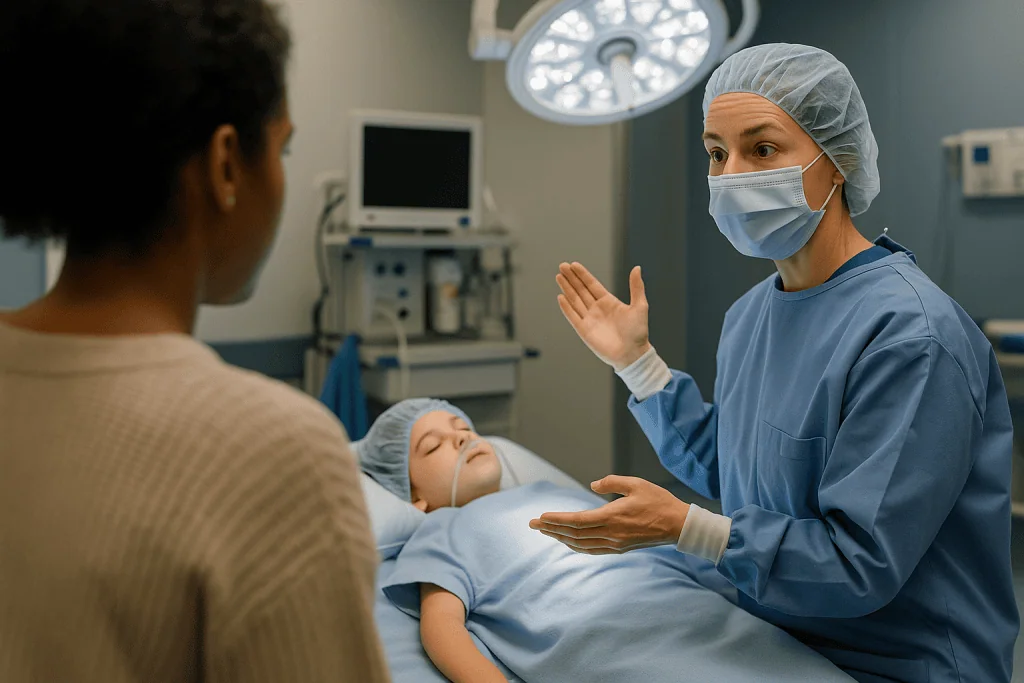
The surgeon works entirely through the mouth. A small instrument holds the mouth open, the soft palate is gently lifted, and the surgeon reaches up behind it to the nasopharynx. There are no cuts on the face or neck, which surprises many parents who imagine an incision near the nose. The adenoid tissue is removed either with a curette, a small spoon-shaped scraping instrument, or with a device that uses heat or suction to shave and seal the tissue. Bleeding is controlled before the child wakes, usually with a small amount of pressure or heat applied to the raw surface.
What remains is a shallow, open area of healing tissue at the very back of the nose. It is not stitched. Over the next one to two weeks it forms a whitish-yellow coating, similar to a scab but softer because it stays moist, and new lining grows underneath. That coating is central to two of the questions in the title. It is the main source of the bad breath, and it is the reason surgeons ask families to avoid pools and rough play until it has come away.
In the recovery area, staff watch breathing, drinking and comfort. Cleveland Clinic notes that most children are ready to leave within a few hours once they are awake, drinking fluids and reasonably settled. A sore throat, a small amount of blood-streaked saliva in the first hours and general grumpiness are all expected at this stage rather than causes for concern.
Who is adenoidectomy usually for, and who is usually asked to wait?
Surgery is rarely the first step. Most children who eventually have their adenoids removed have already been through a stretch of watching and waiting, sometimes with nasal sprays or antibiotic courses along the way. The decision typically comes when symptoms are persistent, clearly linked to the adenoids on examination, and affecting sleep, hearing or daily function.
The children most often offered the operation, according to the NHS and Cleveland Clinic, fall into a few groups:
- Toddlers and school-age children with obstructive sleep apnea or heavy snoring and disturbed sleep, particularly where a specialist has confirmed the adenoids are contributing
- Children with glue ear or repeated ear infections who are having ear tubes placed, where removing the adenoids may reduce the chance of the problem returning
- Children with chronic nasal blockage and constant mouth breathing that has not settled with medical treatment
A surgical team may suggest waiting in other situations. A very young infant with mild symptoms may be observed, because adenoid problems often improve as the airway grows. A child with an active cold, chest infection or fever on the day of surgery is usually rescheduled, since anesthesia is safer when the airway is calm. Children with certain palate conditions, including a cleft palate that has been repaired or a submucous cleft hidden under the lining, need particular care, because the adenoids can help close off the nose during speech; surgeons may modify or postpone the operation in these children.
Bleeding disorders, complex heart conditions and some neuromuscular conditions do not rule out surgery but call for extra planning, often with other specialists involved. None of this is a checklist a parent can run at home. It is the conversation to have with the surgeon, who weighs the child’s symptoms against the risks of the anesthetic and the operation.
How long does adenoidectomy recovery take in children?
The short version: about a week for the difficult part, roughly two weeks for the raw area to heal over, and a few weeks more for the benefits to become obvious. MedlinePlus puts full recovery at one to two weeks, and the NHS advises keeping a child off school for around a week.

That two-week figure is the surgeon’s timeline, not the child’s. Children often feel dramatically better by day three or four and want to run, jump and play with friends long before the tissue behind their nose has finished healing. The parenting challenge in the second week is usually holding an energetic child back, not coaxing a miserable one forward.
Several things shape where a particular child lands in that range:
- Age, since older children tend to describe more discomfort and take slightly longer to settle
- Whether the tonsils were removed at the same time, which extends the sore period considerably
- How well the child drinks in the first two days, because a moist throat heals more comfortably than a dry one
- Whether a cold or infection arrives during the healing window
It helps to think in three overlapping phases. Days one to three are about comfort and fluids. Days four to ten are about steady improvement, with occasional dips, and the peak of the bad breath. From around day ten onward the coating on the healing surface comes away, the stuffy nose clears and parents often notice quieter sleep for the first time in months.
The NHS notes that a full benefit for nasal breathing and snoring may not be visible for a few weeks, as swelling from the surgery itself has to settle first. Anyone told to expect a transformation on the first night home has been set up for disappointment.
Adenoidectomy recovery day by day: what the first two weeks usually look like
No two children follow the same path, but the pattern below reflects the typical course described by MedlinePlus, the NHS and Cleveland Clinic. Treat it as a map rather than a schedule.
| Stage | What is common | What usually helps |
|---|---|---|
| Day of surgery | Sleepy, tearful or unusually clingy; sore throat; possible nausea from the anesthetic; small streaks of blood in saliva | Frequent small drinks, quiet rest, a calm adult nearby |
| Days 1 to 3 | Peak discomfort in throat, ears or jaw; low appetite; mild fever; snoring louder than before because of swelling | Soft foods, plenty of fluids, comfort measures agreed with the team |
| Days 4 to 7 | Energy returning; strong bad breath as the healing coating forms; stuffy nose; voice may sound different | Keep drinking, gentle activity indoors, avoid crowds and people with colds |
| Days 8 to 14 | Coating comes away; breath improves; nose starts to clear; sleep quieter | Return to school, still no swimming or rough play until cleared |
| Weeks 3 to 6 | Nasal breathing settled; snoring reduced; ear fluid may take longer to clear | Follow-up review; resume full activity as advised |
Two features of this timeline trip families up. The first is the dip around days four to six, when a child who seemed almost recovered becomes sore or irritable again. Cleveland Clinic and Mayo Clinic both describe this pattern after throat surgery; it reflects the healing surface maturing, not a setback. The second is the fever. A low-grade temperature in the first couple of days is common and usually relates to the anesthetic and the healing process. A high or climbing fever is a different matter, covered in the red-flag section below.
Children who have both tonsils and adenoids removed should expect a longer, more painful version of this course, which the comparison section explains.
How much discomfort should you expect after adenoid removal?
Adenoidectomy on its own is considered one of the less painful throat operations in children, and many parents are surprised by how quickly their child asks for a snack. The NHS describes a sore throat that can last up to about ten days, alongside pain that may be felt in the ears or jaw.
That ear pain deserves a plain explanation, because it frightens people. The nerves that supply the back of the throat also carry sensation from the ear, so the brain can misread a throat wound as an earache. Doctors call this referred pain. It does not mean an ear infection has developed, and it tends to fade with the throat soreness.
Discomfort follows a pattern rather than a straight decline. The first two to three days are the worst, then most children improve steadily, with the occasional bad morning around days five to seven. Pain is often most noticeable first thing in the morning, when the throat has dried out overnight, and eases once the child has had a drink.
Pain relief is a conversation for the surgical team, and the medicines used are the same ordinary over-the-counter types most households already know. What matters for a parent is the approach rather than the product: the team will explain which medicines are appropriate for your child’s age and weight, how to time them ahead of meals and bedtime, and what to avoid. Follow their written instructions exactly and ask before adding anything else, including herbal remedies or older siblings’ leftovers.
Comfort measures matter as much as medicine. Cool drinks, ice pops, soft foods and a cool-mist humidifier in the bedroom keep the raw surface moist. Some children prefer warm broth to cold things; let them choose. A child who is drinking, sleeping and playing between doses is recovering well even if they wince when swallowing.
Why does my child have bad breath after adenoidectomy, and how long does it last?
The smell is genuinely striking. Parents describe it as sour, rotten or like old cheese, and it often appears around day two or three and peaks toward the end of the first week. Cleveland Clinic and MedlinePlus both list bad breath as an expected part of recovery, and the NHS notes it can last several days.
The explanation is the healing surface itself. Where the adenoids sat, the body lays down a protective layer of dead cells, fibrin and mucus, sometimes called slough or eschar. Because it is warm, damp and at the back of the nose where air passes constantly, bacteria that normally live harmlessly in the mouth colonize it and produce sulfur-containing gases. That is the odor. It is not infection, it is not rotting tissue, and it does not mean anything has gone wrong.
The layer comes away gradually as new lining grows beneath it, usually between days seven and fourteen. The smell fades with it. Parents occasionally notice a small grayish fragment in a tissue or after a sneeze; this is the coating detaching and is normal unless accompanied by fresh bleeding.
A few things ease it in the meantime:
- Frequent drinks, which rinse the area and keep the coating soft rather than crusted
- Gentle tooth brushing as usual, staying away from the back of the throat
- Avoiding forceful nose-blowing in the first week, which can disturb the surface
Mouthwash or strong mints do little because the source sits far above the mouth. Time is the real fix. The combination of bad breath with a rising fever, worsening pain, refusal to drink or a foul discharge from the nose that increases rather than settles is worth a call, but on its own the smell is a sign of healing, not a problem.
Eating, drinking and sleep during adenoidectomy recovery in children
Fluids do more work than any other part of home care. A moist throat hurts less, the healing coating stays soft, and a well-hydrated child is far less likely to end up back in the emergency department. MedlinePlus advises offering plenty of fluids and soft, cool foods in the first days, and the NHS makes the same point.
Children often refuse to drink because swallowing hurts, then hurt more because they are dry. Breaking that loop is the parent’s main job on days one to three. Small, frequent sips work better than negotiations over a full cup. Ice pops, diluted juice, milk, smoothies and water all count. Signs that fluids are falling short include fewer wet diapers or trips to the toilet, a dry mouth, sunken eyes and unusual drowsiness; those signs warrant a call.
Food matters less than parents fear. A child can miss a few proper meals without harm as long as they drink. Soft options such as yogurt, mashed potato, pasta, scrambled eggs and soup go down easily. Unlike tonsillectomy, where some surgeons encourage rougher textures to help the throat heal, adenoidectomy leaves the eating surface of the throat largely untouched, so the main rule is simply to avoid anything sharp, very hot or very spicy in the first week.
Sleep is frequently worse before it is better. Swelling at the back of the nose can make snoring louder for the first several nights, and the anesthetic can disrupt sleep rhythms for a day or two. Propping the head slightly with an extra pillow, running a cool humidifier and keeping the bedroom smoke-free all help. Nasal congestion typically clears over the second week, and many families describe a night around day ten when the house is suddenly quiet.
When can my child go back to school, daycare and normal play?
The NHS suggests around a week off school after adenoidectomy, and Cleveland Clinic gives a similar range, noting that some children are ready within a few days. Two considerations drive the timing, and neither is about the child’s energy.
The first is infection exposure. The healing surface is an open area of tissue, and a cold or throat infection during that fortnight can make the child more uncomfortable and, uncommonly, raise the risk of bleeding. The NHS specifically advises keeping children away from crowded places and from people with coughs and colds for about a week. Classrooms and daycare rooms are, by their nature, full of both.
The second is activity. Running, climbing and rough-and-tumble games raise blood pressure in the head and neck and can jar the healing area. MedlinePlus recommends avoiding strenuous activity and sports for about a week, and many surgical teams extend that to two weeks for contact sports and gym class. Quiet play, drawing, reading and gentle walks outdoors are fine from the first day home.
A practical approach many families use:
- Days one to five: home, quiet, focused on fluids and rest
- Days six to seven: a trial of normal routine at home, watching for tiredness
- Around day seven to ten: return to school with a note excusing gym and outdoor sports
- After the follow-up or around two weeks: full activity once the team agrees
Teachers appreciate a heads-up about the bad breath, which can otherwise draw comments from classmates. A brief note that it is a normal part of healing spares the child some awkwardness. If the child seems exhausted after the first day back, a shorter day or one more day at home is reasonable; the timeline bends to the child.
Swimming after adenoid surgery: when is it actually safe?
This is the question that fills up parenting forums, partly because advice varies between surgeons and partly because swimming lessons are booked months in advance. The principle is more consistent than the exact number of days.
The concern is the open healing surface at the back of the nose. Pool water carries bacteria and chlorine, and swimming almost inevitably pushes water up the nose, directly onto that area. Add the exertion of swimming, which raises pressure in the head and neck, and the risk of irritation, infection or disturbing the healing coating rises. Surgeons therefore ask families to wait until the coating has come away and new lining has covered the area.
MedlinePlus describes full recovery as taking one to two weeks, and that healing window is why most teams keep children out of pools, lakes and the sea for roughly two weeks, with some preferring to wait until they have seen the child at follow-up. Ask your surgeon for a specific date rather than assuming, and treat it as a firm boundary rather than a rough guide.
A few clarifications that come up often:
- Baths and showers at home are fine from the first day, as long as the child is not submerging their face or holding their breath under water
- Splash pads and paddling pools count as swimming for this purpose because water still reaches the nose
- Diving, jumping in and underwater games are the last activities to resume, since they force water high into the nasopharynx with pressure
When swimming does restart, a gentle first session is sensible. If a nosebleed, a sudden return of foul-smelling discharge or new pain follows a swim, stop and call the team. For most children, though, the two-week pause is the whole story, and the lessons resume without incident.
Adenoidectomy alone vs adenoids and tonsils together: how recovery differs
Many children have their tonsils removed at the same time as their adenoids, an operation called adenotonsillectomy. Parents reading about recovery often mix up the two experiences, which can leave a family expecting a rough fortnight after a simple adenoidectomy, or underestimating what a combined operation involves.
The difference is the wound. Adenoidectomy leaves one small raw area high behind the nose, away from the path of food. Tonsillectomy leaves two larger raw areas on either side of the throat, exactly where every mouthful and swallow passes. Mayo Clinic describes recovery from tonsillectomy as typically taking ten days to two weeks, with pain that commonly worsens around days three to five before improving, and with a small but real risk of bleeding as the scabs separate toward the end of that period.
In practice, families notice these contrasts:
- Pain intensity and duration are considerably greater after the combined operation, and pain relief is usually needed for longer
- Eating is harder after tonsillectomy, and dehydration is the most common reason for a return visit
- Bleeding risk is higher and lasts longer after tonsillectomy, with the second week being a particular watch period
- Time off school is usually longer, often the full two weeks
Adenoidectomy alone typically sits at the milder end of all four measures. The bad breath, stuffy nose and referred ear pain are shared features, but a child who has had only adenoids removed is often eating normally within days.
Which operation a child needs is a clinical judgment. Surgeons consider whether the tonsils are also enlarged or repeatedly infected, whether the sleep-breathing problem is likely to be solved by adenoids alone, and the child’s age. Removing tonsils that are not causing trouble adds discomfort without benefit, so a recommendation for adenoidectomy alone is not a lesser option; it reflects the surgeon’s assessment of where the problem lies.
What people often get wrong about adenoidectomy recovery in children
A handful of misunderstandings recur in clinic conversations, and correcting them early saves a lot of anxiety.
The smell means infection. It almost never does. As explained above, the odor comes from bacteria living on the normal healing coating. Infection announces itself with rising fever, increasing pain and a child who is getting worse rather than better.
Snoring should stop the first night. Swelling from the operation temporarily narrows the very space that was just cleared, so snoring often sounds louder for several nights. The NHS notes that the benefits emerge over a few weeks as swelling settles.
A nasal-sounding voice means something was damaged. Some children sound as though they have a heavy cold, or the opposite, a slightly airy voice, for a few weeks. The soft palate is learning to close against a space that has changed shape. Johns Hopkins and Cleveland Clinic describe temporary voice change as common; persistent change beyond several weeks is worth mentioning at follow-up.
The child needs antibiotics to heal. Adenoidectomy is not routinely followed by antibiotics, and the healing coating is not an infection to be treated. If the surgical team does prescribe anything, the reason will be specific to that child.
Removing adenoids weakens immunity. The tissue is one of many immune sites, and studies summarized by Johns Hopkins have not shown an increase in infections after removal.
Once the child feels fine, restrictions can end. Energy returns days before the tissue is healed. The swimming and rough-play limits exist for the wound, not for how the child feels.
Adenoids grow back, so surgery is pointless. Small amounts of tissue can regrow in a minority of children, since the surgeon cannot remove every last cell, but Cleveland Clinic notes that symptomatic regrowth requiring a second operation is uncommon. Most children never need to think about their adenoids again.
Questions to ask your care team before and after adenoid surgery
Good questions turn a printed leaflet into a plan for your child. Consider bringing this list to the pre-operative visit and the discharge conversation.
Before the operation:
- Why do you think the adenoids are the main cause of my child’s symptoms, and what would happen if we waited?
- Are you planning to remove the tonsils as well, and if so, why?
- Will ear tubes be placed at the same time?
- How long will my child be under anesthetic, and will we be able to go home the same day?
- Is there anything about my child’s health, such as a palate condition or bleeding tendency, that changes the plan?
At discharge:
- Which pain relief should we use, at what times, and what should we avoid? Please write it down.
- What is the exact date my child can swim, and the date they can return to sport?
- How many days off school do you recommend for this child?
- What does bleeding that needs attention look like, and what should we do if it happens at night?
- How high a temperature would you want to hear about?
- Who do we call after hours, and which emergency department should we use?
- When is the follow-up, and what will you be checking?
Afterward, keep a simple note of fluid intake, temperature and any bleeding for the first few days. Surgical teams find it far easier to advise a parent who can say the child had four drinks this morning and a temperature of a certain figure than one who reports that the child seems off. Write down the answers you receive as well; the first hours after surgery are not a reliable time for memory.
Every one of these questions has an answer that depends on your child. The surgeon who examined them and performed the operation is the right person to give it.
When to call your doctor after adenoidectomy: red-flag signs
Most children sail through adenoid surgery with nothing more than a grumpy week and unpleasant breath. A small number develop problems that need prompt attention, and the surgical team would always rather hear from you than have you wait. Contact them, or seek emergency care where indicated, for any of the following, which reflect guidance from the NHS, MedlinePlus and Cleveland Clinic.
Seek emergency care immediately if your child:
- Has fresh red bleeding from the nose or mouth that does not stop within a few minutes, or vomits blood or material that looks like coffee grounds
- Has difficulty breathing, noisy labored breathing while awake, or lips that look dusky or blue
- Is very drowsy, floppy or difficult to wake
A small streak of blood in saliva on the day of surgery, or a brownish tinge in nasal mucus as the coating comes away, is different from active bleeding. When in doubt, call.
Call the surgical team the same day if your child:
- Has a fever that is high, keeps climbing, or lasts beyond the first couple of days
- Refuses to drink for several hours, passes noticeably less urine, has a dry mouth or sunken eyes, or seems unusually weak
- Has pain that is getting worse after day three rather than better, or pain that is not controlled by the plan you were given
- Develops a stiff neck, holds the head tilted to one side, or cannot turn the head comfortably
- Has a thick foul discharge from the nose that increases rather than settles, particularly alongside fever
- Cannot keep fluids down because of persistent vomiting
The neck stiffness point is uncommon but worth knowing: rarely, inflammation after surgery can affect the joints at the top of the spine, and early assessment matters.
If you cannot reach the surgical team and your child is unwell, use the emergency number you were given or your local emergency department. Take the discharge paperwork with you. Nobody on the team will consider a call about a child recovering from surgery a nuisance; judging what is normal is their job, and yours is simply to notice and ask.
Frequently asked questions
What is the typical adenoid removal recovery time for a child?
Most children recover from adenoid removal within one to two weeks according to MedlinePlus, with the first three days being the most uncomfortable. Energy often returns by the end of the first week, but the healing surface at the back of the nose takes about two weeks to cover over, which is why activity restrictions last longer than the sore throat.
How long does bad breath after adenoidectomy last?
Bad breath usually begins two or three days after surgery, peaks toward the end of the first week and fades as the healing coating comes away, typically between days seven and fourteen. It is caused by bacteria living on that coating, not by infection. Frequent drinks help; mouthwash does little because the source sits high behind the nose.
When can my child swim after adenoid surgery?
Most surgical teams ask families to wait roughly two weeks, until the raw area behind the nose has healed, and some prefer to see the child at follow-up first. Pool water reaches that surface directly and exertion raises pressure in the head. Ask your surgeon for a specific date; baths and showers without submerging the face are fine from day one.
Is it normal for my child to have ear pain after adenoidectomy?
Yes. The nerves supplying the back of the throat also carry sensation from the ear, so a healing throat wound can be felt as earache. This referred pain is common after adenoid and tonsil surgery and fades with the throat soreness. Ear pain with a high fever or discharge from the ear itself is different and should be reported.
Why is my child snoring more after adenoid removal?
Swelling from the operation temporarily narrows the space that was just cleared, so snoring often sounds louder for the first several nights. The NHS notes that the improvement in nasal breathing emerges over a few weeks as swelling settles. Snoring that persists beyond that, or pauses in breathing during sleep, is worth raising at follow-up.
What does adenoidectomy recovery look like day by day?
Days one to three bring the most soreness, low appetite and possibly a mild fever. Days four to seven see energy returning alongside strong bad breath and a stuffy nose, sometimes with a brief dip in comfort. Between days eight and fourteen the healing coating comes away, breath improves and the nose clears. Full benefit for sleep may take a few more weeks.
How much time off school does a child need after adenoidectomy?
The NHS advises around a week off school, mainly to avoid coughs and colds while the area is healing and to keep the child away from rough play. Some children are ready sooner, according to Cleveland Clinic. A note excusing gym and sports for the second week is sensible, and the surgical team will confirm timing for your child.
Can my child eat normally after adenoid surgery?
Usually within a few days. Because the adenoids sit behind the nose rather than in the swallowing path, eating is far less painful than after tonsillectomy. Soft, cool foods are easiest in the first days, and fluids matter far more than meals. Avoid very hot, sharp or spicy foods for about a week and let the child guide portions.
Do adenoids grow back after they are removed?
A small amount of tissue can regrow in some children because the surgeon cannot remove every cell, but Cleveland Clinic notes that regrowth causing symptoms and needing a second operation is uncommon. Adenoids also shrink naturally from around age seven according to the NHS, so any regrowth tends to matter less as the child gets older.
What are the warning signs after adenoidectomy that need urgent care?
Fresh bleeding from the nose or mouth that does not stop, vomiting blood, difficulty breathing or a child who is very drowsy need emergency care. Call the surgical team the same day for a high or rising fever, refusal to drink with reduced urine, worsening pain after day three, a stiff or tilted neck, or persistent vomiting.
References
This article is for general information only and is not a substitute for professional medical advice. Please consult a qualified doctor about your individual situation.

More from the Blog

Does SMR Help Snoring and Nasal Obstruction? What Results Submucous Resection Can Bring
SMR (submucous resection) straightens a deviated nasal septum or reduces swollen turbinates to improve airflow through the nose. It reliably treats nasal obstruction, but…

Does Septoplasty Improve Breathing? Realistic Results and How Long Full Benefit Takes
Septoplasty straightens a crooked nasal septum, and for people whose blockage comes mainly from that deviation, breathing through the nose usually improves once swelling…

Why Does Untreated Sleep Apnea Strain the Heart, and How Does Treatment Aim to Reduce Risk?
Untreated sleep apnea strains the heart because each pause in breathing drops blood oxygen, triggers a stress-hormone surge and spikes blood pressure, many times…

Preparing for SMR: Blood Thinners, Smoking and Fasting Before Submucous Resection
Preparing for submucous resection usually means three things in the weeks before surgery: telling your team about every blood thinner, painkiller and supplement you…
CPAP or ENT Surgery for Sleep Apnea: How Do Specialists Decide Which Path Fits Your Airway?
Specialists usually offer CPAP first for moderate or severe obstructive sleep apnea because it supports every level of the airway at once and carries…

Cochlear Implant Evaluation: What Do the Hearing Tests, Speech Assessment and Imaging Decide?
A cochlear implant evaluation combines three strands of evidence. Hearing tests measure how much sound the inner ear still detects; speech assessment, done with…