

How Long Does an IVIG Infusion Take? Monitoring, Slow Starting Rates and the Session Itself

Key Takeaways
- Patient resources from Cleveland Clinic describe a typical established IVIG infusion as lasting roughly two to four hours, with first infusions and larger volumes running longer.
- The slow starting rate is a safety step: most common reactions such as headache, chills and flushing are rate-related, and the standard response is to slow the pump rather than stop treatment.
- Vital signs are checked at baseline, at every rate increase and most closely during the first hour, followed by a short observation period before the cannula is removed.
- Infused immunoglobulin has a half-life of around three weeks according to the NIH clinical summary, which is why replacement infusions recur every few weeks.
- For Guillain-Barré syndrome the NHS describes an infusion course of about five days, while recovery of nerve function unfolds over weeks to months.
- Aseptic meningitis, a non-infectious inflammation around the brain, is a recognized but uncommon reaction that usually appears within a day or two as a severe headache with a stiff neck.
A single IVIG infusion usually takes several hours; many patient resources describe roughly two to four hours as typical, with first-ever infusions and larger volumes often running longer. The session begins at a deliberately slow rate that is increased in steps only if vital signs stay stable, and it ends with a short observation period. Your care team sets the exact pace for you.
The chair is wider than it looks online, the blanket is warmer than expected, and the nurse has already asked twice whether you drank enough water this morning. A clear bag hangs on the pole beside you. Someone in the next bay is on her fourteenth infusion and has brought knitting. You have brought a phone charger and a knot in your stomach.
If you are sitting there wondering how long does an IVIG infusion take, you are asking the right question at the right moment, because the answer shapes everything else about the day: what to eat, who drives you home, whether you can make the school pickup. It also has a more interesting answer than a single number.
The length of the session is not a fixed appointment slot. It is the visible result of a safety process that starts slow on purpose, speeds up only when your body says it is fine, and leaves room to stop if it is not.
What actually happens during an IVIG infusion
Immunoglobulin is the medical name for antibodies, the Y-shaped proteins your immune system makes to recognize and neutralize infections. IVIG, or intravenous immunoglobulin, is a concentrated pool of those antibodies collected from the plasma of many screened donors and given directly into a vein. Plasma is the pale liquid part of blood left when the cells are removed.
The mechanics are simple to watch and surprisingly involved underneath. A nurse checks your identity, weight and vital signs, which means blood pressure, pulse, temperature and breathing rate. A small flexible tube called a cannula is placed in a vein, usually in the hand or forearm. The bag of immunoglobulin, sometimes warmed toward room temperature, is connected through a tube to an infusion pump, a machine that pushes fluid at a precise, programmable speed.
Then the pump is set to its slowest starting speed and the waiting begins. At intervals the nurse rechecks your vital signs, asks how you feel, and if everything is steady, raises the speed one notch. This stepped increase is repeated until the maximum rate your prescriber has authorized is reached or until the bag is finished, whichever comes first.
What the antibodies do once inside depends on why you are receiving them. In someone whose body makes too few antibodies, they act as replacements, patrolling for bacteria and viruses for the next few weeks. In autoimmune and inflammatory conditions, where the immune system attacks the body’s own tissues, IVIG appears to calm that attack through several mechanisms at once, including blocking harmful antibodies and dampening inflammatory signals. The National Library of Medicine’s clinical summary describes these effects as still incompletely understood, which is an honest place to start.
How long does an IVIG infusion take on the day?
Ask three people in an infusion suite how long their session lasts and you may hear three different answers. That is not sloppiness. The duration depends on four things that vary from person to person: the total volume prescribed, the concentration of the product, the fastest rate your prescriber has cleared you for, and how many slow steps your team wants to take before reaching it.

Patient education from Cleveland Clinic describes a typical IVIG infusion as taking roughly two to four hours, and that range matches what most people encounter once they are established on treatment. First infusions commonly run longer, because the starting rate is lower and the step-ups are more cautious. A larger person receiving a larger volume will also sit longer than a smaller person receiving less, even at the same rate.
Add the wings to the flight time. Checking in, having the cannula placed, waiting for the pharmacy to release the product, and a post-infusion observation period can easily turn a three-hour infusion into a five-hour visit. Many centers ask you to plan for most of a day the first time and to expect it to shorten on later visits.
The reason the number cannot be promised is worth taking seriously. If your pulse climbs, your temperature rises or you develop a headache at a rate change, the nurse will slow the pump or pause it, wait, and restart more gently. That adds time, and it is exactly what should happen. A session that runs long because someone was careful is not a session that went wrong.
Why the first IVIG infusion starts at a slow rate
The slow start is the part of the day people most often misread as delay. It is the core of the safety design.
Infusion reactions, the medical term for the body’s response to a substance arriving in the bloodstream, are more likely when immunoglobulin enters quickly. The most common reactions, such as headache, chills, flushing, muscle aches and a queasy stomach, are strongly rate-related, which is why the standard response to any of them is to slow the pump rather than to stop treatment altogether. Cleveland Clinic and the National Library of Medicine both describe rate reduction as the first-line response to mild reactions.
Starting slow gives your team a low-stakes window to see how you tolerate the product. If you are going to react, you are far more likely to do so in the first hour and at a rate change, so the early steps are small and the checks are frequent. Each increase is a small experiment with a built-in answer: steady vital signs and no new symptoms mean the next step is allowed.
The exact starting speed, the size of each step and the interval between them are written into the prescription and the product’s labeling, and they differ between products and patients. That is why this article gives no numbers for them, and why the pace you experience may differ from someone else’s. Your prescriber and infusion nurse own those decisions.
Once you have tolerated several infusions of the same product without trouble, teams often begin nearer the target rate and reach it sooner. Switching to a different immunoglobulin product usually means going back to a cautious start, because tolerance to one preparation does not automatically transfer to another.
Vital signs, checks and the watchful hour: what monitoring involves
Monitoring during IVIG is less dramatic than the word suggests. Nobody is hovering with alarms. What you will notice is a rhythm of small interruptions that map onto the pump’s speed changes.
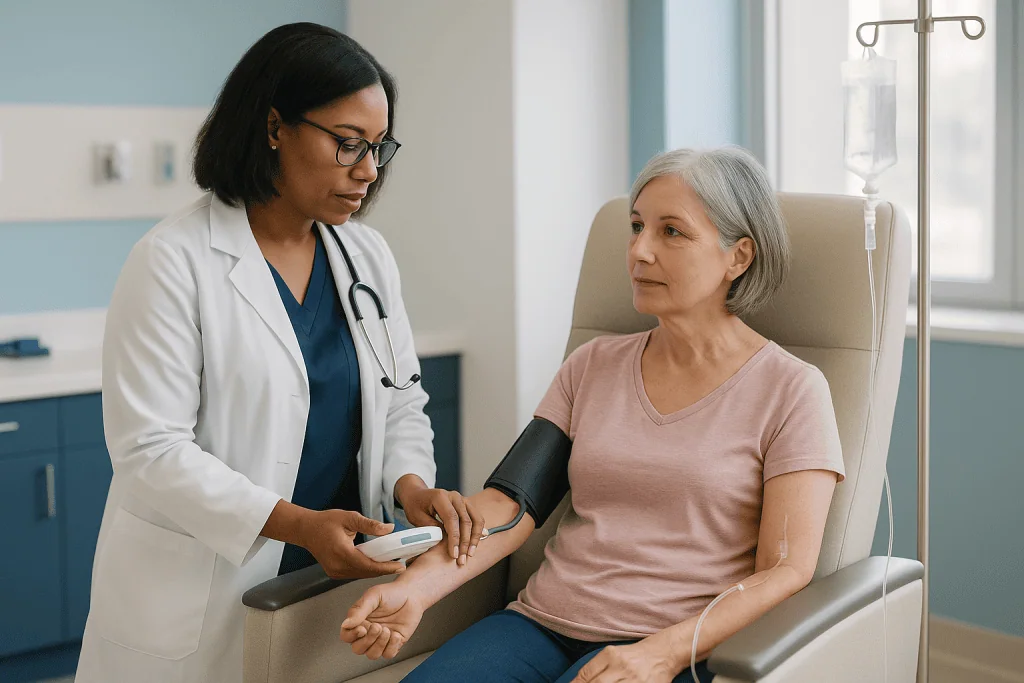
Before the first drop, a baseline set of vital signs is recorded, along with your weight and often a quick review of how you have been feeling, whether you have had a fever or infection recently, and whether you have kept up your fluids. Recent infection matters because it can raise the chance of a reaction, and some teams will postpone an infusion in someone who is acutely unwell.
During the infusion, vital signs are rechecked at each rate increase and at set intervals in between, with the closest attention paid to the first hour. The nurse is watching for a rising temperature, a falling or climbing blood pressure, a faster pulse, breathing changes and anything you report, from an itch to a headache. Skin is checked for hives or flushing.
The cannula site gets its own attention. Swelling, coolness or pain around the tube can mean the fluid is leaking into surrounding tissue rather than the vein, a problem called extravasation, which is fixed by stopping the pump and re-siting the line.
After the bag finishes, most centers keep you for a short observation period before removing the cannula. Delayed reactions are less common than immediate ones, but a final set of vital signs and a few quiet minutes are a low-cost way to catch them. You are then given instructions on fluids, symptoms to watch for at home and who to call overnight.
Who IVIG is usually for, and who is usually asked to wait
IVIG has two broad jobs, and the reason you are receiving it changes how the day and the months ahead look.
The first job is replacement. People with primary immunodeficiency, a group of inherited conditions in which the body makes too few working antibodies, receive IVIG on a regular cycle so that their antibody levels never fall low enough to leave them exposed to infection. The National Institutes of Health describes immunoglobulin replacement as a mainstay for many of these disorders. Some people whose antibody production has been lowered by cancer treatments or other medicines fall into a similar category.
The second job is immune modulation, meaning calming an immune system that has turned on the body. Guillain-Barré syndrome, a sudden autoimmune attack on peripheral nerves, is one well-established use; NHS guidance describes IVIG as a standard treatment. Immune thrombocytopenia, in which the immune system destroys platelets, is another, particularly when a rapid rise in platelet count is needed, as Mayo Clinic notes. Kawasaki disease in children, an inflammation of blood vessels, is treated with IVIG to lower the risk of heart artery damage. Chronic inflammatory demyelinating polyneuropathy and several other conditions also appear in specialist guidelines.
Who is asked to wait? Anyone with an active fever or infection may be rescheduled. People with reduced kidney function, a history of blood clots, heart failure, or a known severe reaction to immunoglobulin need extra evaluation and may be offered a different product, a slower plan or an alternative such as subcutaneous immunoglobulin, which is given under the skin. None of these are decisions a patient makes alone; they belong to the prescribing team, who weigh your history against the reason for treatment.
Typical session lengths and course patterns at a glance
The table below is a map, not a schedule. Every figure is a typical pattern drawn from the cited patient and clinical resources, and your own plan may differ for good reasons.
| Situation | Typical single-session length | Typical course pattern | Source |
|---|---|---|---|
| Established, well-tolerated infusion | Roughly two to four hours | Repeated on a regular cycle set by the prescriber | Cleveland Clinic |
| First-ever infusion or new product | Longer, because the rate begins low and rises in small steps | Pace usually shortens on later visits if tolerated | Cleveland Clinic; NIH clinical summary |
| Guillain-Barré syndrome | Daily infusions | Typically given over about five days | NHS |
| Kawasaki disease | Usually a single infusion, often overnight in hospital | Ideally started within ten days of symptom onset | NHS |
| Primary immunodeficiency replacement | Roughly two to four hours | Repeated every few weeks because antibodies are cleared over time | Cleveland Clinic; NIH |
Two patterns stand out. Conditions treated for an acute crisis, such as Guillain-Barré syndrome, tend to involve a short, intense run of daily infusions and then stop, with recovery measured over subsequent months. Conditions treated for replacement involve shorter, gentler sessions repeated indefinitely, timed to how quickly the body clears the antibodies. The clinical summary in the National Library of Medicine puts the half-life of infused immunoglobulin at around three weeks, which is why replacement cycles cluster in that range.
What the table cannot show is you. Body size, kidney function, previous reactions and the product chosen all nudge the numbers. Treat it as a way to ask better questions rather than as a promise about your calendar.
What to expect during an IVIG infusion: how the hours pass
Most of an IVIG session is uneventful, and the boredom surprises people more than anything else. Once the cannula is in and the pump is running, you are largely free to read, work, nap or talk, as long as the arm with the line stays reasonably still.
The early stretch is the most attentive. Expect the nurse back frequently in the first hour, and expect to be asked the same questions more than once: any headache, any chills, any itching, any tightness in the chest. Answer honestly and quickly rather than waiting to see if it passes. A small symptom reported early is handled by slowing the pump; the same symptom reported an hour later is harder to manage.
Many people describe a mild coolness in the arm as the fluid enters, and some feel a heaviness or dull ache along the vein, especially with faster rates. Flushing of the face and a warm sensation are common and usually settle when the rate is reduced. If you were given a pre-infusion medicine such as an antihistamine, you may feel drowsy, which is another reason not to plan on driving yourself.
Hydration is a running theme. Teams often encourage fluids in the day before and during the session because good hydration is thought to lower the chance of headache and to protect the kidneys, which filter the extra protein load. Some people receive intravenous fluids alongside the immunoglobulin for the same reason.
Bathroom trips are allowed, pump and pole in tow. Meals are usually fine; bring snacks, since the hours pass more slowly on an empty stomach. Dress in layers, because both chills and flushing can arrive without much warning.
IVIG infusion side effects, and is IVIG hard on your body?
Is IVIG hard on your body? For most people, no, though the first infusions can feel like a mild flu, and a small number of people experience more serious problems that deserve plain description.
The common reactions cluster around the infusion itself and the following day: headache, fatigue, low-grade fever, chills, muscle aches, nausea and flushing. Cleveland Clinic describes these as the most frequent effects and as generally mild and short-lived. They are strongly linked to infusion rate, to being dehydrated, and to having a current infection, which is why slowing the pump, drinking fluids and postponing treatment during illness are the standard responses.
Less common but well documented is aseptic meningitis, an inflammation of the membranes around the brain that is not caused by infection. It usually appears within a day or two of an infusion as a severe headache with a stiff neck, sensitivity to light and vomiting, and it typically resolves over a few days once recognized. The National Library of Medicine clinical summary lists it among the recognized reactions.
Rarer still are the effects that make the pre-infusion screening matter. Immunoglobulin thickens the blood slightly and, in people who already have risk factors, has been associated with blood clots. It can strain the kidneys, particularly in older adults, those with existing kidney disease or dehydration, and with certain product formulations. Hemolysis, the breakdown of red blood cells, can follow larger doses. Severe allergic reactions are uncommon but are the reason the cannula stays in until observation is complete.
The honest framing is this: for a person with a clear indication, guidelines regard IVIG as a treatment whose risks are manageable with careful screening and a slow start. That is a statement about process, not a promise about you, which is why the checks exist.
How will you feel after your first IVIG infusion, and should you rest?
The first evening after a first infusion is when most questions arrive, usually by text to whoever drove you home. Here is what patient resources and clinical summaries consistently describe.
Many people feel tired and a little washed out, as if they are coming down with something. A headache is the most common complaint, sometimes starting during the infusion and sometimes hours later. Aches, chills and a low fever can join it overnight. For most, these symptoms are mild and fade over one to two days, and they tend to become less noticeable with subsequent infusions of the same product.
Should you rest? There is no rule that requires bed rest, and gentle movement is generally encouraged, but the sensible reading of the evidence is to plan a light day. Clear the evening. Do not schedule anything that depends on you feeling sharp. If you were given an antihistamine beforehand, drowsiness alone is reason enough to take it easy. Keep drinking fluids into the next day, since dehydration is one of the modifiable drivers of post-infusion headache.
Moving around matters for a specific reason. Because immunoglobulin can nudge blood toward clotting in susceptible people, long stretches of immobility right after treatment are worth avoiding. A short walk, stretching the legs and staying hydrated are simple, low-effort habits. If you have a history of clots, your team may have given you more specific instructions.
Some people feel entirely normal and go back to work the same afternoon. That is common too, and it is not a sign the treatment is not working. How you feel on the day says little about what the antibodies are doing over the following weeks.
How long does IVIG take to work, and how often is it given?
How long IVIG takes to work is a different question from how long the infusion takes, and the answer depends almost entirely on the job the antibodies have been asked to do.
For immune thrombocytopenia, the effect can be rapid. Mayo Clinic describes IVIG as an option when a quick rise in platelet count is needed, and that rise often becomes visible on blood tests within days. The effect is temporary, however, which is why it is typically used to manage a dangerous drop or to prepare for surgery rather than as a long-term strategy on its own.
For Guillain-Barré syndrome, the infusion course finishes within about five days, according to NHS guidance, but recovery of nerve function unfolds over weeks to months. The treatment is thought to shorten the illness and reduce its severity; it does not switch symptoms off at the end of the last bag.
For replacement in primary immunodeficiency, the goal is prevention, so the honest measure is what does not happen: fewer serious infections over the following months and years. You may not feel anything change after the first infusion, and that is expected. Antibody levels build toward a steady state over several cycles.
How often is IVIG given? For replacement, the schedule is tied to the roughly three-week half-life described in the National Library of Medicine clinical summary, so infusions recur every few weeks and are adjusted based on blood levels and infection history. For inflammatory conditions, frequency ranges from a single course to periodic maintenance, and it is reviewed against your response. The frequency is a prescribing decision, revisited as your condition evolves.
The days and weeks after an IVIG infusion
Picture the weeks after an infusion as a slow tide rather than a switch. On the day, your bloodstream carries its highest concentration of donated antibodies. Over the following weeks that level drifts down as the proteins are naturally cleared, and if you are on a replacement schedule, the next infusion tops it up before it falls too far.
Days one to two are when post-infusion symptoms live. Headache, fatigue and aches, if you get them, usually peak here and fade. This is also the window for aseptic meningitis, so a headache that is severe, worsening or accompanied by a stiff neck and light sensitivity is worth a same-day call rather than a wait-and-see.
The first week is often when people feel most like themselves. For those on replacement, some describe more energy and fewer minor infections in the early part of the cycle, though this is anecdotal and varies widely. For those treated for an acute inflammatory condition, this week is spent following the underlying illness rather than the treatment.
Toward the end of a replacement cycle, a minority of people notice a return of fatigue or more frequent infections before the next infusion. This so-called wear-off is one of the things prescribers ask about, because it can prompt a change in frequency or a switch to subcutaneous immunoglobulin, which delivers smaller amounts more often and keeps levels steadier.
Blood tests punctuate the timeline. Antibody levels, kidney function and, for some conditions, platelet counts or nerve assessments are checked at intervals to make sure the plan is doing what it should. Keep a simple diary of infections, symptoms and how each infusion felt; it is the most useful thing you can bring to a follow-up appointment.
What people often get wrong about IVIG
Misunderstandings about IVIG tend to come from reasonable places, which makes them stick. A few deserve correcting.
A longer infusion is not a worse one. People sometimes compare notes and worry that their four-hour session means something is wrong when a neighbor finishes in two. Duration reflects volume, product, tolerance history and how cautious the plan is. It is not a grade.
Feeling nothing does not mean it failed. For replacement therapy, the whole point is to prevent infections that would otherwise have happened. An uneventful month is the treatment working. For inflammatory conditions, improvement is measured in weeks on clinical assessments, not in how the evening after the infusion felt.
IVIG is not a vaccine and does not train your immune system. It lends antibodies that are used up and cleared over weeks. That is why it must be repeated for replacement and why, as CDC guidance on vaccine timing notes, recent immunoglobulin can interfere with the response to certain live vaccines, a scheduling detail your team will manage.
It is not a blood transfusion in the everyday sense. No red cells are given, and the product is highly purified and treated to inactivate viruses. The donor pool is screened, and the manufacturing steps are the reason modern products carry a very low infection risk.
Reactions are not allergies by default. Most infusion reactions are rate-related and respond to slowing the pump; true allergic reactions are uncommon. Labeling yourself allergic after one episode of chills can needlessly close a door, so let the team characterize what happened.
Finally, it is not a treatment for everything immune-related. It is used where evidence and guidelines support it, and it is increasingly scrutinized precisely because it is a finite, donor-dependent resource.
Questions to ask your care team
A good infusion plan survives questions. These are the ones that tend to change the experience most, grouped by when they are most useful to ask.
Before the first session: Why has IVIG been chosen for my condition, and what would we expect to see if it is helping? How long should I plan to be at the center for the first visit, and how might that change later? Is there a specific product I will receive, and what happens if it is switched? Should I take my usual medicines that morning? How much should I drink beforehand, and is there anything I should avoid?
About the infusion itself: What is my starting rate and target rate, and what would make you slow down or stop? Will I be given anything beforehand to reduce reactions, and will it make me drowsy? How long will I be observed afterward? Who do I call if a headache or fever starts at home tonight?
About the bigger picture: How often will infusions repeat, and what will you measure to decide whether the interval is right? Would subcutaneous immunoglobulin, given under the skin at home, be an option for me later, and what are the trade-offs? Do I have any risk factors for clots or kidney strain that change the plan? Are there vaccines I should time differently around infusions?
About the reason for treatment: What are the alternatives if IVIG does not suit me or stops helping? How will we know when to reassess or stop?
Write the answers down, or ask whether they can be added to your printed after-visit summary. The first session is long enough to forget half of what you were told before the cannula is even out.
When to call your doctor
Most people finish an IVIG infusion and have a quiet, slightly tired evening. A few will need to make a call, and knowing which symptoms warrant it removes the guesswork.
Seek emergency care right away, without waiting to reach your infusion team, for any of the following: difficulty breathing, wheezing or a feeling of the throat closing; swelling of the face, lips or tongue; chest pain or pressure; sudden weakness or numbness on one side, facial drooping or trouble speaking, which can signal a stroke; sudden severe shortness of breath or coughing up blood, which can signal a clot in the lung; or a painful, swollen, warm calf or arm, which can signal a clot in a limb.
Call your care team the same day for a severe or worsening headache, especially with a stiff neck, vomiting or sensitivity to light, since these can indicate aseptic meningitis; a fever that is high or persists beyond the first day or two; dark or reddish urine, yellowing of the skin or eyes, or unusual paleness and fatigue, which can point to red cell breakdown; passing much less urine than usual or noticeable swelling of the legs, which can point to kidney strain; a widespread rash or hives; or redness, pain, warmth or pus at the cannula site.
Also let the team know about milder symptoms that do not settle within a couple of days, or about any reaction during the infusion that you would rather not repeat. That information changes how the next session is planned.
None of this is meant to make the evening anxious. The list exists because the serious problems are uncommon and treatable when caught early, and because the people who prescribed and gave your infusion want to hear about them. The decisions about slowing, pausing, switching or continuing treatment rest with them, and the fastest way to help them make good ones is to call.
Frequently asked questions
How long does an IVIG infusion take for a first-time patient?
Longer than later sessions, often most of a day including check-in and observation. First infusions begin at a lower rate and increase in smaller, more cautious steps, and any mild reaction is managed by slowing the pump, which adds time. Cleveland Clinic describes established infusions as roughly two to four hours; plan for more the first time and ask your team for their estimate.
Should you rest after an IVIG infusion?
Plan a light day rather than strict bed rest. Fatigue, headache and aches are common in the first one to two days, and any pre-infusion antihistamine can cause drowsiness, so avoid driving and demanding tasks. Gentle movement and good hydration are generally encouraged, partly because prolonged immobility is best avoided when clot risk is a consideration. Follow any specific instructions from your team.
How will you feel after your first IVIG infusion?
Many people feel tired and slightly flu-like, with headache the most common complaint, sometimes arriving hours later. Chills, aches and a low fever can occur overnight and usually fade within a day or two. Others feel entirely normal. How you feel on the day does not reflect whether the antibodies are doing their job over the following weeks.
What is the success rate of IVIG infusions?
There is no single success rate, because IVIG treats very different conditions with different goals. For primary immunodeficiency, success means fewer serious infections over time; for Guillain-Barré syndrome, it means a shorter, less severe illness; for immune thrombocytopenia, a temporary rise in platelets. Guidelines support its use in these settings, but individual response varies and your team will define what to measure.
Is IVIG hard on your body?
For most people it is well tolerated, with mild, rate-related effects such as headache and fatigue that lessen with subsequent infusions. Serious effects, including aseptic meningitis, blood clots, kidney strain and red cell breakdown, are uncommon and are the reason for pre-infusion screening, hydration and the slow start. Your history of kidney disease or clots shapes how your team plans the infusion.
What to expect during an IVIG infusion?
Expect a cannula in your hand or arm, a pump that starts slowly and speeds up in steps, and a nurse checking blood pressure, pulse and temperature at each change. You can read, work or nap. Mild coolness or ache in the arm and facial flushing are common. Report any headache, itching or chest tightness immediately so the rate can be adjusted.
How long does IVIG take to work?
It depends on the condition. In immune thrombocytopenia, platelet counts often rise within days, though temporarily. In Guillain-Barré syndrome, the infusion course lasts about five days but nerve recovery takes weeks to months. For immunodeficiency replacement, the benefit is prevention, measured as fewer infections over months, and antibody levels build over several cycles.
How often is IVIG given?
For replacement in primary immunodeficiency, infusions typically recur every few weeks, matching the roughly three-week half-life of infused immunoglobulin described in the NIH clinical summary. For inflammatory conditions, frequency ranges from a single course to periodic maintenance and is adjusted based on response. The interval is a prescribing decision reviewed against blood tests and how you feel.
Why does the nurse keep checking my blood pressure during IVIG?
Because changes in blood pressure, pulse, temperature or breathing are the earliest measurable signs of an infusion reaction, and they are most likely at rate increases and in the first hour. Catching a small change early lets the nurse slow the pump before symptoms escalate. Checks become less frequent once you are stable at the target rate.
Can I drive myself home after an IVIG infusion?
Ask your team, but many centers advise against it, especially for the first infusion. Pre-infusion antihistamines can cause drowsiness, and fatigue or headache can develop during the drive. Arrange a companion or other transport for early sessions, and reassess once you know how your body responds to the product.
References
- NIH National Library of Medicine: Intravenous Immunoglobulin (StatPearls)
- NHS: Guillain-Barré syndrome: Treatment
- NHS: Kawasaki disease: Treatment
This article is for general information only and is not a substitute for professional medical advice. Please consult a qualified doctor about your individual situation.

More from the Blog

How to Sleep (and Live) with a Kidney Stent
Most people sleep better with a kidney (ureteral) stent by lying on the side opposite the stent or slightly propped up, emptying the bladder…

Tube Feeding vs IV Nutrition in Clinical Nutrition Therapy: When Doctors Use Each Option
Tube feeding (enteral nutrition) delivers liquid formula into the stomach or small intestine through a tube, while IV nutrition (parenteral nutrition) infuses nutrients directly…

Hardware Removal Surgery: When Plates and Screws Should Come Out
Most orthopedic plates and screws are designed to stay in the body permanently and never need removal. Hardware removal surgery is usually considered only…

Flying with a DVT, Compression Stockings and Prevention
Most people can fly with a DVT once they are established on anticoagulant treatment and their symptoms are stable, but the timing is an…

Living With a Central Venous Port: Showering, Swimming, Flushing Schedules and Travel
Living with a chemo port is mostly a matter of protecting the skin over it and keeping the line clear. Once the incision has…

The Three Types of Cataracts and What Vision Looks Like with Them
The three main types of age-related cataract are nuclear (clouding in the lens center, which slowly yellows and dims vision), cortical (wedge-shaped streaks at…