

How Often Can You Have a Gentle Chemical Peel? Spacing Sessions for Steady Results
Key Takeaways
- Mayo Clinic guidance places light chemical peels at an interval of two to five weeks in a series, medium peels at three to nine months, and deep peels as a one-time procedure.
- Cleveland Clinic gives healing times of one to seven days for light peels, seven to fourteen for medium and fourteen to twenty-one for deep, with deep-peel redness lasting months.
- Oral isotretinoin taken within the previous six months is a standard reason to postpone any chemical peel, because the medicine thins skin and slows healing.
- Pigment changes after peels, both darkening and lightening, are more common in darker skin tones and are the main reason clinicians favor gentler agents and longer gaps for those patients.
- Peels do not tighten sagging skin, fill deep folds or remove pitted scars, so no frequency of superficial peels will address those concerns.
- Daily leave-on acids and retinoids draw on the same skin-barrier reserve as professional peels, so home routine and in-office schedule need to be planned together rather than separately.
For a gentle (superficial) chemical peel, clinicians typically space sessions about two to five weeks apart, often as a short series of several treatments followed by occasional maintenance. Medium-depth peels are usually repeated no sooner than three to nine months, and deep peels are generally performed only once. The right interval depends on your skin's healing, your goals and your treating clinician's assessment.
Three weeks after her first peel, Priya is standing at the bathroom mirror, tilting her chin under the light. The flaking stopped days ago. Her skin looks a little brighter, a little smoother, and the small brown marks along her jaw from last winter’s breakouts seem quieter than before. Her thumb hovers over the booking app. Book another one now, while the momentum is good? Or wait?
That pause is where a lot of people land, and it is the right instinct. The question of how often to get chemical peels has a surprisingly clear answer in the mainstream literature, but it is buried under marketing packages, social media schedules and the assumption that more frequent must mean more effective. It does not.
Skin heals on a biological clock, not a calendar one. Understanding that clock, and what a peel actually asks of your skin, is the difference between steady, cumulative results and a face that is perpetually irritated.
What actually happens to your skin during a gentle chemical peel?
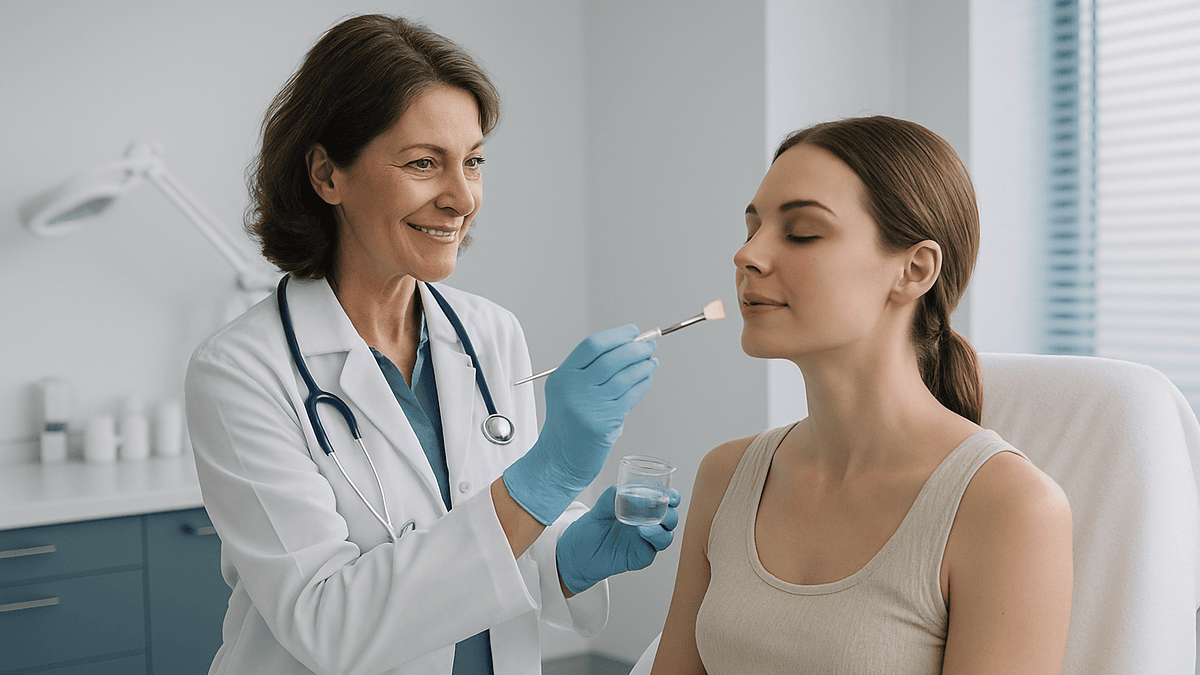
A chemical peel is a controlled injury. A clinician applies an acid solution to cleansed skin, the acid loosens the bonds between cells in the outer layers, and over the next several days those layers shed and are replaced. That is the whole mechanism, and the depth of the injury is what separates a lunchtime treatment from a procedure that requires sedation.
Gentle peels are called superficial or light peels because they work within the epidermis, the outermost layer of skin that you can see and touch. The Mayo Clinic describes light peels as removing the outer layer of skin to improve texture and tone and to soften fine lines, with results that are subtle at first and build with repetition (Mayo Clinic). The acids most often used at this depth are alpha hydroxy acids such as glycolic or lactic acid, which are water-soluble and derived from sugars and milk, and beta hydroxy acid, usually salicylic acid, which is oil-soluble and can reach into pores.
During the session, the solution sits on the skin for a set number of minutes. You may feel warmth, tingling or a mild sting. The clinician then neutralizes or removes it. Some medium and deeper peels produce a temporary white film on the skin called frosting, a sign the acid has reached a certain depth; a gentle peel usually does not (PubMed Central review, Soleymani et al.).
What happens afterward is the useful part. The visible shedding is only the surface story. Underneath, the removal of the outer layer signals the skin to speed up cell production, and repeated superficial peels are thought to encourage a more even distribution of melanin, the pigment that gives skin its color, which is why they are commonly used for uneven tone. None of this is instant. The remodeling takes place over the weeks between sessions, which is exactly why spacing matters.
How often to get chemical peels: what the evidence actually says
Here is the number most people are looking for. The Mayo Clinic states that a light chemical peel may be repeated every two to five weeks until you reach the results you want, while a medium peel can be repeated after three to nine months to maintain results, and a deep peel is typically performed only once (Mayo Clinic). The Cleveland Clinic gives the same range for light peels, with healing described as taking one to seven days (Cleveland Clinic).
Why that gap? The outer skin renews itself on a cycle commonly quoted at around a month in younger adults, slowing with age. A superficial peel accelerates that turnover, but it also uses up some of the skin’s reserve. Peel again too soon and you are exfoliating skin that has not yet finished rebuilding its barrier, the thin lipid-and-protein layer that keeps water in and irritants out. The result is not faster improvement; it is stinging, redness, sensitivity to your usual moisturizer and, in people with darker skin, a real risk of the very discoloration you were trying to treat.
The two-to-five-week window is deliberately wide because skin varies. Someone with oily, resilient skin having a very mild salicylic peel for congestion might comfortably sit at the shorter end. Someone with thin, dry or reactive skin, or anyone whose previous peel left them red for longer than expected, will usually be asked to sit at the longer end or beyond.
In practice, most clinicians plan a gentle peel as a short series, then a pause. The review by Soleymani and colleagues describes superficial peels as repeated at regular intervals of a few weeks in a course, with the exact interval set by the agent, the concentration and the individual’s response (PubMed Central). If your clinician suggests a different rhythm from the one you read online, that is not a red flag. It usually means they are reading your skin rather than a schedule.
Light, medium and deep peels compared: spacing, downtime and what they treat
The word peel covers three quite different procedures, and the frequency question only makes sense once you know which one you are talking about. The table below draws on Mayo Clinic and Cleveland Clinic patient guidance.
| Peel depth | Layer reached | Typical agents (by class) | Usual healing time | How often it is usually repeated | Commonly used for |
|---|---|---|---|---|---|
| Light (superficial) | Outer epidermis | Alpha hydroxy acids, salicylic acid, low-strength trichloroacetic acid | 1–7 days (Cleveland Clinic) | Every 2–5 weeks in a series (Mayo Clinic) | Uneven tone, mild acne, rough texture, fine lines |
| Medium | Epidermis into upper dermis | Trichloroacetic acid, sometimes combined with glycolic acid | 7–14 days (Cleveland Clinic) | After 3–9 months if needed (Mayo Clinic) | Moderate wrinkles, acne scarring, sun damage, uneven pigment |
| Deep | Mid to lower dermis | Phenol | 14–21 days, redness for months (Cleveland Clinic, Mayo Clinic) | Once (Mayo Clinic) | Deeper wrinkles, precancerous growths, deeper scars |
Two things stand out. First, the trade-off is not linear. A medium peel is not twice as strong as a light one; it is a different procedure with a week or two of visible peeling, swelling and crusting. A deep peel is a genuine operation, performed with sedation and heart monitoring because phenol absorbed through the skin can affect the heart, kidneys and liver (Mayo Clinic). Second, the spacing rule runs opposite to intuition: the gentler the peel, the more often it can be repeated, and the less each single session does.
This is why a series of light peels and one medium peel are not interchangeable. They suit different concerns, different skin types and different tolerances for downtime. Someone who cannot take a week off from a public-facing job, or whose skin is prone to pigment changes, may be better served by the slower cumulative path, and a clinician should be able to explain why one route fits you rather than the other.
Who gentle peels are usually for, and who is usually asked to wait
Superficial peels are most often recommended for concerns that live in the top layers of skin: uneven tone from sun exposure, the brown marks that linger after acne (known as post-inflammatory hyperpigmentation), rough texture, mild active acne and the faint lines that appear when skin loses some of its water content. The Mayo Clinic notes that peels are less effective for deep wrinkles and cannot tighten sagging skin or remove deep scars (Mayo Clinic). If those are your main concerns, a peel schedule of any frequency will disappoint, and a frank clinician will say so.
Skin color matters to the conversation, not as a barrier but as a planning factor. People with darker skin tones are more likely to develop uneven darkening or lightening after a peel, particularly after medium and deep procedures (Mayo Clinic). Many clinicians will therefore favor very gentle agents, longer intervals and a careful first test session for patients with deeper skin tones. That caution is a sign of good practice, not of a lesser service.
Several groups are usually asked to wait or to avoid peels altogether, at least for now:
- Anyone who has taken oral isotretinoin, an acne medicine that thins the skin and slows healing, within the past six months (Mayo Clinic).
- People with an active cold sore, a current skin infection, open wounds or a fresh sunburn on the treatment area.
- Those with a personal or family history of keloids, which are thick raised scars that grow beyond the original wound.
- People who are pregnant or breastfeeding, for whom safety data are limited and most clinicians defer treatment (Cleveland Clinic).
- Anyone with an inflammatory skin condition such as eczema, psoriasis or rosacea flaring on the face.
- People who have had recent facial surgery or radiation to the area.
A history of cold sores does not rule a peel out, but it changes the plan; clinicians may discuss antiviral medication before treatment because a peel can trigger an outbreak (Mayo Clinic). Whether that is appropriate for you, and how it is arranged, is for the prescribing clinician to decide. Your job is to mention the history.
How many chemical peels do you need before you notice a change?
The honest answer is that one gentle peel is a preview, not a result. The Mayo Clinic describes light peel outcomes as subtle at first and increasing with repeated treatments (Mayo Clinic). Most people who are pleased with superficial peels describe the change arriving gradually across a series rather than after a single appointment.
How long a series? There is no guideline-mandated number, and anyone quoting a fixed count for everyone is selling a package rather than assessing your skin. Clinical reviews typically describe a course of several superficial peels at intervals of a few weeks, with the number determined by the concern being treated and the response along the way (PubMed Central). Post-acne marks in a person who is still breaking out will need longer, and possibly a parallel acne treatment plan, than mild dullness in someone whose skin is otherwise settled.
A useful way to think about it: you are not counting peels, you are watching for a plateau. Early sessions usually produce the most visible shift, because there is more surface irregularity to remove. Later sessions refine. At some point, usually after a handful of treatments, the change between one session and the next becomes hard to see. That plateau is the natural stopping point for the active series and the moment to discuss a maintenance rhythm, which for many people means an occasional peel rather than a standing monthly booking.
Photographs help enormously here. Skin changes slowly enough that memory is unreliable, and the mirror flatters or punishes depending on lighting and mood. A consistent photo taken in the same spot before each session lets you and your clinician judge whether the series is still earning its keep. If it is not, continuing at the same frequency will not change that; a different approach, or accepting that a peel is not the right tool for what remains, is the more honest next step.
Chemical peel aftercare timeline: what the following days usually look like
People often ask what the worst day after a chemical peel is, and the answer depends on depth. For a gentle peel, there is rarely a dramatic worst day; there is a mildly awkward stretch. The Cleveland Clinic puts healing from a light peel at one to seven days, with redness followed by flaking or dryness that is often described as looking like a mild sunburn (Cleveland Clinic).
In broad strokes, and with the caveat that individual skin varies:
- The first evening: skin may feel tight, warm and slightly pink. Makeup is usually discouraged until the next day, though this varies with the peel and your clinician’s instructions.
- Days two to four: this is when visible flaking, if any, tends to appear, most often around the mouth and nose where skin moves most. For many people this is the least convenient window rather than an uncomfortable one.
- Days five to seven: flaking resolves, and the new surface looks smoother and more even. Sensitivity to fragrance, active skincare ingredients and heat can linger a little longer.
Medium peels are a different story: expect swelling, redness, crusting and darkened patches that shed over seven to fourteen days, and the Cleveland Clinic notes deep peels take fourteen to twenty-one days to heal, with redness persisting for months (Cleveland Clinic).
Two rules dominate aftercare for every depth. Do not pick, peel or scrub. Skin that is pulled off before it is ready is skin that scars or discolors. And protect the new surface from the sun every day. The Mayo Clinic advises daily sunscreen after a peel because freshly peeled skin is more vulnerable to sun damage (Mayo Clinic); the CDC recommends broad-spectrum sunscreen of SPF 15 or higher, reapplied at least every two hours outdoors, alongside shade and hats (CDC). Gentle cleanser, a bland moisturizer and patience cover almost everything else. Your clinician’s written instructions override any general guidance, including this article.
How long does a chemical peel last once the series is done?
Superficial peels do not produce permanent results, and it is worth being clear-eyed about why. A light peel removes the outer layer of skin and encourages faster renewal, but it does nothing to stop the processes that made the surface uneven in the first place: continued sun exposure, ongoing acne, hormonal pigment changes and the ordinary slowing of cell turnover with age. The Mayo Clinic notes that results from light peels are subtle and increase with repetition, and that new sun damage can undo the improvement in tone (Mayo Clinic).
So the honest answer to how long a chemical peel lasts is: as long as the conditions that caused the problem stay controlled. Someone who completes a series for post-acne marks and then keeps their acne well managed and wears sunscreen may hold the improvement for a long time with only occasional touch-ups. Someone who completes the same series and returns to unprotected sun exposure will watch the unevenness return, not because the peel failed but because the skin kept doing what skin does.
Medium peels last longer per session because they reach the upper dermis, the deeper layer where collagen lives, and the Mayo Clinic describes repeating them after three to nine months to maintain results (Mayo Clinic). A deep peel is described as producing longer-lasting change and is generally done once, at the cost of weeks of recovery and a real medical risk profile.
For most people considering gentle peels, the practical framing is maintenance rather than permanence. After the active series, a clinician may suggest an occasional peel spaced further apart than the initial two-to-five-week rhythm, adjusted to how your skin behaves through the seasons. There is no evidence-based universal maintenance interval; there is a sensible principle, which is to peel only when there is something for the peel to address, and to spend the rest of the time protecting what you have gained.
Can you do chemical peels too often? Where the ceiling sits
Yes, and the consequences are more than cosmetic irritation. Every peel temporarily weakens the skin barrier. Given enough time, the barrier rebuilds stronger and smoother. Denied that time, it rebuilds badly. The Mayo Clinic’s stated minimum for repeating a light peel is two weeks (Mayo Clinic), and that floor exists because the epidermis needs at least that long to restore a functional outer layer after even a superficial injury.
What over-peeling looks like in practice:
- Persistent redness that no longer settles between sessions.
- Stinging from products that used to feel neutral, including plain moisturizer or water.
- A shiny, tight, almost waxy surface that some people mistake for glow but is actually a stripped barrier.
- New dark patches, particularly in people with medium or darker skin, as repeated inflammation triggers excess melanin production.
- Breakouts in someone whose acne had been calming, because a damaged barrier lets in bacteria and irritants.
The trap is that over-peeled skin can briefly look good. The first day after any peel, inflammation plumps the skin and blurs texture. Chasing that look with weekly sessions is chasing swelling, not improvement, and it tends to end with a period of no treatment at all while the skin recovers, which puts you further behind than steady spacing would have.
A related question is whether at-home acid products count toward the ceiling. They do. Daily leave-on exfoliants, weekly acid masks and professional peels all draw from the same barrier budget. Most clinicians ask patients to pause active ingredients for several days before and after an in-office peel, with the exact window set by the agent used and by your skin. If you are unsure whether your routine is compatible with your peel schedule, bring the actual bottles to the appointment. It is the fastest way to get a straight answer, and it protects you from paying for a peel your skin cannot safely receive that week.
What is the downside of chemical peels?
Every procedure has a cost beyond the fee, and it is fair to ask what you are risking. For gentle peels the list is short but real; for deeper peels it grows considerably. The Mayo Clinic and Cleveland Clinic describe the following (Mayo Clinic, Cleveland Clinic):
- Redness that outlasts the expected healing window. For light peels this is uncommon; after a deep peel, redness can persist for months.
- Changes in skin color. Peels can cause skin to become darker (hyperpigmentation) or lighter (hypopigmentation), sometimes permanently. Darkening is more common after superficial peels, lightening after deep ones, and both are more likely in people with darker skin tones.
- Scarring, usually in the lower part of the face, which may be treatable but is not always fully reversible.
- Infection, including flare-ups of the herpes simplex virus that causes cold sores in people who carry it.
- Heart, kidney or liver effects from the phenol used in deep peels, which is why those are performed with monitoring and in stages.
Then there are the quieter downsides. A peel series is a commitment of time and money that yields modest, gradual change; people expecting a transformation are often disappointed regardless of how well the procedure goes. Sun avoidance after a peel is not optional, which matters if your job or lifestyle keeps you outdoors. And a peel done on skin that is already inflamed, sunburned or reacting to a new product can make that problem worse rather than better.
The most important protective step happens before any acid touches your face: an unhurried consultation in which the clinician examines your skin, asks about your medical and medication history, and explains which peel they propose and why. The Mayo Clinic advises having peels performed by a doctor or under the supervision of one (Mayo Clinic). Regulation of who may perform peels varies by place, and the depth of a peel is not always obvious from its name. Asking who is performing yours, and what their training is, is not rude. It is the single question most likely to keep the downside list theoretical.
How often to get chemical peels if you already use acids or retinoids at home
Many people asking how often to get chemical peels already have a bathroom shelf full of exfoliating ingredients. That changes the arithmetic, because the skin does not distinguish between a professional peel and a strong nightly serum; it only registers the total demand on its barrier.
Retinoids are a class of vitamin A derivatives that speed up cell turnover and are widely used for acne and photoaging. Prescription and over-the-counter versions differ in strength, but all of them thin the outermost layer over time. This has two effects relevant to peels. It can make a peel penetrate more deeply than intended, and it can lengthen the flaking phase afterward. Some clinicians deliberately use a period of retinoid use before a series to even out penetration, a practice sometimes called priming; others ask for a pause of several days before and after each session. Both approaches appear in the literature (PubMed Central). Which applies to you, and for how long, is a decision for the clinician who knows your skin and the specific agent being used. Do not stop a prescribed medicine on your own to fit a peel appointment; tell the prescriber and the peel provider that both are in play.
Leave-on alpha or beta hydroxy acid products sit in the same category. A daily glycolic toner plus a peel every two weeks is, functionally, more exfoliation than the two-to-five-week guidance assumes. For people using these products, the practical pattern most clinicians favor is either to pause them around each professional session or to space the professional sessions toward the longer end of the range.
Vitamin C serums, benzoyl peroxide for acne and physical scrubs also count as irritants in the days around a peel. None of this means you must choose between home care and professional care. It means the schedule should be built as one plan rather than two parallel ones, and the person best placed to build it is the one applying the acid.
What people often get wrong about peel frequency
Several beliefs circulate widely enough to deserve a direct correction.
More peeling means it worked better. Not for superficial peels. Some gentle peels, particularly lower-strength alpha hydroxy or salicylic acid treatments, produce very little visible flaking and still improve texture and tone over a series. Heavy shedding after a light peel more often signals that the skin was already compromised or that the peel penetrated deeper than intended. Judge results at four weeks, not at the flake.
Weekly peels get you there faster. The Mayo Clinic’s two-week minimum for light peels exists for a physiological reason (Mayo Clinic). Weekly sessions do not compress the timeline; they interrupt the rebuilding that produces the result and raise the risk of pigment changes and prolonged sensitivity.
You have to keep going forever or lose everything. Results from superficial peels are not permanent, but they are also not erased the moment you stop. Sun protection, acne control and a gentle routine preserve most of the gain. Maintenance, when it is needed, is usually occasional rather than perpetual.
Peels are only for older skin. Peels treat concerns, not birthdays. A person in their twenties with post-acne marks and a person in their sixties with sun-related tone changes may both be reasonable candidates for gentle peels; a person of either age with the wrong skin condition active that week is not.
A stronger peel is just a better peel. Medium and deep peels treat different problems and carry substantially different risks and downtime (Mayo Clinic). For surface concerns, a series of gentle peels may reach a similar endpoint with far less risk, especially in darker skin.
You can tell the depth from the name on the menu. You cannot. Concentration, the number of layers applied, the time left on the skin and your own skin’s condition all change how deep a given product goes. Ask what depth is intended and how the clinician will judge it during the session.
Is a chemical peel really worth it?
This depends entirely on what you want and what you are comparing it against, and the evidence supports a measured answer rather than a cheerleading one.
For the concerns superficial peels are designed to address, the mainstream position is that they help. The Mayo Clinic describes light peels as improving skin texture and tone and lessening the appearance of fine wrinkles, with cumulative benefit across repeated sessions (Mayo Clinic). The Cleveland Clinic lists uneven tone, acne and rough texture among the reasons people have them (Cleveland Clinic). Published reviews of peeling agents describe superficial peels as a well-established option for these indications when performed appropriately (PubMed Central). None of these sources offer a percentage of people satisfied, and this article will not invent one.
Where peels are not worth it is equally clear. They do not lift sagging skin, fill deep folds or remove pitted scars (Mayo Clinic). If those are your priorities, the money and downtime are better directed elsewhere, and a clinician should say so at the consultation rather than after the third session.
The comparison that matters most is often not peel versus no treatment but peel versus a consistent home routine. Daily broad-spectrum sunscreen, a well-tolerated retinoid if appropriate for you and effective acne management do a great deal of the same work over a longer horizon and at lower risk. A peel series can accelerate and sharpen that work; it rarely replaces it. People who get the most from peels tend to be those who were already doing the basics and wanted a step up, not those hoping the peel would substitute for them.
One more honest note. Because gentle peel results are gradual and modest, the decision is partly about temperament. If you are the kind of person who will photograph carefully, protect the skin diligently and be pleased by steady improvement, the value proposition is reasonable. If you want a visible change by the weekend, a light peel is the wrong tool, and no frequency will make it the right one.
Questions to ask your care team before booking a series
A good consultation answers most of these unprompted. Bringing the list anyway ensures nothing is left to assumption, and the answers tell you a great deal about the person you are trusting with your face.
- Which agent are you proposing, at what depth, and why is that the right choice for my skin type and my specific concern?
- How many sessions do you anticipate before we review, and how will we decide whether to continue, adjust or stop?
- What interval are you recommending between sessions, and what would make you lengthen it?
- How will my skin tone affect the plan, and what steps will you take to reduce the risk of dark or light patches?
- Which of my current skincare products and medications should I pause before and after, and for how long? I will bring them so you can see the labels.
- I have a history of cold sores, keloids, eczema or another condition; how does that change things?
- What will the first week look like, day by day, and what would you consider outside the normal range?
- Who will actually perform the peel, and what is their training and supervision?
- What is your plan if I have a reaction, and how do I reach you outside regular hours?
- Are there alternatives to a peel for this concern, and what are their trade-offs?
Notice what is not on the list: nothing about packages, discounts or how many sessions come bundled. Those are commercial questions, and they should never drive a clinical schedule. If the recommended frequency happens to match a pre-paid bundle exactly, ask how the interval was chosen. The correct answer references your skin and the agent, not the package.
Notice too that several questions invite the clinician to tell you no, or not yet. A provider who is willing to postpone a peel because your skin is sunburned, your acne is flaring or your medication history calls for a wait is showing you exactly the judgment you want applied to every other decision in the series.
When to call your doctor
Gentle peels heal uneventfully for most people, and mild pinkness, tightness and a few days of flaking are expected. Some signs, however, sit outside that picture and warrant a same-day call to the clinician who performed the peel or to your doctor, drawing on the complications described by the Mayo Clinic and Cleveland Clinic (Mayo Clinic, Cleveland Clinic):
- Pain that is increasing rather than easing after the first day, or pain that feels deep rather than surface-level.
- Redness that is spreading beyond the treated area, becoming hot to the touch or accompanied by swelling that is getting worse rather than better.
- Blisters, open sores, weeping or yellow crusting, which can indicate infection or a deeper injury than intended.
- A cluster of small painful blisters, especially around the lips, which may be a cold sore outbreak triggered by the peel.
- Fever, chills or feeling generally unwell in the days after treatment.
- Any new areas of darkening or lightening that appear after the flaking phase has finished, particularly if they are patchy or spreading.
- Signs of an allergic reaction such as hives, facial swelling, difficulty breathing or swelling of the lips or tongue, which need emergency care immediately.
After a medium or deep peel, the threshold for calling should be lower, because the skin is more vulnerable and infection can progress quickly. Your clinician should have given you a direct contact route; use it rather than waiting for the next scheduled appointment.
Between sessions, it is also worth checking in if your skin has not returned to its normal, comfortable state by the time the next peel is due. Skin that still stings from moisturizer or looks pink at the two-week mark is telling you something about spacing, and the appropriate response is to postpone, not to push through. Every decision about whether, when and how to continue rests with your treating team, who can see your skin and know your history. This article can describe the typical picture; only they can tell you where you fall within it.
Frequently asked questions
How many chemical peels do you need to see results?
One gentle peel is a preview rather than a result; the Mayo Clinic describes light-peel benefits as subtle at first and building with repetition. There is no fixed number that applies to everyone. Most clinicians plan a short series spaced a few weeks apart and review with photographs, stopping the active course when one session no longer produces a visible change over the last. Your treating clinician sets the count based on your response.
How long does a chemical peel last?
Superficial peel results are not permanent and last roughly as long as the underlying causes stay controlled. Sun exposure, ongoing acne and normal aging gradually return the skin toward its previous state, which is why daily sunscreen and good skin management preserve the gains. Medium peels last longer per session and are repeated after three to nine months per Mayo Clinic guidance; deep peels produce more lasting change but are performed once.
Can you do chemical peels too often?
Yes. Repeating a light peel sooner than about two weeks, the minimum cited by the Mayo Clinic, prevents the skin barrier from rebuilding between sessions. Signs of over-peeling include persistent redness, stinging from bland products, a tight waxy surface, new breakouts and, especially in darker skin, new dark patches. Skin that still feels sensitive when the next appointment arrives is a reason to postpone rather than proceed.
What does a chemical peel aftercare timeline look like for a gentle peel?
For a light peel, the Cleveland Clinic gives a healing window of one to seven days. Skin is typically pink and tight the first evening, flakes or feels dry around days two to four, and settles by the end of the week. Throughout, the guidance is consistent: no picking or scrubbing, gentle cleanser and moisturizer, and daily broad-spectrum sunscreen. Written instructions from your own clinician take priority over general timelines.
What is the best age to get a chemical peel?
There is no best age, because peels treat skin concerns rather than birthdays. Younger adults commonly have gentle peels for post-acne marks or congestion; older adults more often seek them for sun-related tone changes and fine lines. Candidacy depends on the concern, skin type, current skin health and medical history, not on age. A clinician assesses whether a peel is the right tool for what you actually want to change.
What is the worst day after a chemical peel?
For a gentle peel there is rarely a dramatic worst day; the least convenient stretch is usually days two to four, when any flaking appears, most visibly around the mouth and nose. Medium peels involve a week or two of swelling, crusting and darkened shedding skin, and deep peels take fourteen to twenty-one days to heal according to the Cleveland Clinic. Pain that increases after the first day is not part of the normal pattern and should be reported.
What is the downside of chemical peels?
The main risks described by the Mayo Clinic are redness that outlasts the expected window, skin darkening or lightening that can be lasting, scarring, infection including cold sore flare-ups, and, with deep phenol peels, effects on the heart, kidneys and liver. Practical downsides include strict sun avoidance, the time and cost of a series, and modest results that disappoint anyone expecting a transformation. A thorough consultation is the best protection.
Can I have a chemical peel if I have dark skin?
Often yes, with adjustments. People with darker skin tones are more prone to post-peel darkening or lightening, so clinicians usually favor very gentle agents, longer intervals between sessions and a cautious first treatment. Medium and deep peels carry more pigment risk and are approached with particular care. Experience treating a range of skin tones is a reasonable thing to ask a provider about before booking.
Can I get a chemical peel while pregnant or breastfeeding?
Most clinicians defer chemical peels during pregnancy and breastfeeding because safety data for the acids used are limited and hormonal pigment changes during pregnancy can complicate results; the Cleveland Clinic lists pregnancy among reasons a peel may not be suitable. Tell your provider if you are pregnant, breastfeeding or planning a pregnancy, and discuss timing with them and your obstetric care team.
Is a chemical peel really worth it?
For surface concerns such as uneven tone, post-acne marks, rough texture and fine lines, mainstream sources including the Mayo Clinic describe light peels as helpful, with benefit building across a series. They are not worth it for sagging, deep folds or pitted scars, which they cannot treat. Value also depends on temperament: gradual, modest improvement suits patient people who already protect their skin daily, and the peel adds to that work rather than replacing it.
References
- Cleveland Clinic: Chemical Peels
- NHS: Chemical peels
- PubMed Central: A Practical Approach to Chemical Peels (Soleymani, Lanoue, Rahman)
- CDC: Sun Safety
This article is for general information only and is not a substitute for professional medical advice. Please consult a qualified doctor about your individual situation.

More from the Blog
What Happens in a Mesotherapy Session: Microinjections, Timing and How It Feels
A mesotherapy session is a short cosmetic procedure in which a practitioner places many tiny, shallow injections of a liquid mixture, often containing hyaluronic…

Lip Filler and Pregnancy, and What Not to Do Afterwards
Lip filler is not recommended during pregnancy. No controlled studies have tested hyaluronic acid fillers in pregnant people, so safety cannot be confirmed, and…
Reconstruction After Skin Disease: How Grafts, Flaps and Scar Revision Rebuild the Area
After a skin cancer is removed, surgeons rebuild the area in several ways: letting a small wound heal on its own, closing it directly…
Preparing for Masseter Botox: Fish Oil, Aspirin and the Questions to Answer Beforehand
Preparing for masseter botulinum toxin injections mostly means a frank conversation with the injector: list every prescribed medicine, supplement and recent illness, and never…

Flying Home After Laser Eye Surgery: Dry Cabin Air, Drops and Follow-Up Abroad
Flying after laser eye surgery is usually possible within days once the surgeon has examined the eye at the first follow-up visit, and normal…
Laser, Microneedling or Radiofrequency for Stretch Marks: How Dermatologists Choose the Method
Dermatologists choose between laser, microneedling and radiofrequency for stretch marks mainly on the mark's age and color, the person's skin tone, and how much…