

How Patching and Glasses Retrain a Lazy Eye: What Amblyopia Treatment Actually Does

Key Takeaways
- Amblyopia affects up to 3 in 100 children and is the leading cause of childhood vision loss, according to the National Eye Institute.
- The patch goes over the stronger eye, forcing the brain to use and strengthen the suppressed pathway from the weaker one.
- Glasses are worn full time first, and in refractive amblyopia they can produce substantial improvement before any patching begins.
- A large randomized trial found that a shorter daily patching schedule matched a much longer one for moderate amblyopia in young children, so more hours are not automatically better.
- Mayo Clinic reports that about half of children aged 7 to 17 still respond to treatment, with the best responses in those never treated before.
- Vision can slip after patching stops, so glasses continue and follow-up visits check both eyes for months to years afterward.
Patching treats a lazy eye by covering the stronger eye for a set number of hours each day, which forces the brain to use and strengthen the connections from the weaker eye. Glasses are usually prescribed first to give that eye a clear image. Evidence shows the approach improves vision in most young children, with benefits also possible in older children and teens, under supervision from an eye care team.
The patch is bright orange, decorated with a cartoon dinosaur, and a four-year-old is peeling it off in the car park for the third time this morning. Her father is wondering, not for the first time, whether something so low-tech can really change how a child sees. He has read that the eye is fine and the problem is in the brain, which makes the sticker on her face feel even stranger.
Understanding how patching works for lazy eye makes the routine easier to keep. Nothing is being done to the covered eye. The work happens in the visual cortex, the part of the brain that assembles what the eyes send, and it happens only while the weaker eye is doing the seeing.
This explainer walks through what amblyopia is, why glasses almost always come first, what the large clinical trials found about patching hours and age, what the first weeks look like, and where the evidence thins out. Every decision along the way rests with the eye care team who examines the child.
What a lazy eye actually is, and what it isn't
Amblyopia is the medical name for lazy eye: reduced vision in one eye (occasionally both) because the brain and that eye never learned to work together properly during early childhood. The eye itself is usually structurally healthy. The trouble sits in the wiring between eye and brain, which is why the term “lazy” misleads so many families. The eye is not idle; it has been sidelined.
According to the National Eye Institute, amblyopia is the most common cause of vision loss in children, affecting up to 3 out of every 100. The brain has a limited window, roughly the first several years of life, in which visual pathways are highly adaptable. When one eye sends a blurred, misaligned, or blocked image during that window, the brain gradually favors the clearer signal and suppresses the other.
Three situations most often set this off. Strabismus, a misalignment in which the eyes point in different directions, gives the brain two conflicting pictures. Refractive amblyopia happens when one eye is much more farsighted, nearsighted, or astigmatic than the other, so its image is chronically blurred. Deprivation amblyopia occurs when something physically blocks light, such as a congenital cataract or a droopy eyelid.
Amblyopia is not the same thing as a squint, though the two travel together. A child can have perfectly straight eyes and still have deep amblyopia from an unequal glasses prescription. That is one reason it is so often missed at home: there is nothing to see. Preschool vision screening exists precisely because the child cannot report a problem they have never experienced any other way. To them, one blurry eye is simply how the world has always looked.
How patching works for lazy eye: retraining the brain, not the eye
Cover the strong eye and the brain has no choice. The suppressed pathway from the weaker eye becomes the only source of visual information, and neural connections that were being pruned away start firing again. Vision scientists call this neuroplasticity, the brain’s capacity to reorganize in response to what it is asked to do. Patching is a deliberate, timed exploitation of that capacity.
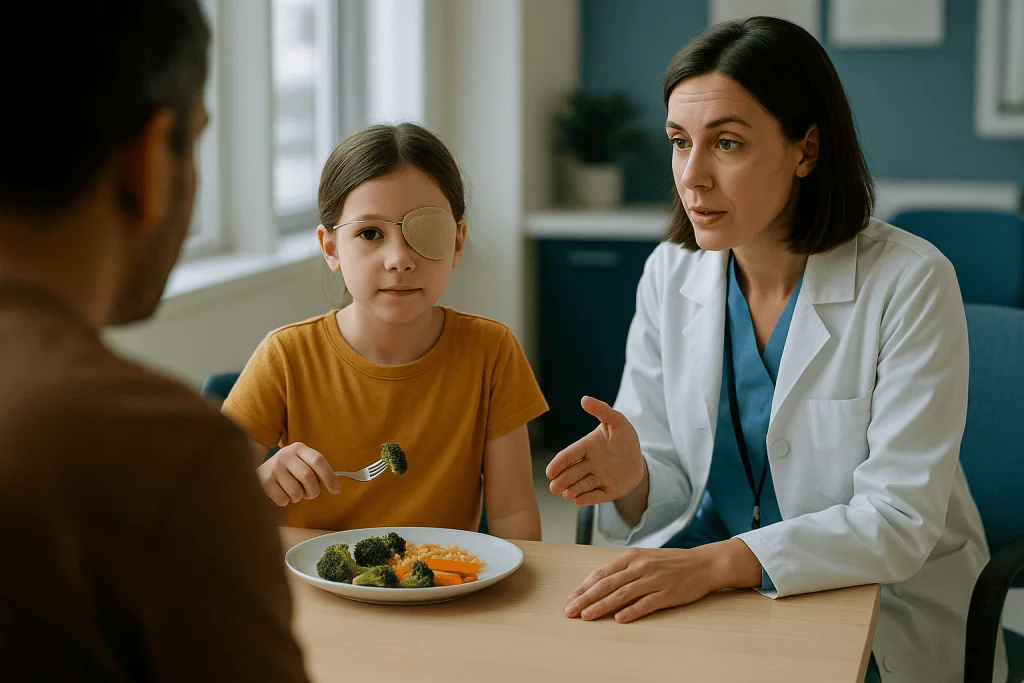
The mechanism explains several things parents notice. First, the patch goes on the good eye, which feels backwards until you understand that the goal is to make the weak eye work. Second, patching only helps while the weaker eye is genuinely being used. A child who sits with the patch on but eyes closed, or who peeks around the edge, gains little. Third, the effect is gradual. Synaptic strengthening takes repetition over weeks, not a single long session.
Mayo Clinic describes patching as typically covering the stronger eye for two to six or more hours a day, with the exact amount set by the eye care team based on how deep the amblyopia is and how the child responds. Those hours are a prescription in the truest sense: adjusted at follow-up, sometimes increased, sometimes reduced, never chosen at home.
What the brain does during patch time matters too. Near activities that demand fine detail, such as drawing, threading beads, reading, or handheld puzzles, ask the weaker eye to resolve small features and appear to make patch hours more productive. Passive screen time at a distance asks less of it. The patch creates the opportunity; the activity supplies the challenge.
None of this repairs the eye’s optics. That job belongs to glasses, which is why they nearly always come first.
Why glasses usually come first, and sometimes finish the job alone
Before any patch appears, most children are prescribed glasses and asked to wear them full time for several weeks to months. This is not a delay. Correcting the refractive error gives the weaker eye a sharp image to work with, and the brain sometimes responds to that alone. The NHS notes that glasses are usually the first treatment and that vision may keep improving with glasses for a period before patching is considered.
The logic is straightforward. If the weaker eye has been sending a blurred picture because it is significantly more farsighted than its partner, forcing the brain to attend to that blurred picture accomplishes little. Sharpen the input first. Clinicians call this optical treatment, and in refractive amblyopia it can account for a meaningful share of the total improvement.
Glasses also serve a diagnostic purpose. If vision in the weaker eye climbs steadily while a child wears them, the team knows the pathway is responsive and can gauge how much residual amblyopia remains once the optical component has been addressed. If improvement plateaus, that plateau is the starting line for patching.
Families often ask why the glasses have to be worn all day when only one eye seems to need them. Consistent wear keeps the image stable, allows the brain to adapt to the new focus, and in children with strabismus may help control the eye alignment as well. Taking them off for school photos or sports days is a common temptation and a common setback.
Glasses remain part of the plan throughout patching. The patch goes over the lens or under it, but the correction stays. Removing the glasses when the patch goes on undoes half the treatment.
Who patching is usually for, and who is usually asked to wait
Patching is generally offered to children whose weaker eye still lags after a period of full-time glasses wear, or to children whose amblyopia stems from strabismus rather than refractive error. Cleveland Clinic and the NHS both describe it as the standard treatment once optical correction alone has done what it can. Younger children with moderate amblyopia are the classic candidates because their visual systems remain highly adaptable.

Several groups are typically asked to wait, or are steered toward a different first step.
- Children still in the glasses-only phase. Starting the patch before optical treatment has plateaued muddles the picture and can add burden without extra benefit.
- Children with an untreated physical cause. A cataract or a lid drooping over the pupil must be addressed first; no amount of patching helps an eye that cannot receive light.
- Children with very mild differences between the eyes. Some may be monitored with glasses alone and reassessed.
- Children whose amblyopia is in both eyes. Patching one eye makes no sense when both need help; glasses and monitoring take priority.
Age shapes the conversation but does not close the door. The evidence, discussed later, shows that older children and teenagers can still improve, particularly if they have never been treated before. What changes with age is the likely size of the gain and the level of effort required to achieve it.
There is also the question of who does the deciding. Screening programs and primary care clinicians identify children who need assessment. The treatment plan itself comes from an ophthalmologist or orthoptist, a specialist in eye movement and binocular vision, after measuring each eye separately, checking alignment, and examining the back of the eye to rule out other causes. That examination is the gate; patching without it is guesswork.
Does eye patching really work for lazy eyes? What the trials show
Yes, for most children who begin treatment during the years when the brain remains adaptable, though the honest answer includes some conditions. The evidence base for patching is unusually strong for a treatment this simple, largely because of a series of large randomized trials run across many clinical sites over two decades.
One landmark trial compared two patching schedules in children under seven with moderate amblyopia and found that a shorter daily schedule combined with near activities produced improvement comparable to a much longer one after four months. That finding, published in a peer-reviewed ophthalmology journal and indexed on PubMed, reshaped clinical practice by showing that more hours were not automatically better. The specific schedule for any child still belongs to the treating team, because deeper amblyopia and different ages were studied separately.
Mayo Clinic summarizes the broader picture plainly: for most children with lazy eye, appropriate treatment improves vision within weeks to months. What “improves” means varies. Some children reach vision in the weaker eye that matches the stronger one. Others gain several lines on the eye chart but stop short of equality. A minority respond little, and the team then reviews whether the glasses prescription is right, whether patch time is actually being completed, or whether another approach is warranted.
Two caveats deserve emphasis. First, trial participants had verified adherence and regular follow-up; real-world results depend heavily on whether the patch actually stays on. Second, improvement measured on a chart does not automatically mean full depth perception, which depends on both eyes working together and is harder to recover, especially when strabismus is present.
So the treatment works, in the way that physical therapy works: reliably, gradually, and in proportion to the effort actually made.
How long does patching take to improve a lazy eye?
Expect months rather than weeks, and expect the pace to change along the way. Mayo Clinic states that treatment might last from six months to two years, with the earliest measurable gains often appearing within the first weeks to months of consistent patching. Those are typical ranges from a general medical reference, not promises for any individual child.
Improvement tends to follow a curve. The steepest rise comes early, when the suppressed pathway first gets meaningful use. Gains then slow, and eventually the eye chart readings level off across two or three consecutive visits. Clinicians treat that plateau as a signal, not a failure: it usually means the brain has extracted what it can from the current regimen, and the team decides whether to adjust, maintain, or begin tapering.
Several factors stretch or shorten the timeline.
- Depth of amblyopia at the start. A weaker eye that begins far behind has further to travel.
- Cause. Refractive amblyopia often responds substantially to glasses alone, leaving less work for the patch.
- Age. Younger visual systems generally move faster.
- Adherence. Patch time that is prescribed but not completed does not count, and studies consistently find that logged hours fall short of prescribed hours in many families.
Follow-up visits usually occur every few weeks to a few months during active treatment so the team can measure both eyes, check that the stronger eye is not losing ground, and confirm the glasses prescription still fits a growing child. Each visit resets the plan based on what the chart shows.
Ask the team at every appointment where the weaker eye sits relative to the last visit. A single number tracked over time tells the story more clearly than any general timeline.
Amblyopia treatment options compared: patching, drops, filters, and glasses
Patching is the best-known approach but not the only one. The table below summarizes the main options described by mainstream sources such as Mayo Clinic, the NHS, and the National Eye Institute. It is a map, not a menu; the treating team selects and sequences these based on the child’s examination.
| Approach | How it works | Typically considered when | Common trade-offs |
|---|---|---|---|
| Glasses alone | Sharpens the image reaching the weaker eye so the brain can use it | First step for nearly all children; may suffice in mild refractive amblyopia | Requires full-time wear; may plateau before vision equalizes |
| Patching | Covers the stronger eye for prescribed hours, forcing use of the weaker eye | Vision lags after glasses; strabismic amblyopia | Skin irritation, resistance from the child, small risk to the covered eye if over-patched |
| Atropine eye drops | Temporarily blurs near vision in the stronger eye so the weaker eye takes over for close tasks | Alternative when patching is refused or impractical; moderate amblyopia | Light sensitivity, blurred near vision in the good eye, prescription-only with clinician monitoring |
| Bangerter filter | A translucent film on the glasses lens degrades the stronger eye’s image | Milder cases or as a step-down from patching | Less potent; can be peeled off by children |
| Binocular digital therapies | Games or video presented differently to each eye to encourage both to work together | Under study; sometimes added alongside standard care | Evidence still developing; not a replacement for glasses or patching |
Atropine deserves a specific note. It is a medicine, applied under prescription, and its mechanism is the mirror image of patching: rather than blocking the good eye, it blurs it for near work. Trials have found it comparable to patching for moderate amblyopia in young children, and some families find drops easier to sustain than a patch. Whether it suits a particular child, and how it is used, is a decision for the prescribing clinician.
At what age is patching no longer effective? Lazy eye treatment for adults and teens
The old teaching was that the window slammed shut around age seven. The evidence has softened that considerably. Mayo Clinic notes that results are best when treatment starts before age seven, but that about half of children between seven and seventeen respond to treatment. A large multicenter trial in older children found meaningful improvement in many participants, with the strongest responses in those who had never been treated before.
What changes with age is not whether the brain can adapt but how readily. In a three-year-old, visual pathways are still being actively shaped, and gains can come quickly. In a twelve-year-old, the same pathways are more settled, so improvement is typically slower, smaller, and more dependent on sustained effort. Teenagers who have already completed a full course of patching earlier in life tend to gain less from a second attempt than those trying for the first time.
Adults occupy a different space. Amblyopia diagnosed in adulthood has usually been present since childhood, and conventional patching has limited evidence of benefit once the visual system has fully matured. Research into adult neuroplasticity, including perceptual learning tasks and binocular video approaches, is active but has not produced a standard treatment endorsed in major guidelines. An adult asking about lazy eye treatment deserves a straight answer: glasses to optimize whatever vision each eye has, protection of the stronger eye, and an honest discussion about what current research does and does not support.
The practical upshot for families is encouraging rather than discouraging. An older child who has never been assessed should still be assessed. A teenager who was told years ago that nothing more could be done may be worth re-examining. The likelihood of benefit falls with age; it does not vanish at a birthday.
What the first days and weeks of using an eye patch for kids usually look like
Day one is rarely smooth. A child who has relied on one eye suddenly loses it, and the weaker eye’s blurry world is disorienting and frustrating. Tears, patch removal, and bumping into furniture are common and expected. Most eye teams tell families to anticipate resistance for the first one to two weeks and to treat that period as establishing a habit rather than judging the treatment.
A few patterns help. Patch time tied to a fixed daily anchor, such as after breakfast or during a favorite program, becomes routine faster than time scattered across the day. Splitting the prescribed hours into two blocks can reduce battles, if the team agrees. Near activities that the child already enjoys make the hours pass and give the weaker eye detailed work to do. Older siblings or a favorite toy “wearing” a patch too can defuse the sense of being singled out.
Skin comfort matters more than parents expect. Adhesive patches can irritate the delicate skin around the eye, particularly in children with eczema. Rotating the patch position slightly, removing it gently, and using a fabric patch that slips over the glasses arm are practical alternatives the orthoptist can discuss. Any redness that persists after the patch is off is worth mentioning.
Around the second to fourth week, many families notice the fight easing and the child moving more confidently during patch time. That is the weaker eye beginning to do its job. The first follow-up visit, often within a couple of months, measures whether the chart agrees.
Keeping a simple daily log of hours actually completed, not hours intended, gives the team the information they need to interpret the chart and adjust the plan honestly.
Risks and side effects of patching a lazy eye
Patching is low-risk, which is part of why it has survived for centuries as a treatment. It is not risk-free, and the risks are worth naming plainly so families know what to watch for.
The most clinically significant concern is reverse amblyopia, sometimes called occlusion amblyopia. If the stronger eye is covered for too many hours over too long a period without monitoring, it can itself begin to lose vision. This is uncommon, usually temporary, and the main reason follow-up visits measure both eyes every time. It is also the reason patch hours are prescribed, reviewed, and adjusted rather than chosen at home, and why “more must be better” is a dangerous assumption.
Skin reactions are far more common. Adhesive can cause redness, mild rash, or small abrasions around the eye, especially with daily use in warm weather. Most settle with a change of patch type or position. A rash that spreads, weeps, or does not improve after the patch is stopped needs assessment.
Children with strabismus occasionally show a change in eye alignment during patching, either an increase in the visible turn or the appearance of a turn that was previously controlled. This is not necessarily harmful, but it should be reported at the next visit and sooner if it appears suddenly.
The emotional cost is real and underappreciated. Being the only child in class with a patch invites questions and sometimes teasing. Frustration at reduced vision during patch time can spill into behavior. Cleveland Clinic and the NHS both acknowledge that the difficulty of patching is a principal reason treatment falls short. Teams can offer school letters, decorated patches, and alternative approaches when the burden becomes too great. Raising the struggle with the team is part of the treatment, not a sign of failure.
When patching stops: weaning, monitoring, and the chance it comes back
Treatment does not end with a single decisive appointment. Once vision in the weaker eye has plateaued across consecutive visits, or has reached the stronger eye, the team usually reduces patch time gradually rather than stopping abruptly. This tapering gives the brain a chance to hold its gains as the stronger eye returns to full-time use.
Recurrence is the reason for caution. Mayo Clinic notes that lazy eye can return in some children after treatment ends, which is why monitoring continues after patching stops. The risk appears higher when patching stops suddenly from a high number of hours and when the underlying cause, such as a significant difference in glasses prescription, remains. Glasses are therefore typically continued after the patch is retired.
Follow-up after patching commonly spans months to a year or more, at intervals the team sets based on the child’s age and how stable the readings look. Each visit checks the weaker eye for any slide and the stronger eye for its own health. If vision slips, a short return to patching often restores it, and the earlier the slip is caught, the shorter that return tends to be.
Parents sometimes assume that a child who has “finished” patching no longer needs eye examinations. The opposite is true during the years when the visual system is still maturing. A child treated at four may be monitored until well into school age, precisely because the brain remains adaptable in both directions until then.
The end of patching is best thought of as a shift from active training to maintenance. The glasses stay, the appointments continue, and the family keeps an eye on whether the child covers or favors one eye in daily life.
Do lazy eye exercises, apps, or vision therapy replace patching?
Not on current evidence. This is the question where marketing and medicine diverge most sharply, so precision matters.
“Vision therapy” is an umbrella term covering supervised eye exercises, prism lenses, and computer-based tasks. For certain eye-movement and focusing disorders, some structured programs have supportive evidence. For amblyopia specifically, mainstream sources including the NHS and Mayo Clinic do not list eye exercises alone as a treatment. The mechanism of amblyopia is cortical suppression of one eye’s input, and an exercise performed with both eyes open does nothing to lift that suppression. The stronger eye simply keeps doing the work.
Binocular digital therapies are a genuinely different idea. These present slightly different images to each eye, often through a game on a tablet with special glasses, so that the child must use both eyes to succeed. The concept is sound and the research is active. Results so far are mixed: some trials show improvement comparable to patching over short periods, others show less benefit, and adherence to home-based digital treatment has proven as difficult as adherence to patching. The National Eye Institute describes these as areas of ongoing research rather than established alternatives.
Near activities during patch time are sometimes called “exercises,” which muddies the water. Drawing or reading while patched is not vision therapy; it is a way of making the weaker eye work harder while the stronger eye is blocked. The patch does the therapeutic work. The activity makes the hours count.
A reasonable position: glasses and patching or drops, under an eye team’s supervision, remain the evidence-based core. Digital binocular approaches may be offered alongside them, particularly in research settings or when standard treatment has stalled. Anything sold as a stand-alone alternative, especially one promising rapid results, deserves skepticism and a conversation with the treating team before money or months are spent.
What people often get wrong about lazy eye treatment
Misunderstandings about amblyopia are common enough that correcting them may do as much good as any patch.
“The patch goes on the bad eye.” It goes on the stronger eye. Covering the weaker eye would deepen the problem by giving the brain even less reason to use it.
“Lazy eye means the eye turns.” A turned eye is strabismus. Amblyopia is reduced vision. They often coexist, but a child with perfectly straight eyes can have significant amblyopia from an unequal glasses prescription, and a child with a visible turn may have normal vision in both eyes.
“The child will grow out of it.” Untreated amblyopia does not resolve on its own. The brain’s preference for the stronger eye becomes more entrenched with time, which is why screening and early treatment exist.
“More patching hours are always better.” Trial evidence has shown that, for moderate amblyopia in young children, shorter daily schedules can match longer ones, and excessive patching risks harming the covered eye. Hours are prescribed for a reason.
“Once treatment ends, it’s over.” Vision can slip after patching stops, so monitoring continues and glasses usually stay.
“Nothing can be done after age seven.” Older children and teens can improve, particularly if never previously treated. The odds fall with age but do not disappear.
“Glasses alone will fix it in every case.” Glasses are the essential first step and sometimes the only step needed, but many children need patching or drops on top.
“Patching restores full 3D vision.” Improving the weaker eye’s sharpness is not the same as restoring depth perception, which requires both eyes to be aligned and working together. Children with strabismic amblyopia may gain sharpness in the weaker eye without gaining full binocular vision.
Questions to ask your care team about patching
Appointments are short and children are wriggly, so it helps to arrive with questions written down. These cover what families most often wish they had asked.
- What is causing my child’s amblyopia? Refractive, strabismic, deprivation, or a mix. The cause shapes the plan.
- What is the vision in each eye today, and what would count as a good result? Ask for the actual measurement so you can track it visit to visit.
- How long should we stay on glasses alone before deciding about patching? And what would tell you it is time to add something.
- Which eye is patched, for how many hours, and can the time be split? Also ask what to do about days when the full time is impossible.
- Should the glasses stay on under the patch? Almost always yes, but confirm.
- What activities should my child do during patch time? Near tasks are usually encouraged; ask for specifics suited to your child’s age.
- Would atropine drops or a filter be a reasonable alternative for us, and why or why not?
- How often will you check the stronger eye, and what signs of over-patching should I watch for at home?
- What happens if vision plateaus? What happens if it slips after we stop?
- How long will follow-up continue after patching ends?
- Can you provide a letter for school or nursery explaining the patch?
- Who do I contact between visits if something changes?
One further question is worth asking even though it feels awkward: “If we are struggling to keep the patch on, what are our options?” Teams have heard this many times. Adherence problems are the most common reason treatment underperforms, and the earlier they are raised, the more room there is to adjust the approach rather than lose months.
When to call your doctor
Most of patching is routine, and most concerns can wait for the scheduled visit. Some cannot. Contact the eye care team promptly, or seek same-day care, if any of the following occur.
- The stronger eye seems to be getting worse. A child who begins struggling to see with the good eye uncovered, squints with it, or reports blur when the patch is off may be developing reverse amblyopia and needs assessment.
- A sudden new eye turn, or a marked worsening of an existing turn. Gradual changes can be reported at the next visit; abrupt ones should be reported now.
- Redness, pain, discharge, or swelling in either eye. Patching should not cause these. They point to infection, injury, or another problem.
- A sudden drop in vision in either eye, a new white or cloudy appearance in the pupil, or a new drooping eyelid. These are not features of ordinary amblyopia and need urgent examination.
- New or worsening light sensitivity, especially if drops are being used. Some sensitivity is expected with atropine; a marked change or eye pain is not.
- Skin around the eye that is broken, weeping, or spreading in rash despite stopping the adhesive patch.
- Headaches, double vision, or unsteadiness that are new, persistent, or occur when the patch is off.
Call sooner rather than later, too, if you simply cannot make the treatment work. Weeks of unsuccessful patching are weeks the team could have used to try a different approach. The plan belongs to the treating team, and they can only adjust it if they know what is happening at home.
For anything that feels like an emergency, such as sudden vision loss, severe eye pain, or an eye injury, use emergency services rather than waiting for a callback.
Frequently asked questions
Does eye patching really work for lazy eyes?
For most children who begin during the years when the brain is still adaptable, yes. Randomized trials involving hundreds of children have shown measurable improvement in the weaker eye with patching combined with glasses, and mainstream sources describe it as standard treatment. Results depend heavily on completing the prescribed hours and on regular follow-up. Some children reach equal vision in both eyes; others gain several chart lines but stop short of that.
How long does patching take to fix a lazy eye?
Most children show early gains within weeks to a few months, and Mayo Clinic notes that treatment overall may last from six months to two years. Improvement usually comes fastest at the start, then slows and plateaus. How long an individual child needs depends on the depth of amblyopia, its cause, their age, and how consistently the patch is worn. The eye care team tracks progress at each visit and adjusts the plan.
At what age is patching no longer effective?
There is no single cutoff. Treatment is most effective before about age seven, but Mayo Clinic reports that roughly half of children between seven and seventeen still respond, particularly if they have never been treated before. Gains in older children tend to be slower and smaller. In adults, conventional patching has limited evidence of benefit, and newer approaches remain under research rather than established in guidelines.
Can eye patches help with lazy eyes in adults?
Evidence for patching in adults is weak. Amblyopia present since childhood becomes entrenched once the visual system matures, and standard patching rarely produces meaningful change in adulthood. Research into adult neuroplasticity, including binocular video tasks and perceptual learning, is ongoing but has not yielded a guideline-endorsed treatment. Adults should still have both eyes examined, wear an accurate glasses prescription, and protect the stronger eye.
Why does the patch go on the good eye?
Because the goal is to make the weaker eye do the seeing. Amblyopia is the brain ignoring input from one eye in favor of the other. Covering the stronger eye removes that preferred input, so the brain must use the suppressed pathway, and the connections strengthen with repeated use. Covering the weaker eye would achieve the opposite, deepening the suppression that treatment is trying to reverse.
What are the main amblyopia treatment options besides patching?
Glasses are the foundation and sometimes sufficient alone. Atropine eye drops, prescribed by an eye specialist, blur near vision in the stronger eye so the weaker eye takes over for close work; trials have found them comparable to patching for moderate amblyopia in young children. Bangerter filters on the glasses lens degrade the stronger eye’s image more gently. Binocular digital games are under study and sometimes added alongside standard care.
Can lazy eye exercises replace patching?
Not according to current evidence. Eye exercises performed with both eyes open do not lift the brain’s suppression of the weaker eye, because the stronger eye continues doing the work. Mainstream sources do not list exercises alone as an amblyopia treatment. Near activities during patch time are useful, but the patch is what creates the therapeutic effect. Binocular digital therapies are a separate, evidence-developing area, not exercises in the traditional sense.
What is the best way to use an eye patch for kids who keep pulling it off?
Anchor patch time to a fixed daily routine, pair it with an engaging near activity the child already enjoys, and consider splitting the hours if the team agrees. Fabric patches that slip over glasses can be gentler than adhesive ones. Decorated patches and a matching patch on a toy help younger children. If resistance persists beyond the first couple of weeks, tell the eye team; drops or filters may be alternatives.
Can patching damage the good eye?
Rarely, and this is why follow-up visits measure both eyes. If the stronger eye is covered for excessive hours over a prolonged period without monitoring, it can temporarily lose vision, a problem called reverse or occlusion amblyopia. It is uncommon under supervised treatment and usually recovers once patching is adjusted. Any sign that the good eye is struggling when uncovered should prompt a call to the eye care team.
Will my child need glasses after patching ends?
Usually, yes. Glasses correct the refractive error that often caused or contributed to the amblyopia, and removing them risks the weaker eye slipping back. Mayo Clinic notes that lazy eye can recur after treatment stops, so glasses typically continue and follow-up visits extend for months to years. Whether the prescription eventually changes or becomes unnecessary depends on how the child’s eyes develop and is decided by the eye team.
References
- Lazy eye (amblyopia): NHS
- Amblyopia (Lazy Eye): National Eye Institute, NIH
- Amblyopia: MedlinePlus Medical Encyclopedia
- Amblyopia (Lazy Eye): Cleveland Clinic
This article is for general information only and is not a substitute for professional medical advice. Please consult a qualified doctor about your individual situation.

More from the Blog

Choosing an Intraocular Lens: Questions to Bring to Your Ophthalmologist
Choosing an intraocular lens means weighing how you use your eyes each day against the trade-offs of each lens design. Monofocal lenses give one…

Do Children Outgrow Strabismus? Misconceptions That Delay Treatment
Most children do not outgrow true strabismus, a condition in which the two eyes point in different directions. Brief eye wandering in newborns that…

Which Symptoms After Vitrectomy Need a Same-Day Call: Pain, Pressure and a Curtain Over Vision
After a vitrectomy, call your eye surgeon the same day for worsening eye pain, a hard or pressured feeling in the eye with headache…

Who Gets an Intraocular Lens Outside Cataract Surgery? Refractive Lens Exchange Explained
Outside cataract surgery, an intraocular lens is usually considered for adults, typically over about 50, whose natural lens still focuses poorly because of presbyopia…

Dry Eyes and Night Glare After Myopia Laser Surgery: What Usually Fades and What to Report
After myopia laser surgery, dry eyes and night glare are the most common side effects. Both usually ease as the cornea heals: dryness tends…

How Does Pink Eye Spread in a Household? Towels, Pillowcases and Protecting Family Members
Pink eye usually spreads in a household through hands: someone touches a discharging eye, then a towel, pillowcase, doorknob or another person's face. Viral…