

How Progress Is Measured in Pediatric Physical Therapy: Milestones, Function and Honest Pacing

Key Takeaways
- CDC milestone ages describe what roughly three in four children can do, so a single late milestone is a prompt for discussion, not a diagnosis.
- Therapists measure change on three layers, body function, activity and participation, and gains on one often show up weeks before the others.
- The GMFCS is a five-level description of how a child with cerebral palsy moves, not a ladder to climb; progress is tracked within a level.
- A plateau after early rapid gains is expected, while loss of a previously reliable skill is a regression that should always be reported promptly.
- Children under three in the United States can be referred to early intervention without a confirmed diagnosis, and mainstream guidance says not to wait if you are concerned.
- A dated phone video of the same walk down the same hallway each month is one of the most useful progress records a family can keep.
Progress in pediatric physical therapy is measured less by the calendar than by function: whether a child can do more of what matters at home, at school and in play. Therapists combine developmental milestones, standardized motor scales, goals chosen with the family, and session-by-session measurements such as joint range and timed tasks. Honest pacing expects plateaus and growth-spurt wobbles, and the treating team decides when goals change.
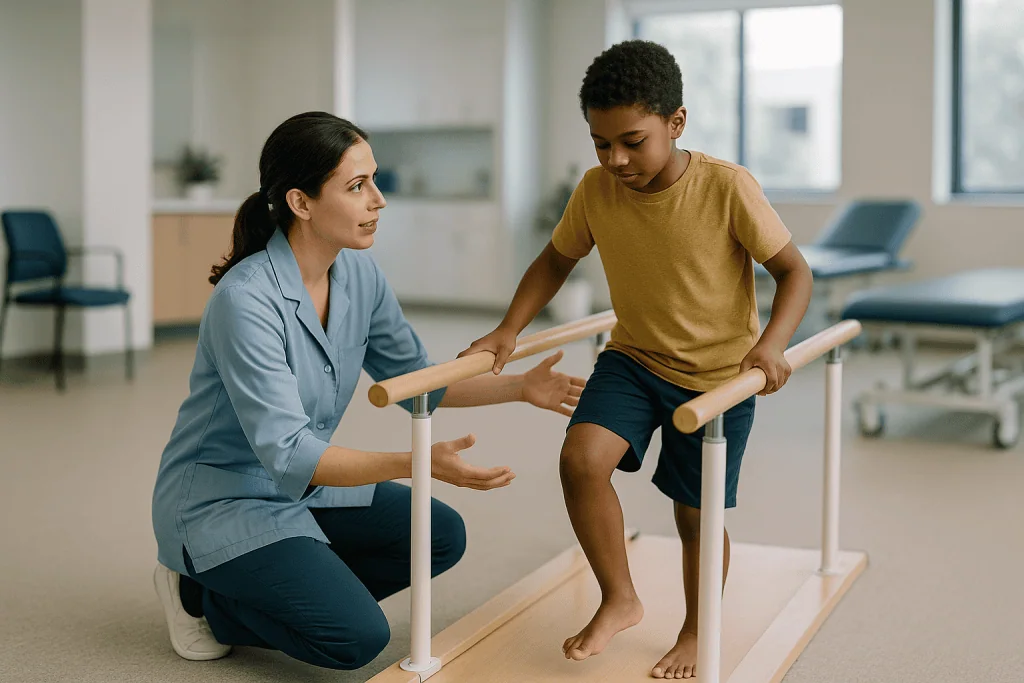
Through the glass of the therapy gym door, a father watches his two-year-old refuse, for the third time, to put weight on her right foot. The therapist does not push. She slides a toy a few inches farther along the padded bench, waits, and the foot comes down on its own. The father exhales. Nothing in that moment will appear on a milestone chart, yet it is exactly the kind of thing that counts as pediatric physical therapy progress.
Families arrive expecting a scoreboard. What they get is closer to a weather log: joint angles in degrees, a count of how many seconds a child can balance, a note that she carried her own cup to the table. Some weeks the log says nothing moved. That silence is not failure, but it is hard to read without a guide.
This article explains how therapists actually measure change, what the standardized tools are, why pacing is slower and lumpier than parents hope, and which signs mean you should pick up the phone rather than wait for the next appointment.
What does progress actually look like in pediatric physical therapy?
The first thing most parents learn is that “better” is not a single number. A pediatric physical therapist, a licensed clinician who helps children build strength, balance and movement skills, tracks change on three overlapping layers, and the layers do not always move together.
Layer one is body structure and function. This is the raw material: how far a knee straightens, measured with a goniometer (a plastic protractor for joints); how much resistance a muscle gives when moved; how many seconds a child holds her head up on her tummy. These numbers are precise and often the first to shift.
Layer two is activity. Can the child roll, sit, crawl, pull to stand, climb a step, kick a ball? Developmental milestones live here, and so do the standardized motor scales discussed later.
Layer three is participation, the layer families feel most. Joining circle time on the floor. Keeping up at recess. Carrying a lunch tray without spilling. The World Health Organization’s International Classification of Functioning uses this same three-part frame, and it is why a good progress note reads like a story rather than a spreadsheet.
Gains on one layer do not guarantee gains on another. A tight calf may loosen for weeks before walking visibly changes. Conversely, a child may find a clever compensation that gets him onto the climbing frame while his hip strength score barely moves. Neither pattern is wrong. The job of measurement is to show which layer a session targeted, what shifted, and what the team is watching next, so that nobody mistakes a quiet fortnight for a wasted one.
Pediatric physical therapy milestones: a map, not a scoreboard
Milestone charts are the most familiar yardstick and the most misunderstood. The checklists published by the CDC describe skills that most children, roughly three in four, can do by a given age: holding the head up on the tummy around 2 months, rolling from tummy to back around 6 months, sitting without support around 9 months, pulling up to stand around 12 months, and walking without holding on by about 18 months (CDC, Developmental Milestones).
Two things follow from that “most” and that “roughly.” A single missed milestone is a prompt for a conversation, not a diagnosis. And a child who meets a milestone late has not failed anything; the chart was never a pass-or-fail exam.
In therapy, milestones serve as a map of the usual route. They tell the therapist which building blocks typically come before others: head control before sitting, sitting balance before reaching across the body, weight shifting before stepping. A child who skips crawling and walks is on a less common route, not a wrong one, and MedlinePlus notes that the sequence matters more than the exact month for many skills (MedlinePlus, Developmental milestones record).
Where milestones genuinely help measurement is in children with no diagnosis yet, often infants referred for stiffness, floppiness or a strong early side preference. There, “sat unsupported for the first time” is a real, dated event, and a therapist will record it alongside the quality of the sitting: rounded or upright, propped on hands or hands free.
For children with a known neurological or genetic condition, the chart recedes. Nobody is served by writing “walking: not met” each quarter for a child whose body works differently. The map is still consulted, but the destination is drawn with the family, not borrowed from a poster.
What happens in a session, and how is each one recorded?
A typical appointment looks, to the untrained eye, like supervised play. That is deliberate. Children under about seven do not perform on command, so therapists hide measurement inside games: a bench becomes a step-up test, a tunnel becomes an assessment of reciprocal crawling, a bubble held just out of reach becomes a check on single-leg stance.
Underneath the play, the structure is consistent. Sessions open with a brief re-check of whatever was measured last time, because children change between visits in ways the therapist cannot see. Then comes the working block, usually two to four targeted activities aimed at a current goal. The close is a quick review with the parent: what was tried, what the child managed, and what to practice at home.
The note that follows is where progress is formally recorded. Most clinics use a format that captures what the family reported, what the therapist observed and measured, an interpretation, and a plan. Measurements typically include joint range in degrees, time held in a position, number of repetitions completed with and without hands-on help, and the level of assistance needed, often described on a scale from full physical support to verbal cue only to independent.
Parents are entitled to see these notes and to ask that the plain-language summary be written in terms they can use. The NHS describes physiotherapy as a partnership built on education, movement and exercise, and hands-on techniques, with the person or family treated as an active participant rather than a passive recipient (NHS, Physiotherapy). Measurement works the same way: it belongs to the family as much as to the chart.
What age should a child start physical therapy, and who is usually asked to wait?
There is no minimum age. Infants a few weeks old are seen for conditions such as congenital muscular torticollis (a tightened neck muscle that tilts the head) or for positioning advice after a complicated birth. At the other end, teenagers are seen after sports injuries, surgery or for conditions that change with growth. Pediatric physical therapy spans birth to young adulthood, and referral is based on need, not birthday.

Children who usually benefit from early referral include infants with marked stiffness or floppiness, a persistent head tilt, or a clear hand or side preference before their first birthday; toddlers who have lost a skill they once had; and any child with a diagnosed neurological, genetic, orthopedic or developmental condition where movement is affected. In the United States, children under three can be referred to publicly funded early intervention services without a confirmed diagnosis, and the CDC’s guidance to families is explicit: if you are concerned, do not wait (CDC, If You’re Concerned).
Who is asked to wait? Often it is the child whose single late milestone sits within the normal spread and whose pediatrician wants one more routine check before referring. Watchful waiting is a legitimate clinical decision when the overall picture is reassuring: the child is gaining skills, just on a slower timetable, with good quality of movement and no loss.
Waiting is not the same as ignoring. A reasonable plan names what will be re-checked and when, and what would trigger an earlier referral. If that plan is not offered, ask for it. And if a parent’s gut says something is different about how their child moves, mainstream guidance treats that instinct as a valid reason to be seen, not as anxiety to be managed.
Physical therapy goals for children: why function beats form
Ask a therapist for the most important shift in pediatric practice over the last two decades and many will say the same thing: goals moved from how a child moves to what a child can do. A perfectly symmetrical gait that still cannot get a boy across a wet playground before the whistle is a limited success. A slightly uneven gait that does get him there is a win.
Functional goals are written in the language of daily life, and the best ones are specific enough to measure. “Improve balance” is a wish. “Stand on one foot long enough to step into trousers while holding the wall” is a goal. “Climb the three steps to the school bus with one hand on the rail” is a goal. Each has a built-in test.
Families should expect to help choose them. Clinicians increasingly use structured methods in which the parent, and the child where old enough, rank the activities that matter most, and progress is scored against those personal targets rather than against a population average. This is why two children with the same diagnosis can have entirely different goal sheets and both be making excellent progress.
Function-first does not mean form is ignored. Quality of movement still matters when poor patterns risk pain or joint problems later, and a therapist will say so. For a child with cerebral palsy, a lifelong condition affecting movement and posture that begins in the developing brain, therapy aims to maximize independence and comfort over years, with braces, equipment and sometimes surgery considered alongside exercise by the wider team (Mayo Clinic, Cerebral palsy). The measuring stick stays the same: more of life, done more easily.
Which tools do therapists use to measure progress?
Standardized tools exist so that two therapists, or the same therapist a year apart, score a child the same way. None of them is a verdict. Each answers a narrow question, and the skill lies in choosing the right one and explaining what a change in score does and does not mean.
| Tool | What it measures | Typically used for | What a change means |
|---|---|---|---|
| Developmental milestone checklists | Skills most children do by a given age | Infants and preschoolers, often before diagnosis | A missed item prompts discussion, not a label |
| Gross Motor Function Measure (GMFM) | Lying, sitting, crawling, standing, walking and jumping items scored on how much of each the child completes | Cerebral palsy and similar conditions | Tracks the child against her own earlier scores |
| Gross Motor Function Classification System (GMFCS) | Five levels describing everyday mobility | Cerebral palsy | A description, usually stable; not a grade to climb |
| Goniometry | Joint angle in degrees | Any child with stiffness or after surgery | Often the earliest number to move |
| Timed tasks (timed up-and-go, walking distance) | Speed and endurance | Children who walk | Directly reflects real-world effort |
| Family-set goal scales | Progress on goals the family chose | Everyone | Captures what the chart cannot |
The GMFCS deserves a word because parents often mistake it for a target. It was developed to classify children with cerebral palsy into five levels based on self-initiated movement, with emphasis on sitting and walking, so that clinicians could communicate consistently and compare like with like (Palisano et al., PubMed). A child does not “pass” from one level to the next through effort; the level describes how she gets around, and it tends to hold steady after early childhood. Progress within a level, measured by tools like the GMFM, is where therapy shows its effect.
How long does pediatric physical therapy take? Honest pacing
No guideline sets a universal number of sessions, and a clinician who promises one is guessing. Duration depends on the diagnosis, the child’s age, the goals chosen, how much practice happens between visits, and how the body changes with growth. What can be said honestly is how different pathways tend to feel.
Short, goal-limited episodes are common for conditions with a clear mechanical cause and a clear endpoint: an infant with a head tilt, a child relearning stairs after a cast comes off, a teenager after a knee injury. Here the goal sheet is short, progress is usually visible session to session, and discharge comes when the goals are met and the family can carry on at home.
Longer, episodic care is typical for lifelong conditions. For cerebral palsy, treatment is described by mainstream sources as ongoing and adjusted across childhood, with physical therapy as a core element alongside braces, equipment and other specialists (Mayo Clinic, Cerebral palsy). “Ongoing” rarely means weekly forever. More often it means blocks of intensive work around a specific goal or a developmental window, then a lighter monitoring phase, then another block when something changes: a growth spurt, a new school, a surgery.
Pacing honestly means saying out loud that progress is not linear. Early gains often come fast as a child learns what is being asked. Then the curve flattens as the remaining targets get harder. A therapist who warns you about that flattening in week one is doing you a service; the family that expects a straight line is the family that gives up at the first plateau.
If you want a number, ask for a different one: not “how many sessions,” but “what will we re-measure, and when will we decide together whether this block is working?”
What do the first weeks of pediatric physical therapy usually look like?
The opening visit is mostly measurement. Expect the therapist to take a detailed history, watch the child move freely before touching anything, then run through standardized items appropriate to age and diagnosis. For an infant this may take most of the session and involve a lot of waiting for the baby to be calm and alert. For a school-age child it looks like an obstacle course with a clipboard.
Families often leave that first visit feeling they were observed rather than helped. That is accurate, and it is the point. Without a baseline, nothing measured later means anything.
The second and third visits set goals and begin the home program. This is the phase where the family’s daily routine is examined as closely as the child’s body: where the baby spends time on the floor, how the toddler gets in and out of the car seat, which stairs the child uses at school. Small environmental changes, such as moving a favorite toy so a child has to turn toward a neglected side, are often the first interventions, and the first things re-measured.
By the end of the first month, a reasonable expectation is that the family understands the goal sheet, can do the home activities confidently, and has seen at least one body-level number move, often joint range or time held in a position. Visible changes in walking, climbing or playing frequently come later, and the therapist should say so in advance.
Children sometimes cry in early sessions. Novel positions, unfamiliar hands and being asked to do hard things are legitimate reasons. Persistent distress, or a child who comes to dread the room, is a reason to talk with the therapist about pacing and approach; the NHS frames physiotherapy for children around play and family involvement precisely because engagement drives practice (NHS, Physiotherapy).
Plateaus, regressions and growth spurts: when progress stalls
Every family in therapy for longer than a few months meets the plateau. Scores stop climbing. The home program feels like treading water. The temptation is to conclude the therapy has stopped working.
Three ordinary explanations come first. One is consolidation: a child who has just learned to stand independently may spend weeks standing, apparently going nowhere, while the nervous system makes that skill automatic enough to free attention for stepping. Two is growth. A child’s legs can lengthen faster than muscles adapt, so a boy who walked comfortably in spring may be up on his toes by autumn, not because therapy failed but because his calves are temporarily short for his bones. Three is life: illness, a new sibling, a school move. Each steals practice time and energy.
Therapists expect these and plan around them. A plateau is often the signal to re-measure comprehensively, revisit goals, and sometimes change the intensity: a short block of more frequent sessions, or a planned break with monitoring.
Regression is different from a plateau and should always be reported. Losing a skill a child reliably had, such as a toddler who sat independently and no longer does, or a child whose walking becomes noticeably worse over weeks, is not a normal part of pacing. Temporary wobbles during illness or after a growth spurt are common and usually recover; sustained loss is a reason for the therapist to loop in the referring physician promptly. The CDC lists loss of previously acquired skills among the signs that warrant acting early rather than waiting (CDC, If You’re Concerned).
The practical skill for parents is telling the two apart: write down what the child could do, with a date. Memory softens; a dated note does not.
How do parents fit into measuring pediatric physical therapy progress?
A child may spend forty-five minutes a week with a therapist and more than a hundred waking hours with family. Whatever is measured in the gym, the practice that changes a nervous system happens at home. That makes parents both the primary intervention and the primary data source, and good clinics treat them as such.
Measurement at home does not require equipment. It requires noticing and recording. A phone video of the child walking across the same hallway once a month is a better record than any memory. A line in a notes app, “climbed into the car seat alone, first time,” dated, is gold to a therapist trying to decide whether a goal has been met. Counting how many times a baby rolled during floor time, or how long a child tolerated a new brace, gives the clinician what she cannot see.
Home programs should be short, specific and woven into routines rather than bolted on. Tummy time while a parent folds laundry; squatting to pick up blocks at cleanup; stairs instead of being carried at bedtime. A program that demands a separate half-hour of drills from an exhausted household will not be done, and a therapist would rather know that than receive a polite nod. Say when it is too much. Adjusting the plan to the family is part of the plan.
Burnout is real and under-discussed. Parents who feel their child’s future rides on their diligence tend to over-practice, over-correct and lose the ordinary joy of playing with their kid. A reasonable check: if every interaction has become an exercise, something needs to be scaled back. Progress that costs a family its ease is not the kind of progress anyone is measuring for.
What people often get wrong about pediatric physical therapy progress
“More sessions means faster progress.” Frequency helps when it increases quality practice, and can hurt when it tires a child, crowds out play, or substitutes for home carryover. The right dose is the one that fits the goal and the family, and it changes over time.
“If my child is not walking by the chart’s age, something is wrong.” Milestone ages describe most children, not all. A late milestone with good movement quality and steady gains is often within normal variation. The signs that matter more are loss of skills, marked asymmetry and very unusual tone, which is why those, not the calendar alone, trigger referrals (CDC, Developmental Milestones).
“The therapist will make my child walk.” Nobody can promise a specific outcome, and a clinician who does is overstepping. What therapy can honestly offer is to maximize whatever mobility a child’s body allows, to prevent avoidable secondary problems such as contractures (joints that stiffen into a fixed position), and to help the family choose equipment and strategies that expand participation.
“A higher GMFCS level is a goal.” The classification describes how a child moves; it is not a ladder. Progress is measured within a level.
“Skipping crawling causes problems later.” Mainstream developmental references treat crawling as common but not universal, and some typically developing children shuffle or go straight to walking without consequence (MedlinePlus). What a therapist watches is the whole pattern, not one skipped step.
“No visible change means nothing is happening.” Joint range, endurance and the amount of help a child needs often improve well before anyone sees a difference at the park. Ask what changed on the chart before deciding nothing changed in the child.
Is my child behind? Reading therapy reports without panic
Reports arrive dense with jargon, and the word that stops parents cold is usually “delay.” In clinical use it is a description of timing, not a prediction of ability. Many children described as delayed at two are indistinguishable from peers at five; others have a lifelong condition for which “delay” was simply the first visible sign. The report alone cannot tell you which, and a good clinician will say so.
Read a report in three passes. First, find the goals and the status of each: met, progressing, not yet started, modified. That is the part written for you. Second, look at the measured values and compare them with the previous report, not with a normal range; the question is whether your child moved, not where she sits on a population curve. Third, read the plan. Does it say what happens next, what will be re-measured and when the team will review?
Standardized scores can be especially misleading in isolation. A percentile is a comparison with other children of the same age. A child can gain real skills every month and still see her percentile hold steady or dip slightly, because the comparison group is also gaining skills. Age-equivalent scores, sometimes written as “functioning at the level of a typical 14-month-old,” are even cruder and are used mainly for eligibility paperwork. Neither should be read as a ceiling.
If a report contains a term you do not understand, ask for it in one plain sentence, and ask what the number would look like if the current block of therapy is working. MedlinePlus is a reasonable first stop for definitions of common developmental and movement terms (MedlinePlus), but the person who wrote the report is the right person to interpret it.
Questions to ask your care team
Parents tend to leave appointments with the questions they meant to ask still in their pocket. These are the ones that unlock how your child’s progress is being judged, phrased so that the answer has to be concrete.
- Which three goals are we working on right now, in words I could explain to a grandparent?
- What did you measure today, what was the value last time, and what would a meaningful change look like?
- Which standardized tool are you using, and what question is it designed to answer for a child like mine?
- Is my child’s current pace of change what you would expect for this condition and age, and what would make you worry?
- What does the home program need to achieve, and how will we know it is being done enough, rather than too much?
- If we reach a plateau, what is the plan: more frequent sessions, a break with monitoring, new goals, or a referral back to the physician?
- Which signs between visits should prompt me to call you or the doctor rather than wait?
- How do you decide when a block of therapy is finished, and what happens after discharge?
- How do braces, equipment or other specialists fit with what you are doing, and who coordinates that?
- Can I see or have a copy of the progress notes, and could the summary be written in plain language?
Bring a notebook or record the answers; details evaporate in a car park. And ask the team how they prefer to receive your observations between visits, whether by a short video, a message through the clinic system or a dated line in a shared log. The NHS and other mainstream bodies describe physiotherapy as collaborative by design (NHS, Physiotherapy); the questions above are how collaboration becomes measurable.
When to call your doctor
Most of pediatric physical therapy unfolds at a pace where the next scheduled visit is soon enough. A small number of changes should not wait for it. Contact your child’s physician, or seek urgent care if the change is sudden and severe, if you notice any of the following.
- Loss of a skill your child reliably had: sitting, standing, walking or using a hand or side that was previously used.
- A new, marked asymmetry: dragging one leg, holding one arm stiffly, a head tilt that appears or worsens quickly.
- Sudden refusal to bear weight or a new limp, especially with fever, swelling, redness or a joint that is hot to touch.
- Pain that wakes the child at night, persists at rest or is out of proportion to activity.
- Rapid change in muscle tone: a child who becomes noticeably floppier or stiffer over days to weeks.
- New problems with bladder or bowel control, numbness, or weakness in both legs together.
- After surgery or a cast: increasing pain, numb or pale toes or fingers, or a brace causing skin breakdown that does not settle.
- Any decline in alertness, feeding or breathing in an infant alongside a change in movement.
These signs are not a self-diagnosis list, and most children who show one will have a treatable or benign explanation. They are included because the cost of a prompt phone call is small and the cost of waiting for the next appointment can be high. The CDC’s advice to families worried about development applies equally here: act early, ask directly, and if the first answer does not match what you are seeing, ask again (CDC, If You’re Concerned).
Decisions about investigation, referral and any change in treatment rest with your child’s treating team. Your role, and it is a crucial one, is to notice, record and report.
Frequently asked questions
What age should a child start physical therapy?
There is no minimum age; infants a few weeks old are treated for conditions such as a tightened neck muscle, and teenagers are treated after injuries or surgery. Referral depends on need rather than age. Marked stiffness or floppiness, a persistent head tilt, a strong side preference before the first birthday, or loss of a skill are common reasons for early referral, and children under three can access early intervention without a diagnosis.
How long does pediatric physical therapy take to show results?
It varies widely and no guideline sets a universal timeline. Body-level measures such as joint range often change within the first few weeks, while visible changes in walking, climbing or play usually follow later. Short episodes are typical for mechanical problems with a clear endpoint; lifelong conditions such as cerebral palsy involve ongoing, episodic care adjusted across childhood. Ask what will be re-measured and when rather than how many sessions.
What are pediatric physical therapy milestones used for in treatment?
Milestones give therapists a map of the usual order in which skills develop: head control before sitting, weight shifting before stepping. For infants without a diagnosis, a newly achieved milestone is a real, dated marker of progress. For children with a known condition, the chart recedes and goals are written with the family around daily function instead of population averages.
What are physical therapy goals for children supposed to look like?
Good goals are specific, functional and measurable: climbing the three steps onto the school bus with one hand on the rail, or standing on one foot long enough to step into trousers while holding a wall. Families help choose them, and progress is scored against those personal targets. Movement quality still matters where poor patterns risk pain or joint problems, but the primary yardstick is more of daily life, done more easily.
What is the GMFCS and is a higher level a goal?
The Gross Motor Function Classification System sorts children with cerebral palsy into five levels based on self-initiated movement, especially sitting and walking, so clinicians can describe mobility consistently. It is a description, not a grade; levels tend to stay stable after early childhood, and a child does not pass from one to the next through effort. Progress within a level is measured with other tools such as the Gross Motor Function Measure.
My child has stopped improving. Does that mean therapy is failing?
Usually not. Plateaus commonly follow early rapid gains while a new skill becomes automatic, and growth spurts can temporarily tighten muscles that have not caught up with lengthening bones. Illness and life changes also steal practice time. A plateau is a cue to re-measure and revisit goals. Losing a previously reliable skill is different and should be reported to the therapist and physician promptly.
What are the most important skills for a pediatric physical therapist, from a parent's view?
The skills you can observe are patience with a child who refuses, the ability to hide measurement inside play, clear plain-language explanation of what changed and why, and willingness to adjust the home program to your family’s reality. A therapist who warns you about plateaus before they happen, shows you the numbers, and treats your observations as data is demonstrating the craft well.
How many years of school does it take to become a pediatric physical therapist?
In the United States, physical therapists complete a Doctor of Physical Therapy degree, a clinical doctorate undertaken after an undergraduate degree, followed by national examination and state licensure. Pediatric specialization is an additional, voluntary board certification built on supervised clinical experience with children. Exact program lengths vary by institution, so check with individual programs rather than relying on a single figure.
Will physical therapy make my child walk?
No clinician can promise a specific outcome, and mainstream guidance avoids such predictions. What therapy honestly offers is to maximize whatever mobility a child’s body allows, to help prevent avoidable secondary problems such as joints stiffening into fixed positions, and to help the family choose equipment and strategies that widen participation. Whether and how a particular child walks depends on the underlying condition, and the treating team can discuss realistic expectations.
How often should a child have physical therapy sessions?
There is no single correct frequency. Intensity depends on the diagnosis, the goals, the child’s tolerance and how much quality practice happens at home. Many children move between blocks of more frequent sessions around a specific goal or developmental window and lighter monitoring phases. More sessions help only when they add useful practice; the treating team sets and adjusts frequency with the family.
References
- CDC: If You're Concerned About Your Child's Development
- MedlinePlus: Developmental milestones record
- NHS: Physiotherapy
This article is for general information only and is not a substitute for professional medical advice. Please consult a qualified doctor about your individual situation.

More from the Blog

Wilms Tumor Survival: What It Means, What to Expect and When to See a Specialist
Most children diagnosed with Wilms tumor survive it. Across all stages, roughly 9 in 10 children are alive five years after diagnosis, and for…

How Bronchiolitis Is Assessed in Clinic: Breathing Rate, Oxygen Level, Feeding and Hydration
Bronchiolitis is diagnosed clinically, meaning a clinician takes a history and examines the baby rather than relying on tests. The assessment centers on four…

Who May Need Early Intervention Therapy for Infants? Delays, Diagnoses and Risk Factors
Early intervention therapy is usually considered for infants and toddlers under three who have a diagnosed condition known to affect development, a measurable delay…

What Progress Looks Like in Developmental Delay Treatment: Small Gains and Realistic Pacing
Developmental delay therapy progress usually shows up as small, specific gains rather than sudden leaps: a child holding a crayon a few seconds longer,…

How Doctors Assess a Febrile Seizure: Finding the Fever Source and When Tests Are Added
Doctors assess a febrile seizure mainly by taking a careful history and examining the child to find the fever's cause. For a simple febrile…

When Do Babies Sleep Through the Night? Expectations vs Reality
Most babies can sleep a five- to six-hour stretch somewhere between 3 and 6 months of age, but true 8- to 12-hour nights often…