

How Recovery Differs After Complex Joint Reconstruction: Slower Milestones, Explained

Key Takeaways
- Complex reconstruction usually means revision of a previous implant, repair of a fracture into the joint, rebuilding lost bone or ligament, or a staged procedure for infection, each of which asks more of the body than a first-time replacement.
- The NHS describes most people after a standard knee replacement stopping walking aids around six weeks, with pain and swelling settling over up to three months; complex cases commonly run past those markers by design.
- Bone graft is a scaffold until living cells replace it with new bone, and a ligament graft is at its weakest partway through remodeling, which is why weight bearing and brace rules are staged over months.
- Weight-bearing instructions have precise meanings, from non-weight-bearing to weight bearing as tolerated, and each step up is granted by the surgeon after X-rays show the tissue is ready.
- Age alone predicts little; bone density, muscle reserve, other medical conditions, home support and fall risk shape recovery after 70 far more than the number itself.
- Long-term restrictions after joint reconstruction are usually limited to high-impact sport, with kneeling, travel and dental care permitted under the surgeon's guidance rather than forbidden.
Recovery after complex joint reconstruction, such as revision replacement, repair of a fracture around a joint or rebuilding lost bone and ligament, is usually slower than after a standard joint replacement. Bone grafts, ligament grafts and weakened surrounding tissue need protected time to heal, so weight bearing, walking without aids and return to normal activity are often measured in months rather than weeks, with the pace set by the surgical team.
The waiting room has two kinds of people in it. One is a retired teacher who had a routine knee replacement, walked into her six-week check without a stick and is mostly here to show off. The other is the man beside her, whose knee has already been replaced once, then loosened, and who is now facing a longer operation with bone grafts and a stem that reaches deep into the thigh bone. He has been told his complex joint reconstruction recovery will look nothing like hers, and he is quietly wondering why.
The honest answer is that they are not having the same surgery, even though both involve a knee and a metal implant. One is a fresh start on reasonably healthy bone. The other is a rebuild on ground that has already been disturbed once.
This explainer sets out what changes when reconstruction becomes complex, why milestones stretch, and how to tell a slow recovery from a worrying one.
What counts as complex joint reconstruction, and how recovery differs from a standard replacement
Surgeons use the word complex loosely, but it usually covers a recognizable set of situations. Revision arthroplasty is the removal and replacement of a joint implant that has already been fitted once. Periarticular fracture repair means fixing a break that runs into or very close to the joint surface. Multi-ligament reconstruction rebuilds two or more of the ligaments that hold a joint stable, most often at the knee after a serious injury. Bone-loss reconstruction fills gaps in the skeleton with bone graft, which is transplanted bone, or with metal augments, which are shaped blocks or sleeves attached to the implant. A two-stage procedure for infection removes an implant, treats the infection, and only later fits a new one.
Each of these shares one feature: the operation asks more of the body than a first-time replacement into intact bone. That is the root of the slower timeline.
For comparison, the NHS describes a standard knee replacement recovery in which most people stop using walking aids and return to everyday activities around six weeks after surgery, with pain and swelling taking up to three months to settle and mild leg swelling sometimes lasting a year. Those figures are the baseline many patients carry in their heads, often because a friend or relative lived them.
Complex joint reconstruction recovery rarely fits that template. Weight bearing may be restricted for a period the surgeon defines. Physical therapy goals are often staged rather than front-loaded. The full picture of how well the joint functions can take longer to emerge, because grafted bone and repaired soft tissue mature over months, not weeks. None of this means something has gone wrong. It reflects a different operation with a different biology.
What actually happens during a complex reconstruction
A first-time joint replacement follows a well-worn path: expose the joint, remove the worn cartilage and a thin layer of bone, fit the components, close. A complex reconstruction adds steps that each cost time and tissue.
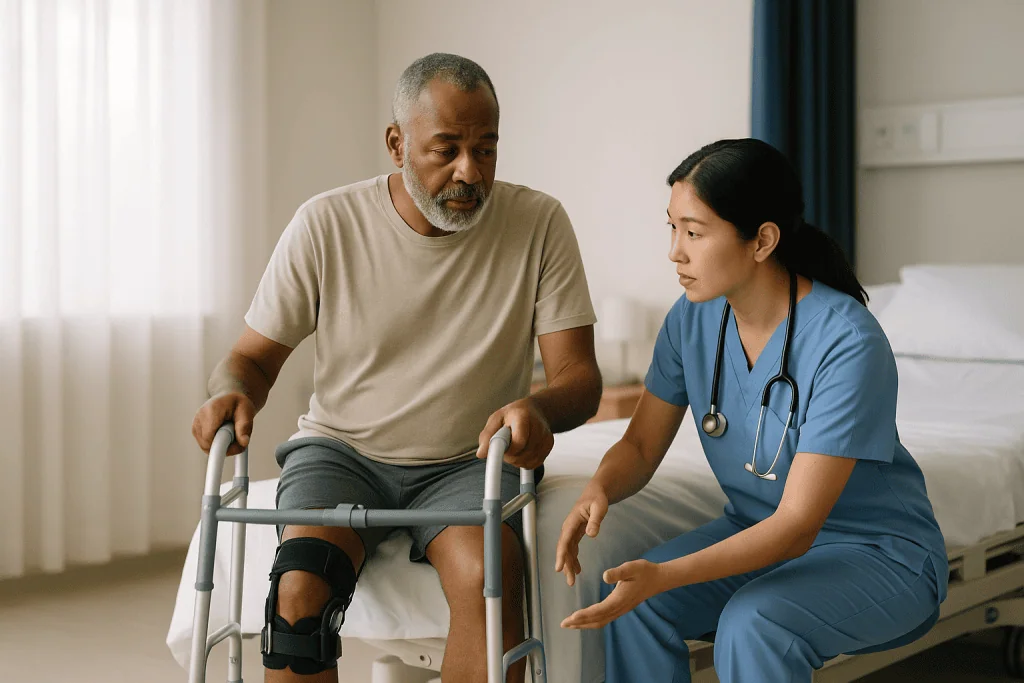
In a revision, the old implant has to come out. Components that were cemented in place, or that have grown into the bone, do not release easily. Removing them can leave the bone thinner or with defects that must be dealt with before anything new goes in. Johns Hopkins notes that revision knee surgery is typically longer and more involved than the original replacement for exactly this reason.
Where bone is missing, the surgeon may use graft, metal augments, or implants with long stems that bypass the damaged area and anchor further along the bone. In a fracture that enters the joint, the pieces are realigned as precisely as possible and held with plates and screws, or the damaged joint surface is replaced outright if it cannot be reassembled.
Ligament reconstruction usually borrows tissue from elsewhere, from the patient’s own body or from a donor, and threads it through tunnels drilled in bone. That new tissue is not a ligament yet. It becomes one gradually as blood vessels and cells move in.
When infection is the reason for surgery, the sequence may be split. The implant is removed, a temporary spacer that releases antibiotic locally is placed, and the definitive reconstruction waits until the infection is judged to be controlled. The interval between stages varies and is decided by the treating team based on how the tissues and blood markers respond.
Every added step means more soft tissue disturbed, more bone asked to heal and, usually, a longer anesthetic. The recovery has to absorb all of it.
Who is usually offered complex reconstruction, and who is asked to wait
Complex reconstruction is rarely a first resort. It tends to be offered when a joint implant has loosened, worn, become unstable or become infected; when a fracture around a joint cannot heal properly on its own; or when a knee has lost so much ligament support that it gives way with ordinary walking. Mayo Clinic lists implant wear, loosening, infection and fracture among the reasons a replaced knee may need further surgery.
Being a candidate is not only about the joint. Surgeons and anesthesiologists look at the whole person before committing to a long operation. Several situations commonly lead to a pause rather than a refusal.
- An active infection anywhere in the body, including a tooth or a skin ulcer, because bacteria can travel to a fresh implant.
- Blood sugar that is poorly controlled, since high glucose slows wound healing and raises infection risk.
- Smoking or other nicotine use, which narrows small blood vessels and impairs bone and skin healing.
- Untreated anemia or nutritional deficiency, which leaves less reserve for a large operation.
- Skin over the joint that is fragile, swollen or scarred from previous surgery and needs time or a plastic surgery opinion first.
Waiting in these circumstances is not a judgment. It is preparation. Teams often describe it as optimization: fixing what can be fixed so that the reconstruction has the best chance of healing. Some people are also asked to build strength before surgery, because muscle lost during a long recovery is easier to protect than to rebuild.
Whether to proceed, wait or choose a different approach, such as bracing or a more limited procedure, is a decision made with the treating team, weighing risk against the disability the joint is causing now.
Why bone and soft tissue set the pace
Two biological facts explain most of the slowdown. Bone heals on its own schedule, and repaired soft tissue is weaker than the original for a long time.
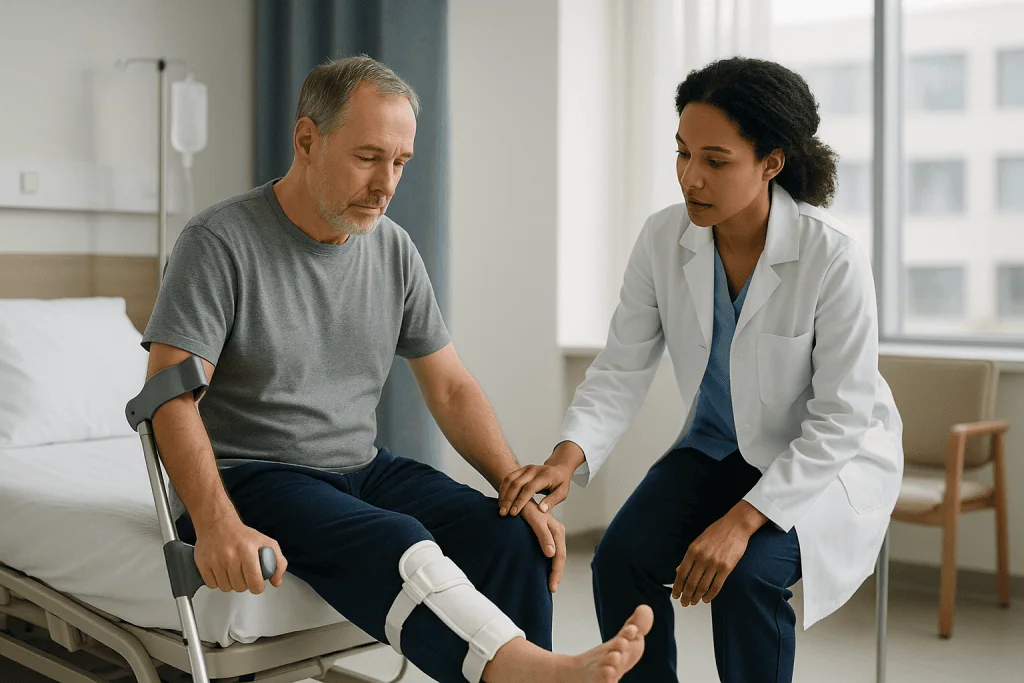
Start with bone. When graft is packed into a defect, the body does not simply glue it in place. Living cells gradually creep into the graft, remove the old material and lay down new bone in its place. Until that process has advanced, the graft is a scaffold, not a structure. Loading it too hard too early risks it collapsing or the implant shifting. Uncemented stems and cups face a similar wait, because they rely on bone growing into their textured surface before they are fully secure. Cemented components are firm on day one, which is one reason a surgeon may choose them in bone that is unlikely to grow well.
Fractured bone follows the same logic. The plates and screws hold the pieces still; they do not make the bone strong. Strength returns only as the fracture knits, and the surgeon judges progress on X-rays before loosening restrictions.
Soft tissue tells a parallel story. A ligament graft begins life as tendon or donor tissue. Over months it is remodeled into something closer to ligament, and during the middle of that process it can be at its weakest, even though the joint feels better. Muscles around a joint that has been operated on more than once also start from a lower baseline. Scar tissue from earlier surgery limits how freely they glide, and the nervous system often dampens the thigh or shoulder muscles after joint trauma, a reflex sometimes called arthrogenic inhibition, meaning the muscle switches off to protect the joint.
Rehabilitation after complex reconstruction is largely the art of loading these tissues enough to encourage healing without exceeding what they can bear that week.
Complex joint reconstruction recovery timeline: what the first days and weeks usually look like
The first day rarely differs much from a standard replacement. The NHS describes getting people up with a physical therapist on the day of surgery or the day after, because early movement protects lungs, circulation and morale. After complex reconstruction the same principle applies, though the movement may be more constrained: a brace locked at a set angle, a walker rather than a cane, or a rule that the operated leg touches the floor for balance only.
Hospital stays tend to be longer than the short stays now typical for standard replacement, though the length is individual. Teams watch the wound closely because tissue that has been operated on before has a less generous blood supply. Drains, if used, come out in the first days.
Once home, the early weeks are dominated by three tasks: keeping the wound clean and dry, doing the prescribed exercises exactly as taught, and moving around enough to keep blood flowing without breaching weight-bearing limits. Swelling and stiffness are expected. The NHS notes that after knee replacement it can take up to three months for pain and swelling to settle; after complex work, many teams warn patients that this settling period may run longer.
Follow-up appointments in this phase serve a purpose beyond reassurance. X-rays check that grafts, plates or stems are where they should be, and the surgeon uses them to decide when to allow more weight or more motion. That is why the timeline cannot be written in advance. Each permission is granted after the tissue has shown it is ready.
A useful mental frame is to think in phases rather than dates: protect, then restore motion, then build strength, then return to activity. The phases are the same as after a standard replacement. Their boundaries simply move later, and the team sets them.
Standard versus complex: a milestone comparison
The table below sets typical published milestones for a standard hip or knee replacement beside what commonly changes when the reconstruction is complex. The standard figures come from NHS and Mayo Clinic patient guidance. The complex column is deliberately descriptive rather than numeric, because published timelines for revision and reconstruction vary widely by joint, technique and bone quality, and any single number would be misleading.
| Milestone | Standard replacement (typical range) | Complex reconstruction (what commonly changes) |
|---|---|---|
| First steps with therapist | Day of surgery or the next day (NHS) | Usually the same day or next day, often with a brace or strict weight limit |
| Walking without aids | Around 6 weeks for many people (NHS) | Often later; aids kept until X-rays show bone healing or graft settling |
| Return to most daily activities | Roughly 3 to 6 weeks (Mayo Clinic) | Frequently staged over months, with lifting and twisting restricted longer |
| Driving | When able to control the vehicle and no longer affected by pain medicines, often about 6 weeks (NHS) | Depends on which leg or arm was operated on and on weight-bearing status; surgeon decides |
| Pain and swelling settling | Up to 3 months (NHS) | Often longer, particularly after revision or fracture repair |
| Final functional result | Improvement can continue up to a year (NHS) | May continue past a year as grafts mature and muscle rebuilds |
Two cautions when reading it. First, the standard figures are averages of large groups, and plenty of uncomplicated patients land outside them. Second, the complex column describes tendencies, not destiny. Some revisions for a simple worn plastic liner recover almost like a first replacement. Some fracture repairs in fragile bone take far longer than anything listed. The only timeline that applies to a given person is the one their surgical team writes and revises as healing is observed.
When are the hardest days after joint surgery, and which joints are hardest to recover from?
Ask a room of people who have had joint surgery when it was worst and most will point to the first couple of weeks. The anesthetic and nerve blocks have worn off, swelling is at its peak, sleep is broken and the exercises hurt. The NHS is candid that pain and stiffness are expected in this early period and that they ease as the weeks pass. After complex reconstruction the same trough tends to arrive, sometimes deeper because more tissue was disturbed, and it can be followed by a second low point when the novelty has gone and progress feels slow.
The question of which joint is hardest has no single evidence-based answer, and it is worth being honest about that. Knee replacement is often described by patients as more demanding than hip replacement, largely because regaining bend and straightening requires daily effort against a stiff, swollen joint. Mayo Clinic notes that knee stiffness is a recognized challenge after knee replacement. Hips tend to feel steadier sooner but come with movement precautions after some approaches. Shoulder and elbow reconstruction bring a different burden: the arm must often be kept in a sling for weeks, and everyday tasks like dressing become two-person jobs.
Complexity changes the ranking more than the joint does. A revision knee with bone grafting is usually harder than a first-time hip; a multi-ligament knee reconstruction is usually harder than a routine knee replacement; an infected joint treated in two stages is hard because it is two recoveries, not one.
What the hardest days need is not heroics but structure: pain control taken as directed, exercises done in short sessions rather than marathons, ice and elevation for swelling, and someone to talk to who understands that a bad Tuesday is not a bad outcome.
Recovery after knee or hip surgery at 70 and beyond: does age slow everything down?
Age is the question families ask most, and it is rarely the most important variable. The NHS notes that most people having knee replacement are between 60 and 80, which means the published recovery timelines already describe older adults. A healthy 70-year-old who walks daily, has good bone density and lives with support often recovers along a path close to the standard one.
What does slow recovery at any age is the company that age sometimes keeps: lower bone density, which affects how securely implants and screws hold; reduced muscle mass, which means less reserve to lose; heart, lung or kidney conditions that limit how hard rehabilitation can push; and medicines that raise bleeding or fall risk. Complex reconstruction interacts with each of these. Thinner bone is a common reason a revision is complex in the first place, and it is also a reason weight bearing may be protected for longer.
Falls deserve a specific mention. A fall onto a fresh reconstruction can undo the operation, so teams put real effort into balance training, home hazard checks and the right walking aid. Accepting a walker for longer than pride prefers is one of the more effective things an older patient can do for the result.
Cognition matters too. Recovery after a long anesthetic can include a period of confusion in older adults, which tends to clear but can make the first days at home harder for everyone. Having a relative present for discharge instructions, and written copies of the exercise program and weight-bearing rules, reduces mistakes.
None of this argues against surgery in later life. It argues for planning. The treating team weighs frailty, not birth year, and a candid conversation about home support, stairs and who will drive is as much part of the workup as the X-rays.
Weight bearing, braces and walking aids: the rules that feel frustrating
Nothing tests patience after complex reconstruction like being told the leg or arm cannot yet carry its share. The vocabulary helps, because the instructions are precise even when they feel arbitrary.
- Non-weight-bearing means the limb does not touch the ground for support at all.
- Toe-touch or touch-down weight bearing allows the foot to rest on the floor for balance only, roughly the weight of the leg itself.
- Partial weight bearing permits a set fraction of body weight, which therapists often teach using a bathroom scale.
- Weight bearing as tolerated allows as much load as pain permits.
After a standard replacement, most people are weight bearing as tolerated from the first day. After bone grafting, fracture fixation or an uncemented implant in poor bone, the surgeon may prescribe one of the stricter categories for a period, then advance it as X-rays show healing. The reason is mechanical: a screw in soft bone or a graft that has not yet been colonized by living cells can fail under a load that healthy bone would shrug off.
Braces serve a related purpose for ligament work. A hinged brace can be locked to prevent the joint moving into positions that would stretch a new graft, then unlocked in stages as the tissue matures. Wearing it exactly as instructed, including at night if asked, is part of the treatment, not an optional accessory.
Walking aids are chosen for the load they remove, not for how they look. A walker offloads more than two crutches, which offload more than one, which offloads more than a cane. Moving down that ladder is a milestone the therapist confirms, usually by watching for a steady gait without a limp. Rushing it trades a few weeks of inconvenience for a real risk to the reconstruction.
Pain control, blood clot prevention and the medicines you may hear about
Medicine plans after complex reconstruction follow the same principles as after standard surgery, adjusted for a longer and harder recovery. The specifics belong to the prescribing team; what follows is the logic behind them.
Pain is usually managed with several classes at once, an approach called multimodal analgesia, because combining mechanisms lowers the amount of any single drug needed. Regional nerve blocks numb the limb for the first hours or days. Acetaminophen and, where kidneys and stomach allow, anti-inflammatory drugs handle background pain. Opioids are generally reserved for breakthrough pain and for the shortest period the team judges necessary, since they bring constipation, drowsiness and dependence risk. Ice, elevation and pacing are treated as active parts of the plan rather than afterthoughts.
Blood clots are a recognized risk after lower-limb surgery because the leg is still, the vessels have been handled and the blood clots more readily after tissue injury. Prevention combines movement, compression devices or stockings and, for most people, an anticoagulant, which is a medicine that slows clotting. Classes commonly used include injectable heparin-type drugs, newer oral anticoagulants and, in some protocols, aspirin. The choice and duration depend on the operation, mobility and bleeding risk, and a longer period of restricted weight bearing after complex surgery is one reason the course may be extended. The CDC lists leg swelling, pain, warmth and redness as signs of a clot in the leg, and sudden breathlessness or chest pain as signs it may have travelled to the lungs.
When infection was the reason for surgery, antibiotics may continue for weeks, guided by laboratory results. Stopping early or skipping doses is not a decision for the patient to make alone; any concern about side effects should go straight back to the team, who can adjust the plan safely.
What not to do after a joint reconstruction: the long-term restrictions explained
The search phrase people type is what can you never do again, and the truthful answer is shorter than most fear, with a few honest caveats for complex cases.
Mayo Clinic advises people with knee replacements to avoid high-impact activities such as jogging and contact sports, and MedlinePlus gives similar guidance, because repeated pounding accelerates wear on the plastic bearing and can loosen the fixation over years. Lower-impact activity, walking, cycling, swimming, golf and gentle hiking, is generally encouraged. The same logic applies to hips and, with sport-specific adjustments, to shoulders and elbows.
Kneeling is the most common surprise. Many people find it uncomfortable after knee replacement, but discomfort is not damage, and most surgeons do not prohibit it once the wound has healed. After complex reconstruction with grafts or plates at the front of the knee, the surgeon may ask for a longer wait, so the specific instruction matters more than the general rule.
Hip precautions, such as avoiding deep bending or crossing the legs, depend on the surgical approach and on whether the joint has been unstable before. A revision done for recurrent dislocation usually comes with stricter and longer-lasting precautions than a first replacement.
Heavy lifting and twisting under load are typically limited while bone heals, then reintroduced gradually. Very heavy or repetitive loading, the kind found in some manual jobs, may be discussed as a permanent modification after reconstruction of poor-quality bone.
Two things are not on the list. Air travel is not forbidden, though the team will advise on timing and clot precautions. Dental work is not forbidden either; whether antibiotics are needed before it is a decision the surgeon and dentist make together.
Restrictions after complex reconstruction are not a life sentence. They are a longer protected period followed by a return to most of ordinary life, with the surgeon defining where the lines sit.
What people often get wrong about complex joint reconstruction recovery
The myths around recovery are rarely foolish. Most are the standard-replacement truths applied to a situation where they no longer hold.
Slow means failing. After a first-time replacement, being far behind the six-week benchmark can be a prompt to look harder. After a revision with bone graft, being behind that benchmark is the plan. Progress is measured against the surgeon’s protocol, not against a neighbor’s knee.
More therapy, faster, is better. Rehabilitation works by loading tissue just enough. Overloading a graft in its weakest weeks can stretch or tear it, and forcing range of motion against a healing fracture can shift the fixation. Discipline in this setting often means doing less than one feels able to.
Pain means damage. Aching after exercise, evening swelling and a joint that feels warm for weeks are expected features of healing. Pain that is sharp, sudden, worsening day on day or accompanied by fever is different, and belongs in the red-flag list below.
Rest heals. Prolonged sitting or bed rest raises clot risk, stiffens the joint and wastes muscle. The instruction is protected movement, not stillness: walk within the weight-bearing limit, do the exercises, change position often.
The implant is now the weak point. In most complex cases the bone around the implant is the limiting factor, which is why so many rules are about protecting bone rather than metal.
A good result should feel like the old joint. The realistic aim after reconstruction is a stable, comfortable joint that allows daily life and low-impact activity. Some residual stiffness, a clicking sensation or an awareness of the joint on stairs are common and do not indicate a problem.
Correcting these ideas early, ideally before surgery, spares a great deal of unnecessary alarm in month two.
Questions to ask your care team before and after complex reconstruction
A long recovery is easier to tolerate when the reasons behind each rule are understood. These questions tend to produce the answers that matter; the responses will differ from person to person, and that is the point.
- What specifically makes my reconstruction complex, and which part of it will set the pace of recovery: bone healing, graft maturation, soft tissue or infection control?
- What weight-bearing status will I start with, what has to happen before it changes, and how will you check?
- Will I wear a brace, and if so, what positions is it protecting against and for how long?
- Which milestones from a standard replacement should I expect to reach later, and which might not apply at all?
- How long is the hospital stay likely to be, and what needs to be in place at home before discharge: equipment, a ground-floor bed, someone to help?
- How will pain be managed in the first weeks, and what is the plan for reducing stronger medicines?
- What is the clot-prevention plan, and how long does it run given my weight-bearing limits?
- If this is a staged procedure, what decides the timing of the second stage?
- Which signs should prompt a same-day call, and which can wait for the next appointment?
- When can I drive, return to work, travel and resume the activities I care about most, and what evidence will you use to decide?
- What long-term restrictions do you anticipate for me specifically, rather than for joint surgery in general?
- Who do I contact, and how, if something worries me outside clinic hours?
Writing the answers down, or having someone else in the room to do it, is worth the small awkwardness. Discharge conversations happen quickly, and the details about weight bearing and wound care are the ones most often misremembered.
When to call your doctor
Most of the discomfort after complex reconstruction is expected, and most of the questions can wait for a scheduled visit. A small number of signs should not wait, because they can indicate infection, a blood clot, a problem with the fixation or a nerve or vessel under pressure. Contact the surgical team or emergency services the same day if any of the following occur.
- Fever, chills or feeling generally unwell, particularly alongside a wound that is increasingly red, hot, swollen or leaking fluid or pus.
- A wound that opens, bleeds persistently or develops a foul smell.
- Calf or thigh pain, swelling, warmth or redness in either leg, which the CDC lists as signs of deep vein thrombosis.
- Sudden shortness of breath, chest pain that worsens with breathing, a racing heart or coughing up blood, which can indicate a clot in the lung and are an emergency.
- A sudden increase in pain, a pop or shift felt in the joint, a limb that looks deformed, or a new inability to bear the weight you were previously allowed.
- Numbness, tingling, coldness or color change in the hand or foot below the surgery, or an inability to move the toes or fingers.
- Pain that is worsening day on day rather than slowly improving, or swelling that makes the skin tight and shiny.
- Persistent vomiting, inability to keep down medicines, or new confusion or drowsiness.
These are indicators for assessment, not a checklist for self-diagnosis. Many will turn out to have a simple explanation. The treating team would far rather hear about a false alarm than see a real problem a week late. Keep the contact number for the ward or clinic where it can be found quickly, and do not hesitate to use it.
Frequently asked questions
What is the hardest joint replacement surgery to recover from?
There is no single hardest joint supported by evidence, but complexity matters more than location. Patients often describe knee replacement as more demanding than hip because regaining bend and straightening takes daily effort against stiffness, which Mayo Clinic recognizes as a common challenge. A revision knee with bone graft, a multi-ligament reconstruction or a two-stage procedure for infection is usually harder than any routine first-time replacement.
How long does it take a 70 year old to recover from knee surgery?
For a healthy 70-year-old having a standard knee replacement, recovery often follows the published NHS pattern: walking aids for around six weeks, with pain and swelling settling over up to three months. The NHS notes most people having this surgery are 60 to 80. Complex reconstruction extends that timeline, and other conditions, bone density and home support influence the pace far more than age itself.
What is the typical revision knee replacement recovery time?
Published guidance does not give a single figure, because revision recovery depends on how much bone was lost, whether graft or long stems were used and the state of the soft tissue. Johns Hopkins describes revision as a longer and more involved operation than the original, and most teams warn that milestones such as walking unaided and settled swelling arrive later than after a first replacement, with the surgeon setting the schedule.
When are the hardest days after knee replacement surgery?
The first couple of weeks are usually the hardest, once nerve blocks wear off and swelling peaks, disturbing sleep and making exercises uncomfortable. The NHS is clear that pain and stiffness are expected early and ease over the following weeks. After complex reconstruction a second low point can follow around the second month, when progress feels slow; structure, pacing and pain control taken as directed help most.
What can you never do again after knee replacement surgery?
The permanent list is short. Mayo Clinic and MedlinePlus advise avoiding high-impact activities such as running and contact sports, because pounding wears the bearing and can loosen fixation. Walking, cycling, swimming and golf are generally encouraged. Kneeling is often uncomfortable but usually not prohibited once healed. After complex reconstruction the surgeon may add longer restrictions on lifting or twisting while bone heals.
What not to do after knee replacement or reconstruction in the first weeks?
Avoid exceeding the prescribed weight-bearing limit, skipping the brace if one was fitted, sitting or lying still for long stretches, soaking the wound before it has sealed, and forcing range of motion beyond what the therapist has set. Each of these risks the graft, the fixation or a blood clot. Protected, regular movement within the rules is the goal, not rest and not heroics.
Why is weight bearing restricted after complex joint reconstruction but not after a standard replacement?
A standard implant sits in reasonably healthy bone and is usually stable enough to take full load immediately. After bone grafting, fracture fixation or an uncemented implant in thin bone, the structure relies on living bone growing into or around it before it can bear body weight safely. The surgeon protects that period with a defined weight-bearing status and advances it once X-rays show healing.
How do I know if my slow recovery is normal or a problem?
Normal slow recovery after complex reconstruction shows gradual improvement week to week within the surgeon’s protocol, with expected aching, swelling and stiffness. Warning features are different: pain that worsens day on day, fever, a wound that is redder, hotter or leaking, calf swelling or pain, sudden breathlessness, or a new inability to bear weight you were allowed. Those warrant a same-day call to the team.
Do blood clot precautions last longer after complex reconstruction?
Often they do, because restricted weight bearing and a longer, more extensive operation both raise clot risk. Prevention combines movement, compression and usually an anticoagulant, a medicine that slows clotting; the class and duration are chosen by the treating team based on the procedure, mobility and bleeding risk. The CDC lists leg swelling, pain, warmth or redness, and sudden breathlessness or chest pain, as signs needing urgent assessment.
Will the reconstructed joint ever feel like a normal joint?
The realistic aim is a stable, comfortable joint that supports daily life and low-impact activity, not an exact copy of the original. Some residual stiffness, clicking or awareness of the joint on stairs is common after any replacement and more so after complex work. The NHS notes improvement can continue up to a year after standard replacement; after reconstruction it may continue longer as grafts mature.
References
- NHS: Knee replacement, recovery
- NHS: Hip replacement, recovery
- MedlinePlus: Knee joint replacement, discharge
- CDC: About venous thromboembolism (blood clots)
This article is for general information only and is not a substitute for professional medical advice. Please consult a qualified doctor about your individual situation.

More from the Blog

Local, Regional or General? Anesthesia Options for Finger and Toe Surgery Explained
Most finger and toe operations can be done under local anesthesia, usually a digital block that numbs only the affected digit while you stay…

Who May Be a Candidate for Proximal Fibular Osteotomy When Inner-Knee Arthritis Is Mild?
Proximal fibular osteotomy is usually considered for adults whose knee osteoarthritis is confined mainly to the inner (medial) compartment, who have mild to moderate…

Knee Pain Causes: Why Knees Hurt (and Why It Differs in Women)
Knee pain in women most often comes from patellofemoral (front-of-knee) pain, osteoarthritis, tendon or bursa irritation, meniscus wear, or ligament injury. Women see certain…

Shoulder, Elbow, Wrist or Hand: How Upper Limb Surgery Is Planned for Each Joint
Upper limb surgery covers operations on the shoulder, elbow, wrist and hand, from nerve releases and tendon repairs to fracture fixation and joint replacement.…

Life After Adult Reconstruction Surgery: Why High-Impact Sport Is Limited and What Replaces It
After adult reconstruction surgery, the orthopedic term for hip and knee replacement, most care teams advise a long-term shift away from running, jumping and…

How Foot Surgery Is Performed: Bunion Correction, Fusion and Tendon Repair Step by Step
Foot surgery is usually performed as a day procedure under a nerve block, spinal or general anesthetic. The surgeon makes one or more small…