

How Surgeons Sequence Combined Face Aesthetics Procedures: One Operation or Several?

Key Takeaways
- A hematoma, a collection of blood under the skin, is the most common complication of facelift surgery and usually forms within the first 24 hours, which is why blood pressure control is central to combined operations.
- Surgeons typically sequence from the brow downward because raising the brow changes how much upper eyelid skin actually needs removing.
- Deep laser resurfacing is usually kept off freshly lifted skin because undermined skin has a reduced blood supply until new vessels grow in.
- Mayo Clinic information gives 10 to 14 days for eyelid bruising and swelling to subside and around 2 to 3 months for the face to feel normal after a facelift.
- The deep plane facelift is a long-established deep-layer technique, not a new procedure, and comparative trials ranking facelift methods remain scarce.
- Smoking is flagged by both the NHS and the Mayo Clinic as a cause of poor healing and skin loss after facelift, and it is a common reason surgeons decline to combine procedures.
Surgeons may combine facial procedures such as a facelift, eyelid surgery and fat grafting in one operation when a person is healthy, does not smoke and has controlled blood pressure, sequencing steps from the brow downward so each informs the next. Longer operations raise hematoma, clot and healing risks, so treatments like deep laser resurfacing are often staged weeks or months later. The treating team decides.
She had come in with one complaint, the heaviness over her eyes, and left the first consultation with a quiet new worry: the surgeon had also pointed to her jawline and her neck. Now she sits at the kitchen table with two folders, one labeled for eyelids and one for a facelift, and the real question is not whether to do either. It is whether combining facial procedures into a single morning in the operating room is sensible, or whether she should take them one at a time.
It is a question surgeons wrestle with far more carefully than the marketing around “stacked” treatments suggests. The answer depends on anatomy, on blood supply to the skin, on how long a body should sensibly be under anesthesia, and on something less glamorous: whether a surgeon can judge the second step accurately before the first has healed.
What follows is how that reasoning actually works, and where the evidence stops.
Why do surgeons consider combining facial procedures at all?
Aging rarely confines itself to one zone. The brow drifts, upper eyelid skin folds, the cheek fat pad slides toward the jawline and the neck loosens, often within the same decade. A surgeon who tightens only the lower face while leaving heavy eyelids untouched can produce a result that reads as uneven, because the eye takes in the face as a whole rather than as parts. That is the first and most defensible reason for combining facial procedures: harmony between regions.
The second reason is practical. A facelift, which the NHS describes as surgery to lift and tighten the skin and deeper tissues of the face and neck, takes around 2 to 3 hours on its own according to NHS patient information. Adding an eyelid procedure during the same anesthetic avoids a second trip to the operating room, a second round of pre-operative tests and a second recovery. For many people, recovering once is a meaningful trade.
The third reason is anatomical. Some procedures share incisions or planes of dissection. A brow lift and an upper eyelid lift both act on the forehead-to-eyelid complex; raising the brow first changes how much eyelid skin actually needs to come away. Sequencing is therefore not only about efficiency. One step informs the next.
None of this means more is automatically better. Each added procedure lengthens time under anesthesia, increases the total tissue trauma the body must heal and compounds swelling. The question a surgeon weighs is whether the combined benefit justifies the combined load for this particular person, with this particular health history. That judgment, not a menu, is what the consultation exists to make.
What actually happens during a combined facial operation
On the day, a combined operation looks like one long procedure with several chapters. Once anesthesia is established, usually general anesthesia (you are fully asleep) or deep sedation with local anesthetic (you are drowsy and the area is numbed), the team confirms incision markings while you lie in the surgical position, because gravity changes how tissue sits.
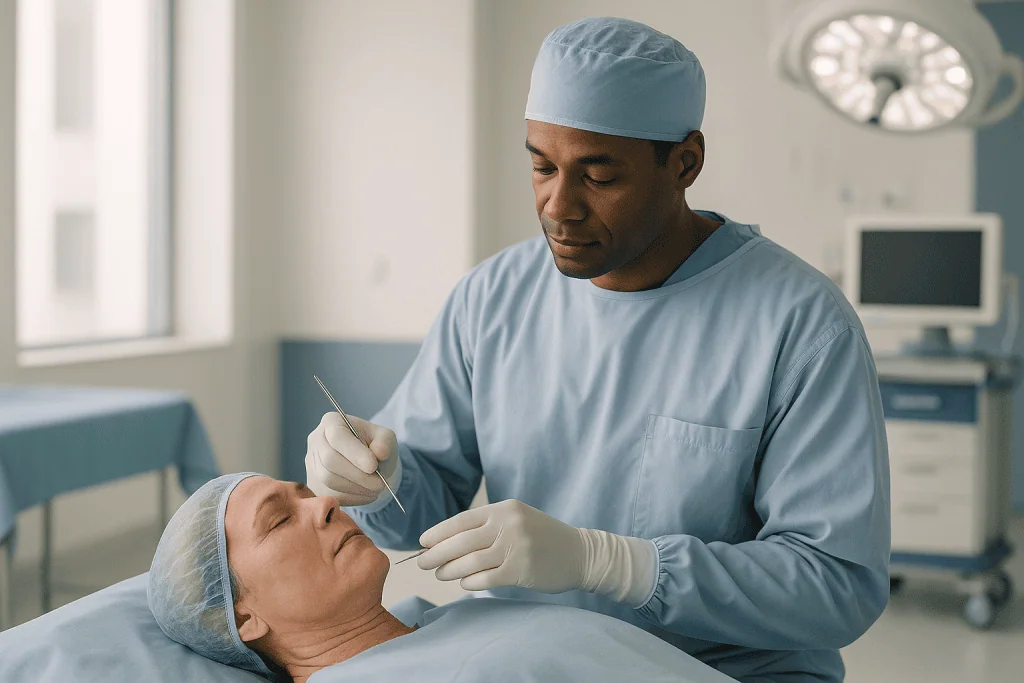
Most surgeons work from the top of the face downward, or from the deepest structures outward, so earlier steps do not disturb later ones. A brow lift, if planned, often comes first. Eyelid work follows, since the surgeon can now judge the true excess of upper lid skin with the brow in its new position. The facelift and neck lift usually take the longest and come next, with the surgeon repositioning the SMAS, the sheet of muscle and connective tissue beneath facial skin, before trimming and closing the skin itself.
Fat grafting, in which a small amount of your own fat is drawn from the abdomen or thigh, processed and placed into hollow areas of the face, is often done after the lift so the surgeon can see where volume is still missing. Skin resurfacing with a laser or chemical peel, when combined at all, is typically confined to areas that have not just been lifted, because freshly undermined skin has a reduced blood supply.
Throughout, the anesthesia team watches blood pressure closely. The Mayo Clinic identifies a hematoma, a collection of blood under the skin, as the most common complication of facelift surgery, and notes it usually forms within 24 hours. Keeping pressure stable during and after the operation is one of the quietest and most consequential parts of the whole sequence.
Facelift and eyelid surgery together: why this pairing is so common
Ask what surgeons combine most often and the honest answer is the facelift and blepharoplasty, the medical term for eyelid surgery that removes or repositions excess skin, muscle and fat around the eyes. The two address different problems in different tissues, which is precisely why they sit comfortably in one session: neither dissection interferes with the other.
The eyelid portion is relatively short, with incisions hidden in the natural crease of the upper lid or just beneath the lower lash line. Facelift incisions run from the temple hairline, around the ear and sometimes into the hairline behind it. Because the fields are separate, the surgeon can close one and move to the other without compromise.
Recovery timelines overlap neatly. The Mayo Clinic notes that swelling and bruising after blepharoplasty generally subside in 10 to 14 days, while a facelift usually leaves people needing a few weeks before they feel comfortable in public, with tightness or numbness persisting longer. Done together, the shorter eyelid recovery is absorbed into the longer facelift recovery rather than adding separate downtime later.
There are limits. People with dry eyes, thyroid eye disease or previous eyelid surgery may be advised against lower eyelid work, or asked to see an eye specialist first. A lower blepharoplasty that removes too much skin can pull the lid downward, a complication called ectropion, and that risk is weighed independently of the facelift decision. Combining does not mean two procedures are evaluated as one. It means two separate judgments happen to land on the same day, and either can be pulled from the plan without affecting the other.
How surgeons decide the order of steps inside one operation
Order follows three practical rules more than any formula. Dependence comes first: when one step changes what another step needs, the determining step happens earlier. The brow-then-eyelid sequence is the classic example, because elevating the brow lifts some upper eyelid skin with it, and a surgeon who trimmed the eyelid first might remove too much.
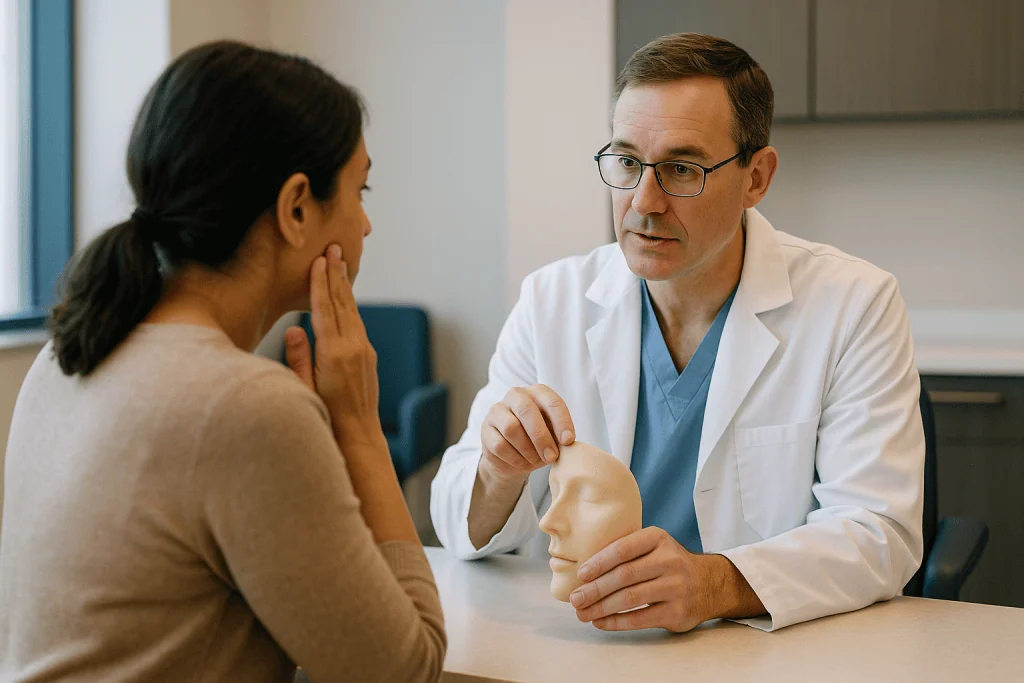
Blood supply comes second. Every incision and every area of skin lifted from the tissue beneath temporarily reduces circulation to that skin. Procedures that further stress circulation, such as deep laser resurfacing, are usually kept away from freshly lifted skin or deferred to a later session. Smokers face a sharper version of this problem: both the NHS and the Mayo Clinic flag smoking as a cause of poor wound healing and skin loss after facelift, and many surgeons will not combine resurfacing with lifting in someone who smokes.
Time under anesthesia comes third. The longer an operation runs, the more the body cools, the more fluid shifts occur and the greater the chance of clots forming in the legs. Surgeons tend to place the steps that most need fresh judgment, such as the lift itself, in the middle of the case, and leave quicker refinements like fat grafting toward the end. If a case runs long or blood pressure proves hard to control, the team may stop before an optional final step. That is not a failure of planning; it is the plan working.
For you, this means the sequence discussed in consultation is a map, not a contract. Sound surgical planning builds in the option to leave something for another day, and a surgeon who says so openly is being careful, not indecisive.
Who is usually a candidate for multiple cosmetic surgeries at once, and who is asked to wait
The decision rests far more on general health than on how much a person wants done. Candidates for a longer combined operation are typically non-smokers, or people who stopped well before surgery, with controlled blood pressure, stable blood sugar if they have diabetes, and no history of clotting disorders or anesthesia problems. Age alone is not the deciding factor; a healthy person in their seventies may be a sounder candidate than a younger person with untreated hypertension.
People who are often asked to wait, or to split procedures into separate sessions, include:
- Those who smoke or use nicotine products, because of impaired healing and the risk of skin loss along incision lines.
- Those taking medicines that affect clotting, including anticoagulants and some antiplatelet drugs. Whether and when these are adjusted is a decision for the prescribing clinician in coordination with the surgical team, never for the patient alone.
- Those with recent significant weight change, since facial volume is still shifting and results would be unstable.
- Those with active skin disease in the operative field, uncontrolled thyroid eye disease or recent eye surgery.
- Those whose expectations center on repairing a life situation rather than a specific physical feature. Screening for body image concerns is a routine and respectful part of good aesthetic practice.
The NHS advises anyone considering cosmetic surgery to check that the surgeon is registered with the relevant national regulator and to expect time between consultation and surgery to reflect. A surgeon who readily agrees to stack several procedures at a first visit, without a full medical history and examination, is not doing you a favor. Being asked to wait is sometimes the most protective recommendation a surgeon can make.
One operation or several? A side-by-side comparison
There is no single right answer, which is why the comparison below describes trade-offs rather than a verdict. The timelines draw on Mayo Clinic and NHS patient information for facelift and eyelid surgery; individual recovery varies.
| Factor | One combined operation | Separate staged operations |
|---|---|---|
| Anesthesia exposure | One longer session | Two or more shorter sessions |
| Recovery periods | One, with most activities resuming in roughly 2–4 weeks after a facelift and eyelid swelling settling within that window | Two or more, each with its own downtime |
| Early swelling | More pronounced, since more tissue has been operated on | Milder per session |
| Assessing one result before the next step | Limited; judged during the operation | Full; second step planned on a healed result |
| Hematoma and clot risk | Rises with operative time and extent | Lower per session |
| Facial harmony | Planned in one sitting | Achievable with a consistent plan across sessions |
| Who tends to be suited | Healthy non-smokers with controlled blood pressure and realistic expectations | People with health factors, work constraints or a preference for gradual change |
A few points deserve emphasis. The “fewer recoveries” advantage is real but not absolute, because a combined recovery is heavier than either alone. The ability to see a healed first result before committing to the second is the strongest clinical argument for staging, and people eager to be finished often underrate it. Some surgeons routinely stage certain pairs, such as a facelift followed later by resurfacing, precisely so healed skin can tolerate the second treatment. Neither column is a compromise. Each is a legitimate plan for the right person.
How long should you wait between facial treatments?
People searching this question want a number, and the frank answer is that no national guideline sets a universal interval. What exists instead is a biological logic that surgeons apply to each pair of procedures.
For surgery following surgery, most wait until the first operation has passed its main healing milestones. After a facelift, the Mayo Clinic describes bruising and swelling easing over a few weeks and the face taking around 2 to 3 months to feel normal again; many surgeons prefer to see that settled state before operating again on nearby tissue, so that scar tissue has matured and the true shape is visible. For eyelid surgery, the 10 to 14 days the Mayo Clinic gives for bruising and swelling to subside is a floor, not a target; judging final lid position reliably takes longer.
For non-surgical treatments following surgery, the question is skin resilience. Laser resurfacing, which uses focused light to remove or heat the outer skin layers so they regenerate, places a demand on blood supply. Skin recently lifted from its base has reduced circulation until new vessels grow in, so surgeons typically delay resurfacing of lifted areas rather than perform it on the same day. Injectables such as botulinum toxin, a medicine that temporarily weakens targeted muscles, or hyaluronic acid fillers are generally kept away from healing incisions until swelling has resolved, both for safety and because swelling makes it impossible to judge how much is actually needed.
For non-surgical treatments following one another, intervals depend on the specific technology and depth, and the treating clinician sets them. The pattern across all of these is consistent: the interval is governed by when tissue can be accurately assessed and safely stressed again, not by the calendar.
Is the deep plane facelift new, and does it change how procedures are sequenced?
Many people arrive asking about “the new facelift.” Usually they mean the deep plane facelift, a technique in which the surgeon lifts and repositions the SMAS layer and the ligaments that tether it, rather than tightening skin alone or pulling on the SMAS from above. It is not new. Deep-layer lifting has been described and refined over decades; what has changed is its visibility on social media and in marketing.
Does it alter sequencing? Modestly. Because the deep plane approach releases tissue more extensively, the operation tends to take longer than a limited skin-only or short-scar lift, which eats into the total time available for add-on procedures in the same session. Some surgeons who favor deep plane techniques are therefore more inclined to stage eyelid or resurfacing work separately; others combine them routinely. The variation reflects surgeon preference and patient factors far more than any established rule.
It is also worth being clear about what the evidence does and does not show. Comparative, high-quality trials ranking facelift techniques against each other are scarce, partly because outcomes are judged on appearance and are hard to measure objectively. Mainstream patient information from the Mayo Clinic and the NHS describes facelift broadly, notes that results are not permanent, and does not endorse one technique over another. A surgeon should be able to explain why they favor a method for your anatomy, and should be equally able to say where the comparative data run thin.
The question that matters more than the label is whether the proposed technique, combined with whatever else is planned, suits your tissue, your health and your tolerance for recovery. A well-executed conventional lift matched to the right face serves a person better than a fashionable one that was never a good fit.
Can lasers, fat grafting or injectables be added to surgery in the same session?
Sometimes, and the pattern of what gets added reveals how surgeons think about tissue stress. Fat grafting is the most common same-day addition. Fat is harvested from the abdomen or thigh through a thin cannula, concentrated and placed into the temples, under-eye hollows or cheeks. Because it adds volume rather than removing or heating tissue, it does not compete with the lift for blood supply, and surgeons like to place it after the lift when they can see which hollows remain. A portion of grafted fat is reabsorbed over the following months, so the volume seen on day one is not the final volume.
Resurfacing is more selective. A light peel or a laser pass around the mouth, an area a facelift does little to improve, is sometimes performed on the same day because perioral skin has not been lifted. Full-face deep resurfacing on freshly undermined skin is generally avoided for the circulation reasons already described.
Injectables are a different matter. Botulinum toxin is occasionally given at the end of surgery to relax forehead or frown muscles, but many surgeons prefer to wait until swelling has subsided so that treatment decisions rest on a stable face. Fillers are usually deferred for the same reason. The decision and the timing sit with the treating team.
What these additions share is that they are refinements, not the main event. If a plan places resurfacing or filler at its center and the lift as an afterthought, or the reverse, ask why. The order of priority in the plan should mirror the order of what actually bothers you when you look in the mirror, and a surgeon should be able to draw that line for you clearly.
What the first days and weeks after combined facial surgery usually look like
Expect the first 24 to 48 hours to be about monitoring rather than appearance. Many people stay overnight after a combined operation so the team can watch for a hematoma, which the Mayo Clinic identifies as the most common facelift complication and which usually appears within the first day. A light dressing, and sometimes thin drains, may be in place. Keeping the head elevated and blood pressure steady are the priorities; discomfort is usually described as tightness and soreness rather than sharp pain, and the team manages it.
Days 3 to 7 are typically the peak of swelling and bruising, and this is where combined surgery differs most from a single procedure: there is simply more of it, spread across eyelids, cheeks, jawline and neck at once. Sutures around the eyes and face are often removed within the first week, with those in the hairline sometimes left a little longer. The Mayo Clinic notes that eyelid bruising and swelling generally subside within 10 to 14 days.
By weeks 2 to 4, most people feel presentable with makeup and return to non-strenuous work. NHS and Mayo Clinic information both describe this as the usual window for resuming ordinary activities after a facelift, with vigorous exercise deferred further on the surgeon’s advice. Numbness over the cheeks and in front of the ears, and a sense of tightness, are common and can persist for weeks to months.
The Mayo Clinic puts the time for the face to feel normal again at around 2 to 3 months. Final settling of swelling, particularly in the neck and around the eyes, and maturation of scars continue beyond that. Photographs taken at one month are not the result. They are a waypoint, and judging the operation by them is a reliable way to worry unnecessarily.
Which risks grow when procedures are stacked?
Every operation carries general risks: bleeding, infection, poor scarring, reaction to anesthesia and blood clots. Combining procedures does not introduce new categories of risk so much as raise the stakes on several existing ones.
Hematoma risk tracks with the extent of dissection and with blood pressure swings, both of which increase in longer, larger operations. Nerve injury, including temporary or rarely permanent weakness of facial muscles, is a recognized facelift risk; adding a brow lift brings its own nerve territory into play. Skin loss along incision edges, which the Mayo Clinic lists among facelift complications, becomes more likely when circulation is stressed by multiple adjacent procedures or by smoking.
Venous thromboembolism, a clot forming in a leg vein that can travel to the lungs, is uncommon in facial surgery but rises with operative time, immobility, age and certain medical conditions. Surgical teams assess this risk and may use compression devices during the operation or other preventive measures; early walking afterward is part of the plan for a reason.
Asymmetry and revision also become more complex after a combined operation, because several variables changed at once. If one eyelid sits slightly differently from its partner, it can be harder to know whether the cause lies in the eyelid surgery, the brow position or residual swelling from the lift.
None of this argues against combining procedures for the right person. It argues for honest pre-operative assessment, for a surgeon willing to recommend staging when health factors tilt the balance, and for a patient who understands that “one recovery” means one recovery heavier than either alone. Alternatives, including doing less, doing it in stages or choosing non-surgical options with more modest effects, deserve to be discussed with the same seriousness.
What people often get wrong about combining facial procedures
Several beliefs surface repeatedly in consultations, and most are half true in a way that makes them harder to correct.
“Doing everything at once is more efficient, so it must be better.” Efficient for the calendar, yes. Better for the result, not necessarily. Seeing a healed first result before planning the second is a genuine clinical advantage of staging, and convenience changes nothing about blood supply or anesthesia time.
“Non-surgical treatments are always safe to add on the same day.” Lasers, peels and injectables each stress or alter tissue. Added to freshly operated skin, they can impair healing or produce results that cannot be judged through swelling. Non-surgical does not mean non-interacting.
“The newest technique is the one to ask for.” The much-marketed deep plane facelift is a refinement with a long history, and comparative evidence between techniques is limited. Technique should match anatomy, not novelty.
“A facelift makes the whole face look younger.” A facelift repositions sagging tissue in the lower face and neck. It does not change skin texture, pigment, fine lines around the mouth or the appearance of the eyes. That gap is exactly why combinations are considered, and why a facelift alone can leave someone feeling something still looks off.
“Results are permanent.” Both the Mayo Clinic and the NHS state plainly that facelift results are not permanent; the face continues to age from its new starting point.
“Recovery is a couple of weeks.” Two to four weeks covers returning to ordinary life after a facelift. Feeling fully normal, and seeing the settled result, takes months. Scheduling a major event at week three is a frequent and avoidable regret.
Questions to ask your care team before agreeing to a combined plan
A good consultation should leave you able to explain the plan to a friend in plain words. These questions help get there, and the answers tell you as much about the surgeon as about the surgery.
- Which of my concerns would each proposed procedure address, and which would it leave unchanged?
- Why do you recommend doing these together rather than in stages, and what would make you change that recommendation?
- In what order will the steps be performed, and which, if any, would you drop if the operation ran long or my blood pressure proved difficult to control?
- How long do you expect the combined operation to take, and what type of anesthesia will be used?
- Will I stay overnight, and who monitors me in the first 24 hours?
- What is your approach to preventing hematoma and blood clots in a longer case?
- Which of my current medicines or supplements need review before surgery, and who coordinates that with my prescribing doctor?
- What are the specific risks of each procedure, and which risks increase because they are combined?
- What does a typical recovery look like at one week, one month and three months for this combination?
- If something is uneven afterward, how do you assess it, and who provides that follow-up care?
- What would you suggest if I chose to do less?
Notice what is missing: nothing here asks about trends, celebrities or what other patients chose. Those answers describe other people. The questions above describe your own anatomy, your own health and the reasoning behind your own plan. If a consultation runs out of time before they are answered, ask for a second appointment. The NHS advises taking time to decide and never committing to cosmetic surgery under pressure, and that advice applies with extra force when several procedures are on the table at once.
When to call your doctor after combined facial surgery
Most of what you experience in the first two weeks will be expected: swelling that peaks and recedes, bruising that migrates downward as it fades, tightness, itching along incisions and patchy numbness. The signs below are different in kind and warrant a call to your surgical team, or emergency care where indicated, rather than waiting for a scheduled visit.
Call your surgical team promptly if you notice:
- Swelling that is markedly worse on one side, or rapidly increasing, especially with pressure or pain on that side. A hematoma usually forms within the first 24 hours and needs assessment.
- Bleeding that soaks through dressings or does not stop with gentle pressure.
- Fever, spreading redness, warmth, pus or an unpleasant smell at an incision.
- Skin along an incision turning dusky, purple or black, which may indicate compromised blood supply.
- New or worsening weakness of facial movement, such as difficulty closing an eye or an uneven smile not present immediately after surgery.
- Pain that escalates rather than settles, or that the plan you were given does not control.
Seek emergency care immediately for:
- Chest pain, sudden shortness of breath, coughing up blood or a racing heartbeat, which can signal a clot in the lungs.
- Pain, swelling or warmth in one calf, which can signal a clot in the leg.
- Sudden loss of or significant change in vision, or severe eye pain after eyelid surgery.
- Difficulty breathing or swelling of the lips or tongue, which can signal an allergic reaction.
When in doubt, make the call. Surgical teams would far rather hear about a concern that turns out to be ordinary swelling than learn about a hematoma a day late. Every decision about treatment, including whether and how to act on any of these signs, rests with the team caring for you.
Frequently asked questions
What is the new facelift procedure called and what does it do?
The technique most people mean is the deep plane facelift, which repositions the SMAS layer of muscle and connective tissue and releases the ligaments beneath it rather than tightening skin alone. It is a refinement with a decades-long history rather than a new invention. Mainstream patient information from the Mayo Clinic and the NHS does not endorse one technique over another, and comparative evidence between methods is limited.
How long do you have to wait between facial treatments?
No national guideline sets a fixed interval. Surgeons generally wait until the first procedure has passed its main healing milestones: the Mayo Clinic describes eyelid swelling settling in 10 to 14 days and the face feeling normal around 2 to 3 months after a facelift. Resurfacing of lifted skin is usually delayed longer than fat grafting. Your treating team sets the interval based on how your tissue is healing.
What is the newest facial procedure?
There is no single newest procedure recognized by mainstream medical bodies, and novelty is a poor guide to suitability. Most techniques marketed as new are refinements of established methods, such as deep-layer lifting or combinations of fat grafting with surgery. The Mayo Clinic and NHS describe facelift, brow lift and eyelid surgery without ranking techniques. A surgeon should match the method to your anatomy and health rather than to a trend.
What procedure makes your face look younger?
Different procedures address different signs of aging, which is why none works alone for everyone. A facelift repositions sagging tissue in the lower face and neck; blepharoplasty treats excess eyelid skin and fat; a brow lift raises a drooping forehead; fat grafting restores lost volume; resurfacing improves skin texture. The right choice depends on which changes bother you, and the treating team decides what is suitable after examination.
Is it safe to have multiple cosmetic surgeries at once?
It can be appropriate for healthy non-smokers with controlled blood pressure and no clotting or anesthesia problems, which is why surgeons assess health before extent. Longer operations raise the risk of hematoma, blood clots and healing problems, so people with smoking history, clotting concerns or certain medical conditions are often advised to stage procedures. The decision is individual and rests with the surgical and anesthesia team.
Can you have a facelift and eyelid surgery together?
Yes, this is one of the most common combinations because the two procedures use separate incisions and work on different tissues. The Mayo Clinic notes eyelid bruising and swelling usually subside within 10 to 14 days, which fits inside the longer facelift recovery. People with dry eyes, thyroid eye disease or previous eyelid surgery may be asked to have the eyelid portion assessed separately or deferred.
How long does combined facial surgery take?
A facelift alone takes around 2 to 3 hours according to NHS patient information, and each added procedure lengthens the operation. Combined cases involving brow, eyelids, face and neck can therefore run considerably longer, which is one reason surgeons weigh total anesthesia time carefully. Your surgeon should give you an estimate for your specific plan and explain which steps might be dropped if the operation runs long.
Does a deep plane facelift take longer to recover from than a standard facelift?
Recovery after any facelift follows a similar pattern described by the Mayo Clinic: swelling and bruising over a few weeks, ordinary activities within roughly 2 to 4 weeks, and the face feeling normal around 2 to 3 months. Deep plane techniques involve more extensive release of tissue, which may mean more early swelling, but high-quality comparative data on recovery between techniques are limited. Your surgeon can describe what they typically see.
Can laser resurfacing be done on the same day as a facelift?
Usually only in areas that have not been lifted, such as around the mouth. Freshly undermined skin has a reduced blood supply until new vessels grow in, and deep resurfacing on it raises the risk of poor healing. Full-face resurfacing is therefore commonly staged until the facelift has healed. The timing depends on the depth of treatment and your healing, and the treating clinician decides.
Will I need to stay overnight after multiple cosmetic surgeries at once?
Many people do, because the first 24 hours are when a hematoma is most likely to form and close monitoring of blood pressure matters most. Whether you stay depends on the length of the operation, the type of anesthesia, your health and local practice. Ask your team who will monitor you overnight and what arrangements exist if you are discharged the same day.
References
This article is for general information only and is not a substitute for professional medical advice. Please consult a qualified doctor about your individual situation.

More from the Blog

How Surgeons Sequence Combined Face Aesthetics Procedures: One Operation or Several?
Surgeons combine facial procedures in one operation when the areas heal on a similar timetable, the patient is medically well, and total anesthesia time…
Are Facial Implants Right for Your Face? Bone Structure, Skin Thickness and Age Considered
Facial implants are usually considered for adults whose bones have finished growing, who have a specific structural gap such as a recessed chin or…

Silicone vs Porous Polyethylene Facial Implants: What the Material Changes for Healing
Solid silicone and porous polyethylene are the two most common facial implant materials, and the difference is mainly about how tissue attaches. Silicone is…
Is Ethnic Rhinoplasty Right for You? Skin Thickness, Cartilage Strength and Goals Weighed
You may be a reasonable ethnic rhinoplasty candidate if you are in good general health, your nose has finished growing, you have a specific…

CT and MRI Before Orbit Surgery: How Imaging Maps the Eye Socket and Guides the Approach
Before orbit surgery, a CT scan maps the bony walls of the eye socket in fine detail, showing fractures, wall thickness, sinus anatomy and…

Ethnic Rhinoplasty Results: How Surgeons Refine the Nose While Preserving Heritage Features
Ethnic rhinoplasty results depend on reshaping the nose in proportion to a person's own face while keeping the features that signal their heritage, rather…