

How Technique Choice Changes Shaving and Placement: FUE or DHI for a Female Hair Transplant?
Key Takeaways
- DHI is a placement variant of FUE, not a separate operation: both harvest follicles one by one with the same punch and leave the same small donor dot scars.
- The implanter pen used in DHI opens the channel and inserts the graft in one motion, which is why it suits placement between long existing hairs without shaving the recipient area.
- Classic FUE with pre-made channels is generally faster per graft, which is why it remains the usual choice for larger sessions.
- Transplanted hairs typically shed 2–6 weeks after surgery and new growth appears from about six months, with a fair judgment of the result around 12–18 months.
- No large randomized trial has compared FUE and DHI in women, so any confident survival percentage you read online is not grounded in guideline-level evidence.
- Female pattern hair loss often thins the donor area too, so a stable diagnosis and a lifetime donor plan matter more than which placement tool is used.
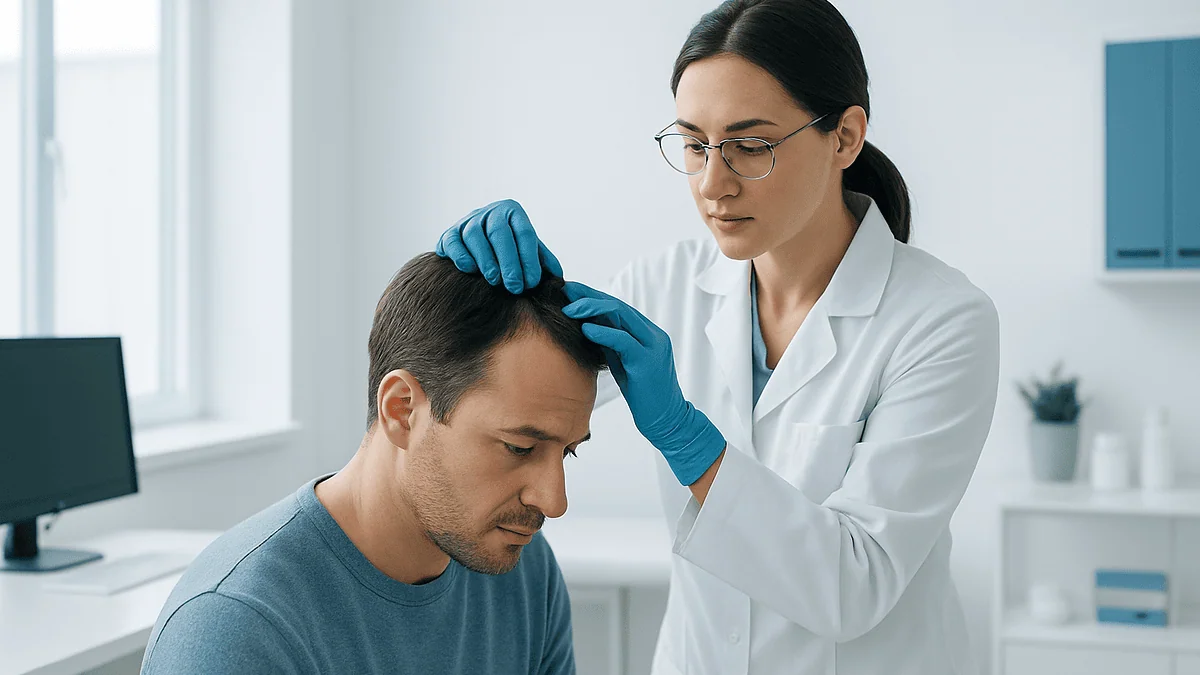
For a female hair transplant, FUE and DHI use the same method of harvesting follicles one by one from the back of the scalp; they differ mainly in how grafts are placed. DHI uses an implanter pen to open the channel and insert the graft in one motion, which can allow placement between existing hairs without shaving the recipient area. Neither technique is proven superior; suitability depends on your hair loss pattern and your surgeon's assessment.
She had already made peace with the parting. What she could not make peace with was the question a friend asked over coffee: “Would you have to shave your head?” For many women weighing surgery for thinning hair, that single worry outranks everything else, including how the grafts are actually placed. The consultation brochures do not help much. They talk about punches, pens and channels, and leave the reader guessing which acronym answers her question.
So it is worth slowing the conversation down. When people search for information on a female hair transplant FUE vs DHI, they are usually asking two practical things at once: how much hair has to come off, and how precisely new hair can be tucked between the strands she still has. Those two questions are linked, and the link is technique.
What follows is an honest walk through both methods, what the evidence supports, where it goes quiet, and which questions belong on the table at your consultation.
Female hair transplant FUE vs DHI: what is actually being compared?
Start with a fact that surprises many people: DHI is not a rival to FUE. It is a variation of it. Both begin with follicular unit extraction, the process of removing hair follicles individually from a donor area, usually the back and sides of the scalp, using a small circular punch. That extraction step is identical in the two approaches.
The difference appears afterwards. In classic FUE, the surgeon first makes tiny incisions, called channels, across the thinning area, then a team places each graft into a waiting channel with fine forceps. In DHI, short for direct hair implantation, each graft is loaded into a hollow, spring-loaded implanter pen. Pressing the pen opens the channel and releases the follicle in one motion. The graft spends less time outside the body between extraction and placement, and the surgeon controls depth, angle and direction at the moment of insertion.
Why does this matter more for women than for men? Female pattern hair loss tends to thin diffusely across the crown and central parting rather than receding in a clean line, a distribution often described using the Ludwig scale, a three-stage classification of central thinning in women. Surgeons are therefore rarely filling a bald zone; they are threading new follicles between surviving ones. Any method that helps place a graft precisely without damaging its neighbors becomes more relevant, and so does any method that lets the surrounding hair stay long.
According to the NHS, a hair transplant is a day-long procedure carried out under local anesthetic, with transplanted hairs shedding in the first weeks before regrowth. Those basics hold whether the placement tool is forceps or a pen. The rest of this article is about the differences that remain once you accept how much the two techniques share.
What actually happens on the day of a female hair transplant
The morning usually begins with photographs and a marking session. The surgeon draws the target zone on the scalp and confirms the direction of existing growth, because transplanted hairs need to lie the same way. Local anesthetic is injected into the donor area first. Mayo Clinic notes that hair transplant procedures are performed while you are awake, with numbing medicine, and that several sessions may be needed depending on the extent of thinning.
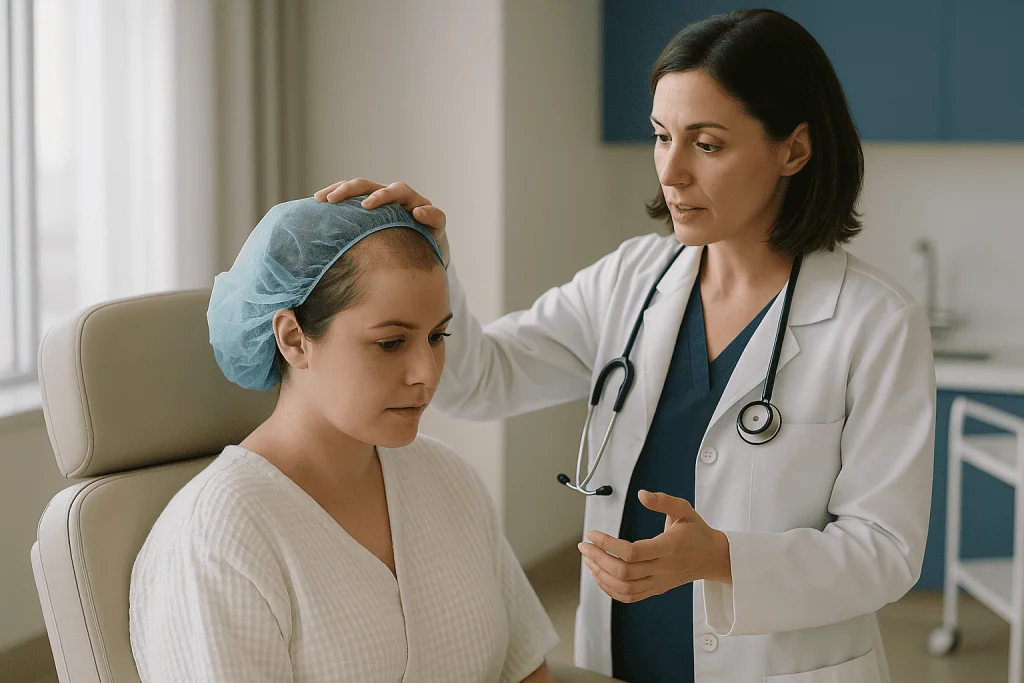
Extraction follows. A punch, typically well under a millimeter in diameter, is used to free each follicular unit, which is a natural cluster of one to four hairs sharing a root bundle. The grafts rest in a chilled holding solution while the team counts and sorts them by hair number, because single-hair grafts are used at the front to soften the hairline and multi-hair grafts go behind them for density.
Here the two techniques part ways. In FUE, the surgeon now numbs the recipient area and creates channels with a fine blade or needle before any grafts go in. The blade material varies; some surgeons use sapphire-tipped instruments and call this sapphire FUE, though it is a change of tool rather than of principle. In DHI, no separate channel-making stage exists. The loaded implanter pen does both jobs, graft by graft.
Cleveland Clinic describes a typical procedure lasting roughly 4–8 hours, with the exact length depending on how many grafts are moved. Women undergoing smaller, targeted sessions may be finished sooner. You go home the same day with a light dressing on the donor area and written aftercare instructions. Most people describe tightness or mild soreness rather than sharp pain, and the treating team will discuss what pain relief is appropriate for you.
Do you have to shave for a female hair transplant? The unshaven question
Ask a room of women considering surgery what they fear most and shaving wins comfortably. It is not vanity; a shaved scalp announces a procedure that many people would rather keep private, at work and at home.
The donor area is the first part of the answer. To extract follicles cleanly, the surgeon needs to see them, so some trimming of the back of the head is almost always required. The practical trick is a hidden strip: a narrow band low on the occipital scalp is clipped short, and the longer hair above is combed down over it. With hair of shoulder length or more, the trimmed zone can be difficult to spot within days.
The recipient area, where new hair is placed, is the second part, and this is where technique choice bites. Classic FUE channel-making is easier when the surrounding hair is short, because the surgeon must see each slit to place the graft into it later. Many FUE surgeons will still work unshaven in women, but it is slower and more demanding. DHI was developed partly to sidestep this. Because the pen opens and fills the channel in one step, the surgeon does not need to find a pre-made slit among long strands. That makes placement between existing hair, with no shaving of the crown or parting, more straightforward.
Two honest caveats belong here. Unshaven work of any kind takes longer and usually limits how many grafts can be placed in one session. And the phrase “no-shave” in marketing almost always still means a hidden donor trim. If keeping your length intact is your top priority, say so explicitly and ask exactly which areas will be clipped and how short.
Placement precision: implanter pens versus pre-made channels
Picture two ways of planting seedlings in a bed that is already half full. In one, you dig every hole first, then come back with the seedlings and try to find each hole. In the other, you push a planting tool into the soil and release a seedling in the same movement. Both can produce a healthy row. The second is simply easier to control when there are established plants in the way.
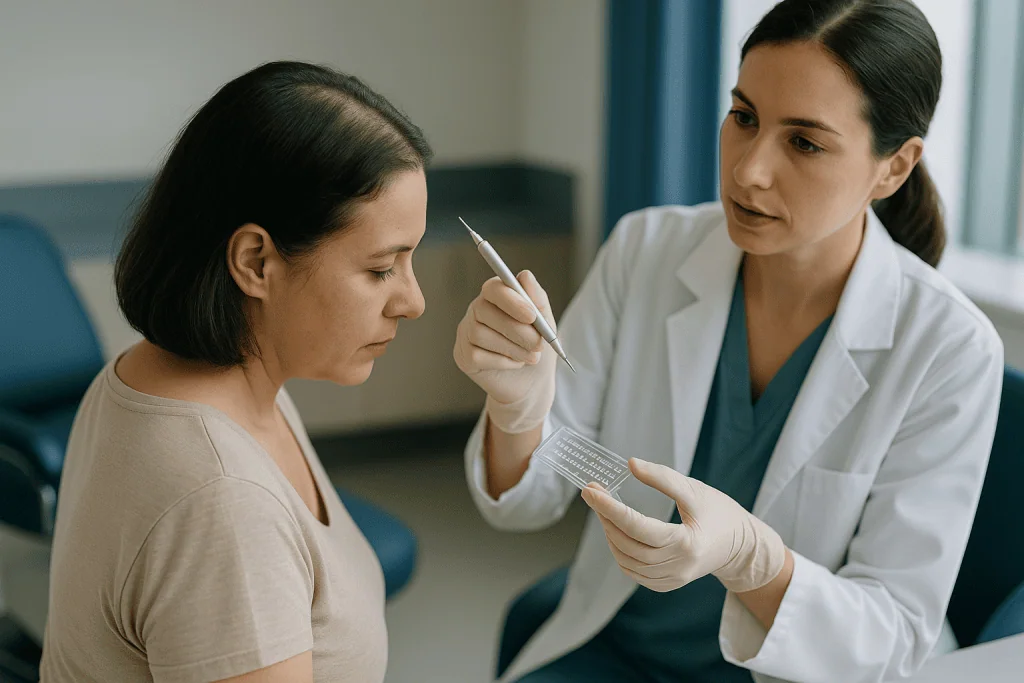
That is the logic behind DHI placement. The surgeon holding the pen decides, at the moment of insertion, how deep the graft sits, which way it tilts and how far it lies from its neighbors. Angle matters enormously on a woman’s crown, where hair spirals rather than sweeping forward, and in the central parting, where existing hairs must be preserved. A graft placed at the wrong angle grows visibly against the grain.
Classic FUE separates those decisions. The surgeon sets the angle and density when cutting the channels, then assistants place grafts into them. In skilled hands the result is equally natural, and the two-stage process has a practical advantage: channel-making for hundreds of grafts is fast, which is why FUE remains the workhorse for large sessions.
What about survival of the graft itself? The theory favors DHI slightly because grafts spend less time outside the body and are handled less. The evidence is thinner than the theory. Comparative studies are small, often single-center, and rarely involve women. Cleveland Clinic points out that results in any technique depend heavily on the surgeon’s experience and on healthy donor hair; no mainstream guideline currently declares one placement method superior. Hold on to that when you read confident online claims.
Who is a female hair transplant usually for, and who is asked to wait?
Candidacy is where honest surgeons spend most of their consultation time with women, and for good reason. A transplant moves hair; it does not create it. The donor area has to be stable and reasonably dense, and in female pattern hair loss the thinning often affects the whole scalp to some degree, including the back. A surgeon will examine the donor zone closely, sometimes with magnification, to judge whether it can supply grafts without becoming visibly sparse itself.
Women who tend to do well include those with a stable, localized pattern: a widened central parting, a receded frontal hairline after years of tight styling (traction alopecia), thinning at the temples, or hair loss scarring from surgery or injury. Harvard Health notes that about one third of women experience hair loss at some point, and that in many cases the pattern is genetic and progressive, which is exactly why timing matters.
Who is usually asked to wait, or to consider other paths first? Mayo Clinic describes several causes of hair loss that need diagnosis before any cosmetic step: thyroid disease, iron deficiency, recent childbirth, significant illness, certain medications and autoimmune conditions such as alopecia areata. Transplanting into a scalp affected by an active inflammatory or scarring disorder such as lichen planopilaris risks losing the new grafts. Women whose loss is diffuse across the entire head, including the donor zone, may be told that surgery would simply redistribute thin hair.
Age and stability matter too. If the pattern is still changing quickly, most surgeons prefer to observe and, where appropriate, treat medically for a period before committing donor hair. The decision belongs to you and your treating team, ideally including a dermatologist who has confirmed what type of hair loss you have.
Is DHI really better than FUE for women? What the evidence shows
Type this question into a search engine and you will find pages that answer yes with great confidence, usually written by those who offer DHI. Read the clinical literature and the answer becomes more careful.
Here is what can be said with reasonable support. DHI and FUE share the same extraction step, so donor-site healing and scarring are comparable. DHI allows one-step placement, which can shorten the time a graft spends outside the body and supports implanting between existing hairs without shaving. FUE with pre-made channels allows larger sessions to proceed quickly, because channel creation is faster than pen loading, and a well-drilled team can place grafts efficiently.
Here is what cannot be said. There is no large randomized trial comparing the two techniques in women. Published comparisons are mostly small, retrospective and conducted in men, with follow-up periods that vary. Reported graft survival figures in those papers cannot responsibly be quoted as expected outcomes for an individual patient, and no major clinical body has endorsed a survival percentage for either method. Cleveland Clinic’s patient guidance stresses that outcomes depend on the surgeon’s skill and on the health of your donor hair rather than on the tool alone.
So how should a woman weigh the choice? Think of DHI as a placement technique that fits certain situations particularly well: modest graft numbers, dense existing hair that must be protected, a strong wish to avoid shaving the recipient area. Think of FUE as the versatile default, with unshaven variants possible in experienced hands. Neither is “better” in the abstract. The better technique is the one your surgeon performs regularly, in the pattern of loss you have, with a plan that protects your donor supply for the years ahead.
DHI vs FUE for women at a glance
Tables flatten nuance, so treat this one as a starting map rather than a verdict. Every row has exceptions, and your surgeon may reasonably choose differently for your scalp.
| Feature | Classic FUE | DHI (implanter pen) |
|---|---|---|
| Donor harvesting | Individual follicular unit extraction with a small punch | Identical to FUE |
| Recipient channels | Made first with a blade or needle; grafts placed afterwards with forceps | Opened and filled in one motion by the pen |
| Shaving of recipient area | Often preferred; unshaven possible but slower | Frequently avoided; placement between long hairs is the method’s strength |
| Control of angle and depth | Set during channel-making by the surgeon | Set at the moment of insertion by the surgeon |
| Session size | Suits larger graft numbers | Typically slower per graft; suits smaller, targeted sessions |
| Time graft spends outside body | Longer, held in solution until channels are ready | Shorter in principle; evidence of a survival advantage is limited |
| Donor scarring | Small dot scars hidden by surrounding hair | Same as FUE |
| Evidence base in women | Limited, mostly extrapolated from male studies | Limited, mostly extrapolated from male studies |
Two rows deserve a second look. “Session size” explains why some surgeons combine approaches, using pre-made channels in bare areas and an implanter pen where existing hair is dense. And “evidence base in women” is the row most brochures leave out. The NHS describes hair transplantation as effective for many people but reminds patients that results vary and that the procedure is not suitable for everyone; that caution applies equally to both columns.
What are the disadvantages of DHI? And of FUE?
Marketing tends to list only the other technique’s drawbacks. A balanced view lists both.
The disadvantages of DHI begin with pace. Loading each graft into a pen and placing it individually is slower than making hundreds of channels in one pass. That translates into fewer grafts per session, longer chair time, or both, and for women needing broad coverage it may mean more than one procedure. The pens themselves require training; an unfamiliar operator can crush a graft while loading or place it too shallow, where it pops out, or too deep, where the skin heals over it. Because the surgeon does everything at the point of insertion, the technique also depends heavily on that one person’s stamina across a long day.
Classic FUE has its own weak points. Pre-made channels are easier to place in a shaved field, so women who insist on keeping recipient hair long may find fewer surgeons willing to do it, or may be offered a smaller session. Grafts wait longer outside the body. Placing them with forceps demands that assistants find each channel and insert the graft without bending the root, a skill that varies between teams.
Some drawbacks are shared. Both methods leave tiny white dot scars in the donor area; MedlinePlus lists infection, bleeding, swelling, numbness, folliculitis (inflammation of hair follicles) and an unnatural appearance among possible complications of any hair transplant. Both can trigger temporary shedding of surrounding hair. Both can exhaust a woman’s limited donor supply if planned carelessly, and that is the disadvantage that outlasts every other, because donor hair does not grow back once removed. The honest question is not which technique has fewer flaws, but which flaws matter least for your particular scalp and priorities.
The first days and weeks after surgery: what usually happens
The pattern is similar regardless of technique, and knowing it in advance spares a lot of anxiety.
In the first 2–3 days the donor area feels tender and the recipient area is dotted with tiny scabs around each graft. Mild swelling of the forehead is common and can drift toward the eyes before settling. Your team will explain how to sleep with the head raised and when the first gentle rinse is permitted. Many women worry about washing; the goal is to soften scabs without dislodging grafts, and the instructions are specific for that reason.
Around days 7–10 the scabs lift. Redness fades over the following weeks, faster in fair skin, slower where pigmentation is deeper. Then comes the moment that unsettles nearly everyone: the transplanted hairs fall out. The NHS explains that this shedding typically occurs 2–6 weeks after surgery, before new growth begins, and that new hair should start to appear after about six months. The follicle stays behind; only the shaft is shed while the root enters a resting phase.
Regrowth is gradual and initially fine. Cleveland Clinic notes that early hairs can look thin or uneven before thickening, and that a fair judgment of the result usually waits until around 12–18 months. Women with long surrounding hair have an advantage here, because the existing strands camouflage the awkward middle months that men with short styles cannot hide.
Return to work is often possible within days for desk-based roles, sooner when there is no visible shaving. Heavy exercise, swimming and hair coloring are usually delayed for several weeks. Follow the timeline your own team gives you rather than any generic one, including this.
Do all FUE grafts fall out? Shock loss explained
The question sounds alarming, and the reassuring answer is that shedding is expected while loss is not.
Nearly all transplanted hairs shed in the weeks after surgery. The hair shaft, which has been through extraction and placement, drops away as the follicle resets into telogen, the resting phase of the hair cycle. This is normal for both FUE and DHI and does not mean the graft has died. Regrowth from the surviving follicle follows over subsequent months, in line with the NHS timeline of shedding at 2–6 weeks and visible new hair from about six months.
What people actually fear is the permanent kind of loss, and two mechanisms account for it. The first is a graft that fails to take: it was damaged during handling, dried out, placed at the wrong depth or dislodged in the first days. Good technique, in either method, keeps this to a small minority, but no clinician can promise a specific survival figure for an individual patient, and you should be wary of anyone who does.
The second mechanism has particular relevance for women and is called shock loss. Existing hairs near the transplanted zone can shed in response to the trauma of surgery, especially if they were already miniaturized, meaning thinned by the same hormonal process that caused the hair loss in the first place. Most of these hairs recover over several months, but weak follicles may not. This is one reason surgeons are cautious about dense packing between fragile native hairs, and one reason many advise stabilizing the underlying condition before operating.
Neither technique eliminates shock loss. Careful placement that respects the existing follicles, whether by pen or by pre-made channel, reduces the risk. Ask your surgeon how they minimize it in diffuse thinning.
What people often get wrong about DHI, FUE and female hair loss
Some beliefs circulate so widely that they are worth correcting one at a time.
“DHI is scarless and FUE is not.” Both methods harvest the same way and leave the same small donor dot scars. Only the older strip method, known as FUT, in which a strip of scalp is removed and stitched, leaves a linear scar. DHI has no unique claim to being scar-free.
“Transplanted hair is permanent, so the problem is solved.” Transplanted follicles from the back of the scalp usually keep their resistance to the hormonal process driving pattern hair loss. The native hairs around them do not. Mayo Clinic describes female pattern hair loss as typically progressive, so untreated thinning can continue and change the overall picture, which is why the team may discuss ongoing medical management.
“More grafts means a better result.” For women, dense packing between existing hairs raises the risk of shock loss and can drain a donor area that was never abundant. Coverage in the right place at the right angle beats raw numbers.
“Supplements can do what surgery does.” The NIH Office of Dietary Supplements notes that biotin supplementation improves hair only in people with a genuine biotin deficiency, which is rare. Correcting a diagnosed deficiency such as low iron matters; megadoses of vitamins do not regrow pattern hair loss.
“A famous person had FUE, so it works.” Public figures rarely confirm their procedures, and speculation about anyone’s medical care says nothing about what suits your scalp.
“Sapphire FUE is a different operation.” It refers to the blade material used to make channels, not a new method. The evidence that blade material changes results is limited.
Each of these myths steers women toward the wrong question. The right one is whether your pattern, donor supply and diagnosis make any transplant sensible, and only then which placement tool fits.
Alternatives and what usually runs alongside surgery
Surgery is one option among several, and for many women it is not the first.
Diagnosis comes before everything. Mayo Clinic lists blood tests, a pull test, scalp examination and occasionally a scalp biopsy as tools for identifying the type of hair loss. A woman whose thinning stems from iron deficiency, thyroid dysfunction or a recent illness (telogen effluvium, a temporary shedding triggered by stress on the body) may regain hair without any procedure once the cause is addressed.
For confirmed female pattern hair loss, topical minoxidil is the most widely used non-surgical treatment. It is thought to prolong the growth phase of the hair cycle and enlarge miniaturized follicles; Harvard Health describes it as requiring months of consistent use before any change is visible, with gains lost if it is stopped. Some clinicians also use oral medicines from the anti-androgen class in selected women. Whether any medication is appropriate, and in what form, is a decision for the prescribing clinician who knows your history.
Low-level laser devices are marketed widely. The evidence base is modest and of mixed quality, and mainstream guidance treats them as an option with uncertain benefit rather than an established therapy. Platelet-rich plasma injections fall into a similar category: promising in small studies, not yet proven in large, well-designed trials.
Camouflage deserves a mention without embarrassment. Scalp micropigmentation, keratin fibers, hairpieces and strategic styling help many women, sometimes as a bridge and sometimes as the whole solution.
Where surgery is chosen, many surgeons encourage continuing medical treatment afterwards, because it protects the native hairs around the grafts. The transplant addresses today’s parting; the medical plan addresses next year’s. Your dermatologist and surgeon should be talking to each other about both.
Questions to ask your care team before choosing FUE or DHI
A good consultation is a two-way examination. These questions help you test whether the plan fits you rather than the other way round.
- What type of hair loss do I have, and how was that confirmed? Has a dermatologist assessed me?
- Is my hair loss stable enough for surgery now, or would you prefer to observe or treat medically first?
- How dense is my donor area, and how many grafts can it realistically supply over my lifetime, not just today?
- Which technique do you perform most often in women with my pattern, and why do you favor it for me?
- Exactly which areas will be trimmed or shaved, how short, and how will they be hidden?
- Who places the grafts: you, or assistants? How many people will be involved on the day?
- How do you reduce the risk of shock loss to my existing hair?
- What is your plan if my thinning progresses around the transplanted area?
- What results should I expect in my case, and what would you consider a disappointing outcome?
- What complications have you seen in women, and how were they managed?
- How many follow-up visits are included, and who do I call if something worries me at home?
- Which medical treatments, if any, would you want me to continue afterwards, and who will prescribe and monitor them?
Listen for how the answers are framed. Vague reassurance, guaranteed percentages, pressure to decide quickly or reluctance to discuss donor limits are all reasons to pause. A surgeon who volunteers the disadvantages of their own preferred technique is usually the one worth trusting. The NHS also recommends checking that any practitioner performing cosmetic procedures is appropriately registered and that the setting is regulated; whatever country you live in, the equivalent check is worth making.
When to call your doctor after a female hair transplant
Most recoveries are uneventful, and knowing what is normal helps you recognize what is not. Tenderness, mild swelling, small scabs, itching as the skin heals and the expected shedding of transplanted hairs between roughly 2 and 6 weeks are all part of the ordinary course described by the NHS and MedlinePlus.
Contact your surgical team promptly, or seek urgent care if you cannot reach them, for any of the following red-flag signs:
- Spreading redness, warmth or increasing pain in the donor or recipient area, or pus draining from any site, which may indicate infection.
- Fever or chills in the days after surgery.
- Bleeding that does not stop with gentle pressure after several minutes.
- Swelling of the face or eyelids that worsens after the third day rather than settling, or that affects your vision.
- Numbness or tingling that persists beyond the timeframe your team described, or new weakness anywhere.
- Clusters of painful pimple-like bumps in the transplanted area, which can signal folliculitis needing assessment.
- Sudden, extensive shedding of your existing hair beyond the mild shock loss you were told to expect.
- Any reaction to prescribed medicines such as rash, breathing difficulty or swelling of the lips or tongue, which needs emergency care.
Trust your instinct on the vaguer signs too. If a graft area looks different from the photographs you were shown of normal healing, or you simply feel unwell in a way you cannot name, a phone call costs nothing and often resolves the worry in minutes. Every decision about treatment, whether to adjust wound care, start or stop a medicine, or bring you back for review, rests with the team who operated on you and who know your case; this article can inform that conversation but cannot replace it.
Frequently asked questions
Is DHI really better than FUE for a female hair transplant?
No technique has been shown to be superior in women. DHI and FUE share the same extraction step and differ only in how grafts are placed. DHI’s implanter pen makes unshaven placement between existing hairs easier, while FUE with pre-made channels is faster for larger sessions. Small studies, mostly in men, do not support a clear survival advantage for either. Your surgeon’s experience with your pattern of loss matters more than the label.
Did Elon Musk have FUE?
There is no confirmed medical record in the public domain, and speculation about any public figure’s hair is exactly that: speculation. People in the public eye rarely disclose procedures, and photographs cannot reveal which technique, if any, was used. More to the point, what suited another person’s scalp says nothing about yours. Candidacy for FUE or DHI depends on your diagnosis, donor density and pattern of thinning, assessed in person.
Do all FUE grafts fall out after surgery?
Nearly all transplanted hairs shed within the first weeks, but the follicles beneath remain and regrow. The NHS describes shedding at 2–6 weeks with new growth appearing after around six months. This happens with DHI as well as FUE. Permanent loss of a graft is different and less common; it occurs when a follicle is damaged, dislodged or placed at the wrong depth. No clinician can promise an exact survival figure for an individual.
What are the disadvantages of DHI hair transplant?
DHI is slower per graft because each follicle must be loaded into the pen and placed individually, which limits session size and may mean more than one procedure for broad thinning. It depends heavily on one operator’s skill and stamina, and improper loading can crush a graft. It also shares all the general risks of hair transplantation, including infection, folliculitis, swelling and temporary shock loss of surrounding hair, and it leaves the same donor dot scars as FUE.
Can I have an unshaven hair transplant as a woman?
Often, yes, with an important caveat. The donor area at the back of the head almost always needs a narrow hidden trim so follicles can be seen and extracted; longer hair above is combed over it. The recipient area can frequently be left unshaved, particularly with DHI, whose pen places grafts between long hairs in one step. Unshaven work takes longer and may limit graft numbers, so discuss exactly which areas will be clipped.
Does FUE leave visible scars in women?
FUE leaves tiny white dot scars where each follicle was removed. They are usually hidden by surrounding hair, and for women with longer styles they are rarely visible. DHI leaves identical marks because it uses the same extraction method. Only the strip technique, FUT, produces a linear scar. Over-harvesting any donor area can make dot scars more noticeable as the hair between them thins, which is one reason donor planning matters.
How long does a female hair transplant take, and is it painful?
Cleveland Clinic describes a typical procedure lasting around 4–8 hours depending on graft numbers; smaller targeted sessions in women may be shorter. It is performed under local anesthetic while you are awake. Most people report tightness or mild soreness in the days afterward rather than severe pain. Your treating team will explain what pain relief and wound care are appropriate for you; follow their instructions rather than a generic timeline.
Is DHI vs FUE for women decided by the pattern of hair loss?
Largely, yes. Diffuse thinning between surviving hairs, as in a widened central parting, favors precise placement that protects native follicles, where an implanter pen has practical advantages. Larger bare areas, such as a receded hairline from traction alopecia, can be filled efficiently with pre-made channels. Many surgeons mix the two in a single session. The final choice sits with the surgeon after examining your scalp and donor supply.
Will my remaining hair keep thinning after a transplant?
It can. Transplanted follicles usually keep their resistance to the hormonal process behind pattern hair loss, but the native hairs around them do not. Mayo Clinic describes female pattern hair loss as typically progressive. This is why many teams discuss continuing medical treatment after surgery and plan grafts with future thinning in mind. Any decision about starting or continuing medication belongs to the prescribing clinician who knows your history.
When will I see the final result of a female hair transplant?
Patience is built into the process. After the expected shedding at 2–6 weeks, new hairs emerge from about six months according to the NHS, initially fine and uneven. Cleveland Clinic notes that a fair assessment usually waits until roughly 12–18 months, when the hairs have thickened and matured. Women with longer surrounding hair often find the middle months easier to manage because existing strands camouflage the transition.
References
This article is for general information only and is not a substitute for professional medical advice. Please consult a qualified doctor about your individual situation.

More from the Blog
What Happens During PRP for Hair Loss: From the Blood Draw to the Scalp Injections
During PRP for hair loss, a clinician draws a small tube of your own blood, spins it in a centrifuge to separate a platelet-rich…
How Surgeons Assess Keloid Risk and Scar Tendency Before an Afro Hair Transplant
Before an afro hair transplant, surgeons assess keloid risk by asking about personal and family scar history, examining existing scars anywhere on the body,…
How a Hair Transplant Without Shaving Is Done: Hidden Donor Windows and Graft Placement
A no shave hair transplant procedure harvests follicles from narrow, concealed strips of the back and sides of the scalp, trimmed short beneath longer…

Beard Transplant Recovery: Healing Without Ruining the Grafts
Most people are socially presentable within 7 to 10 days of a beard transplant, but biological recovery takes months. Grafts anchor securely by about…
Hair Transplant Without Shaving Results: Does Working Around Existing Hair Limit Density?
A hair transplant can be done without shaving the whole head, usually as an unshaven or partially shaved follicular unit extraction. Working around existing…

Who Suits Scalp Micropigmentation for Scars and Thinning, and Who Needs Another Approach?
Scalp micropigmentation for scars usually suits adults whose scar is fully healed and flat, whose skin does not tend to form raised keloids, and…