

How to Stop Hair Loss: The Treatments With Evidence, Ranked

Key Takeaways
- Losing 50 to 100 hairs a day is normal turnover, and shedding that arrives in clumps about three months after childbirth, illness or surgery usually reflects telogen effluvium, which typically recovers without treatment.
- Topical minoxidil and oral finasteride for men are the only pattern hair loss treatments backed by multiple large randomised trials, and both lose their benefit within months of stopping.
- In the original finasteride trials, sexual side effects affected roughly one to two men in a hundred, only slightly above placebo, and reports of persistent symptoms come from observational data that cannot establish how often it happens.
- Three JAK inhibitors approved between 2022 and 2024 are the first licensed medicines for severe alopecia areata, with roughly a quarter to two in five trial participants regrowing most scalp hair, but they are not approved for pattern hair loss.
- The rosemary oil claim rests on a single 2015 trial of about a hundred men with no placebo group and no replication, which places it well below minoxidil on any evidence scale.
- The NIH Office of Dietary Supplements finds no evidence that biotin helps hair in people who are not deficient, and high-dose biotin can distort thyroid and cardiac blood tests.
The best-supported ways to stop or slow hair loss depend on its cause. For male and female pattern hair loss, topical minoxidil and, in men, oral finasteride have the strongest randomised-trial evidence; both work only while used. Severe alopecia areata now has approved JAK inhibitor medicines. Shedding after illness, surgery or childbirth usually settles on its own within months. A clinician should confirm the type of hair loss first.
The drain usually tells you before the mirror does. One morning there is a dark swirl of hair in the shower trap, and by lunchtime you have typed how to stop hair loss into a search bar, scrolled through a dozen confident videos, and come away less sure than when you started.
Searches for that phrase have climbed again, and as of mid-2025 the reasons are fairly specific. Short videos praising oral minoxidil, a blood pressure tablet that dermatologists have repurposed, have gathered millions of views. Three prescription medicines for severe alopecia areata have been approved by the US Food and Drug Administration since 2022, the first ever for that condition. And a steady drumbeat of supplement advertising promises thicker hair from a gummy.
What follows is a ranking built on the quality of the evidence rather than the volume of the hype. Some treatments have decades of randomised trials behind them. Others rest on a single small study. Knowing which is which is most of the game.
What changed recently in hair loss treatment
For most of the past thirty years, the medical answer to pattern hair loss had two names: minoxidil and finasteride. The last three years have widened the field, mainly for a different condition.
In June 2022 the FDA approved baricitinib, the first systemic medicine ever licensed for severe alopecia areata, an autoimmune form of hair loss in which the immune system attacks hair follicles. Ritlecitinib followed in June 2023, notable because it was approved for adolescents aged 12 and older as well as adults. Deuruxolitinib arrived in July 2024 for adults. All three belong to a class called JAK inhibitors, which block Janus kinase enzymes that relay inflammatory signals inside immune cells. None of them is approved for the common inherited thinning most people mean when they search for hair loss.
Minoxidil has had its own second act. The tablet form, approved decades ago for high blood pressure, is now widely prescribed off-label for hair at far lower strengths than the blood pressure range. Large observational case series since 2020 reported good tolerability, and a 2024 randomised trial in men found oral and topical minoxidil produced broadly similar results over 24 weeks. That is a single trial, not a settled question, and the prescription remains off-label in the United States.
Finasteride’s safety labelling also moved. In April 2024 the UK medicines regulator completed a review of reports of mood changes and persistent sexual side effects, and patients in the UK now receive an alert card describing symptoms that should prompt a conversation with the prescriber. The NHS finasteride guidance was updated to reflect it. The underlying efficacy evidence did not change; the emphasis on informed discussion did.
Which kind of hair loss are you trying to stop?
Nothing about treatment makes sense until the type is named, because the treatments barely overlap.

Every scalp hair cycles through a growing phase (anagen) lasting roughly 2–6 years, a brief transition, and a resting phase (telogen) of about three months before it falls out and a new hair starts. Losing 50 to 100 hairs a day is the normal cost of that turnover, which is why a handful on the pillow proves nothing on its own.
Androgenetic alopecia, better known as male or female pattern hair loss, is by far the most common cause. Follicles inherit a sensitivity to androgens, the hormones that include dihydrotestosterone (DHT), and shrink over successive cycles until they produce only fine, short hairs. Around half of men show it by 50; a large share of women notice it after menopause, though it can begin earlier.
Telogen effluvium is different in kind. A physical or emotional shock pushes an unusually large number of follicles into the resting phase at once, and two to three months later they shed together. The follicles are healthy and the hair usually returns.
Alopecia areata produces smooth, coin-sized bald patches and sometimes total scalp or body hair loss. Traction alopecia comes from years of tight braids, ponytails or extensions pulling at the hairline. Scarring alopecias, a rarer group, involve inflammation that destroys the follicle permanently, which is why they are the most urgent to catch.
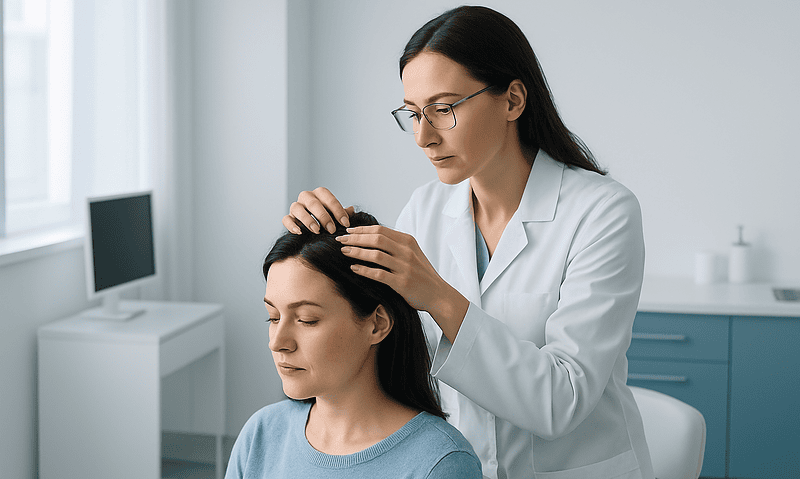
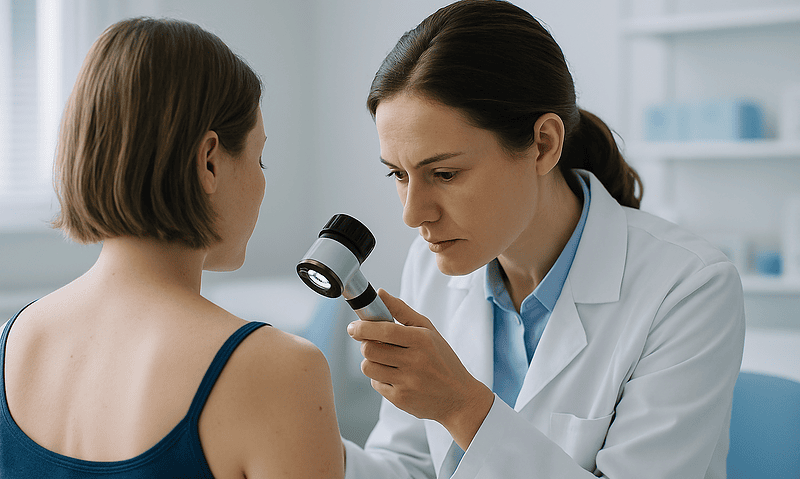
A dermatologist sorts these with a few tools: gently tugging a lock of hair to count what comes away, a handheld magnifier called a dermatoscope to inspect follicle openings, blood tests for thyroid function and iron stores, and occasionally a small scalp biopsy. Ten minutes of that beats ten hours of videos.
What the evidence actually says: grading the treatments
Medical evidence comes in grades, and the labels matter more than the marketing. Randomised controlled trials, in which people are assigned by chance to a treatment or a placebo, are the only design that reliably separates a real effect from wishful thinking. Observational studies, which follow people who chose a treatment, can suggest but not prove. Expert opinion sits below both.
Applying that ladder to hair loss produces a clearer picture than the search results do.
At the top, with multiple large randomised trials and regulatory approval for the indication, sit topical minoxidil for pattern hair loss in men and women, oral finasteride for pattern hair loss in men, and JAK inhibitors for severe alopecia areata. Corticosteroid injections into alopecia areata patches rest on decades of clinical use plus moderate-sized trials.
The middle tier holds treatments with smaller or less consistent randomised evidence: low-level laser devices, microneedling combined with minoxidil, platelet-rich plasma (PRP), oral minoxidil, and spironolactone for women. Each has shown benefit in at least some trials; none has the depth of data the top tier enjoys, and protocols vary so widely between studies that comparing them is difficult.
Lower still are treatments supported mainly by observational data or mechanism: correcting a confirmed iron or vitamin D deficiency, antifungal shampoos, and botanical oils backed by a single small trial.
At the bottom are products with essentially no credible evidence in people who are not deficient: biotin gummies, collagen powders, scalp massage gadgets and “DHT-blocking” shampoos.
Hair transplantation sits slightly to the side. It is surgery with a long track record and visible results, but it is not tested against placebo the way medicines are, and its success depends on keeping the surrounding native hair alive with the treatments above.
Does minoxidil really work, and what about the tablet version?
Minoxidil was a blood pressure drug whose patients kept growing unexpected hair, and the topical liquid and foam that followed have been studied in randomised trials for more than three decades. The honest answer is yes, for many people, modestly, and only while it is used.

Its mechanism is still not fully understood. It opens potassium channels in cells, widens small blood vessels, lengthens the growing phase and nudges miniaturised follicles to produce thicker hairs. Trials and the Mayo Clinic’s summary agree on the practical points: a meaningful share of users see slowed loss or some regrowth, results are strongest at the crown and weaker at the temples, and it takes at least six months of consistent use to judge whether it is working. A temporary increase in shedding during the first weeks is common and reflects old resting hairs being pushed out early.
Stop, and the benefit fades over a few months. That is not addiction; the follicles simply return to their programmed course.
Side effects are mostly local: scalp irritation, dryness, and unwanted fine hair on the face if the product migrates. Dizziness or a racing heartbeat is uncommon but worth reporting.
The tablet form behind the current trend is a prescription medicine approved for high blood pressure. Dermatologists prescribe it off-label for hair at far lower strengths, citing convenience for people who dislike the topical texture. The evidence is a step below the topical: large observational series, and so far one 2024 randomised trial in men suggesting comparable results. Reported side effects include body hair growth, ankle swelling, fluid retention and a faster pulse, and it is avoided in people with certain heart conditions. Whether it suits a given person is a decision for the prescribing clinician, who can weigh blood pressure, heart history and other medicines.
Finasteride: the strongest evidence for men, and the finasteride side effects question
If minoxidil treats the follicle, finasteride treats the hormone. It blocks 5-alpha reductase, the enzyme that converts testosterone into DHT, and lowers DHT in the scalp. Because DHT is what shrinks sensitive follicles, removing most of it halts the shrinking.
Randomised trials running for up to five years, summarised by the NHS and Mayo Clinic, show that most men who take it either hold their hair count steady or regain some density, with the crown responding better than the front. Three to six months pass before change is visible. As with minoxidil, the effect is conditional: within six to twelve months of stopping, hair returns to where it would have been.
Side effects are where the search traffic concentrates. In the original trials, reduced sex drive, difficulty with erections or changes in ejaculation affected roughly one to two men in a hundred, a rate only slightly above placebo, and most resolved either during treatment or after stopping. Since then, case reports and observational studies have described symptoms persisting after discontinuation, along with low mood. Those reports cannot establish how often this happens or prove causation, because people who stop a medicine for side effects are not a random sample. Regulators have responded by strengthening warnings rather than restricting use, which is a fair reading of uncertain evidence.
Two practical cautions are not uncertain. Finasteride must not be handled or taken by women who are or may become pregnant, because it can affect the development of a male fetus. And it lowers prostate-specific antigen (PSA), so any man having prostate screening should tell the clinician he takes it.
A topical finasteride spray is approved in parts of Europe but not in the United States, where it remains off-label. All forms are prescription-only, and starting, continuing or stopping belongs with the prescriber.
Female pattern hair loss treatment: what is different for women
Women rarely go bald in the male sense. Female pattern hair loss widens the central parting and thins the crown while the front hairline usually holds, and it often announces itself as a ponytail that feels half its old thickness. Because the change is diffuse rather than patchy, it is easy to blame shampoo or stress for years before anyone names it.
The evidence base is smaller than for men but points in a consistent direction. Topical minoxidil is the only treatment with randomised trials and regulatory approval for women, and Harvard Health describes it as first-line. The same rules apply: months before judgement, ongoing use to keep the benefit, and a possible early shedding phase.
Spironolactone, a diuretic that also blocks androgen receptors, is widely prescribed off-label. Its support comes from observational studies and small trials rather than large randomised ones; it requires reliable contraception in women who could become pregnant and periodic blood tests. Finasteride in women has produced mixed results in small trials, works, if at all, mainly after menopause, and carries the same pregnancy prohibition. Oral minoxidil has observational data in women similar to that in men.
Before any of that, a good clinician looks for what else might be thinning hair. Iron deficiency, thyroid disease and polycystic ovary syndrome are common, treatable and routinely checked with blood tests. Hair loss accompanied by irregular periods, acne or new facial hair should prompt a hormonal work-up rather than a trip to the pharmacy aisle.
Transplant surgery suits fewer women, because the donor area at the back is often thinning too. Hair fibres, root-lift sprays and a shorter layered cut are not medicine, but they are legitimate and immediate.
The middle tier: laser caps, PRP and microneedling
Three treatments draw heavy marketing and sit on genuinely ambiguous evidence. They are neither scams nor proven.
Low-level laser therapy uses red light from a comb, band or helmet, with the proposed mechanism of stimulating cellular energy production in the follicle. Several randomised trials over about six months have found modest increases in hair density versus a sham device. The devices are FDA-cleared, a regulatory route that assesses safety and similarity to existing products rather than requiring the efficacy evidence demanded for a new drug. Expect modest gains, and expect to keep using the device.
Platelet-rich plasma involves drawing your own blood, spinning it to concentrate platelets and the growth factors they carry, and injecting that fraction into the scalp in a course of sessions. Trials are small, protocols differ in spin speed, volume and schedule, and results range from clear benefit to none. Reviews generally rate PRP as a reasonable add-on for pattern hair loss in people already using an established treatment, not a stand-alone option.
Microneedling rolls or stamps fine needles across the scalp to create micro-injuries that may trigger repair signalling and improve absorption of topical products. A randomised trial in men found weekly microneedling plus minoxidil outperformed minoxidil alone. Home rollers carry real infection risk if shared or poorly cleaned, and aggressive use can scar; the trial evidence comes from clinic settings.
None of these should be the first move for someone untreated, and none has evidence in alopecia areata or scarring hair loss comparable to its evidence in pattern thinning. Think of them as amplifiers for a signal that minoxidil or finasteride has already started.
Hair transplant surgery: moving hair, not making it
A transplant does not create hair. It relocates follicles from the back and sides of the scalp, which are genetically resistant to DHT, into thinning areas where they keep growing for life. That single fact explains both what surgery can do and what it cannot.
Two techniques dominate. Follicular unit transplantation removes a strip of scalp and dissects it into tiny grafts, leaving a linear scar hidden by surrounding hair. Follicular unit extraction harvests follicles one by one with a small punch, leaving dot scars and allowing a very short haircut afterwards. Both are performed under local anaesthetic, and both produce transplanted hair that falls out within weeks before regrowing over nine to twelve months.
The limiting resource is donor hair. Everyone has a finite supply, and a surgeon who moves it all into a dense young hairline leaves nothing for the thinning that continues behind it. Pattern hair loss does not stop because of surgery, which is why most surgeons advise continuing medical treatment to protect the native hair around the grafts. Without it, the result can be an island of transplanted hair in a receding field.
Suitability is specific. Surgery works best for men with stable, well-defined pattern loss and a strong donor area. It is generally not appropriate during active rapid shedding, in alopecia areata, where the immune system may attack the grafts, or in scarring alopecias unless the disease has been inactive for years. Diffuse female pattern thinning often lacks a safe donor zone.
Risks include infection, swelling, numbness, poor graft survival and an unnatural direction of growth. The Mayo Clinic recommends choosing a board-certified dermatologist or plastic surgeon and viewing long-term results, not just six-month photographs. A transplant is the end of the ranking, not the start.
Alopecia areata and the JAK inhibitor era
Alopecia areata is the hair loss that behaves least like the others. It is autoimmune: T cells, a type of white blood cell, surround and attack hair follicles that would otherwise be healthy. It affects roughly 2 percent of people at some point in life, often first appearing in childhood or early adulthood, and it can come and go for decades.
The spectrum is wide. A single smooth patch the size of a coin may regrow on its own; the NHS notes that many limited patches recover within a year without treatment. At the other end, alopecia totalis removes all scalp hair and alopecia universalis all body hair, and spontaneous recovery there is uncommon.
Treatment has long followed severity. For a few patches, corticosteroid injections into the affected skin reduce the local immune attack and have the most consistent record. Potent topical steroids help some people, especially children. Contact immunotherapy, which deliberately provokes a mild allergic reaction on the scalp to distract the immune response, is used in specialist centres.
The three JAK inhibitors approved between 2022 and 2024 changed the outlook for severe disease. In their randomised trials, somewhere between a quarter and two in five participants regrew hair over 80 percent of the scalp within about 36 weeks, versus a few percent on placebo, with the figure depending on the medicine and the group studied. The flip side is real. Hair tends to fall again if the medicine stops, and the class carries warnings about serious infections, blood clots and cardiovascular events that originate from data in older patients with rheumatoid arthritis. Prescribing sits with a dermatologist who will screen for infections such as tuberculosis and hepatitis, monitor blood tests, and decide whether the severity justifies the trade-off.
Telogen effluvium: when hair loss stops on its own
Some of the most alarming hair loss is also the most benign. A woman three months after childbirth, a man two months after a bad bout of COVID-19, someone who has just come through surgery or a crash diet: each may find hair coming away by the handful, with a small white bulb at the root. That bulb is the signature of telogen effluvium.
The mechanism is a timing problem rather than a damage problem. A systemic shock, whether fever, blood loss, rapid weight loss, major emotional stress or a new medicine, pushes a larger than usual proportion of follicles into the resting phase simultaneously. Roughly three months later, when those hairs would naturally release, they all do. Up to a third of scalp hair can shed, which looks catastrophic in the drain even though the parting rarely widens much.
Medicines that can trigger it include some blood pressure drugs, anticoagulants, retinoids, certain antidepressants and thyroid medicines; so can an untreated thyroid disorder itself, and iron deficiency. Nobody should stop a prescribed medicine on suspicion. The right move is to tell the prescriber, who can judge whether a switch is sensible.
Here is the reassuring part the videos skip: no treatment has been shown in randomised trials to speed recovery beyond removing the trigger, because the follicles are already restarting. New growth is usually visible within three to six months and density returns over six to twelve. Minoxidil is sometimes offered to bridge the gap, but the evidence for that use is thin.
Shedding that continues past six months, or that reveals a widening part or a receding temple, suggests something else is going on, most often an unmasked pattern hair loss. That is the point to be assessed rather than to wait longer.
Best vitamins for hair loss: what nutrition can and cannot do
Hair is one of the fastest-growing tissues in the body, and a true shortage of protein, iron, zinc or certain vitamins will show up there. That biological fact has been stretched into an industry.
Biotin is the clearest case. The NIH Office of Dietary Supplements states that biotin deficiency is rare in people eating a normal diet and that there is no good evidence that supplements improve hair in people who are not deficient. High-dose biotin also interferes with common laboratory tests, including those for thyroid function and the cardiac marker troponin, which can produce dangerously misleading results in an emergency. Anyone taking it should tell every clinician who orders blood work.
Iron has a more credible link. Observational studies associate low ferritin, the body’s iron store, with increased shedding, especially in women with heavy periods. Replacing iron when a blood test shows it is low makes sense; taking it blind does not, because excess iron accumulates and harms the liver and heart.
Vitamin D levels are lower on average in people with alopecia areata and telogen effluvium in observational studies. Whether correcting a deficiency regrows hair has not been shown in randomised trials, though correcting a deficiency is sensible for other reasons.
Too much of some nutrients causes hair loss. Excess vitamin A, from supplements or acne medicines derived from it, is a recognised trigger, and so is selenium overload.
Gummies marketed as “clinically proven” generally rely on small, company-funded studies without placebo arms, which no evidence grading would rank highly. The practical rule is simple: test, then treat the deficiency you actually have, and spend the rest on the treatments that have trials behind them.
How to stop hair loss: the treatments ranked by evidence
Put side by side, the options sort themselves. The table ranks each by the strength of its supporting evidence for the condition it is meant to treat, which is a different question from how impressive its before-and-after photographs are.
| Treatment | Best supported for | Evidence strength | Time to judge | Key caveat |
|---|---|---|---|---|
| Topical minoxidil | Pattern hair loss, men and women | Strong: multiple randomised trials, approved | 6 months or more | Benefit fades after stopping |
| Oral finasteride | Pattern hair loss, men | Strong: multi-year randomised trials, approved | 3–6 months | Sexual side effects in a small minority; not for pregnancy |
| JAK inhibitors | Severe alopecia areata | Strong: randomised trials, approved 2022–2024 | 6–9 months | Class safety warnings; relapse on stopping |
| Steroid injections | Patchy alopecia areata | Moderate: long clinical use, smaller trials | 1–3 months | Skin thinning at injection sites |
| Oral minoxidil | Pattern hair loss | Moderate: observational data, one 2024 trial | 6 months or more | Off-label; fluid retention, body hair |
| Low-level laser | Pattern hair loss | Moderate to weak: small sham-controlled trials | 6 months | Modest effect; ongoing use needed |
| Microneedling | Pattern hair loss, with minoxidil | Moderate to weak: small trials | 3–6 months | Infection and scarring risk at home |
| PRP | Pattern hair loss, as add-on | Weak to moderate: inconsistent small trials | 3–6 months | No standard protocol |
| Spironolactone | Female pattern hair loss | Weak: observational, small trials | 6–12 months | Off-label; contraception required |
| Hair transplant | Stable pattern hair loss with good donor area | Established surgery, not placebo-tested | 9–12 months | Native hair keeps thinning |
| Supplements without deficiency | None | No credible evidence | Not applicable | Biotin distorts blood tests |
The pattern across the table is consistent. Everything that works does so slowly, measured in months not weeks, and everything that works medically works only while it continues. A product promising visible change in thirty days is describing something other than follicle biology.
Common myths about how to stop hair loss
The viral claims tend to share a flaw: each starts from a true fragment and builds a false conclusion.
Washing your hair does not cause hair loss. Hairs that have already reached the end of their cycle come loose in the shower because that is when the scalp is handled; washing less often simply saves them up to fall later, in a more alarming clump. The same logic applies to brushing.
Hats and helmets do not suffocate follicles. Follicles are fed by blood vessels, not by air. Only a strap tight enough to pull hair repeatedly over years can cause the friction-and-traction pattern seen in some athletes.
Shaving does not make hair grow back thicker or faster. A cut hair has a blunt tip that feels coarser, but the follicle beneath has no idea it was trimmed.
Rosemary oil is not the equal of minoxidil. The claim traces to a single 2015 trial of about a hundred men that found similar hair counts after six months. It was small, unblinded and had no placebo group, and no one has replicated it. That places rosemary oil in the “plausible, unproven” category, not alongside a medicine with thirty years of randomised data.
Hair loss is not inherited only from the mother’s father. Pattern hair loss involves many genes from both parents; the maternal grandfather is one data point, not a prophecy.
“DHT-blocking” shampoos cannot meaningfully block DHT. A product rinsed off within a minute does not reach follicles at concentrations that matter, and no randomised trial shows one slows pattern loss. A shampoo containing the antifungal ketoconazole has weak evidence as an add-on, which is the most that can be said for anything in that aisle.
Biotin gummies, cold-water rinses and inversion over the edge of a bed round out the list. None has trial evidence; all have excellent engagement metrics.
When to see a doctor about hair loss
Most hair loss is not an emergency, but a few patterns deserve prompt assessment because early treatment protects follicles that cannot be replaced.
Arrange an appointment soon if hair is falling out suddenly or in distinct patches, which may indicate alopecia areata or a scalp infection. Do the same if the scalp is red, scaly, painful, itchy or has pustules, or if bald areas look shiny and smooth with no visible follicle openings; those are warning signs of scarring alopecia, where delay means permanent loss. Hair loss accompanied by fatigue, unexplained weight change, feeling cold or hot, palpitations, irregular periods or new facial hair points toward a thyroid or hormonal cause that blood tests can identify.
Shedding that began within months of starting a new medicine should be mentioned to whoever prescribed it; do not stop the medicine yourself. Hair loss in a child, patchy loss with broken hairs and scaling, which can be a fungal infection that spreads between children, and loss of eyebrow or body hair also warrant an examination.
Expect a focused visit: questions about family history, recent illness, diet, periods and medicines; a close look at the scalp with a dermatoscope; a gentle pull test; and usually blood work for thyroid function and ferritin. A biopsy is reserved for unclear or possibly scarring cases.
Treatment decisions follow from that diagnosis and belong with the clinician who makes it. That includes whether minoxidil or finasteride is appropriate, whether an off-label option such as oral minoxidil or spironolactone fits your health history, and whether a referral for alopecia areata or surgical opinion makes sense. Hair loss also carries a psychological weight that is well documented and entirely legitimate; raising it is part of the consultation, not a distraction from it.
Frequently asked questions
How can I stop hair loss naturally without medicine?
No natural approach has randomised-trial evidence comparable to minoxidil or finasteride. What does help is removing causes: correcting a tested iron or vitamin D deficiency, eating enough protein, avoiding crash diets, loosening tight hairstyles, and treating thyroid problems. Botanical oils such as rosemary have a single small, unblinded study behind them. A clinician can confirm whether a reversible cause is present.
Does minoxidil really work for a receding hairline?
It works less well at the temples than at the crown. Randomised trials show topical minoxidil slows loss and produces some regrowth for many people, with the strongest response on the vertex. Frontal recession responds more modestly, and judgement needs at least six months of consistent use. Any gains fade within months of stopping, so it is a maintenance treatment rather than a one-off.
What are the most common finasteride side effects?
Reduced sex drive, difficulty with erections and changes in ejaculation are the most reported, affecting roughly one to two men in a hundred in trials and usually resolving. Breast tenderness, low mood and, in a small number of reports, symptoms persisting after stopping have also been described, though observational data cannot show how common that is. Finasteride must not be handled by women who may become pregnant.
What is the best female pattern hair loss treatment?
Topical minoxidil is the only option with randomised trials and approval for women, and it is the usual first choice. Spironolactone and oral minoxidil are prescribed off-label on the basis of observational and small-trial evidence. Before treatment, blood tests for iron stores, thyroid function and, where periods are irregular, androgen levels can reveal a reversible cause. The choice belongs with the treating clinician.
What are the best vitamins for hair loss?
Only the ones you are actually short of. Low ferritin, vitamin D deficiency and inadequate protein or zinc from restrictive eating are associated with shedding and worth testing for. Biotin has no evidence of benefit in people who are not deficient, and in high doses it interferes with thyroid and cardiac blood tests. Excess vitamin A and selenium can themselves cause hair loss, so blind supplementing can backfire.
How long does it take to see results from hair loss treatment?
Months, because treatments act on a hair cycle measured in years. Finasteride typically shows change at three to six months, topical and oral minoxidil need six months or more, and laser or PRP studies usually run six months before measuring. A temporary increase in shedding in the first weeks of minoxidil is common. Anything promising visible regrowth within a few weeks is not describing follicle biology.
Can stress cause hair loss, and will it grow back?
Yes, through telogen effluvium. A severe physical or emotional stressor pushes many follicles into the resting phase together, and they shed roughly three months later, often with a small white bulb at the root. Because the follicles are intact, hair usually regrows over six to twelve months once the trigger has passed. Shedding that continues beyond six months should be assessed for another cause.
Is hair loss after COVID permanent?
Usually not. Hair loss two to three months after COVID-19 is a recognised form of telogen effluvium triggered by fever and illness, and most people see regrowth beginning within a few months and density returning within about a year. No treatment has been shown in trials to speed this. If thinning persists past six months or concentrates at the crown or temples, an underlying pattern hair loss may have been unmasked.
Can women take finasteride for hair loss?
Only in specific circumstances and under specialist supervision. Small trials in women have produced mixed results, with any benefit seen mainly after menopause, and the use is off-label. It is contraindicated in anyone who is pregnant or could become pregnant because it can affect development of a male fetus. Topical minoxidil remains the evidence-based first option for women; the prescriber decides whether anything further is appropriate.
Does rosemary oil work as well as minoxidil?
The evidence does not support that claim. It comes from one 2015 trial of around a hundred men that reported similar hair counts after six months, but the study was small, participants knew what they were using, and there was no placebo group. It has never been replicated. Minoxidil, by contrast, has decades of randomised trials. Rosemary oil is best described as unproven and probably harmless.
References
This article is for general information only and is not a substitute for professional medical advice. Please consult a qualified doctor about your individual situation.

More from the Blog

Hair Loss Concealers and Fibres: What They Do Well, and What They Cannot
Hair loss concealers, keratin fibers, tinted powders, sprays, and cream sticks, genuinely improve the appearance of thinning hair by reducing the color contrast between…

Traction Alopecia: How Tight Hairstyles Cause Hair Loss and Whether It Grows Back
Traction alopecia is hair loss caused by repeated pulling on the hair roots from tight braids, buns, ponytails, extensions, weaves or locs. It usually…
Keratin Treatments and Hair Botox: What the Salon Treatments Do and the Formaldehyde Question
A keratin treatment coats hair with a protein-rich solution and seals it with a flat iron to reduce frizz for roughly 2–5 months; so-called…

Receding Hairline: The Norwood Stages, Temple Thinning and the Options at Each Stage
A receding hairline is the gradual backward movement of the front hairline, usually starting at the temples, and in most men it is the…
Oral Minoxidil: Why Dermatologists Now Prescribe the Blood-Pressure Pill for Hair
Oral minoxidil is a prescription tablet approved to treat severe high blood pressure that dermatologists increasingly prescribe off-label, in amounts far below the blood-pressure…

Scalp Psoriasis vs Dandruff: How to Tell Them Apart and Treat Each
Scalp psoriasis is an immune-driven condition that produces thick, sharply bordered, silvery plaques that often extend past the hairline, while dandruff is a mild,…