

How Vaginoplasty Is Performed: Anesthesia, Tissue Repair and Time in the Operating Room
Key Takeaways
- In penile inversion vaginoplasty the glans and its nerve bundle are preserved to form the clitoris, which is why sensation is retained rather than rebuilt.
- The prostate is deliberately left in place because removing it would risk urinary control and add surgical danger without functional benefit.
- A skin-lined canal will shorten without regular dilation, and Mayo Clinic describes dilation as a lifelong routine that becomes less frequent but does not end.
- Hair removal from the scrotum and penile shaft is started several months before surgery because living follicles inside the canal cause irritation and odor.
- Peritoneal and intestinal linings are used when skin is limited or a previous canal has failed; they add moisture but also add abdominal or bowel-surgery risks.
- Stool or gas passing from the canal after surgery can indicate a fistula, an uncommon but serious complication that needs same-day contact with the surgical team.
Vaginoplasty is performed under general anesthesia and takes several hours. In the most common technique, penile inversion, surgeons remove the testes, preserve the nerves and part of the glans to form a clitoris, shorten the urethra, create a canal between the bladder and rectum, and line it with penile and scrotal skin. Peritoneal and intestinal linings are alternatives. A hospital stay of several days and months of dilation follow.
The consultation room is quiet except for the click of a pen. On the desk sits a printed diagram, the kind that turns a body into clean lines and labels, and the person across from the surgeon has one question that keeps circling back: what will actually happen while I’m asleep? Not the brochure version. The real sequence.
It’s a fair thing to want to know. Asking how is vaginoplasty performed is really asking several questions at once: how the anesthesia works, which tissues are moved where, how long the whole thing takes and what the first week looks like when you wake up with packing, a catheter and a body that is both familiar and new.
This explainer walks through those steps in order, using the language surgeons use and defining it as we go. Technique choices, waiting times and healing expectations vary from team to team, so treat what follows as a map, not a promise. The specifics belong to the people who will be holding the instruments.
What actually happens during vaginoplasty, in plain language
Strip away the terminology and vaginoplasty does four things. It removes the tissue that will not be used, preserves the tissue that carries sensation, creates a space where a vaginal canal will sit, and lines that space with living tissue so it stays open and heals as a mucosa-like surface.
The word itself simply means surgical construction or repair of a vagina. In gender-affirming care it usually refers to genital surgery for transgender women and some nonbinary people. The same term also covers reconstructive operations for women born without a fully formed vaginal canal, or whose canal was damaged by cancer treatment or injury, and it is sometimes borrowed by the cosmetic industry for procedures that tighten the vaginal wall after childbirth. Those are different operations with different goals, and much of the marketing around the cosmetic version runs ahead of the evidence. This article concentrates on the gender-affirming procedure, which is what most people typing the question are looking for.
The surgeon works in a defined order because each step depends on the last. The testes come out first. The penis is then taken apart into its components: the skin, the erectile bodies, the urethra, and the bundle of nerves and blood vessels that runs along the top and feeds the glans. Each component gets a new job or is removed. Skin becomes canal lining and labia. The glans becomes a clitoris. The urethra is shortened so urine exits in a seated position. The erectile bodies, which would otherwise swell during arousal and distort the result, are largely removed.
Mayo Clinic and Cleveland Clinic both describe this as a single, staged operation in one sitting for most patients, with a smaller revision sometimes offered months later to refine the labia and clitoral hood once swelling has settled. That second step is optional and is a decision for you and your surgeon after healing, not before.
How is vaginoplasty performed under anesthesia? Monitoring, positioning and the first hour
You will be asleep for the entire operation. General anesthesia means a combination of intravenous and inhaled medicines that produce unconsciousness, block pain and relax the muscles, while a breathing tube and an anesthesiologist manage your airway and breathing throughout. MedlinePlus describes the routine: medicines given through a cannula in the hand or arm, a tube placed once you are unconscious, and continuous monitoring of heart rhythm, blood pressure, oxygen level and temperature until you wake.
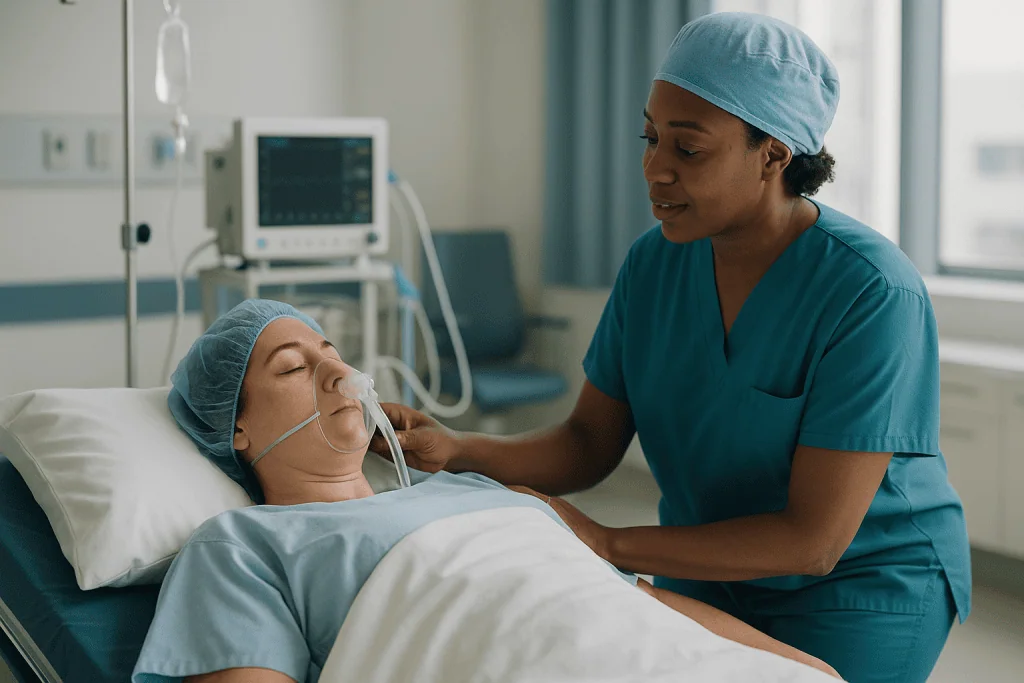
Many teams add a regional block, an injection of local anesthetic near the nerves of the pelvis or spine, to reduce pain in the first day or two. Whether that is used, and which agents are chosen, is the anesthesiologist’s call, made after reviewing your health history, medicines and any previous reactions to anesthesia.
Once you are asleep, several things happen before a single incision is made. A urinary catheter, a soft tube into the bladder, is placed to drain urine during surgery and for the days afterward. Compression sleeves on the calves inflate and deflate to keep blood moving and lower the chance of a clot in the leg veins. Antibiotics are given through the drip. Your legs are positioned in supports, similar to a gynecological examination, so the surgeon can reach the perineum, the area between the genitals and the anus.
The skin is cleaned, the field is draped, and the team confirms your identity, the planned procedure and any allergies out loud. Cleveland Clinic notes that this preparation, though it feels like nothing to the patient, adds real time to the day: the clock in the operating room starts well before the surgery you are picturing begins.
Penile inversion vaginoplasty step by step: how the canal and vulva are built
Penile inversion is the technique most surgeons train in and most patients receive, according to both Johns Hopkins and Cleveland Clinic. Its logic is economical: the penile skin, turned inside out like a sock, becomes the lining of the canal.
The sequence runs roughly like this:
- Orchiectomy. The testes and spermatic cords are removed through the scrotal skin, which is kept for later use.
- Degloving. The skin of the penis is separated from the shaft as a single tube while its blood supply at the base is protected.
- Preserving the neurovascular bundle. The nerves and vessels along the top of the shaft are carefully lifted off the erectile bodies. This bundle, still attached to a trimmed portion of the glans, becomes the clitoris.
- Removing the erectile bodies. Most of the spongy tissue is excised so it cannot engorge later.
- Shortening the urethra. The tube is cut to length and its new opening is positioned below the clitoris.
- Creating the canal. Working from the perineum, the surgeon dissects a pocket between the prostate and bladder in front and the rectum behind. This is the most delicate part of the operation because the rectal wall is millimeters away.
- Lining the canal. The inverted penile skin, often extended with a graft of scrotal skin that was cleared of hair before surgery, is placed into the pocket and secured.
- Forming the vulva. Remaining scrotal and penile skin is shaped into labia majora and minora, and a hood is fashioned over the clitoris.
- Packing and dressing. Soft packing or a stent holds the new canal open while the lining adheres to the surrounding tissue.
Every one of those steps can be adjusted. The prostate is deliberately left in place because removing it risks bladder control. The depth achievable depends partly on how much skin is available, which is one reason surgeons ask about circumcision and examine tissue carefully at consultation.
Peritoneal, intestinal and shallow-depth vaginoplasty: how the techniques differ
Not everyone has enough genital skin for penile inversion alone, and not everyone wants a canal. Three other approaches address those situations.
Peritoneal pull-through. The peritoneum is the thin, moist membrane that lines the inside of the abdomen. Surgeons can reach it through small abdominal incisions, often with robotic assistance, and draw a flap of it down to line the deepest part of the canal. Johns Hopkins describes this as useful when penile skin is limited, for example after puberty-blocking medicines in adolescence or in people with smaller anatomy. The peritoneum produces some natural moisture and heals with a mucosal quality.
Intestinal vaginoplasty. A segment of bowel, usually sigmoid colon, is detached, repositioned into the pelvis to serve as the canal, and the remaining bowel is rejoined. Cleveland Clinic lists this mainly as a revision option when a previous canal has narrowed or lost depth, or when skin is very scarce. It brings a self-lubricating lining but also carries the risks of bowel surgery and can produce ongoing discharge.
Vulvoplasty, sometimes called zero-depth or shallow-depth vaginoplasty. The external anatomy, clitoris, labia, urethral opening, is created exactly as in full vaginoplasty, but no canal is made or only a shallow dimple is formed. Mayo Clinic notes this suits people who do not intend to have receptive vaginal intercourse, who cannot commit to lifelong dilation, or for whom the deeper dissection carries too much medical risk.
Each variation changes the anesthesia plan, the operating time and the recovery. Abdominal work adds incisions, bowel handling adds a period before eating normally, and vulvoplasty removes the dilation burden entirely. The choice is anatomical and personal at once, and it is worth asking a surgeon which techniques they perform and how they decide between them for someone with your anatomy and goals.
Which vaginoplasty technique is used when? A side-by-side summary
The table below condenses what Cleveland Clinic, Johns Hopkins and Mayo Clinic describe about each approach. It is a guide to the conversation, not a decision tool; the same person can be a reasonable candidate for more than one option.
| Approach | Canal lining | Typically considered when | Distinctive considerations |
|---|---|---|---|
| Penile inversion | Penile skin, often extended with scrotal skin graft | Adequate genital skin is available; first-time surgery | Most widely performed; depth depends on skin available; lining is skin, so lubrication is needed |
| Peritoneal pull-through | Penile skin plus peritoneal flap for the deep canal | Limited skin, small anatomy, or revision for lost depth | Requires abdominal incisions, often robotic; some natural moisture |
| Intestinal (sigmoid) | Segment of colon | Mainly revision after failed canal; very scarce skin | Bowel surgery risks; self-lubricating; may produce discharge |
| Vulvoplasty (shallow depth) | No canal or a shallow dimple | No wish for receptive intercourse; dilation not feasible; higher medical risk | Shorter operation; no dilation; external appearance the same |
Two points deserve emphasis. First, a technique that sounds more advanced is not automatically better. Peritoneal and intestinal linings solve specific problems and introduce their own. Second, external appearance is largely independent of the lining chosen; the labia and clitoris are constructed the same way regardless of what sits inside the canal.
What the table cannot show is the surgeon’s own experience. Ask how many of each approach a team performs and what they do when a plan changes mid-operation, since the decision to add a peritoneal flap, for example, is sometimes made only once the available skin is assessed under anesthesia.
How long does vaginoplasty take, and how long is the hospital stay?
Time in the operating room depends on the technique and on whether other procedures are combined with it. Cleveland Clinic describes vaginoplasty as an operation lasting several hours, and both Cleveland Clinic and Johns Hopkins place hospital stays in the range of several days rather than overnight. Adding peritoneal or intestinal work extends the operating time because abdominal access, robotic setup and bowel reconnection each take time of their own.
Bear in mind what the clock is measuring. Family in the waiting area often hear that surgery “took six hours” when the incision-to-closure time was shorter; anesthesia induction, positioning, catheter placement and the careful hand-off to the recovery room are all part of the day. Surgeons usually quote their own typical range at consultation, and that figure is more useful than any national average.
The hospital stay serves specific purposes. The packing that holds the canal open stays in for roughly the first several days, and the catheter usually remains until the packing comes out, so that swelling around the urethra has time to settle. Cleveland Clinic and Johns Hopkins describe the first removal of packing, the first look at the healing vulva, and the first supervised dilation as happening before discharge, so that you leave knowing what to do rather than reading about it later. Nurses also confirm you can urinate, pass wind or stool, walk to the bathroom and manage pain with tablets rather than intravenous medicine.
Discharge is not the end of medical supervision. Mayo Clinic notes that return to desk work is typically measured in weeks and that strenuous activity is restricted for about six weeks, with full healing of the canal taking many months. Those ranges are typical rather than guaranteed, and your team will adjust them based on how your tissue behaves.
Who is usually a candidate for vaginoplasty, and who is asked to wait
Eligibility is set by international standards of care adopted by most surgical teams, and it rests on three ideas: a persistent, well-documented experience of gender incongruence; the capacity to consent to an irreversible operation and its aftercare; and health that is stable enough for major surgery.
Mayo Clinic’s description of the pathway includes a period of feminizing hormone therapy, commonly around a year, unless hormones are medically contraindicated or not wanted, and a supporting assessment from one or more mental health professionals experienced in gender care. The NHS describes a similar route through specialist gender services before referral to a surgeon. The purpose is not gatekeeping for its own sake; hormone therapy softens skin and redistributes fat in ways that affect the surgical result, and the assessment period gives time to plan hair removal, arrange time off and line up support at home.
People are commonly asked to wait, rather than declined outright, when:
- Blood sugar, blood pressure or another chronic condition is not yet controlled.
- They currently smoke or use nicotine, which narrows small blood vessels and raises the risk of skin graft loss and wound breakdown.
- Body weight is outside the range a particular surgeon considers safe for the pelvic dissection and anesthesia.
- Hair removal from the donor skin is incomplete.
- A mental health condition is active enough to make the demanding recovery, including dilation several times a day, unrealistic for now.
- There is no one to help during the first week or two at home.
Age matters mostly at the lower end: this surgery is generally reserved for adults. Older age alone is not a barrier if overall health supports it. The final decision on timing sits with the surgical and anesthesia teams, and a request to wait is usually paired with a plan for what would change the answer.
Getting ready: hair removal, medicines and the weeks before surgery
Preparation for vaginoplasty starts months before the operation, and one task dominates: hair removal. Skin used to line the canal will keep growing hair if the follicles are alive, and hair inside a canal collects debris and is a source of odor and irritation. Mayo Clinic and Cleveland Clinic both describe electrolysis or laser treatment of the scrotum and the base and shaft of the penis over a series of sessions beginning several months ahead. Your surgeon will mark exactly which areas need clearing, because it depends on the planned technique.
Medicines are reviewed carefully. Estrogen is linked to a higher risk of blood clots, and some teams ask patients to pause it for a period before and after surgery while others continue it with clot-prevention measures. This is a genuine area of clinical judgment; whichever approach your team takes, do not change your hormone regimen on your own. The same applies to blood thinners, some supplements and any medicine that affects bleeding or healing. Bring a complete list, including over-the-counter products.
Nicotine in any form is the single modifiable factor surgeons care about most, because it starves skin grafts of oxygen. Most teams require complete cessation for a defined period before and after surgery, and some test for it. Blood sugar control, adequate protein intake and treating any skin infection near the surgical site also come up in pre-operative visits.
Practical preparation matters as much as medical. You will need a helper at home for the first week or two, a comfortable place to lie down and dilate in private, loose clothing, and a way to travel to follow-up visits without long periods of sitting on the wound. Some teams also ask for a bowel preparation the day before, particularly when intestinal or peritoneal work is planned, so ask what to expect.
Vaginoplasty recovery timeline: the first days and weeks after surgery
Waking from anesthesia, you will be aware of pressure rather than sharp pain in the pelvis, a catheter draining urine, and bulky dressings holding packing in place. Cleveland Clinic and Johns Hopkins describe the first days as a period of bed rest with gradual walking, medicines to manage pain and prevent clots, and close checks of the wound for bleeding or signs of poor blood supply to the clitoris or labia.
Bruising and swelling of the whole area are expected and can look alarming; the labia often appear very swollen for the first few weeks before settling. Some bloody or yellowish discharge from the canal is normal as the lining sheds and heals.
A typical progression, drawing on the timelines those institutions publish, looks like this:
- Days one to several days: catheter and packing in place; walking short distances; first bowel movement often eased with stool softeners to avoid straining.
- Around the end of the first week: packing removed, catheter removed once you can urinate, and the first supervised dilation with a graduated set of smooth dilators.
- Weeks two to six: dilation several times a day; no sitting for long periods on the wound; no lifting, cycling or vigorous exercise; return to light desk work for some people toward the end of this window.
- Six weeks onward: strenuous activity gradually resumed with the team’s clearance; sexual activity, including receptive intercourse, discussed individually and typically not before this point.
- Months three to twelve: dilation frequency reduced in steps as the canal stabilizes; swelling continues to resolve; sensation in the clitoris returns gradually.
Dilation deserves its own emphasis. A skin-lined canal will contract and shorten if it is not stretched regularly, and Mayo Clinic describes dilation as a lifelong routine that becomes less frequent over time but never stops entirely. Teams differ on the exact schedule, and yours will give you a written plan. Following it in the first year is the single largest thing you control about the outcome.
Do trans women feel pleasure after vaginoplasty? Sensation and what the evidence shows
This is among the most searched questions about the operation, and it deserves a straight answer rather than a reassuring one. The surgical design is built around sensation. The clitoris is not a cosmetic feature; it is a portion of the glans kept alive on its original nerve and blood supply, so the sensory pathway that existed before surgery is preserved rather than reconstructed. Johns Hopkins and Cleveland Clinic both describe this as the reason many people retain erogenous sensation and the capacity for orgasm.
What the evidence supports is that sensation and orgasm are commonly reported after gender-affirming vaginoplasty, that they return gradually over months as nerves recover from the operation and swelling resolves, and that outcomes vary between individuals. Published reviews report favorable but variable figures, and because this article does not quote percentages without a named review, the honest summary is: most people in follow-up studies report preserved sensation, a minority report reduced or absent sensation, and no surgeon can promise where a given patient will land.
Several factors shape the result. The neurovascular bundle can be stretched or partially injured during dissection. Swelling can mute sensation for weeks, and the brain takes time to remap sensation to a differently shaped organ. Hormone therapy influences libido independently of surgery. The canal itself, when lined with skin, has touch and pressure sensation but not the mucosal sensitivity of the vulva; peritoneal or intestinal linings behave differently again.
Lubrication is a practical point. A skin-lined canal does not produce its own moisture, so a lubricant is needed for dilation and intercourse. That is a feature of the technique, not a complication. Ask your surgeon how they preserve the bundle, what their patients typically describe about sensation at three, six and twelve months, and what they offer if sensation is slow to return.
Vaginoplasty risks and complications, described in neutral terms
Every operation of this scale carries risk, and vaginoplasty concentrates that risk in a small space where the urinary, reproductive and digestive systems meet. Cleveland Clinic, Johns Hopkins and Mayo Clinic each list a similar set of complications, which fall into early and later groups.
Early complications include bleeding, infection, and the general risks of anesthesia and major surgery such as blood clots in the leg or lung. Poor blood supply can cause part of the skin lining, the labia or, uncommonly, the clitoris to lose tissue. Wound edges may separate, especially along the perineal incision, and usually heal with dressing care rather than further surgery.
Later complications include:
- Granulation tissue, the over-exuberant pink healing tissue that bleeds easily and is treated in clinic.
- Narrowing or shortening of the canal, particularly when dilation has lapsed.
- Urinary changes such as spraying, a narrowed opening, or difficulty emptying, some of which settle and some of which need a minor revision.
- A fistula, an abnormal connection between the canal and the rectum or urethra. This is uncommon but serious, and it is the reason the dissection between rectum and prostate is performed so slowly.
- Prolapse or displacement of the lining, hair growth inside the canal if removal was incomplete, and persistent pain.
Intestinal techniques add bowel-specific risks: leak at the reconnection, obstruction and chronic discharge. Peritoneal techniques add abdominal incisions and the small risks that come with them.
None of this is a reason for alarm, and none of it should be minimized. A good consent conversation names each item, gives the surgeon’s own experience with it, and describes what would be done if it occurred. If a surgeon suggests complications are not a realistic concern, that is a signal to ask more questions, not fewer.
What people often get wrong about how vaginoplasty is performed
Misunderstandings cluster around a handful of points, and correcting them tends to make the consultation more productive.
“They remove everything and start from scratch.” The opposite is closer to the truth. The operation is largely a rearrangement of existing tissue. Skin, glans, nerves, vessels and urethra all keep their original blood supply and are repositioned. Very little is created from nothing, which is why the quality of your own tissue matters so much.
“The prostate comes out.” It stays. Removing it would risk continence and add surgical danger for no functional gain. It sits in front of the canal and can be felt through the front wall, which is one reason receptive intercourse can be pleasurable.
“Once it heals, dilation stops.” Frequency drops substantially over the first year, but Mayo Clinic is explicit that some form of maintenance continues indefinitely for skin-lined canals. People who stop entirely commonly lose depth.
“Depth is the measure of a good result.” Depth matters for those who want receptive intercourse, but a shallow or zero-depth result chosen deliberately is not a lesser outcome. Function, sensation, comfort in one’s body and the ability to urinate normally are the endpoints most people describe as mattering.
“Cosmetic vaginoplasty and gender-affirming vaginoplasty are the same operation.” They share a word and little else. Procedures marketed for tightening after childbirth involve the vaginal wall and pelvic floor, have a different evidence base, and are not covered here.
“Any surgeon who does genital surgery can do this.” Gender-affirming vaginoplasty is a distinct subspecialty. Volume and specific training in these techniques are legitimate questions to ask, and the answers should be concrete.
Questions to ask your care team before vaginoplasty
The consultation goes better when you arrive with questions in writing. These are the ones that tend to change decisions or expectations.
- Which technique do you recommend for my anatomy, and what would make you change that plan during the operation?
- How many vaginoplasties do you perform, and how many of the specific technique you are proposing?
- How do you preserve the neurovascular bundle, and what do your patients typically report about sensation at several months?
- What is your usual operating time and hospital stay for this technique?
- What is your approach to estrogen around surgery, and who makes that decision?
- Which areas need hair removal, by when, and how will you confirm it is complete?
- What is your dilation schedule for the first year, and what do you do if the canal starts to narrow?
- What complications have you seen with this technique, how often, and how were they managed?
- Who do I call at night or on a weekend if something worries me, and where would I be seen?
- How many follow-up visits are typical, and can some be done remotely if I live far away?
- Do you routinely offer a later revision of the labia or clitoral hood, and how do you decide?
- What would make you advise a vulvoplasty instead of a full-depth canal for someone like me?
- Is there anything about my health, medicines or lifestyle that you would want changed before you would operate?
Write the answers down or bring someone who will. Surgeons expect these questions, and the ones who answer with specifics rather than reassurance are giving you real information. If an answer feels evasive, it is reasonable to seek a second opinion before committing to an irreversible operation. The decision to proceed, and when, rests with you and your treating team together.
When to call your doctor after vaginoplasty
Recovery involves discharge, swelling, bruising and discomfort that are unpleasant but expected. A smaller set of signs means you should contact your surgical team the same day, and a few mean going to an emergency department without waiting for a call back. Your team will give you their own list; the one below reflects what Cleveland Clinic, Johns Hopkins and Mayo Clinic highlight.
Call your surgical team promptly if you notice:
- Bleeding that soaks through a pad in an hour or does not slow with gentle pressure and rest.
- Fever, chills or a wound that becomes increasingly red, hot, swollen or foul-smelling.
- Pain that is escalating rather than easing, or that is not controlled by the medicines you were given.
- Inability to pass urine, a very weak stream, or urine leaking from anywhere other than the urethral opening.
- Stool, gas or brown discharge coming from the vaginal canal, which can indicate a fistula.
- A section of skin or the clitoris turning dark, purple or black, or an area that has lost feeling and looks dusky.
- Wound edges pulling apart, or tissue protruding from the canal.
- Being unable to insert the dilator you were previously using comfortably, or a sudden loss of depth.
- New or worsening low mood, or thoughts of harming yourself; recovery is physically and emotionally demanding, and your team can connect you with support.
Seek emergency care immediately for:
- Chest pain, sudden shortness of breath, coughing up blood, or a fast heartbeat with lightheadedness, which can signal a clot that has traveled to the lung.
- A swollen, painful, warm calf or thigh, especially on one side.
- Heavy bleeding with dizziness, fainting or a racing pulse.
- Severe abdominal pain with vomiting, particularly after peritoneal or intestinal techniques.
Never wait to see whether a worrying sign resolves on its own overnight. Surgical teams would rather hear about ten normal recoveries than miss one that is not.
Frequently asked questions
How is vaginoplasty performed for gender affirmation?
Under general anesthesia, the surgeon removes the testes, separates the penile skin from the shaft, preserves the nerve and blood vessel bundle with part of the glans to form a clitoris, shortens the urethra, dissects a canal between the prostate and rectum, and lines it with the inverted penile skin and often a scrotal graft. Labia are then shaped from remaining skin and the canal is packed.
How long does vaginoplasty take in the operating room?
Cleveland Clinic describes vaginoplasty as an operation lasting several hours, with longer times when peritoneal or intestinal techniques or other procedures are combined. Time under anesthesia includes positioning, catheter placement and hand-off to recovery, so the total is longer than incision-to-closure. Your surgeon’s own typical range is the most reliable figure.
What is the vaginoplasty recovery timeline?
Institutions such as Johns Hopkins and Cleveland Clinic describe several days in hospital with packing and a catheter, packing removal and first dilation around the end of the first week, several weeks of restricted activity, and strenuous exercise avoided for about six weeks per Mayo Clinic. Swelling resolves and dilation frequency decreases over months, with full healing taking up to a year.
Do trans women feel pleasure after vaginoplasty?
Many do, because the clitoris is formed from the glans on its original nerve supply rather than built from scratch. Johns Hopkins and Cleveland Clinic note that erogenous sensation and orgasm are commonly retained, returning gradually over months as nerves recover. Results vary between individuals, a minority report reduced sensation, and no surgeon can guarantee an outcome.
How much does a vaginoplasty cost?
This article does not provide price figures. Costs vary widely with technique, hospital stay, surgeon, region and whether insurance or a national health service covers gender-affirming surgery. The most accurate information comes from a written estimate from the surgical team’s financial office and a coverage check with your insurer or health service before scheduling.
Is penile inversion vaginoplasty the same as peritoneal vaginoplasty?
No. Penile inversion lines the canal with penile skin, often extended with a scrotal graft. Peritoneal vaginoplasty adds a flap of the abdominal lining, reached through small abdominal incisions, to line the deepest part of the canal. Johns Hopkins describes the peritoneal approach as useful when genital skin is limited. External anatomy is constructed the same way in both.
What are the main vaginoplasty risks and complications?
Cleveland Clinic and Mayo Clinic list bleeding, infection, blood clots, tissue loss from poor blood supply, wound separation, granulation tissue, canal narrowing, urinary spraying or stricture, and rarely a fistula between the canal and rectum or urethra. Intestinal techniques add bowel-surgery risks. Your surgeon should describe their own experience with each and how it would be managed.
Is the prostate removed during vaginoplasty?
No. The prostate is left in place because removing it would risk urinary incontinence and add significant surgical danger. It sits in front of the new canal. Because it remains, routine prostate health monitoring continues to apply after surgery, which is worth raising with your primary care clinician.
Why is hair removal needed before vaginoplasty?
Skin from the scrotum and penile shaft becomes the canal lining, and living hair follicles would keep producing hair inside the canal, causing irritation, debris and odor. Mayo Clinic and Cleveland Clinic describe electrolysis or laser sessions starting several months before surgery. Your surgeon marks exactly which areas need clearing based on the planned technique.
Who is usually asked to wait before having vaginoplasty?
People are commonly asked to delay when they currently use nicotine, when blood sugar or blood pressure is not controlled, when body weight is outside a surgeon’s safety range, when hair removal is incomplete, when an active mental health condition would make daily dilation unrealistic, or when no one is available to help at home. A request to wait usually comes with a plan for what would change the answer.
References
This article is for general information only and is not a substitute for professional medical advice. Please consult a qualified doctor about your individual situation.

More from the Blog
Is Body Aesthetics Surgery Right for You? Weight Stability, Skin Quality and Overall Health
A body aesthetics surgery candidate is usually an adult whose weight has held steady for months, who does not smoke, whose long-term conditions are…

Does Hi Def Liposuction Build Muscle? Separating Fact From Marketing on Sculpted Abs
No. Hi def liposuction does not build muscle. It removes fat from the thin layer under the skin and sculpts what remains so that…

CoolSculpting vs Liposuction: What Each Can Remove, Downtime and Who Suits Which Approach
Cryolipolysis (the technique widely known by the trade name CoolSculpting) and liposuction both target pockets of fat under the skin, but they differ in…

Which Patients Suit Fat Grafting? Donor Areas, Skin Quality and Volume Goals Explained
A good fat grafting candidate is generally a healthy, non-smoking adult at a stable weight who has enough surplus fat in a donor area…

Does Laser Liposuction Hurt? Anesthesia Options and Managing Soreness in the First Days
Laser liposuction is usually done under local anesthesia, so most people feel pressure, warmth and tugging rather than sharp pain during the procedure. Soreness…

How Lymphedema Microsurgery Is Performed: Tiny Vessels, the Microscope and Operating Time
Lymphedema microsurgery reroutes or rebuilds lymphatic drainage rather than cutting swelling away. Under a high-power microscope, a surgeon either joins lymphatic vessels under a…