

Vaser Liposuction Side Effects: Normal Swelling vs Signs Your Surgeon Wants to Hear About

Key Takeaways
- Vaser liposuction is a form of ultrasound-assisted liposuction, and the heat from the vibrating probe creates a skin-burn risk that suction-only liposuction does not carry, according to Mayo Clinic and Cleveland Clinic.
- Swelling usually peaks in the first days and, per Mayo Clinic, subsides over a few weeks, but the NHS warns swelling and bruising can persist up to six months in some people.
- Fluid often migrates downward with gravity, so abdominal liposuction commonly produces puffiness in the pubic area or thighs rather than where the work was done.
- A seroma feels soft and sloshy with normal-colored skin, whereas an infected collection is hot, red and increasingly painful; the first is a same-day call, the second may need urgent care.
- Numbness after liposuction typically eases over six to eight weeks according to the NHS, and numb skin can be burned by heat packs or hot showers without any pain warning.
- Calf pain, one-sided leg swelling, chest pain or breathlessness after liposuction can signal a blood clot or fat embolism and are emergencies, not follow-up questions.
After Vaser liposuction, swelling, bruising, soreness, mild numbness and pink fluid leaking from small incisions are expected in the first weeks, and swelling can take several months to settle fully. Signs that need a same-day call to the surgical team include spreading redness, fever, a rapidly growing or tense fluid pocket, calf pain, chest pain, breathlessness, or a skin patch that blisters or darkens.
Day three. You are standing sideways in the bathroom mirror, compression garment peeled down to the hips, and the stomach you paid to slim is rounder than it was before surgery. It is tight, warm, and yellow-purple in patches. Your phone is in your hand. You are trying to decide whether this is a call to the surgeon or a story to laugh about in six weeks.
That uncertainty is the most common vaser liposuction side effects question patients bring back to clinic, and it is a fair one. Early recovery looks alarming to almost everyone, because a body that has just had fat cells broken up and suctioned out responds the only way tissue knows how: it floods the area with fluid. Most of what you see is that flood.
The job of this article is to separate the ordinary from the urgent, using what mainstream surgical sources actually say, so that the phone call you make is the right one.
What Vaser liposuction actually does under the skin
Vaser is the trade name for one form of ultrasound-assisted liposuction. In plain terms, ultrasound-assisted liposuction means a thin metal probe that vibrates at very high frequency is passed under the skin to loosen fat before it is suctioned out. Mayo Clinic describes the mechanism simply: the ultrasonic energy ruptures the walls of fat cells and breaks the fat down so it is easier to remove.
The sequence in the operating room usually runs like this. The surgeon injects a large volume of dilute fluid into the target area first. That fluid contains a local anesthetic and a medicine that narrows blood vessels; the combination numbs the tissue and limits bleeding. Surgeons call this tumescent fluid, which is simply the word for tissue swollen by injected liquid. The vibrating probe then goes in through incisions a few millimeters long. Once the fat is loosened, a hollow tube called a cannula suctions it out, and the small openings are either stitched or left to drain.
Two things about this process shape almost every side effect you will feel afterward. First, the tissue has been deliberately inflated with fluid, and much of it stays behind. Second, the space where fat used to be is now a raw, honeycombed layer of tiny channels. Blood vessels, lymphatic vessels and nerve endings in that layer have been disturbed, and the body treats the area as an injury to be repaired.
The ultrasound step adds one variable that traditional suction-only liposuction does not: heat. The probe generates warmth at its tip, which is why both Mayo Clinic and Cleveland Clinic list skin burns among the risks specific to ultrasound-assisted techniques. Keep that in mind; it explains one of the red flags later.
Who is usually considered for Vaser liposuction, and who is asked to wait
Liposuction of any kind is a contouring procedure, not a weight-loss treatment, and every major patient source says so. Mayo Clinic notes that surgeons generally look for adults who are close to a stable weight, have firm and elastic skin, and want to reduce specific pockets of fat that have not responded to diet and exercise. The NHS makes the same point from the other direction: it is not a treatment for obesity, and it will not remove cellulite or stretch marks.

Skin quality matters more than most people expect. When fat is removed from under skin that has already lost its elasticity, the skin may not shrink back, and Mayo Clinic lists loose or sagging skin as a possible outcome. A surgeon may therefore suggest waiting, choosing a different approach, or combining procedures, and that judgement is theirs to make after examining you.
People are commonly asked to postpone or reconsider when they:
- Smoke or use nicotine, because it narrows blood vessels and slows wound healing.
- Have poorly controlled diabetes, heart disease, or a condition that affects clotting.
- Have a weakened immune system or an active infection anywhere in the body.
- Are still losing or gaining weight, planning a pregnancy, or recently gave birth.
- Take medicines that increase bleeding risk, which the surgical team will review and manage; never stop a prescribed medicine on your own.
The NHS also advises against having cosmetic surgery during a period of emotional upheaval, and encourages people to take time before committing. None of these is a moral judgement. They are risk factors that raise the chance of exactly the side effects this article is about, and a cautious surgeon treats them as reasons to slow down rather than proceed.
Why swelling after Vaser liposuction is expected, not a warning
Think of the treated area as a sponge that has been squeezed, scraped, and then dropped in water. The tumescent fluid injected during surgery does not all come out with the fat. What remains sits in the tissue and gradually drains through the incisions or is absorbed into the bloodstream over days.
On top of that, the body’s own inflammatory response kicks in. Damaged capillaries leak plasma, the liquid part of blood, into the surrounding space. White blood cells migrate in to clear debris. Lymphatic vessels, the fine drainage pipes that normally carry excess fluid away, have themselves been disrupted by the cannula, so the plumbing is temporarily less efficient at the very moment demand is highest.
The result is a treated area that can look larger, firmer and rounder than it did before surgery, often peaking in the first several days. Mayo Clinic states plainly that after liposuction you should expect swelling and that it typically subsides within a few weeks, at which point the area should begin to look less bulky. The NHS is more conservative in its patient information, warning that swelling and bruising may last for up to six months in some people.
Gravity adds a twist that surprises people. Fluid follows the lowest path, so abdominal liposuction frequently produces swelling in the pubic area or upper thighs, and arm liposuction can leave the hands puffy. This migration is uncomfortable but ordinary.
Compression garments exist precisely to counter all of this. By applying steady pressure, they limit how much fluid can pool, help the skin re-adhere to the deeper tissue, and reduce the chance of the fluid pockets discussed later. Your surgical team decides how long to wear yours; the NHS describes several weeks as typical.
Vaser lipo swelling timeline: what the first weeks usually look like
No two bodies follow the same schedule, and any surgeon who promises one is guessing. What follows are typical ranges drawn from Mayo Clinic and NHS patient information, not a guarantee.
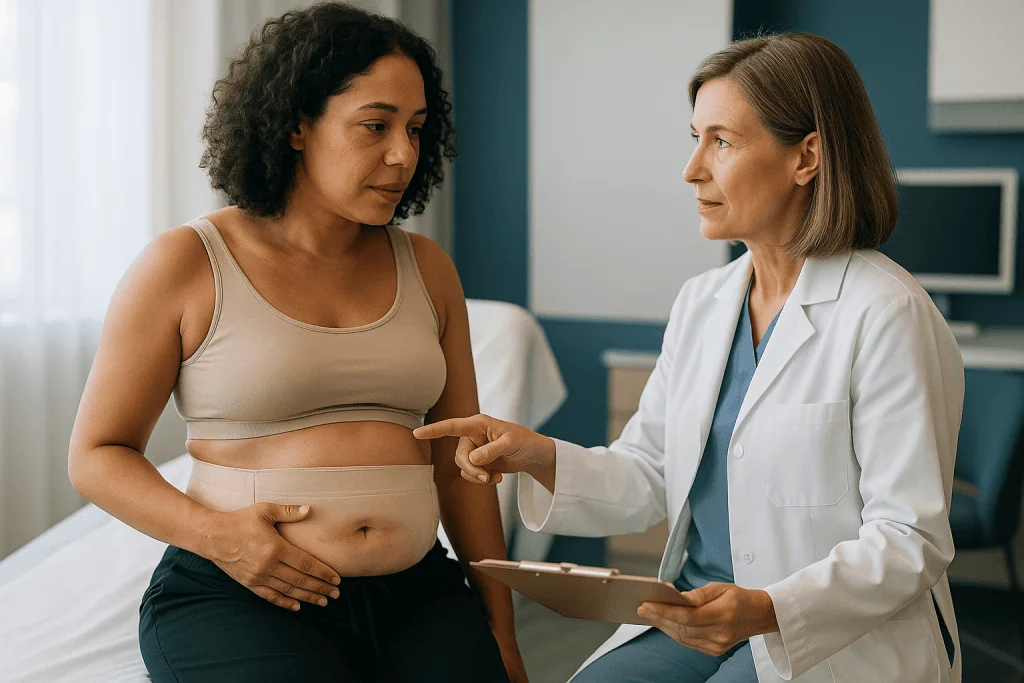
The first two to three days. Swelling climbs. Pink or blood-tinged fluid seeps from the incisions, sometimes enough to soak dressings. The area feels tight and bruised, and the compression garment is uncomfortable but purposeful. Pain is generally described as deep soreness, like a hard workout multiplied.
Days four to fourteen. Drainage slows and usually stops. Bruises bloom from purple to green and yellow as the body breaks down leaked blood. The NHS suggests many people are back to desk work after about two weeks, though it advises avoiding strenuous activity for around four to six weeks.
Weeks three to six. The bulk of the early swelling recedes, in line with Mayo Clinic’s description of swelling subsiding within a few weeks. Firmness under the skin becomes more noticeable now that the softer fluid has drained, and this is when patients start worrying about lumps.
Months two to six. Residual swelling continues to leave slowly. Skin retracts. Numb patches wake up. The NHS tells patients it can take up to six months to see the results of liposuction, and Mayo Clinic describes the final, leaner contour appearing over several months.
Swelling that follows a rough version of this arc is normal even if it feels slow. What is not normal is swelling that reverses direction: an area that was shrinking and suddenly balloons, becomes tense and shiny, or grows on one side only. That change in trajectory, rather than the swelling itself, is the signal to pick up the phone.
Common vaser liposuction side effects: bruising, drainage, soreness and fatigue
Beyond swelling, a predictable cluster of vaser liposuction side effects turns up in nearly every recovery. None of them requires a call unless they take an unexpected turn.
Bruising. The cannula tears tiny blood vessels as it moves. Blood leaks into the tissue and shows through the skin as bruises that may spread well beyond the treated zone, again following gravity. MedlinePlus lists bruising among the expected effects, and the NHS notes it can persist for weeks or, in some cases, months.
Drainage. Leftover tumescent fluid mixed with a little blood leaks from the incisions. It looks dramatic on white sheets, but it is mostly the saline solution injected during surgery. Heavy drainage typically settles within the first few days.
Soreness. Cleveland Clinic describes post-liposuction discomfort as similar to muscle soreness after strenuous exercise. Movement, especially twisting or bending, aggravates it, while gentle walking tends to help. Pain control is prescribed and adjusted by the surgical team.
Fatigue. Surgery is a physiological stress. The body diverts energy toward repair, anesthesia takes time to clear, and disrupted sleep from garment discomfort compounds it. Feeling wiped out for a week or two is common.
Low mood. This one is rarely mentioned in consent forms. Seeing an area look worse before it looks better, combined with pain and reduced activity, can produce a flat, regretful stretch in the first weeks. It usually lifts as swelling does. If it deepens or persists, that is worth raising with your care team too.
The pattern to watch across all of these is direction. Bruising that fades, drainage that slows, soreness that eases, energy that returns: each is a body doing what it should.
Lumps after Vaser lipo: fibrosis, unevenness and what usually softens
Somewhere around the second or third week, once the soft fluid has drained, many people press on the treated area and find it feels like a bag of frozen peas, or ridged like corduroy. Understandably, this is when the word botched enters the search history.
Most of these lumps are a stage, not an outcome. The channels left by the cannula fill with healing tissue, and early healing tissue is dense, disorganized collagen. Surgeons and physiotherapists call this fibrosis, which simply means the formation of firm scar-like tissue inside the body. Over months, the body remodels that collagen into something softer and flatter, which is one reason the NHS gives six months as the horizon for judging results.
Small pockets of trapped fluid and areas of residual swelling add to the lumpiness in the early months. Skin that has not yet re-attached to the deeper layer can also fold or ripple. All of this tends to smooth as swelling leaves and the skin contracts.
Some irregularity does persist. Mayo Clinic lists contour irregularities, described as bumpy, wavy or withered-looking skin, among the recognized risks of liposuction, and notes they may be permanent. MedlinePlus similarly lists skin irregularities. The likelihood rises with poor skin elasticity, uneven fat removal, or unusual healing, and cannot be predicted with certainty beforehand.
The practical distinction is this. Lumps that are diffuse, firm, non-tender and gradually softening are typical fibrosis and belong in a follow-up conversation, not an emergency call. A single lump that is soft, sloshy and growing may be a fluid collection, covered next. A lump that is hot, red and increasingly painful may be infection. Your surgeon can usually tell which by examination, which is exactly why they want to feel it rather than hear it described.
Seroma after liposuction: what a fluid pocket feels like
A seroma is a pocket of clear or straw-colored fluid that collects in the space left behind after tissue has been removed. The NHS lists fluid-filled lumps among the specific risks of liposuction, and Mayo Clinic describes temporary pockets of fluid forming under the skin as a recognized complication.
Why does it happen? The cannula creates a cavity. Lymphatic vessels that would normally drain that cavity have been cut, so they leak into it instead of carrying fluid away. Without enough compression, or if the area is large or the patient very active early on, the fluid accumulates faster than the body can absorb it.
The feel is distinctive once you know it. A seroma is usually soft and squishy rather than hard, and when pressed it may ripple or feel like a water balloon under the skin. Some people describe a sloshing sensation when they move. The overlying skin is typically normal in color and not especially tender, which separates it from the hot, angry surface of an infected collection.
Many small seromas are absorbed on their own over weeks, helped by consistent compression. Larger ones may need to be drained with a needle in clinic, sometimes more than once. Mayo Clinic notes that fluid pockets may need to be drained with a needle. Left untreated, a large seroma can stretch the skin, become infected, or harden into a capsule that affects the final contour, which is why surgeons prefer to hear about them early rather than late.
Report a suspected seroma to your surgical team, and treat it as urgent if it is enlarging quickly, becoming tense or painful, turning red or warm, or if you develop a fever. Do not attempt to drain it yourself; introducing a needle at home is a direct route to infection.
Numbness and odd skin sensations: how long is too long?
Run a fingertip over a freshly treated area and you may feel nothing at all, or a strange, distant version of touch, as if through a layer of cloth. Elsewhere the skin may tingle, itch relentlessly, or fire off brief electric zings for no reason.
All of these come from the same source. The layer of fat that was removed is threaded with tiny sensory nerve fibers, and the cannula stretches, bruises or severs many of them. Mayo Clinic explains that patients may feel temporary or permanent numbness, and that temporary nerve irritation is also possible. Nerves regrow slowly, and the sensations produced during regrowth are often stranger than the numbness itself.
Typical recovery is measured in weeks to months. The NHS tells patients that numbness after liposuction should ease over about six to eight weeks. MedlinePlus is more cautious, noting that numbness may last for weeks and that in rare cases some loss of sensation is permanent. The itching phase, which many people find the most maddening, tends to arrive as nerves reconnect and usually fades on its own.
Numbness carries one practical hazard worth taking seriously. Skin that cannot feel cannot warn you. Heat packs, hot showers aimed at the area, and heating pads can burn numb skin without any pain signal, so surgical teams generally advise avoiding direct heat on treated zones until sensation returns.
Sensation changes that are patchy and slowly improving are expected. What deserves a mention at follow-up is numbness that is unchanged well past the typical window, new numbness appearing weeks after surgery, or burning pain that escalates rather than settles. None of these is necessarily dangerous, but each is something your surgeon would rather assess than assume.
Burns and skin injury: the risk specific to ultrasound energy
Here is where ultrasound-assisted liposuction parts company with the traditional kind. Because the probe tip generates heat as it vibrates, there is a possibility of thermal injury to the skin or the tissue just beneath it. Mayo Clinic states directly that ultrasound-assisted liposuction can cause skin burns, and Cleveland Clinic lists burns among the risks of ultrasound-based techniques.
Surgeons reduce this risk with technique: keeping the probe moving, protecting the incision edges with small shields, and avoiding excessive time close to the skin surface. Even so, it cannot be eliminated entirely, which is why it belongs in informed consent.
A burn does not always look like a kitchen burn. Superficial thermal injury may appear as a patch of skin that is unusually red, then blisters, or as an area that feels firm and leathery compared with the surrounding tissue. Deeper injury can show up days later as skin that turns dusky, purple or gray, then darkens further. The medical term for tissue that has died from lack of blood supply is necrosis, and it is a rare but serious complication that sometimes requires wound care or surgical revision. The incision sites themselves are a common location, because the probe passes through them repeatedly.
The distinction from ordinary bruising matters. A bruise is soft, changes color through the familiar purple-green-yellow sequence, and is not usually associated with skin breakdown. A thermal injury tends to be more localized, may blister, and may progress to open or blackened skin rather than fading.
Any blister, any patch of skin that darkens rather than yellows, and any area where the surface breaks down should be reported to the surgical team promptly. Early wound care can limit how much tissue is affected, and it is one of the clearest examples of a side effect that surgeons genuinely want to hear about within hours, not at the next scheduled visit.
Infection: telling an irritated incision from an infected one
Every incision is a door, and the small drainage openings left after liposuction stay open longer than most surgical wounds. Infection is therefore on every risk list, including those from the NHS, Mayo Clinic and MedlinePlus. Fortunately, healing incisions are noisy in ways that mimic infection, so it helps to know what each looks like.
A normal healing incision may be slightly pink at the edges, mildly tender, and crusted with dried drainage. Bruising around it is common. In the first few days it may leak thin pink fluid. These features generally improve day by day.
An infected incision behaves differently, and MedlinePlus describes the pattern clearly in its guidance on surgical wound infections. Redness spreads outward rather than fading, often with a sharp edge. The area becomes increasingly warm and swollen. Pain worsens after it had started to ease. Drainage changes from thin and pink to thick, cloudy, yellow or green, and may smell. A fever or chills, or feeling generally unwell, points to infection that has moved beyond the skin surface.
Deeper infections can form in the fat layer itself, especially around a seroma, producing a hot, hard, painful lump with or without changes at the skin surface.
Treatment decisions belong to the surgical team. Depending on what they find, they may take a swab, prescribe an antibiotic, open a small area to let it drain, or arrange imaging. Antibiotics work by killing or stopping the growth of bacteria; if one is prescribed, the course length and timing are set by the prescriber, and stopping early because things look better is something to discuss with them first, not decide alone.
Spreading redness, worsening pain, foul drainage or fever after liposuction should trigger a same-day call.
Blood clots and breathing trouble: the rare side effects that matter most
Most liposuction side effects are unpleasant but harmless. A small number are dangerous, and they share a feature that makes them easy to miss: they often show up far from the treated area.
Deep vein thrombosis. A deep vein thrombosis, usually shortened to DVT, is a blood clot forming in a deep vein, most often in the calf or thigh. Surgery, anesthesia, and reduced movement afterward all increase the risk, which is why the NHS lists blood clots among liposuction complications. NHS guidance on DVT describes the typical signs as throbbing pain in one leg, swelling of one leg, skin that is warm or red around the painful area, and swollen veins that are hard or sore to touch. If part of that clot breaks free and travels to the lungs, it becomes a pulmonary embolism, which can cause sudden breathlessness, chest pain that worsens on breathing in, and coughing up blood.
Fat embolism. Mayo Clinic describes a rarer, liposuction-specific risk in which loosened fat enters a torn blood vessel, travels to the lungs or brain, and blocks blood flow. The warning signs overlap with pulmonary embolism: breathlessness, chest pain, confusion, or a rash of tiny red-purple spots.
Fluid shifts. Because large volumes of fluid are injected and removed, Mayo Clinic notes that shifts in fluid levels can occasionally cause kidney, heart or lung problems, and that the local anesthetic used in tumescent fluid can, rarely, reach toxic levels.
Prevention is largely about movement. Surgical teams typically ask patients to walk gently and often from the first day, to stay well hydrated, and to avoid long periods of immobility. Some patients are also given clot-preventing measures, decided individually.
Any breathlessness, chest pain, one-sided leg swelling or calf pain after liposuction is an emergency, not a follow-up question.
Vaser liposuction side effects at a glance: normal versus tell your surgeon
The table below gathers the distinctions made throughout this article into one reference. It is a guide to which conversation to have, not a substitute for having it. When in doubt, surgical teams universally prefer an unnecessary call to a missed one.
| Side effect | Usually expected | Tell your surgeon | Seek urgent care |
|---|---|---|---|
| Swelling | Peaks in the first days, then slowly recedes over weeks to months | Stops improving, or returns after shrinking | Sudden, tense, one-sided or with fever |
| Bruising | Purple to green to yellow, fading | A bruise that keeps enlarging or feels very firm | Rapidly expanding with faintness or dizziness |
| Drainage | Thin, pink, slowing over a few days | Restarts after stopping, or persists longer than expected | Thick, cloudy, foul-smelling, with fever |
| Lumps | Diffuse firmness, gradually softening | A single soft, sloshy or growing pocket | Hot, red, increasingly painful lump |
| Skin sensation | Numbness, tingling, itching, slowly improving | No change past typical window, or escalating burning pain | Skin that blisters, darkens or breaks down |
| Incisions | Slightly pink, crusted, improving | Redness not settling | Spreading redness, warmth, pus, fever |
| Legs and chest | Mild general aches | Persistent one-leg heaviness | Calf pain, one-leg swelling, chest pain, breathlessness |
Two habits make this table more useful. Take a photograph of the treated area in the same light each morning, so change over time is visible rather than remembered. And keep your surgical team’s after-hours contact number where you can find it at two in the morning, because that is when worries tend to arrive.
What people often get wrong about liposuction side effects
Recovery forums are full of confident advice, and some of it is quietly wrong. A few corrections, grounded in what mainstream sources actually say.
Myth: more swelling means something went wrong. Swelling volume varies enormously with the area treated, the amount of fat removed, body type and genetics. Mayo Clinic frames swelling as expected and describes its gradual retreat over weeks. The trajectory matters more than the size.
Myth: ultrasound-assisted liposuction has no downtime. The technology changes how fat is loosened; it does not change the fact that tissue has been injured and needs repair. The NHS recovery guidance, including several weeks before strenuous activity and up to six months for final results, applies regardless of the device used.
Myth: massage will fix any lump. Gentle lymphatic drainage massage is commonly recommended by surgical teams to help swelling move, and many patients find it helpful. It is not a treatment for seroma, infection or thermal injury, and aggressive massage of an unhealed area can cause harm. Ask your team what they recommend and when.
Myth: numbness that lasts more than a month is permanent. The NHS describes typical improvement over six to eight weeks, and MedlinePlus notes numbness can last weeks, with permanent loss described as rare rather than expected.
Myth: the fat comes back somewhere else. Removed fat cells do not regenerate, but remaining fat cells anywhere in the body enlarge with weight gain. Mayo Clinic advises that results are generally lasting as long as weight stays stable.
Myth: a seroma will always go away on its own. Small ones often do. Larger ones may need drainage in clinic, and ignoring one risks infection or a hardened capsule.
Myths persist because early recovery is genuinely confusing. A cited source and a phone call to your team beat a confident stranger every time.
Questions to ask your care team before and after
The best time to learn what a red flag looks like is before you have one. These questions are worth bringing to your consultation and your first follow-up. The answers will be specific to you, which is the point.
Before surgery:
- How much swelling and bruising do you expect for the areas I am having treated, and roughly how long do you expect it to last for someone like me?
- What is your plan for reducing the risk of blood clots, and what should I do about movement in the first days?
- How do you protect the skin from heat during the ultrasound step, and what would a thermal injury look like if one occurred?
- How long will I wear compression, and what happens if the garment causes skin problems?
- Who do I call after hours, and what is the response time?
- What would make you want to see me before the scheduled follow-up?
After surgery:
- Is this lump fibrosis, a seroma or something else, and how will we know?
- Is the amount and color of drainage I am seeing within what you expect?
- When can I return to work, driving, exercise and sexual activity?
- Do you recommend lymphatic massage, and if so, when should it start and who should do it?
- How will we judge the final result, and when?
- If a contour irregularity does not settle, what are the options?
Write the answers down. Recovery brain, a mixture of pain, poor sleep and medication, is not good at remembering verbal instructions. A surgeon who welcomes these questions and answers them without hedging is telling you something useful about how they will handle a complication, should one arrive.
When to call your doctor
Most of what you feel after Vaser liposuction is repair work, uncomfortable and slow. A short list of signs is different in kind, and each deserves a same-day call to your surgical team or, where marked, emergency care.
Call your surgeon the same day if you notice:
- Redness around an incision or over the treated area that spreads rather than fades, especially with increasing warmth or pain.
- Drainage that becomes thick, cloudy, yellow-green or foul-smelling.
- A fever, chills, or feeling suddenly and generally unwell.
- A soft, sloshy or enlarging lump, or any lump that is hot and tender.
- A patch of skin that blisters, turns dusky, purple, gray or black, or breaks down.
- Swelling that was improving and abruptly worsens, or becomes tense and shiny.
- Bleeding that soaks through dressings repeatedly and does not slow with gentle pressure.
- Nausea, vomiting, faintness or confusion.
Seek emergency care immediately, without waiting to reach the clinic, for:
- Chest pain, especially pain that worsens on breathing in.
- Sudden breathlessness, rapid breathing, or coughing up blood.
- Pain, swelling, warmth or redness in one calf or thigh.
- Fainting, severe dizziness, or a rash of pinpoint red-purple spots.
These signs correspond to infection, thermal injury, hematoma, seroma, deep vein thrombosis, pulmonary embolism and fat embolism, all of which appear on the risk lists published by the NHS, Mayo Clinic and MedlinePlus. Every one of them is more manageable when caught early.
One last thing. You are never bothering anyone by calling. Surgical teams build their after-hours systems precisely for the day-three patient in the mirror, phone in hand. The decision about what your symptom means, and what to do about it, belongs to the people who operated on you and know your case. Let them make it.
Frequently asked questions
How long does swelling last after Vaser liposuction?
Swelling typically peaks in the first few days and, according to Mayo Clinic, subsides over a few weeks, though the NHS notes it can persist for up to six months in some people. The exact course depends on the area treated, how much fat was removed and individual healing. Swelling that follows a gradually improving trend is expected; swelling that reverses direction and suddenly worsens should be reported to your surgical team.
What does Vaser liposuction recovery usually involve week by week?
Recovery generally moves from heavy swelling, drainage and soreness in the first days, to fading bruises and slowing drainage over the next two weeks, to firmness and lumpiness as fluid clears, and finally to gradual smoothing over several months. The NHS suggests desk work after about two weeks and avoiding strenuous activity for around four to six weeks, with results judged at up to six months. Your surgeon will tailor these ranges to you.
Is it normal to have lumps after Vaser lipo?
Yes, firm and uneven areas are common in the weeks after liposuction as the channels left by the cannula fill with dense early healing tissue called fibrosis, and as residual swelling drains unevenly. Most soften and flatten over months. A single soft, sloshy or growing lump may be a seroma, and a hot, red, painful lump may be infection; both should be examined by your surgical team rather than watched at home.
What is a seroma after liposuction and how is it treated?
A seroma is a pocket of clear or straw-colored fluid that collects in the space left after fat removal, listed by the NHS and Mayo Clinic as a recognized complication. It feels soft and may ripple when pressed. Small seromas are often absorbed with time and compression, while larger ones may be drained with a needle in clinic. Never attempt to drain one yourself, and report any seroma that enlarges, becomes tense, reddens or comes with fever.
How can I tell a normal bruise from a skin burn after ultrasound liposuction?
A bruise is soft, spreads diffusely, and fades through purple, green and yellow without the skin surface breaking. A thermal injury from the ultrasound probe tends to be more localized, may blister, and can progress to skin that turns dusky, gray or black or breaks open. Mayo Clinic lists skin burns among the risks specific to ultrasound-assisted liposuction. Any blistering or darkening skin should be reported to your surgeon promptly.
When does numbness after liposuction go away?
The NHS tells patients that numbness after liposuction should ease over roughly six to eight weeks, while MedlinePlus notes it can last for weeks and that permanent loss of sensation is rare. Tingling, itching and brief electric sensations often accompany nerve regrowth. Avoid heat packs or hot water on numb areas, since the skin cannot warn you of a burn, and mention any numbness that is not improving at your follow-up appointment.
What are the signs of infection after Vaser liposuction?
Infection usually shows as redness that spreads outward from an incision or treated area, increasing warmth and swelling, pain that worsens after it had started to ease, drainage that becomes thick, cloudy, yellow-green or foul-smelling, and fever or chills. MedlinePlus describes these features in its guidance on surgical wound infections. Any of them warrants a same-day call to your surgical team, who decide whether a swab, antibiotic or drainage is needed.
Can Vaser liposuction cause blood clots?
Any surgery with anesthesia and reduced movement afterward increases the risk of a deep vein thrombosis, and the NHS lists blood clots among liposuction complications. Signs include throbbing pain, swelling, warmth or redness in one leg. If a clot travels to the lungs it can cause chest pain and breathlessness, which is an emergency. Surgical teams reduce risk by encouraging early gentle walking and hydration, and may add individual clot-prevention measures.
Why is the swelling in my pubic area or thighs after stomach liposuction?
Fluid in the tissue follows gravity, so swelling from abdominal liposuction commonly drifts downward into the pubic area, groin or upper thighs, just as arm liposuction can leave the hands puffy. This migration is uncomfortable but ordinary and settles as overall swelling recedes. Compression garments help limit it. Swelling that is one-sided, tense, red or accompanied by fever is different and should be reported to your surgical team.
Does lymphatic massage help with Vaser liposuction side effects?
Gentle lymphatic drainage massage is frequently recommended by surgical teams to help residual swelling move and may ease early lumpiness, and many patients find it comfortable. It does not treat seroma, infection or thermal injury, and forceful massage of unhealed tissue can cause harm. Ask your surgeon whether they recommend it for your case, when it should begin, and who should perform it, rather than starting on your own.
References
- NHS: Liposuction
- MedlinePlus: Liposuction
- NHS: Deep vein thrombosis (DVT)
- MedlinePlus: Surgical wound infection: treatment
This article is for general information only and is not a substitute for professional medical advice. Please consult a qualified doctor about your individual situation.

More from the Blog

Liposuction Recovery Time: Swelling, Compression and When Results Actually Show
Most people return to desk work within one to two weeks after liposuction, but complete recovery takes far longer than many expect. Swelling peaks…

Life After Lipedema Surgery: Compression Garments, Diet and Long-Term Care of the Legs
Compression after lipedema surgery is worn to limit swelling, support the healing tissue and help the lymphatic system clear fluid while the legs settle.…

Who Is a Candidate for a BBL? Donor Fat, Body Shape and Why Very Slim Patients May Be Told No
A typical BBL candidate is a healthy adult who is at or near a stable weight, has enough spare fat on the abdomen, flanks,…

Sitting, Walking and Sleeping After a Thigh Lift: Protecting the Incision in the First Weeks
After a thigh lift, most surgical teams ask patients to walk short distances from the first day to lower blood-clot risk, while avoiding deep…

Which Tests Come Before Lymphedema Surgery? Lymphatic Imaging, Staging and Planning
Before lymphedema surgery, most teams confirm the diagnosis, exclude other causes of swelling such as a blood clot or vein disease, measure limb volume,…
Vaser vs Traditional Liposuction: Bruising, Skin Tightening and Which Areas Each Suits
Vaser is a brand of ultrasound-assisted liposuction that uses sound energy to loosen fat before it is suctioned out; traditional liposuction removes fat with…