

How Whooping Cough Is Diagnosed: Nasal Swab, Blood Tests and Why Early Sampling Matters

Key Takeaways
- The bacterium that causes whooping cough is most detectable in the nose during the first week or two of coughing, when the illness still looks like a cold, and fades as the dramatic fits begin.
- PCR on a nasopharyngeal swab is the usual first-line whooping cough test because it returns results in about one to two days and remains useful for roughly three weeks after the cough starts.
- Culture takes about a week and is most sensitive only in the first two weeks, but a positive culture is definitive and remains the reference standard for confirming outbreaks.
- A blood antibody test becomes useful two to eight weeks into the cough but cannot be interpreted within a year of a pertussis-containing vaccine and is unhelpful in infants.
- A negative swab taken after three weeks of coughing, or after antibiotics have started, does not rule out pertussis, and clinicians can diagnose it on the clinical pattern alone.
- About one in three babies under one year who develop whooping cough need hospital care, which is why any respiratory illness in an infant or a coughing adult near a newborn prompts early assessment.
Whooping cough is usually diagnosed with a swab taken from the back of the nose, tested by PCR or culture for the bacterium Bordetella pertussis. Blood antibody tests are used when the cough is older. Timing matters: swab tests work best in the first two to three weeks of coughing, which is why doctors sample early rather than waiting for the classic whoop.
The cough had been going on for nine days when a mother finally counted them. Not the ordinary coughs, but the runs of them: eight, ten, twelve in a row, her four-year-old’s face reddening, then a long dragging breath at the end that sounded like a gate hinge. The pediatrician’s office asked one question before anything else. When did the cough start?
That question sits at the heart of every whooping cough test. The bacterium responsible, Bordetella pertussis, behaves like a guest who leaves before the mess becomes obvious. It is easiest to find in the nose during the days when the illness looks like nothing more than a cold, and hardest to find once the dramatic coughing fits that give the disease its name have set in.
Understanding that mismatch explains almost everything about how the test is done, why the swab goes so far back, why a blood test is sometimes ordered instead, and why a doctor may act before the laboratory has answered.
Why timing matters more than the type of whooping cough test
Most infections are diagnosed when they are at their worst. Whooping cough runs backward. The bacterium multiplies in the lining of the nose and throat during the earliest, mildest phase, then gradually disappears from the airway even as the coughing gets louder and more exhausting. The damage that keeps the cough going is caused by toxins the bacterium leaves behind, not by the bacterium itself.
This has a practical consequence. The CDC advises that culture, the method that grows live bacteria in the laboratory, is most useful during the first two weeks of coughing, and that PCR, the DNA-based test, remains useful for roughly the first three weeks, with sensitivity falling steadily after that. By the time a child has coughed for a month, a nasal swab often comes back negative even when the diagnosis is correct.
Doctors therefore face a trade-off. Testing early, when symptoms are vague, means swabbing many children who simply have colds. Testing late, when the pattern is unmistakable, means the test is more likely to miss. The evidence points firmly toward the first option whenever there is a reasonable reason for suspicion: a known exposure at daycare or school, a cough that is getting worse rather than better after a week, coughing fits with vomiting, or a household with a newborn.
One honest note on the numbers. Sensitivity figures for pertussis tests vary a great deal between laboratories and studies, so the windows above are guidance about when a test is useful, not guarantees about when it will be right. The principle, however, is consistent across the CDC, NHS and major clinical references: sample early, because the window closes.
How is whooping cough diagnosed? The three stages and what each means
Clinicians describe pertussis in three stages, and each stage changes what a test can and cannot do.

The first is the catarrhal stage. Catarrhal simply means “like a cold”: runny nose, mild cough, perhaps a low fever. According to the CDC, this phase typically lasts one to two weeks, and it follows an incubation period of about five to ten days after exposure, occasionally as long as three weeks. Nothing about it announces whooping cough. Yet this is when the bacterium is most abundant in the nose, so a swab taken now has the best chance of finding it.
The second is the paroxysmal stage. A paroxysm is a sudden burst of coughing, often ten or more coughs on a single breath, sometimes ending in the inspiratory whoop, vomiting, or exhaustion. The CDC notes this stage usually lasts one to six weeks and can extend to ten. Between fits, many children look surprisingly well, which is one reason parents hesitate to call. PCR is still reasonably useful early in this stage; culture is already fading.
The third is the convalescent stage, a slow recovery over weeks to months during which the fits become less frequent. Any new cold can bring the coughing back. Swab tests are of little use here, and a blood antibody test becomes the only laboratory option for an older child or adult.
Diagnosis, in other words, is a combination of three things: the story of how the cough began, the pattern of the coughing itself, and a laboratory result whose meaning depends entirely on which stage the patient was in when the sample was taken. The CDC’s clinical case definition reflects this, describing a cough of two weeks or more with paroxysms, whoop, post-cough vomiting, or, in infants, pauses in breathing.
What actually happens during a whooping cough swab
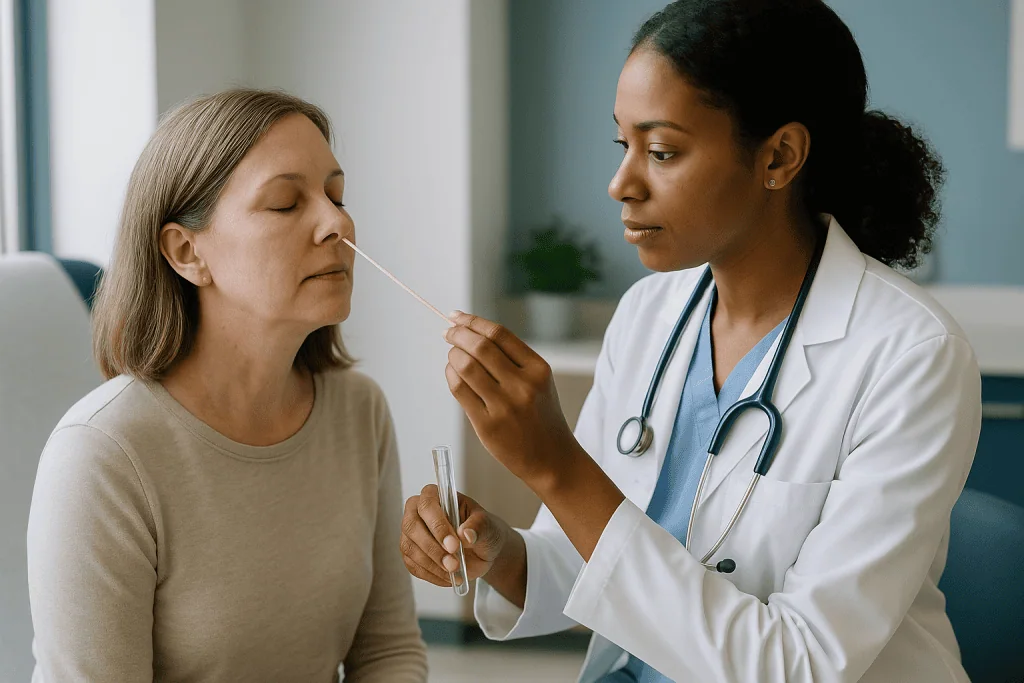
The sample for a whooping cough test is a nasopharyngeal swab or, less often, a nasopharyngeal aspirate. Nasopharyngeal means the space at the very back of the nasal passage, above the soft palate, where the nose meets the throat. A swab that merely brushes the nostril will not do; the bacterium lives on the ciliated cells deep at the back.
The swab itself is a long, thin, flexible shaft with a small tip made of polyester, rayon, or a similar synthetic fiber. The CDC specifies these materials because ordinary cotton contains substances that can interfere with growing the bacterium in culture, and calcium alginate tips can interfere with PCR. Patients sometimes notice the swab looks different from a flu or COVID swab; that is deliberate.
In practice, the clinician tilts the head back slightly, passes the swab gently along the floor of the nostril until it meets resistance at the back, holds it there for a few seconds so the tip collects cells and secretions, then withdraws it. Many clinicians take samples from both sides. The whole procedure takes well under a minute. It is uncomfortable rather than painful: eyes water, the nose stings, and most people sneeze or cough afterward.
An aspirate uses a soft tube attached to gentle suction to draw secretions from the same area. It collects more material and is sometimes preferred in young infants, though it requires more equipment and is less common in office settings.
Once collected, the swab is placed in a transport medium suited to the test ordered. For culture, the sample needs to reach the laboratory quickly because the bacterium is fragile. For PCR, timing is less critical since the test looks for DNA rather than living organisms.
The pertussis PCR test: how it finds the bacterium's DNA
PCR stands for polymerase chain reaction, a laboratory technique that copies a chosen stretch of DNA millions of times until there is enough to detect. For pertussis, the test targets sequences specific to Bordetella pertussis, most commonly a repeated element called IS481, sometimes alongside a second target to improve accuracy.
The great advantage is speed and sensitivity. Results are often available within a day or two rather than the week or more required for culture, and the CDC describes PCR as more sensitive than culture, particularly after the first two weeks of cough or once a person has already started an antibiotic that kills the bacteria but leaves fragments of their DNA behind. This is why PCR has become the routine first-line whooping cough test in most settings.
Sensitivity brings a cost. Because PCR detects tiny amounts of DNA, it can also detect contamination. The CDC has documented situations where pertussis DNA from vaccines, which are made from bacterial components, contaminated surfaces in clinics and produced false-positive results in people who were never infected. Laboratories and clinics follow strict procedures to separate vaccine handling from swab collection for this reason.
A second limitation is specificity between related species. The IS481 sequence is also present in Bordetella holmesii and, in lower copy numbers, Bordetella bronchiseptica, which can cause a similar but usually milder illness. Laboratories using a single target may not distinguish them; those using multiple targets can.
For the person being tested, none of this changes the experience. What it changes is interpretation. A positive PCR in a child with a compatible cough and a known exposure is strong evidence. A positive PCR in someone with no cough, in a clinic that gave pertussis vaccines that morning, deserves a second look.
Culture: the slow, older test that is still the reference standard
Culture means placing the swab material on a special nutrient plate and waiting to see whether Bordetella pertussis grows. The bacterium is fussy. It requires enriched media, incubation for up to a week or longer, and prompt transport because it does not survive well outside the body. Many laboratories no longer offer it routinely.
So why does it survive as a test at all? Because a positive culture is definitive. If the organism grows and is identified, there is no question of contamination or of a related species. The CDC continues to describe culture as the standard against which other tests are judged, and it remains valuable when a laboratory needs to confirm an outbreak, check whether the strains circulating match those covered by vaccines, or test for antibiotic resistance, which is uncommon but does occur.
The weaknesses are equally clear. Culture is most sensitive during the first two weeks of cough and falls off quickly after that. It is also strongly affected by prior antibiotic use; a few days of treatment can render a culture negative while the person is still coughing. Anyone who has been coughing for three weeks, or who started antibiotics before the swab, is unlikely to have a positive culture even with genuine infection.
In everyday clinical care, culture and PCR are frequently ordered together from the same swab, especially in hospitalized infants or during suspected outbreaks. The PCR gives a fast provisional answer; the culture, days later, gives certainty and material for public-health laboratories.
For a family waiting on results, the practical message is that a culture result takes time, that a negative culture late in the illness does not overturn a diagnosis based on the cough pattern, and that the treating team will interpret it alongside everything else they know.
Is there a whooping cough blood test? Serology and white cell counts explained
Two very different blood tests come up in pertussis, and they answer different questions.
The first is serology, a test for antibodies the immune system makes against pertussis toxin, the main poison the bacterium produces. Antibody levels rise over weeks, so the CDC advises serology is most useful between two and eight weeks after the cough begins, precisely the period when swab tests have become unreliable. For an adolescent or adult who has coughed for a month and only now suspects pertussis, serology may be the only laboratory route to a diagnosis.
Serology has boundaries. It cannot separate antibodies from infection and antibodies from recent vaccination, so the CDC notes it is not interpretable within a year of a pertussis-containing vaccine. It is also unhelpful in infants, whose blood carries antibodies passed across the placenta from the mother. Interpreting a single sample requires knowing what antibody level is normal in the local population, and not every laboratory offers a validated assay. Where it is available and appropriate, it fills a real gap.
The second blood test is a complete blood count. This does not look for pertussis at all. It counts white blood cells, and in infants and young children with whooping cough there is often a striking rise in lymphocytes, a type of white cell, driven by pertussis toxin. Clinical references from the CDC and Mayo Clinic describe this lymphocytosis as a supporting clue rather than a diagnostic test, and in very young infants an extremely high count is one marker doctors watch closely because it is associated with more severe illness.
Neither blood test replaces the swab in the early weeks. They complement it, one for late diagnosis and one for assessing how ill a baby is.
Which whooping cough test works when: a side-by-side view
Laid out together, the tests tell one coherent story about timing. The windows below come from CDC diagnostic guidance and are typical ranges, not cut-offs a laboratory applies rigidly.
| Test | What it detects | Best window after cough begins | Typical turnaround | Main limitation |
|---|---|---|---|---|
| Nasopharyngeal culture | Living Bordetella pertussis bacteria | First 2 weeks | About 7 days or longer | Sensitivity drops quickly; affected by prior antibiotics |
| Nasopharyngeal PCR | Bacterial DNA | First 3 weeks, occasionally to 4 | Often 1 to 2 days | Can pick up contamination or related species |
| Serology (blood) | Antibodies to pertussis toxin | 2 to 8 weeks | Days, depending on laboratory | Not interpretable after recent vaccination; unhelpful in infants |
| Complete blood count | White cell and lymphocyte numbers | Any time, mainly in infants | Same day | Supports severity assessment; does not confirm pertussis |
A few patterns stand out. In the first two weeks there is genuine overlap, and clinicians may send a single swab for both PCR and culture. Between weeks two and three, PCR stands largely alone. After week three, the conversation shifts from the nose to the blood, and only for older children and adults who have not been recently vaccinated.
The table also explains a common frustration. A family whose child has coughed for five weeks may be told that no test is likely to give a clear answer. That is not a brush-off; it is the biology of an infection whose evidence fades while its symptoms linger. In that situation, the diagnosis rests on the clinical picture, and public-health agencies including the CDC accept a clinical diagnosis for exactly this reason.
Who is usually tested, and who is usually asked to wait
Not every cough warrants a swab, and testing decisions rest with the treating clinician. The evidence and public-health guidance do, however, describe fairly consistent priorities.
Testing is usually prompted when the cough has features that suggest pertussis rather than an ordinary viral illness: fits of coughing, vomiting after coughing, a whoop, or, in infants, pauses in breathing or turning blue. It is also prompted by contact with a confirmed case, particularly at daycare, school, or within the home, and by any respiratory illness in an infant under a year, because the CDC reports that about one in three babies under one who develop whooping cough are sick enough to need hospital care.
Household contacts of a confirmed case occupy a special place. Because the bacterium spreads readily through coughing and sneezing, and because early treatment can shorten the period during which a person is infectious, clinicians often assess close contacts, especially pregnant people in their final trimester and anyone caring for a newborn. Some contacts may be offered preventive treatment without being tested at all; that judgment belongs to the clinician and local public-health guidance, and it depends on the vulnerability of the people around the case.
Who is typically asked to wait, or not tested? A person with a few days of a mild cold and no exposure history is unlikely to be swabbed, since the vast majority of such illnesses are viral. Someone who has already coughed for more than a month, without a vulnerable contact, may be told that a swab is unlikely to be informative and that a blood test is either unavailable or uninterpretable because of recent vaccination.
None of these are refusals of care. They reflect the reality that a whooping cough test is only as useful as the window in which it is taken, and that management often proceeds on clinical grounds when the window has passed.
Why a negative test does not always rule it out, and a positive is not always right
Laboratory results feel like verdicts. In pertussis they are closer to witness statements, each with a point of view.
A negative swab can happen for reasons that have nothing to do with whether the infection is present. The sample may have been taken too late, after the bacterium had cleared from the nose. The swab may not have reached the nasopharynx. The person may have started an antibiotic days earlier, which clears live bacteria before culture and can reduce DNA before PCR. The CDC explicitly cautions that a negative result does not exclude pertussis, especially after three weeks of cough, and that clinicians should not withhold treatment from a symptomatic patient solely because of a negative result when suspicion is high.
A positive PCR carries its own caveats. Contamination with vaccine-derived DNA has produced pseudo-outbreaks, clusters of positive tests in people who were not actually infected. Related Bordetella species can trigger the same signal. A person can also carry small amounts of bacterial DNA for a time without symptoms, and testing people who are not coughing at all yields results that are hard to interpret. For these reasons, the CDC advises against routine PCR testing of asymptomatic contacts.
What this means for a family is that the result will be read in context. A clear pertussis-like cough, a known exposure, and a positive PCR line up neatly. A negative PCR in a child who has coughed for four weeks with classic fits changes very little; the clinician may still diagnose pertussis clinically and manage accordingly. A positive PCR in a well person with no symptoms may prompt a conversation about whether the result reflects infection at all.
Asking the doctor “how confident are you in this result, and why?” is a fair question, and a good clinician will welcome it.
Testing babies and toddlers: preparation, comfort and what to expect
For a parent, the hardest part of a whooping cough test is often the moment itself: a small child, a long swab, and no way to explain what is coming. A little preparation makes a measurable difference to how it goes.
Babies are usually swabbed while held securely against a parent’s chest or lying on the examination table with the head steadied. Toddlers do best sitting on a parent’s lap, facing outward, with one arm gently wrapped around the child’s arms and the other hand resting on the forehead. The clinician will explain the hold; the parent’s role is to keep the head still for the few seconds the swab is in place. Movement is what turns a brief sting into a repeated attempt.
Older toddlers and preschoolers can be told the truth in simple words: a soft stick will tickle the back of the nose, it will feel funny for a few seconds, and they can count or squeeze a hand while it happens. Promising that it will not hurt tends to backfire; describing it as “a big tickle that makes your eyes water” is closer to the experience and preserves trust for next time.
Afterward, expect watery eyes, sneezing, a brief cry, and sometimes a coughing fit triggered by the swab itself. This settles within a minute or two. A feed, a cuddle, or a favorite toy is the entire recovery plan.
Where a nasopharyngeal aspirate is used, usually in hospital and in very young infants, the process involves a thin soft tube and gentle suction. It looks more alarming than it feels, and it collects a richer sample, which matters most in the babies for whom the diagnosis matters most.
If a blood count is also ordered in an infant, it will be drawn in the usual way and interpreted by the treating team as a marker of how the baby is coping rather than as a test for the bacterium.
What the following days and weeks usually look like after a whooping cough test
The result is only the first milestone. What happens next follows a fairly predictable rhythm, though every family’s version differs.
PCR results typically return within one to two days; culture takes about a week. Many clinicians will not wait. If the picture strongly suggests pertussis, or if there is a newborn or a pregnant person at home, an antibiotic from the macrolide class may be started while results are pending. Its mechanism is worth understanding: it kills the bacterium and shortens the time a person can pass it on, but because the cough is driven by toxin damage already done, treatment started after the first weeks rarely changes how long the coughing lasts. The CDC notes that antibiotics are generally of little benefit to the patient once the cough has continued beyond three weeks, though they may still be used to protect others. Whether and what to prescribe is the clinician’s decision.
Isolation follows a clear rule. The NHS advises that a person with whooping cough should stay away from school, nursery or work until 48 hours after starting an appropriate antibiotic, or for three weeks from the start of symptoms if no antibiotic is taken, since that is roughly how long a person remains infectious without treatment.
The cough itself is the long tail. The CDC describes the paroxysmal stage as lasting one to six weeks and sometimes ten, followed by a convalescent period of weeks to months in which fits gradually thin out. A subsequent cold can revive the coughing even though the infection is long gone. Parents often find this the most disheartening part, so it helps to know in advance that it is expected.
Follow-up is usually clinical: checking that eating, drinking and breathing between fits remain normal, especially in young children, and revisiting the plan if things change.
What people often get wrong about whooping cough testing
Several persistent misunderstandings shape how families approach the test, and each has a straightforward correction.
The first is waiting for the whoop. The whoop is a late feature and many people never produce one at all; adults and adolescents frequently have a prolonged, hacking cough without it, and infants may have pauses in breathing instead. Waiting for the sound means waiting past the point where a swab is most reliable.
The second is assuming vaccination rules it out. Pertussis vaccines substantially reduce risk and severity, but protection wanes over the years after the childhood series, which is why boosters exist for adolescents, adults and during pregnancy. A vaccinated child or adult with a compatible cough can still have pertussis and can still be tested; the CDC’s guidance on interpreting tests in vaccinated people concerns serology, not swabs.
The third is treating a negative swab as the end of the matter. As described earlier, sensitivity falls sharply with time and with prior antibiotics. A negative result late in the illness carries little weight against a classic clinical picture.
The fourth is expecting an antibiotic to stop the cough. Because the cough is caused by toxin injury to the airway rather than by living bacteria, antibiotics begun after the early weeks mainly serve to stop transmission. Families who understand this are less likely to feel treatment has failed when the coughing continues.
The fifth is believing whooping cough is a childhood disease alone. Adults and adolescents are common sources of infection for infants, and testing them when they have a persistent cough near a newborn is standard practice.
The last is thinking the test is dangerous or painful. It is briefly unpleasant and carries no meaningful risk beyond a nosebleed in rare cases.
Questions to ask your care team about a whooping cough test
Appointments move quickly, and the questions that matter most are easy to forget once the swab is done. These are the ones worth writing down beforehand.
- Which test are you sending, PCR, culture, or both, and how many days should we expect to wait for each result?
- Based on when the cough started, how reliable do you expect this test to be, and what would you do if it came back negative?
- Are you considering starting treatment before the result, and if so, what is the reasoning?
- How long should my child stay away from daycare or school, and does that change depending on the result or on treatment?
- Who else in the household should be assessed, particularly anyone pregnant, any newborn, or an older relative?
- What signs at home would mean we should call you the same day or go to an emergency department?
- If this is confirmed, will it be reported to public health, and what will that involve for us?
- Is anyone in the family due for a pertussis-containing vaccine or booster, and is now the right time to discuss it?
- How long should we expect the cough to last, and what would suggest something else is going on?
- When should we come back for a review?
Two of these deserve emphasis. The question about what happens if the test is negative matters because the answer reveals how much weight the clinician is placing on the clinical picture versus the laboratory, which in turn helps a family understand any decision to treat or not. The question about household members matters because the most serious consequences of pertussis fall on the youngest, and identifying an unwell baby’s contacts is often as important as the baby’s own test.
None of these questions second-guess the doctor. They simply make the reasoning visible, which is where confidence in a plan comes from.
When to call your doctor: red-flag signs during and after testing
A whooping cough test is a low-risk procedure, and the concern is never the swab itself but the illness it is investigating. Because coughing fits can look frightening yet be safe, while the truly dangerous signs are quieter, it helps to know which is which.
Seek emergency care immediately, without waiting for a test result, if a baby or child stops breathing or pauses in breathing for more than a few seconds, turns blue or gray around the lips or face, becomes limp or unusually difficult to rouse, has a seizure, or shows signs of struggling to breathe between coughing fits rather than only during them. The CDC identifies apnea, the medical term for a pause in breathing, as a key warning sign in infants, and notes that babies may have it with little or no cough.
Call your doctor the same day if a child is unable to keep down fluids because of vomiting after coughing, is passing much less urine than usual, has a fever that is climbing or persisting, develops chest pain, or if a coughing fit ends with the child exhausted and slow to recover color. An infant under six months with any suspected pertussis warrants a same-day conversation with a clinician regardless of how well the baby looks between fits, since the NHS and CDC both single out this age group as the one at greatest risk of complications including pneumonia.
Contact the care team promptly, though not necessarily as an emergency, if the cough has changed character after a period of improvement, if a new fever appears weeks into the illness, if someone in the household is pregnant or has a newborn and has not yet been assessed, or if a nosebleed after the swab does not settle within a short time.
Every one of these judgments is easier for a clinician who knows the child. Keeping the same practice informed as the illness evolves is itself part of good care.
Frequently asked questions
How is whooping cough diagnosed if the cough has lasted more than three weeks?
After three weeks, swab tests become unreliable because the bacterium has usually cleared from the nose, so diagnosis rests mainly on the clinical picture and, in older children and adults, a blood antibody test taken between two and eight weeks after the cough began. Public-health agencies accept a clinical diagnosis based on a prolonged cough with fits, whoop, vomiting after coughing or, in infants, breathing pauses.
Does the whooping cough swab hurt?
It is uncomfortable rather than painful. The swab has to reach the very back of the nasal passage, so most people feel a sharp sting, watering eyes and an urge to sneeze or cough for a few seconds. Young children usually cry briefly and settle within a minute or two. Serious problems are very rare; an occasional small nosebleed is the main one.
What does a pertussis PCR test look for, and how long do results take?
The pertussis PCR test amplifies and detects DNA sequences specific to Bordetella pertussis from a nasopharyngeal swab, often returning results within one to two days. It is more sensitive than culture, particularly after the first two weeks of cough or once antibiotics have started. Its limitations are the possibility of false positives from contamination with vaccine-derived DNA and cross-reaction with related Bordetella species.
Is there a whooping cough blood test for adults?
Yes, in many settings. Serology measures antibodies against pertussis toxin and is most useful two to eight weeks after the cough starts, which is exactly when swab tests have stopped working. It cannot be interpreted within a year of a pertussis-containing vaccine, and not every laboratory offers a validated version. A complete blood count may also be ordered, mainly in infants, as a marker of severity rather than a diagnostic test.
Can a vaccinated child still test positive for whooping cough?
Yes. Pertussis vaccines reduce the risk and severity of illness but protection wanes over several years, and no vaccine is completely protective. A vaccinated child with a compatible cough can be infected and can have a positive swab. Vaccination only complicates interpretation of the blood antibody test, not the PCR or culture from a nasal swab.
Why did the doctor start treatment before the whooping cough test result came back?
Because treatment mainly works by shortening the time a person can spread the bacterium, and that benefit is greatest when started early. When the clinical picture strongly suggests pertussis, or when a newborn or pregnant person lives in the home, many clinicians begin treatment while awaiting results rather than lose days. The decision, and any adjustment once results arrive, rests with the treating clinician.
What does a negative whooping cough test mean?
It means the laboratory did not detect the bacterium or its DNA in that sample, not necessarily that pertussis is absent. Swabs taken after about three weeks of cough, taken after antibiotics have started, or not reaching the back of the nose can all be falsely negative. When the cough pattern and exposure history are typical, clinicians can still make and manage a clinical diagnosis.
How long is someone with whooping cough contagious after testing?
Without treatment, a person is considered infectious for about three weeks from the start of symptoms. With an appropriate antibiotic, the NHS advises staying away from school, nursery or work until 48 hours after the first dose. The cough itself may continue for many weeks after the infectious period has ended, because it is driven by toxin damage rather than living bacteria.
Should household contacts have a whooping cough test too?
Usually only if they have symptoms. Testing people who are not coughing gives results that are hard to interpret, and the CDC advises against routine PCR testing of asymptomatic contacts. Close contacts may instead be assessed by a clinician and, depending on their vulnerability and local guidance, offered preventive treatment without a test. Pregnant people and anyone caring for a newborn are prioritized.
What is the difference between a whooping cough swab and an aspirate?
A swab is a long flexible stick with a synthetic tip passed to the back of the nose for a few seconds. An aspirate uses a thin soft tube and gentle suction to draw secretions from the same area, collecting more material. Aspirates are used more often in hospital and in young infants; swabs are standard in clinics. Both are sent for the same PCR or culture tests.
References
- CDC – About Whooping Cough
- NHS – Whooping cough
- MedlinePlus – Whooping Cough
- Cleveland Clinic – Whooping Cough (Pertussis)
This article is for general information only and is not a substitute for professional medical advice. Please consult a qualified doctor about your individual situation.

More from the Blog

How Parents Can Support a Child in Intensive Care After Pediatric Cardiac Surgery
Parents in the PICU after a child's heart surgery help most by being a steady, familiar presence: talking and singing in a normal voice,…

Head Lice: What Works Now That Resistance Is Common
Head lice in the United States are now widely resistant to over-the-counter permethrin and pyrethrin products, so a failed first treatment usually reflects resistance…

Night Terrors in Toddlers: What They Are and Are Not
No. Night terrors in toddlers are not a sign of mental illness. They are a common parasomnia, a partial arousal from deep sleep in…

Pediatric Physical Therapy vs Occupational Therapy: Which Skills Does Each One Work On?
Pediatric physical therapy mainly works on how a child moves through space: strength, balance, posture, walking and other large-muscle skills. Pediatric occupational therapy works…

Going Home After Neonatal Sepsis Treatment: Discharge Criteria and Development Reviews
Babies usually go home after neonatal sepsis once the treating team is satisfied that the infection is controlled, the antibiotic course is complete or…

Preparing Your Child for Pediatric Plastic Surgery: Evaluations, Tests and Talking It Through
Preparing a child for plastic surgery usually means a consultation with the surgical team, a separate anesthesia assessment, and only the tests the child's…