

Hyperbaric Oxygen Therapy Myths: What It Is Prescribed For and Which Claims Lack Evidence
Key Takeaways
- Hyperbaric oxygen works by dissolving oxygen directly into blood plasma under pressure, which matters only in tissue that is short of oxygen, not in a healthy body.
- Established uses include decompression sickness, gas embolism, serious carbon monoxide poisoning, severe soft-tissue infections, selected non-healing diabetic foot wounds, delayed radiation injury and sudden hearing loss.
- A Cochrane review of diabetic foot ulcers found improved short-term healing but no clear long-term benefit or reduction in major amputation, which is why wound teams use the therapy selectively.
- Autism, cancer, stroke, traumatic brain injury, multiple sclerosis, Parkinson's disease, aging and fatigue are not supported uses, according to Mayo Clinic's published summary.
- The most common side effect is middle-ear barotrauma; temporary nearsightedness, low blood sugar and, rarely, oxygen toxicity seizures or lung injury are also documented.
- Oxygen treatment does not create dependence; the body resumes normal oxygen extraction from room air as soon as a session or course ends.
Hyperbaric oxygen therapy means breathing pure oxygen inside a pressurized chamber. Mainstream evidence supports it for a short list of conditions, including decompression sickness, serious carbon monoxide poisoning, certain non-healing diabetic foot wounds, delayed radiation injury and severe soft-tissue infections. Claims that it treats autism, cancer, stroke, dementia, aging or general fatigue are not supported by reliable studies, and a treating clinician should guide any use.
A man in his sixties sits in a wound clinic with his shoe off, looking at a foot ulcer that has refused to close for four months. His daughter has already searched the internet. One tab promises that a pressurized chamber will “supercharge” healing; another calls the same treatment a scam. His nurse mentions that the vascular team may consider hyperbaric oxygen. He has no idea which tab to believe.
That gap between hype and dismissal is where most hyperbaric oxygen therapy myths live. The treatment is real, decades old and sometimes life-saving. It is also one of the most over-marketed procedures in wellness culture, sold for everything from jet lag to autism with no credible evidence behind those uses.
This explainer sorts the two piles. It covers what actually happens in the chamber, which conditions have earned a place on evidence-based lists, which claims fall apart under scrutiny, and the questions worth bringing to the team that would prescribe it.
What is a hyperbaric chamber, and what actually happens inside?
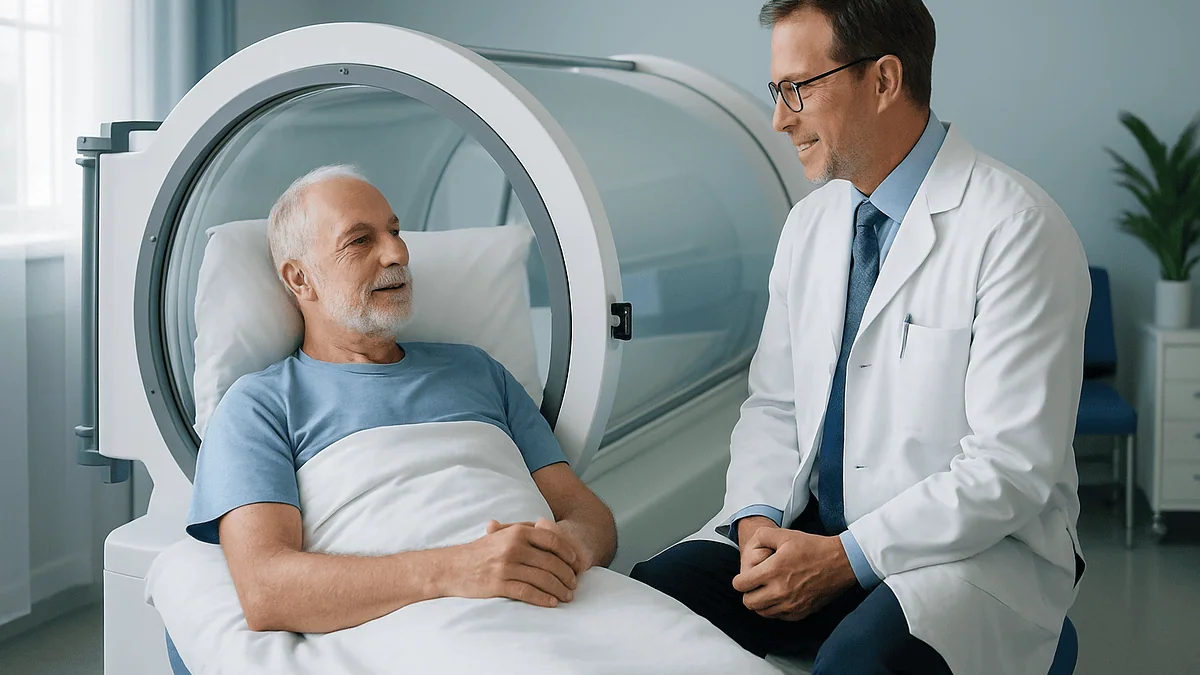
People sometimes search for a “barometric chamber,” which is a mix-up with the word barometer; the clinical term is hyperbaric chamber. Hyperbaric simply means higher than normal atmospheric pressure. The chamber is a sealed vessel, either a clear acrylic tube built for one person or a room-sized steel unit that seats several patients with a staff member inside.
Once the door closes, the pressure is raised gradually, usually to between 1.5 and 3 times the pressure at sea level, according to Cleveland Clinic. Your ears feel it first, much like the descent of a plane, and staff coach you to swallow, yawn or gently blow against a pinched nose to equalize. In a single-person chamber the whole space fills with oxygen; in a multiplace room you breathe through a hood or mask while the room itself holds ordinary air.
Most sessions last about two hours, including the time spent pressurizing and depressurizing, per Mayo Clinic. Patients lie or sit, watch television through the acrylic, nap or listen to music. Nothing is injected and nothing is swallowed. A technician watches continuously and can stop the session at any point.
Fire safety shapes the rules you will hear before you go in. Pure oxygen under pressure makes ordinary objects flammable, so lighters, battery devices, hand warmers, petroleum-based skin products and some fabrics stay outside. Expect to be asked to change into cotton garments provided by the unit.
Coming back to normal pressure is slower than going up, and the ears pop again on the way. Many people describe the whole experience as uneventful, which is roughly the point: the therapy is physiology, not spectacle.
How does hyperbaric oxygen therapy work in the body?
At sea level, almost all of the oxygen in your blood rides on hemoglobin, the protein inside red blood cells. Hemoglobin is nearly full already, so breathing extra oxygen in ordinary conditions adds very little. Pressure changes the math. Gases dissolve into liquid in proportion to pressure, which is why a sealed soda holds its fizz, and under hyperbaric conditions oxygen dissolves directly into blood plasma in much larger amounts.

That dissolved oxygen can reach tissue that red cells struggle to serve: swollen tissue, poorly perfused wound edges, bone with damaged blood supply, or areas where radiation has scarred the smallest vessels. Johns Hopkins Medicine describes the resulting effects as supporting the growth of new blood vessels, improving the ability of white blood cells to fight certain bacteria, and reducing swelling.
Pressure does something separate and more mechanical in decompression sickness and gas embolism. Bubbles of nitrogen or air that have formed in blood or tissue shrink as pressure rises, and breathing oxygen helps wash the nitrogen out. Here the chamber is not a general tonic; it is the direct physical answer to the problem.
Carbon monoxide poisoning illustrates a third mechanism. Carbon monoxide binds hemoglobin far more tightly than oxygen does, locking cells out of their oxygen supply. High-pressure oxygen helps displace it faster than breathing oxygen at room pressure, which is why MedlinePlus lists the treatment for serious exposures.
These are specific, measurable effects tied to specific problems. They are not evidence that “more oxygen” improves a healthy body. In fact, oxygen at high concentration is mildly toxic to lungs and the nervous system over time, which is one reason sessions are limited in length and spaced across days rather than given continuously.
What is hyperbaric oxygen therapy used for? The conditions with evidence
The accepted list is short, and most items on it were established through decades of clinical use plus controlled studies. Mayo Clinic and Cleveland Clinic both describe the following as established medical uses:
- Decompression sickness, the “bends” that scuba divers can develop after surfacing too quickly.
- Air or gas embolism, when a bubble enters a blood vessel, sometimes during a medical procedure.
- Serious carbon monoxide poisoning.
- Gas gangrene and other severe, rapidly spreading soft-tissue infections.
- Crush injuries and some cases of acute, severe blood loss when transfusion is not possible.
- Non-healing wounds, particularly diabetic foot ulcers with impaired blood supply.
- Delayed injury from radiation treatment, such as damage to the jawbone or the bladder lining months or years after cancer therapy.
- Chronic bone infection (osteomyelitis) that has not responded to standard treatment.
- Skin grafts or flaps that are at risk of failing.
- Sudden sensorineural hearing loss, where it is used as an add-on to other treatment.
- Severe burns, in selected cases, alongside burn-unit care.
Even within this list, the strength of evidence varies. For decompression sickness and gas embolism, the therapy is the standard of care and has been for generations. For diabetic foot ulcers, a Cochrane systematic review found that hyperbaric oxygen improved healing in the short term but found no clear benefit in long-term healing or in preventing major amputation, and rated the studies as small with risk of bias. That is a modest, qualified endorsement, not a miracle, and it explains why wound specialists use it selectively rather than routinely.
Notice what the list shares: a mechanism tied to oxygen delivery or bubble physics, and a condition that is diagnosed by a clinician before treatment begins. Those two features are the quickest way to tell a legitimate use from a marketed one.
Evidence at a glance: proven, promising, and unproven uses
Tables flatten nuance, so treat this one as a map rather than a verdict. The categories reflect how major academic medical centers and systematic reviews currently describe the evidence.

| Use | Evidence status | What the evidence actually shows |
|---|---|---|
| Decompression sickness, gas embolism | Established | Standard emergency treatment; mechanism is direct bubble compression. |
| Severe carbon monoxide poisoning | Established in practice; trial data mixed | Widely used for serious cases; a Cochrane review found trials conflicting on whether it prevents later neurological problems. |
| Diabetic foot ulcers with poor circulation | Qualified support | Short-term healing improved in small trials; long-term and amputation outcomes unclear. |
| Delayed radiation injury (bone, bladder, rectum) | Supported | Used as an adjunct; benefit varies by tissue. |
| Necrotizing infections, gas gangrene | Supported as adjunct | Added to surgery and antibiotics, never a replacement. |
| Sudden sensorineural hearing loss | Supported as add-on | Guidelines list it as an option alongside other treatment. |
| Stroke, traumatic brain injury | Unproven | Trials have not shown consistent benefit; not recommended outside research. |
| Autism, cerebral palsy | Unproven | No reliable evidence of benefit; Mayo Clinic lists these among claims without support. |
| Cancer, HIV, multiple sclerosis, Parkinson’s disease | Unproven | No credible evidence; may delay effective care. |
| Anti-aging, fatigue, athletic recovery, “detox” | Unproven | Marketing claims; no clinical endorsement. |
Two things stand out. First, even “established” uses can carry uncertainty when the question shifts from “does it help now” to “does it change the long-term outcome.” Second, the unproven column is where almost all of the advertising lives. A condition appearing in a brochure is not the same as a condition appearing in a guideline.
Which hyperbaric oxygen therapy claims lack evidence?
Mayo Clinic maintains a plain statement that there is not enough scientific evidence to support hyperbaric oxygen for a long roster of conditions, including autism, cancer, cerebral palsy, depression, heart disease, HIV and AIDS, multiple sclerosis, Parkinson’s disease, spinal cord injury, sports injuries, stroke and traumatic brain injury. Some of these have been studied; the studies have been small, inconsistent or negative. Others have never been tested at all.
Stroke and brain injury deserve a specific word, because they are the uses parents and spouses ask about most. The theory sounds plausible: injured brain tissue is starved of oxygen, so deliver more. The problem is that the damage from a stroke or head injury is not simply a lack of oxygen hours or months later; it involves cell death, inflammation and scarring that extra oxygen does not reverse. Controlled trials have struggled to separate any real effect from the improvement that occurs naturally with time and rehabilitation.
Cancer claims run in two contradictory directions, and that alone should raise doubt. Some sellers say oxygen “kills tumors”; others warn that oxygen feeds them. Neither is supported. Oncologists do use hyperbaric oxygen, but to treat the late tissue damage caused by radiation, not the cancer itself.
Then there is the wellness tier: longevity, skin rejuvenation, hangover relief, better sleep, faster recovery after a marathon. None of these appear in any mainstream guideline. The honest summary is that no one has shown a measurable health benefit of pressurized oxygen in a person whose tissues already receive enough of it.
When a claim is uncertain rather than disproven, say so. Several conditions sit in a gray zone of early research. That is a reason for clinical trials, not for a course of sessions bought on a payment plan.
Why hyperbaric oxygen therapy myths spread so easily
A therapy with genuine, dramatic wins makes a persuasive stage for exaggeration. A diver pulled from paralysis within hours, a carbon monoxide victim who wakes up, a wound that finally closes after months: these stories are true, and they are retold far beyond the conditions they came from.
The science is also easy to misstate in a way that sounds right. “Your cells need oxygen; this gives them more” is accurate as far as it goes. The missing step is that healthy cells are not short of oxygen, and more of a nutrient is not better once need is met. Few people carry the physiology to spot that gap, and marketers rarely volunteer it.
Testimonials do the rest. Many conditions on the unproven list, including autism and brain injury, improve or fluctuate over time without any intervention. A family that starts sessions during a natural upswing will credit the chamber. Add the cost and effort involved, and the mind’s tendency to justify both, and a sincere believer is born. This is why controlled trials matter: they are the only reliable way to tell a treatment effect from a coincidence.
Regulation adds confusion. Chambers can be legally sold for a handful of uses, yet once a device exists, a facility can offer sessions for almost anything. Patients reasonably assume the chamber in a storefront has the same oversight as the one in a hospital wound center. Often it does not.
Finally, the word “natural” does heavy lifting. Oxygen feels wholesome in a way that a pill does not. It is still a drug when concentrated and pressurized, with a dose, a toxicity ceiling and side effects, which the next sections explain.
Does using oxygen make you more dependent on oxygen?
No. This is one of the most common worries about any form of oxygen treatment, and it mixes up two different things.
Dependence, in the pharmacological sense, means the body adapts to a substance so that stopping it causes withdrawal. Oxygen does not work that way. Your lungs, your breathing drive and your hemoglobin do not “forget” how to function after a series of hyperbaric sessions. When a course ends, your body returns to extracting oxygen from ordinary air exactly as it did before.
The confusion usually comes from people with chronic lung disease who use home oxygen. They are not dependent because the oxygen weakened them; they need it because the underlying disease limits how much oxygen their damaged lungs can transfer. Removing the oxygen reveals the disease; it does not create it.
Hyperbaric sessions are also brief, intermittent exposures. Between sessions you breathe room air for twenty-two hours or more. The physiological effects that matter, such as new small blood vessels forming in a wound bed, are the body’s own responses that persist after the oxygen stimulus is gone, which is the whole intent.
There is one nuance worth stating precisely. Very prolonged exposure to high oxygen concentration can irritate the lungs and, under pressure, can rarely trigger a seizure. These are toxicity effects, the opposite of dependence, and they are the reason sessions are capped in length and interrupted with short “air breaks” in many protocols. The treating team manages that ceiling; the patient does not need to.
So the honest answer to the search query is reassuring: a course of hyperbaric oxygen does not leave you needing oxygen afterward.
Is hyperbaric oxygen therapy safe? Side effects and risks explained
In supervised medical settings the therapy is generally well tolerated, but it is not risk-free, and anyone who tells you it has “no side effects” is repeating a myth. The common problems are mechanical, caused by pressure, and the rare ones are caused by oxygen itself.
The most frequent complaint is ear discomfort or middle-ear barotrauma, which means the pressure difference across the eardrum causes pain, fluid or occasionally a small tear. Cleveland Clinic and Johns Hopkins both list it first. Sinus pain follows the same logic. Staff reduce the risk by slowing the pressure change and teaching equalizing techniques; a cold or blocked nose on the day may lead to a postponed session.
Temporary changes in vision are also well described. Some people become more nearsighted over a course of treatment, an effect on the lens that usually reverses in the weeks after sessions end, according to Mayo Clinic. People with cataracts may notice them progress.
Rarer but more serious:
- Oxygen toxicity seizures, uncommon and usually brief, managed immediately by the team.
- Lung injury, including a collapsed lung, which is why an untreated pneumothorax is an absolute reason not to enter the chamber.
- Low blood sugar in people with diabetes, so glucose is typically checked before sessions.
- Claustrophobia, particularly in single-person tubes.
- Fire, which is why the restrictions on what enters the chamber are strict and non-negotiable.
Certain lung diseases, recent ear surgery, some chemotherapy drugs, pregnancy and a few other situations require individual assessment. None of this makes the treatment unsafe; it makes it medical, which is the point. The safety record of hospital-based hyperbaric medicine rests on screening, trained staff and monitoring, and those are exactly what a retail chamber may lack.
Who is hyperbaric oxygen therapy usually for, and who is asked to wait?
Referral usually comes from a specialist who has already diagnosed one of the accepted conditions: a wound care or vascular team for a diabetic ulcer, a radiation oncologist for late tissue damage, an emergency physician for carbon monoxide exposure, a dive medicine clinician for decompression illness, an ear specialist for sudden hearing loss. The chamber is rarely a first step and almost never a stand-alone one. For infections it rides alongside surgery and antibiotics; for wounds it sits on top of offloading, debridement and blood-supply assessment.
A careful team also checks whether the problem is actually one that oxygen delivery can fix. A foot ulcer with no blood flow at all, for instance, may need a vascular procedure first, because dissolved oxygen still has to reach the tissue through some circulation. Some units measure oxygen levels in the skin around a wound to predict who is likely to respond.
Who is asked to wait, or to pursue something else:
- Anyone with an untreated collapsed lung, which is the one absolute contraindication.
- People with an active cold, ear infection or sinus blockage, until it clears.
- Those with uncontrolled seizures or a high fever, which raise oxygen toxicity risk.
- Patients on certain chemotherapy agents, where timing matters.
- People with severe claustrophobia, who may be offered a multiplace room or a trial session.
- Pregnant patients, except for emergencies such as carbon monoxide poisoning, where the balance of risk changes.
The waiting list also includes a broader group: people whose condition is not on the evidence-based list at all. For them, the kindest answer from a treating team is a clear “this is not likely to help you,” and a conversation about what might.
What the days and weeks of a course usually look like
The shape of a course depends entirely on the diagnosis. Emergencies and chronic conditions could hardly look more different.
For decompression sickness, gas embolism or carbon monoxide poisoning, treatment starts within hours and may be finished in one to three sessions, per Mayo Clinic. The chamber is part of emergency care, and the patient is usually in hospital for the underlying problem.
Chronic conditions run on a different clock. Non-healing wounds, radiation injury and bone infection are typically treated with one session a day, five days a week, and Mayo Clinic notes that such courses can run to 40 sessions or more. That is eight weeks of daily appointments, each about two hours in the chamber plus travel and preparation. People who work, drive or care for others find the commitment the hardest part.
During the course, the wound or affected tissue is reviewed regularly. If nothing changes after a defined number of sessions, the team may stop rather than push on; evidence does not support indefinite treatment. Patients are coached to tell staff about ear pain, vision changes, new breathlessness or unusual fatigue, and sessions are paused for colds or uncontrolled blood sugar.
Afterward there is no formal recovery in the surgical sense. Most people go home and continue the day. Vision changes, if they occurred, tend to settle in the weeks after the final session. The benefit, where there is one, continues to unfold as new vessels and healing tissue mature, which is why the real measure of success is what the wound or bone looks like a month or two later, not how the patient felt walking out of the chamber.
What people often get wrong about hyperbaric oxygen therapy
Myth: it is a “miracle” treatment. People search for “the miracle of hyperbaric oxygen therapy.” The accurate framing is narrower: for a diver with bubbles in the bloodstream, the chamber can be dramatic and decisive. For a chronic wound, it is a useful adjunct with modest, qualified evidence. For autism or aging, it is a marketing story.
Myth: if it helps wounds, it must help everything that heals slowly. The wound benefit depends on a specific problem, oxygen-starved tissue with some remaining blood supply. Joint pain, fatigue or a sprained ankle do not share that mechanism.
Myth: more pressure or more sessions is always better. Oxygen has a toxicity ceiling. Protocols cap pressure and session length for safety, and evidence does not support open-ended courses.
Myth: it has no side effects. Ear injury, sinus pain, temporary nearsightedness, low blood sugar and, rarely, seizures or lung injury are all documented.
Myth: it replaces surgery or antibiotics. For infections and compromised grafts, it is always an add-on to standard care.
Myth: it is like an oxygen bar, only stronger. Breathing extra oxygen at room pressure adds almost nothing to the blood, because hemoglobin is already nearly full. Pressure is what changes the physiology, and pressure is what carries the risks.
Myth: you get “high” or euphoric. Most people describe boredom. Any feeling of well-being is usually relief that the ears equalized.
Myth: it makes you dependent on oxygen. Covered above, and false.
Myth: a chamber at a spa is the same as one in a hospital. Pressure, oxygen concentration, screening and staffing can differ enormously, and the next section explains why that matters.
Soft chambers, spas and oxygen bars: what the evidence says
Walk through a wellness district and you will find inflatable “mild” hyperbaric chambers, cryotherapy pods and bars that sell flavored oxygen through a nasal tube. All three borrow credibility from hospital hyperbaric medicine while sharing little of its physiology.
Soft-sided chambers typically operate at lower pressure than medical units and often pump compressed air rather than pure oxygen. At that pressure, the increase in dissolved oxygen is small, and no mainstream guideline lists these devices as treatment for any of the accepted conditions. Their use for autism, concussion, athletic recovery or “brain fog” rests on testimonials.
Lower pressure does not mean no risk. Ear and sinus injury can still occur, and a chamber of any kind containing enriched oxygen carries fire risk. An untrained attendant, or none at all, cannot screen for the lung conditions that make pressurization dangerous.
Oxygen bars sit at the other end: ordinary pressure, modestly enriched oxygen for a few minutes. Because hemoglobin at sea level is already close to full in a healthy person, the extra oxygen in the blood is negligible. Any pleasant feeling is more plausibly explained by sitting down, breathing slowly and inhaling a scented stream. People with certain lung diseases should avoid them, because their breathing drive can be sensitive to oxygen levels.
None of this is a judgment on anyone who has tried these services. It is a statement about evidence. If a device or service claims to deliver what a hospital chamber delivers, it should be able to point to the same kind of controlled studies. So far, the retail versions cannot.
The practical test is simple: ask who diagnosed the condition being treated, what pressure and oxygen concentration are used, and who will be watching for complications. A medical unit answers all three without hesitation.
Questions to ask your care team before starting hyperbaric oxygen
A good consultation leaves you knowing why this treatment, why now, and what would make the team stop. These questions help get there.
- Which of my diagnoses is the reason for referral, and is it on the established list of indications?
- What is the evidence for my specific condition, and how strong is it?
- What other treatments are running alongside, and does hyperbaric oxygen replace any of them? (It should not.)
- Has my blood supply or tissue oxygen level been assessed to predict whether I am likely to respond?
- How many sessions are planned, how will progress be reviewed, and at what point would you stop if nothing changes?
- Which side effects should I expect, and which should prompt me to call immediately?
- Do I have any condition, such as a lung problem, ear surgery or a medication, that changes my risk?
- If I have diabetes, how will blood sugar be monitored around sessions?
- Is the chamber a single-person unit or a multiplace room, and what happens if I feel panicked inside?
- Who is in the room or at the console during the session, and what is their training?
- What should I bring, wear and avoid on treatment days?
- How will the results be communicated back to my referring specialist?
If someone outside a medical setting offers the therapy, the same questions apply with one addition: ask what the device is cleared for and whether the condition being marketed is on that list. A vague or defensive answer is informative in itself.
Bring a family member or a written list. Two hours in a chamber every weekday for two months is a serious undertaking, and the decision deserves the same care as any other procedure.
When to call your doctor
Most sessions pass without incident, but a few symptoms need prompt attention, during a course and in the days after it.
Call the hyperbaric unit or your doctor the same day if you notice:
- Ear pain that persists after a session, fluid or bleeding from the ear, or a sudden change in hearing.
- Dizziness, spinning sensations or new ringing in the ears.
- Vision changes that are worsening rather than mild and stable.
- Unusual breathlessness, chest tightness or a cough that started after treatment.
- Low blood sugar symptoms such as shakiness, sweating or confusion if you have diabetes.
- A wound that looks more red, swollen, hot or foul-smelling, or that bleeds more than before.
Seek emergency care without waiting for a call back if you have severe chest pain, sudden severe shortness of breath, a seizure, fainting, sudden weakness or numbness on one side, difficulty speaking, or coughing up blood. A sudden sharp chest pain with breathlessness after decompression can signal a collapsed lung and is an emergency.
Separately, if the chamber was prescribed for carbon monoxide poisoning, new headache, confusion, memory problems or mood change in the weeks afterward should be reported, since delayed neurological symptoms are a recognized pattern.
Every decision about continuing, pausing or stopping sessions belongs with the treating team. Do not alter other prescribed treatments, such as antibiotics, wound dressings or diabetes medication, on your own because the chamber seems to be helping; those elements are usually doing a good share of the work.
Frequently asked questions
What is a hyperbaric chamber, and is it the same as a barometric chamber?
A hyperbaric chamber is a sealed vessel in which air pressure is raised above normal so that pure oxygen can dissolve into the blood in larger amounts. “Barometric chamber” is a common mix-up with the word barometer; clinicians say hyperbaric. Chambers come as clear single-person tubes or room-sized units that seat several people, with a trained attendant monitoring throughout.
What is hyperbaric oxygen therapy used for in mainstream medicine?
Accepted uses include decompression sickness, air or gas embolism, serious carbon monoxide poisoning, gas gangrene and other severe soft-tissue infections, crush injuries, selected non-healing diabetic foot wounds, delayed radiation injury, chronic bone infection, failing skin grafts and sudden sensorineural hearing loss. In most of these it is added to surgery, antibiotics or wound care rather than used alone.
What are the effects of hyperbaric oxygen therapy on the body?
Under pressure, oxygen dissolves into plasma and reaches tissue that red blood cells struggle to serve. Documented effects include reduced swelling, improved bacterial killing by white blood cells and stimulation of new small blood vessels in oxygen-starved tissue. In decompression illness and gas embolism, pressure also physically shrinks gas bubbles. These effects are specific to damaged or oxygen-poor tissue, not a general boost to a healthy body.
What is the "miracle" of hyperbaric oxygen therapy that people talk about?
The dramatic stories usually come from emergencies: a diver whose paralysis reverses, or a carbon monoxide victim who recovers. Those outcomes are real and tied to a clear mechanism. The word “miracle” becomes misleading when it is stretched to chronic wounds, where evidence is modest and qualified, or to autism, stroke and aging, where reliable studies show no benefit.
Does using oxygen make you more dependent on oxygen?
No. Oxygen does not cause physiological dependence or withdrawal. People with chronic lung disease who use home oxygen need it because of their underlying disease, not because oxygen weakened them. Hyperbaric sessions are brief, intermittent exposures, and the body returns to extracting oxygen from ordinary air as soon as each session ends.
Is hyperbaric oxygen therapy safe?
In supervised medical units it is generally well tolerated, with screening and monitoring reducing risk. Ear and sinus discomfort are the most common problems. Temporary nearsightedness, low blood sugar in people with diabetes and claustrophobia also occur. Rare but serious risks include oxygen toxicity seizures and lung injury, which is why an untreated collapsed lung is an absolute reason not to enter a chamber.
What are the common hyperbaric oxygen therapy side effects after a session?
Most people notice little beyond ear fullness or mild fatigue. Over a course, some develop blurred distance vision that usually settles in the weeks after the final session. Persistent ear pain, fluid or bleeding from the ear, worsening vision, new breathlessness or chest pain should be reported to the treating team promptly rather than waited out.
How many hyperbaric oxygen sessions are usually needed?
It depends on the diagnosis. Emergencies such as carbon monoxide poisoning may be treated in one to three sessions, according to Mayo Clinic, while chronic conditions such as non-healing wounds or radiation injury can require 40 sessions or more, usually one per weekday. The treating team sets the number and reviews progress at intervals, stopping if there is no response.
Can hyperbaric oxygen therapy treat autism, stroke or brain injury?
Current evidence does not support it for these conditions. Mayo Clinic lists autism, cerebral palsy, stroke and traumatic brain injury among uses without adequate scientific backing, and controlled trials have not shown consistent benefit beyond natural recovery and rehabilitation. Families are encouraged to discuss any such use with the treating specialist and to consider clinical trials rather than commercial courses.
Are soft inflatable hyperbaric chambers or oxygen bars as effective as hospital chambers?
No mainstream guideline supports them for any established indication. Soft chambers usually operate at lower pressure, often with compressed air rather than pure oxygen, so dissolved oxygen rises only slightly. Oxygen bars run at normal pressure, where hemoglobin is already nearly full. Both still carry ear, sinus and fire risks, typically without medical screening or trained monitoring.
References
This article is for general information only and is not a substitute for professional medical advice. Please consult a qualified doctor about your individual situation.
Add us as a Preferred Source to see more of our trusted health content across Google Search, AI Overviews and Discover.

More from the Blog

How to Sleep After Wisdom Teeth Removal: Head Elevation, Side Sleeping and the First Nights
For the first few nights after wisdom teeth removal, sleep on your back with your head raised on two pillows, take out any gauze…

Weight Loss After Hysterectomy: Why Weight Changes, What Is Expected and When to Tell Your Team
Weight loss after hysterectomy is usually modest and temporary. Reduced appetite, fluid shifts and the removal of a large uterus or fibroids can lower…

Hyperbaric Oxygen Therapy With Diabetes: Why Blood Sugar Is Checked Around Each Session
Hyperbaric oxygen therapy is sometimes added to standard wound care for a diabetic foot ulcer that has not healed with offloading, debridement and good…

Preparing for Hyperbaric Oxygen Therapy: Ear Checks, Blood Sugar and What Stays Outside
To prepare for hyperbaric oxygen therapy, expect a pre-treatment assessment that includes an ear exam, a review of your medicines and lung history, and,…

Why Hyperbaric Oxygen Therapy Is Given as a Course: How Sessions Are Planned and Reviewed
How many HBOT sessions are needed depends on the condition being treated, not on a fixed package. Emergencies such as carbon monoxide poisoning may…
Inside a Hyperbaric Oxygen Therapy Session: Pressurization, Ear Equalizing and Chamber Time
During hyperbaric oxygen therapy you lie or sit in a sealed chamber while the air pressure is raised to roughly two to three times…