

In-Office vs Take-Home Teeth Whitening: Speed, Sensitivity and How Even the Shade Comes Out
Key Takeaways
- Both routes use the same peroxide chemistry; the chair delivers a higher concentration for about an hour, while dentist-made trays deliver a milder gel over roughly two to four weeks, according to NHS guidance.
- Reviews of controlled trials generally find a comparable final shade once a tray course is completed, so the in-office route mainly buys speed rather than a higher ceiling.
- Sensitivity is a temporary pulp response reported more often and more intensely after in-office sessions, and it usually settles within days of stopping, per Cleveland Clinic.
- Part of the immediate chair result is dehydration; the true shade is best judged after about a week once the teeth have rehydrated.
- Crowns, veneers and fillings do not lighten, so visible dental work should be planned around before whitening and matched afterward.
- No whitening is permanent; the NHS puts the typical duration at a few months to up to three years, shortest for smokers and regular tea, coffee or red wine drinkers.
In-office whitening uses a higher-concentration peroxide gel applied by a dental professional and typically lightens teeth within a roughly one-hour visit, while dentist-made take-home trays use a milder gel over about two to four weeks. Reviews of clinical trials generally find a similar final shade once the home course is completed; the chair route is faster but is more often linked to short-term sensitivity.
The photo was taken at a kitchen table, under a warm bulb, and the teeth in it looked the color of weak tea. That is usually how the question starts: not with a dentist, but with a camera and a small, private wince. Then comes the leaflet with two columns on it, and the decision nobody expected to find complicated.
The in office vs take home whitening choice is less a contest than a trade. One route buys speed and supervision; the other buys control, gradual blending and a reusable tool for later. Both run on the same chemistry, and neither can change a crown, a filling or the gray band left by a childhood antibiotic.
What follows is the version of that leaflet a seasoned dental editor would want: how the gel actually works, where sensitivity comes from, why some teeth lag behind, and which questions change the plan. The decision itself stays where it belongs, with the dentist who can see inside your mouth.
How teeth whitening actually works, whichever route you choose
Every whitening method that genuinely changes the color of a tooth, rather than scrubbing off surface film, relies on the same chemistry. The active ingredient is a peroxide: either hydrogen peroxide itself or carbamide peroxide, a compound that breaks down into hydrogen peroxide and urea once it meets saliva. Peroxide releases reactive oxygen that slips through enamel, the hard outer shell of the tooth, and into dentin, the softer and naturally yellowish layer beneath. There it breaks apart chromogens, the large pigmented molecules left behind by coffee, tea, red wine, tobacco and plain aging. Smaller fragments scatter light differently, and the tooth reads as lighter.
Two consequences follow from that mechanism, and they explain most of the differences between the chair and the tray. First, the result depends on concentration multiplied by contact time: a strong gel for a short period and a gentle gel for many hours can land in a similar place. Second, the same oxygen that reaches the chromogens also reaches the pulp, the living nerve and blood supply at the center of the tooth. That is why sensitivity is a recognized side effect of both approaches rather than a sign that something has gone wrong.
What whitening cannot do is alter anything that is not natural tooth. Crowns, veneers, bonding and tooth-colored fillings keep their original color, a point Cleveland Clinic makes plainly in its patient guidance. Nor does the gel remove plaque or tartar, which is why a professional cleaning usually comes first. Peroxide is a bleaching chemistry, not a polish. Keeping those two ideas apart is the beginning of realistic expectations, and it will come up again in nearly every section below.
In-office whitening: what actually happens in the chair
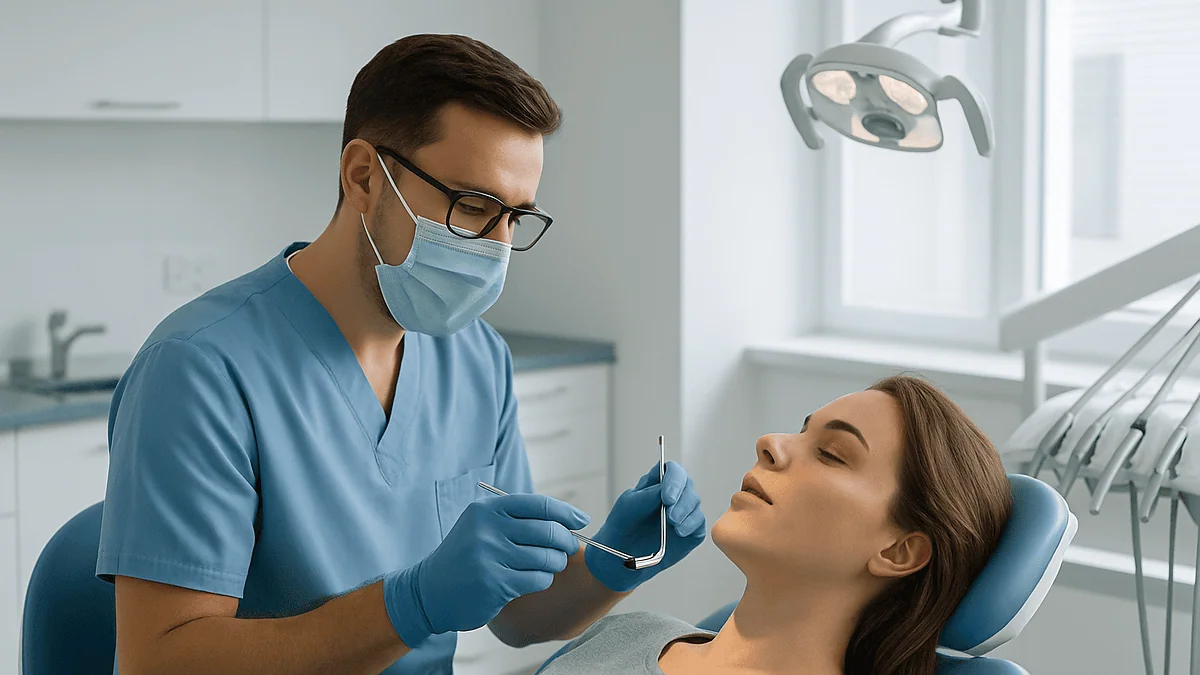
The chair appointment is more methodical than the word “laser” suggests. After a check that the gums are healthy and any decay has been treated, the dental team records a starting shade against a shade guide, a row of tooth-colored tabs used to track change. Lips and cheeks are held back with a retractor, and the gums are painted with a protective barrier that sets into a rubbery film. Only then is the higher-concentration peroxide gel brushed onto the front teeth.
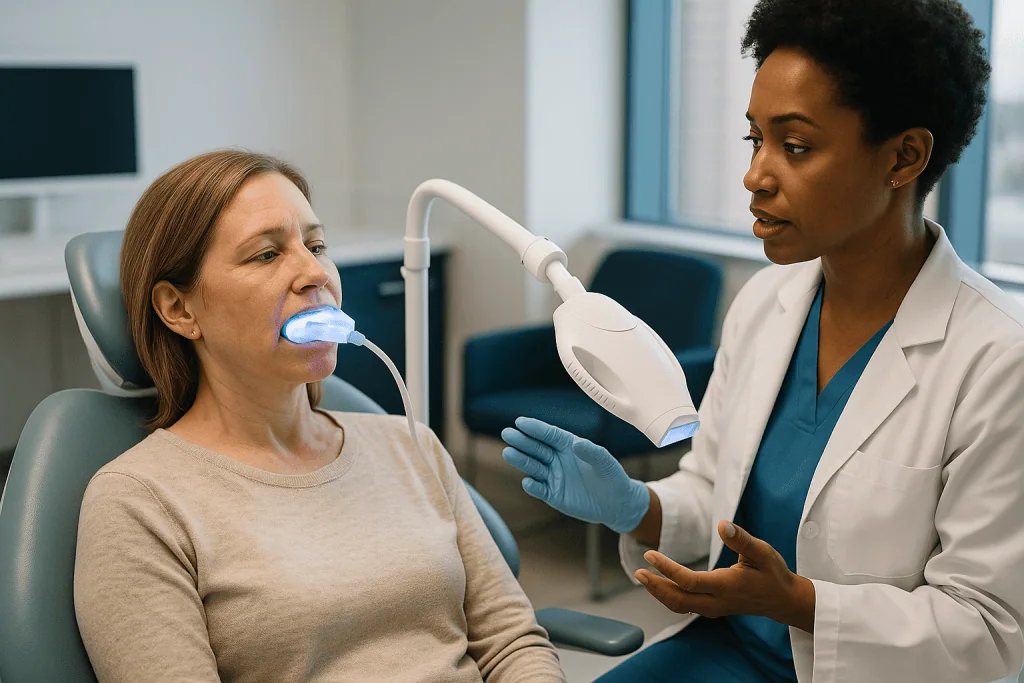
The gel sits for a timed interval, is wiped away and is often reapplied in two or three cycles. Some practices shine a light or laser on the teeth during each cycle. The NHS describes the whole visit as taking about an hour. Whether the light adds anything beyond the gel is one of the more honest uncertainties in this field: laboratory and clinical studies have reached mixed conclusions, and some suggest the heat raises sensitivity without clearly improving the final shade. A neutral reading of the evidence is that the gel does the work and the light is optional.
Throughout, a clinician watches for gel that has crept onto gum tissue, which shows up as a blanched white patch and stings. That supervision, plus the barrier, is the main safety argument for the in-office route: a powerful oxidizing agent is kept exactly where it belongs. At the end, the teeth are rinsed, the barrier is peeled off and a second shade reading is taken. Many practices also send people home with a tray to hold or extend the result, a hybrid that quietly blurs the either-or framing of this article’s title.
Whitening trays from the dentist: what the take-home course looks like
The dentist-made tray route begins with the same exam, cleaning and shade reading, and then with an impression or a digital scan of the teeth. From that, a laboratory or the practice itself makes a thin, clear tray that hugs each tooth, with small reservoirs on the front surfaces to hold gel. The fit is the whole point. A well-made tray keeps a lower-concentration peroxide against enamel and off the gums.
At home, a small amount of gel goes into the tray, the tray goes in and any excess that squeezes onto the gums is wiped away. Wear time depends on the gel the dentist has chosen. The NHS describes regular applications over two to four weeks, and notes that some gels can be worn for up to eight hours, usually overnight, which can shorten the course to around a week. The product, its concentration and the schedule belong to the prescribing dentist; the patient’s job is to follow the written instructions and to stop and call if sensitivity becomes more than a passing twinge.
Progress is gradual, which turns out to be a feature rather than a drawback. Looking in the mirror each morning, people can see when the shade has reached what they want and stop, or pause for a few days if the teeth are zinging. Because the gel works for hours rather than minutes, it also has time to penetrate evenly, and clinicians often describe tray results as blending more smoothly across the arch. The tray itself is reusable, which matters later, when a brief top-up is the usual way to refresh a result that has faded.
Speed: how long does in-office whitening take compared with trays?
Speed is the clearest difference, and it is best measured two ways: how soon teeth look lighter, and how soon they reach their final shade. In the chair, lightening is visible by the end of the roughly one-hour visit the NHS describes. With trays, most people notice a change within the first several days and reach a stable shade by the end of the two-to-four-week course.
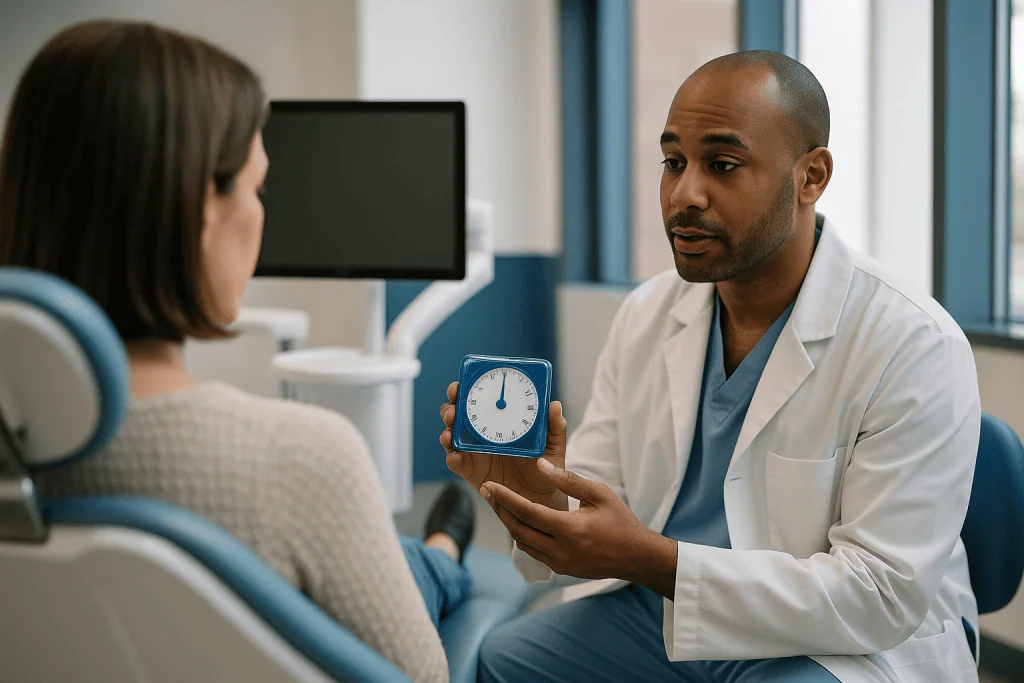
That immediate chair result carries a caveat. Part of what you see walking out is dehydration. Isolating the teeth for an hour dries them, and dry enamel looks whiter and more opaque than hydrated enamel. Over the following days, as the teeth rehydrate, the shade settles back somewhat. Clinicians often call this rebound and ask patients to judge the true result after about a week rather than in the car on the way home. Tray whitening shows the same effect on a smaller scale, because wear sessions are shorter and the teeth rehydrate between them.
So which route is faster to the final shade? If there is an event within a week, the in-office session, sometimes followed by a short tray course, is the only option that reliably fits. If the horizon is a month or more, the tray course reaches a comparable endpoint. Systematic reviews of controlled trials comparing the two routes, indexed on PubMed, have generally found similar final color change when the home course is completed, with the in-office arm ahead at the early time points. The fair summary: faster to start, not necessarily further at the finish.
In-office vs take-home whitening and sensitivity: which is gentler?
Tooth sensitivity after whitening is a sharp, brief, cold-triggered zing, sometimes a spontaneous shooting sensation with no trigger at all. It occurs because peroxide passes through enamel and dentin and briefly irritates the pulp. Cleveland Clinic lists it, alongside gum irritation, as the most common side effect and describes it as typically temporary, easing within days once whitening stops.
Both routes can cause it, but not in the same pattern. Higher-concentration gel delivered quickly tends to produce more intense sensitivity in the hours after a chair session, which is why many practices apply a desensitizing product before or after treatment. Tray whitening more often produces milder sensitivity that comes and goes across the course, and because the patient controls the schedule, it can be managed by skipping a night, shortening wear time or alternating days, all with the dentist’s guidance. Reviews of comparative trials have fairly consistently reported more sensitivity during treatment in the in-office group.
Gum irritation is a separate problem with a separate cause: gel touching soft tissue. In the chair, a painted barrier and a clinician’s eye keep that to a minimum. At home, the quality of the tray fit does the job, which is one reason dentist-made trays behave differently from one-size-fits-all strips or molds. If the gums blanch white or sting, the usual culprit is an overfilled tray, and the fix is less gel, not more tolerance.
Who is most at risk? People who already have sensitive teeth, exposed root surfaces from gum recession, cracked teeth or untreated decay. For them a dentist may suggest the slower route, a gentler gel, a fluoride or potassium nitrate desensitizer beforehand, or sometimes no whitening at all. Those are clinical judgments, and they belong to the treating team.
How even does the shade come out, and why some teeth lag behind?
“Even” is the word people say in the chair and the word that disappoints them most, so it deserves a mechanism. Teeth are not uniform to begin with. Dentin is thicker near the gum line and in the canines, which is why those areas look warmer and whiten more slowly than the broad face of a front incisor. Biting edges, where enamel is thin with little dentin behind it, often look translucent or gray rather than white. Whitening lightens the yellow of dentin; it cannot add white where there is nothing to lighten.
Then there are stains that live deep inside the tooth. Tetracycline staining, a gray-brown banding from certain antibiotics taken while the teeth were forming, responds slowly and incompletely, and the bands can look more obvious as the surrounding enamel lightens. Fluorosis, white or brown mottling from excess fluoride during tooth development, behaves similarly. White spots left after braces, or from early decay that never progressed, usually stand out more in the first days of whitening before the rest of the tooth catches up.
How does the route change this? A one-hour chair session lightens everything at once, so any patchiness is on display immediately, though it often blends as the teeth rehydrate. A tray course lightens gradually, giving slower areas time to catch up before anyone decides the result is final. For that reason many clinicians prefer trays, or a chair session followed by trays, when a mouth has mixed stains or a history of orthodontics.
One more source of unevenness is entirely predictable: existing dental work. Crowns, veneers and fillings stay the color they were made. The practical sequence is to whiten first, let the shade stabilize for a couple of weeks, then have any visible front-tooth restorations remade to match. Raise this before starting if your smile includes dental work you can see.
In office vs take home whitening at a glance
Side by side, the differences are less about which is “better” and more about which trade-off suits a particular mouth and calendar. The table below gathers the points that most often tip the decision.
| Feature | In-office (chair) | Take-home (dentist-made tray) |
|---|---|---|
| Who applies the gel | Dental professional, with gum barrier | Patient, in a custom-fitted tray |
| Gel strength | Higher concentration, short contact | Lower concentration, longer contact |
| Time to visible change | Within the roughly one-hour visit (NHS) | Days; full course about 2–4 weeks (NHS) |
| Final shade | Comparable in trial reviews | Comparable when course is completed |
| Sensitivity pattern | More intense, peaks in first 1–2 days | Milder, intermittent, easier to pause |
| Evenness | All at once; patchiness visible early | Gradual; slower areas catch up |
| Control | Clinician decides endpoint on the day | Patient can stop at the preferred shade |
| Maintenance | Repeat appointment or add trays | Reuse the tray with fresh gel |
| Not suitable for | Untreated decay, gum disease, cracked teeth, visible restorations without a plan, pregnancy, children and younger teens |
Two things the table cannot show. The first is that the combination of both, a chair session to start and a tray to hold the result, is common enough that many practices offer it as a package, and it answers the speed-versus-maintenance tension directly. The second is that the rows marked “comparable” rest on reviews of trials in which participants finished their tray course; a tray left in a drawer whitens nothing. Chair whitening removes that variable by putting the whole dose of effort into one supervised afternoon, which for some people is the honest reason to choose it.
Who whitening is usually for, and who is usually asked to wait
Whitening is generally offered to adults with healthy gums, no untreated decay and natural front teeth whose color they would like lighter. The classic candidate has yellow or light brown staining from diet, tobacco or age, which responds best. Gray tones and deep developmental stains respond less predictably, and a dentist will say so before anyone commits.
Several groups are routinely asked to wait or to decline:
- Children and younger teens. Cleveland Clinic advises against whitening in this group; the pulp chamber is larger in young teeth, which raises the chance of sensitivity, and in some countries cosmetic whitening is not permitted below adulthood.
- People who are pregnant or breastfeeding. There is no evidence of harm, but there is little safety data either, so most guidance suggests postponing.
- Anyone with untreated cavities, cracked teeth, gum disease or exposed roots. Peroxide reaching the pulp through these pathways can cause significant pain; the sensible order is to treat the underlying problem first.
- People with visible crowns, veneers or front fillings who are not prepared for a mismatch and possible replacement.
- Those with a known peroxide allergy or a history of severe whitening sensitivity.
Who should be examined rather than reaching for a kit? Anyone whose discoloration is confined to a single tooth, which can signal a dead or dying nerve; anyone with new brown or gray patches; and anyone whose sensitivity started before whitening did. A whitening consultation is, in practice, a dental check-up, and the NHS stresses that whitening should be carried out by a registered dental professional. Whether to whiten, by which route and when are decisions that sit with that clinician, informed by what they see on the X-ray and in the mirror.
Is professional whitening better than at-home kits from a store?
The question blurs two different things. Dentist-made trays are at-home whitening, and the evidence suggests they are as effective as the chair in the long run. The real contrast is between dentist-supervised whitening of either kind and over-the-counter strips, pens, lights and molds bought without an exam.
Store products use lower peroxide concentrations by regulation in many countries, and the NHS notes that some home kits contain too little whitening agent to make much difference. Their trays or strips are not shaped to an individual mouth, so gel contacts the gums more often, and coverage of the canines and the gum-line third of the tooth is patchier. A mouthguard from a kit may also fail to reach the back of the smile. These are coverage and safety limits rather than chemistry limits, which is why results tend to be lighter and less even rather than absent.
Whitening toothpastes sit in a different category again. Most work by mild abrasion or by binding surface stain, and they do not bleach dentin. They can help a whitened smile resist re-staining, which is useful, but they will not move a tooth several shades on their own.
The most valuable thing a professional route adds is not the gel. It is the exam. A dentist checks for decay, cracks, recession and gum disease that make whitening painful or unsafe, confirms that the discoloration is the kind that responds and plans around any restorations. The chair and the custom tray are then two delivery methods for the same chemistry. “Professional versus at-home” is really “examined versus unexamined”, and that is the comparison worth making.
Can yellow teeth become white again at home?
Yes, with qualifications. Yellow is the most responsive color, because it mostly reflects dentin showing through enamel plus accumulated chromogens, exactly what peroxide acts on. A dentist-prescribed tray course lightens yellow teeth to a stable new shade for most people, and the NHS description of a two-to-four-week course is a reasonable expectation. Stains from coffee, tea, red wine and tobacco respond; so does the gradual yellowing of middle age, which happens because enamel thins and dentin darkens over time.
“White” is the part that needs managing. Teeth have a natural ceiling, and that ceiling is a lighter version of your own tooth, not the uniform paper-white of a stock photograph. Shade guides run through warmer and cooler families, and whitening moves a tooth along its own family. Pushing past the ceiling with longer wear or extra sessions does not produce more white; it produces more sensitivity and, in some people, a chalky or glassy look at the edges.
Brown and gray are different stories. Brown surface stain often lifts with a professional cleaning alone. Brown or gray tones inside the tooth, from old trauma, tetracycline or a dying nerve, respond slowly or not at all. A single dark tooth needs an examination rather than a kit, because it may require root canal treatment or an internal bleaching technique performed by a dentist.
Home habits decide how long the result lasts. Brushing twice daily with a fluoride toothpaste, rinsing with water after staining drinks, cleaning between the teeth and avoiding tobacco keep new chromogens from settling in. None of this is dramatic. It is simply the routine MedlinePlus describes for healthy adult teeth, carried out with a little more intention.
What the following days and weeks usually look like
The first day or two after a chair session is when sensitivity peaks, if it is going to appear. Cold drinks, breathing in on a cold morning and sometimes nothing at all can trigger a brief jolt. Cleveland Clinic describes this as usually resolving within a few days. Many clinicians suggest a fluoride or desensitizing toothpaste during this window and advise steering clear of very cold or very hot foods; anything beyond that is a question for the treating team.
Color settles during the first week as the teeth rehydrate, which is when a fair “after” photo can be taken. It is also the window many practices call the white diet: pigments bind more readily to freshly whitened enamel, so tea, coffee, red wine, curry, tomato sauce, dark berries and tobacco are commonly limited for a day or two. The evidence for exactly how long is thin; the practice persists because it is harmless and plausible.
With trays, the timeline stretches. Sensitivity, when it occurs, tends to show up mid-course and is managed by spacing applications. The shade creeps lighter day by day and then plateaus, usually before the gel runs out. That plateau is the signal to stop. The NHS notes that whitening is not permanent, and that the teeth of people who smoke or drink staining beverages re-darken sooner, so some practices suggest an occasional single-night top-up with the same tray once the result begins to fade. Timing and frequency should come from the dentist who prescribed the gel.
Gum irritation, if it occurs, fades within a day or two of stopping. Persistent soreness, a spot that will not heal, or sensitivity that worsens rather than eases are not part of the normal pattern, and they belong in the red-flag list near the end of this article.
How long do in-office teeth whitening results last?
Longer than a haircut, shorter than a filling. The NHS gives the widest honest range: results can last from a few months to up to three years, with the shorter end for people who smoke or who regularly drink red wine, tea or coffee. That range applies to both routes, because what fades a result is new staining and the slow natural darkening of dentin, not the method used to get there.
Three things shape where a given person lands in that range. The first is diet and tobacco, the only factor fully under the patient’s control. The second is the starting stain type: yellow dietary stain that responded well tends to hold, whereas a mouth that needed a long course for a modest change tends to drift back faster. The third is maintenance. A custom tray kept in a drawer makes a brief top-up straightforward; refreshing an in-office result means another appointment or buying trays anyway.
That last point tips the practical balance for many people. An in-office session followed by a take-home tray, often offered together, gives the speed of the chair and the maintenance tool of the tray. Dentists suggest the combination not because the chair result is weaker, but because the tray is what keeps it.
A word on “permanent” claims. No whitening is permanent, and the NHS says so directly. Anyone promising a lifetime result is describing marketing, not enamel. The useful question is not “how long will it last” but “what will I need to do, and how often, to keep it where I like it”. The honest answer depends, more than anything, on the cup of coffee in your hand as you read this.
What people often get wrong about whitening
Whitening attracts folklore the way enamel attracts coffee. The most common misunderstandings, corrected briefly:
“The light is what whitens.” The gel whitens. Lights and lasers are activators of uncertain benefit; comparative studies have not consistently shown a better final shade with them, and some report more sensitivity.
“Stronger is better.” Concentration mostly buys speed, not a higher ceiling. Trial reviews find the two routes landing in a similar place once a tray course is completed.
“Whitening destroys enamel.” Dentist-supervised peroxide whitening has not been shown to cause lasting enamel damage in clinical studies; the sensitivity is a pulp response that settles. Harm comes from misuse: acidic kitchen recipes, store products used far beyond their directions, or bleaching over untreated decay.
“Baking soda, charcoal, lemon or strawberries whiten teeth.” Abrasives remove surface film and can wear enamel; acids soften it. None of them bleaches dentin, so none is a whitening method in any clinical sense.
“My crowns and fillings will lighten too.” They will not, which is why mismatch after whitening is a planning issue rather than a surprise.
“Sensitivity means it is working.” Sensitivity means peroxide reached the pulp. It tracks contact time and concentration, not how many shades you will gain.
“Once white, always white.” Results fade over months to years, per the NHS, at a pace set mainly by what passes your lips.
“Whitening toothpaste does the same job, just slowly.” It keeps surface stain down. It does not change intrinsic tooth color.
The thread running through all of these is a confusion between surface cleaning and bleaching. Keeping those two ideas separate makes every other decision, from choosing a route to judging a result, considerably easier.
Questions to ask your care team before you choose a route
A whitening consultation goes better when the questions are specific. These are the ones that tend to change the plan:
- What type of discoloration do I have, and how well does that type usually respond to peroxide?
- Is there any decay, cracking, recession or gum inflammation that should be treated before whitening?
- Which of my front teeth are crowns, veneers or fillings, and what happens to the match if the natural teeth lighten?
- Given my sensitivity history, would you suggest the chair, trays or a combination, and why?
- If trays, what wear time and course length are you prescribing, and what should I do if sensitivity appears mid-course?
- If the chair, will you use a light, and what does the evidence say it adds in my case?
- How will we record the starting and finishing shade so we both agree on the result?
- What are the signs that I should stop and call you?
- How would you suggest maintaining the result, and how often?
- What is included in the written quote, and what would be extra, such as replacement trays or gel refills?
Two of these matter more than the rest. The question about existing dental work prevents the most common disappointment, a bright smile with one dull tooth in the middle of it. And the question about stopping signals turns a vague “call if there’s a problem” into a clear threshold. Write the answers down; sensitivity at eleven at night is not the moment to try to recall what was said.
It is also reasonable to ask the dentist to hold up the shade guide and point to a realistic target rather than an ideal one. A clinician who answers candidly, including “this tooth may not respond much”, is handing you the most useful information in the room.
When to call your doctor or dentist
Most whitening side effects are mild and self-limiting, but a few signs mean the plan should pause and the dental team should hear from you the same day:
- Tooth pain that is severe, throbbing or lasts more than a few days after stopping, especially in one tooth; this can signal pulp inflammation or an undiagnosed problem that needs examination.
- Gum tissue that stays white, raw or ulcerated for more than a day or two, or any burn-like area in the mouth or throat after gel contact.
- Swelling of the lips, tongue, face or throat, hives or difficulty breathing; treat this as a possible allergic reaction and seek emergency care immediately.
- A single tooth that is darkening rather than lightening, which can indicate a dying nerve or a crack.
- Sensitivity to heat rather than cold, or spontaneous pain that wakes you at night; both point toward the pulp rather than ordinary post-whitening sensitivity.
- Vomiting or stomach pain after swallowing a significant amount of gel, particularly in a child; contact poison control or emergency services.
For milder issues, such as cold zings that ease within hours or a small gum sting that fades once the gel is wiped away, a call during office hours is enough. The usual advice is to stop whitening until the team has reviewed, and never to compensate for a disappointing result by doubling wear time or layering products.
This article explains how in-office and take-home whitening compare, what the evidence shows and what to ask. It does not diagnose, and it cannot see your mouth. Every decision about whether to whiten, which route, which gel and for how long sits with the dentist who examines you.
Frequently asked questions
Professional whitening vs at home kits: is the dentist really better?
Dentist-supervised whitening, whether in the chair or with custom trays, generally produces a stronger and more even result than store kits. The NHS notes some home kits contain too little whitening agent to work well, and one-size trays let gel reach the gums. The bigger advantage is the exam beforehand, which catches decay, cracks and restorations that change the plan.
How long does in office whitening take from start to finish?
The NHS describes a chair whitening visit as taking about an hour, including gum protection, two or three timed gel cycles and a final shade check. Lightening is visible immediately, but part of that is dehydration, so the settled shade is best judged after roughly a week. Some practices add a short tray course afterward to stabilize the result.
Does teeth whitening cause sensitivity, and how long does it last?
Yes, sensitivity is the most common side effect of both routes. Peroxide passes through enamel and dentin and briefly irritates the pulp, producing sharp cold-triggered twinges. Cleveland Clinic describes it as typically temporary, easing within a few days once whitening stops. It tends to be more intense after in-office sessions and milder but intermittent during a tray course.
Can yellow teeth become white again at home?
Yellow is the most responsive color, and a dentist-prescribed tray course lightens most yellow teeth over the two to four weeks the NHS describes. The result is a lighter version of your natural shade rather than uniform paper-white. Gray tones, tetracycline bands and a single dark tooth respond poorly and need a dental examination rather than a kit.
How much do whitening trays from the dentist cost?
This magazine does not publish price figures, and quotes vary widely between practices and regions. What usually shapes the quote is whether an exam and cleaning are included, whether the tray is made in a laboratory or in-house, how much gel is supplied and whether refills are extra. Ask for a written, itemized quote before starting.
How long do in-office teeth whitening results last?
The NHS gives a range of a few months to up to three years, with the shorter end for people who smoke or regularly drink tea, coffee or red wine. The method does not change that range much; new staining and the natural darkening of dentin do. Keeping a custom tray makes an occasional top-up, timed by your dentist, straightforward.
Does the light or laser in the chair make whitening work better?
The evidence is mixed. The gel does the bleaching; lights and lasers are activators, and comparative studies have not consistently shown a better final shade when they are used. Some report more sensitivity, likely from heat. A neutral reading is that the light is optional, and it is reasonable to ask your dentist what it adds in your case.
Can I whiten my teeth while pregnant or breastfeeding?
Most guidance, including Cleveland Clinic’s, suggests postponing cosmetic whitening during pregnancy and breastfeeding. There is no evidence of harm, but there is also very little safety data, and elective treatments are usually deferred when the evidence is thin. Your dentist and prenatal care team can advise on timing for after that period.
Will whitening change the color of my crowns, veneers or fillings?
No. Peroxide only acts on natural tooth structure, so crowns, veneers, bonding and tooth-colored fillings keep their original shade, as Cleveland Clinic notes. The usual sequence is to whiten first, let the color stabilize for a couple of weeks, then have any visible front restorations remade to match. Raise this at the consultation if you have dental work you can see.
Which is gentler on teeth, in-office whitening or take-home trays?
Neither has been shown to cause lasting enamel damage when supervised by a dentist, but trays are usually gentler in the short term. The lower-concentration gel produces milder, intermittent sensitivity, and the patient can pause or shorten sessions. Chair sessions more often cause intense sensitivity in the first day or two. People with existing sensitivity or recession are often steered toward trays.
This article is for general information only and is not a substitute for professional medical advice. Please consult a qualified doctor about your individual situation.
Add us as a Preferred Source to see more of our trusted health content across Google Search, AI Overviews and Discover.

Planning This Treatment in Turkey
Our full guide for international patients: techniques, hospital stay, recovery and cost.
More from the Blog

When Is It Better to Wait Before Clear Aligners? Growth, Gum Health and Combined Plans
It is usually better to wait before clear aligners when the jaws are still growing, when gum disease or untreated cavities are present, when…
Can the Tooth Be Saved Instead? How Dentists Weigh Root Canal, Crown and Extraction
Dentists usually favor saving a tooth when its root is intact, the surrounding bone and gum are healthy, and enough sound tooth remains to…
What a Panoramic X-Ray Shows Before Wisdom Teeth Removal: Roots Near the Nerve
A panoramic X-ray before wisdom teeth removal shows the whole lower jaw in one image, including each wisdom tooth's position, root shape, and how…
How Deep Is the Cavity? Reading a Tooth Decay X-Ray to Choose Filling or Root Canal
Dentists read cavity x ray depth by how far a dark shadow travels through the tooth: into enamel only, into dentin, close to the…
Why a Tooth Becomes Impacted: Crowding, Angle and Bone, and How Care Is Planned
Teeth become impacted when they cannot erupt into their normal position because the jaw lacks space, the tooth is angled against a neighbor, or…
Sore or Swollen Gums: Common Causes, Safe Home Care and When to See a Dentist
Gum pain is most often caused by gingivitis, plaque-driven inflammation that makes gums red, puffy and quick to bleed, and it usually settles with…