

Teeth Whitening in Turkey: In-Chair vs Home Kits and Results
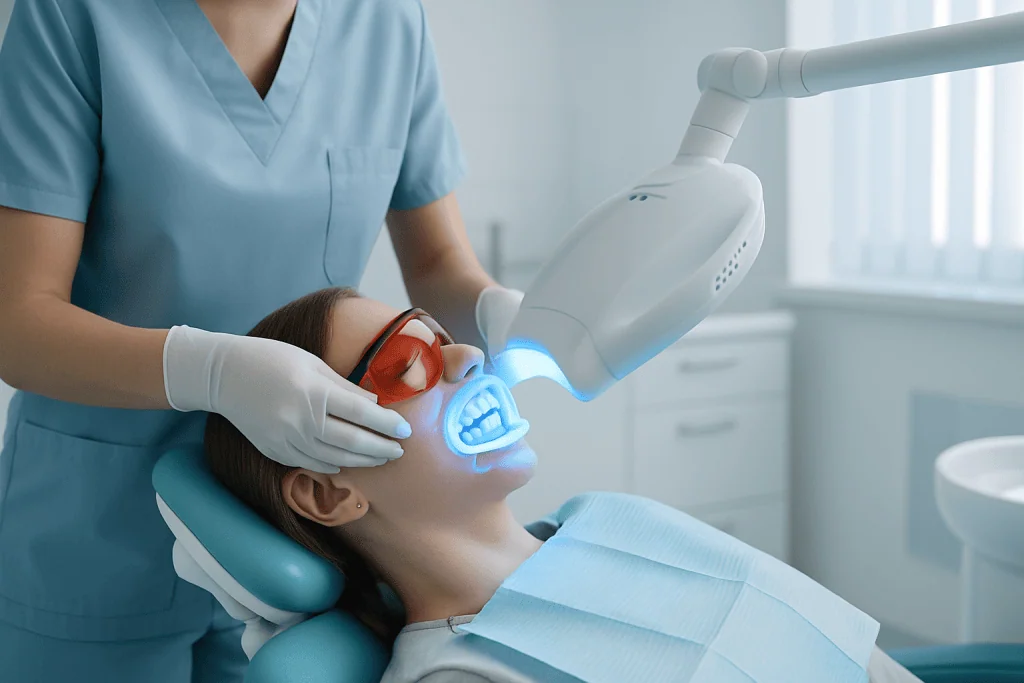
Teeth whitening in Turkey attracts adults from the United Kingdom, Ireland and North America who want a professionally supervised way to lighten stained or yellowed teeth, often combined with a short stay in Istanbul. The treatment itself is straightforward: a dentist examines the teeth and gums, cleans them where needed, then applies a professional bleaching agent chosen for the condition of the enamel. Nothing is drilled or removed, no anaesthesia is required, and the appointment lasts between 30 and 90 minutes.
What differs from a high-street offer is the setting. Within Acıbadem’s hospital network, whitening is one part of a full dental service rather than a stand-alone product, so the cause of the discolouration is investigated first and existing dental work is taken into account. This page explains who whitening suits and who should avoid it, how in-chair systems (including those marketed as laser or Zoom whitening) differ from take-home kits, what sensitivity to expect, and how to compare the pathway with private dentistry at home. A verified price band appears below the article.
What teeth whitening is and who it suits
Teeth whitening is a dentist-supervised cosmetic dental treatment that lightens discolouration and brightens the smile using professional bleaching agents tailored to the condition of your enamel. It is non-surgical: the tooth structure is not altered, and the treatment works by breaking down stain molecules within the enamel and the layer beneath it.
It is most effective for discolouration caused by lifestyle and age: coffee, tea, red wine, tobacco and strongly coloured foods, together with the natural darkening that happens over decades. Discolouration from certain medicines, trauma to a tooth, or developmental enamel conditions responds less predictably, which is one reason a proper examination comes first.
Who is usually a good candidate
- Adults with healthy teeth and gums and no active decay.
- People whose staining is surface or age-related rather than internal.
- Those with realistic expectations: whitening lightens natural teeth, it does not change the colour of fillings, crowns or veneers.
Who should not have whitening, or should wait
- Anyone with untreated cavities, gum disease or exposed roots, because bleaching agents can cause pain or worsen inflammation.
- People who are pregnant or breastfeeding, as a precaution.
- Patients with recent dental work that needs to settle first.
- Those with many visible restorations at the front of the mouth, since whitening may create a colour mismatch that then needs further treatment.
Before whitening, the dentist examines the enamel, gums, fillings and crowns and identifies the cause of the discolouration. You should tell the dentist about any tooth sensitivity, gum problems, pregnancy or recent dental treatment. In some cases professional cleaning is recommended first so the result is more even.
Why patients from the UK and the US travel to Turkey for teeth whitening
Whitening is available in every British high street and American strip mall, so the reason people travel is rarely the treatment alone. More often it is the combination of a hospital-based dental service, a trip to Istanbul, and the possibility of addressing several dental questions in one visit.
Hospital medicine rather than a whitening bar
Acıbadem provides dentistry inside a hospital group with 7 JCI-accredited hospitals in a network of more than 20 hospitals and over 3,300 physicians. For a simple cosmetic procedure this may sound like more infrastructure than necessary, and for many patients it is. Its value lies in what sits around the chair: imaging to check the roots and existing restorations, colleagues in restorative dentistry if a filling needs replacing before bleaching, and the same sterilisation, record-keeping and consent standards that apply to every other department.
Experience with international patients
International patient coordinators work in English, handle appointment scheduling around your flights, and remain the single point of contact from the first medical review to follow-up after you return home. Records are prepared in a format you can hand to your own dentist.
No waiting
Private cosmetic dentistry in the UK does not usually involve NHS waiting lists, but many patients still find it hard to get an examination, hygienist appointment and whitening session arranged within a single week. In Istanbul these steps can be scheduled consecutively over a short stay.
Cost is a factor for many readers, and the verified price band below sets out the comparison. Price should be one consideration among several, not the deciding one.
How teeth whitening works with Acıbadem, step by step
The pathway is designed so that most of the thinking happens before you travel, and the visit itself is short and predictable.
- Remote medical review. You send recent photographs of your teeth, any dental X-rays you have, and a short history: previous whitening, sensitivity, fillings, crowns, gum problems, medicines and whether you are pregnant. A dentist reviews this and indicates whether whitening is likely to suit you, or whether something else needs attention first.
- Personal plan. You receive a written outline of the recommended approach (in-chair, take-home or a combination), the likely sequence of appointments and how many days to allow. A personal quotation follows this free medical review.
- Arrival and coordinator. On arrival in Istanbul your coordinator confirms appointment times and transport. Hospitals such as Acibadem Maslak Hospital are on the European side of the city with good access to the airports.
- Consultation and pre-treatment checks. The dentist examines enamel, gums, fillings and crowns and confirms the cause of the discolouration. Professional cleaning may be carried out to remove surface deposits so the bleaching agent works evenly. Baseline shade is recorded.
- The treatment. The whitening session lasts 30 to 90 minutes with no anaesthesia. You leave the same day; there is no hospital admission.
- Recovery in Istanbul. You can return to normal activities immediately. For the first 24 to 48 hours you avoid staining foods and drinks, and the dentist can review the shade before you fly if your stay allows.
- Follow-up at home. You receive your records, aftercare instructions and touch-up guidance. The coordinator remains reachable, and you are encouraged to keep your routine check-ups with your own dentist.
The procedure: in-chair whitening, laser and Zoom systems, and home kits
All professional whitening relies on the same principle: a dentist-strength bleaching agent applied to clean teeth for a controlled period, with the gums protected. The variations you read about mostly concern how the agent is delivered and whether it is activated with a light.
In-chair whitening
The dentist isolates the gums, applies the bleaching gel to the teeth and leaves it in place for set intervals, repeating as needed within the appointment. This is the format used for the 30 to 90 minute outpatient session described on this page. No anaesthesia is involved because nothing is cut or drilled; the sensations, if any, are transient tingles in the teeth.
Laser and Zoom whitening
Many patients ask specifically about laser teeth whitening or Zoom whitening in Turkey. These are names for light-activated in-chair systems, one describing a type of light source and the other a commercial brand. In both cases the active step remains the bleaching agent; the light is intended to assist the process during the appointment. The dentist selects the system according to the state of your enamel and your history of sensitivity, and no single system is right for everyone.
Take-home kits
Dentist-supervised home whitening uses custom trays and a lower-strength gel worn over a period of days or weeks. It is sometimes recommended alone, or after an in-chair session to consolidate and maintain the shade. Over-the-counter strips and pastes bought without an examination are not the same thing and are not covered here.
Key facts at a glance
- Type: non-surgical, cosmetic
- Anaesthesia: none
- Duration: 30 to 90 minutes
- Hospital stay: outpatient, no overnight stay
- Recovery: immediate return to daily activities; sensitivity may last 1 to 2 days
Recovery and aftercare timeline
Whitening has one of the shortest recoveries in dentistry, but the first two days matter for how well the result settles.
Immediately after the session
You can eat, drink, talk and travel normally. Teeth may feel slightly more sensitive to cold air or water. The dentist records the new shade and gives you written aftercare.
The first 24 to 48 hours
- Avoid coffee, tea, red wine, tobacco and strongly coloured foods and drinks such as curry, beetroot, berries and dark sauces. Freshly whitened enamel takes up stain more readily during this window.
- Choose pale foods: chicken, rice, pasta with light sauces, white fish, bananas, milk and water.
- Mild sensitivity is common and usually temporary. A desensitising toothpaste helps many people; your dentist can suggest one.
- Brush gently with a soft brush and avoid very hot or very cold drinks if your teeth are reacting.
Days 3 to 14
Sensitivity typically settles within 1 to 2 days. Normal diet resumes, although limiting the main staining drinks, or using a straw for them, prolongs the result. If you have been given take-home trays, this is usually when you begin using them as instructed.
Maintaining the result
Whitened teeth are still living teeth and they gradually pick up stain again at a pace that depends on diet, smoking and oral hygiene. Good daily cleaning, regular dental check-ups and hygienist visits, and dentist-approved touch-up guidance keep the shade for longer. Your dentist advises how often a touch-up is reasonable; more frequent bleaching is not better and can increase sensitivity.
Contact the clinic or your own dentist if sensitivity is severe, if a single tooth throbs, or if the gums become white, sore or ulcerated, as this can indicate gel contact with soft tissue that needs attention.
What it costs: UK, US and Türkiye
Typical self-pay ranges from the Turkey Medical Price Index. Türkiye figures are guide ranges for hospital treatment; your personal quote follows a free medical review.
Source: Turkey Medical Price Index (quarterly edition). Ranges depend on the extent of treatment, materials and hospital stay; they are not a quote.
Safety and risks
Professional whitening carried out after a proper examination is a low-risk procedure, but low risk is not no risk, and the treatment has a poor reputation in some corners of the medical tourism market because of how it is sometimes sold rather than because of the chemistry.
Who is not suitable
Whitening should not be carried out on teeth with untreated decay, cracks or exposed roots, on inflamed or bleeding gums, or in patients who are pregnant or breastfeeding. It is postponed after recent dental work. Where the front teeth carry several crowns or veneers, the dentist should explain that these do not lighten and that whitening may leave them visibly darker than the surrounding natural teeth.
Known complications
- Sensitivity: the most common effect, usually mild and lasting 1 to 2 days; occasionally sharper and longer in people with thin enamel or existing sensitivity.
- Gum irritation: temporary whitening or soreness of the gum margin if gel contacts soft tissue.
- Uneven results: patches or banding, more likely if teeth were not cleaned first or if there are white spots in the enamel.
- Disappointment: internal or medication-related staining may lighten less than expected.
What poor outcomes abroad usually have in common
Cases that go badly tend to share features that have little to do with geography: whitening sold as a package without an examination, bleaching over undiagnosed decay or gum disease, several unrelated procedures compressed into a day or two, and no one to contact once the patient is home. Occasionally the agent used is stronger than a dentist would apply in a clinical setting.
How a hospital setting changes this
Within a hospital dental department, whitening follows a documented examination, imaging is available if a tooth's health is in doubt, restorations can be addressed by the appropriate colleague, and aftercare contact is part of the service. A particular shade cannot be promised, as the outcome depends on the individual evaluation, but this approach does mean the decision to whiten is a clinical one, made after looking at your mouth rather than your booking.
UK and US vs Türkiye
The clinical treatment is the same wherever it is done well. The differences are in access, cost structure and how aftercare is organised.
The pathway at home
In the UK, whitening is not available on the NHS because it is cosmetic, so all patients self-pay privately. By law it must be carried out by, or under the prescription of, a registered dental professional. Availability is good, but coordinating an examination, hygienist appointment and whitening session can take several weeks. In the US the position is similar, with whitening almost always excluded from dental insurance and a wide range of providers from dental surgeries to non-dental salons.
The pathway in Türkiye
The examination, cleaning and whitening session can be arranged over consecutive days during a short stay, with a coordinator managing the schedule. Aftercare then depends on remote contact with the clinic and on your own dentist at home, which works well for a low-maintenance treatment like whitening but does require you to keep those appointments.
What the lower cost means, and does not mean
The gap in the price band below reflects lower professional salaries, staffing costs, rents and general overheads in Türkiye. It does not reflect different bleaching agents, cheaper equipment or lower sterilisation standards in a hospital setting; the materials and systems are the same international products used in Britain and North America. The lower figure also does not include your flights, accommodation and time away, which you should add when comparing.
Comparing like for like
- Is an examination and cleaning included, or is it whitening alone?
- Is the treatment performed by a registered dentist?
- Is take-home maintenance included, and are touch-ups explained?
- Who do you contact if you have a problem two weeks later?
Planning your trip to Istanbul
Whitening is one of the easiest treatments to fit around travel because there is no anaesthesia, no admission and no physical recovery. A little planning still makes the visit smoother.
Documents and entry
UK, Irish, US, Canadian and Australian passport holders enter Türkiye visa-free for up to 90 days; check current rules before travel, as entry conditions can change. Your passport should be valid for the whole stay. Flights from London take around 4 hours and from New York around 10 hours.
How long to stay
Allow at least two to three days: one for the examination and any cleaning or preparatory work, one for the whitening session, and ideally a day afterwards for the first stain-free period and a shade check before you fly. If the remote review identifies fillings or gum treatment that should come first, your coordinator advises on a longer stay.
Companion and insurance
A companion is not medically necessary but many patients enjoy turning the visit into a short break. Standard travel insurance does not usually cover planned treatment abroad or its complications; look for a policy that explicitly includes elective medical or dental travel, and read the exclusions.
What to bring
- Any recent dental X-rays or a letter from your own dentist.
- A list of medicines and allergies.
- A soft toothbrush and a desensitising toothpaste to start after the session.
- Pale snacks and plain water for the first 24 to 48 hours, especially for the flight home if you travel soon after.
Istanbul’s tap water is generally used for brushing, though most visitors drink bottled water. Tea and Turkish coffee are central to local hospitality; plan to enjoy them before the session rather than in the two days after it.
Back home: follow-up, records and insurance
Whitening needs little formal follow-up, but you should leave Istanbul with everything your own dentist would want to see.
Records to take with you
Ask for the examination findings, any X-rays taken, the product and concentration used, the before-and-after shade recorded on a standard shade guide, and written aftercare and touch-up guidance. Share these with your dentist at your next routine appointment so they can monitor sensitivity, restorations and future maintenance with full information.
Keeping your own dentist involved
Continue your usual check-ups and hygienist visits at home. Regular cleaning is the single most effective way to keep the shade, and your dentist is best placed to judge when a touch-up is appropriate rather than simply when you feel like one. If your dentist has questions about the treatment, the international patient team can provide clarification through your coordinator.
When to seek help
Seek advice promptly if sensitivity is severe or lasts well beyond two days, if one tooth becomes painful on its own, if gums are ulcerated or bleeding, or if you notice new dark lines around fillings or crowns. In the UK your own dentist or NHS 111 can advise; in the US contact your dentist or an urgent dental service.
Insurance, NHS and your own doctor
Private medical and dental insurance rarely covers elective treatment abroad, and whitening is cosmetic in any case, so assume you are paying yourself unless your provider confirms otherwise in writing. In the UK, the NHS treats complications from treatment abroad as it would any other patient, but it does not fund cosmetic corrections. US readers should check whether an HSA or FSA can be used for dental care abroad and whether a travel-medical policy covers complications; terms vary widely between plans.
Questions to ask before deciding
Whitening is a small procedure, but the questions below separate a clinical service from a product bundled with a hotel. Use them with any provider, at home or abroad.
About the clinical assessment
- Who examines my teeth before whitening, and are they a registered dentist?
- Do you check for decay, gum disease and exposed roots first, and what happens if you find them?
- Do I have fillings, crowns or veneers at the front that whitening cannot change, and how would you manage the colour difference?
- What is the likely cause of my discolouration, and how well does that type usually respond?
About the treatment
- Which system do you recommend for me and why: in-chair, light-activated, take-home or a combination?
- What concentration of bleaching agent is used, and how are my gums protected?
- How long is the session, and is professional cleaning included beforehand?
About afterwards
- What sensitivity should I expect, and what do I do if it is worse than usual?
- How do I maintain the result, and how often is a touch-up reasonable?
- Who do I contact once I am home, and how quickly do you respond?
- What records do I receive to give to my own dentist?
About cost and the trip
- What exactly is included in the quotation shown against the price band below, and what is not?
- How many days do you recommend I stay, and what happens if the examination changes the plan?
A good provider welcomes these questions and answers them plainly, and is willing to tell you that whitening is not the right treatment if that is the honest conclusion. Whether teeth whitening is suitable for you is determined by a physician’s evaluation.
How much does teeth whitening in Turkey cost?
Cost depends on whether you have in-chair whitening, a take-home kit or both, and on any cleaning or dental work needed first. The verified UK, US and Türkiye price band appears below this article as part of the Price Index. A personal quotation follows a free remote medical review of your photographs and dental history.
Is laser teeth whitening in Turkey different from ordinary whitening?
Laser whitening is a light-activated form of in-chair bleaching. The active step is still the professional bleaching agent applied to the teeth; the light is used to assist the process during the appointment. The dentist chooses the system based on your enamel and sensitivity history, and no system suits everyone.
Can I have Zoom whitening in Turkey?
Zoom is a commercial brand of light-activated in-chair whitening, and light-activated systems are among the options a dentist may recommend. Whether it is the right choice depends on your examination rather than on the brand name. Ask which system is proposed for you and why.
Does teeth whitening hurt, and is anaesthesia used?
No anaesthesia is used because nothing is cut or drilled. Some people feel brief tingling in the teeth during the session and mild sensitivity to cold afterwards, which usually settles within 1 to 2 days. Tell the dentist beforehand if you already have sensitive teeth so the approach can be adjusted.
How long do I need to stay in Istanbul for teeth whitening?
Two to three days is usually enough: one for the examination and any cleaning, one for the 30 to 90 minute whitening session, and ideally a day afterwards for a shade check. There is no overnight hospital stay. If the review finds dental work that should come first, your coordinator advises on a longer visit.
Will whitening change the colour of my fillings, crowns or veneers?
No. Bleaching agents lighten natural tooth enamel only, so existing restorations keep their current shade. If you have visible restorations at the front of the mouth, the dentist should discuss this before treatment, because whitening can make them appear darker by comparison and may lead to further work.
What should I avoid after teeth whitening?
For the first 24 to 48 hours avoid coffee, tea, red wine, tobacco and strongly coloured foods, as freshly whitened enamel picks up stain more easily. Use a soft brush and a desensitising toothpaste if your teeth react to cold. After that, good oral hygiene and regular check-ups help the result last.
Who should not have teeth whitening?
People with untreated decay, gum disease or exposed roots should have those problems treated first. Whitening is postponed during pregnancy and breastfeeding and after recent dental work. A dental examination before treatment identifies these situations, which is why whitening should never be sold without one.
Your care team
Physicians of the Acıbadem network who perform this treatment in Istanbul.
 Where it is performed Acibadem Maslak Hospital İstanbul · JCI-accredited hospitals

Clinical guide & data
The evidence-based pages behind this guide.